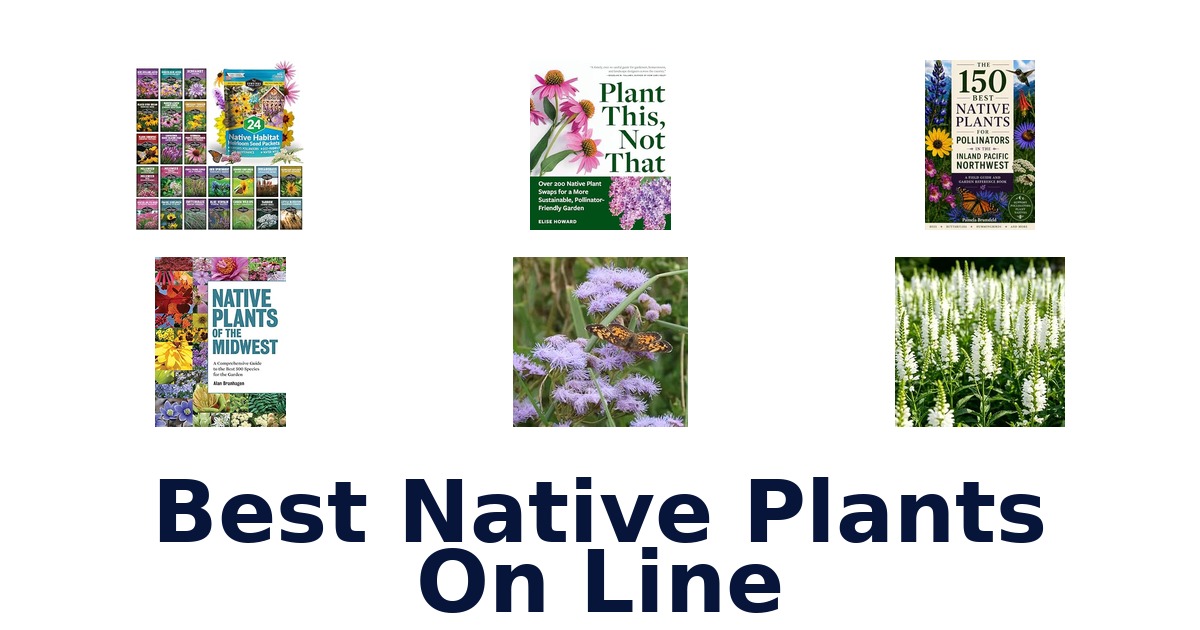
A strong choice among the Best Native Plants On Line matches your growing conditions and gives you the format you need, whether that is a live perennial, a seed collection, or a regional reference book. For a ready-to-plant option, My Home Park Blue Mistflower provides three live plants and soft blue flowers for pollinator gardens. Seed buyers can compare a 24-variety wildflower collection, a single-species obedient plant packet, and beautyberry seeds.
The books serve a different purpose: they help gardeners research native choices for particular regions or plan native plant swaps. Before ordering, check whether the listing is for a live plant, seeds, or a book, and compare the stated habitat, plant quantity, or regional focus with your garden.
My Home Park Blue Mistflower is the leading choice for gardeners seeking native plants online because the listing offers three live perennial plants, rather than seeds or a book, and describes them for pollinator gardens and groundcover use. Its soft blue blooms are presented as a nectar source for native bees, butterflies, and other beneficial insects. Consider it for a sunny garden or naturalized planting, but check local suitability and growing conditions before ordering.
Our Top Picks
 Best Overall
It includes three live native perennials for pollinator gardens and groundcover, with soft blue blooms described as a nectar source for native pollinators.
View on Amazon Broadest Seed Mix
Survival Garden Seeds Wildflower Mix
The 24-variety collection includes named native flowers and grasses, offering a wide selection for gardeners starting a varied native planting from seed.
View on Amazon Best for Shade
This live Southern native is listed for full to part shade and summer-to-frost blooms, making it a useful flowering option for shadier yards.
View on Amazon- Best Native Shrub Seeds CZ Grain Beautyberry Seeds
Compare these native plant and garden guide options
| # | Product | Material Feature | Material Features | Buy |
|---|---|---|---|---|
| 1 | 1. My Home Park Blue MistflowerBest Overall | Organic | Organic | View on Amazon |
| 2 | 2. Survival Garden Seeds Wildflower MixBroadest Seed Mix | GMO Free, Heirloom | GMO Free, Heirloom | View on Amazon |
| 3 | 3. Turks Cap Live PlantBest for Shade | Shade Tolerant | Shade Tolerant | View on Amazon |
| 4 |  4. Carpet Creeping Obedient Plant SeedsLong-blooming cut-flower seeds | GMO Free, Heirloom | GMO Free, Heirloom | View on Amazon |
| 5 |  5. CZ Grain Beautyberry SeedsBest Native Shrub Seeds | Heirloom | Heirloom | View on Amazon |
| 6 |  6. Smoke Camp Crafts Button BushDamp-site native shrub starter | Heirloom | Heirloom | View on Amazon |
| 7 |  7. Native Plants of the MidwestMidwest native plant reference | — | — | View on Amazon |
| 8 |  8. The Texas Native Plant PrimerTexas native garden planning | — | — | View on Amazon |
| 9 |  9. Inland Pacific Northwest Pollinator GuideInland Northwest pollinator guide | — | — | View on Amazon |
| 10 |  10. Plant This, Not ThatNative plant swap inspiration | — | — | View on Amazon |
Detailed Reviews: Best Native Plants On Line
#1 · Best Overall
1. My Home Park Blue Mistflower
- Material Feature: Organic
- Material Features: Organic
Best for: Sunny pollinator groundcover.
Why it ranks #1: It includes three live native perennials for pollinator gardens and groundcover, with soft blue blooms described as a nectar source for native pollinators.
Soft blue-lavender flowers and a spreading habit make Blue Mistflower a useful choice for sunny beds where you want both seasonal color and a naturalized groundcover effect. This live perennial is identified as a Florida native, and its blooms provide nectar for native bees, butterflies, and other beneficial insects.
The spreading growth can create informal drifts along paths, in meadows, or within mixed borders, so it suits gardeners aiming for a less formal planting rather than isolated specimens. Its abundant soft blue blooms add color and offer nectar for pollinators during the blooming season. The listing identifies it as low maintenance and specifies full sun, which helps define where to place it and how much routine attention the seller describes. It is supplied as three live plants.
- Three live plants included
- Spreading habit suits groundcover and naturalized plantings
- Soft blue-lavender flowers add color to sunny beds
- Blooms provide nectar for native bees and butterflies
- Its spreading habit may require boundaries in tightly controlled garden beds.
Skip it if you need a compact plant for a tightly defined bed; this perennial is described as spreading.
Choose these plants if you have a sunny pollinator garden, meadow edge, or informal border and want blue-lavender blooms with spreading coverage. They are a less suitable fit where a strictly contained, compact planting is essential.
Full product details
| Brand | My Home Park |
|---|---|
| Manufacturer | My Home Park |
| Part Number | CONCOE03 |
| Material Feature | Organic |
| Material Features | Organic |
| Special Features | Low Maintenance |
| Special Feature | Low Maintenance |
Listed on Amazon as: Blue Mistflower 3 Live Plants (Conoclinium coelestinum) – Native Perennial Wildflower for Pollinator Gardens & Groundcover Use, Spreading Habit, Low Maintenance, Full Sun Landscaping Plant
View on Amazon#2 · Broadest Seed Mix
2. Survival Garden Seeds Wildflower Mix
- Material Feature: GMO Free, Heirloom
- Material Features: GMO Free, Heirloom
Best for: Diverse native meadow seed mix.
Why it ranks #2: The 24-variety collection includes named native flowers and grasses, offering a wide selection for gardeners starting a varied native planting from seed.
Twenty-four varieties, including asters, coneflowers, milkweeds, grasses, and sunflowers, give this seed collection breadth for a mixed native planting. The listed species span flowering plants and grasses, with features identifying the collection as pollinator-attracting, drought tolerant, and suited to extended bloom time.
The named varieties offer several kinds of planting material in one collection, from bee balm and milkweed to little bluestem and switchgrass. That mix can help gardeners plan a varied native planting rather than selecting one species at a time, and the listed extended bloom time and pollinator appeal support a wildlife-focused goal. The collection is described as non-GMO and heirloom, with low-maintenance and drought-tolerant features. The product information does not provide individual sowing rates or site-by-site instructions.
- Includes 24 varieties of native plants
- Named selections include milkweed, coneflowers, asters, and native grasses
- Listed as attracting pollinators and supporting extended bloom time
- Described as non-GMO, heirloom, and drought tolerant
- The listing does not provide individual sowing rates for its 24 varieties.
Skip it if you need species-by-species sowing rates before planting; the listing does not provide them.
This collection fits gardeners aiming for a varied native planting with flowers and grasses, particularly for pollinator support. Its breadth is useful, but gardeners who need precise per-species sowing rates will need that information elsewhere.
Full product details
| Brand | SURVIVAL GARDEN SEEDS |
|---|---|
| Color | Multicolor |
| Manufacturer | JD Hardware LLC |
| Part Number | SGSNativeCollection |
| Material Feature | GMO Free, Heirloom |
| Material Features | GMO Free, Heirloom |
| Special Features | Attracts Pollinators, Drought Tolerant, Extended Bloom Time, High Germination Rate, Low Maintenance |
| Care Instructions | Each variety in this non-GMO, heirloom seed collection comes in a professionally detailed packet designed to be your complete growing guide. Our packets provide precise, variety-specific instructions for planting depth, soil temperature, sunlight requirements, and moisture needs. You will also find |
| Special Feature | Attracts Pollinators, Drought Tolerant, Extended Bloom Time, High Germination Rate, Low Maintenance |
Listed on Amazon as: American Wildflower Seeds for Planting – 24 Variety Pack of Native Plants
View on Amazon#3 · Best for Shade
3. Turks Cap Live Plant
- Material Feature: Shade Tolerant
- Material Features: Shade Tolerant
Best for: Flowering shade for hummingbirds.
Why it ranks #3: This live Southern native is listed for full to part shade and summer-to-frost blooms, making it a useful flowering option for shadier yards.
Red, turban-shaped blooms that remain furled rather than opening flat give Turk’s Cap a distinctive way to bring flowers to shaded parts of the yard. This container-grown Southern native flowers from early summer until frost and is listed for full to part shade, while also tolerating sun.
The listing highlights flowering in shade, an uncommon fit for gardeners trying to add summer color beneath tree cover or in other dimmer spaces. Its red blooms continue until the first frost, and their furled shape is described as attractive to hummingbirds. The plant arrives as a single well-rooted specimen grown in a container, not field dug. Water regularly until established, then cut it back in late winter; in hard winters it dies back before returning.
- Flowers in full to part shade and also takes sun
- Red blooms continue until first frost
- Furled blooms attract hummingbirds
- Container-grown, well-rooted live plant
- It dies back in hard winters, so the display is not evergreen year-round.
Skip it if you want foliage and flowers to remain above ground through hard winters; this plant dies back before returning.
This is a useful choice for gardeners seeking a flowering Southern native in shade, especially where hummingbirds are welcome. Allow for regular watering until establishment and seasonal dieback in hard winters when planning its placement.
Full product details
| Brand | Generic |
|---|---|
| Color | Dark Green |
| Item Weight | 5 pounds |
| Manufacturer | Roger's Plant Nursery |
| Material Feature | Shade Tolerant |
| Material Features | Shade Tolerant |
| Special Features | Attracts Hummingbirds |
| Care Instructions | Plant In Full Shade To Full Sun. Water Regularly Until Established. Cut Back In Late Winter. |
| Special Feature | Attracts Hummingbirds |
Listed on Amazon as: Turks Cap Live Plant, 1 Gallon, Native Shade Perennial
View on Amazon#4
4. Carpet Creeping Obedient Plant Seeds
- Material Feature: GMO Free, Heirloom
- Material Features: GMO Free, Heirloom
Best for: Long-blooming cut-flower seeds.
Why it ranks #4: The native perennial seed listing describes white flower spikes blooming from mid-summer into early fall, with flowers that can be repositioned on the spike.
White flower spikes that open upward from the bottom extend obedient plant’s display from mid-summer into early fall. This native perennial seed collection also offers movable flowers that can be repositioned along each spike, giving gardeners an interactive feature alongside its pollinator-garden and cut-flower uses.
The listed 18–36-inch mature height helps gardeners plan where the spikes can fit in a border, meadow, or cutting garden. Flowers open from the bottom of each spike upward, extending the display for weeks, while their movable positioning makes the plant an unusual conversation piece. The listing identifies it as a native perennial that attracts pollinators and is low maintenance. Seeds require watering according to the product care instructions; the supplied information does not give a more detailed sowing schedule.
- White tubular flowers bloom from mid-summer through early fall
- Flowers can be repositioned and stay in place
- Listed mature height is 18–36 inches
- Native perennial identified for pollinator gardens and cut flowers
- The supplied care instructions specify watering but do not provide a detailed sowing schedule.
Skip it if you want a live plant rather than seeds, or need detailed sowing directions beyond the listed watering instruction.
Choose these seeds if you want a native perennial with long-lasting white spikes for borders, pollinator plantings, or cutting. Plan for the stated 18–36-inch height, and note that the listing offers only brief watering guidance.
Full product details
| Brand | Carpet Creeping |
|---|---|
| Color | Obedient Plant Seeds |
| Manufacturer | Carpet Creeping |
| Part Number | Obedient Plant Seeds 1000 |
| Material Feature | GMO Free, Heirloom |
| Material Features | GMO Free, Heirloom |
| Special Features | Attracts Pollinators, Extended Bloom Time, Low Maintenance |
| Care Instructions | water |
| Special Feature | Attracts Pollinators, Extended Bloom Time, Low Maintenance |
Listed on Amazon as: CarpetC1000+ Obedient Plant Seeds for Planting, Native Perennial Long-Lasting Low Maintenance for Cut Flowers, Pollinator Gardens, Borders and Meadows
View on Amazon#5 · Best Native Shrub Seeds
5. CZ Grain Beautyberry Seeds
- Material Feature: Heirloom
- Material Features: Heirloom
Best for: Purple-berry shrub from seed.
Why it ranks #5: This 100-seed packet is intended to grow a native shrub with summer flowers and vivid purple berries, adding a distinct wildlife-garden option.
Clusters of vivid purple berries make Beautyberry a seed-grown native shrub option for adding a striking fall display to a landscape. This packet contains 100 seeds, and the listing describes summer pink-to-lavender flowers followed by berries on graceful, arching branches for ornamental and wildlife-oriented plantings.
The sequence of summer flowers followed by bright purple berries gives the shrub seasonal interest beyond a single bloom period, while its arching branches can suit borders, hedges, or naturalized plantings. The listed uses also include wildlife habitats and pollinator gardens. This is a seed-starting project rather than a live shrub: the care notes call for cold stratification before sowing in well-drained soil and providing full sun. Those preparation steps matter when planning the planting schedule.
- 100 seeds per packet
- Summer flowers are followed by bright purple berries
- Suitable for borders, hedges, wildlife habitats, and naturalized plantings
- Care instructions specify cold stratification and well-drained soil
- Seeds need cold stratification before planting, adding a preparation step.
Skip it if you need an established shrub immediately; these seeds require cold stratification before planting.
Beautyberry seeds suit gardeners planning a native shrub for colorful berries, wildlife interest, or a border planting. Choose them if you can prepare seeds through cold stratification and provide the listed full-sun, well-drained conditions.
Full product details
| Brand | CZ Grain |
|---|---|
| Color | Pink Lavender Flowers, Bright Purple Berries |
| Manufacturer | CZ Grain, LLC |
| Material Feature | Heirloom |
| Material Features | Heirloom |
| Special Features | High Germination, Native Shrub, Brilliant Purple Berries, Wildlife Friendly, Drought Tolerant, Easy to Grow |
| Care Instructions | Cold stratify seeds before planting. Sow in well-drained soil and provide full sun to partial shade for best growth. See more |
| Special Feature | High Germination, Native Shrub, Brilliant Purple Berries, Wildlife Friendly, Drought Tolerant, Easy to Grow See more |
| Style Name | 100 Seeds per Packet |
Listed on Amazon as: Beautyberry Seeds for Planting Native Shrub 100 Premium Seeds
View on Amazon#6
6. Smoke Camp Crafts Button Bush
- Material Feature: Heirloom
- Material Features: Heirloom
Best for: Damp-site native shrub starter.
Why it ranks #6: The listing offers a live North American native start in a 2.5-inch pot, described as a woody perennial for damp garden spots.
A native woody perennial that can grow into a shrub or small tree makes Button Bush a longer-term option for a damp part of a wildlife garden. This live North American native is supplied as a plant start, and its flowers provide nectar while its leaves feed moth larvae.
The listing identifies Button Bush as native to the eastern United States and Canada and hardy in zones 3–10, giving gardeners a broad stated climate range to consider. Its flowers provide nectar, while leaves support many moth larvae, so it offers more than a floral display. As a woody perennial, it can develop into a shrub or small tree and produce buttonlike seed heads over time. The seller recommends it for damp spots and describes the plant as deer resistant.
- Native to the eastern United States and Canada
- Hardy in listed zones 3–10
- Flowers provide nectar and leaves feed moth larvae
- Woody perennial develops into a shrub or small tree
- Its stated fit is damp spots, limiting its appeal for dry planting sites.
Skip it if you need a plant for a dry site; the listing recommends Button Bush for damp spots.
Consider this native plant if you have a damp garden area and room for a woody shrub or small tree. Its wildlife value spans nectar and moth-larval food, but the stated site preference makes dry locations a poor match.
Full product details
| Brand | Smoke Camp Crafts |
|---|---|
| Manufacturer | Smoke Camp Crafts |
| Material Feature | Heirloom |
| Material Features | Heirloom |
| Special Features | Deer Resistant |
| Special Feature | Deer Resistant |
Listed on Amazon as: Organic Button Bush (Cephalanthus occidentalis) Live Perennial, Native Plant in 2.5 inch Pot – Pollinator Plant
View on Amazon#7
7. Native Plants of the Midwest
Best for: Midwest native plant reference.
Why it ranks #7: This hardcover guide covers 500 native species for Midwestern gardens, making it a region-focused reference rather than a plant or seed order.
Coverage of 500 species gives this Midwest-focused guide a broad starting point for gardeners comparing native plants for their regional landscapes. Alan Branhagen’s book is titled as a comprehensive garden guide, making it relevant to readers who want a single reference centered on species choices rather than a live plant or seed mix.
The stated focus on the Midwest helps narrow the book’s relevance for readers selecting plants with that region in mind, while its 500-species scope offers a wide range of options to explore. Its garden-oriented framing makes it a reference for considering potential species in a planting plan, rather than a source of plants themselves. The hardcover format is suited to keeping a physical guide available for repeated consultation. The listing does not specify individual species details or growing instructions.
- Covers 500 species
- Focuses on native plants of the Midwest
- Framed as a comprehensive garden guide
- Hardcover format for a physical reference shelf
- Its regional focus is the Midwest, not a nationwide native-plant guide.
Skip it if you garden outside the Midwest and need a guide focused on your own region.
Midwest gardeners seeking a broad species reference may find this guide a useful planning companion. Its regional scope is the key boundary: readers gardening elsewhere should seek advice and plant choices tailored to their own area.
Listed on Amazon as: Native Plants of the Midwest: A Comprehensive Guide to the Best 500 Species for the Garden
View on Amazon#8
8. The Texas Native Plant Primer
Best for: Texas native garden planning.
Why it ranks #8: This Texas-focused book covers 225 plants for an earth-friendly garden, useful for planning but not a listing for live plants or seeds.
A selection of 225 plants puts this Texas-focused primer within reach of gardeners looking for native options for an earth-friendly landscape. Authored by the Lady Bird Johnson Wildflower Center and Andrea DeLong-Amaya, it is a regional plant reference rather than a packet of seeds or a live-plant assortment.
The title’s 225-plant scope gives readers a defined set of choices to consult while considering a Texas garden, and its emphasis on native plants keeps the subject focused on regional planting. The earth-friendly garden framing connects species selection with the broader goal of sustainable landscaping. As a book, it supports planning and research before buying or planting. The provided listing does not specify individual plant profiles, cultivation instructions, or the book’s format, so those details cannot guide the choice here.
- Covers 225 plants
- Focused on Texas native plants
- Written for earth-friendly garden planning
- Authored by the Lady Bird Johnson Wildflower Center and Andrea DeLong-Amaya
- Its Texas-specific focus is a limitation for gardeners seeking another region’s native plants.
Skip it if you garden outside Texas and need a native-plant reference centered on your region.
Texas gardeners researching native choices for an earth-friendly landscape are the clearest audience for this primer. Its regional emphasis is useful when it matches your location, but it is not presented as a guide for other regions.
Listed on Amazon as: The Texas Native Plant Primer: 225 Plants for an Earth-Friendly Garden
View on Amazon#9
9. Inland Pacific Northwest Pollinator Guide
Best for: Inland Northwest pollinator guide.
Why it ranks #9: The field guide covers 150 native plants for pollinators in the Inland Pacific Northwest, providing regional information rather than planting material.
A focus on 150 native plants for pollinators gives this field guide a clear role for gardeners in the Inland Pacific Northwest. Pamela Brunsfeld’s title identifies it as both a field guide and garden reference, bridging regional plant identification interests with practical landscape planning.
The stated coverage of 150 plants gives readers a substantial set of pollinator-oriented native choices to explore, while the Inland Pacific Northwest scope keeps the subject geographically specific. Its dual field-guide and garden-reference framing can serve readers who want a book for learning about plants as well as considering them for a garden. The paperback format is a physical reference option. The supplied product information does not name individual species, growing conditions, or planting instructions.
- Covers 150 native plants
- Focuses on pollinator plants
- Specific to the Inland Pacific Northwest
- Combines field guide and garden reference roles
- Its regional scope does not serve gardeners seeking a guide for other areas.
Skip it if you garden outside the Inland Pacific Northwest and need region-specific native plant guidance.
This book fits Inland Pacific Northwest gardeners and readers seeking a pollinator-focused regional reference. Its stated scope is the main boundary; gardeners elsewhere should look for a guide centered on their own local flora.
Listed on Amazon as: The 150 Best Native Plants for Pollinators in the Inland Pacific Northwest: A Field Guide and Garden Reference Book
View on Amazon#10
10. Plant This, Not That
Best for: Native plant swap inspiration.
Why it ranks #10: This paperback offers more than 200 native plant swaps, but it is a gardening guide rather than a live plant, seed packet, or regional species reference.
More than 200 native plant swaps give this book a practical comparison format for gardeners seeking a more sustainable, pollinator-friendly landscape. Elise Howard’s title centers on choosing native alternatives to other plants, making it a planning resource for readers rethinking what already grows in their garden.
The swap-based approach can help readers connect an existing planting choice with a native alternative, while the stated focus on sustainability and pollinator friendliness gives those choices a clear garden goal. With more than 200 swaps, the book offers a broad set of comparisons to consult during redesign planning. It is a paperback guide, not a supply of plants. The provided information does not identify specific regions, species, or step-by-step cultivation guidance, so its stated value is in swaps and planning.
- Includes more than 200 native plant swaps
- Focuses on sustainable gardening
- Emphasizes pollinator-friendly planting
- Paperback format for a physical planning reference
- The supplied information does not specify regional coverage for its plant swaps.
Skip it if you need a guide explicitly focused on your region or detailed cultivation instructions.
Gardeners replacing existing choices with native alternatives may appreciate this swap-focused planning book. It is best suited to comparison and redesign; readers who need regional plant lists or growing instructions should seek those details in another reference.
Listed on Amazon as: Plant This, Not That: Over 200 Native Plant Swaps for a More Sustainable, Pollinator-Friendly Garden
View on AmazonAvoid the live-plant versus seed mix-up
Check the product format before adding a native planting to your cart: these listings include live plants, seeds, and books, and they are not interchangeable. My Home Park Blue Mistflower lists three live plants, while the Smoke Camp Crafts Button Bush listing describes one plant start in a 2.5-inch pot. By contrast, the Survival Garden Seeds listing is a 24-variety seed collection, and CZ Grain Beautyberry is a packet of 100 seeds.
Seeds require a germination and growing stage before they become established plants; the supplied descriptions do not promise a particular emergence rate or time to maturity. A book, such as Native Plants of the Midwest, supplies information rather than planting material.
A useful order check is to confirm the item format, quantity, and any stated pot size, then plan for the extra growing steps if you choose seeds.
Match the plant to its stated habitat
The listings describe different habitat needs, so a plant labeled native is not automatically suitable for every garden. Turks Cap is specifically described as flowering in full to part shade and taking sun too, while Blue Mistflower is presented for sunny pollinator gardens. Button Bush is described as suited to damp spots.
Those distinctions matter: choosing a plant for a mismatched light or moisture condition can undermine the purpose of buying a native option. Seed packets also need attention to the plants included: the 24-variety collection spans named flowers and grasses, whereas the obedient plant and beautyberry listings focus on one type.
The supplied data does not establish your local climate, soil, or whether a listed plant is native to your specific area. Check regional suitability and site conditions before ordering, especially when a listing describes a broad geographic range or a particular habitat.
How to Choose Native Plants Online
Choose live plants or seeds
Start by deciding whether you want an established plant or are prepared to grow from seed. The listings range from three live Blue Mistflower plants and one Button Bush plant start in a 2.5-inch pot to seed packets with 100 Beautyberry seeds and a 24-variety wildflower collection. A live plant suits buyers who want planting material at an established stage; seeds suit gardeners willing to sow and tend them.
These quantities are not directly comparable: the 24 varieties describe diversity, while 100 seeds refers to one shrub species. The best end of this range depends on your goal: pick live plants for a specific planting, or a multi-variety seed mix when you want more kinds of native flowers and grasses to try.
Match light and moisture to your site
Look for a listing whose stated habitat resembles the garden spot where you plan to plant. Turks Cap is described for full to part shade and also tolerates sun, while Blue Mistflower is presented for sunny gardens and Button Bush is recommended for damp spots. These options address different conditions, not a single universal growing situation.
If you have a shaded area and want flowers, Turks Cap is the clearest match in this group; for a sunny pollinator bed, Blue Mistflower fits the listing. For a wetter location, Button Bush is the specific option to investigate.
The descriptions do not provide complete soil or climate guidance for every product, so confirm local suitability and care requirements before choosing.
Consider the scale and purpose of the planting
Decide whether your priority is a focused feature, a wider planting, or information for planning before selecting a product. Blue Mistflower is offered as three live plants for garden beds, borders, and groundcover use, while the Survival Garden Seeds pack contains 24 named varieties for a broader mix. The Beautyberry listing provides 100 seeds for a single native shrub type, and the books offer regional plant information instead of planting material.
A small, defined area may suit a live-plant listing or a single-species seed packet; gardeners developing a varied meadow or pollinator garden may prefer the multi-variety mix. If you are still choosing species, a regional guide may be more useful than ordering seeds before checking which plants suit your location.
Which Native Plant Option Should You Choose?
For a ready-to-plant pollinator garden, choose My Home Park Blue Mistflower: it lists three live plants and a sunny-garden use. If your priority is variety from seed, Survival Garden Seeds Wildflower Mix includes 24 named native flowers and grasses. For a flowering plant suited to shade, consider Turks Cap Live Plant; for a damp spot, the Button Bush listing is the habitat-specific option.
Choose Carpet Creeping Obedient Plant Seeds for its white flower spikes or CZ Grain Beautyberry Seeds if you want to try growing a native shrub with purple berries. If you need regional planning information instead of planting material, select Native Plants of the Midwest, The Texas Native Plant Primer, or Inland Pacific Northwest Pollinator Guide according to your region.
Plant This, Not That is a general native-swap guide.
Frequently Asked Questions
How can I confirm that a native plant is suitable for my region?
Check the plant’s native range against your location, then confirm that its listed light, soil, and moisture needs fit your planting site. Regional native-plant guides can help narrow choices. Before ordering, verify the listing’s plant identity and growing information, and consult a local extension service or native-plant organization if suitability remains unclear.
When is the best time to sow native wildflower seeds?
Follow the seed packet’s sowing directions for the species and your region, since timing can vary. Check whether the instructions recommend sowing in spring or fall, and consider your local weather and soil conditions. If the packet does not specify timing, seek region-specific guidance before sowing rather than assuming all wildflowers follow the same schedule.
How should I prepare soil for native plants without disturbing local habitat?
Prepare only the area you intend to plant, and avoid digging or clearing nearby established vegetation. Remove competing growth selectively, then follow the plant or seed listing’s guidance for soil preparation. Preserve existing habitat where possible, and check for local restrictions or sensitive species before disturbing ground, especially in naturalized or shared spaces.
Should I choose live plants, seeds, or a guide?
Choose live plants when you want planting material already growing, seeds when you want to start plants from seed or seek a mix, and a guide when regional planning information is your priority. Compare each listing’s format and intended use with your project. The products here include all three types, so they are not interchangeable.
What should I check before ordering a native plant online?
Confirm the plant’s identity, whether the listing offers a live plant or seeds, and the growing conditions and intended use described. Compare those details with your region and planting site, including available light and moisture. For a live plant, review the listing’s delivery and care information; for seeds, check the sowing directions.
Final Words
For a ready-to-plant pollinator garden, the Blue Mistflower listing is the leading choice: it offers three live perennial plants and describes sunny-garden use. Choose the wildflower mix if seed variety matters more, or match Turks Cap and Button Bush to the shade or damp spot described in the verdict. For regional planning, select the guide for your area.
Before ordering any option, confirm local suitability and site conditions.