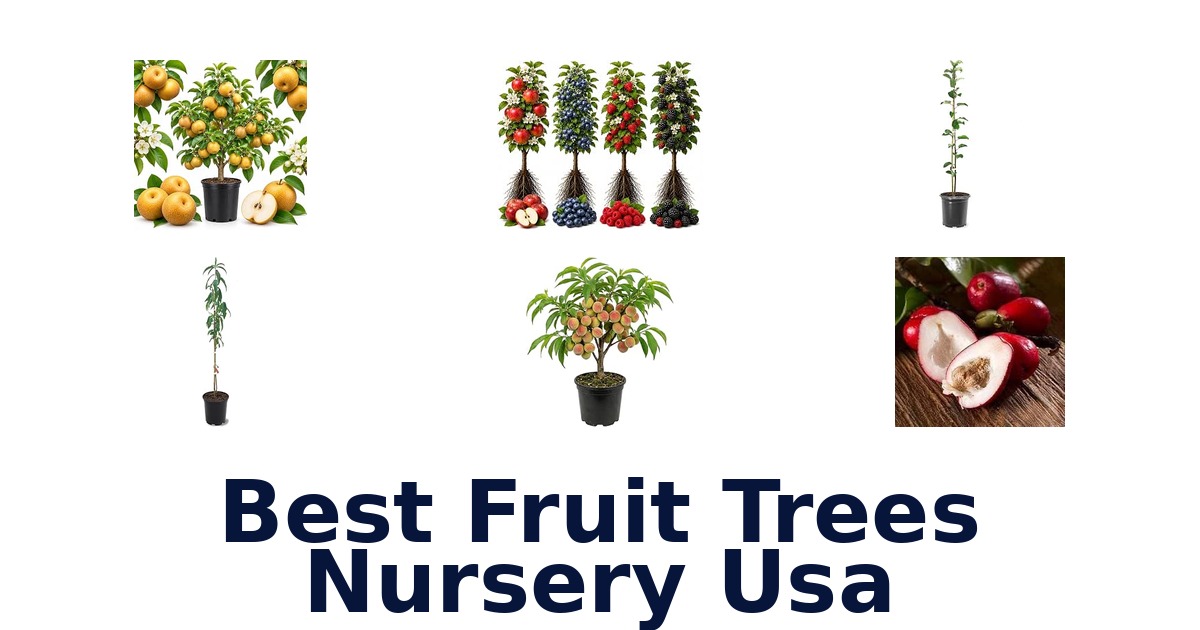
A strong fruit-tree nursery choice is a healthy, appropriately sized live tree or bare-root set that matches your climate, planting space, and harvest goals. This lineup includes potted apples and peaches, a native persimmon, an Asian pear, a tropical apple, and two multi-fruit starter bundles. Their differences matter: the Belle of Georgia peach lists 850 chill hours and Zones 5–8, while the Fuji apple lists Zones 4–9 and a semi-dwarf size.
Some listings also have state shipping restrictions, so check eligibility before ordering. The picks below prioritize useful, clearly stated growing details and practical formats for a home orchard.
Use the comparison and buying guidance to narrow the choices to trees suited to your site rather than choosing by fruit type alone.
American Plant Exchange Granny Smith Apple Tree leads this roundup because its listing combines a 5-gallon potted format, self-pollination, USDA Zones 5–9, and a clear use for crisp, tart apples. Those details make it a well-specified option for a home orchard or edible landscape. If you want a smaller nursery pot and broader listed hardiness range, the Arbor Day Foundation Fuji Apple Tree is a strong alternative, but it cannot ship to California, Washington, or Arizona.
Our Top Picks
 Best Overall
American Plant Exchange Granny Smith
Its 5-gallon pot, self-pollinating description, and stated USDA Zones 5–9 give home orchard growers several useful, concrete selection details.
View on Amazon Widest Listed Zones
Arbor Day Foundation Fuji Apple
The 1-gallon potted tree lists Zones 4–9 and semi-dwarf growth to 15–20 feet, though shipping excludes CA, WA, and AZ.
View on Amazon Chill-Hour Specific
This 1-gallon peach lists Zones 5–8, self-pollination, and a specific requirement of 850 chill hours for buyers who can meet it.
View on Amazon- Large Pot Peach Red Haven Peach
- Native Fruit Tree Beyond The Ridges Persimmon
Compare These Fruit Tree Nursery Picks
| # | Product | Weight | Buy |
|---|---|---|---|
| 1 | 1. American Plant Exchange Granny SmithBest Overall | 10 lb | View on Amazon |
| 2 | 2. Arbor Day Foundation Fuji AppleWidest Listed Zones | 5 lb | View on Amazon |
| 3 | 3. Belle of Georgia PeachChill-Hour Specific | 10 lb | View on Amazon |
| 4 |  4. Red Haven PeachLarge Pot Peach | 15 lb | View on Amazon |
| 5 |  5. Beyond The Ridges PersimmonNative Fruit Tree | 2 lb | View on Amazon |
| 6 |  6. GINGERGLOW Asian PearEstablished Asian pear orchard | — | View on Amazon |
| 7 |  7. Moc Nursery Golden Red PeachCompact-space peach grower | — | View on Amazon |
| 8 |  8. CZ Grain Bare-Root Fruit SetMixed-fruit orchard starter | 2 lb | View on Amazon |
| 9 |  9. CZ Grain Dwarf Orchard KitCompact mixed-fruit planting | 2 lb | View on Amazon |
| 10 |  10. Red Malay Apple TreeTropical patio fruit grower | — | View on Amazon |
Detailed Reviews: Best Fruit Trees Nursery Usa
#1 · Best Overall
1. American Plant Exchange Granny Smith
- Weight: 10 lb
Best for: Tart apple home orchard.
Why it ranks #1: Its 5-gallon pot, self-pollinating description, and stated USDA Zones 5–9 give home orchard growers several useful, concrete selection details.
Granny Smith’s crisp, tart green apples make this five-gallon potted tree a specific pick for growers who want fruit for eating, baking, or cider. The listing identifies it as self-pollinating and suitable for USDA Zones 5–9, adding useful planning details for a home orchard.
A five-gallon nursery pot with potting soil gives this live apple tree a container-grown starting point for a backyard garden or edible landscape. Its self-pollinating habit can simplify a single-tree planting plan, while the stated Zones 5–9 range and full-sun, well-drained-soil guidance help define the growing conditions. Granny Smith fruit is described as firm, crisp, tart, and green, with uses from fresh eating to baking and cider-making.
- Five-gallon live plant in a nursery pot with potting soil
- Self-pollinating apple tree
- Listed for USDA Zones 5–9
- Crisp, tart Granny Smith apples suit eating, baking, and cider
- The listed growing guidance calls for full sun and well-drained soil.
Skip it if you cannot provide full sun and well-drained soil; those are the listed conditions for this Granny Smith tree.
Choose this potted Granny Smith for a sunny home orchard or edible landscape in USDA Zones 5–9, especially if tart apples suit your kitchen plans. Its full-sun and drainage requirements should match the planting site.
Full product details
| Brand | American Plant Exchange |
|---|---|
| Color | Green, White, Pink |
| Container Material | Plastic |
| Item Weight | 10 pounds |
| Manufacturer | AMPLEX |
| Material Feature | Live Plant, Nursery Pot, Potting Soil |
| Material Features | Live Plant, Nursery Pot, Potting Soil |
| Special Features | Air Purification, Attracts Pollinators, Deer Resistant, Disease Resistant, Pest Resistant |
| Care Instructions | Water your apple tree deeply once a week, ensuring the soil stays consistently moist but not waterlogged, especially during dry spells. |
| Special Feature | Air Purification, Attracts Pollinators, Deer Resistant, Disease Resistant, Pest Resistant |
Listed on Amazon as: American Plant Exchange Apple Tree 'Granny Smith' – Live Fruit-Bearing Plant, 5-Gallon Pot, Cold-Hardy, for Home Orchards, Backyard Gardens & Edible Landscapes
View on Amazon#2 · Widest Listed Zones
2. Arbor Day Foundation Fuji Apple
- Weight: 5 lb
Best for: Cold-hardy Fuji apple grower.
Why it ranks #2: The 1-gallon potted tree lists Zones 4–9 and semi-dwarf growth to 15–20 feet, though shipping excludes CA, WA, and AZ.
A one-gallon Fuji apple tree combines established roots with a semi-dwarf mature size of 15–20 feet tall and wide. Its sweet, crisp apples are listed for fresh eating, baking, or cider, while the USDA Zones 4–9 range gives buyers a clear climate suitability guide.
The nursery-pot format and established roots are described as supporting easy transplanting and a strong start, while the potted-tree facts note less root handling and flexible planting timing. Its semi-dwarf size of 15–20 feet tall and wide can fit a home landscape or small orchard, provided that space is available. Full sun and well-drained soil are specified. The fall apples are medium to large and sweet-crisp, with uses spanning fresh eating, baking, and cider.
- One-gallon potted tree with established roots
- Semi-dwarf mature size of 15–20 feet tall and wide
- Listed for USDA Zones 4–9
- Sweet, crisp fall apples suit eating, baking, or cider
- Its 15–20-foot mature height and width require substantial planting space.
Skip it if you lack room for a tree reaching 15–20 feet in both height and width; its semi-dwarf size still needs space.
A strong fit for a home landscape or small orchard in USDA Zones 4–9 with room for a 15–20-foot tree. Choose it for Fuji apples and a potted transplant format, not a tiny-space planting.
Full product details
| Brand | Arbor Day Foundation |
|---|---|
| Color | Red |
| Container Material | Plastic |
| Item Weight | 5 pounds |
| Manufacturer | Arbor Day Foundation |
| Special Features | Edible |
| Special Feature | Edible |
| Style Name | Apple |
Listed on Amazon as: Fuji Apple Tree, 1 Gallon Live Nursery Pot, Sweet, Crisp Fruit | Arbor Day Foundation (Due to Agricultural Laws, Unavailable to CA, WA or AZ)
View on Amazon#3 · Chill-Hour Specific
3. Belle of Georgia Peach
- Weight: 10 lb
Best for: Cold-winter peach orchard.
Why it ranks #3: This 1-gallon peach lists Zones 5–8, self-pollination, and a specific requirement of 850 chill hours for buyers who can meet it.
Belle of Georgia’s stated 850 chill-hour requirement makes this peach tree a specific choice for growers whose winters can meet that need. It arrives in a one-gallon nursery pot at 1–2 feet tall, and its self-pollinating habit means the listing does not require a second peach tree for pollination.
This Prunus persica is listed for USDA Zones 5–8 and needs 850 chill hours, giving buyers concrete climate criteria to check against their location. Its self-pollinating trait can simplify a small orchard plan, while the one-gallon pot and 1–2-foot current height make it a manageable nursery-sized start. The mature height is listed as 15–20 feet, so reserve room for a full-size tree rather than treating it as a compact patio variety.
- Listed for USDA Zones 5–8
- Self-pollinating variety
- One-gallon nursery pot; current height 1–2 feet
- Produces medium-sized peaches that ripen in late summer
- Its stated 850 chill-hour requirement rules out locations that cannot provide that winter chill.
Skip it if you cannot provide 850 chill hours or lack room for a 15–20-foot mature tree; its listed needs are substantial.
Choose this Belle of Georgia for a temperate-climate orchard where 850 chill hours are available and a 15–20-foot mature tree can fit. Its self-pollinating habit suits growers planting a single peach tree.
Full product details
| Brand | Generic |
|---|---|
| Color | Belle of Georgia |
| Item Weight | 10 pounds |
| Manufacturer | Simpson Nursery |
| Care Instructions | Plant in full sun in clay soil or well-draining soil. |
Listed on Amazon as: Belle of Georgia Peach Tree, 1 gal Nursery Pot
View on Amazon#4 · Large Pot Peach
4. Red Haven Peach
- Weight: 15 lb
Best for: Freestone peach canning tree.
Why it ranks #4: The 5-gallon nursery pot and freestone, heavy-bearing description suit peach growers seeking an established-size listing; shipping excludes CA, AZ, AK, and HI.
Red Haven’s freestone peaches and heavy-bearing habit make this five-gallon potted tree a useful choice for growers planning fresh eating, canning, or freezing. The listing gives USDA Zones 5–8 and identifies juicy flesh with pink-blushed skin, helping buyers match the fruit and climate to their orchard.
A five-gallon nursery pot provides a substantial container-grown starting point, while the deciduous tree’s Red Haven peaches are described as freestone, juicy, and red-skinned with pink blush. That freestone quality is relevant for buyers preparing peaches for canning or freezing, uses specifically mentioned in the description. Care instructions call for full sunlight, regular watering, well-drained soil, late-winter pruning, and mulch. Shipping is restricted from California, Arizona, Alaska, and Hawaii.
- Five-gallon nursery-pot tree
- Freestone peaches described as juicy with pink-blushed skin
- Heavy-bearing and self-pollinating
- Listed for USDA Zones 5–8
- Cannot ship to California, Arizona, Alaska, or Hawaii.
Skip it if you live in California, Arizona, Alaska, or Hawaii; this listing excludes shipment to those states.
A suitable choice for a Zones 5–8 grower who wants freestone peaches for fresh use, canning, or freezing and can provide full sun and regular care. Shipment is unavailable to four listed states.
Full product details
| Brand | Generic |
|---|---|
| Color | Green |
| Item Weight | 15 pounds |
| Manufacturer | Simpson Nursery |
| Special Features | Attracts Pollinators |
| Care Instructions | Water regularly, ensure well-drained soil, provide full sunlight, prune in late winter, and mulch. Enjoy sweet, juicy peaches from your Red Haven Peach Tree with ease. See more |
| Special Feature | Attracts Pollinators |
Listed on Amazon as: Red Haven Peach Tree, Freestone, Heavy-Bearing, Self-Pollinating, Deciduous, 5 gal Nursery Pot (Due to Agricultural Laws, we Cannot Ship to CA, AZ, AK, or HI)
View on Amazon#5 · Native Fruit Tree
5. Beyond The Ridges Persimmon
- Weight: 2 lb
Best for: Native persimmon landscape pair.
Why it ranks #5: The two-pack of American persimmons offers a North American native fruit tree for gardens, orchards, and wildlife-friendly landscapes.
Two American Persimmon plants make this listing an appealing option for growers planning a native-fruit planting rather than a single specimen. The 12–24-inch potted trees are presented for gardens, orchards, homesteads, and wildlife-friendly landscapes, with mature fruit suited to fresh eating and recipes.
The American Persimmon (Diospyros virginiana) is described as a North American native with seasonal foliage and distinctive edible fruit, linking landscape interest with a future harvest. This is a two-plant pack, and each plant is listed at 12–24 inches, which can support a paired planting plan. Care guidance calls for well-draining soil, regular watering, and full sun; buyers should be prepared to provide those conditions as the trees establish.
- Two American Persimmon plants in the pack
- Listed at 12–24 inches and potted
- Native tree with seasonal foliage and edible fruit
- Care guidance specifies full sun, regular water, and well-draining soil
- The listing requires full sun and regular watering, limiting fit for low-attention or shaded sites.
Skip it if you have a shaded site or cannot water regularly; these persimmons are listed for full sun and regular watering.
Consider this pair for a sunny, well-drained garden, homestead, or naturalized landscape where native trees and future edible fruit both matter. The stated watering and sun requirements are important fit considerations.
Full product details
| Brand | Beyond The Ridges |
|---|---|
| Color | green |
| Item Weight | 2 pounds |
| Manufacturer | Beyond The Ridges |
| Material Feature | Heirloom |
| Material Features | Heirloom |
| Care Instructions | Plant In Well-draining Soil, Water Regularly, And Provide Full Sun Exposure |
| Style Name | American Persimmon Trees to Grow |
Listed on Amazon as: 2 Persimmon Tree Live Plant 12-24 Inch Potted Fruit Tree (2 Pack)
View on Amazon#6
6. GINGERGLOW Asian Pear
Best for: Established Asian pear orchard.
Why it ranks #6: The listing specifies a 3-gallon potted Asian pear and cold-hardiness, but its stated shipping exclusions include CA, HI, and AK.
A 3-gallon Korean Giant Asian Pear arrives as a 3–4-foot live plant with a robust root system, giving orchard growers a larger starting tree than a small bare-root option. Its listing also highlights cold hardiness and resistance to common fire blight for a resilient planting choice.
The Korean Giant Asian Pear (Pyrus pyrifolia) is supplied in a 3-gallon nursery pot and listed at 3–4 feet tall, so it offers a substantial starting size for a home orchard. Its cold-hardy description and stated resistance to common fire blight are relevant to buyers weighing resilience. The listing describes the root system as robust and ready for planting. It cannot ship to California, Hawaii, or Alaska, which directly limits availability by destination.
- 3-gallon nursery pot and listed 3–4-foot height
- Robust root system described as ready for planting
- Cold-hardy variety
- Listing states resistance to common fire blight
- Cannot ship to California, Hawaii, or Alaska.
Skip it if you live in California, Hawaii, or Alaska; this tree is listed as unavailable for shipment to those states.
A candidate for orchard growers seeking a larger potted Asian pear start with stated cold hardiness and fire-blight resistance. It is not an option for delivery to California, Hawaii, or Alaska.
Full product details
| Brand | GINGERGLOW |
|---|---|
| Color | Brown |
| Manufacturer | GINGERGLOW |
Listed on Amazon as: Giant Asian Pear Tree Live Plants, 3 Gallon Pot, 3-4 Inches Tall Fruit Tree, Cold-Hardy Variety, Well-Rooted Plant, No Ship to CA,HI,AK
View on Amazon#7
7. Moc Nursery Golden Red Peach
Best for: Compact-space peach grower.
Why it ranks #7: Its dwarf peach format, half-gallon pot, and 6–9-inch stated height target patios and small gardens; it does not ship to California.
A dwarf Golden Red Peach in a half-gallon pot offers a peach-tree starting point for patios, raised beds, and small gardens. Its listed height of 6–9 inches makes it especially easy to place in a compact growing area, while its container-grown format is ready for transplanting.
The dwarf variety is specifically described for small spaces, patios, raised beds, and backyard gardens, giving space-limited growers several planting options. It arrives about 6–9 inches tall in a half-gallon pot and is described as ready for transplanting into containers, gardens, or small orchards. Full sun and well-drained soil are listed needs; the care guidance also calls for watering and seasonal pruning to support development into a fruit-bearing plant.
- Dwarf peach variety for small spaces
- Arrives 6–9 inches tall in a half-gallon pot
- Listed as ready to transplant into containers or gardens
- Care guidance specifies full sun, well-drained soil, watering, and seasonal pruning
- Its 6–9-inch listed height makes it a very small starting plant.
Skip it if you want a larger tree at planting; this dwarf seedling arrives only 6–9 inches tall.
A fit for growers who want a dwarf peach in a patio container, raised bed, or small garden and are willing to tend a small seedling. Its listed starting height is only 6–9 inches.
Full product details
| Brand | Moc Nursery |
|---|---|
| Manufacturer | Moc Nursery |
Listed on Amazon as: Golden Red Peach Trees Live Plants, Dwarf Peach Tree, Sweet Fruits, 6-9 Inch Tall a Half-Gallon Pot, No Ship CA
View on Amazon#8
8. CZ Grain Bare-Root Fruit Set
- Weight: 2 lb
Best for: Mixed-fruit orchard starter.
Why it ranks #8: Eight dormant bare-root plants include two each of apple, blueberry, raspberry, and blackberry, offering more fruit types than a single-tree listing.
Four fruit types arrive in one bundle: two each of apple, blueberry, raspberry, and blackberry. This eight-plant assortment gives a new backyard orchard more variety from the outset, while dormant bare roots offer a planting-season format rather than a leafy potted display.
The eight dormant bare roots include two plants each of apple, blueberry, raspberry, and blackberry, making the bundle useful for growers who want several kinds of fruit rather than a single-variety planting. The listing notes well-developed root systems and recommends planting during the appropriate season, so buyers should plan around seasonal bare-root planting. Its outdoor recommended use and low-maintenance feature suit garden projects, though the bundle does not specify individual varieties or mature dimensions.
- Eight plants total, with two each of four fruit types
- Includes apple, blueberry, raspberry, and blackberry
- Dormant bare roots have well-developed root systems
- Listed for outdoor use and as low maintenance
- The bundle does not identify specific cultivars or individual mature sizes.
Skip it if you want one named cultivar or a potted, leafy tree; this assortment is dormant bare-root stock across four fruit types.
A practical choice for gardeners starting a varied outdoor fruit planting and comfortable scheduling work around the appropriate bare-root season. It is less suitable if you need named cultivars or established potted specimens.
Full product details
| Brand | CZ Grain |
|---|---|
| Color | Red Green |
| Dimensions | 14"D x 2"W x 3"H |
| Item Weight | 2 pounds |
| Manufacturer | CZ Grain, LLC |
| Material | fruit tree kit |
| Model Number | 8 fruit trees |
| Special Features | Low Maintenance |
| Recommended Uses | Outdoor |
| Special Feature | Low Maintenance |
Listed on Amazon as: 8 Bare Root Fruit Plants | 2 Each Apple, Blueberry, Raspberry & BlackBerry
View on Amazon#9
9. CZ Grain Dwarf Orchard Kit
- Weight: 2 lb
Best for: Compact mixed-fruit planting.
Why it ranks #9: The 9-pack is described as compact and includes apple, blueberry, and blackberry plants, but its features also mention plums and pears inconsistently.
Three fruit types—apple, blueberry, and blackberry—give this dwarf orchard starter a varied planting plan in one nine-plant pack. The listing highlights compact varieties for small spaces and patios, while well-rooted live plants are presented as ready for transplanting into an outdoor growing space.
The pack is described as nine plants, with three each of apple, blueberry, and blackberry, allowing a buyer to plant several specimens across three fruit types. Its compact dwarf varieties are identified as suitable for small spaces and patios, which can make this assortment more manageable where a full-size orchard is impractical. The plants are described as live and well-rooted, ready for transplanting; the listing also labels them low maintenance and recommends outdoor use.
- Nine plants, described as three each of apple, blueberry, and blackberry
- Compact dwarf varieties listed for small spaces and patios
- Live plants with well-rooted systems
- Listed as low maintenance and for outdoor use
- The listing’s fruit-type description conflicts with its separate mention of plums and pears.
Skip it if you need unambiguous fruit varieties before planting; this listing also mentions plums and pears despite naming apple, blueberry, and blackberry.
This bundle may suit a patio or small-space grower seeking several compact fruit plants in one shipment. Review the listed fruit-type discrepancy before choosing it if exact varieties are essential to your planting plan.
Full product details
| Brand | CZ Grain |
|---|---|
| Color | Red Green |
| Dimensions | 14"D x 2"W x 3"H |
| Item Weight | 2 pounds |
| Manufacturer | CZ Grain, LLC |
| Material | fruit tree kit |
| Model Number | 9 fruit trees |
| Special Features | Low Maintenance |
| Recommended Uses | Outdoor |
| Special Feature | Low Maintenance |
Listed on Amazon as: Apple, Blueberry, BlackBerry – Dwarf Fruit Trees, Easy Grow Backyard Orchard Starter Kit (9 Pack – 3 of Each)
View on Amazon#10
10. Red Malay Apple Tree
Best for: Tropical patio fruit grower.
Why it ranks #10: This listing offers a tropical Red Malay apple live plant, but supplies no hardiness zones or mature-size details to assess suitability across U.S. climates.
A 12–24-inch Red Malay Apple live tree brings a tropical fruit choice to a home garden, patio, or container planter. Its combination of edible harvests and ornamental foliage gives growers a plant that can contribute both greenery and fruit as it develops.
The listing identifies the plant as Red Malay Apple (Syzygium malaccense) and presents it for gardens, patios, and container planters, so it suits several kinds of home growing spaces. Its ornamental foliage adds landscape interest while its fruit offers a harvest to look forward to. At 12–24 inches tall on arrival, it is a starting-size plant rather than an immediate focal-point canopy; plan for a smaller presence while it grows.
- Red Malay Apple (Syzygium malaccense) is identified by name
- Arrives 12–24 inches tall
- Listed for gardens, patios, or container planters
- Combines ornamental foliage with edible fruit
- Its 12–24-inch arrival size does not provide an established canopy.
Skip it if you need a taller, established tree on arrival; this one is listed at just 12–24 inches.
A good fit for home growers seeking a named tropical fruit tree with ornamental appeal for a garden, patio, or planter. Choose it with the understanding that its listed arrival height is only 12–24 inches.
Full product details
| Brand | Generic |
|---|---|
| Color | Green |
| Manufacturer | Generic |
Listed on Amazon as: Live Plant – Red Malay Apple (Syzygium malaccense) Tropical Fruit Tree 12′′- 24′′
View on AmazonAvoiding fruit-tree pollination surprises
A self-pollinating label does not guarantee every fruit tree in this roundup will set fruit on its own. The Belle of Georgia and Granny Smith listings explicitly describe their trees as self-pollinating, but the other listings do not provide equivalent pollination details. Do not assume that silence means a tree is self-fertile—or that adding a second tree will solve every pollination issue.
Before buying, check whether your chosen variety needs a compatible pollinator, whether another suitable tree flowers at the same time, and whether there is room for both as they mature. This is especially important when a listing encourages an orchard bundle: the CZ Grain bundles identify several fruit types, but the supplied information does not specify flowering overlap or pollination compatibility.
Treat those sets as variety bundles, not as a confirmed pollination plan.
Check shipping eligibility before choosing a tree
A fruit tree’s listed growing range is not a promise that it can ship to every state. The Fuji listing names Zones 4–9 but excludes California, Washington, and Arizona; the Red Haven listing excludes California, Arizona, Alaska, and Hawaii; the Asian pear excludes California, Hawaii, and Alaska. The Golden Red Peach also says it will not ship to California.
These restrictions can rule out an otherwise suitable choice before climate or pot size matters. Verify the current destination restrictions on the product listing before ordering, especially if you are comparing trees by hardiness zones.
Also distinguish a missing restriction from confirmation of nationwide shipping: the product details supplied here do not establish shipping eligibility for every other tree or state. Check availability for your address rather than inferring it from a nursery-pot description or a broad growing claim.
How to Choose a Fruit Tree for Your Yard
Match hardiness and chill needs
Look for a listed growing-zone range and, where given, a chill-hour requirement that fits your local conditions. The Fuji apple lists USDA Zones 4–9, the Granny Smith apple Zones 5–9, and both named peach varieties list Zones 5–8; Belle of Georgia also requires 850 chill hours. These figures are not interchangeable: the zone range describes a different climate constraint from the stated chill requirement.
Buyers in colder listed zones may favor the Fuji, while someone whose conditions meet the Belle of Georgia’s chill need can consider that peach. Several other products provide no zone range in the supplied details, so check local suitability before selecting them.
Choose a format and mature size
Check both the shipped plant size and the tree’s stated mature dimensions; a small arrival does not necessarily mean a compact mature tree. The Fuji arrives in a 1-gallon pot and is listed at 15–20 feet tall and wide; Belle of Georgia also ships in a 1-gallon pot and lists a mature height of 15–20 feet. The Golden Red Peach is a dwarf variety in a half-gallon pot and is listed at 6–9 inches tall, while the Red Haven comes in a 5-gallon pot.
A buyer with limited space should investigate the dwarf peach’s mature size before planting; someone prioritizing a more established nursery format may prefer a larger pot, while planning for the ultimate footprint remains essential.
Compare single trees with bundles
Decide whether you want one named fruit variety or a set containing several types of plants. The CZ Grain bare-root bundle includes eight dormant plants, two each of apple, blueberry, raspberry, and blackberry. Its other kit is described as a 9-pack with apple, blueberry, and blackberry, although some feature text mentions plums and pears, so verify the exact contents in the listing.
Single-tree options include potted apples, peaches, persimmons, and an Asian pear. A buyer starting a diverse garden may prefer the eight-plant bundle, while someone seeking a particular apple or peach variety should choose a specific named tree.
Bare-root plants are shipped dormant, unlike the listed potted-tree formats, so plan planting around the appropriate season.
Which Fruit Tree Should You Choose?
For a well-specified apple for a home orchard, choose American Plant Exchange Granny Smith: it is self-pollinating, comes in a 5-gallon pot, and lists Zones 5–If your priority is a broader stated zone range, consider Arbor Day Foundation Fuji Apple, but confirm its shipping restriction for CA, WA, and AZ. Choose Belle of Georgia Peach if your site suits Zones 5–8 and its 850 chill-hour requirement; choose Red Haven Peach for a 5-gallon freestone peach, subject to its state exclusions.
Small-space shoppers can investigate Moc Nursery Golden Red Peach, while buyers wanting several fruit types can compare the CZ Grain Bare-Root Fruit Set. For a native option, consider Beyond The Ridges Persimmon.
Always check local growing suitability, pollination needs, and destination eligibility before ordering.
Frequently Asked Questions
How can I tell whether an apple or pear tree needs a second pollinator?
Check the listing for an explicit self-pollinating claim and confirm what it says about pollination. The Granny Smith listing is identified as self-pollinating; the Fuji and Asian pear titles do not establish that. If a listing is unclear, ask the nursery whether another compatible tree is needed for fruiting.
When is the best time to plant a potted or bare-root fruit tree?
Plant when local conditions are suitable for the tree and follow the nursery’s instructions for its format. Bare-root trees are commonly planted while dormant, while potted trees offer more flexibility, but heat, frozen ground, and regional climate affect timing. Check local guidance and the tree’s listing before planting.
What should I do if a live fruit tree arrives stressed or damaged?
Photograph the tree and its packaging, keep the order details, and contact the seller promptly to report the condition and ask for care or replacement guidance. Avoid discarding the plant or packaging until you receive instructions. Follow the seller’s handling advice, since needs may differ by tree and damage.
How should I compare a tree’s hardiness zone and chill-hour requirement?
Match the listed conditions to your site before ordering. Belle of Georgia is listed for Zones 5–8 and requires 850 chill hours; Granny Smith lists Zones 5–These figures describe different considerations, so check local conditions and confirm that both the zone and chill requirement suit your location.
How can I check whether a fruit tree can ship to my state?
Read the full listing for destination exclusions and verify eligibility before placing an order. The Fuji listing excludes California, Washington, and Arizona; the Red Haven listing excludes California, Arizona, Alaska, and Hawaii. Other product titles also state restrictions, so do not assume a tree ships everywhere in the United States.
Final Words
For a well-specified apple for a home orchard, choose the American Plant Exchange Granny Smith: its listing gives a 5-gallon pot, self-pollination, and Zones 5–Consider the Fuji if its smaller pot and listed range fit your needs, but check its state restrictions. For peaches, compare the Belle of Georgia’s chill requirement with your site, or consider Red Haven subject to shipping limits.
Before ordering any tree, verify local suitability, pollination needs, and delivery eligibility.