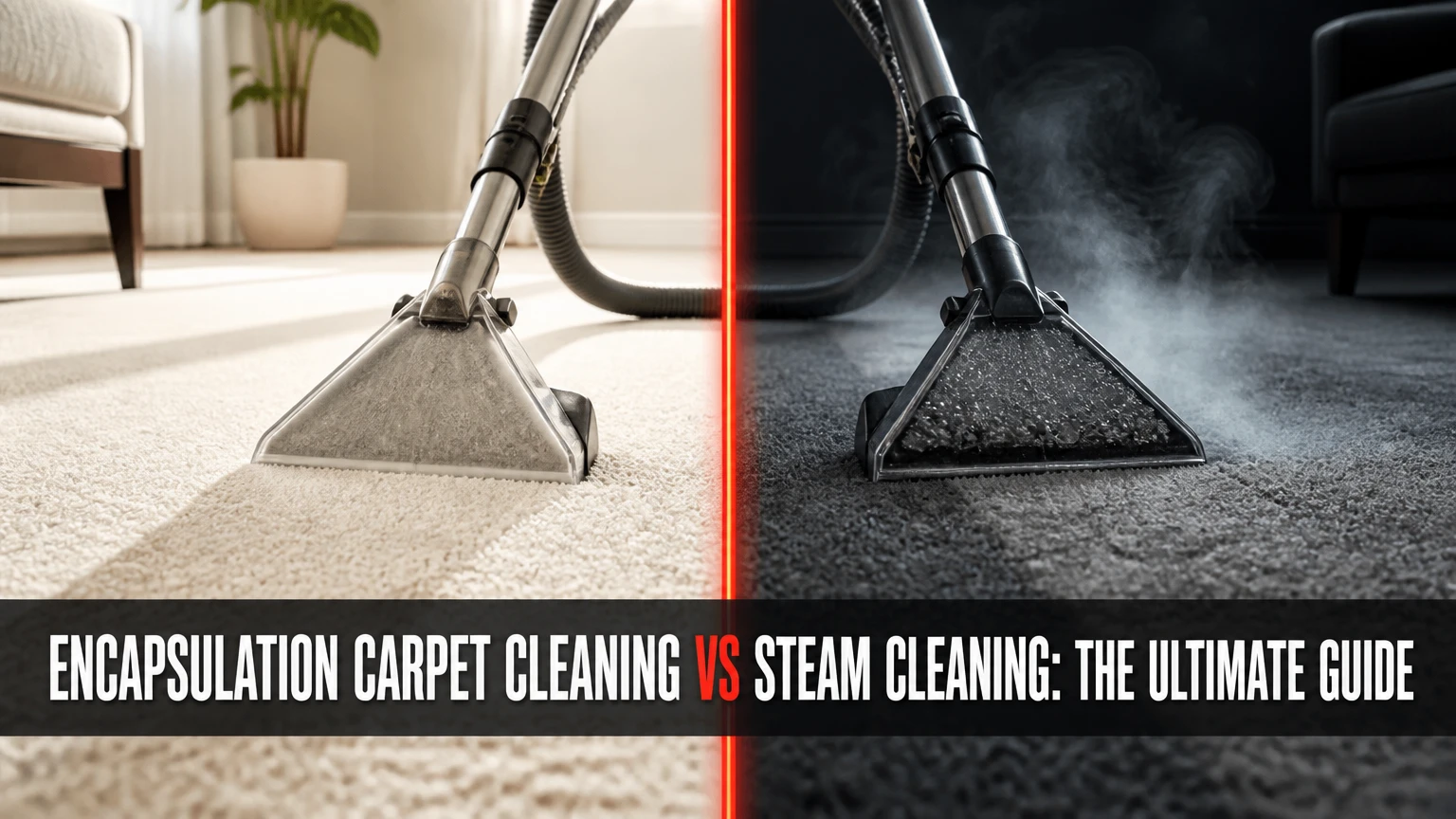
Encapsulation carpet cleaning relies on low-moisture crystallizing polymers to rapidly trap surface dirt for fast-drying commercial maintenance, whereas steam cleaning (hot water extraction) injects pressurized 212°F water to deeply flush embedded soils from the carpet backing. Steam cleaning remains mandatory for restorative deep cleaning and residential warranties, while encapsulation dominates high-square-footage commercial facilities requiring zero operational downtime.
Key Facts / At a Glance:
- Encapsulation uses 4–8 liters of water per 1,000 square feet, allowing carpets to dry completely in 20 to 60 minutes.
- Steam cleaning flushes carpets with 40–150 liters of water per 1,000 square feet, requiring 6 to 24 hours to cure.
- Commercial encapsulation covers 2,000 to 3,500 square feet per hour, dropping labor pricing to $0.05–$0.15 per square foot.
- Hot water extraction operates at 300–500 PSI and 190°F–212°F, neutralizing 9.0–11.5 pH pre-sprays with a 2.5–4.5 pH acid rinse.
- Most major carpet manufacturers explicitly void structural warranties unless professional steam cleaning is performed every 12 to 18 months.
Master Comparison Matrix
| Metric Specification | Encapsulation Cleaning | Steam Cleaning (HWE) |
| Water Consumption | Extremely low (4–8 liters / 1,000 sq ft) | High (40–150 liters / 1,000 sq ft) |
| Operating Pressure | N/A (Gravity / Low-pressure mist) | 300 to 500 PSI (Commercial standard) |
| Solution Temperature | Ambient room temperature | 65°C to 100°C (150°F to 212°F) |
| Drying Timeframe | 20 minutes to 1 hour | 6 hours to 24 hours |
| Production Speed | Fast (2,000 to 3,500 sq ft per hour) | Slow (300 to 1,000 sq ft per hour) |
| Chemical pH Range | Neutral to Mildly Alkaline (6.5 to 8.5 pH) | High Alkaline (9.0–11.5) neutralized by Acid (2.5–4.5) |
| Primary Target Market | Commercial (Glue-down, low pile) | Residential (Cut pile) & Restorative Commercial |
| Noise Profile | Low (60–70 dB, inside only) | High (85+ dB at the truck, quiet at wand) |
How Does the Chemical Process Work for Each Method?
To understand how encapsulation carpet cleaning vs steam cleaning achieves results, you must examine the specific mechanics of soil suspension and removal. The methods utilize entirely different physical principles to separate dirt from carpet fibers.
The Encapsulation Process
Encapsulation chemistry converts liquid detergents into dry, brittle crystals. The process relies on highly specialized polymeric surfactants.
- Dry Soil Removal: The technician performs thorough pre-vacuuming with a commercial-grade pile-lifter vacuum to remove 70-80% of dry particulate matter.
- Chemical Application: The encapsulation polymer is evenly sprayed onto the carpet fibers using a pump or battery-powered sprayer.
- Mechanical Agitation: A counter-rotating brush (CRB) or orbital pad machine agitates the carpet. This friction detaches sticky soils from the fibers and surrounds them with the liquid polymer.
- Crystallization: As the water carrier evaporates (typically in 20 to 60 minutes), the polymer encapsulates the suspended dirt, drying into microscopic crystals.
- Extraction: Routine post-vacuuming (often performed during the facility’s next scheduled maintenance cycle) pulls the crystallized dirt out of the carpet permanently.
The Steam Cleaning (HWE) Process
Hot water extraction relies on thermal energy, chemical dwell time, and high-powered mechanical suction to physically flush contaminants out of the building.
- Pre-Conditioning: An alkaline pre-spray (9.0 to 11.5 pH) is applied to break down surface oils, traffic lane grease, and stubborn proteins.
- Agitation & Dwell: The pre-spray sits for 10-15 minutes and is mechanically agitated into the fibers to maximize chemical suspension.
- Pressurized Flush: Industrial equipment pumps water heated up to 212°F (100°C) into the carpet at 300–500 PSI.
- Simultaneous Extraction: A high-powered vacuum slot on the cleaning wand immediately sucks out the water, soil, and dissolved detergents. An acidic rinse agent (2.5 to 4.5 pH) is blended into the water stream to neutralize the carpet’s pH.
- Dry Strokes: The technician runs the wand over the carpet using vacuum suction only to pull out the remaining moisture.
Winner: Tie. Encapsulation features superior chemical engineering for rapid appearance improvement, while steam cleaning provides superior physical extraction.
Which Method Removes Deep-Seated Soil and Allergens Better?
Steam cleaning drastically outperforms low-moisture methods when measuring the total mass of soil removed from the carpet backing. Encapsulation cleaning operates in the top third of the carpet fiber; it physically cannot reach or extract heavy solids, sand, silt, or biological fluids embedded at the base of the pile.
Steam cleaning utilizes high heat that kills dust mites, bacteria, fungal spores, and viruses on contact. Furthermore, the massive vacuum lift generated by positive-displacement blowers in truck-mounted systems literally pulls contaminated material out of the building and into a waste tank.
Expert Insight: Encapsulation is a cosmetic maintenance procedure. If a facility has heavy grease tracking from a kitchen, or a residential home has severe pet urine saturation, encapsulation will simply spread the contamination around. Restorative extraction requires the flushing power of steam.
Winner: Steam Cleaning. It is the only acceptable method for restorative sanitation and allergen removal.
How Do Drying Times and Downtime Compare?
Encapsulation cleaning offers infinitely superior drying times, allowing carpets to return to foot traffic in under an hour. Because the encapsulation method relies on a light chemical mist (4–8 liters per 1,000 square feet) rather than a deep water flush, the carpet is merely damp to the touch immediately after service.
Steam cleaning saturates the carpet and backing pad. Even with excellent extraction techniques and air movers, HWE leaves the carpet wet for 6 to 24 hours. If ventilation is poor or the technician over-wets the carpet, excess moisture can cause sour odors, dangerous mold growth, or delamination (separation of the carpet backing). Furthermore, steam cleaning carries a high “wicking hazard.” Old stains locked in the backing pad can travel up the damp fiber and reappear as it dries over the 24-hour window. Encapsulation completely eliminates this anti-wicking problem because the polymer traps migrating soils instantly.
Winner: Encapsulation. Fast dry times eliminate operational downtime for 24/7 commercial facilities.
What Are the Cost and Production Speed Differences?
Encapsulation carpet cleaning is substantially more cost-effective due to massive increases in square-foot-per-hour production speed. A single technician using a cylindrical roto-wash unit or 20-inch orbital pad machine can encapsulate 2,000 to 3,500 square feet per hour. This rapid execution drives commercial contract pricing down to $0.05 to $0.15 per square foot.
Steam cleaning is heavily labor-intensive. Moving hundreds of feet of heavy vacuum and solution hose, managing water supply, and physically pushing a wand reduces production to 300 to 1,000 square feet per hour. Consequently, pricing ranges from $0.15 to $0.45 per square foot. Additionally, owner-operators face much higher overhead with steam cleaning; a modern truck-mounted HWE system costs upwards of $25,000 to $40,000, consumes fossil fuels continually during operation, and requires specialized wastewater disposal.
Winner: Encapsulation. It delivers maximum ROI and minimal disruption for large-scale floor plans.
What Equipment is Required for Proper Execution?
Equipment selection determines the efficacy of both methods. Residential consumer spotters and cheap rental units lack the required heat, pressure, and lift to achieve professional-grade results.
Encapsulation Sub-Types:
- Counter-Rotating Brush (CRB) Systems: Dual cylindrical brushes spin inward to lift the pile and agitate encapsulation chemicals deeply into loop or cut-pile commercial carpets.
- Rotary / Orbital Pad Machines: Utilize oscillating drive plates with cotton or microfiber pads. They absorb emulsified soil directly while encapsulating the remainder.
- Cylindrical Roto-Wash Units: Combine fluid delivery, active brush scrubbing, and immediate wet-crystal reclamation in a single pass.
Steam Cleaning Sub-Types:
- Truck-Mounted HWE Systems: The industry gold standard. Heavy-duty engines mounted inside a van power integrated heat exchangers (achieving stable 194°F+ temperatures) and massive vacuum blowers.
- Commercial Portable Extractors: Self-contained electric units running on dual cords. They offer variable 100–500 PSI and internal heaters, designed specifically for high-rise buildings where hoses cannot reach.
Winner: Situational. Truck-mounts provide unmatched power, while CRB encapsulation machines provide unmatched agility.
What Are the Most Common Failures and Mistakes?
Both cleaning methods fail spectacularly when technicians violate basic chemistry and physical extraction rules.
Encapsulation Blunders:
- Skipping Pre-Vacuuming: If loose dry soil isn’t vacuumed first, the liquid polymer binds with the surface dust to create a gray slurry that cements onto the fibers permanently.
- Using Non-Crystallizing Chemicals: Applying standard high-foam shampoos instead of true encapsulation polymers leaves a sticky residue that acts as a dirt magnet, causing rapid re-soiling.
- Over-Wetting: Flooding the carpet with encapsulation liquid destroys the polymer’s crystallizing balance and extends dry times unnecessarily.
Steam Cleaning Blunders:
- Leaving Alkaline Residues: Failing to use an acidic neutralizing rinse leaves high-pH surfactants in the carpet. This chemically strips the carpet’s factory protectants (like Teflon) and attracts dirt.
- Over-Wetting / Weak Extraction: Using too much water with too little vacuum lift causes prolonged drying, mildew, and browning.
- Excessive Heat on Synthetics: Pushing temperatures beyond fiber tolerance thresholds (above 150°F on specific synthetics) can permanently distort olefin or delicate wool loops.
Field Troubleshooting Guide: If spots reappear 24 hours after steam cleaning (wicking), lightly mist the area with an encapsulation spotter and bonnet-buff the surface to trap the migrating soil. If a carpet looks dull or crunchy after encapsulation, the crystallization process worked, but post-vacuuming was insufficient. Run a heavy dual-motor vacuum over the zone.
Which Should You Choose?
The decision between encapsulation carpet cleaning vs steam cleaning is not about superiority; it is about matching the technology to the environment.
For Commercial Facility Managers
Choose a hybrid maintenance strategy.
Run encapsulation cleaning 3 to 4 times a year to keep traffic lanes bright, remove daily surface soil, and prevent operational downtime. Schedule a full truck-mounted steam cleaning once a year (ideally over a long holiday weekend) to deeply flush out the compacted soils and abrasive sand trapped at the carpet backing. This maximizes visual appearance while protecting the capital investment of the flooring.
For Residential Homeowners
Choose steam cleaning (HWE) exclusively.
Residential carpets feature deep, plush cut piles that act as massive filters for skin flakes, pet dander, food spills, and hair. These require the aggressive flushing and sanitizing power of hot water extraction. Most major carpet manufacturers explicitly require steam cleaning every 12-18 months to maintain the warranty. Use encapsulation exclusively for quick interim spot treatments on small spills.
For Property Managers (Tenant Turnovers)
Choose heavy-duty steam cleaning.
Move-outs present highly unpredictable biological and chemical conditions, including heavy cooking grease, bodily fluids, and unknown pet accidents. Encapsulation cannot sanitize these threats. Turnovers require the heavy flushing, thermal sanitizing, and sub-surface deodorizing power of hot water extraction to prepare the unit for the next tenant.
Frequently Asked Questions
Does encapsulation cleaning leave a sticky residue?
No, true encapsulation chemistry dries into a brittle, non-sticky crystal that actively resists dirt. However, if a technician mistakenly uses traditional high-foaming shampoo without extracting it, a sticky residue will remain and cause rapid re-soiling.
Can you use encapsulation on wool carpets?
Yes, but you must use a specialized, wool-safe encapsulation polymer with a neutral pH (around 7.0). Wool is highly sensitive to alkalinity and high heat, making low-moisture, neutral-pH encapsulation a very safe maintenance option when applied correctly.
Which method is better for pet urine extraction?
Steam cleaning is the only effective method for pet urine. Urine penetrates the carpet fiber, the backing, and the subfloor. It must be chemically neutralized and physically flushed out using a specialized sub-surface extraction tool hooked to a high-powered vacuum system.
How often should commercial carpets be steam cleaned?
High-traffic commercial carpets (like hotel lobbies or retail floors) should undergo hot water extraction at least once every 12 months to remove abrasive sand that cuts the fibers. This should be supplemented by encapsulation cleaning every 1 to 3 months for visual maintenance.