Commercial and residential carpet cleaning differ fundamentally in scale, equipment pressure, and chemical formulation. While residential cleaning focuses on deep allergen extraction and preserving delicate cut-pile fibers using hot water extraction, commercial cleaning prioritizes high-speed soil encapsulation, rapid drying times, and extreme durability for heavy-traffic glue-down carpets.
Key Facts / At a Glance
- Residential carpet cleaning averages $0.25 to $0.50 per square foot, while commercial cleaning volume discounts drop costs to $0.05 to $0.20 per square foot.
- Residential spaces require Hot Water Extraction (HWE) with drying times of 6 to 12 hours to safely remove bio-contaminants.
- Commercial facilities rely heavily on Very Low Moisture (VLM) encapsulation to achieve 1 to 2-hour dry times and prevent operational downtime.
- Residential extraction equipment operates at 200 to 400 PSI to protect subfloors, whereas commercial machinery exceeds 400 to 1,200 PSI to blast out industrial grit.
- Applying high-alkaline commercial degreasers (above 10 pH) to residential wool or nylon strips protective coatings and causes permanent color loss.
Quick Verdicts by Persona
- For Homeowners: Demand truck-mounted Hot Water Extraction (steam cleaning) every 12 to 18 months using pH-balanced, low-VOC chemistry to protect fiber warranties and remove deep allergens.
- For Facility Managers: Implement a hybrid maintenance schedule using monthly Very Low Moisture (VLM) encapsulation to prevent wick-back, paired with an annual restorative hot water extraction.
- For Small Business Owners in Converted Homes: Specify your carpet construction (residential cut-pile vs. commercial loop) when requesting quotes; you likely need residential chemistry applied with commercial frequency.
Master Comparison: Operational Metrics and Baselines
The structural constraints of homes versus businesses dictate vastly different approaches to cleaning.
| Metric | Residential Cleaning | Commercial Cleaning |
| Primary Method | Hot Water Extraction (HWE) | Encapsulation / VLM |
| Target Soils | Pet dander, dust mites, food spills | Asphalt grit, heavy grease, coffee |
| Average Pricing | $0.25 – $0.50 / sq. ft. | $0.05 – $0.20 / sq. ft. |
| Production Speed | 400 – 800 sq. ft. per hour | 2,000 – 6,000 sq. ft. per hour |
| Drying Time | 6 – 12 hours | 1 – 2 hours |
| Equipment Pressure | 200 – 400 PSI | 400 – 1,200+ PSI |
| Water Temperature | 160°F – 200°F | 180°F – 240°F |
| Service Frequency | Every 12 – 18 months | Monthly, Quarterly, or Semi-Annually |
How Do Equipment and Extraction Capabilities Differ?
Commercial equipment delivers vastly higher pressure, heat, and mechanical agitation than residential counterparts. Residential cleaning utilizes portable units or dialed-down truck mounts operating at 200 to 400 PSI. This pressure limitation is intentional; pushing higher PSI into residential cut-pile carpet over a wood subfloor causes over-saturation, leading to subfloor rot and delamination (the separation of the carpet backing). Temperatures are capped around 200°F to prevent melting delicate synthetic fibers or shrinking natural wool.
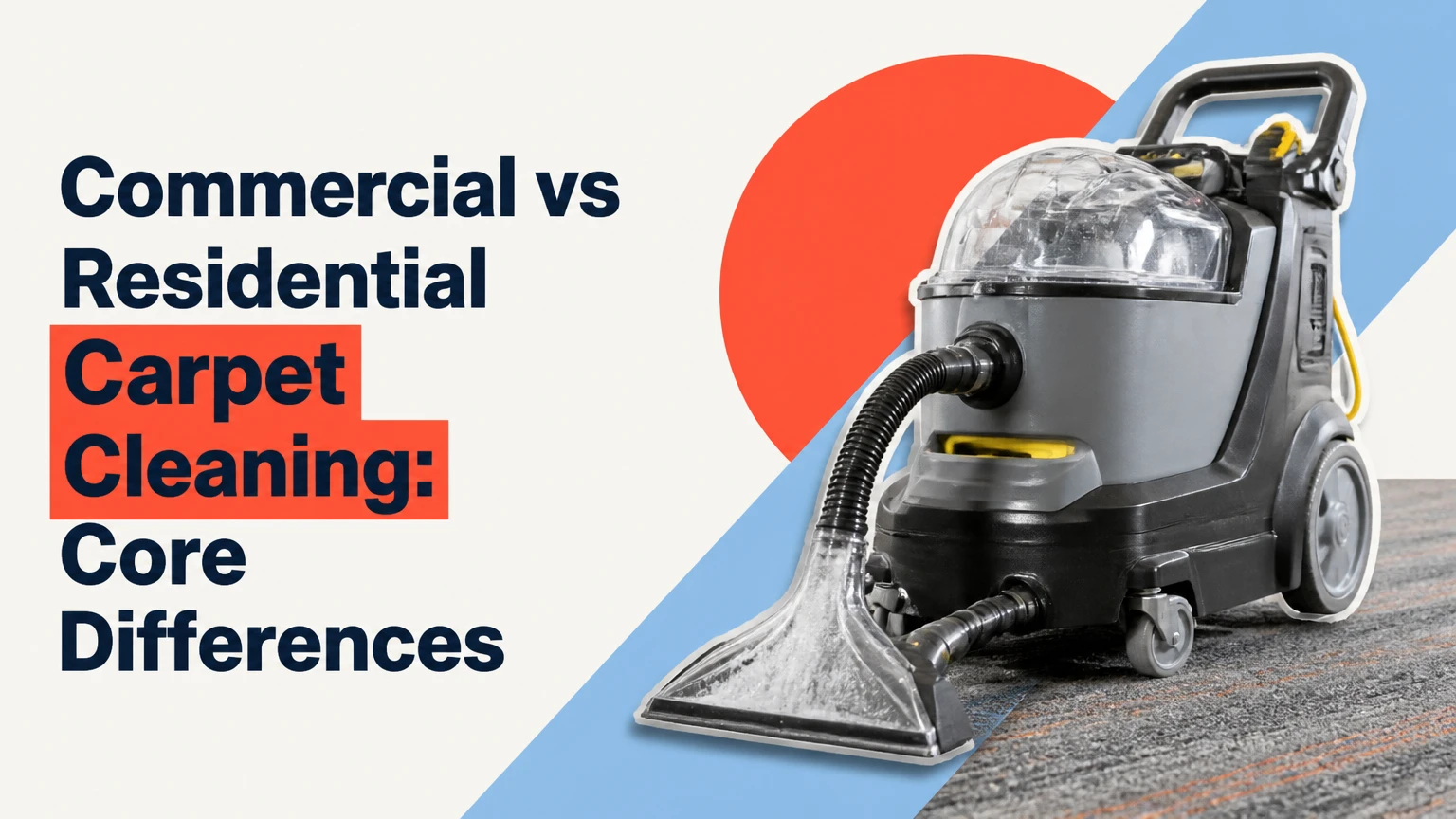
Commercial cleaning leverages high-production machinery designed for concrete subfloors and dense loop carpets. Truck-mounted units for commercial restoration routinely push water at 400 to over 1,200 PSI at temperatures up to 240°F. For routine maintenance, commercial cleaners abandon water extraction entirely, utilizing heavy cylindrical brush machines or planetary rotary scrubbers to drive crystallization chemistry deep into the pile.
The Verdict: Commercial equipment wins on pure power and speed, but residential equipment provides the precision required to clean delicate environments without causing structural water damage.
What Are the Chemical Formulations and Target Soils?
Residential carpet chemistry focuses on biological extraction and fiber preservation, while commercial chemistry focuses on dissolving industrial hydrocarbons. Residential pre-sprays rely on pH-neutral or mildly alkaline solutions (7 to 9 pH) containing enzymes. These enzymes digest organic matter—pet urine, skin cells, and food spills—while leaving factory-applied stain resistants (like fluorochemicals) intact.
Commercial carpets face completely different contaminants: tracked-in asphalt, elevator grease, heavy oils, and massive volumes of soil. Commercial chemistry utilizes aggressive alkaline solvents (often exceeding 10 to 12 pH) to emulsify these heavy carbons. In VLM systems, technicians apply crystalline polymers that chemically trap dirt particles. As the polymer dries over 30 minutes, it becomes a brittle crystal that holds the dirt until it is removed by routine janitorial vacuuming.
The Verdict: Residential chemistry prioritizes safety and fiber health, whereas commercial chemistry prioritizes aggressive soil suspension and encapsulation.
How Do the Cleaning Processes Work?
The step-by-step procedures differ because residential cleaning extracts soil immediately with water, while commercial maintenance often suspends soil for later dry removal.
The Residential Deep-Clean Process (HWE)
- Pre-Inspection: Technicians identify the fiber type (wool, nylon, polyester) and locate permanent stains or high-wear pathways to determine the correct pH chemistry.
- High-Filtration Vacuuming: A certified HEPA vacuum pulls up 70 to 80% of dry, loose particles.
- Pre-Treatment: Technicians apply a pH-balanced traffic-lane cleaner to emulsify embedded organic soils, allowing a 10-minute dwell time.
- Agitation: A counter-rotating brush (CRB) machine gently lifts the carpet pile and works the pre-spray into the backing.
- Hot Water Extraction: Pressurized hot water (180°F to 212°F) flushes the fibers while a high-vacuum wand simultaneously extracts the moisture and soil.
- Post-Cleaning Drying: Technicians groom the carpet with a rake to align fibers and deploy high-velocity air movers to accelerate drying.
The Commercial Maintenance Process (Encapsulation)
- Site Mapping: Technicians identify high-traffic funnels, hard-surface transitions, and sensitive electronic floor outlets.
- Industrial Pre-Vacuuming: Heavy-duty dual-motor vacuums clear large-scale debris and abrasive street grit.
- Polymer Spraying: Technicians apply a specialized crystalline polymer pre-spray that chemically attracts and wraps around dirt particles.
- Mechanical Agitation: Heavy rotary machines scrub the polymers deep into the dense, glue-down commercial pile.
- Crystallization: The polymer surrounds the soil and cures into microscopic, non-sticky crystals over 20 to 30 minutes.
- Post-Vacuum Extraction: The encapsulated soil is removed during the building’s regular daily janitorial sweeps.
The Verdict: The residential process is restorative and immediate; the commercial process is highly efficient and integrates seamlessly into ongoing facility maintenance.
Why Do Pricing Structures and Production Rates Vary?
Pricing differences stem directly from economies of scale and setup logistics. Residential cleaning costs $0.25 to $0.50 per square foot because technicians spend significant unbilled time navigating driveways, protecting drywall corners, moving residential furniture, and running hoses up staircases. A residential crew typically cleans 400 to 800 square feet per hour.
Commercial cleaning drops to $0.05 to $0.20 per square foot because the environments are built for scale. Technicians work in wide-open, obstacle-free spaces using wide-track, walk-behind machinery. A commercial crew utilizing encapsulation can effectively clean 2,000 to 6,000 square feet per hour. Furthermore, commercial jobs are often secured on recurring annual contracts, allowing vendors to offer steep volume discounts.
The Verdict: Commercial cleaning is vastly cheaper per square foot due to open floor plans, rapid VLM methods, and massive economies of scale.
What Are the Most Common Cleaning Mistakes?
Improperly applying commercial tactics to a home, or vice versa, routinely destroys carpets and voids manufacturer warranties.
Residential Troubleshooting
- Mistake: Over-Saturating the Carpet. Applying too much water causes the primary and secondary backings to separate (delamination). It also warps wood subfloors and triggers mold growth within 48 hours.
- Fix: If the carpet smells musty 24 hours post-clean, deploy industrial dehumidifiers instantly and treat the fibers with an EPA-registered antimicrobial sanitizer.
- Mistake: Using Commercial Chemistry. Applying high-alkaline commercial strippers to residential wool or nylon strips protective coatings, ruining color fastness and leaving a sticky residue.
- Fix: Always neutralize the carpet with an acidic rinse step (4 to 5 pH) to return the fibers to their natural state and prevent rapid resoiling.
Commercial Troubleshooting
- Mistake: Splitting Adhesives. Running restorative hot water extraction above 230°F over cheap commercial glue-down carpets melts the adhesive latex holding the carpet to the concrete, creating permanent bubbles and ripples.
- Fix: Regulate truck-mount temperatures and rely primarily on cold-water encapsulation for lower-grade installations.
- Mistake: Ignoring Wick-Back. Large liquid spills (coffee, soda) pool on the commercial concrete subfloor. Surface cleaning removes the visible stain, but capillary action draws the subfloor liquid back up the fiber as the carpet dries.
- Fix: Spot-treat recurring stains with an anti-wicking agent, encapsulate the area, and dry it instantly using a weighted, highly absorbent bonnet pad.
Which Should You Choose?
For Homeowners & Landlords
Stick strictly to residential Hot Water Extraction. Most major carpet manufacturers (like Shaw and Mohawk) mandate professional HWE every 12 to 18 months by an IICRC-certified firm to maintain the warranty. Request green-certified, low-VOC chemistry if pets, toddlers, or asthma sufferers live in the home.
For Property Managers & Facilities Directors
Implement a hybrid commercial program. Utilize Low-Moisture Encapsulation for monthly or quarterly maintenance cycles to control costs, prevent wick-back, and keep the facility open. Schedule an annual Hot Water Extraction during off-peak weekend hours to deep-flush heavy traffic lanes. Ensure your selected vendor carries substantial commercial general liability insurance to protect against accidental damage to server rooms or electronic building systems.
For Small Businesses in Converted Homes
If you operate a dental clinic, law office, or day spa out of a converted residential building with plush, cut-pile carpet, you face an edge case. You have commercial traffic but residential carpet construction. You must hire a vendor who uses residential HWE methods and pH-balanced chemistry, but you will need to schedule the service at commercial frequencies (every 3 to 6 months) to manage the soil load.
Frequently Asked Questions
Can you use a commercial carpet cleaner at home?
You should not use commercial equipment or chemistry on residential carpet. Commercial machines apply too much pressure and heat for residential wood subfloors, and commercial chemicals are too alkaline, which will strip the protective coatings off plush residential fibers and leave a sticky residue.
Does encapsulation cleaning work on residential carpets?
Encapsulation is rarely recommended for residential homes. Residential carpets feature thick, cut-pile fibers that trap heavy particulate soil and pet dander deep near the backing. Encapsulation only cleans the top portion of the fiber and relies on frequent industrial vacuuming, making it ineffective for the deep bio-contaminants common in homes.
How long does commercial glue-down carpet take to dry?
When cleaned using Very Low Moisture (VLM) encapsulation, commercial glue-down carpet dries in 1 to 2 hours. If subjected to restorative Hot Water Extraction, it generally dries in 4 to 8 hours due to the dense, low-pile construction and commercial HVAC airflow.
What is the wick-back effect in commercial carpets?
Wick-back occurs when a liquid spill penetrates the carpet and pools on the concrete subfloor. Surface cleaning removes the top of the stain, but as the carpet dries, capillary action draws the hidden liquid from the subfloor back up the fiber, causing the stain to magically reappear hours later.