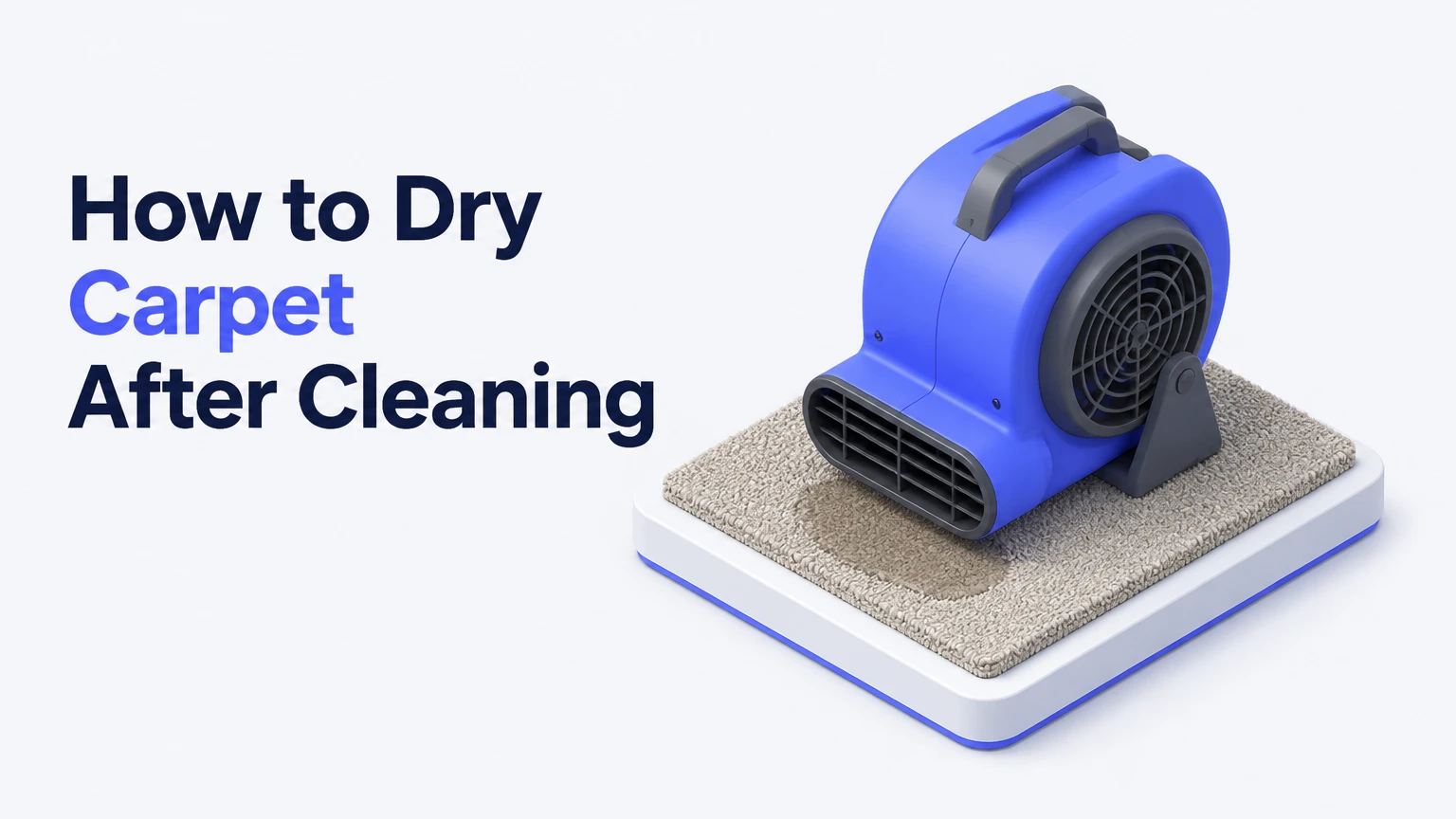
Figuring out how to dry carpet after cleaning determines whether you end up with fresh flooring or a musty, bacteria-laden disaster. This six-step method takes 14 to 26 hours total and relies on maximizing physical extraction before managing indoor humidity and airflow. The single biggest factor for success is controlling your room temperature alongside your extraction equipment.
Before You Start
Drying a carpet fast requires the right atmospheric conditions and specific physical tools.
Time Required: 14 to 26 hours (active labor is 45 to 60 minutes).
Difficulty Level: Beginner.
Typical Cost Range: $40 to $120 for equipment rentals.
Prerequisites: You must confirm whether only the carpet pile is wet, or if the underlying foam pad is soaked. Press a dry paper towel firmly into the floor. If water pools around your knuckles, the pad is saturated, and drying times will push toward the 24-hour mark.
| Tool or Material | Quantity / Specification | Typical Cost | Purpose |
| High-Volume Air Movers | 2 to 4 units (centrifugal fans) | $25/day rental | Creates a high-speed cyclone across the floor. |
| Dehumidifier | 1 large unit (15-20 gallons/day) | $45/day rental | Pulls evaporated moisture out of the trapped room air. |
| White Cotton Towels | 5 to 10 clean towels | $10 | Absorbs standing water without transferring dye to the floor. |
| Heavy Squeegee or Roller | 1 unit with a rigid handle | $15 | Physically pushes deep water out of the pile. |
| Carpet Rake | 1 unit with nylon bristles | $20 | Stands fibers upright to increase evaporative surface area. |
| Baking Soda | 1 to 2 boxes (16 oz each) | $2 | Absorbs lingering odors once the floor is dry to the touch. |
Step Summary Overview
| Step Number | Action | Active Time | Most Common Mistake |
| Step 1 | Extract Excess Moisture | 15-30 mins | Using colored towels that bleed dye. |
| Step 2 | Groom the Carpet Pile | 5 mins | Skipping this step entirely. |
| Step 3 | Seal and Condition Air | 5 mins | Turning on home heating systems. |
| Step 4 | Position Air Movers | 10 mins | Pointing fans straight down instead of at an angle. |
| Step 5 | Deploy Dehumidifier | 12-24 hours | Forgetting to check the water collection tank. |
| Step 6 | Neutralize and Vacuum | 2 hours | Applying baking soda while the floor is still damp. |
Step 1: Extract Excess Moisture
Physically remove as much standing water as possible using heavy pressure and clean cotton.
Lay a clean white cotton towel flat on the wettest section of the floor. Step onto the towel wearing clean, rubber-soled shoes, pressing your full body weight down into the pile. Hold for five seconds, then move to a dry section of the towel and repeat. Alternatively, press a heavy squeegee firmly into the floor and pull it steadily toward a drain or hard surface area to push the water out of the fibers. Work in 3-foot by 3-foot grid sections.
You will know this step worked when the carpet feels damp rather than soggy, and stepping on it no longer produces a visible puddle around your shoe.
The most common mistake here is using dyed towels. High alkalinity from cleaning solutions causes towel dye to bleed instantly, leaving permanent stains on your flooring.
Step 2: Groom the Carpet Pile
Pull a carpet rake across the damp flooring in one uniform direction to stand the fibers straight up.
Place the head of the carpet rake at the far wall. Pull it gently but firmly toward your body in long, overlapping strokes. Do not push the rake back and forth aggressively. You want to lift the crushed, matted yarns upright so the individual fibers separate.
You will know it worked when the entire floor looks uniform and you can see distinct spaces between the yarn tufts.
Failing to groom matted fibers increases drying time by hours. Matted wet carpet traps moisture underneath the top layer, completely blocking airflow from reaching the base of the yarn.
Step 3: Seal and Condition the Room Air
Close off the space from external weather elements and set your HVAC system to a neutral temperature.
Shut all exterior windows and doors tightly. Turn your home air conditioning or HVAC thermostat to between 68 and 72 degrees Fahrenheit (20 to 22 degrees Celsius). Do not turn the heat up. High temperatures cause the backing of the carpet to warp, and warm air holds more moisture, creating a tropical greenhouse effect inside the room.
You will know it worked when the room feels distinctly enclosed and the ambient temperature stabilizes around 70 degrees.
Leaving windows open during humid weather is a fatal error. The dehumidifier will endlessly try to pull moisture from the outside environment instead of drying out your wet carpet.
Step 4: Position Air Movers for Cyclone Flow
Arrange your high-volume floor fans to create a continuous, circular air vortex across the entire floor surface.
Place the first air mover in a corner, pointing the nozzle parallel to the wall but angled downward at a 45-degree pitch toward the center of the room. Place the second fan in the adjacent corner, pointing in the same clockwise direction. Turn all units to their highest speed setting. The air from the first fan will push into the path of the second, creating a cyclone that constantly moves dry air across the wet fibers.
You will know it worked when you can drop a tissue in the center of the room and watch the air current push it in a circular motion.
Pointing the fans directly at the center of the room from opposite sides is a common mistake. Opposing airflow crashes in the middle, creating dead zones where the moisture simply settles back into the pad.
Step 5: Deploy the Dehumidifier on Continuous Mode
Position your moisture extraction unit to capture the water vapor being pushed into the air by your fans.
Place the large-capacity dehumidifier near the center of the room, ensuring the intake vents face the main circulation path of the air movers. Set the machine to “Continuous” mode, or dial the target relative humidity (RH) to between 30 and 40 percent. According to the Institute of Inspection, Cleaning and Restoration Certification (IICRC) S500 standard, maintaining indoor humidity below 40 percent during the drying phase prevents secondary mold growth. Run the machine uninterrupted for 12 to 24 hours.
You will know it worked when the room feels distinctly dry and cool, and the dehumidifier tank begins filling with liquid water.
Forgetting to check the tank is a major failure point. If you cannot attach a garden hose for continuous floor drainage, you must physically empty the internal collection bucket every four to six hours, or the machine will automatically shut off.
Step 6: Neutralize Odors and Final Vacuum
Apply a mild alkaline powder to pull out trapped odors and restore the final texture of the pile.
Wait until the carpet is completely dry to the touch all the way down to the backing. Sprinkle a thin, even layer of plain baking soda across the entire surface using roughly one 16-ounce box per 100 square feet. Leave the powder completely undisturbed for exactly two hours. Set your vacuum cleaner height to “Medium” or “Low” based on your specific pile, turn on the brush roll, and vacuum the room slowly in overlapping passes.
You will know it worked when the room smells entirely neutral and the floor feels soft and bouncy underfoot.
Applying baking soda while the fibers are still damp creates a hard, cement-like paste that bonds to the backing and ruins the vacuum filter.
Common Mistakes and How to Fix Them
Even with a systematic approach, environmental variables cause problems. Avoid these realistic failure modes to protect your flooring.
Walking on Wet Fibers
Wet carpet fibers are highly susceptible to physical crushing. When you walk on damp flooring, your body weight permanently crushes the yarn into the backing, transferring dirt from your shoes deep into the matrix.
The Fix: If you must cross the room, wear clean, white socks and step lightly. Rake the crushed footprints immediately afterward.
Relying on Ceiling Fans
Standard residential ceiling fans push air downward. This forces the evaporating moisture directly back down into the carpet pad, creating a cycle of condensation that traps water at the subfloor level.
The Fix: Turn off overhead fans. Rely entirely on floor-level centrifugal air movers pushing air horizontally across the surface.
Using Residential Space Heaters
Applying direct, concentrated heat to wet synthetic fibers causes the latex backing to delaminate and separate. It also bakes cleaning chemicals into the yarn permanently.
The Fix: Remove localized heat sources. If the room is freezing, use the central HVAC system to bring the ambient air up to 68 degrees Fahrenheit gently.
Drying Too Fast with Extreme Heat
Some homeowners attempt to dry a carpet fast by blasting industrial heaters. Rapid evaporation flash-dries the tips of the fibers while the root remains soaked, sealing moisture into the base.
The Fix: Prioritize dehumidification over heat. Pulling moisture out of the air is always safer and more effective than baking the floor.
Troubleshooting Process Failures
Sometimes the cleaning process leaves behind chemical imbalances or trapped moisture. Use these professional recovery tactics.
Problem: Carpet Still Smells Musty After 24 Hours
Cause: The foam pad underneath the backing is still holding standing water. Dark, damp environments allow bacteria to multiply rapidly, producing off-gassing that smells like wet dog or old basement air.
Solution: Go to an inconspicuous corner of the room with a pair of pliers. Grab the carpet fibers near the baseboard and pull gently upward to detach the floor from the tack strip. Fold a two-foot section back to expose the foam pad. Aim an air mover directly underneath the carpet layer, blowing between the pad and the backing. Run this for another 12 hours, then re-hook the floor onto the tack strip.
Problem: Carpet Feels Crunchy or Stiff
Cause: The extraction equipment failed to pull out all the detergent. High-pH soap residue was left behind, which hardened as the water evaporated.
Solution: Mix a solution of 50 percent distilled white vinegar and 50 percent warm water in a spray bottle. The acetic acid in the vinegar neutralizes the alkaline soap residue. Lightly mist the stiff areas (do not soak them). Wait five minutes, then blot the area aggressively with a clean white towel. Once dry, run a vacuum with a stiff brush roll over the area to break up the softened residue.
Problem: The Dehumidifier Tank Fills and Shuts Off Repeatedly
Cause: The initial moisture extraction rate is extremely high in the first four hours. A standard residential bucket fills too quickly, triggering the safety float switch and stopping the drying process while you sleep.
Solution: Locate the continuous drain port on the back of the dehumidifier. Unscrew the plastic cap and attach a standard garden hose. Run the opposite end of the hose into a floor drain, a bathtub, or out a sealed window. Ensure the hose runs steadily downhill, as these machines rely on gravity rather than a pump.
Variations for Different Situations
You must alter your drying strategy based on the materials and constraints of your specific project.
Wool and Natural Fiber Carpets
Wool fibers hold up to 30 percent of their weight in water without feeling wet. They shrink violently if exposed to high heat while damp.
Process Change: Never use heat on wool. Set the room temperature to a maximum of 65 degrees Fahrenheit. Double the amount of air movers, and expect the process to take a full 24 to 36 hours. Do not use an aggressive squeegee, as physical tension stretches the natural weave.
No Professional Equipment Available
If you cannot rent centrifugal air movers or a commercial dehumidifier, you must rely on household items.
Process Change: Turn your home air conditioning down to 65 degrees. AC units naturally dehumidify the air as a byproduct of cooling. Open all interior doors to increase total air volume. Place standard box fans flat on the floor, angled to push air across the wettest zones. Swap out dry towels every two hours to maximize manual extraction.
Spot Cleaning vs Entire Rooms
When you only wash a three-foot section to remove a pet stain, treating the entire room is a waste of resources.
Process Change: Stack three heavy white towels over the wet spot. Place a 20-pound weight (like a heavy box of books) on top of the towels and leave it for two hours. Remove the weight, discard the wet towels, and point a single desk fan directly at the spot overnight.
How Long Does It Take and What Does It Cost?
Understanding the time and financial commitment helps you decide between renting equipment or hiring a professional restoration crew. The typical time frame ranges from 14 to 26 hours.
| Drying Method | Equipment Needed | Average Time | Estimated Cost |
| Professional Setup | 4 Air Movers, 1 XL Dehumidifier | 12 to 16 hours | $100 to $150 (Rental) |
| Standard DIY Setup | 2 Box Fans, AC Unit running | 24 to 36 hours | $0 to $15 (Electricity) |
| Heavy Pad Saturation | Fans underneath lifted carpet | 48+ hours | $50 to $75 (Rental) |
The numbers above assume a standard 12-foot by 12-foot bedroom. Your time frame moves toward the lower end of the range if the ambient humidity in your region is naturally low (below 35 percent). If you live in a coastal area with high humidity, even the best equipment will push toward the longer end of the time estimates.
Frequently Asked Questions
Is it safe to sleep in a room with wet carpet?
No. Wet flooring drastically increases the humidity in the room, which creates an environment where mold spores multiply within 24 hours. Sleeping in high-humidity environments with active bacterial off-gassing causes respiratory irritation and allergy flare-ups.
Will baking soda dry a wet carpet faster?
Baking soda does not speed up the evaporation of water. It is highly effective at absorbing lingering odors, but applying it to wet fibers turns the powder into a hardened paste that ruins the pile texture. Only apply it once the floor is dry.
Why does my carpet smell like a wet dog after steam cleaning?
This smell occurs when the underlying foam pad gets too wet and dries too slowly. The moisture activates dormant bacteria trapped in the pad. You must increase airflow and drop the room humidity immediately to stop the bacterial growth.
Can I use a hairdryer to dry a wet spot?
You can use a hairdryer on the “Cool” setting for small areas. Using the “Hot” setting on synthetic fibers will melt the yarn tips and warp the latex glue holding the backing together. Keep the nozzle six inches away and keep it moving continuously.
Does opening windows help dry out carpet?
Opening windows only helps if the outdoor air is significantly warmer and drier than the indoor air. If the outside humidity is above 50 percent, opening a window pulls external moisture inside, drastically slowing down the evaporation process.
Successfully figuring out how to dry carpet after cleaning relies entirely on the rapid, systematic removal of moisture from the air. By physically extracting the standing water, standing the fibers upright with a rake, and balancing high-speed airflow with aggressive dehumidification, you prevent permanent odors and protect the life of your flooring. Follow the steps precisely, monitor your equipment, and never apply heat.