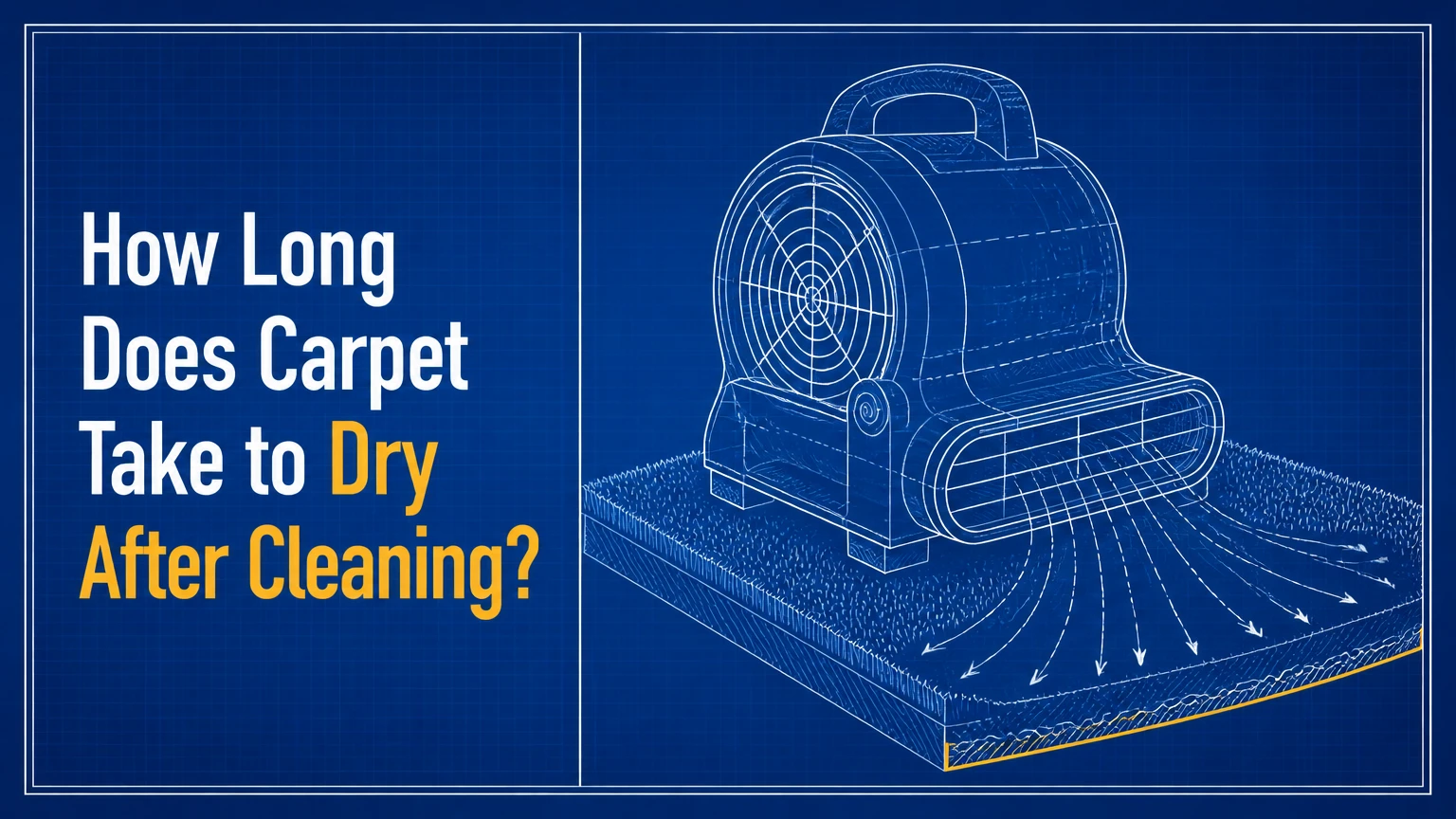
Carpet takes between 6 and 24 hours to dry completely after a professional hot water extraction. The exact drying timeframe depends on the cleaning method used, the thickness of the carpet fibers, and the indoor humidity levels. Dry chemical cleaning methods allow for immediate foot traffic within one hour.
At a Glance
- Standard hot water extraction requires 8 to 24 hours of drying time.
- Very Low Moisture (VLM) encapsulation treatments dry completely in 1 to 4 hours.
- Wool and thick cut-pile carpets retain more moisture and need 12 to 36 hours before drying.
- Walking on damp carpets with bare feet or outdoor shoes transfers oils and dirt immediately.
- Carpets remaining wet beyond 48 hours face a high risk of mold spore germination.
- Setting the thermostat between 70°F and 78°F maximizes indoor evaporation rates.
What is the fastest drying carpet cleaning method?
Dry chemical cleaning represents the fastest method available on the market today. This technique requires zero to 60 minutes of drying time because the process introduces almost no liquid water into the carpet backing. Technicians spread a specialized absorbent compound mixed with minimal solvents across the floor. A motorized brush works this compound deep into the carpet pile.
The chemical sponges attach to soil, grease, and dust within the fibers. Once the compounds capture the dirt, a high-powered vacuum extracts the dry granules completely. Homeowners can walk on the carpet immediately after the vacuuming step finishes. Facilities that operate 24 hours a day frequently utilize dry chemical cleaning to avoid shutting down corridors or lobby areas. This method excels at surface brightening but fails to reach the deep soils trapped near the carpet padding.
How do different cleaning methods affect drying time?
The volume of water injected into the carpet determines the baseline drying expectation. Methods that rely on heavy saturation require significantly longer evaporation periods than those relying on chemical agitation.
| Cleaning Method | Water Volume Used | Average Drying Time | Immediate Traffic Safety |
| Hot Water Extraction (Steam) | High (2-4 gallons per room) | 8-24 hours | Low (Wait 6+ hours) |
| Very Low Moisture (VLM) | Low (Less than 1 gallon) | 1-4 hours | Medium (Wait 1 hour) |
| Dry Chemical Sweeping | Trace (Ounces of solvent) | 0-1 hour | High (Immediate) |
| Bonnet Cleaning | Low (Surface dampness only) | 1-2 hours | Medium (Wait 1 hour) |
Hot water extraction forces pressurized water deep into the carpet base before sucking it back out. The equipment must recover at least 95 percent of that water to prevent extended dampness. Very Low Moisture methods use polymer encapsulants sprayed lightly over the surface. The polymers crystalize around dirt particles as they dry rapidly in the ambient air. The physical mechanics of each system guarantee vastly different timelines for the end user.
Does commercial cleaning dry faster than DIY rentals?
Professional truck-mounted systems dry carpets drastically faster than consumer rental machines. The difference comes down to mechanical vacuum lift. Truck-mounted cleaning units generate immense suction power driven by dedicated gasoline or diesel engines. These industrial vacuums pull up to 95 percent of the injected moisture directly out of the carpet pad and fibers.
Consumer rental units from hardware stores rely on standard 15-amp electrical outlets. The weak vacuum motors in DIY machines struggle to pull water up through thick carpet layers. Data published by the Carpet and Rug Institute (CRI) in 2022 indicates that DIY rental extractors often leave up to three times more water behind than commercial truck-mounts. A homeowner using a rental machine typically faces a 48-hour to 72-hour drying window. Over-wetting by amateur equipment remains the leading cause of damaged carpet backing and prolonged dampness.
Do fast-drying carpet cleaning services cost more?
Low-moisture and rapid-drying cleaning services frequently cost 15 percent to 30 percent more than standard hot water extraction. The price difference reflects the cost of specialized chemical solutions and advanced mechanical agitation equipment.
Standard steam cleaning utilizes relatively inexpensive detergents combined with heated tap water. Very Low Moisture (VLM) technicians must purchase expensive crystalline polymers and specialized rotating floor pads to execute their method properly. A typical living room might cost $50 to clean using traditional steam, while a dry encapsulation service for the same room could reach $75. Property managers and homeowners willingly pay this premium to regain access to their rooms within two hours rather than waiting an entire day. The time saved often justifies the upfront expense for busy households.
How long do wool and thick carpets take to dry?
Pure wool and thick cut-pile carpets routinely require 12 to 36 hours to dry completely. Natural wool fibers feature a highly porous cellular structure. The cortex of a wool fiber can absorb up to 30 percent of its own weight in water without feeling wet to the human hand.
Synthetic nylon or polyester carpets shed water rapidly because plastic fibers cannot absorb liquid internally. Moisture on synthetic carpets sits strictly on the outside of the fiber shaft. Wool pulls the water deep into its core. Thick shag or heavy saxony carpets present a secondary physical barrier. The density of the yarn prevents ambient air from reaching the moisture trapped near the base of the rug. Technicians cleaning natural fibers must deploy specialized centrifugal air movers immediately to force evaporation down into the thickest part of the pile.
How long does pet stain removal take to dry?
Carpet sections treated for severe pet urine stains take 24 to 48 hours to dry. Standard carpet cleaning only washes the top fibers. Professional pet odor removal requires sub-surface extraction to reach the contaminated padding underneath.
Technicians flood the specific urine spot with heavy neutralizing enzymes. The liquid must soak entirely through the carpet backing, saturate the sponge-like foam padding, and hit the concrete or wood subfloor. The technician then stands on a specialized extraction tool called a water claw. The tool compresses the padding and sucks the liquid vertically through the layers. Even with maximum suction, the padding remains heavily saturated. The isolated spots treated for pet accidents will stay soggy long after the rest of the living room feels completely dry.
How long does carpet take to dry after cleaning in winter?
Carpets actually dry faster during cold winter months provided the home heating system is running constantly. The science of evaporation relies entirely on relative humidity rather than raw temperature alone.
| Season | Outdoor Temperature | Indoor HVAC Status | Indoor Relative Humidity | Estimated Dry Time |
| Winter | 20°F to 40°F | Furnace ON (72°F) | 15% to 25% (Very Dry) | 4 to 8 hours |
| Spring | 50°F to 65°F | System OFF | 50% to 60% (Moderate) | 12 to 18 hours |
| Summer | 80°F to 95°F | AC ON (72°F) | 35% to 45% (Dry) | 8 to 12 hours |
| Autumn | 60°F to 75°F | Windows Open (Rain) | 75% to 90% (Humid) | 24 to 48 hours |
Cold winter air holds very little moisture. When a household furnace brings that cold, dry air up to 72°F, the indoor relative humidity plummets. The heated air acts like an empty sponge pulling moisture rapidly out of the damp carpet fibers. Homeowners who open windows during humid spring rainstorms trap moisture inside, which halts evaporation and extends drying times well past 24 hours.
How can you speed up the carpet drying process?
Active air management accelerates the evaporation timeline significantly. Passive waiting allows moisture to settle into the backing and prolong the dampness. You can force rapid drying by manipulating the airflow and humidity in the room.
- Turn on all ceiling fans to push air downward across the floor surface.
- Position standalone box fans directly aimed at the most heavily saturated areas.
- Place a portable mechanical dehumidifier in the center of the room to strip water from the air.
- Run kitchen and bathroom exhaust fans to pull humid air out of the building envelope.
- Leave interior doors completely open to prevent dead-air pockets from forming in small rooms.
Moving air constantly across the surface breaks the boundary layer of high humidity that naturally forms just above wet fibers. Once you remove that barrier, the underlying moisture evaporates much faster.
Should you adjust the heat or AC to dry carpets?
You should set your thermostat between 70°F and 78°F to create the ideal environment for evaporation. You must also switch the HVAC fan setting from “Auto” to “On” to maintain continuous air circulation throughout the house.
Warm air holds substantially more moisture than cold air. Setting the thermostat too low prevents the air from absorbing the evaporating water. However, extreme heat creates a dangerous greenhouse effect. Pushing the thermostat above 85°F in a wet room creates tropical indoor humidity that heavily promotes bacterial growth. “Many homeowners make the mistake of turning off their HVAC systems when leaving the house, which stops evaporation completely,” states John Davis, a certified master textile cleaner. The system must run constantly to filter the humid air through the return vents.
Can you walk on freshly cleaned carpet while damp?
You can walk on damp carpet safely only if you wear clean socks, bare feet, or protective plastic booties. You must strictly avoid wearing street shoes or dirty slippers onto the wet fibers.
Moisture acts as a powerful magnet for soil. The damp carpet will instantly strip oils, asphalt residue, and loose dirt from the rubber soles of outdoor shoes. This dirt wicks deeply into the open fibers and creates permanent dark traffic lanes before the floor even finishes drying. Keep dogs and cats off the wet areas entirely. Pet paws carry microscopic outdoor soils that easily transfer onto damp yarn. If you must cross the room, step lightly and wipe your feet thoroughly on a dry towel before transitioning onto the wet section.
What happens if carpet stays wet past 48 hours?
Carpets remaining wet beyond the 48-hour mark begin to grow mold and mildew. The organic materials found in carpet backing provide a perfect food source for fungal spores when combined with stagnant water.
According to the Institute of Inspection, Cleaning and Restoration Certification (IICRC) S100 Standard from 2021, any carpet wet for longer than two days falls into a high-risk category for permanent structural degradation. The secondary backing held together by latex adhesive begins to break down. This chemical failure causes delamination, meaning the top layer of the carpet separates entirely from the bottom mesh. The carpet will bubble, wrinkle, and lose its structural integrity. You must hire a water damage restoration specialist with commercial air movers if your floors stay soggy past this critical deadline.
How do you check if carpet padding is wet underneath?
Pressing a completely dry paper towel firmly into the base of the carpet reveals hidden moisture issues. The top fibers of a carpet often feel dry to the touch within 10 hours while the sponge-like polyurethane padding underneath remains soaked.
Stand directly on the paper towel in your bare feet to compress the carpet layers fully. If the towel pulls up damp, the padding still holds water. Professionals use specialized penetrating moisture meters equipped with stainless steel prongs to measure the electrical resistance beneath the surface. Old or degraded padding acts like a reservoir. As the dry ambient air pulls moisture upward, the wet padding feeds water slowly back into the surface fibers. This wick-back phenomenon creates mysterious damp spots days after the initial cleaning service finishes.
How can you fix a musty smell in damp carpet?
A sour or musty smell indicates active bacterial off-gassing within the damp fibers. You must immediately increase air movement and apply a topical antimicrobial treatment to stop the bacterial reproduction.
Standard deodorizers simply mask the odor temporarily. You need an enzymatic cleaner or a dedicated quaternary sanitizer to kill the bacteria generating the smell. Renting a commercial axial air mover from a hardware store will force high-velocity air across the problem area, starving the bacteria of the moisture they need to survive. The Environmental Protection Agency (EPA) 2023 indoor air quality guidelines note that rapid drying remains the only permanent solution to microbial odors in textiles. If the smell persists after the carpet dries completely, the padding has permanently soured and requires physical replacement.
The Bottom Line
Carpet typically requires between 6 and 24 hours to dry after a standard hot water extraction service. You can cut this timeframe down to just a few hours by requesting very low moisture (VLM) cleaning or by aggressively managing your indoor airflow with fans and dehumidifiers. You must monitor the drying process closely, as carpets left wet beyond 48 hours will develop mold, structural delamination, and severe bacterial odors. Keep your thermostat running at a moderate 72°F and restrict heavy foot traffic until the fibers feel completely dry to the touch.