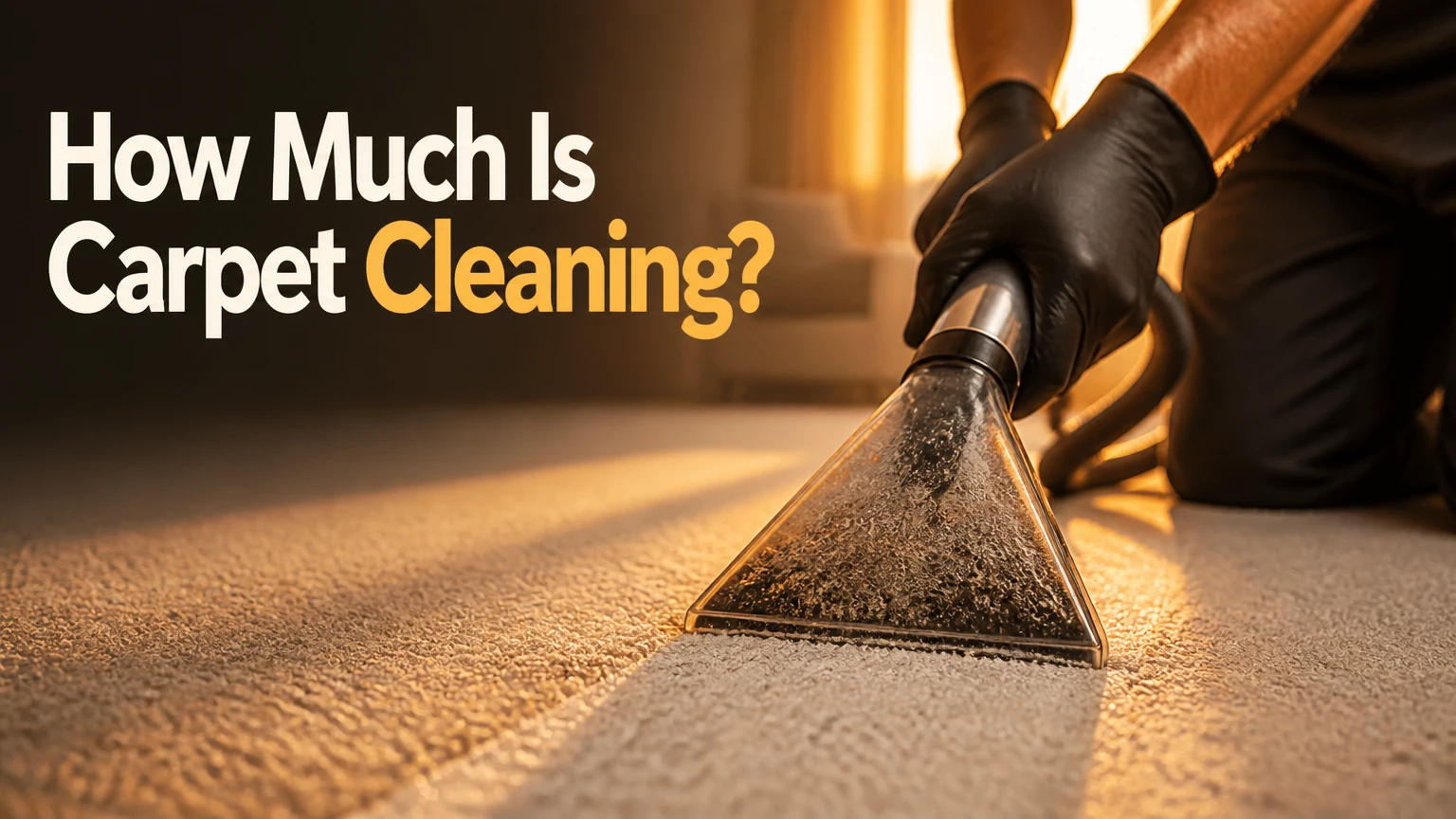
On average, professional carpet cleaning costs between $123 and $242, with the national average sitting around $183. Homeowners typically pay $0.20 to $0.50 per square foot or $40 to $90 per room. Final prices depend heavily on the cleaning method, carpet material, and localized stain treatments required. Anyone wondering exactly how much is carpet cleaning for their specific home must factor in their unique architectural layout and the level of soil accumulation.
At a Glance
- Standard hot water extraction ranges from $40 to $90 per room.
- Contractors charge an additional $3 to $6 per step for staircases.
- Most reputable service providers enforce a minimum dispatch fee between $75 and $125.
- Severe biohazard and pet odor restorations require flat rates reaching up to $2,000.
- Renting a DIY consumer unit costs under $80 but often leaves behind damaging moisture.
- Major manufacturers void abrasive wear warranties if carpets are not professionally cleaned every 18 to 24 months.
What factors determine standard professional rates?
Standard professional rates depend on the total floor area, the physical layout complexity, and the level of soil accumulation. Service providers use either a square-footage model or a per-room flat rate to generate their initial quotes. The chosen pricing structure allows technicians to estimate the chemical usage, equipment wear, and labor hours required to restore the textile flooring.
Companies evaluate the baseline condition of the home before locking in a price. A vacant living room with light surface dust requires significantly less labor than a heavily trafficked family room covered in crushed food particles and muddy footprints. Furthermore, the geographical location plays a massive role in standard pricing. Homeowners in coastal urban centers pay up to thirty percent more for identical services compared to residents in rural Midwestern towns. The type of dwelling also dictates the logistics of the job. Technicians must determine whether they can run hoses directly from a truck-mounted unit or if they need to manually carry heavy portable extractors up multiple flights of stairs.
How much does carpet washing cost per square foot?
Carpet washing costs between $0.20 and $0.90 per square foot depending on the service tier and soil severity. Lightly soiled residential rooms sit at the bottom of this range. Heavily stained commercial spaces or delicate textiles sit at the top. This granular pricing model benefits homeowners with unusually small rooms or highly customized open floor plans.
Contractors physically measure the cleanable area using a laser distance meter. They subtract the square footage occupied by heavy, immovable furniture like grand pianos or massive entertainment centers. This ensures the customer only pays for the exact surface area receiving treatment.
| Service Tier | Price Per Square Foot | Typical Application |
| Basic Tier | $0.20 – $0.35 | Lightly soiled, low-traffic residential areas. |
| Mid-Range Tier | $0.35 – $0.50 | Standard domestic living spaces requiring deep steam extraction. |
| Premium Tier | $0.50 – $0.90 | Delicate natural fibers, commercial properties, or heavy staining. |
What is the average price to clean carpets by the room?
Cleaning carpets by the room costs $40 to $125 for a single area, scaling up to $299 or more for an entire four-bedroom house. This flat-rate model assumes a standard room size capping out at 250 square feet. It provides a simple, predictable estimate for homeowners without requiring complex measurements.
Service companies clearly define what constitutes a single room in their terms of service. An L-shaped living and dining room combination usually counts as two distinct rooms. Hallways and large walk-in closets count as half-rooms or carry a separate flat fee. Customers benefit from this pricing structure when they have expansive master bedrooms that push right up against the 250-square-foot maximum limit. However, consumers with tiny bedrooms might overpay under this model. Companies almost always apply a hard limit to the dimensions to prevent massive open-concept basements from being priced as a single room.
How do different extraction methods affect the final bill?
Hot water extraction is the most common method and costs $40 to $90 per room, while dry chemical cleaning commands a higher premium of $70 to $200 per room. The specific equipment required, the cost of chemical agents, and the total labor time directly dictate these price variations.
Steam cleaning utilizes pressurized hot water to agitate and extract deep-seated dirt. It remains the industry standard for synthetic fibers. Dry cleaning relies on specialized chemical compounds and extreme physical agitation to absorb soil with minimal moisture. This method costs significantly more because the proprietary chemical solvents are expensive to manufacture and procure. Carpet shampooing costs $80 to $150 per room. It brightens surface fibers effectively but carries a high risk of leaving behind sticky, dirt-attracting residues. Finally, bonnet encapsulation costs $30 to $90 per room. This low-moisture technique focuses entirely on surface-level aesthetic improvement. Commercial offices favor encapsulation because it allows employees to walk on the floors almost immediately.
| Cleaning Method | Cost Per Room | Best Application | Average Drying Time |
| Bonnet / Encapsulation | $30 – $90 | Routine commercial office upkeep. | 1 – 2 hours |
| Steam Cleaning (Hot Water) | $40 – $90 | Deep cleaning standard residential homes. | 2 – 6 hours |
| Carpet Shampooing | $80 – $150 | Heavily soiled commercial textiles. | 6 – 12 hours |
| Dry Cleaning | $70 – $200 | Facilities requiring zero downtime or moisture. | Under 1 hour |
What extra charges should homeowners expect on their invoice?
Homeowners should expect extra charges for difficult architectural layouts, specialty fabrics, and targeted chemical stain removal. Standard base quotes only cover basic synthetic carpets experiencing normal daily wear. Any situation that forces the technician to deviate from standard operating procedures triggers a mandatory upcharge.
The final invoice follows a predictable mathematical formula. The technician takes the base room fee, adds any material premiums, calculates structural layout fees, and tacks on high-margin chemical add-ons. For instance, staircases require painstaking manual labor using specialized handheld upholstery tools. Because technicians must clean the tread, the nose, and the riser of each step individually, contractors charge $3 to $6 per step. Alternatively, they charge a flat $60 to $120 for an entire flight. Applying stain protectors like Scotchgard adds another $15 to $25 per room. Moving heavy furniture safely requires specialized teflon sliders and assumes liability for potential damages, adding $10 to $50 per room to the final bill.
How do specialized materials change the base estimate?
Delicate natural fibers like wool and cotton add $50 to $100 to the base room rate, bringing the total to $130 or $190 per room. These sensitive textiles require low-heat equipment and expensive pH-neutral detergents to prevent severe shrinkage or color bleeding. Standard synthetic pricing does not apply to organic materials.
Nylon and polyester represent the vast majority of modern household installations. Because these synthetic plastics withstand high heat and aggressive alkaline detergents, they fall under the standard $0.20 to $0.40 per square foot base rate. Berber weaves cost $95 to $120 per room. The dense, looped construction of Berber traps dirt aggressively at the base of the pile. Technicians must spend twice as much time performing slow, overlapping vacuum passes to successfully extract the soil. Failing to extract moisture properly from dense Berber loops leads to a phenomenon known as cellulosic browning, which ruins the appearance of the floor completely.
What is the standard fee for removing pet stains and odors?
Treating localized pet stains and odors costs $25 to $50 per affected area for specialized enzymatic treatment. Severe biological saturation that has breached the carpet padding requires full toxicological restoration, pushing costs from standard per-room rates to flat fees between $450 and $2,000.
Standard cleaning detergents simply mask pet odors temporarily with artificial fragrances. True odor removal requires technicians to inject living enzyme cultures directly into the carpet pile. These enzymes physically digest the uric acid crystals left behind by animal urine. If an animal has repeatedly soiled the exact same corner of a room, the urine penetrates the primary backing, saturates the polyurethane sponge padding, and seeps into the wooden subfloor. In these extreme biohazard scenarios, surface cleaning fails completely. Technicians must pull back the carpet, physically cut out and replace the contaminated padding, seal the wooden subfloor with an oil-based primer, and clean both the front and back of the textile face.
Why do companies enforce minimum call-out fees?
Service providers enforce a minimum call-out fee of $75 to $125 to cover the inescapable fixed costs of dispatching a fully equipped van and certified technicians to a property. Cleaning a tiny 50-square-foot hallway priced purely by the square foot would generate a massive financial loss for the operating business.
Every single job requires a baseline investment of time and capital. The company pays for the fuel to drive to the location. The technicians spend twenty minutes parking the truck, pulling heavy hoses, and setting up corner guards to protect the drywall. The truck-mounted generator burns gasoline for the entire duration of the appointment. A basic service call easily consumes an hour of labor before a single drop of water touches the floor. The minimum fee trap catches many homeowners off guard. They calculate their small bedroom at thirty cents per square foot and expect a fifteen-dollar invoice. Reputable firms transparently state their minimum dispatch requirements over the phone to prevent anger and confusion upon arrival.
How much does apartment carpet cleaning cost?
Apartment carpet cleaning costs fifteen to twenty-five percent more than a standard residential ground-floor service call. Technicians must manually transport heavy portable extraction machines up elevators, navigate tight common hallways, and deal with complex urban parking restrictions.
High-rise logistics fundamentally alter the cleaning process. Powerful truck-mounted steam units rely on vacuum hoses that cannot maintain adequate suction beyond the third or fourth floor of a building. When a client lives on the tenth floor, the company must utilize a portable extractor. These wheeled units plug directly into the apartment wall outlets, severely limiting their heating capacity and vacuum lift. Because portable units operate at lower pressures, the technician must work much slower to achieve a satisfactory result. Furthermore, the crew must constantly pause their work to dump dirty water down a toilet and refill the fresh water tank from a bathtub spout. This logistical friction doubles the labor time required to clean a standard two-bedroom unit.
Are cheap service vouchers a bait and switch scam?
Yes, aggressively priced online vouchers offering whole-house cleaning for under $100 are frequently bait and switch operations. These introductory promotional prices explicitly exclude mandatory chemical pre-treatments, basic spot removals, and the dual-process extraction required to actually clean the floor.
When the discount technician arrives at the home, they perform a walk-through and inform the homeowner that the voucher only covers a basic hot water rinse. They explain that a plain water rinse will not remove the visible dirt paths in the hallways. The technician then aggressively upsells the customer on the necessary alkaline pre-sprays, agitation tools, and deodorizers. By the time the final invoice is written, the upcharges tacked on at the door routinely bring the total cost back up to the standard market rate of $200 or more. According to the 2024 Angi pricing report, consumers who purchase heavily discounted online coupons end up paying the exact same national average as those who book reputable firms directly.
What exactly is included in a standard service package?
A standard service package includes a visual pre-inspection, light furniture moving, alkaline pre-spray application, hot water extraction, and final fiber grooming. It explicitly excludes deep chemical stain removal, specialized pet odor treatment, and the application of aftermarket liquid protectants.
The pre-inspection allows the technician to identify permanent damage and set realistic expectations with the homeowner. Moving light furniture (like dining chairs and small side tables) gives the crew access to the majority of the floor space. The technician then applies a heated chemical pre-spray to break down the oily binders holding dirt to the fibers. After allowing the chemistry to dwell for ten minutes, they use the extraction wand to blast the pile with hot water and simultaneously vacuum away the suspended soil. Finally, the technician uses a carpet rake to lift the crushed fibers, ensuring the floor dries evenly and looks uniform. Anything beyond these core steps triggers an itemized add-on fee.
Is renting a DIY machine cheaper than hiring a pro?
Renting a DIY machine costs $30 to $45 per day plus $15 to $25 for concentrated chemical detergents, making it significantly cheaper upfront than hiring a professional. However, these consumer-grade rental units lack the extreme mechanical vacuum suction of commercial truck-mounted systems, creating massive hidden risks.
A standard DIY clean costs under $80 total. Consumers often view this as a massive financial victory. Unfortunately, consumer rental machines operate on standard 15-amp household circuits. They cannot generate the heat required to activate modern detergents, nor can they generate the vacuum lift necessary to recover the water they inject into the floor. This critical shortfall often leaves behind completely saturated padding. According to the Institute of Inspection, Cleaning and Restoration Certification (IICRC) guidelines, carpets must dry rapidly to prevent microbial growth. Furthermore, DIY users frequently overdose the chemical tanks. This leaves a sticky, soapy residue on the fibers that actually attracts new dirt, causing the carpet to look worse three weeks after the initial cleaning.
How long does a professionally washed carpet take to dry?
A professionally washed carpet takes between two and six hours to dry completely under normal household conditions. High ambient humidity, inadequate interior ventilation, or heavily soiled carpets requiring multiple extraction passes can stretch this drying window to a full 24 hours.
The extraction equipment determines the baseline moisture level left behind. A modern truck-mounted system recovers up to ninety percent of the water it puts down. Once the technicians leave, environmental factors dictate the evaporation rate. Homeowners can actively speed up the drying process by manipulating their climate control systems. Running the HVAC system at a constant 70 degrees Fahrenheit (21 degrees Celsius) pulls moisture out of the indoor air. Turning on overhead ceiling fans forces dry air down into the damp fibers. Customers who need their rooms operational immediately can pay an extra $5 to $10 per room for the cleaning company to deploy high-velocity commercial air movers during the service appointment.
Can a professional contractor remove every permanent blemish?
No, a professional contractor cannot remove every permanent blemish from textile flooring. Standard hot water extraction lifts surface grease, suspended mud, and deep-set particulate dirt. Chemical spills like hair dye, household bleach, or older pet urine physically alter the dye structure of the fibers themselves.
Dirt sits on the outside of the fiber. Stains penetrate the fiber and change its chemical composition. When a homeowner spills bleach on a brown carpet, the chemical strips the color away entirely. No amount of steam cleaning will wash color back into a bleached spot. Removing these permanent alterations requires advanced aesthetic repair techniques. Certified technicians can perform specialized spot-dyeing to inject matching color back into bleached areas. Alternatively, they can perform a section patch (often called a bonded insert) by cutting out the damaged square and gluing a donor piece of carpet from a closet into the hole. These physical repairs typically run $10 to $20 per specific spot.
What happens if carpet padding gets wet during maintenance?
If carpet padding becomes oversaturated during maintenance, it traps moisture against the wooden or concrete subfloor and creates an ideal, dark breeding ground for dangerous mold. The trapped moisture also triggers a frustrating secondary problem known as rapid soil wicking.
Polyurethane foam padding acts exactly like a giant sponge beneath the decorative surface layer. Once water penetrates the primary backing of the carpet, the padding absorbs it instantly. Because the padding receives absolutely zero airflow, it can stay wet for days. As that deep moisture slowly evaporates upward into the dry air of the room, it carries deep-seated dirt and old urine crystals up the fiber shafts. Homeowners often wake up two days after a cleaning to find massive brown spots appearing on floors that looked perfect when the technicians left. This wicking effect proves exactly why extreme mechanical vacuum suction remains the most important variable in successful textile restoration.
How often should you pay for professional extraction?
You should pay for professional extraction every 12 to 18 months for normal residential foot traffic. Homes with indoor pets, multiple active children, or family members suffering from severe respiratory allergies require professional extraction every six to nine months to maintain indoor air quality.
Carpet functions as the largest passive air filter in a home. It traps airborne dust, pet dander, and volatile organic compounds as they settle out of the atmosphere. Once the fibers fill up with particulate matter, simply walking across the room kicks those allergens back into the breathing zone. Regular vacuuming removes dry topsoil, but it cannot remove the sticky, oily soils bound to the fibers by cooking grease and atmospheric pollution. Mark Henderson, a certified master textile cleaner, notes: “Consumers often wait until their floors look visibly black before calling a professional. By the time soil becomes visible to the naked eye, the abrasive dirt particles have already scratched the plastic fibers and permanently destroyed the light-reflecting properties of the yarn.”
Does skipping routine maintenance void your manufacturer warranty?
Yes, skipping routine professional maintenance will permanently void the manufacturer warranty on almost all new carpet installations. Major industry manufacturers require documented proof of professional hot water extraction every 18 to 24 months to keep their abrasive wear and texture retention warranties active.
Consumers frequently misunderstand the terms of their flooring warranties. They assume a ten-year wear warranty guarantees the product will look perfectly new for a decade regardless of how they treat it. In reality, the fine print contains strict maintenance clauses. If a homeowner files a claim for premature matting or fiber crushing in year four, the manufacturer will immediately request copies of all professional cleaning invoices. If the homeowner cannot produce receipts proving they hired a certified firm using truck-mounted hot water extraction, the claim faces instant denial. Renting a grocery store DIY machine absolutely does not satisfy this contractual warranty requirement.
The Bottom Line
Understanding exactly how much is carpet cleaning requires looking past the heavily advertised base rates and calculating the inevitable upcharges for your specific home. Expect to pay a national average of $183, with final invoices directly dictated by square footage, staircases, specialized materials like wool, and mandatory biological stain treatments. While renting a $40 DIY machine seems like a brilliant financial shortcut, the massive risk of leaving behind soapy residue and mold-inducing moisture makes it a poor long-term decision. Protect your flooring investment by hiring reputable professionals who use truck-mounted hot water extraction, avoiding the bait-and-switch minimum fee traps entirely.