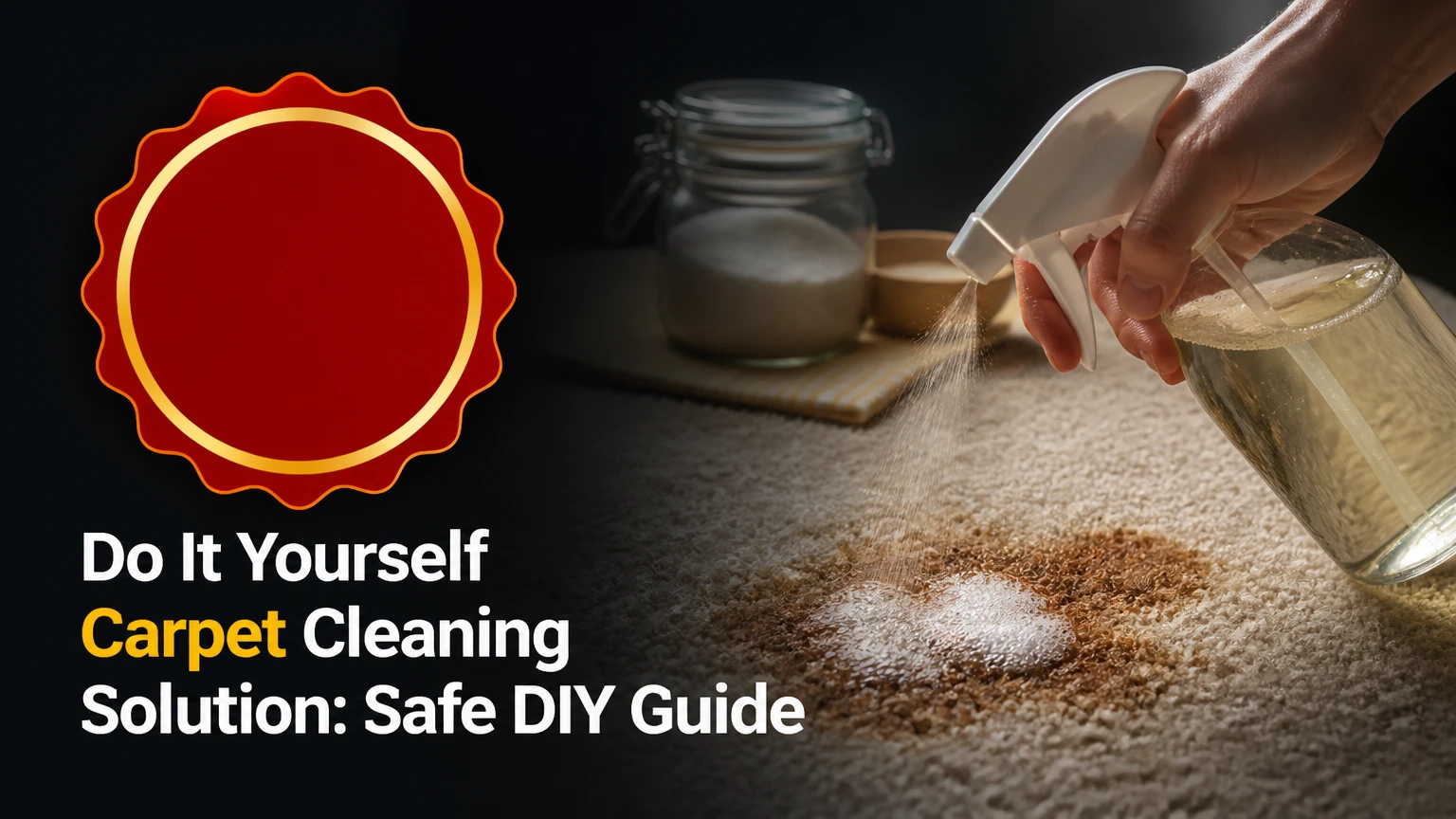
A do it yourself carpet cleaning solution is usually a diluted mixture of water with a carefully measured surfactant, vinegar, or hydrogen peroxide, selected for the stain and carpet fiber. The safest method is to vacuum first, test a hidden area, apply minimal liquid, blot rather than scrub, rinse residue, and dry the carpet completely.
Key Facts at a Glance
- Clear dish soap diluted to about 1/4 teaspoon per cup of water lifts fresh grease, but excess soap leaves sticky residue.
- White vinegar diluted with three parts water can refresh some synthetic carpets, but vinegar does not replace an enzyme cleaner for urine contamination.
- Baking soda and vinegar should not be treated as a superior combined cleaner because their acid-base reaction largely neutralizes both ingredients.
- Three-percent hydrogen peroxide can lighten organic stains on some light synthetic carpets, but it may permanently alter dark dyes, wool, silk, and plant fibers.
- Typical spot cleaning takes 10-20 minutes, while carpet drying usually takes 4-12 hours depending on moisture, airflow, humidity, and carpet padding.
- The most important safety factor is moisture control: saturated carpet can damage backing, tack strips, subflooring, and indoor air quality.
What Is a Homemade Carpet Cleaning Solution?
A homemade carpet cleaning solution is a small-batch mixture made from household ingredients to loosen soil, dissolve grease, reduce odors, or oxidize certain colored stains. The mixture is not automatically safer than a commercial product, because concentration, carpet fiber, dye stability, and drying conditions determine the result.
Carpet cleaning has three separate goals: removing dry soil, dissolving oily material, and extracting dissolved contamination. Vacuuming handles much of the first goal. A liquid formula handles the second, while blotting or extraction must accomplish the third.
The Carpet and Rug Institute recommends frequent soil removal because abrasive particles can damage carpet fibers during foot traffic. Its consumer guidance states, “The most important thing you can do to keep your carpet clean is vacuum regularly.” That principle matters more than adding extra ingredients to a spray bottle.
Which formula should you use?
Use diluted dish soap for fresh oily spots, diluted vinegar for limited synthetic-carpet refreshing, and three-percent hydrogen peroxide only for suitable light-colored synthetic fibers. Use an enzyme-based pet-odor product for urine that has reached the backing or pad, because household acids and bases cannot reliably digest the full protein residue.
| Problem | Preferred DIY or household approach | Typical concentration | Main limitation |
|---|---|---|---|
| Fresh grease | Clear dish soap and water | 1/4 teaspoon per 1 cup | Residue if overdosed |
| General synthetic soil | White vinegar and water | 1 part vinegar to 3 parts water | Limited deep-soil removal |
| Blood or berry stain | 3% hydrogen peroxide, spot tested | Use as supplied, or 1/2 cup with 1 teaspoon soap | Can lighten dyes |
| Pet urine odor | Enzyme cleaner, not a kitchen mixture | Follow product label | Requires contact time and saturation control |
| Dry odor on surface | Baking soda, vacuumed later | Thin dry layer | Does not remove embedded contamination |
How Does DIY Carpet Cleaning Work?
DIY carpet cleaning works through surfactant action, dilution, mechanical absorption, and, in limited cases, oxidation. Surfactants surround oily particles so water and towels can carry them away; vinegar changes pH; hydrogen peroxide breaks down some colored organic compounds.
A formula cannot remove contamination that remains below the carpet surface unless liquid reaches it and a towel or extractor removes the resulting solution. That is why repeated spraying often makes a stain larger without removing its source.
Surfactants lift oily soil
Dish detergent contains surfactants that reduce water’s surface tension and interact with hydrophobic grease. The detergent does not make grease disappear. It suspends the grease so clean water and absorbent towels can remove it.
Use the smallest effective dose. A carpet can feel clean immediately after excessive soap application, then become crunchy or rapidly resoil after the residue dries.
Vinegar changes pH, but does not sterilize carpet
White vinegar contains acetic acid, which can help dissolve some alkaline mineral deposits and alter odor compounds. Diluted vinegar may reduce a temporary smell on colorfast synthetic carpet, but claims that vinegar reliably “kills all bacteria” or substitutes for professional disinfection are unsupported.
Never mix vinegar with chlorine bleach, ammonia, or other unknown cleaners. Chemical reactions can produce irritating or dangerous vapors.
Why baking soda and vinegar are often misunderstood
Baking soda is sodium bicarbonate, while vinegar is acidic acetic acid. When combined, they fizz because carbon dioxide forms, but that visible bubbling does not mean the mixture has greater cleaning power. Much of the acid and base become water, carbon dioxide, and acetate salt.
Use baking soda dry for a light surface odor treatment, then vacuum it thoroughly. Use diluted vinegar separately when appropriate. Do not pour a wet baking soda and vinegar mixture into carpet padding, where the added moisture can worsen wicking and drying problems.
Hydrogen peroxide oxidizes some stains
Three-percent hydrogen peroxide can oxidize chromophores in blood, juice, wine, and berry stains. Oxidation can also alter carpet dye, so peroxide belongs only on a tested, compatible surface.
Hydrogen peroxide decomposes with light, heat, and contamination. Store it in its original opaque container, and never mix it with chlorine bleach, vinegar, or ammonia.
Which DIY Carpet Cleaning Formula Fits the Stain?
The best formula depends on the stain’s chemistry, carpet fiber, age, and depth. Fresh grease needs a low-residue surfactant, while urine needs biological treatment and deep extraction rather than a scented acid spray.
| Formula | Exact mixture | Suitable surfaces | Contact time |
|---|---|---|---|
| Mild detergent spray | 1/4 tsp clear dish soap in 1 cup warm water | Colorfast nylon and polyester | 2-5 minutes |
| Vinegar rinse | 1/4 cup white vinegar in 3/4 cup water | Tested synthetic carpet | 2-3 minutes |
| Peroxide spotter | 3% peroxide, optionally with 1 tsp clear soap per 1/2 cup | Light nylon or polyester | 1-5 minutes |
| Baking soda deodorizer | Dry baking soda, thinly scattered | Dry synthetic carpet surface | 15-60 minutes |
| Plain-water rinse | Cool or lukewarm water | Most water-cleanable carpets | Blot immediately |
How do you remove grease and oily food?
Blot the grease with white towels, apply diluted clear dish soap, wait two minutes, and blot from the outer edge toward the center. Follow with a light mist of clean water and blot again until the towel no longer picks up a slippery film.
Do not rub butter, cooking oil, makeup, or lotion deeper into the pile. For a large oil spill, place absorbent paper over the area first and remove solids with a spoon before applying any liquid.
How do you remove blood, wine, or berry stains?
Use cool water first, because hot water can set protein-based blood stains. Blot, then apply a small amount of three-percent hydrogen peroxide to a white cloth rather than flooding the carpet; transfer the solution to the stain and watch for dye change.
Peroxide is most appropriate for light, colorfast nylon or polyester. Avoid it on dark carpet, wool, silk, cotton-backed rugs, and any surface that fails the hidden-area test. Remove residual peroxide with a water-dampened cloth.
How should you treat pet urine?
Pet urine requires absorption, odor-compound removal, and often biological breakdown in the backing or pad. Blot fresh liquid immediately, apply an enzyme cleaner according to its label, maintain the required dwell time, and extract or blot without leaving the area saturated.
Baking soda and vinegar can reduce a surface smell temporarily, but neither reliably removes urine crystals below the pile. Ammonia-based products are a poor choice because ammonia-like odors can encourage repeat marking and may irritate people or animals.
Is Vinegar Safe for Every Carpet?
Vinegar is not safe for every carpet. Diluted white vinegar is generally less risky on tested, colorfast synthetic carpet than on wool, silk, jute, sisal, viscose, cotton, or carpets with unstable dyes, but manufacturer care instructions control the decision.
Natural protein fibers such as wool can be damaged by unsuitable pH, excess moisture, heat, and agitation. Plant-based fibers can develop water marks or shrinkage. Viscose and rayon rugs are especially prone to texture change and browning after wet cleaning.
Before using any homemade formula, identify the fiber from the carpet label, purchase documentation, or manufacturer. If the fiber is unknown and the rug is valuable, use a professional rug cleaner instead of experimenting.
How Do You Deep-Clean Carpet With a Homemade Solution?
Deep cleaning requires dry soil removal, controlled application, agitation, extraction, and rapid drying. A household spray can loosen surface contamination, but a carpet extractor is needed to remove significant dissolved soil from a full room.
Before you start
| Requirement | Typical specification |
|---|---|
| Working time | 45-90 minutes for a 10-by-12-foot room |
| Drying time | 4-8 hours with strong airflow |
| Basic cost | $2-$10 for household ingredients |
| Equipment | Vacuum, white towels, spray bottle, soft brush, fans |
| Machine cleaning | Extractor with clean-water tank and upholstery-safe formula |
| Prerequisite | Fiber identification and hidden-area color test |
Step 1: Vacuum thoroughly
Vacuum slowly in two directions, concentrating on entrances, hallways, and furniture edges. Remove visible grit before adding water because wet grit becomes harder to extract and can abrade fibers during agitation.
Success checkpoint: the vacuum collects little loose debris after a second pass.
Common mistake: skipping vacuuming because the carpet looks only stained.
Step 2: Test the formula
Mix a fresh, small batch and apply one teaspoon to a hidden corner. Press a white cloth over the area after two minutes, then inspect the cloth and carpet for dye transfer, yellowing, texture change, or sticky residue.
Success checkpoint: no color transfers and the dried test area feels normal.
Common mistake: testing only while the carpet is wet.
Step 3: Apply a light mist
Spray enough solution to dampen the pile without wetting the backing. For a spot approximately four inches wide, begin with one or two teaspoons rather than a full spray-bottle coating.
Success checkpoint: the stain darkens slightly but no liquid pools around it.
Common mistake: saturating the carpet because the stain appears deep.
Step 4: Agitate gently
Use a soft nylon brush or folded microfiber cloth, working from the stain perimeter toward the center. Limit brushing to 10-20 seconds, particularly on cut pile, loop pile, and textured carpet.
Success checkpoint: soil transfers to the cloth or loosens visibly.
Common mistake: scrubbing until the pile becomes fuzzy.
Step 5: Blot and extract
Press clean white towels straight down, replace them as they become damp, and continue until little moisture transfers. With an extractor, make one slow wet pass followed by two or three slower dry passes.
Success checkpoint: the carpet feels damp, not wet, and the towel shows decreasing soil.
Common mistake: dragging a wet towel sideways across the stain.
Step 6: Rinse detergent residue
Mist a small amount of clean water over detergent-treated areas, then blot or extract again. Rinsing is particularly important after dish soap because surfactant residue attracts soil when it remains on the fiber.
Success checkpoint: the dried pile does not feel slick or crunchy.
Common mistake: adding vinegar to “neutralize” an unknown cleaner.
Step 7: Dry the carpet completely
Raise furniture legs with foil or waterproof blocks, aim fans across the carpet, and keep indoor humidity controlled. Avoid walking on the area until dry, because traffic can flatten damp pile and redistribute soil.
Success checkpoint: the backing and pad no longer feel cool or damp after several hours.
Common mistake: closing windows and turning off fans as soon as the surface appears dry.
Can You Put Homemade Cleaner in a Carpet Machine?
A homemade cleaner should not automatically go into a carpet extractor. Many machines require low-foaming chemistry, and dish soap can create foam that reduces suction, leaves residue, or damages pumps and seals.
Check the machine manual before adding vinegar, detergent, peroxide, or any non-approved mixture. Some rental companies require their own formula, and using an unapproved solution can create equipment or deposit problems.
For a machine, plain warm water is the lowest-residue household option when the carpet manufacturer permits water extraction. If detergent is necessary, a product labeled for the specific extractor is usually more predictable than kitchen soap.
DIY Versus Commercial Carpet Cleaner
DIY mixtures cost less and can handle small, fresh spots, but commercial carpet formulas offer controlled pH, low-foam performance, detergency, and compatibility testing. Professional hot-water extraction becomes more valuable when contamination reaches the pad or when a room has widespread soil.
| Decision factor | Homemade mixture | Commercial carpet formula | Professional service |
|---|---|---|---|
| Typical spot cost | $0.05-$0.50 | $0.50-$3.00 | $75-$250 minimum |
| Formula consistency | Kitchen-measured | Manufactured batch | Technician-controlled |
| Machine compatibility | Uncertain | Label-specific | Equipment-specific |
| Drying range | 4-12 hours | 4-12 hours | 4-24 hours |
| Best application | Fresh small stains | Room extraction | Deep soil or urine pad damage |
| Main risk | Residue or color damage | Wrong product selection | Higher upfront price |
The Institute of Inspection Cleaning and Restoration Certification publishes S100 standards for professional carpet cleaning practices, including procedures related to fiber identification, pretesting, cleaning, and drying. A household recipe does not provide the same procedural controls.
What Mistakes Damage Carpet?
The most damaging mistakes are excess moisture, excessive detergent, heat on protein stains, aggressive brushing, and using an incompatible oxidizer. Carpet damage often appears after drying, so a result that looks successful at minute five may still fail later.
- Flooding the carpet: Moisture can reach tack strips, wood subfloors, and padding. Use smaller applications and repeated extraction.
- Using too much dish soap: Residue creates crunchy fibers and rapid resoiling. Rinse with clean water and blot.
- Scrubbing loops: A stiff brush can pull loops or fuzz cut pile. Use a soft cloth and short agitation.
- Applying peroxide without a dye test: Peroxide can create a pale spot that cannot be reversed. Test first.
- Using hot water on blood: Heat can set protein residues. Start with cool water.
- Layering incompatible chemicals: Never mix bleach, ammonia, vinegar, peroxide, or unknown commercial products.
Expert insight: odor usually signals moisture, not weak fragrance
A vinegar smell commonly fades as diluted acetic acid and carpet moisture evaporate. If odor remains after the carpet should be dry, inspect the pad, backing, subfloor, or a hidden spill instead of adding fragrance.
Expert insight: stain reappearance indicates wicking
A stain that returns after drying often contains dissolved soil below the pile. As moisture rises through the fiber, it carries that soil upward. Re-treating the surface alone can repeat the cycle.
Expert insight: less chemical often produces a cleaner carpet
Carpet cleaning is an extraction task, not a fragrance task. More detergent increases the amount that must be rinsed away, while controlled moisture and slow dry passes improve soil removal with fewer residues.
How Do You Fix Common Cleaning Failures?
Most DIY carpet failures can be corrected by identifying whether the problem is residue, wicking, dye transfer, or incomplete drying. Stop adding chemicals until the carpet is identified and the existing product has been removed.
| Symptom | Likely cause | Corrective action | Escalation point |
|---|---|---|---|
| Crunchy fibers | Dried detergent | Rinse lightly, blot, dry | Texture remains after two rinses |
| Stain returns | Wicking from pad | Re-treat lightly, towel-weight overnight | Urine or large spill below pile |
| Vinegar odor | Residual moisture | Increase airflow for 12-24 hours | Odor remains after full drying |
| Pale patch | Peroxide or dye loss | Do not reapply chemicals | Color restoration professional |
| Brown edge | Overwetting or browning | Dry quickly, avoid more water | Natural-fiber rug or spreading mark |
| Sticky feel | Soap residue | Clean-water rinse and extraction | Repeated resoiling |
For wicking, place several dry white towels over the area and add a flat, washable weight for several hours. Replace damp towels, then dry the carpet with airflow. Do not use a colored book, newspaper, or dyed textile as the weight.
Which Alternatives Are Safer for Special Situations?
Plain water, an approved low-foam formula, or professional treatment can be safer than a homemade chemical mixture when the carpet is valuable, the fiber is uncertain, or the spill is extensive. Household ingredients are not automatically non-toxic, hypoallergenic, or environmentally harmless.
- Homes with crawling infants: Remove all residue with clean-water rinsing and keep children away until the carpet is fully dry.
- Homes with pets: Use an enzyme product for urine and feces; block access during treatment and drying.
- Dark carpet: Prefer detergent and water after testing; avoid peroxide unless the manufacturer approves it.
- Wool or antique rugs: Avoid vinegar, peroxide, prolonged wetting, and vigorous brushing; consult a rug specialist.
- Large water spills: Extract promptly and use dehumidification, especially when padding is wet.
- Unknown chemical spills: Do not neutralize them with vinegar or baking soda; follow the substance’s safety guidance.
How Much Does DIY Carpet Cleaning Cost and How Long Does It Take?
A small spot treatment typically costs $0.05-$1.50 and takes 10-20 minutes, while a full room using rented extraction equipment commonly costs $30-$80 before optional cleaning products. Drying usually takes 4-8 hours for a lightly damp spot and up to 12-24 hours when padding receives substantial moisture.
| Job size | Ingredient cost | Active work | Typical drying |
|---|---|---|---|
| 4-inch spot | $0.05-$0.25 | 10-15 minutes | 2-4 hours |
| 3-by-3-foot area | $0.25-$1.50 | 15-30 minutes | 4-8 hours |
| 10-by-12-foot room | $2-$10 | 45-90 minutes | 6-12 hours |
| Two-room extraction | $5-$15 plus machine rental | 90-180 minutes | 8-24 hours |
Humidity, carpet density, pad thickness, ventilation, and the volume of rinse water determine drying time. A fan aimed across the surface generally helps more than a fan pointed straight down, because horizontal airflow accelerates evaporation across a wider area.
FAQ
Can I use laundry detergent to clean carpet?
Laundry detergent is usually a poor carpet choice because it may contain builders, brighteners, fragrances, or foam-producing ingredients that are difficult to rinse. Use a carpet-labeled formula in an extractor, or use a tiny amount of clear dish soap for a tested spot treatment.
Is steam cleaning better than a homemade solution?
Steam or hot-water extraction is better for widespread embedded soil when the carpet and equipment support it, because extraction removes suspended soil from deeper fibers. A homemade spray is more efficient for a fresh, small stain that does not justify full-room cleaning.
Can I clean carpet with only baking soda?
Baking soda can absorb limited surface moisture and reduce some odors after vacuuming, but it cannot dissolve grease or remove contamination in carpet padding. Apply a thin dry layer, allow 15-60 minutes, and vacuum repeatedly until no powder remains.
Why does my carpet smell worse after cleaning?
A stronger odor after cleaning usually indicates trapped moisture, disturbed pet contamination, or residue below the pile. Increase airflow, avoid adding fragrance, and inspect the pad if the smell continues after the carpet and backing have fully dried.
Can I use rubbing alcohol on carpet stains?
Rubbing alcohol can affect dyes, backing adhesives, and synthetic fibers, so it should not be a default carpet cleaner. For ink or adhesive, test a small hidden area and use a white cloth with controlled transfers, or consult the carpet manufacturer.
When should I hire a professional carpet cleaner?
Hire a professional when urine reaches the pad, flooding affects the subfloor, dye has transferred, a valuable wool rug is involved, or repeated DIY treatments fail. Professional equipment and fiber-specific procedures reduce the risk of spreading contamination or causing permanent texture and color damage.
The Bottom Line
The best do it yourself carpet cleaning solution is the least concentrated formula that matches the stain and survives a hidden-area test. Use diluted clear dish soap for grease, cautious vinegar dilution for suitable synthetic carpet, and three-percent hydrogen peroxide only for compatible light fibers. Vacuum first, apply minimal moisture, rinse detergent, extract thoroughly, and dry the carpet completely.