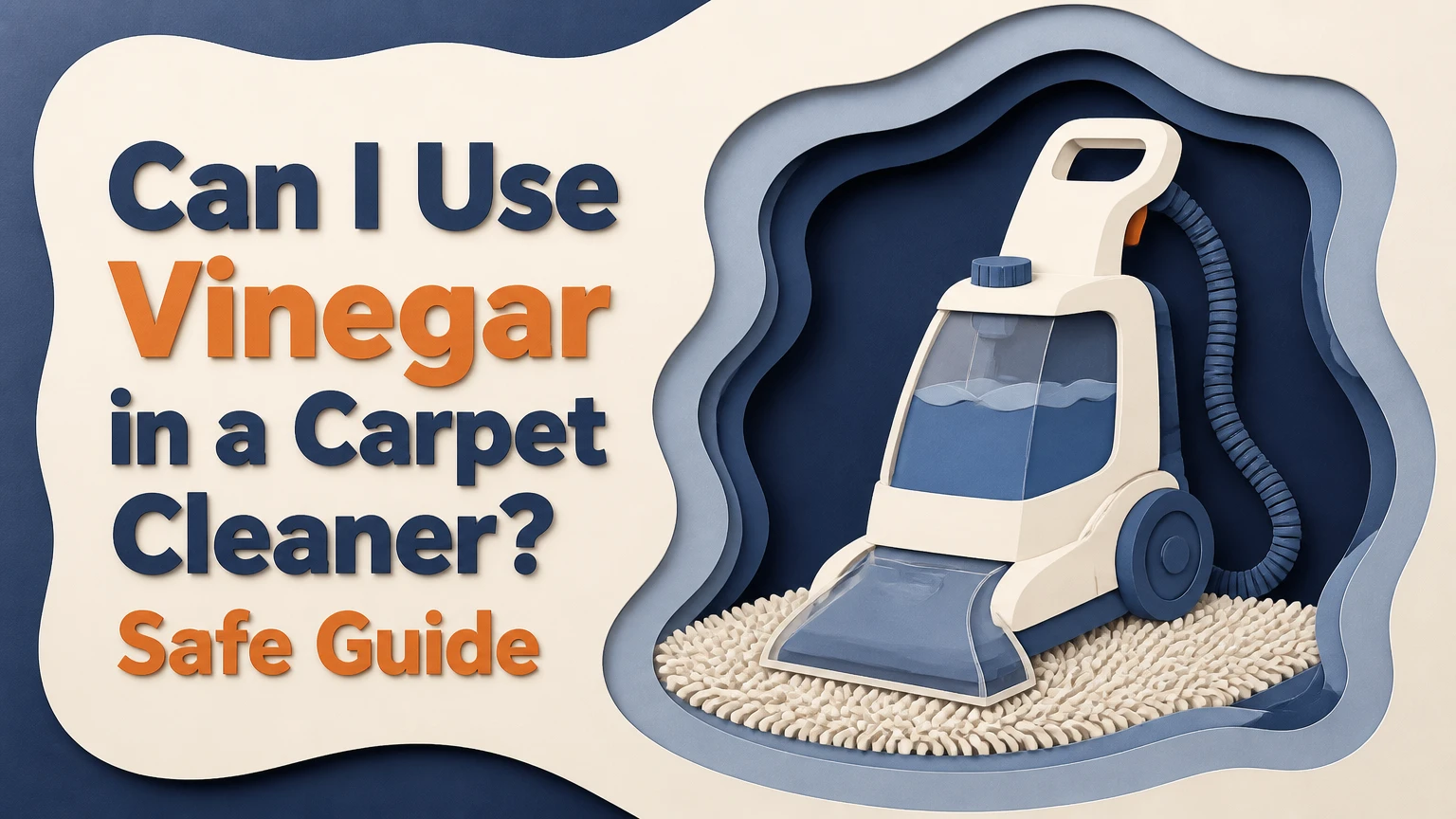
Yes, you can use diluted white distilled vinegar for some carpet spot treatments, but you should not automatically pour vinegar into a carpet-cleaning machine. Check the machine manual and carpet warranty first, because acidic vinegar can damage certain fibers, dyes, backings, seals, or pumps, while some manufacturers require approved low-foaming detergent.
Key Facts at a Glance
- White distilled vinegar commonly contains about 5% acetic acid, so undiluted vinegar is too strong for many carpet applications.
- A 1:4 vinegar-to-water ratio is a cautious starting point for a synthetic-fiber spot test; a 1:1 mixture is more aggressive.
- Carpet machines need low-foaming solutions. Household vinegar may void a warranty or contribute to equipment problems.
- Vinegar does not reliably remove pet-urine crystals, oily stains, or deeply embedded soil; enzyme products or extraction are usually better.
- Never use vinegar on wool, silk, sisal, jute, or valuable dyed rugs without written care guidance or a professional assessment.
- Carpet should dry completely, typically within 6-24 hours after damp cleaning, before furniture returns to the area.
Can I use vinegar in a carpet cleaner?
You can use vinegar in limited circumstances, but white vinegar is not a universal substitute for carpet-cleaning detergent. The safest general use is a small, diluted spot treatment on colorfast synthetic carpet after a hidden-area test. Machine use requires a separate decision because the solution must be compatible with the appliance, carpet backing, and manufacturer warranty.
Many carpet-cleaner manuals specify formulated detergent because it controls foam, pH, soil suspension, fragrance, and extraction behavior. Bissell, Hoover, and Rug Doctor products do not all share the same fluid requirements, so a recipe suitable for one model is not automatically suitable for another. The owner’s manual outranks an internet formula.
Vinegar is inexpensive and may reduce some acidic or alkaline odor compounds, but “natural” does not mean risk-free. Vinegar can alter unstable dyes, affect latex or adhesive components, and leave moisture in the pad when users apply too much liquid.
How does vinegar work on carpet?
Vinegar’s acetic acid can loosen some alkaline mineral deposits and alter odor chemistry, but vinegar does not chemically dissolve every carpet stain. The result depends on the contaminant, fiber, dye stability, temperature, contact time, and how thoroughly the liquid is extracted.
A 5% white vinegar solution has a pH commonly near 2-3, although the exact value varies by product. That acidity can help with residues from alkaline products, some hard-water deposits, and certain food soils. It is less useful against hydrophobic grease, wax, tar, paint, and old pigment that has bonded to the fiber.
Vinegar also does not sterilize carpet in the way a registered disinfectant used according to its label can. Michigan State University Extension describes vinegar as useful for some household cleaning tasks, but household vinegar should not be treated as a tested carpet disinfectant. Odor reduction is not the same as pathogen removal.
What does vinegar remove well?
Vinegar is most reasonable for small, recent spills involving water-soluble residue, mild musty odor, or alkaline cleaning-product buildup. Vinegar is not a reliable first choice for every stain category.
| Carpet problem | Vinegar suitability | Better method | Typical treatment time |
|---|---|---|---|
| Light coffee residue | Moderate | Blot, diluted detergent, rinse extraction | 10-20 minutes |
| Water-ring mineral residue | Moderate to high | Diluted vinegar spot test | 5-10 minutes |
| Grease or cooking oil | Low | Solvent-safe carpet product | 15-30 minutes |
| Fresh mud | Low before drying | Dry vacuum, then detergent rinse | 30-60 minutes |
| Pet urine crystals | Low | Enzyme treatment and extraction | 8-24 hours |
| Candle wax | Very low | Harden, scrape, absorb with controlled heat | 20-40 minutes |
| Latex paint | Low after curing | Manufacturer-approved paint remover | 30-90 minutes |
| General surface soil | Moderate | Low-foam carpet detergent and extraction | 1-3 hours |
Is vinegar safe for every carpet fiber?
Vinegar is not safe for every carpet fiber, dye, or backing. Synthetic nylon, polyester, and polypropylene may tolerate a carefully diluted spot treatment, while wool, silk, plant fibers, and valuable rugs need fiber-specific care.
Carpet fiber is only one part of the risk. A solution can affect the dye, secondary backing, latex adhesive, seam, underlay, or floor beneath the carpet. A hidden test reduces uncertainty but cannot guarantee that a large wet application will behave identically.
| Carpet or rug material | Vinegar recommendation | Main risk | Safer decision |
|---|---|---|---|
| Nylon | Diluted spot test only | Color change or residue | Use labeled carpet detergent |
| Polyester | Diluted spot test only | Oil retention and color transfer | Use synthetic-carpet product |
| Polypropylene | Usually tolerant of mild products | Backing moisture and wicking | Use low-moisture extraction |
| Wool | Avoid without professional guidance | Fiber damage, dye bleeding, felting | Use WoolSafe-approved care |
| Silk | Do not use at home | Permanent dye and fiber damage | Professional rug cleaner |
| Sisal or jute | Avoid liquid vinegar | Browning, shrinkage, distortion | Dry methods or specialist care |
| Oriental or antique rug | Avoid unapproved acid | Unstable dyes and foundation damage | Rug specialist inspection |
The Carpet and Rug Institute’s Spot Solver guidance emphasizes identifying the carpet type and testing a cleaning solution in an inconspicuous location before treating a visible area. That principle matters more than any universal vinegar ratio.
How should you patch-test vinegar?
Vacuum loose soil, mix the intended solution, and apply two or three drops to a hidden edge or inside corner. Cover the test area with a white cloth, press for 30 seconds, then inspect the cloth and fibers immediately and again after complete drying.
Stop if the white cloth picks up dye, the pile changes texture, the backing becomes tacky, or a ring forms. A test that passes with a 1:4 mixture does not authorize a stronger 1:1 mixture or whole-room cleaning.
Can you put vinegar in a carpet-cleaning machine?
You should put vinegar in a carpet-cleaning machine only when the machine manufacturer and carpet-care instructions permit it. A homemade vinegar mixture may foam unpredictably, lack soil-suspending agents, alter seals or adhesives, and create a warranty dispute even when the carpet appears undamaged.
Before filling the tank, check four documents or labels:
- Machine manual: Look for approved formulas, low-foam requirements, and warnings against household chemicals.
- Carpet warranty: Some warranties require a specific pH range or professional hot-water extraction.
- Carpet fiber label: Confirm whether the material is nylon, polyester, polypropylene, wool, or another fiber.
- Rental agreement: Rental companies may prohibit non-approved fluids or charge for pump damage.
If all instructions allow vinegar, use a weak solution rather than assuming the common “one cup per gallon” recipe is safe. One cup of 5% vinegar in one US gallon of water produces roughly 0.3% acetic acid before accounting for the machine’s other water and recovery conditions. That is still an acidic solution, not plain water.
| Machine use case | Suggested fluid decision | Typical quantity | Operating condition |
|---|---|---|---|
| Manufacturer-approved vinegar use | Follow manual exactly | Often 1-4 fl oz per gallon | Low-foam requirement |
| Unknown home machine | Do not add vinegar | 0 fl oz | Use approved detergent |
| Rental machine with no vinegar permission | Do not add vinegar | 0 fl oz | Use rental-supplied formula |
| Small synthetic spot extractor | Use only if manual permits | 1:4 test solution | One slow extraction pass |
| Wool or rug-cleaning machine | Avoid household vinegar | 0 fl oz | Use fiber-approved product |
The machine’s recovery tank should collect visibly dirty water after each pass. If foam rises, stop immediately, empty the tank, rinse the system according to the manual, and switch to the approved solution.
How do you clean a carpet spot with vinegar?
Use a diluted vinegar spot treatment only after removing loose soil and confirming that the carpet is colorfast. The full process usually takes 10-20 minutes of active work and 6-24 hours of drying, depending on how much liquid enters the carpet.
Step 1: Remove loose material
Lift solids with a spoon or dull scraper, then vacuum dry soil without grinding it into the pile. Fresh liquid should be pressed with white towels until transfer becomes minimal.
Success checkpoint: The towel absorbs liquid without picking up loose grit.
Common mistake: Rubbing outward from the stain, which spreads pigment and roughens the pile.
Step 2: Mix a cautious solution
For synthetic carpet, begin with one part white distilled vinegar and four parts cool or lukewarm water. Use a 1:1 mixture only for a small, colorfast spot when the care instructions allow it.
Measure the mixture in a clean spray bottle. Do not add bleach, ammonia, hydrogen peroxide, or an unrelated commercial product.
Success checkpoint: The bottle contains a clearly measured, colorless solution.
Common mistake: Using apple cider vinegar, red wine vinegar, cleaning vinegar of unknown strength, or a fragranced blend.
Step 3: Apply minimal moisture
Spray the cloth or apply a small amount around the stain rather than soaking the carpet. Work from the outside toward the center to limit the ring.
Allow approximately 5 minutes of contact time. Longer dwell time does not guarantee better cleaning and increases the chance of dye movement or backing saturation.
Success checkpoint: The pile is damp, not wet enough to feel squishy beneath your fingers.
Common mistake: Pouring solution directly onto a large area.
Step 4: Blot and extract
Press a white microfiber towel onto the spot, lift it vertically, and repeat with clean sections. For an approved portable extractor, make one slow wet pass followed by two or three dry suction passes.
Success checkpoint: The towel shows less transferred soil with each press.
Common mistake: Scrubbing, which pushes soil down and can create a fuzzy texture.
Step 5: Rinse lightly
Mist a small amount of plain water over the treated area, then blot or extract again. Rinsing reduces acid and loosened soil left near the fiber surface.
Success checkpoint: The area feels neither sticky nor powdery after drying.
Common mistake: Skipping extraction and assuming evaporation removes all residue.
Step 6: Dry completely
Place a dry white towel over the spot and weigh it with a flat, stable object if the area remains damp. Run fans, open windows where weather permits, and keep foot traffic away until the carpet is fully dry.
Success checkpoint: The pile returns to its normal texture and the backing feels dry.
Common mistake: Repeating the treatment before the first application has dried.
How much vinegar should you use?
Use the lowest concentration that passes a patch test, and measure it rather than estimating. For a synthetic spot, one part 5% white vinegar to four parts water is a cautious starting point; machine quantities must come from the appliance instructions.
| Application | Vinegar | Water | Typical coverage |
|---|---|---|---|
| Small synthetic spot test | 1 teaspoon | 4 teaspoons | 4-6 square inches |
| Cautious spot treatment | 2 fl oz | 8 fl oz | One small stain |
| Stronger spot treatment, if approved | 4 fl oz | 4 fl oz | One stain under 1 square foot |
| Light deodorizing mist | 4 fl oz | 12 fl oz | About 20-30 square feet |
| Machine tank | Manual-specific | Manual-specific | Entire machine-rated area |
A 1:3 maintenance spray can freshen a limited area, but it is not a deep-cleaning method. Avoid routine misting when the carpet pad cannot dry quickly, because repeated low-level moisture can accumulate below the visible pile.
Is vinegar better than carpet shampoo or plain water?
Vinegar is cheaper than most specialty formulas, but approved carpet detergent is usually the better choice for whole-room soil removal. Plain water has the lowest chemical risk, while enzyme products outperform vinegar on biological odor sources such as urine.
| Cleaning option | Typical cost per room | Best target | Machine compatibility | Main limitation |
|---|---|---|---|---|
| White vinegar mixture | $0.50-$3 | Mild residue and odor | Manual approval required | Weak on grease and urine |
| Carpet detergent | $3-$15 | Suspended soil and traffic lanes | Formulated for extraction | May leave residue if overdosed |
| Plain water extraction | $0-$2 | Loose water-soluble soil | Usually compatible | Limited stain chemistry |
| Enzyme cleaner | $8-$25 | Urine and organic odor | Usually spot-use only | Needs dwell time and correct pH |
| Professional extraction | $100-$300 typical | Whole-room embedded soil | Technician-controlled | Higher upfront cost |
| Oxygen-based product | $5-$15 | Some colored organic stains | Label-specific | Can alter unstable dyes |
When does carpet detergent win?
Carpet detergent wins when the carpet has traffic soil, greasy film, or a large area requiring controlled extraction. Formulated products contain surfactants that surround soil and help suspend it in rinse water, while vinegar mainly changes acidity.
Use the detergent at the label dilution. More product does not mean cleaner carpet. Excess surfactant can remain in the pile, attract new soil, and make the carpet feel stiff or sticky.
When does enzyme cleaner win?
An enzyme cleaner wins for fresh or aged pet urine when the product label identifies urine or biological odor as a target. Enzymes need adequate contact time and enough product to reach the contaminated material, including the backing when urine has penetrated below the pile.
Vinegar may temporarily change the smell of urine, but it does not reliably break down all uric-acid deposits. Avoid combining vinegar with an enzyme product unless the enzyme manufacturer specifically permits it, because an unsuitable pH can reduce enzyme performance.
Can vinegar remove pet urine and old stains?
Vinegar alone is not a dependable treatment for pet urine or deeply set stains. Pet urine often penetrates the backing and pad, so surface spraying can mask odor temporarily while leaving the source below the carpet.
For urine, absorb fresh liquid first, apply a labeled enzyme product at the stated coverage rate, allow the full dwell time, and extract or blot as directed. A UV flashlight can help locate older contamination, although fluorescence does not measure the full size or depth of the deposit.
Old stains can also involve dye migration, fiber damage, oxidation, or wicking from the pad. If a stain returns after drying, use less surface liquid and improve extraction rather than repeatedly increasing vinegar concentration.
Why does a carpet stain come back after vinegar treatment?
A stain that returns after drying is usually wicking, where dissolved soil from the backing or pad travels upward as moisture evaporates. Vinegar can loosen surface material without removing the deeper source, especially when the spot was oversaturated.
Allow the area to dry, vacuum the pile, then place a slightly damp white towel over the spot and use controlled pressure to draw residue upward. Extract with plain water or an approved detergent, followed by several dry suction passes.
Professional service is warranted when the stain covers more than about 2 square feet, reaches the pad, has a strong urine odor, or returns after two careful treatments.
What should you never mix with vinegar?
Never mix vinegar with chlorine bleach, because the combination can release irritating chlorine gas. Do not mix vinegar with ammonia, either, and avoid combining it with hydrogen peroxide or commercial carpet chemicals unless the label explicitly confirms compatibility.
Baking soda and vinegar are safer from a toxic-gas perspective, but the familiar foaming reaction is not a superior carpet cleaner. Acetic acid reacts with sodium bicarbonate, producing carbon dioxide, water, and sodium acetate; much of the acid and alkaline cleaning effect is canceled.
If baking soda has already been used, vacuum the carpet thoroughly after it dries. Do not add vinegar merely to create foam, because damp powder can settle into the backing and leave a stiff residue.
How long does vinegar-treated carpet take to dry?
A lightly damp spot may dry in 2-6 hours, while machine-cleaned carpet commonly needs 6-24 hours. Humidity, airflow, carpet density, pad thickness, room temperature, and the amount of rinse water determine the actual drying time.
| Condition | Typical drying range | Recommended action |
|---|---|---|
| Small blot-treated spot | 2-6 hours | Airflow and no traffic |
| Light mist over synthetic carpet | 4-8 hours | Fan and open ventilation |
| Portable extractor treatment | 6-18 hours | Multiple dry suction passes |
| Dense carpet with pad moisture | 12-24 hours | Fans and dehumidifier |
| Humid room above 60% RH | 18-36 hours | Dehumidify and reassess |
| Wet backing or visible pooling | Over 24 hours | Stop use and seek assessment |
The vinegar smell should decline as the solution dries, but a persistent odor can indicate trapped moisture, remaining residue, or an underlying contamination source. Do not add fragrance to conceal it.
What are the main mistakes with vinegar carpet cleaning?
The most damaging mistake is excessive liquid, not an insufficient vinegar concentration. Saturation can wet the backing and pad, increase drying time, promote odor, and cause a stain to wick upward.
- Ignoring the machine manual: Use approved low-foam fluid when the manufacturer requires it.
- Skipping the patch test: Test the exact concentration on the exact carpet.
- Using undiluted vinegar: Strong acid increases dye and fiber risk.
- Scrubbing the pile: Blotting protects texture and limits spread.
- Treating urine like coffee: Use an enzyme process for biological contamination.
- Returning furniture too soon: Moisture trapped under legs can stain floors and flatten carpet.
- Repeating failed treatments: Diagnose wicking, grease, dye loss, or pad contamination first.
A practitioner rule of thumb is simple: if the carpet feels wet below the surface, the application was too large for a household spot treatment.
Which alternative should you choose?
Choose approved carpet detergent for whole-room soil, enzyme cleaner for pet urine, plain water for a light rinse, and professional extraction for valuable rugs or deep contamination. Vinegar is most appropriate as a carefully tested, low-cost spot option on compatible synthetic carpet.
| Situation | First choice | Why | Avoid |
|---|---|---|---|
| One fresh coffee spill | Diluted detergent or water rinse | Removes soluble residue | Soaking the pad |
| Greasy hallway traffic | Carpet detergent | Surfactants suspend oily soil | Vinegar-only cleaning |
| Cat urine in padding | Enzyme treatment | Targets biological residue | Fragrance or vinegar masking |
| Wool area rug | WoolSafe-approved cleaner | Protects protein fiber and dyes | Household vinegar |
| Whole synthetic room | Approved extractor formula | Controls foam and soil removal | Unapproved tank additives |
| Unknown antique rug | Professional rug cleaner | Identifies dyes and construction | Home wet cleaning |
The Bottom Line
You can use diluted white distilled vinegar on a small, tested area of compatible synthetic carpet, but vinegar is not automatically safe in a carpet-cleaning machine. Check the appliance manual and carpet-care instructions, use minimal moisture, rinse and extract the spot, and choose detergent, enzyme treatment, or professional cleaning when the stain chemistry or fiber makes vinegar a poor match.
FAQ
Can I use apple cider vinegar on carpet?
Do not use apple cider vinegar on carpet because its color, flavor compounds, and impurities can leave or intensify discoloration. Use clear white distilled vinegar only when a diluted spot treatment is compatible with the fiber and passes a hidden-area test. Apple cider vinegar also offers no special carpet-cleaning advantage.
Does vinegar make carpet smell worse?
Vinegar can create a sharp temporary odor, but the smell should reduce as the treated area dries. A persistent smell after 24-36 hours usually points to trapped moisture, residue, urine in the backing, or inadequate ventilation. More vinegar will not correct those causes and may increase moisture damage.
Can vinegar bleach carpet?
Vinegar is not a conventional bleach, but its acidity can alter unstable dyes or change the appearance of sensitive fibers. Color loss is more likely with undiluted vinegar, prolonged dwell time, heat, or a carpet with unstable dye. Patch-test the exact mixture and stop if any color transfers to a white cloth.
Can I use vinegar in a steam cleaner?
A steam cleaner and a carpet extractor are different appliances, and vinegar is not automatically appropriate for either one. Use only the fluid specified by the steam-cleaner or extractor manufacturer. If the manual requires distilled water, detergent, or a proprietary solution, substituting vinegar can damage components or void warranty coverage.
Is vinegar safe around pets after carpet cleaning?
Diluted vinegar residue is generally less concerning than many concentrated chemicals, but pets should stay off damp carpet until it dries completely. Prevent licking of wet treated areas, provide ventilation, and use a product labeled for the specific pet odor when urine is involved. “Pet-safe” does not mean safe to ingest.
How often can I clean carpet with vinegar?
Use vinegar only occasionally for a compatible, tested spot rather than as a routine whole-carpet spray. Repeated acidic moisture can affect dyes, leave the backing damp, and spread residue. Vacuum regularly, address spills promptly, and schedule extraction according to traffic, household use, and the carpet manufacturer’s care instructions.