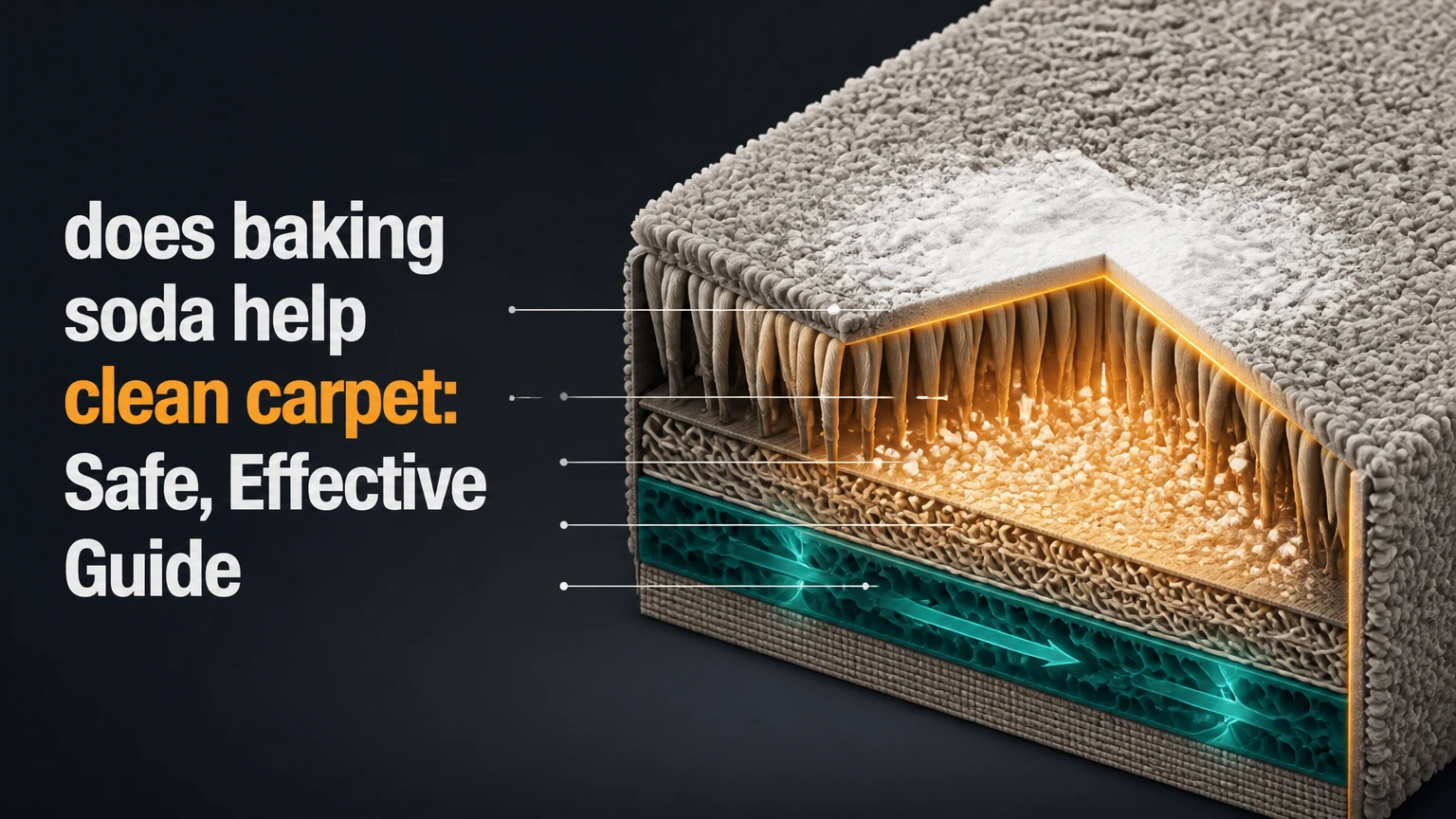
Baking soda helps clean carpet in a limited way: it deodorizes the surface, absorbs some moisture, and loosens small particles that a vacuum can remove. Baking soda does not deep-clean carpet, dissolve grease, remove established pet urine from padding, or reliably eliminate a set stain without rinsing or extraction.
Key facts at a glance
- Baking soda is sodium bicarbonate, written chemically as NaHCO₃, with a mildly alkaline aqueous pH of about 8.3.
- Dry baking soda is most useful for temporary surface deodorizing and light soil removal.
- A typical 10-by-12-foot room needs about 1-2 cups, followed by slow vacuuming after 30-120 minutes.
- Baking soda cannot replace hot-water extraction, an enzyme cleaner, or professional remediation for deep contamination.
- Vinegar and baking soda fizz because of an acid-base reaction, but the fizz does not extract embedded carpet soil.
- Fine powder can overload vacuum filters, irritate airways, and leave residue in dense carpet or carpet padding.
Does baking soda really clean carpet?
Baking soda provides light surface cleaning, not complete carpet cleaning. The powder can bind some odor molecules, absorb a small amount of surface moisture, and loosen dry particles from carpet fibers, but it has little ability to emulsify oil or flush contamination from the pile, backing, and pad.
That distinction matters because “cleaning” involves several separate actions: removing soil, dissolving or suspending oily residue, reducing odor, removing microorganisms, and extracting contaminated liquid. Sodium bicarbonate performs some deodorizing and particle-loosening work, but it does not perform all of those actions.
The Carpet and Rug Institute recommends regular vacuuming and following carpet manufacturers’ care instructions because carpet construction and fiber chemistry vary. The Institute of Inspection, Cleaning and Restoration Certification, commonly called the IICRC, also treats extraction and controlled drying as central parts of professional carpet and upholstery cleaning.
Baking soda is therefore a useful low-cost refresher. It is a poor choice for saturated padding, old urine, grease, mold, floodwater, or stains that have chemically bonded to the fiber.
How does baking soda affect carpet odors?
Baking soda reduces some surface odors through mild alkalinity, physical adsorption, and dilution of odor residues. The result is strongest when the odor is shallow, dry, and lightly acidic, such as stale food residue or ordinary foot traffic.
Sodium bicarbonate is not a universal chemical neutralizer. Odors come from many different compounds, and baking soda does not chemically “bond” with every volatile organic compound. Dry powder also has limited contact with contamination buried beneath carpet backing, so an improved smell may be temporary.
Chemistry versus marketing claims
Baking soda dissolves in water to create a mildly alkaline solution. That alkalinity can alter the environment around some acidic odor compounds, but the powder does not sterilize carpet or destroy the source of biological odors.
“Adsorption” is the more accurate term when molecules or particles cling to a solid surface. “Absorption” means a substance enters the bulk of another material. Dry baking soda may adsorb some odor compounds and absorb limited moisture, but it is not a high-capacity moisture desiccant for carpet padding.
What baking soda cannot deodorize reliably
Baking soda rarely solves these problems on its own:
- Old cat or dog urine that reached the pad
- Milk, vomit, or meat residue beneath the surface
- Smoke absorbed into carpet backing and walls
- Mold caused by persistent dampness
- Sewer water, floodwater, or sewage contamination
- Grease tracked repeatedly into high-traffic paths
A source-removal treatment is required when the odor returns after vacuuming. For protein-based pet accidents, a carpet-safe enzymatic product is usually more appropriate than another layer of dry powder.
Which carpet types can use baking soda?
Synthetic nylon, polyester, and polypropylene carpets generally tolerate a small, dry application better than natural fibers, but the manufacturer’s care label remains the controlling instruction. Wool, silk, sisal, jute, viscose, and adhesive-backed rugs require greater caution because moisture, alkalinity, abrasion, or residue can alter fibers and dyes.
| Carpet material | Dry powder risk | Wet paste risk | Practical recommendation |
|---|---|---|---|
| Nylon | Low to moderate | Moderate | Use sparingly; vacuum thoroughly |
| Polyester | Low to moderate | Moderate | Patch-test colored and patterned carpet |
| Polypropylene | Low | Moderate | Suitable for light dry deodorizing |
| Wool | Moderate | High | Use only if manufacturer permits; prefer a specialist |
| Sisal or jute | High | Very high | Avoid wet methods and routine powder use |
| Viscose or silk | High | Very high | Use a qualified rug cleaner |
Why carpet construction matters
Carpet has more than a visible surface. The face fiber sits in a backing, often above a separate pad that can retain liquid for hours or days. A powder that appears dry on top may mix with spilled moisture underneath and form residue where ordinary vacuuming cannot reach.
Natural fibers also respond differently to alkaline products. Wool contains protein fibers and may felt, discolor, or lose protective treatments when exposed to excessive moisture, friction, or unsuitable chemistry. Sisal and jute can develop browning or edge damage after wet cleaning.
How do you use baking soda to deodorize carpet?
Use baking soda as a dry, controlled treatment after removing loose debris and addressing the odor source. For a typical 10-by-12-foot room, spread 1-2 cups evenly, leave the powder for 30-120 minutes, then vacuum slowly in multiple directions.
Step 1: Inspect and vacuum
Remove toys, cables, and furniture that can be moved safely. Inspect for dampness, dye transfer, sticky residue, exposed tack strips, and pet-soiled areas before applying powder.
Vacuum slowly rather than making quick passes. A practical target is 2-3 passes in each direction over visibly dirty traffic lanes. Do not apply baking soda to a wet carpet, because paste can form in the pile and backing.
Step 2: Patch-test the carpet
Place a teaspoon of baking soda on a hidden section, leave it for 30 minutes, and vacuum it. Check for color change, dullness, residue, or a roughened texture under strong white light.
A patch test does not prove that a large treatment is safe, but it can reveal obvious dye or texture problems. Follow the carpet manufacturer’s label if it prohibits powders or recommends a particular cleaning chemistry.
Step 3: Apply a thin, even layer
Use a flour sifter or shaker rather than dumping a concentrated mound onto the carpet. A thin coating is easier to vacuum and gives more uniform contact than a thick layer.
Typical quantities are:
| Area | Baking soda amount | Dwell time | Vacuum passes |
|---|---|---|---|
| 3-by-5-foot spot | 2-4 tablespoons | 30-60 minutes | 2 slow passes |
| 5-by-7-foot rug | 1/4-1/2 cup | 30-90 minutes | 2-3 passes |
| 10-by-12-foot room | 1-2 cups | 30-120 minutes | 2-3 directions |
| Strong shallow odor | Up to 2 cups per room | 8-12 hours | 3 slow directions |
“Generous” does not mean a visible blanket several millimeters thick. Excess powder increases residue and equipment stress without creating proportional odor removal.
Step 4: Brush only when appropriate
A soft carpet brush can distribute dry powder through the upper pile, but aggressive scrubbing can distort cut pile, push soil downward, or damage looped construction. Most delicate rugs should receive no brushing.
Step 5: Vacuum slowly and inspect
Vacuum the treated area in overlapping passes, then empty the canister or replace the bag before it becomes full. Inspect the pile from several angles for white residue.
You will know the method worked when the carpet is dry, the powder is gone, and the odor remains reduced after the room has been closed for several hours. If the smell returns quickly, the source is probably below the surface or still present on the fiber.
How do you treat a fresh spill with baking soda?
Blot a fresh, non-greasy, water-based spill first, then use a small amount of baking soda only after removing as much liquid as possible. Do not rub, flood the carpet, or use this method as a general treatment for oil, wax, ink, or old stains.
- Blot the spill. Press clean white towels into the liquid and replace them as they become wet. Work from the outside toward the center to limit spreading.
- Check the stain type. Water, unsweetened tea, and some soft drinks may respond to careful rinsing; grease and dyes require different chemistry.
- Apply a light dusting. Cover the damp spot with a thin layer, not a thick mound.
- Wait until fully dry. This may take 2-12 hours depending on humidity, pile density, and spill volume.
- Vacuum the residue. Use slow passes, then inspect for a ring or remaining color.
- Rinse if residue remains. Lightly blot with clean water and dry towels, avoiding saturation of the backing.
The method is most useful for absorbing the last trace of surface moisture. It does not pull all liquid from carpet padding, and a dried crust can leave a pale ring if too much powder or water is used.
Is baking soda and vinegar better than baking soda alone?
Baking soda and vinegar are not a superior deep-cleaning system. Vinegar, which contains acetic acid, reacts with sodium bicarbonate to produce carbon dioxide, water, and a dissolved acetate salt; the visible foam is short-lived and does not extract embedded soil.
The reaction can help lift a small amount of loose surface material when agitation and blotting accompany it. However, the two ingredients largely neutralize each other, reducing the alkalinity that baking soda would otherwise provide and leaving moisture that may reach the backing.
| Method | Main action | Best use | Main limitation |
|---|---|---|---|
| Dry baking soda | Surface deodorizing and particle loosening | Stale, shallow odors | Does not remove deep contamination |
| Diluted white vinegar | Mild acidic rinse | Some alkaline residue or odors | Can affect dyes and leaves moisture |
| Baking soda plus vinegar | Fizzing neutralization reaction | Small experimental spot treatment | Foam does not equal extraction |
| Carpet pre-spray plus extraction | Soil suspension and removal | Embedded soil and traffic lanes | Requires suitable equipment and drying |
| Enzyme carpet cleaner | Biological residue breakdown | Fresh or old protein-based accidents | Needs correct dwell time and complete drying |
Never mix vinegar with chlorine bleach, ammonia, or products containing unknown active ingredients. Combination cleaning can produce harmful vapors or unwanted chemical reactions.
Can hydrogen peroxide be used with baking soda?
Hydrogen peroxide can lighten some organic stains, but combining it with baking soda increases the risk of dye alteration, fiber damage, and uneven bleaching. A 3% solution should be considered an oxidizing spot treatment, not a routine carpet cleaner.
Red wine, blood, and vomit contain colored organic compounds that may respond to oxidation. Yet the same oxidation can change carpet dyes, especially on wool, silk, viscose, dark nylon, and older or sun-faded carpet.
Use these controls if the carpet manufacturer permits peroxide:
- Test an inconspicuous area for 24 hours.
- Use fresh 3% hydrogen peroxide, not hair developer or concentrated peroxide.
- Apply with a white cloth rather than pouring it onto the pile.
- Keep the area small and avoid mixing it with chlorine products.
- Blot with clean water after the stain improves.
- Dry the spot quickly and inspect for a halo.
Professional cleaners often select chemistry according to fiber, dye stability, pH, stain age, and backing type. A home recipe cannot identify all of those variables reliably.
Baking soda versus other carpet-cleaning methods
Baking soda is the lowest-cost option for surface odor, while extraction and professional treatment provide more complete soil removal. The correct choice depends mainly on contamination depth, fiber sensitivity, drying conditions, and whether the problem is odor, color, grease, or biological residue.
| Method | Typical cost | Drying or dwell time | Suitable contamination |
|---|---|---|---|
| Baking soda | $1-$3 per large box | 30 minutes-12 hours | Shallow odor and dry surface soil |
| Ready-made carpet powder | $5-$20 per container | 15-60 minutes | Routine deodorizing with easier vacuuming |
| Enzyme spot cleaner | $8-$25 per bottle | 8-48 hours | Pet urine, vomit, milk, and protein residue |
| Rental extractor | $30-$80 per day plus solution | 6-24 hours | Moderate whole-room soil |
| Professional extraction | $130-$314 typical home visit | 6-24 hours | Heavy soil, large areas, difficult stains |
The prices above are typical consumer ranges, not universal quotes. Location, room count, furniture movement, stain treatment, and carpet condition can change professional pricing substantially.
When should you choose extraction?
Choose hot-water extraction when dark traffic lanes remain after vacuuming, the carpet feels sticky, soil is embedded below the visible tips, or multiple previous products have left residue. Extraction works by applying a cleaning solution, suspending soil, and recovering liquid with vacuum rather than leaving powder in the pile.
Extraction still has risks. Excess water, slow drying, blocked airflow, or a saturated pad can produce browning, odor, delamination, or microbial growth. Open windows, use fans, and keep foot traffic off the carpet until it is fully dry.
Can baking soda damage a vacuum or carpet?
Baking soda can damage or shorten the life of a vacuum when fine powder bypasses filtration, cakes inside filters, or reaches the motor. Carpet damage is more likely when powder is overapplied, scrubbed aggressively, mixed with moisture, or left in a dense pile.
| Risk | Warning sign | Likely cause | Corrective action |
|---|---|---|---|
| Vacuum clogging | Reduced suction or hot smell | Powder-filled filter or bag | Stop, clean filter, replace bag |
| White residue | Pale film after vacuuming | Excess powder or weak suction | Vacuum again; do not add water first |
| Carpet crust | Hard or gritty patch | Wet powder in pile | Dry completely, then remove carefully |
| Returning odor | Smell returns within hours | Source remains below surface | Use enzyme treatment or extraction |
| Browning or yellowing | Tan ring after drying | Moisture, natural fiber, or residue | Stop DIY treatment; consult a specialist |
| Airway irritation | Coughing or dusty air | Fine powder exhaust | Ventilate and use sealed HEPA filtration |
Bagless vacuums with washable filters need special care because powder can coat the filter media. Manufacturers differ, so check the vacuum manual before applying any fine cleaning powder.
What should allergy sufferers do?
People with asthma or powder sensitivity should avoid broadcasting baking soda into an occupied room. Fine particles can become airborne during application and vacuuming, even when the powder itself has a low household toxicity profile.
A sealed vacuum with a genuine HEPA filter can reduce exhaust emissions, but it does not eliminate exposure during sprinkling. A low-moisture encapsulation product applied according to its label may be a better option, especially when another person can perform the treatment and ventilation is available.
What should pet owners know?
Baking soda can reduce a shallow pet odor temporarily, but it cannot break down urine crystals or remove liquid from carpet padding. Pet urine that reaches the pad usually needs an enzyme product designed for urine, followed by extraction or replacement of contaminated pad in severe cases.
Avoid adding essential oils to carpet powder around animals. Tea tree, eucalyptus, peppermint, cinnamon, and some citrus oils can irritate or poison pets depending on concentration, exposure route, and species. Cats are particularly vulnerable to some concentrated essential oils because of their metabolism.
For a fresh accident, blot first, apply a labeled enzyme cleaner at the quantity needed to reach the contamination, observe its stated dwell time, and dry the area thoroughly. Baking soda can be considered only after the enzymatic treatment is complete and the surface is dry.
Why does carpet smell worse after baking soda?
Carpet may smell worse after baking soda because moisture, urine, food residue, or cleaning chemicals have moved upward from the backing or pad. The powder can reduce surface odor while leaving the underlying source untouched, so the smell becomes noticeable again as humidity changes.
Use this troubleshooting sequence:
- Stop applying powder, vinegar, or perfume.
- Check whether the carpet or pad is still damp.
- Identify the source with a UV light only as a screening aid, because fluorescent residue is not proof of urine.
- Treat confirmed protein contamination with a labeled enzyme cleaner.
- Extract or blot excess liquid and dry with fans.
- Call a restoration or carpet professional if the pad is saturated, mold is suspected, or odor persists after one correctly performed treatment.
Do not pour vinegar onto urine as a substitute for enzyme treatment. Acidic rinses may alter odor temporarily but cannot reliably break down the full residue profile.
How do you remove leftover baking soda residue?
Remove baking soda residue by vacuuming repeatedly with a clean, suitable filter before adding moisture. If a small amount remains, lightly dampen a white towel with clean water, blot the residue, and dry the carpet immediately.
Do not spray an entire room to dissolve powder. Water can carry sodium bicarbonate into the backing, create a sticky deposit with existing soil, or produce a drying ring.
For a dense rug, use a vacuum with adjustable height and a crevice tool around edges. Never scrape hard against looped fibers. If residue remains after several passes, a professional low-moisture or extraction cleaning may remove it more evenly than repeated home treatments.
Expert rules for safer results
- Treat odor source before odor symptom. A dry powder cannot reach every liquid pathway in a backing or pad.
- Use less powder than social-media recipes recommend. A thin, recoverable layer usually outperforms a thick layer that overloads filtration.
- Never judge cleaning by foam. Vinegar and baking soda can create dramatic fizz without removing suspended soil.
- Drying controls the outcome. Fans, airflow, and limited solution volume matter more than adding another household ingredient.
- Separate stain chemistry from deodorizing chemistry. Blood, grease, ink, tannins, and urine require different approaches.
The American Cleaning Institute describes baking soda as a mild abrasive and deodorizing ingredient, while the U.S. Environmental Protection Agency recommends following product labels and preventing unnecessary exposure to cleaning aerosols and powders. Those principles support using sodium bicarbonate selectively rather than treating it as a complete carpet detergent.
Frequently asked questions
Can I leave baking soda on carpet overnight?
You can leave a thin layer on a compatible, dry synthetic carpet for 8-12 hours if the area is unoccupied and the vacuum can remove the powder completely. Overnight exposure will not extract deep odor, and prolonged contact increases residue risk on dense pile, wool, and rugs with moisture below the surface.
Will baking soda remove cigarette smoke from carpet?
Baking soda may reduce a light surface smell, but it will not remove cigarette smoke absorbed into carpet backing, padding, walls, curtains, or furniture. Smoke remediation generally requires thorough vacuuming, washing hard surfaces, controlled extraction, ventilation, and replacement of porous materials that remain contaminated.
Can baking soda remove grease from carpet?
Baking soda alone does not dissolve grease effectively. Blot fresh oil, avoid spreading it, and use a carpet-safe product labeled for oily soil after testing the fiber and dye. A professional pre-spray and extraction process is more reliable for large grease areas or repeated kitchen traffic.
Is baking soda safe for a carpet-cleaning machine?
Do not put loose baking soda into a carpet extractor unless the machine manufacturer specifically permits it. Powder can clog pumps, filters, recovery systems, and hoses, while undissolved particles may remain in the carpet. Use the machine’s approved solution at its labeled dilution instead.
How often can baking soda be used on carpet?
For a compatible synthetic carpet, occasional use every few weeks on a targeted area is more reasonable than weekly whole-room applications. Frequent powdering can create cumulative residue and filtration problems, especially when vacuuming is incomplete or the carpet has a dense pile.
Does baking soda kill carpet bacteria?
Baking soda does not reliably disinfect carpet or kill all bacteria, viruses, fungi, or parasites. Disinfection requires an appropriate registered product, sufficient wet contact time, and safe use on the specific fiber. For sewage, flooding, or extensive biological contamination, use professional remediation rather than household powder.
The bottom line
Does baking soda help clean carpet? Yes, baking soda can refresh dry synthetic carpet, reduce some shallow odors, and loosen small amounts of surface soil when applied sparingly and vacuumed thoroughly. It is not a deep cleaner, disinfectant, grease remover, or dependable treatment for old pet urine. Use it as a limited deodorizing aid, and choose enzyme treatment, extraction, or professional cleaning when contamination has entered the backing or pad.