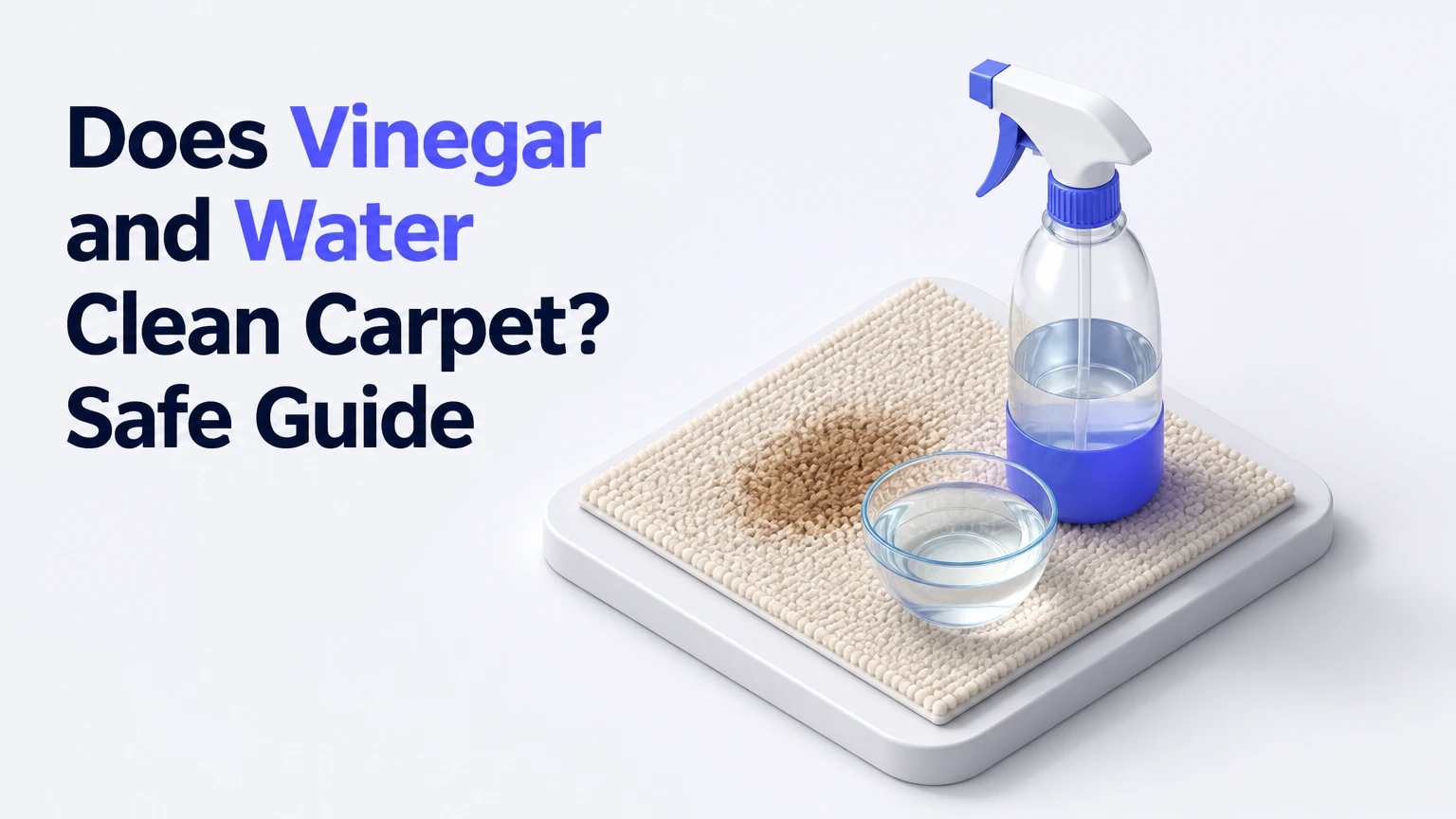
Yes, vinegar and water can clean some carpets, especially when diluted white vinegar is used for light surface soil, mild odors, and alkaline residue. Vinegar is not a complete carpet cleaner: it performs poorly on grease, may damage wool or unstable dyes, and will not reliably remove deep pet urine contamination or disinfect carpet.
Key Facts at a Glance
- Distilled white vinegar typically contains about 5% acetic acid, so dilution matters when applying it to carpet.
- A practical spot solution is 1 part white vinegar to 3 parts water, not automatic full-strength application.
- Vinegar helps with alkaline residues and some odors, but it is weak against oily stains such as butter, cooking grease, and cosmetics.
- Vinegar does not reliably disinfect carpet or permanently remove deep urine odor. An EPA-registered disinfectant or enzyme treatment may be more appropriate.
- Carpet must dry quickly and completely. A lightly treated spot often dries in 2-6 hours, while saturated padding can remain damp for 24 hours or longer.
- Always test colorfastness and check the carpet manufacturer’s instructions before using an acidic solution.
What does vinegar do to carpet soil?
White vinegar is a dilute acetic acid solution that can loosen alkaline residue and alter the chemistry of some water-soluble soils. Vinegar does not lift dirt by itself as effectively as an extraction detergent because it contains no dedicated surfactant system for surrounding and suspending oily particles.
Carpet soil is chemically mixed. Dust, mineral salts, food residue, skin oils, pet waste, and detergent film can occupy the same fibers. Acetic acid may help with alkaline deposits and hard-water minerals, while water absorbs and transports water-soluble material away from the yarn.
The acidity has limits. A low-pH liquid can affect dyes, latex backing, natural fibers, and stain chemistry. The vinegar smell usually fades as acetic acid evaporates, but persistent odor often indicates damp backing, remaining contamination, or excess solution.
Vinegar is therefore best viewed as a limited spot-treatment ingredient, not a universal replacement for carpet detergent. The Carpet and Rug Institute recommends following carpet and equipment manufacturers’ cleaning instructions because fiber, backing, dye, and construction vary substantially.
What vinegar does well
- Light drink spills that are still water-soluble
- Mild alkaline detergent residue
- Some stale household odors
- Small areas of general surface soil
- Mineral deposits left after poor rinsing
What vinegar does poorly
- Cooking oil, butter, sunscreen, and greasy cosmetics
- Dried blood and other protein-heavy stains
- Deep urine crystals inside carpet padding
- Large areas of embedded traffic soil
- Mold growth beneath carpet or inside padding
Is vinegar and water safe for every carpet?
Vinegar and water is usually lower risk on tested, colorfast synthetic carpet than on wool, silk, sisal, jute, cotton, or unknown natural-fiber rugs. Nylon and polyester still require a hidden-area test because dye stability, stain-resistant treatments, backing materials, and prior chemical exposure differ between products.
| Carpet or rug material | Vinegar risk | Safer default | Professional advice |
|---|---|---|---|
| Nylon carpet | Moderate dye risk | Test 1:3 solution first | Follow the manufacturer’s pH range |
| Polyester carpet | Moderate residue and dye risk | Use minimal moisture | Rinse and extract thoroughly |
| Olefin or polypropylene | Low-to-moderate dye risk | Test before treatment | Avoid aggressive rubbing |
| Wool carpet | High pH and browning risk | Wool-safe neutral cleaner | Use WoolSafe guidance or a specialist |
| Silk, sisal, jute, cotton | High shrinkage, browning, or dye risk | Do not experiment | Use a qualified rug cleaner |
| Unknown antique rug | High construction and dye risk | Keep vinegar off the rug | Request fiber and dye testing |
Natural fibers deserve particular caution. Wool can brown when moisture and alkaline contamination migrate through its structure, while cellulosic fibers such as jute and cotton can develop water marks or dye transfer. Vinegar is acidic, but “acidic” does not automatically mean safe for every natural fiber.
How should you test carpet before using vinegar?
Vacuum first, mix the intended solution, and apply two or three drops to a hidden area such as a closet edge. Wait at least 10 minutes, blot with a white towel, and inspect both the towel and the dried carpet for color transfer, texture change, yellowing, or a visible ring.
A successful test does not guarantee that a large wet treatment is safe. It only indicates that the tested amount caused no obvious immediate reaction.
What vinegar-to-water ratio should you use?
Use 1 part distilled white vinegar to 3 parts water for a cautious spot treatment, then increase concentration only when the carpet manufacturer permits it and the test area remains stable. A 1:1 mixture is stronger, but stronger acid is not automatically more effective and increases the chance of dye or backing problems.
| Situation | White vinegar | Water | Application | Typical contact time |
|---|---|---|---|---|
| Mild odor or residue | 1 tablespoon | 1 cup | Light mist on a cloth or spot | 3-5 minutes |
| Small synthetic-carpet spot | 1 cup | 3 cups | Light spray, then blot | 5 minutes |
| Stubborn tested spot | 1 cup | 1-2 cups | Limited treatment only | 5-10 minutes |
| Final rinse after treatment | 0 cups | Clean cool water | Light mist, then extract | Immediate |
| Machine cleaning | Manual-specific | Manual-specific | Approved detergent preferred | Equipment setting |
Use distilled white vinegar only. Apple cider vinegar, red wine vinegar, balsamic vinegar, and malt vinegar contain color and organic compounds that can mark pale carpet. Warm water is sufficient for hand treatment; very hot water can set some protein stains and may affect adhesive or backing.
Do not combine vinegar with chlorine bleach, ammonia, or commercial chemicals unless the product manufacturer explicitly confirms compatibility. Vinegar mixed with chlorine bleach can release chlorine gas, while vinegar and ammonia produce irritating vapors.
How do you clean a carpet spot with vinegar?
A controlled spot treatment takes approximately 15-25 minutes of active work and 2-6 hours of drying for a lightly dampened synthetic carpet. The success factor is moisture control: blotting and extraction matter more than spraying a stronger vinegar mixture.
Step 1: Remove dry soil
Vacuum the affected area slowly in two directions. Pick up solids with a spoon or dull edge, and avoid grinding them into the pile.
You will know this step worked when loose grit no longer transfers to a white cloth. A common mistake is wetting mud before removing it, which turns removable particles into a larger smear.
Step 2: Blot the spill
Press a clean white towel into the stain, working from the outer edge toward the center. Replace the towel as it becomes wet, and continue until very little liquid transfers.
Do not scrub. Scrubbing can distort pile, spread pigment, and push liquid into the backing.
Step 3: Apply the diluted solution
Put the 1:3 vinegar mixture in a clean spray bottle and mist the towel or stain lightly. For a spot approximately 10 centimetres wide, start with 1-2 teaspoons of solution rather than saturating the area.
The carpet should feel damp, not wet through. You will know the application is controlled when no liquid reaches the backing or forms a pool beneath the fibers.
Step 4: Allow limited dwell time
Leave the solution for about 5 minutes on tested synthetic carpet. Avoid a long dwell period because prolonged moisture increases wicking, dye migration, and backing exposure without guaranteeing better cleaning.
For delicate fibers, skip vinegar and use the care-label-approved product instead.
Step 5: Blot and extract
Press a fresh white towel firmly over the spot. A wet-dry vacuum can remove more liquid than hand towels, provided the machine is clean and the nozzle does not damage the pile.
Repeat with dry towel sections until the transfer is faint. The treated area should look cleaner without a hard circular edge.
Step 6: Rinse lightly
Mist a small amount of clean cool water over the treated area, then blot again. Rinsing reduces remaining acetic acid and loosened soil, although excessive rinse water can recreate the original moisture problem.
Step 7: Dry with airflow
Place a fan over the area, lift nearby furniture, and keep people and pets away until the carpet is fully dry. A folded dry towel with a flat weight can help absorb residual moisture, but do not use a heavy object if it crushes the pile or traps dampness.
The carpet is dry when the fibers and backing feel normal, no cool dampness remains, and the vinegar odor has disappeared.
Can vinegar go in a carpet-cleaning machine?
Vinegar should not automatically replace carpet-extraction detergent in a rental or home carpet machine. Some manufacturers restrict household acids because vinegar can affect seals, hoses, warranty coverage, foam control, or the machine’s intended cleaning chemistry.
Extraction machines depend on a balanced combination of water pressure, vacuum recovery, surfactants, rinse agents, and drying. Vinegar supplies acidity but does not provide the surfactants needed to emulsify oily soil. A 1:1 vinegar mixture can also be unnecessarily strong for carpet fibers and expensive equipment.
Before using vinegar in a machine:
- Read the machine manual and carpet warranty.
- Confirm that household vinegar is permitted.
- Use only distilled white vinegar, never scented or colored vinegar.
- Avoid adding dish soap, baking soda, bleach, or other chemicals.
- Perform extra dry passes after the wet pass.
- Ventilate the room and measure drying progress.
For whole-room cleaning, an approved low-residue extraction detergent is normally the safer and more effective choice. Vinegar may have a role as a limited hand-applied spot treatment, but machine manufacturers’ instructions take priority.
Which stains can vinegar remove?
Vinegar works best on small, fresh, water-soluble stains and alkaline residue, while dish detergent or an enzyme product is more suitable for greasy, protein-based, or biological contamination. Stain age, carpet fiber, dye, and the substance’s pH determine the outcome more than vinegar concentration alone.
| Stain or problem | Vinegar suitability | Better first choice | Reason |
|---|---|---|---|
| Light coffee spill | Moderate | Water, then approved spot cleaner | Coffee is water-soluble but may contain oils |
| Mud | Low before drying | Vacuum, water, detergent | Remove dry particles first |
| Grease or butter | Poor | Small amount of carpet-safe detergent | Surfactants emulsify oil |
| Blood | Poor | Cold water and protein-safe product | Heat and acid can complicate protein stains |
| Soap residue | Moderate | Water rinse and extraction | Physical removal matters most |
| Pet urine | Limited surface help | Enzymatic urine treatment | Crystals may remain in padding |
| Vomit or milk | Limited | Enzyme cleaner | Organic proteins require specialized chemistry |
| Rust | Poor | Product formulated for rust | Acid and metal reaction require control |
Coffee, tea, and wine may respond partially because their soluble components can move into water, but tannins and added sugars can remain. Blotting immediately improves the result. Old stains often require identification before treatment because repeated household experiments can permanently alter the dye.
Does vinegar remove pet urine odor?
Vinegar may reduce a mild surface odor temporarily, but vinegar and water does not reliably remove deep pet urine odor from carpet padding or subfloor. Urine leaves salts and organic residues that can recrystallize when damp, and cats or dogs may detect traces that humans cannot smell.
Use an enzyme-based urine product according to its label, applying enough to reach the contaminated depth without flooding the room. Enzymatic products need the right dwell time and should not be mixed with vinegar, bleach, or disinfectants because those chemicals can reduce biological activity.
For repeated accidents, a professional may need to inspect the pad and subfloor. Carpet replacement or sealed subfloor treatment can become necessary when urine has penetrated beneath the backing.
What are the main alternatives to vinegar?
The best alternative depends on the soil, not on whether a product is marketed as natural. A low-residue carpet detergent is more suitable for broad synthetic-carpet cleaning, an enzyme product fits biological stains, and a dry absorbent method suits moisture-sensitive fibers.
| Cleaning option | Best use | Typical cost range | Main limitation |
|---|---|---|---|
| Vinegar and water | Small residue or mild odor spots | $0.05-$0.30 per spot | Weak on oil and deep contamination |
| Low-residue carpet detergent | Whole-room synthetic carpet | $0.20-$1.00 per room in solution | Requires correct dilution and extraction |
| Enzyme urine cleaner | Fresh or aged pet urine | $8-$25 per bottle | Needs correct saturation and dwell |
| Clear dish detergent solution | Small greasy spot | Under $0.10 per spot | Excess leaves sticky residue |
| Professional hot-water extraction | Embedded soil and large areas | Typically $100-$300 per visit | Higher cost and drying logistics |
| Dry compound cleaning | Moisture-sensitive maintenance | Typically $0.15-$0.60 per square foot | Limited deep-soil removal |
Baking soda is not a superior partner for vinegar. The acid and alkaline powder react to form carbon dioxide, water, and sodium acetate; the visible fizz is mostly a neutralization reaction, not a powerful mechanical lifting process. Applying baking soda first can absorb some surface moisture, but spraying vinegar over it largely consumes both materials.
Never use a household steam mop on carpet unless the carpet and machine manufacturer specifically approve that method. High heat and excess moisture can cause shrinkage, delamination, dye movement, or prolonged drying.
How long does vinegar-cleaned carpet take to dry?
A lightly misted spot usually dries in 2-6 hours with ventilation, while a machine-cleaned room often takes 8-24 hours and saturated padding can remain wet longer. Humidity, airflow, carpet density, backing, room temperature, and the amount of solution determine the actual drying time.
| Treatment | Typical liquid amount | Typical drying time | Drying aid |
|---|---|---|---|
| Cloth-applied spot | 1-2 teaspoons | 1-4 hours | One floor fan |
| Light spray spot | 1-4 tablespoons | 2-6 hours | Fan and ventilation |
| Several square metres by hand | 0.5-1 litre | 6-12 hours | Cross-ventilation |
| Extracted room | 3-10 litres recovered imperfectly | 8-24 hours | Air movers and dry passes |
| Saturated pad or backing | More than surface holds | 24 hours or longer | Professional extraction |
Do not close the room while carpet remains cool or damp. Persistent musty odor, bubbling carpet, discolored backing, or dampness after 24 hours warrants prompt inspection because moisture may be trapped beneath the surface.
What mistakes make vinegar treatment fail?
The most common failures are oversaturation, wrong chemistry, poor stain identification, and inadequate extraction. Vinegar treatment fails when users focus on acidity while ignoring the physical removal of dissolved soil and moisture from the carpet system.
- Using full-strength vinegar: Dilute first and test colorfastness.
- Flooding the spot: Use teaspoons rather than cups for a small stain.
- Rubbing aggressively: Blot and press to protect the pile.
- Skipping the rinse: Remaining acid and soil can attract or hold residue.
- Using vinegar on wool or jute: Follow fiber-specific care instructions.
- Treating grease with acid: Use a suitable low-residue detergent.
- Mixing chemicals: Keep vinegar separate from bleach, ammonia, and other cleaners.
- Cleaning over a stain-resistant treatment: Some coatings can be weakened or stripped by unsuitable products.
A recurring brown or dark edge usually indicates wicking, where dissolved material from the backing travels upward as moisture evaporates. Lightly re-wet with clean water, extract thoroughly, and dry rapidly. Repeating vinegar applications without removing the underlying liquid often makes wicking worse.
When should you avoid vinegar completely?
Avoid vinegar when the carpet is wool, silk, sisal, jute, antique, unusually dyed, heavily backed, or covered by a warranty that specifies another cleaning method. Avoid it also when the stain is extensive, the carpet has delaminated, or water already sits beneath the surface.
Professional cleaning is the safer route when:
- A pet has repeatedly urinated in one area.
- Mold or a musty odor comes from beneath the carpet.
- The stain covers more than a few square feet.
- Dye transfers during the hidden-area test.
- The carpet has water damage or a soaked pad.
- A valuable rug lacks a readable care label.
- The carpet must be disinfected after sewage, flooding, or infectious contamination.
Vinegar is not an EPA-registered disinfectant merely because it is acidic. Use a product whose label specifically permits carpet application when pathogen reduction is required, and follow the label’s contact time and ventilation instructions.
FAQ
Can vinegar damage carpet padding?
Yes, excessive vinegar solution can contribute to backing, adhesive, or padding problems when moisture remains trapped. A small, diluted spot treatment is less risky than flooding, but carpet padding should never become wet enough to stay damp overnight without active extraction and airflow.
Does vinegar remove carpet fleas?
No, vinegar and water is not a dependable flea-control treatment. Flea eggs and larvae can remain in carpet fibers, upholstery, and pet bedding. Vacuum frequently, wash washable items at the hottest permitted setting, and use a pest-control product labeled for the affected species and surfaces.
Can vinegar remove mold from carpet?
Vinegar may affect some surface organisms, but it cannot make mold-contaminated carpet reliably safe when growth has entered the backing or padding. Remove the moisture source first, isolate affected materials, and obtain professional remediation for extensive growth or water damage.
Is vinegar safe around dogs and cats after it dries?
A diluted vinegar spot is generally low risk after the carpet has dried, but animals should stay away from wet treatment areas. Prevent licking, provide ventilation, and avoid assuming that vinegar removes the biological compounds that caused a pet odor.
Why does the carpet smell worse after vinegar dries?
A stronger odor after treatment usually indicates remaining moisture, disturbed urine or organic residue, or vinegar trapped in the backing. Increase airflow, extract with clean water if the carpet is suitable, and investigate the pad if the smell persists after complete drying.
Is commercial carpet cleaner better than vinegar?
Commercial carpet cleaner is usually better for whole-room soil because it combines surfactants with extraction-compatible chemistry. Vinegar is cheaper and useful for limited residue or mild odors, but the commercial product wins for grease, embedded soil, and predictable machine performance when used according to its label.
The Bottom Line
Does vinegar and water clean carpet? Yes, but only within a narrow range of jobs. Diluted distilled white vinegar can help with a small, tested spot, mild odor, or alkaline residue on suitable synthetic carpet, while approved detergent, enzyme treatment, or professional extraction is better for grease, deep urine, mold, delicate fibers, and large areas. Use minimal moisture, blot instead of scrub, rinse lightly, and dry the carpet completely.