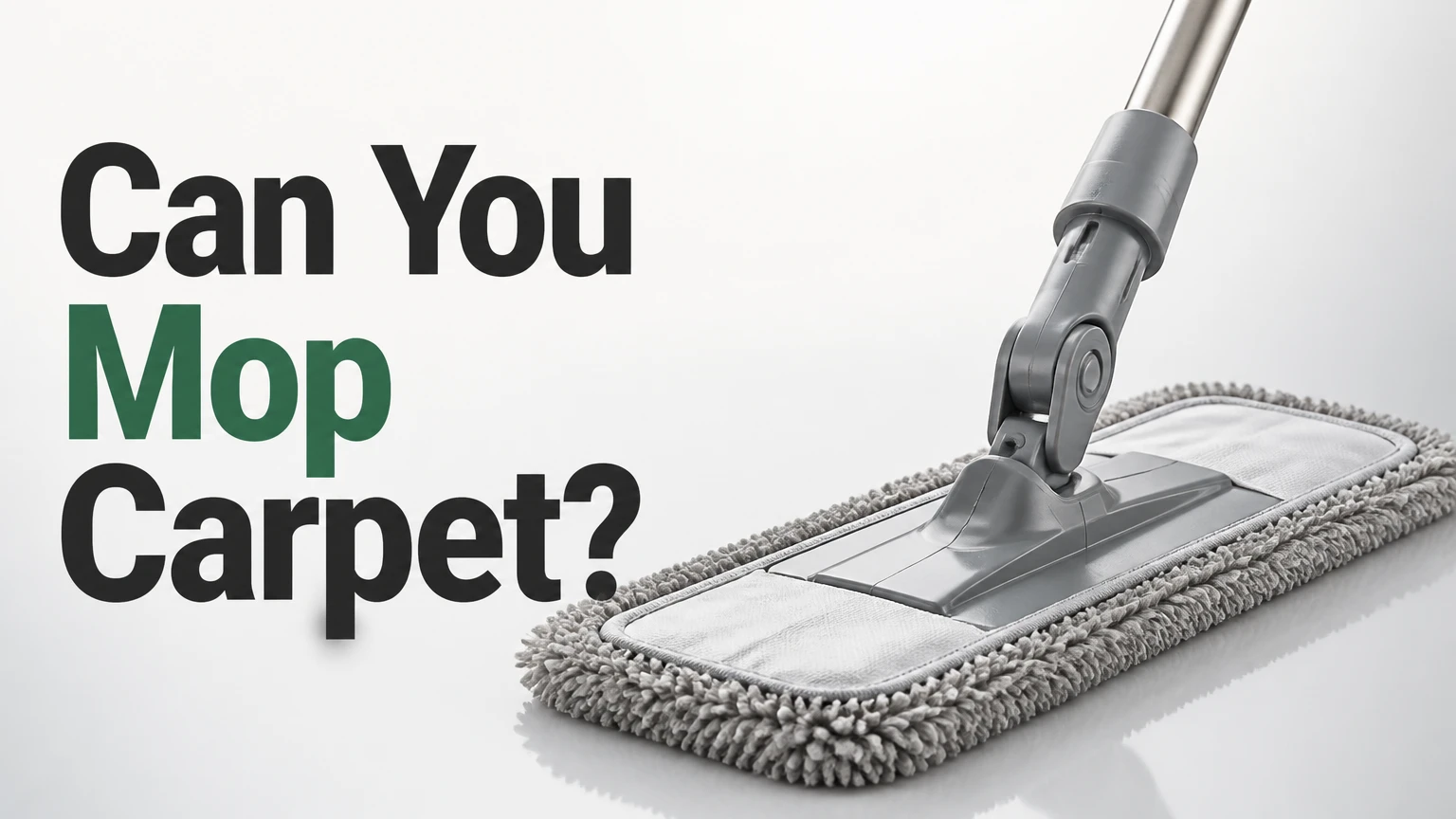
No, you should not use a traditional wet mop on carpet because excess water can penetrate the pile, backing, and pad, extending drying time and increasing the risk of dye bleed, delamination, odor, and microbial growth. You can refresh low-pile carpet with a barely damp microfiber pad, but deeper soil requires an approved carpet extractor or professional cleaning.
Key Facts
- A standard string, sponge, or flat hard-floor mop is not a carpet-cleaning machine.
- A barely damp microfiber pad can collect surface hair and loose soil from low-pile carpet.
- Carpet should dry completely within about 6-12 hours after low-moisture cleaning; longer drying signals excessive water, poor airflow, or dense construction.
- A steam mop is safe only when the carpet manufacturer and steam-mop manufacturer explicitly approve the carpet-glider attachment.
- Carpet extractors apply cleaning solution and recover it with suction; that recovery step separates them from ordinary mops.
- Wool, viscose, jute, shag, antique, and glued rugs need fiber-specific care rather than a general damp-mop method.
Can you mop carpet safely?
You can “mop” carpet only in the limited sense of wiping its surface with a nearly dry microfiber pad. A traditional wet mop is unsuitable because carpet fibers hold water vertically while the backing and underlay hold it horizontally, creating slow evaporation and hidden moisture.
The distinction matters. A microfiber pad used dry or lightly misted can gather pet hair, crumbs, and surface dust through friction and fiber entanglement. It does not rinse the carpet, flush soil from the backing, or replace vacuuming and extraction.
The Carpet and Rug Institute recommends following the carpet manufacturer’s maintenance instructions and using cleaning products tested for the specific carpet. IICRC S100, the professional standard for textile floor covering maintenance, treats hot-water extraction and low-moisture systems as controlled processes with prescribed equipment, chemistry, and recovery, not as ordinary floor mopping.
A damp wipe is therefore a maintenance technique, not deep cleaning. Use it for a low-pile synthetic rug with a light film of soil. Do not use it to treat saturated carpet, pet urine in the pad, a large stain, or a valuable natural-fiber rug.
What does mopping carpet actually mean?
Carpet surface mopping means moving a dry or slightly damp textile pad over the pile to collect loose contamination without saturating the carpet. The method depends on friction, fiber capture, and limited moisture rather than the rinse-and-wring cycle used on tile or vinyl.
A microfiber pad contains very fine split fibers that increase contact with the carpet surface. When the pad moves slowly in one direction, those fibers can collect hair and particulate soil that a quick vacuum pass leaves behind. A damp pad may also soften a thin film of dried residue.
A low-moisture carpet machine works differently. Some systems use encapsulation chemistry, which surrounds soil in a brittle polymer that is removed during later vacuuming. Others use a small amount of solution and immediate vacuum recovery. Commercial bonnet cleaning uses a rotating absorbent pad to transfer surface soil from low-pile carpet, although it requires trained operation to avoid overwetting and pile distortion.
None of these methods makes carpet equivalent to a hard floor. Carpet has a pile, primary backing, secondary backing, adhesive, and often a cushion underneath. Water that reaches those lower layers is much harder to remove than water on a sealed floor.
Why does excess water damage carpet?
Excess water damages carpet by increasing drying time and allowing moisture to reach backing adhesives, cushion, subfloor materials, and trapped soil. The visible fibers may feel dry while the pad underneath remains wet, which can produce odor, delamination, browning, or microbial growth.
Synthetic fibers such as nylon and polypropylene usually tolerate correctly performed water-based cleaning, but the backing and installation still impose limits. A glued carpet can separate when adhesive weakens. A jute-containing backing can brown or distort. Wood subfloors can swell after repeated or severe wetting.
The practical rule is simple: moisture must be controlled at application and removed through evaporation or suction. A floor mop provides neither calibrated application nor meaningful recovery.
Which equipment is safe for carpet?
A carpet-safe tool must either use minimal moisture or provide strong recovery, and its product documentation must specifically identify carpet or textile floors. A hard-floor mop, even one with a spray trigger, does not become carpet-safe merely because its pad is washable.
| Equipment | Typical price | Suitable carpet | Typical drying time | Main limitation |
|---|---|---|---|---|
| Dry microfiber carpet sweeper | $15-$40 | Low-pile synthetic carpet, rugs | 0-15 minutes | Does not remove embedded soil |
| Flat microfiber pad, lightly dampened | $20-$50 | Low-pile nylon or polypropylene | 1-4 hours | Requires careful moisture control |
| Carpet encapsulation machine | $500-$2,500 purchase or $75-$200 rental | Commercial low-pile synthetic carpet | 1-4 hours | Chemistry and machine settings matter |
| Carpet extractor | $100-$600 rental or purchase | Synthetic residential carpet | 6-12 hours | Overwetting is possible with slow recovery |
| Professional hot-water extraction | $120-$300 per room, typical | Manufacturer-approved carpet | 6-24 hours | Scheduling and access cost more |
| Standard steam mop | $40-$180 | Usually no carpet use | Not applicable | Heat and water may reach backing |
Is a carpet cleaner better than a mop?
A carpet extractor is better than a mop for embedded soil, because the machine applies measured solution and removes contaminated liquid through a recovery tank. A microfiber pad is better for a fast surface refresh when the carpet is low-pile, lightly soiled, and unsuitable for wet cleaning at that moment.
| Cleaning goal | Best method | Liquid exposure | Typical labor | Expected result |
|---|---|---|---|---|
| Remove daily crumbs | Vacuum with crevice tool | 0 ounces | 5-10 minutes per 100 sq. ft. | Loose debris removal |
| Collect pet hair | Rubber-brush vacuum, then dry microfiber pad | 0 ounces | 10-20 minutes per 100 sq. ft. | Surface hair reduction |
| Remove a fresh drink spill | Blotting, then targeted rinse extraction | 2-8 ounces per square foot | 10-25 minutes | Reduced stain and residue |
| Refresh traffic lanes | Encapsulation or low-moisture cleaning | 1-3 ounces per square foot | 15-30 minutes per 100 sq. ft. | Surface soil reduction |
| Remove embedded soil | Hot-water extraction | 6-12 ounces applied per square foot, equipment-dependent | 30-60 minutes per 100 sq. ft. | Deeper soil removal |
| Treat urine in pad | Professional inspection and subsurface treatment | Site-specific | 1-3 hours per affected area | Odor source treatment |
The liquid figures in the table are typical operating ranges, not universal limits. Manufacturer instructions, carpet density, equipment design, and technician technique can change them substantially. Never pour cleaning solution directly onto carpet.
How do you clean carpet with a damp microfiber pad?
Clean low-pile carpet with a damp microfiber pad in seven controlled steps. Vacuum first, test the fiber and dye, use label-diluted carpet solution, wring the pad until it cannot drip, make light passes, change dirty pads, and dry the area rapidly with airflow.
Before you start
| Requirement | Typical specification |
|---|---|
| Time | 20-40 minutes per 100 sq. ft., plus 1-4 hours of drying |
| Difficulty | Low for surface soil, moderate for stains |
| Cost | $20-$50 for a reusable pad system, $5-$15 for solution |
| Tools | Vacuum, 2-4 microfiber pads, spray bottle, white cloth, fan |
| Suitable carpet | Low-pile nylon or polypropylene, manufacturer-approved |
| Do not proceed | Wool, viscose, jute, shag, saturated carpet, unknown antique rug |
Step 1: Read the care instructions
Check the carpet label, rug tag, lease, and manufacturer’s warranty before adding moisture. Look for fiber type, cleaning-code information, and restrictions against solvent, alkaline, heat, or wet cleaning.
Success checkpoint: The care instructions permit the planned method, or a flooring professional has confirmed it.
Common mistake: Assuming a synthetic-looking rug is polypropylene. Some decorative rugs contain viscose or cotton blends that can watermark or distort.
Step 2: Vacuum in two directions
Vacuum slowly in overlapping north-south and east-west passes. Use the vacuum’s upholstery or crevice tool along baseboards, where a flat pad cannot reach.
Pet hair may need a rubber-bristle attachment before vacuuming. Removing dry soil first prevents the damp pad from turning fine dust into a sticky film.
Success checkpoint: No visible crumbs, grit, or loose hair remain on the surface.
Common mistake: Wet-wiping before vacuuming. Moisture binds loose soil to the pile and makes later removal harder.
Step 3: Test colorfastness
Mix the carpet cleaner at the label dilution in a small container. Apply one drop to a hidden edge, press a white cloth over it for 10 seconds, and inspect the cloth for transferred color.
Success checkpoint: The white cloth shows no dye transfer, and the tested area dries without a ring.
Common mistake: Testing only for immediate color loss. Check again after the test patch dries, because browning and watermarking can appear later.
Step 4: Prepare the pad and solution
Use a carpet-labeled, low-residue cleaner at the manufacturer’s dilution. If the label gives a ratio, measure it; do not substitute a universal 1:20 ratio because formulas vary in concentration.
Mist the pad rather than spraying the carpet. Wring or press the pad until it feels cool and flexible but produces no droplets when squeezed.
Success checkpoint: A folded pad leaves no wet imprint on a dry white towel after a firm five-second press.
Common mistake: Adding extra detergent for heavy soil. Higher concentration often leaves residue that attracts soil and makes carpet feel crunchy.
Step 5: Wipe in small sections
Work in 3-by-3-foot sections. Push the pad in straight overlapping lines with light pressure, then turn the pad to a clean face when it becomes visibly soiled.
Do not scrub aggressively. Excessive pressure bends pile, spreads a stain, and pushes moisture toward the backing.
Success checkpoint: The pile looks evenly groomed, and no dark wet edge forms around the cleaned section.
Common mistake: Moving in circles. Circular scrubbing can create visible pile direction changes, especially on plush surfaces.
Step 6: Remove residue
If the product requires rinsing, use the compatible low-moisture rinse method or an extractor. Do not flood the area with plain water to correct detergent buildup, because the rinse can create the same backing problem as the original spill.
For a small residue issue, use a barely damp clean pad, make one pass, and follow immediately with a dry pad.
Success checkpoint: The dry carpet feels flexible rather than tacky or stiff.
Common mistake: Mixing vinegar, bleach, ammonia, and commercial carpet products. Chemical combinations can create hazardous vapors or permanent discoloration.
Step 7: Dry and reset the pile
Keep furniture and foot traffic off the area until the carpet is fully dry. Open doors, run a fan across the surface, and use a dehumidifier when indoor humidity is high.
Low-moisture surface wiping often dries in 1-4 hours. A properly extracted carpet commonly needs 6-12 hours, while dense padding, cool weather, or high indoor humidity can extend drying to 24 hours.
Success checkpoint: The pile and backing feel dry, no cool dampness remains, and the room has no musty odor.
Common mistake: Replacing furniture immediately. Furniture legs can trap moisture and transfer dye or rust to damp carpet.
How wet should carpet become?
Carpet should feel slightly cool or damp during low-moisture wiping, never wet enough to leave a handprint, dark halo, or squelching sound. A damp microfiber pad should transfer a thin film of moisture to the pile, while the backing and cushion remain dry.
A useful household check is the towel test: press a dry white towel firmly onto the cleaned area for five seconds. The towel should show little or no moisture. Repeat the test after 30 minutes; persistent dampness indicates that airflow or water control needs attention.
Drying time depends on fiber density, room temperature, humidity, pad thickness, and ventilation. The American Society of Heating, Refrigerating and Air-Conditioning Engineers identifies 60% relative humidity as a commonly used upper target for many indoor environments, although carpet-specific drying depends on more than humidity alone.
Do not use a moisture meter reading as a universal pass-fail number. Meter calibration varies by backing and subfloor. Dryness, odor, touch, and the absence of visible wicking provide a more practical household assessment.
Are steam mops and robot mops safe?
Steam mops and robot mop functions are generally unsafe for carpet unless the exact manufacturer documentation approves textile-floor use. Steam introduces heat and moisture, while robot mop pads can repeatedly drag water across carpet without the recovery system needed for extraction.
A carpet-glider attachment may lift a steam head away from the pile, but that does not prove the carpet, adhesive, or backing can tolerate the heat. Follow the carpet warranty and the appliance manual together. If either source excludes carpet, do not use the appliance.
Robot vacuum-mop combinations also vary. Some models detect carpet and lift the mop pad, some avoid carpet only when a setting is enabled, and some leave a damp pad behind. Confirm the model’s carpet behavior before operating it near rugs.
| Tool or method | Carpet recommendation | Why | Safer alternative |
|---|---|---|---|
| String mop soaked in bucket | Do not use | Releases uncontrolled water | Vacuum or damp microfiber pad |
| Spray mop for hard floors | Usually do not use | Hard-floor chemistry and excess spray | Carpet-labeled low-moisture cleaner |
| Steam mop with carpet glider | Conditional | Heat and moisture may reach backing | Vacuum or approved extractor |
| Robot mop with lifted pad | Conditional | Model-specific carpet detection | Disable mopping near rugs |
| Wet-dry floor washer | Conditional | Many models exclude carpet | Use only a textile-approved mode |
| Carpet extractor | Use when label-approved | Applies and recovers solution | Professional extraction for severe soil |
Which carpet-cleaning method should you choose?
Choose the method according to pile height, fiber, soil depth, and moisture tolerance. A dry vacuum handles loose soil, a damp pad handles surface dust on low pile, encapsulation handles routine commercial traffic lanes, and extraction handles embedded soil when the carpet permits wet cleaning.
| Carpet or situation | Recommended method | Avoid | Typical frequency or timing |
|---|---|---|---|
| Low-pile nylon rug, light dust | Vacuum, then dry microfiber pad | Wet string mop | Weekly surface care |
| Polypropylene entry rug, pet hair | Rubber-brush vacuum, dry pad | Fragrant soap overload | Every 2-7 days |
| Plush polyester wall-to-wall carpet | Vacuum and spot extraction | Aggressive flat-pad scrubbing | Professional cleaning every 12-18 months |
| Wool area rug | Certified wool-rug professional | Hot steam, alkaline detergent | Inspection before wet cleaning |
| Shag rug over wood floor | Vacuum with adjustable height | Saturating any pile | Dry method until specialist advice |
| Commercial low-pile nylon | Encapsulation or bonnet system | Untrained rotary scrubbing | Weekly to monthly traffic-based care |
| Pet urine through to pad | Professional subsurface treatment | Surface deodorizer alone | Treat as soon as discovered |
| Flooded or soaked carpet | Water extraction and moisture inspection | Walking and ordinary mopping | Emergency response immediately |
Is dry carpet cleaning better than wet cleaning?
Dry or low-moisture cleaning is better when rapid access, shallow soil, or moisture-sensitive construction is the main constraint. Wet extraction is better when soil is embedded, allergen load is a concern, or a low-moisture process cannot remove the contamination.
Dry cleaning is not automatically deeper. A dry compound or encapsulation system removes soil that reaches the treated surface, while extraction can remove more suspended soil when performed with adequate vacuum recovery. Poor extraction can leave a carpet wetter and dirtier than a correctly managed low-moisture process.
The Carpet and Rug Institute’s Seal of Approval program evaluates carpet cleaning products and equipment for performance and compatibility. Choosing a CRI-approved product is more defensible than selecting a household soap based on fragrance or foam.
How should you handle spills and pet urine?
Blot a fresh spill immediately, remove solids with a spoon, and use a small amount of carpet-compatible rinse solution rather than mopping the entire area. Pet urine that penetrates the pad requires more than surface wiping because odor compounds can remain below the visible pile.
For a fresh liquid spill, place white towels over the area and press from the outside toward the center. Replace towels as they become wet. Avoid rubbing, which spreads the liquid and distorts the fibers.
For a small surface stain, apply cleaner to a white cloth or a controlled spray, wait according to the label, and blot. Do not mix products. Never use chlorine bleach on colored carpet.
Pet urine needs an ultraviolet inspection, odor assessment, and sometimes removal or replacement of affected pad. A surface enzyme product may help with a shallow accident, but it cannot reliably neutralize contamination that has reached the subfloor.
Can baking soda remove carpet odor?
Baking soda can absorb some surface odor after carpet is fully dry, but it does not disinfect carpet or remove urine trapped in padding. Apply a thin layer for several hours, vacuum thoroughly, and stop if fine powder enters the vacuum filter or causes respiratory irritation.
Baking soda is a deodorizing aid, not a substitute for extraction or source removal. Fragrance sprays have the same limitation and may conceal a developing musty odor.
Why did the carpet become crunchy or smell musty?
Crunchy carpet usually contains dried detergent residue, while a musty smell usually indicates retained moisture, contaminated padding, or microbial activity. Both problems often follow excessive solution, incomplete rinsing, slow drying, or cleaning over heavily soiled carpet.
For crunchy fibers, vacuum slowly to remove dry residue. Then test a barely damp clean pad on a small area and make one pass, followed by a dry pad. If stiffness persists across a room, professional rinsing or extraction is safer than repeatedly adding household water.
For musty odor, stop foot traffic, remove furniture, increase cross-ventilation, run a fan and dehumidifier, and inspect the carpet edge and pad. If the carpet remains wet after 24 hours, shows visible growth, or has a persistent odor after drying, contact a water-damage or carpet professional.
Do not apply baking soda to wet carpet. Powder can cake into the pile and complicate later extraction.
What are the most common carpet-mopping mistakes?
The most damaging mistakes are uncontrolled water, unsuitable detergent, aggressive agitation, skipped vacuuming, and delayed drying. Each mistake increases either residue, pile damage, stain spread, or moisture retention.
- Pouring water directly onto carpet: Apply solution to a cloth, pad, or approved machine instead.
- Using hard-floor soap: Select a low-residue carpet product and follow its measured dilution.
- Cleaning without vacuuming: Remove dry soil first so it does not become mud.
- Scrubbing a stain outward: Blot from the edge toward the center.
- Ignoring the backing: Check for dampness at an exposed edge or beneath a removable rug.
- Walking on damp carpet: Keep traffic off until the pile and backing are dry.
A practitioner rule of thumb is to make the first cleaning pass less wet than expected. You can add a controlled second pass, but recovering excess moisture from a backing is much harder.
When should you vacuum, extract, or hire a professional?
Vacuum when soil is dry and loose, use a damp microfiber pad for a light surface refresh, and extract when contamination is embedded and the carpet manufacturer permits wet cleaning. Hire a professional for wool, viscose, antique rugs, widespread urine, flooding, severe browning, or repeated odor.
Professional cleaning becomes more appropriate when the affected area exceeds roughly 10% of a room, the stain has migrated into padding, or home equipment leaves the carpet wet overnight. A technician can inspect fiber, backing, cushion, and subfloor rather than treating only the visible pile.
Hot-water extraction is not a universal answer. It can remove substantial soil when water temperature, pressure, chemical concentration, vacuum recovery, and drying are controlled. It can also cause overwetting, browning, or wick-back when equipment is poorly matched to the carpet.
Carpet manufacturers commonly recommend regular vacuuming and periodic professional cleaning, but the interval varies with traffic, pets, occupants, and warranty requirements. A high-traffic home may need professional service every 6-12 months, while a lightly used room may need it every 12-24 months.
What does carpet cleaning cost?
Typical household costs range from $0 for a vacuum-only refresh to $300 or more for professional cleaning across several rooms. The final price depends on room count, minimum service charges, furniture movement, stain treatment, access, and the cleaning method.
| Option | Typical equipment or service cost | Typical coverage | Drying or access time |
|---|---|---|---|
| Existing vacuum and dry pad | $0-$20 additional | 100-300 sq. ft. per session | Immediate access |
| Microfiber pad system | $20-$50 | 100-500 sq. ft. per pad set | 1-4 hours |
| Portable extractor rental | $30-$80 per day | 300-1,000 sq. ft. | 6-24 hours |
| Portable extractor purchase | $100-$600 | 1-3 rooms per session | 6-24 hours |
| Professional single room | $80-$180 | 100-300 sq. ft. | 6-12 hours |
| Professional multi-room service | $150-$400 | 500-1,500 sq. ft. | 6-24 hours |
| Urine or subsurface treatment | $150-$600 | One affected zone | 12-48 hours, case-dependent |
These are typical consumer ranges rather than fixed market prices. Obtain an itemized quote that identifies pretreatment, extraction, deodorization, furniture movement, and any pad or subfloor work.
Frequently Asked Questions
Can I use a Swiffer on carpet?
Use a Swiffer-style pad on carpet only if the specific pad and appliance instructions permit textile floors. A dry pad may collect surface hair, but a wet hard-floor pad can transfer detergent and excess moisture. A dedicated dry microfiber carpet sweeper is the safer choice for routine surface maintenance.
Can you mop carpet with vinegar and water?
Vinegar and water are not a universal carpet cleaner. The mixture can alter dye, leave odor, affect backing materials, and fail to remove oily soil. Use a manufacturer-approved carpet product at its label dilution, and test colorfastness in an inconspicuous area before treating any visible section.
Can you mop a carpeted floor after a spill?
Do not mop the whole carpet after a spill. Blot the liquid, remove solids, apply a controlled amount of compatible spot cleaner, and extract or blot the remaining moisture. Whole-floor mopping spreads contamination and increases the chance that liquid reaches the pad or subfloor.
Can you mop a rug on a wood floor?
You can use a barely damp pad on a low-pile synthetic rug only when the rug label allows moisture, but protect the wood floor underneath. Lift the rug or place a breathable drying layer beneath it, because trapped water can stain, swell, or dull the wood finish.
How often should carpet be deep cleaned?
Many homes benefit from professional or machine extraction every 6-18 months, with more frequent cleaning for pets, children, allergies, or heavy traffic. Vacuuming several times weekly removes dry soil before it abrades fibers, so deep-cleaning frequency should follow soil load rather than a rigid calendar.
The Bottom Line
Can you mop carpet? You can use a dry or barely damp microfiber pad on suitable low-pile carpet for surface maintenance, but you should not use a conventional wet mop, steam mop, or hard-floor cleaning solution. Vacuum first, control moisture, test the fiber, follow the carpet label, and dry the area completely. Use an approved extractor or a qualified professional when soil, urine, water, or delicate fibers exceed what a surface pad can safely handle.