To clean apartment carpet, remove loose soil, test the fiber and cleaner, pretreat stains, use a low-foam extraction solution, make slow dry passes, and ventilate until the carpet is fully dry. A typical one-room DIY cleaning takes 2-4 hours of active work and 12-24 hours to dry, with moisture control determining the result.
Key facts
- Vacuuming removes dry surface soil before water turns it into sticky residue.
- Most apartment carpet is nylon, polyester, or olefin, but the carpet label determines safe chemicals and heat.
- Hot-water extraction is commonly called steam cleaning, although the cleaning process primarily uses sprayed water and vacuum recovery.
- Carpet should feel dry to the touch and show no cool, damp backing before furniture returns.
- Too much detergent increases rapid resoiling because residue remains on the fiber.
- Professional cleaning may cost about $75-$200 per room in the United States, while a rental machine commonly costs $35-$70 per day.
Before You Start
Apartment carpet cleaning requires a lease check, a fiber test, a dry vacuuming pass, and a plan to keep the carpet usable while it dries. Do not begin with a rented machine until you know the carpet’s condition, the approved cleaning method, and where the recovered water can be emptied.
Photograph stains, loose seams, ripples, and existing discoloration before cleaning. Those photographs distinguish pre-existing damage from a later cleaning complaint, which matters during a security-deposit dispute.
Tools and materials
| Item | Typical quantity or specification | Purpose |
|---|---|---|
| Vacuum cleaner | 1 machine, adjustable-height head | Removes dry soil and pet hair |
| Carpet extractor | 1 portable unit, 1-2 gallon tank | Applies and recovers cleaning solution |
| Carpet detergent | 2-4 fluid ounces per gallon, label permitting | Suspends oily soil for recovery |
| White towels | 6-12 cotton towels | Blotting, testing, and wick-back control |
| Soft spotting brush | 1 brush, nylon bristles | Gentle agitation around stains |
| Air movers or fans | 1-2 fans per room | Moves humid air away from carpet |
| Nitrile gloves | 1 pair per cleaning session | Limits skin contact with solution |
| Plastic or foil tabs | 4-8 per furniture item | Protects legs and prevents dye transfer |
Safety and rental checks
Use a grounded outlet and keep electrical cords away from wet paths. Never place a rental extractor against a bathtub, sink, or toilet if the machine’s instructions prohibit that use, and never mix bleach, ammonia, vinegar, peroxide, or commercial spotters in the same container.
Ask the property manager whether the apartment carpet has a stain-resistant treatment, a warranty requirement, or a mandated move-out method. A lease can require professional service, but a lease requirement does not make every contractor competent. Keep the written invoice, room count, service date, and company details.
How to Clean Apartment Carpet
The safest apartment carpet cleaning sequence has seven stages: inspect, clear, vacuum, pretreat, extract, recover moisture, and ventilate. Work from the far corner toward the exit, divide the room into strips about 2-3 feet wide, and keep the cleaning solution volume low enough that the backing never becomes saturated.
Step 1: Inspect and clear the room
Remove small furniture, plants, electronics, floor lamps, and items stored on the carpet. Place large furniture on protective tabs only if the lease and machine instructions permit cleaning around it.
Inspect the carpet edge, transitions, tack strips, and seams. Do not clean over exposed tack strips, delaminated backing, loose transitions, or a visible wet spot from a plumbing leak. Those conditions require maintenance or a flooring professional.
You’ll know it worked when: the entire cleaning path is visible, dry damage is documented, and no electrical item remains near the wet area.
Common mistake: dragging heavy furniture across the pile. Lift furniture or use approved sliders, because dragging can stretch the carpet and damage the edge.
Step 2: Vacuum slowly in two directions
Vacuum the whole room in one direction, then repeat at a right angle. Move at approximately 1 foot every 2-3 seconds over traffic lanes, and use the crevice tool along baseboards where the floor head cannot reach.
A second vacuum pass matters because loose grit behaves like abrasive material underfoot. The Carpet and Rug Institute recommends regular vacuuming as a core part of carpet maintenance, and professional cleaners generally treat dry soil removal as the largest controllable part of a routine clean.
You’ll know it worked when: the vacuum canister or bag collects visible soil, edges look cleaner, and no loose crumbs remain when you run a white towel across the pile.
Common mistake: using the highest brush setting on a low-pile carpet. Excessive brush contact can fuzz looped carpet, so follow the vacuum manufacturer’s height setting.
Step 3: Treat stains without soaking them
Identify the stain before choosing a product. Blot liquid spills with a white towel, scrape solids with a spoon, and apply spotter to the towel first when the stain’s dye stability is unknown.
Test the cleaner in an inconspicuous corner, such as inside a closet, then wait until the test dries. Use enough solution to dampen the fibers, not enough to wet the pad. A typical dwell time is 5-10 minutes, but the product label controls the safe duration.
| Stain type | First treatment | Typical dwell | Avoid |
|---|---|---|---|
| Coffee or tea | Mild carpet spotter, blot outward | 5-10 minutes | Hot iron, colored towel |
| Grease or cooking oil | Carpet-safe solvent or low-residue degreaser | 3-5 minutes | Flooding the backing |
| Red wine or fruit drink | Absorbent towel, labeled acidic spotter | 5 minutes | Chlorine bleach |
| Mud | Dry completely, vacuum, then detergent spotter | 5-10 minutes | Scrubbing wet grit |
| Pet urine | Enzyme product labeled for carpet | Product label, often 10-15 minutes | Ammonia-based cleaner |
| Nail polish or paint | Professional advice for dried material | Varies | Acetone without fiber testing |
Blot from the outside toward the center to avoid spreading the mark. Repeat small applications instead of pouring a large amount onto one point.
You’ll know it worked when: the towel lifts less color after each blot and the stain edge stops expanding.
Common mistake: rubbing aggressively. Rubbing can distort yarn, spread oily soil, and create a fuzzy patch that remains after the stain disappears.
Step 4: Prepare the extractor correctly
Fill the machine with the water temperature and detergent dilution specified by the extractor and carpet-cleaning product labels. Many portable machines use warm water rather than boiling water; water that is too hot can damage dyes, soften adhesives, or create a burn hazard.
Use low-foaming extraction detergent. Do not add laundry detergent, dish soap, fabric softener, essential oil, or disinfectant unless the machine and carpet manufacturer specifically approves it.
Before cleaning the full room, make one test strip. Check the recovered water, pile appearance, color transfer, and drying speed after 15-30 minutes.
You’ll know it worked when: the machine sprays evenly, recovers visible soil, produces little foam, and leaves the test strip uniformly damp rather than saturated.
Common mistake: filling the tank to the top with concentrated chemical. Excess detergent leaves sticky residue and can make the carpet look dirty again within days.
Step 5: Extract the carpet in controlled strips
Press the spray trigger while pulling the extractor backward slowly, then release the trigger at the end of the strip. Overlap each pass by approximately 1-2 inches so narrow dirty lines do not remain between sections.
Make one wet cleaning pass, followed by two or three dry recovery passes with no spray. Do not leave the machine stationary while the pump is running. Portable extractors have less vacuum power than truck-mounted units, so slow recovery passes are especially important in apartments.
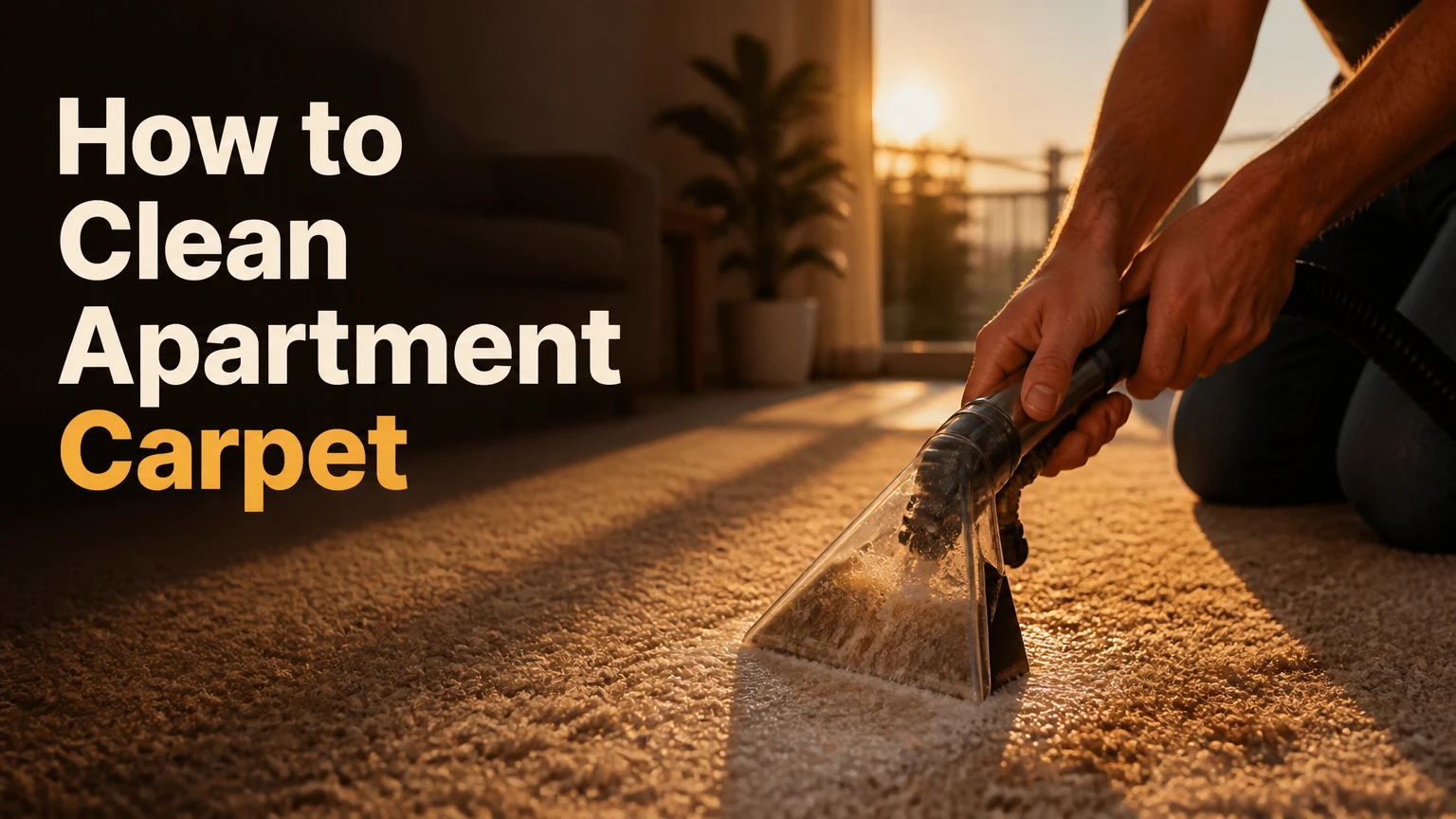
Hot-water extraction, often called steam cleaning, works through solution chemistry, heat, mechanical movement, dwell time, and vacuum recovery. The International Institute of Cleaning and Restoration Certification, or IICRC, describes hot-water extraction as a method that sprays solution into carpet and immediately recovers soil and moisture, rather than relying on steam alone.
You’ll know it worked when: recovered water becomes progressively clearer, the pile stands evenly, and no strip feels squishy underfoot.
Common mistake: making repeated wet passes because the carpet still looks shaded. Some pile shading is permanent wear or directional light, not removable soil.
Step 6: Remove remaining moisture
Make two or three slow passes without spraying after each wet pass. Empty the recovery tank before it reaches the machine’s maximum line, because a full tank can reduce recovery performance or trigger an automatic shutoff.
Press a folded white towel onto the carpet for 10 seconds. If the towel shows transfer of water or the backing feels cold and wet, continue recovery passes. A carpet surface may look dry while moisture remains in the pad.
You’ll know it worked when: the towel is nearly dry, the pile springs back, and walking in clean socks does not produce a damp sensation.
Common mistake: stopping after the first extraction pass. The dry passes often determine whether the carpet dries overnight or remains wet into the next day.
Step 7: Ventilate until completely dry
Set fans to move air horizontally across the carpet, not merely downward at one spot. Open windows only when outdoor air is less humid than indoor air, and run a dehumidifier when outdoor humidity is high.
A typical apartment room dries in 6-12 hours after restrained cleaning, while heavier wetting can require 12-24 hours. Keep indoor relative humidity near 30-50% when possible, and do not replace furniture until the carpet and pad are dry.
You’ll know it worked when: the carpet has no cool damp areas, no musty odor develops, and the towel test remains dry.
Common mistake: closing the room to preserve air conditioning. A closed, humid room slows evaporation and increases odor risk.
Which Cleaning Method Fits an Apartment?
Hot-water extraction is the strongest choice for heavily soiled carpet when the apartment can remain empty for 12-24 hours. Encapsulation or other very-low-moisture cleaning suits lightly to moderately soiled carpet when rapid access matters, while dry compound cleaning suits moisture-sensitive situations but usually removes less soil from the backing.
| Method | Moisture and equipment | Typical apartment cost | Typical dry time | Best use |
|---|---|---|---|---|
| Portable hot-water extraction | 1-2 gallon machine, warm water, vacuum recovery | $35-$70 DIY rental | 12-24 hours | Heavy traffic and deep soil |
| Professional hot-water extraction | Portable or truck-mounted unit, pre-spray, rinse | $75-$200 per room | 6-24 hours | Move-out or severe soil |
| Encapsulation, VLM | Polymer solution, low moisture, rotary or cylindrical brush | $60-$150 per room | 1-3 hours | Fast return to service |
| Dry compound | Absorbent compound, counter-rotating brush, vacuum | $80-$180 per room | 0-2 hours | Moisture-sensitive flooring |
| Spot extraction | Small handheld extractor, limited solution | $0-$150 equipment cost | 2-8 hours | One spill or small pet mark |
“Steam cleaning” is an understandable consumer term, but hot-water extraction is the more accurate technical description for most carpet machines. A truck-mounted system can recover moisture more effectively, yet building access, hose length, elevator rules, and parking can make a portable professional unit more practical in a high-rise.
When should you hire a professional?
Hire a professional for widespread pet urine, sewage, flooding, mold growth, large oil stains, severe odor, or carpet with visible delamination. A rental extractor cannot reliably decontaminate padding or subfloor materials when urine or dirty water has penetrated below the carpet.
For a high-rise apartment, ask whether the contractor uses a portable extractor, how the hose reaches the unit, and whether the crew carries the equipment through shared areas. For move-out work, confirm the invoice will identify the apartment, date, rooms cleaned, method, and payment.
How Often Should Apartment Carpet Be Cleaned?
Most apartments benefit from professional or machine extraction every 12-18 months, with high-traffic homes needing cleaning every 6-12 months. Vacuum traffic lanes at least twice weekly, treat spills immediately, and clean entry areas more often than bedrooms.
| Apartment condition | Vacuum frequency | Spot treatment | Deep-clean interval |
|---|---|---|---|
| One or two adults, no pets | 1-2 times weekly | Same day | 12-18 months |
| Children in main living areas | 2-4 times weekly | Within 1 hour | 6-12 months |
| One indoor pet | 3-5 times weekly | Immediately | 6-12 months |
| Multiple pets or allergy concerns | Daily traffic lanes | Immediately | 3-6 months |
| Move-out cleaning | Before inspection | Before service | Lease deadline |
Cleaning more frequently does not compensate for poor extraction. Residue and moisture can make a recently cleaned carpet look dull, sticky, or uneven.
Common Mistakes and How to Fix Them
Over-wetting the carpet
Over-wetting pushes solution into the pad and can loosen adhesive, create odor, or cause backing distortion. Stop adding water, make repeated extraction-only passes, increase airflow, and notify maintenance if the pad remains wet after 24 hours.
Using too much detergent
High detergent concentration leaves a sticky film that attracts dry soil. Rinse with the extractor using the manufacturer-approved amount of water, then make extra dry passes; do not add another chemical to hide the residue.
Treating every stain with the same product
Coffee, grease, protein, dye, and urine respond to different chemistry. Test a labeled carpet product, use the smallest effective quantity, and stop when color transfers to the towel.
Ignoring carpet seams and ripples
A ripple usually indicates installation tension, backing movement, or moisture-related distortion. Do not assume synthetic carpet will shrink back on its own after 48 hours; report persistent rippling to the landlord or installer, because stretching may be required.
Returning furniture too soon
Furniture traps moisture and can transfer rust or wood dye into damp fibers. Wait until the carpet passes the towel test, then use foil or plastic tabs until the furniture legs no longer leave impressions.
What If Stains or Odors Return?
Returning stains usually indicate wick-back, where dissolved material rises from the carpet or pad as moisture evaporates. Blot the area, apply a light mist of clean water, cover it with a white towel, add a flat weight, and inspect after several hours without flooding the spot.
A musty odor indicates prolonged dampness or contamination below the surface. Increase airflow, run a dehumidifier, and contact property management if the smell remains after the carpet is dry. Do not mask the odor with fragrance, because fragrance does not remove wet padding, microbial growth, or urine salts.
Pet accidents and biological contamination
Enzyme cleaners can break down some organic residues, but an enzyme spray cannot guarantee removal when urine has reached the pad or subfloor. Mark the affected area, avoid ammonia products, use a moisture-limited labeled treatment, and hire an odor-remediation professional for repeated or large accidents.
Mold is not a routine carpet stain. If visible mold follows flooding or a long leak, stop DIY cleaning, isolate the area if possible, and request building maintenance or qualified remediation.
Move-Out Cleaning for a Security Deposit
Move-out carpet cleaning should follow the lease, the landlord’s written instructions, and the carpet manufacturer’s requirements. A receipt supports compliance, but a receipt cannot prove that cleaning removed damage such as burns, permanent dye loss, pet damage, delamination, or worn traffic lanes.
Use this move-out sequence:
- Photograph the carpet before moving furniture.
- Remove all belongings and vacuum edges, closets, and traffic lanes.
- Treat visible spots before the cleaning appointment or rental period.
- Clean early enough to allow 24 hours of drying and a second inspection.
- Photograph the dry result and retain the itemized invoice.
- Report pre-existing damage in writing with dated photographs.
Professional cleaning is usually preferable when the lease explicitly requires it, the carpet is heavily soiled, or the apartment inspection is scheduled soon after cleaning. DIY cleaning is reasonable when the lease allows it, the carpet has localized soil, and you can control moisture and drying.
Typical Cost and Time
Typical US apartment carpet cleaning costs range from $35-$70 for a one-day rental machine, $75-$200 per professionally cleaned room, and $150-$500 for a small apartment depending on room count, minimum charges, stairs, stains, and location. Prices in Canada, the United Kingdom, Bangladesh, Australia, and other markets differ substantially, so local estimates should replace US figures.
| Service situation | Typical price | Active time | Drying time |
|---|---|---|---|
| One-room DIY rental | $35-$70 | 2-3 hours | 12-24 hours |
| Two-bedroom DIY rental | $50-$90 | 3-5 hours | 12-24 hours |
| One-room professional service | $75-$200 | 1-2 hours | 6-12 hours |
| Small-apartment professional service | $150-$500 | 2-4 hours | 6-24 hours |
| Pet urine remediation | $150-$600+ | 2-6 hours | 12-48 hours |
Get a written quote that states whether the price includes furniture movement, spot treatment, deodorizer, stairs, tax, and minimum service charges. The lowest quote may exclude the pre-spray, rinse, or odor treatment that the carpet actually needs.
Expert Rules That Prevent Most Failures
- Dry soil first, moisture second. Water applied before thorough vacuuming turns loose grit into a paste that is harder to recover.
- The pad is the hidden drying limit. A carpet surface can feel nearly dry while the underlay remains wet, so the white-towel and cool-spot tests are more useful than appearance alone.
- Clean traffic lanes, not just visible stains. Oily soil often darkens broad walkways without forming a distinct spot, which is why isolated spot treatment produces uneven results.
- Low residue beats strong fragrance. A neutral-smelling carpet with minimal detergent residue generally stays cleaner longer than a heavily scented carpet with incomplete rinsing.
- A professional machine still needs restraint. Higher spray pressure or hotter water does not automatically improve results if recovery is weak or the backing becomes saturated.
FAQ
Can I clean apartment carpet with vinegar and baking soda?
Vinegar and baking soda are poor general-purpose carpet cleaners because they neutralize each other and can leave moisture or particulate residue. Use a labeled carpet spotter after testing color stability, and use clean water sparingly when the product instructions require rinsing.
Can I use a regular vacuum on wet apartment carpet?
A standard household vacuum should not collect water unless the manufacturer identifies it as a wet-dry vacuum. Use a carpet extractor for liquid recovery, keep electrical connections dry, and contact maintenance if a leak has soaked the pad or subfloor.
How long should I wait before walking on cleaned carpet?
Wait until the carpet feels dry and passes a white-towel test, usually 6-12 hours after restrained professional cleaning and 12-24 hours after many portable rental machines. Wear clean socks and avoid replacing furniture until dampness is absent from both surface and backing.
Is carpet powder safe in a rental apartment?
Carpet powder is generally usable when the carpet label and vacuum manufacturer permit it, but powder must be removed completely. Avoid it on looped, shag, or moisture-sensitive carpet when the vacuum cannot extract particles from the backing.
Why does apartment carpet look darker after cleaning?
Dark bands after cleaning can result from wet pile direction, remaining soil, wick-back, or permanent traffic wear. Allow the carpet to dry completely before judging the result, then inspect whether the dark area follows a traffic path or returns from one specific stain.
Should I clean apartment carpet before or after painting?
Clean carpet after painting and after dusty repairs are finished. Cover the carpet during painting, keep tape and drop cloths secured, and remove dried paint according to the product and carpet manufacturer’s guidance rather than saturating the area.
The Bottom Line
How to clean apartment carpet safely depends on controlled moisture, correct pretreatment, slow extraction, and complete drying. Vacuum thoroughly, test every chemical, use low-foam detergent, make two or three dry passes for each wet pass, and document the dry result before a move-out inspection. For extensive pet urine, flooding, mold, rippling, or lease-mandated service, use a qualified professional rather than risking the carpet, pad, or security deposit.