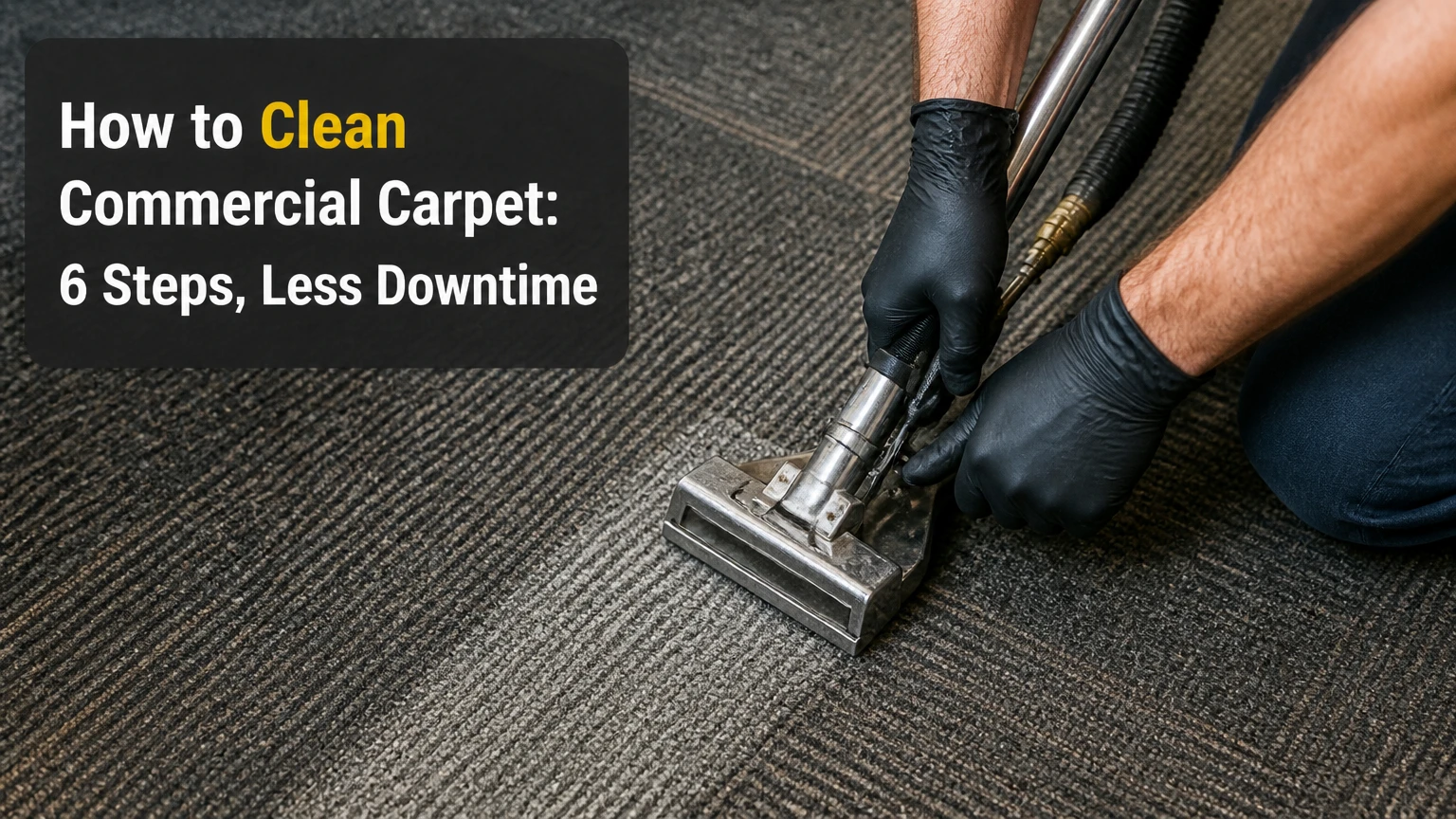
To clean commercial carpet, remove dry soil first, pre-treat spots, apply a compatible pre-spray, agitate, extract or encapsulate the suspended soil, and dry the carpet rapidly with airflow. A six-step maintenance clean typically takes 2-6 hours including drying, while restorative hot water extraction can require 6-12 hours of drying; carpet construction and moisture control determine the result.
Key Facts at a Glance
- Commercial carpet cleaning works by combining time, agitation, chemical action, and temperature, commonly called TACT.
- Thorough vacuuming before moisture enters the carpet prevents dry soil from becoming extractable mud.
- Encapsulation usually dries in 1-2 hours, while hot water extraction commonly needs 4-12 hours.
- Hot water extraction removes more embedded soil than bonnet cleaning, but it creates greater moisture and downtime requirements.
- Carpet manufacturer instructions override generic pH, pressure, temperature, and chemical recommendations.
- Commercial carpet should be tested for fiber, dye stability, backing, adhesive, and moisture tolerance before full cleaning.
What does commercial carpet cleaning involve?
Commercial carpet cleaning is the controlled removal of particulate soil, oils, stains, allergens, and residues from carpet installed in offices, retail locations, hotels, schools, healthcare buildings, and other high-traffic facilities. Most commercial carpeting uses solution-dyed or conventional nylon, polypropylene, polyester, or wool blends in loop, cut-pile, tile, or glue-down construction.
Commercial carpet differs from residential carpet in more than density. Glue-down broadloom and carpet tile may have thin backing, pressure-sensitive adhesive, or latex adhesive that can soften, delaminate, ripple, or release when saturated. Low-pile loop carpet also responds poorly to aggressive rotary brushing or abrasive bonnet pads.
Inspect the floor before selecting a method. Record fiber type, pile construction, backing, installation date, visible damage, traffic lanes, furniture, electrical outlets, and areas with previous water intrusion. Check the carpet manufacturer’s maintenance guide and warranty conditions, because a generic cleaning formula can void warranty coverage even when the visible result initially looks acceptable.
Why does TACT determine the cleaning result?
TACT means time, agitation, chemical action, and temperature. Commercial carpet cleaning succeeds when these variables are balanced, so a technician can often reduce heat or moisture by increasing dwell time and mechanical agitation rather than treating every soil load with more water.
Chemical action suspends oily soil. Time allows the pre-spray to work. Agitation separates soil from fibers and distributes chemistry. Temperature accelerates many cleaning reactions, although excessive heat can damage dyes, adhesives, backing, or sensitive fibers.
The four variables are adjustable. A lightly soiled office may need low-moisture encapsulation, moderate agitation, and short dwell time. A greasy restaurant corridor may need a stronger degreasing pre-treatment, longer dwell time, controlled hot water extraction, and several dry vacuum passes.
The sequence matters as much as the ingredients. Applying liquid over unremoved dust converts loose particulate into a wet soil mass that can migrate toward the backing and become harder to remove.
What should you do before cleaning commercial carpet?
Before cleaning commercial carpet, identify the carpet system, remove movable obstacles, protect occupants, read chemical safety data, and perform a small test. A typical preparation period is 20-45 minutes per 1,000 square feet, depending on furniture, access, and contamination.
Before-you-start checklist
| Requirement | Typical specification | Why it matters |
|---|---|---|
| Work area | 500-5,000 sq. ft. sections | Limits open-floor disruption |
| PPE | Nitrile gloves, eye protection, closed shoes | Reduces chemical and slip exposure |
| Vacuum | Commercial upright or backpack vacuum | Removes particulate soil before wet work |
| Air movement | 1 air mover per 500-1,000 sq. ft. | Shortens drying time |
| Test area | 12 x 12 inch inconspicuous section | Checks dye bleed and fiber response |
| Moisture plan | Occupant barriers and warning signs | Prevents slips and traffic damage |
Use an SDS for every concentrated chemical. Never mix acid rinse with alkaline prespray in a container, and never combine oxidizers with ammonia, chlorine products, or unknown formulations. Keep cords away from wet areas, isolate electrical equipment from spray, and provide ventilation when a product label requires it.
A pre-inspection should identify urine contamination, mold, adhesive failure, carpet delamination, permanent wear, and color loss. Cleaning cannot restore fiber that has been crushed, abraded, chemically bleached, or permanently stained.
Step 1: Remove dry soil with thorough vacuuming
Vacuum the entire area slowly in two directions before applying liquid. Use overlapping passes, concentrate on entrances and traffic lanes, and empty the vacuum before airflow drops; the success checkpoint is visibly reduced grit and a vacuum canister or bag containing dry particulate rather than only lint.
A commercial vacuum with strong airflow and a sealed filtration system is more important than a marketing label alone. HEPA filtration can reduce exhaust particulate when the machine is correctly sealed, but it does not compensate for a blocked filter, worn brush, or rushed operator.
Vacuum edges, under desk fronts, mat boundaries, and corners with a crevice or edge tool. Move lightweight chairs and wastebaskets so soil is not left in a rectangular outline around furniture. Do not saturate a heavily soiled carpet simply because the surface looks dusty.
Common mistake: using one fast pass over the middle of the room.
Correction: reduce walking speed, overlap each pass by approximately one-third, and make additional passes on entry lanes where grit acts like sandpaper against the pile.
How much soil can vacuuming remove?
A typical commercial maintenance program removes a large majority of loose surface particulate before wet cleaning, but the exact percentage depends on pile height, vacuum airflow, soil type, and frequency. The often-repeated “80 percent” figure is an operational estimate, not a universal measurement for every carpet.
The Carpet and Rug Institute places regular vacuuming at the center of carpet maintenance because dry soil causes abrasive wear. That principle has a practical consequence: more frequent vacuuming often extends appearance life more effectively than more frequent restorative extraction.
Step 2: Pre-treat stains according to soil type
Blot or scrape solid contamination, identify the stain category, apply the smallest effective amount of spotter, and allow about 5-10 minutes of dwell time when the product label permits. The checkpoint is a softened or visibly transferred stain with no dye bleeding; the mistake is rubbing aggressively before testing.
Use a white towel for transfer testing. Apply product to the towel or lightly to the stain, work from the outside toward the center, and extract or blot the dissolved soil rather than spreading it outward.
| Soil or stain | First treatment | Typical dwell | Main caution |
|---|---|---|---|
| Coffee or tea | Neutral detergent, then mild oxidizer if approved | 5-10 minutes | Heat can set some dyes |
| Grease or food oil | Alkaline detergent or labeled degreaser | 5-15 minutes | Rinse residue completely |
| Gum | Freeze aerosol or gel solvent | 1-3 minutes | Scrape without cutting fibers |
| Ink | Manufacturer-approved solvent spotter | 2-5 minutes | Test dye stability first |
| Protein or urine | Enzyme product labeled for carpet | 10-20 minutes | Avoid hot water before treatment |
Stain chemistry has limits. Bleach marks, permanent dye loss, rust migration, fiber-tip damage, and stains that have chemically altered the carpet cannot always be removed. A professional should document those conditions before promising restoration.
Expert rule: use the least aggressive chemistry that can dissolve the soil. Escalating from mild detergent to solvent or oxidizer is safer than starting with the strongest product.
Step 3: Apply a compatible pre-spray
Apply a diluted carpet prespray evenly across a manageable section, following the product label for dilution and coverage. Typical coverage is 500-1,000 square feet per gallon of ready-to-use solution, but concentrated products vary widely; the checkpoint is uniform dampness without puddling or saturation.
Use a pump-up, electric, or battery sprayer with a calibrated output. Keep spray away from walls, wood, unsealed stone, electrical equipment, and furniture legs. Folded towels or foil tabs can protect vulnerable furniture feet from moisture and dye transfer.
Alkaline presprays often work well on synthetic commercial carpet with oily traffic soil, but higher pH does not automatically mean better cleaning. Wool and other protein fibers generally need near-neutral chemistry, and some commercial carpet tile systems specify restricted pH ranges.
Allow label-directed dwell time, commonly 5-15 minutes. Do not let the prespray dry on the carpet, especially near sunny windows or HVAC outlets. If the section begins drying before agitation, lightly adjust the work sequence rather than flooding the area.
Step 4: Agitate the carpet without damaging the pile
Agitate the prespray with a counter-rotating brush machine, cylindrical brush machine, or suitable rotary machine at the manufacturer’s recommended speed. The checkpoint is even soil suspension and consistent pile appearance; the mistake is using an aggressive pad or brush that fuzzes loop tips.
A CRB machine is useful on many low-pile commercial carpets because counter-rotating brushes distribute chemistry and lift compacted soil with less operator effort. Rotary equipment can be effective, but brush pressure, pad selection, speed, and dwell control become more important.
Avoid standard rotary bonnet work on delicate loop pile unless the carpet manufacturer approves the method. Abrasion can create fuzzing, tip blooming, or visible texture changes. Carpet tile with weak adhesive also requires controlled moisture and pressure.
Agitation should support chemistry, not replace it. If the machine is leaving visible brush tracks, reducing speed or pressure may improve appearance and reduce wear without sacrificing soil suspension.
Step 5: Remove suspended soil by extraction or encapsulation
Choose hot water extraction when embedded soil, grease, contamination, or periodic restorative cleaning requires maximum soil removal; choose encapsulation when rapid drying and routine appearance control matter more. The checkpoint is recovered solution that becomes progressively clearer and carpet that feels free of sticky residue.
Hot water extraction, often called steam cleaning, does not primarily clean with steam. The process applies heated solution and removes suspended soil through vacuum recovery. Water temperature, pressure, vacuum lift, wand speed, hose length, and the number of recovery passes determine moisture left in the carpet.
Use an acid rinse only when the carpet system and cleaning chemistry support it. An acidic rinse can reduce alkaline residue, but automatic acid use is poor practice when the manufacturer specifies a neutral detergent or when the stain chemistry requires another approach.
Make slow wet passes followed by multiple vacuum-only passes. Commercial glue-down carpet may tolerate moderate pressure, but manufacturer limits override generic figures; pressure above 400-500 PSI can increase risk on some systems, while excessive water can soften adhesive or damage backing.
Encapsulation uses a polymer detergent that surrounds suspended soil as the carpet dries. The dried crystals are removed during later vacuuming, so encapsulation requires excellent routine vacuuming and cannot substitute for periodic deep extraction in heavily soiled facilities.
Which commercial carpet cleaning method should you use?
The best commercial carpet cleaning method depends on soil depth, carpet construction, drying time, noise limits, and maintenance frequency. Encapsulation is usually the practical routine choice for offices and hotels, while hot water extraction is stronger for restorative work, food soil, and contamination that low-moisture methods cannot remove.
| Method | Typical production | Typical dry time | Soil removal | Best application |
|---|---|---|---|---|
| Encapsulation or VLM | 2,000-3,500 sq. ft./hour | 1-2 hours | Moderate, improves with vacuuming | Offices and hotel corridors |
| Hot water extraction | 500-1,200 sq. ft./hour | 4-12 hours | High | Periodic restorative cleaning |
| Bonnet cleaning | 1,000-2,000 sq. ft./hour | 1-3 hours | Surface-focused | Approved short-term appearance work |
| Dry compound | 1,000-1,500 sq. ft./hour | 0-1 hour | Moderate | Moisture-sensitive areas |
When is encapsulation the better choice?
Encapsulation is better when a facility needs low disruption, quick re-entry, and frequent appearance maintenance. The method uses less water than extraction, usually permits traffic within 1-2 hours, and suits synthetic low-pile carpet when the facility can vacuum regularly.
Encapsulation is not the best answer for heavy grease, urine saturation, flood residue, or deeply embedded soil in the backing. Polymer residue and crystallized soil still need removal, so weak vacuuming can create gradual buildup.
When should you use hot water extraction?
Hot water extraction is appropriate when soil is embedded, oily, biologically contaminated, or too substantial for low-moisture maintenance. Extraction also provides a useful periodic reset for carpet that has received months of encapsulation and routine vacuuming.
Hot water extraction creates the greatest operational burden. Typical drying takes 4-12 hours, and poor recovery can extend drying, create odor, promote wicking, or threaten adhesive integrity.
Is bonnet cleaning or dry compound cleaning enough?
Bonnet cleaning is mainly a surface-cleaning method and should not be presented as equivalent to restorative extraction. Friction transfers soil to an absorbent pad, but the pad must be changed frequently and the process can abrade loop pile.
Dry compound cleaning reduces liquid exposure and may suit locations that cannot tolerate wet floors. Its limitations include powder recovery, possible residue in dense pile, and weaker performance against dissolved grease or contamination below the surface.
Step 6: Dry the carpet and verify the result
Deploy air movers immediately after wet cleaning, open safe airflow paths, and keep people off the carpet until the surface is dry. A typical commercial section dries in 2-6 hours with controlled moisture and airflow, although humidity, HVAC operation, backing type, and extraction quality can extend that window.
Position air movers so air travels across the carpet rather than directly into walls or loose objects. Run HVAC dehumidification where available, and avoid turning off building ventilation during drying unless a facility safety protocol requires it.
Check the carpet at several points, including seams, edges, dense traffic lanes, and areas near walls. A moisture meter can compare cleaned carpet with an unaffected control area, but readings are meaningful only when the meter is suitable for the carpet construction and used consistently.
Success checkpoint: the carpet feels dry rather than cool or tacky, no transfer appears on a white towel, and the room has no rising damp odor.
Common mistake: leaving fans in one corner while assuming the whole floor receives equal airflow.
How often should commercial carpet be cleaned?
Commercial carpet commonly needs daily vacuuming in entrances and traffic lanes, weekly vacuuming across low-use areas, monthly or quarterly encapsulation in busy zones, and hot water extraction every 6-12 months. Restaurants, schools, healthcare facilities, and high-occupancy buildings may require shorter intervals.
| Facility type | Daily action | Routine cleaning | Restorative extraction |
|---|---|---|---|
| Corporate office | Entrance vacuuming | Encapsulation every 1-3 months | Every 6-12 months |
| Hotel corridor | Vacuum traffic lanes | VLM every 2-6 weeks | Every 3-6 months |
| School | Vacuum entrances and classrooms | Low-moisture cleaning monthly | During major breaks |
| Restaurant | Remove dry food soil | Degreasing every 1-4 weeks | Every 1-3 months |
| Healthcare facility | Zone-based vacuuming | Approved low-moisture program | Risk-assessed schedule |
Traffic counts matter more than the calendar. A small entrance can soil faster than a large conference room, so inspect appearance, soil load, odor, and vacuum recovery rather than scheduling every area identically.
What are the most common commercial carpet cleaning mistakes?
The most common mistakes are inadequate vacuuming, excessive prespray, poor chemical compatibility, insufficient extraction, aggressive agitation, and premature reopening. Each mistake either leaves soil behind or increases the chance of wicking, odor, pile damage, adhesive failure, or rapid resoiling.
| Failure | Likely cause | Immediate recovery |
|---|---|---|
| Sticky carpet | Excess detergent or incomplete rinse | Lightly rinse and increase vacuum passes |
| Stain returns | Wicking from backing or pad | Re-treat, extract lightly, dry with towel and airflow |
| Yellow or brown cast | Browning from cellulosic backing | Stop alkaline treatment and test an approved acid reducer |
| Ripples or buckles | Excess moisture or backing movement | Isolate area, dry rapidly, call installer if movement persists |
| Fuzzy traffic lane | Abrasive pad or brush | Stop agitation and document permanent fiber damage |
| Odor after cleaning | Slow drying or contaminated backing | Increase ventilation and assess hidden moisture |
The claim that most ripples will automatically disappear is unsafe. Some temporary movement may reduce as carpet dries, but persistent rippling can require professional restretching or replacement, especially when adhesive or backing has failed.
Wicking is not proof that the spot treatment was ineffective. A spill can reside below the visible pile, then travel upward as surface moisture evaporates. Controlled re-treatment and rapid drying may help, but repeated wetting can worsen the problem.
How should the process change by facility?
Facility conditions should determine the cleaning method, not the label “commercial.” Offices prioritize low disruption, restaurants prioritize degreasing, hospitals prioritize approved protocols and containment, and hotels prioritize fast drying in guest-facing corridors.
Offices and corporate buildings
Use frequent vacuuming, entry-mat maintenance, and encapsulation for routine appearance. Schedule extraction during evenings or weekends, then verify drying before the next work period.
Healthcare facilities
Follow the facility infection-control plan and chemical approvals. Carpet cleaning does not replace disinfection of hard surfaces, and antimicrobial additives should not be used unless the product label and facility protocol authorize the claim and application.
Hotels and hospitality venues
Use low-moisture cleaning for hallways and public spaces when occupancy leaves little drying time. Reserve extraction for planned closures or targeted spills, and keep response equipment available for beverage and food incidents.
Restaurants and food courts
Remove grease at the source with a compatible degreaser and adequate dwell time. Extraction usually outperforms bonnet cleaning when fats and food oils have migrated below the surface, but the floor must be isolated until fully dry.
How much does commercial carpet cleaning cost?
Typical commercial carpet cleaning costs range from $0.05-$0.25 per square foot, with smaller jobs often subject to a $150-$250 minimum charge. Actual pricing changes with furniture, stain treatment, access, after-hours labor, method, contamination, travel, and the required drying or protection plan.
| Job size | Typical price per sq. ft. | Typical service subtotal |
|---|---|---|
| Under 2,000 sq. ft. | $0.15-$0.25 | $150-$500 |
| 2,000-10,000 sq. ft. | $0.10-$0.14 | $200-$1,400 |
| 10,000-25,000 sq. ft. | $0.07-$0.10 | $700-$2,500 |
| Over 25,000 sq. ft. | $0.05-$0.09 | $1,250-$2,250+ |
These are typical planning ranges, not a universal price list. A quote should identify square footage, method, chemical treatment, furniture movement, drying equipment, stain limitations, and whether tax or after-hours access is included.
FAQ
Can I clean commercial carpet with a rental machine?
A rental extractor can handle a small, synthetic, glue-down area when the operator understands dilution, recovery, and drying. Rental machines are poor choices for wool, delicate loop pile, large facilities, heavily contaminated carpet, or areas where excessive moisture could affect adhesive.
How long should people stay off carpet after cleaning?
People should stay off extracted carpet until the surface is dry, commonly 4-12 hours, while encapsulation often permits re-entry after 1-2 hours. Place warning signs and barriers during drying because foot traffic can grind soil into damp fibers and create visible pathways.
Should commercial carpet be steam cleaned?
Commercial carpet may be cleaned with hot water extraction, which many people call steam cleaning, but the machine does not need to produce steam. Use extraction when deep soil removal outweighs drying time, and select low-moisture cleaning when rapid re-entry is the dominant requirement.
Can vinegar remove stains from commercial carpet?
Vinegar is not a universal commercial carpet stain remover and can create odor, alter dye appearance, or conflict with professional chemistry. Use a labeled carpet product matched to the stain and fiber, then rinse or extract according to the product instructions.
How do you prevent commercial carpet from re-soiling quickly?
Prevent rapid resoiling by removing dry soil, applying the correct chemical dilution, avoiding over-application, and completing adequate recovery passes. Clean entry mats and hard-surface transitions because outdoor grit often causes faster carpet wear than the cleaning schedule can correct.
When should a professional stop cleaning and recommend replacement?
A professional should stop when testing reveals unstable dye, delamination, failing adhesive, severe backing damage, permanent bleaching, mold contamination, or structural rippling. Cleaning can remove soil, but it cannot rebuild missing fiber, restore lost color, or reliably repair failed carpet construction.
The Bottom Line
The safest way to clean commercial carpet is to vacuum thoroughly, test the carpet system, treat stains selectively, apply controlled chemistry, agitate with a compatible machine, remove suspended soil, and dry the floor before reopening it. Use encapsulation for frequent low-disruption maintenance and hot water extraction for periodic deep cleaning, while following the manufacturer’s limits for every fiber, backing, adhesive, temperature, and pressure setting. Properly planned how to clean commercial carpet procedures protect appearance, indoor operations, and carpet service life.