To clean polyester carpet, vacuum slowly, blot spots, pre-treat oily soil, then use low-agitation hot-water extraction with a low-residue detergent and strong suction. Keep the solution within the carpet manufacturer’s temperature limit, avoid soaking the backing, and dry the carpet completely with airflow. The safest process takes about 30 minutes of cleaning plus 2-12 hours of drying.
Key facts
- Polyester carpet is usually PET, or polyethylene terephthalate, a synthetic fiber that resists water-based staining but attracts oily soil.
- Slow vacuuming with the rotating brush disabled reduces abrasive grit and fuzzing on soft polyester pile.
- Hot-water extraction is suitable for many polyester carpets, but the manufacturer’s care label controls temperature, chemistry, and moisture limits.
- Low-residue detergent and complete rinsing matter more than a large quantity of soap.
- Typical drying takes 2-6 hours with fans and up to 12 hours in humid, poorly ventilated rooms.
- A polyester fiber can survive higher temperatures than the installed carpet system, so fiber melting point is not a safe operating setting.
What makes polyester carpet different?
Polyester carpet is commonly made from PET fiber, a smooth synthetic material with low water absorption and strong resistance to many water-based spills. The same fiber is oleophilic, meaning body oils, cooking grease, cosmetics, greasy pet residue, and oily outdoor soil adhere readily to its surface.
The practical consequence is uneven. A polyester carpet can look clean after a water-only rinse while retaining a gray, sticky film in traffic lanes. Conversely, aggressive scrubbing can roughen the pile, flatten low-resilience tufts, and create a fuzzy appearance that no detergent can reverse.
Polyester is also less resilient than nylon. Heavy furniture and repeated footsteps can crush the pile, especially in plush or high-softness styles. Cleaning can lift damp fibers temporarily, but it cannot restore permanently distorted yarn or repair delamination beneath the carpet.
Check the carpet before applying anything
Find the manufacturer’s label, warranty instructions, or installation paperwork before deep cleaning. Confirm whether the carpet is PET polyester, a polyester blend, a printed carpet, or a specialty construction such as a shag, loop, or attached-pad product.
Test every chemical in an inconspicuous corner. Apply a small amount, blot with a white cloth, and inspect the cloth and carpet after drying. Color transfer, browning, texture change, or sticky residue means the product or process is unsuitable.
Which method is best for polyester carpet?
Hot-water extraction is usually the best deep-cleaning method for polyester carpet when the equipment provides strong suction and the carpet manufacturer permits water extraction. Encapsulation is better for light to moderate soil when fast drying matters, while traditional rotary shampooing is generally a last choice because excessive agitation and detergent residue encourage rapid re-soiling.
| Method | Typical moisture and time | Best use | Main limitation |
|---|---|---|---|
| Hot-water extraction | 20-40 minutes per 12 x 12-foot room; 2-12 hours drying | Deep soil, oily traffic lanes, embedded pet residue | Over-wetting can affect pad and backing |
| Encapsulation | 30-60 minutes drying; 1-2 hours total labor | Light commercial or household soil between deep cleans | Limited removal of saturated oil and urine |
| Dry compound | 30-60 minutes before vacuuming | Low-moisture maintenance and delicate installations | Requires thorough post-vacuuming |
| Rotary shampoo | 30-45 minutes cleaning; 6-24 hours drying | Surface brightening by trained operators | Brush damage, foaming, and sticky residue |
| Hand spot treatment | 5-20 minutes per spot | Fresh spills and small isolated marks | Cannot flush deep contamination from padding |
Hot-water extraction does not necessarily use steam. Most portable and truck-mounted systems inject heated solution and immediately recover it with vacuum. “Steam cleaning” is common consumer language, but the actual process is controlled hot-water extraction.
Can polyester carpet be steam cleaned?
Polyester carpet can often be cleaned with a hot-water extraction machine, but the care label and equipment instructions determine the safe setting. Do not use an unregulated steam wand directly on the pile, because concentrated heat and moisture can distort yarn, loosen adhesive, discolor backing, or drive water into the cushion.
The 150°F limit sometimes repeated online is not a universal polyester-fiber limit. PET melts at a much higher temperature than ordinary extraction solution, yet carpet backing, dyes, latex, adhesives, and manufacturer warranties can have lower limits. Use the lowest solution temperature that removes the soil effectively, and follow the carpet manufacturer’s published instructions.
What do you need before cleaning?
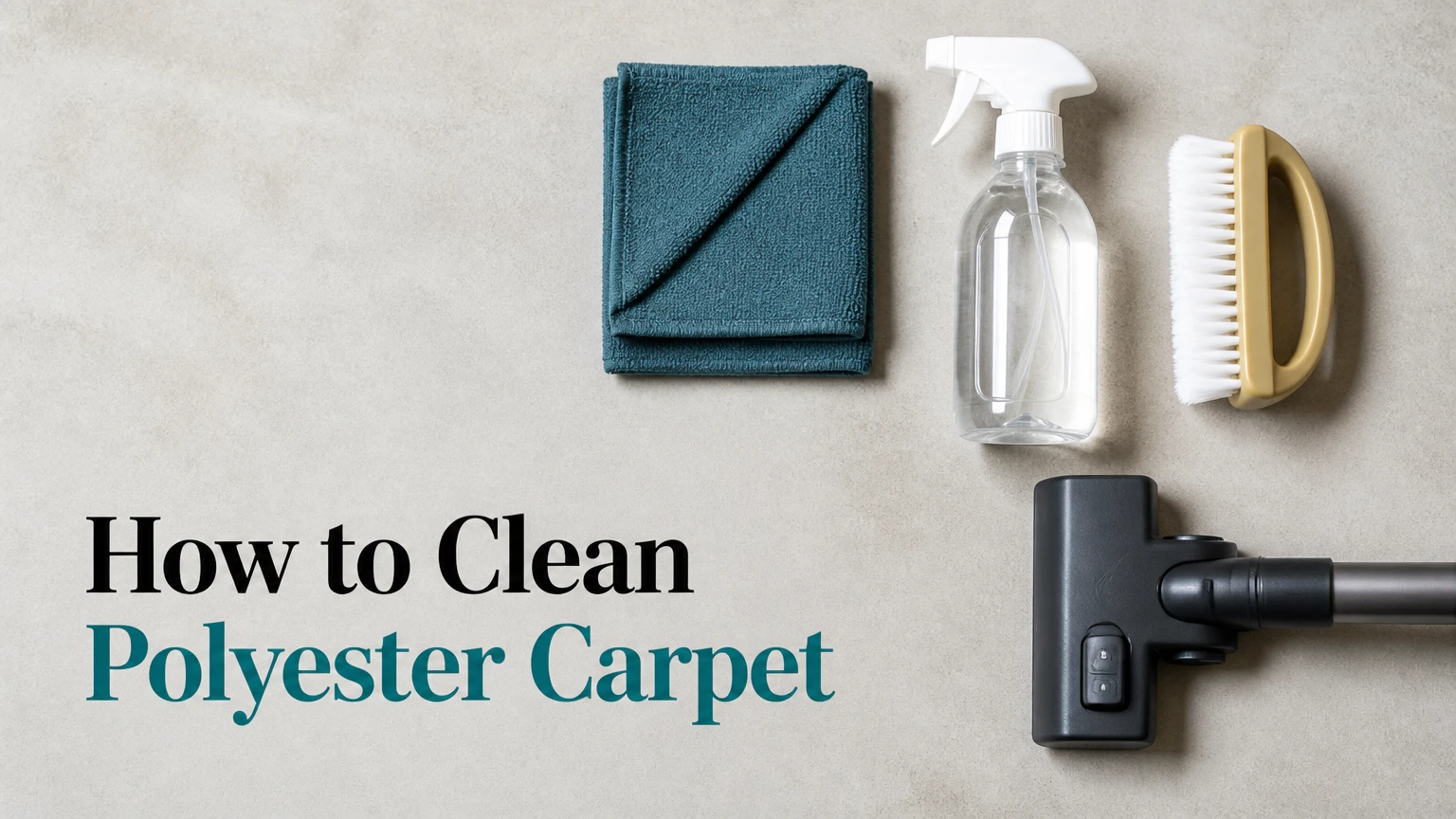
A typical 12 x 12-foot polyester carpet requires 30-45 minutes of preparation and extraction, a machine, measured low-residue detergent, white towels, a pump sprayer, fans, and a vacuum. The direct cost is commonly $5-$15 for consumables at home, $35-$70 for a rental, or $40-$90 per professionally cleaned room.
Before you start
| Item | Typical specification or quantity | Purpose |
|---|---|---|
| Vacuum | Adjustable height; brush roll off or gentle setting | Removes abrasive dry soil |
| Extraction machine | Portable extractor or truck-mounted unit | Rinses and recovers dissolved soil |
| Carpet detergent | Manufacturer-approved synthetic-safe formula; label dilution | Suspends soil without excess residue |
| White microfiber towels | 6-12 towels for one room | Blotting and transfer testing |
| Pump sprayer | 1-2 liters, clean and labeled | Even pre-treatment application |
| Air movers or fans | 1 fan per 150-300 square feet | Speeds evaporation |
| Plastic tabs or foil | 4-8 pieces under furniture legs | Prevents dye or rust transfer |
| Protective gloves | Nitrile or equivalent | Reduces skin contact with chemicals |
Remove small furniture, toys, and floor-level objects. Place foil or plastic tabs under furniture that must remain, and do not replace heavy items until the carpet and pad are dry.
How to clean polyester carpet step by step
The following process suits general soil and many ordinary spills. Pet urine saturation, dye transfer, severe browning, and carpet with unknown fiber content require a modified approach or professional inspection.
Step 1: Identify the fiber and test the process
Read the label and test the detergent, spotter, and extraction method in a hidden area. Allow the test patch to dry before judging color or texture, because wet polyester can appear darker and temporarily matted.
You will know it worked when the dried test patch matches the surrounding carpet and the white towel shows no dye transfer. A common mistake is testing only for immediate color change while ignoring sticky residue that appears after drying.
Step 2: Vacuum slowly and thoroughly
Vacuum the room in two directions, making 2-4 slow passes over traffic lanes and one pass over lightly used areas. Use a high-suction vacuum with the brush roll off when the pile is delicate, looped, heavily crushed, or visibly fuzzy.
Vacuum edges with a crevice tool, then remove the dry soil from the machine before wet cleaning. Grit left in the pile becomes an abrasive paste during extraction.
You will know the step is complete when the vacuum collects little additional soil and no loose debris remains along baseboards. The common mistake is moving quickly; one slow pass often removes more dry particulate than several fast passes.
Step 3: Blot fresh spills immediately
Lift solids with a spoon and blot liquid from the outside edge toward the center using a dry white towel. For a water-based spill, apply a small amount of cool or lukewarm water, blot again, then use a diluted neutral carpet spotter if the mark remains.
Do not pour a cup of water onto a tablespoon-sized stain. Use enough solution to dampen the fibers without wetting the backing, normally 15-30 milliliters for a small spot.
You will know it worked when the towel absorbs color or moisture without spreading the mark. Rubbing is the common mistake because it drives the contaminant sideways and roughens the polyester tips.
Step 4: Pre-treat oily traffic lanes
For body oil, grease, cosmetics, or dark traffic lanes, apply a synthetic-safe alkaline carpet pre-spray according to its label, commonly at 30-60 milliliters per square meter. Allow 5-10 minutes of dwell time, keeping the area damp but never flooded.
Agitate only with a soft carpet brush or gentle grooming tool when the manufacturer permits it. Low mechanical action gives the chemistry time to suspend oil without cutting or fuzzing the pile.
You will know the pre-treatment is working when the surface film feels less tacky and the damp fibers release soil onto a white towel. The common mistake is using household dish soap at full strength; its surfactants are difficult to rinse and can leave an oil-attracting film.
Step 5: Extract with measured solution
Fill the machine with warm water and the exact detergent dose printed for that machine. Make one controlled wet pass, then two or three slow suction-only passes over the same strip. Overlap adjacent strips by approximately 2-3 inches.
Keep the machine moving while the spray is active. Do not stop with the trigger held down, and do not repeatedly wet a stain that has already released its soil.
You will know it worked when the carpet looks evenly damp rather than saturated, the recovery tank contains visibly soiled water, and no standing moisture remains. The common mistake is maximizing detergent or spray volume; extra chemistry increases residue without improving recovery.
Step 6: Rinse when the detergent requires it
If the pre-spray or extraction detergent instructions call for rinsing, make a separate pass with clean water or the approved acid-side rinse. Use enough water to remove residue, followed by several dry passes, rather than repeatedly applying concentrated soap.
Do not mix products in the machine tank unless the manufacturer explicitly permits the combination. Alkaline pre-sprays, acidic rinses, oxidizers, solvents, and enzymes have different compatibility and safety requirements.
You will know the rinse is sufficient when the dried carpet does not feel stiff, crunchy, or tacky under a clean hand. The common mistake is skipping the rinse because the carpet looks bright while wet.
Step 7: Dry the carpet completely
Set fans to move air across the carpet, open windows when outdoor humidity is lower, and run air conditioning or a dehumidifier when practical. Keep foot traffic off the carpet until it is dry, because damp polyester pile marks easily and transfers soil from socks and shoes.
Typical drying times range from 2-6 hours with active airflow to 8-12 hours in a closed, humid room. A pad that remains wet beyond 24 hours indicates over-wetting, poor extraction, inadequate airflow, or a water-retaining installation problem.
You will know the job is complete when the carpet feels room-temperature and dry at the pile base, not merely dry at the tips. The common mistake is replacing furniture or closing the room while the cushion is still damp.
Step 8: Groom and inspect after drying
Use a soft nylon grooming brush or carpet rake only if the manufacturer permits it, and groom in the pile direction. Inspect under natural light for wicking, browning, sticky areas, or remaining oily lanes.
A clean carpet should have consistent texture and no detergent tack. Grooming can improve temporary crushing, but it cannot repair melted, chemically damaged, or permanently flattened fibers.
Which cleaning solution should you use?
Use a low-residue carpet detergent labeled for synthetic fibers, diluted exactly as directed by the product manufacturer and extraction machine manufacturer. Neutral or moderately alkaline carpet chemistry can remove ordinary soil and oils, but household mixtures are less predictable because concentration, surfactant load, dyes, and rinsability vary.
| Soil or stain | First treatment | Dwell or contact time | Avoid |
|---|---|---|---|
| Coffee, tea, juice | Blot, then cool water and neutral spotter | 1-3 minutes | Hot water before blotting |
| Body oil or grease | Synthetic-safe alkaline pre-spray | 5-10 minutes | Full-strength dish soap |
| Mud | Let dry, vacuum, then spot clean | 2-5 minutes | Wet-vacuuming fresh mud |
| Pet urine | Blot, extract, then use labeled enzyme product | Product label, often 10-15 minutes | Chlorine bleach and ammonia |
| Ink or dye | Professional solvent or dye specialist | Product-specific | Vinegar experiments |
| Candle wax | Harden, lift, then treat remaining film | 1-5 minutes | Scraping with a blade |
White vinegar is not a dependable universal polyester-carpet cleaner. Diluted vinegar may help with a limited alkaline residue, but it does not dissolve most bonded grease as effectively as a formulated solvent or alkaline pre-spray, and acidic mixtures can interact poorly with dyes, backing, or other products.
Never combine bleach with ammonia, acids, or unknown cleaners. Avoid hydrogen peroxide unless the carpet manufacturer and product label permit it, because oxidizers can lighten colored polyester carpet even when the fiber itself is chemically resistant.
How should you handle pet urine and odor?
Pet urine requires removal of both the liquid contamination and the odor compounds that have penetrated the pile, backing, and sometimes the cushion. Blotting and surface extraction can improve a fresh accident, but repeated or large urine deposits often require inspection, enzyme treatment, subsurface extraction, or replacement of contaminated pad.
For a fresh spot, absorb as much liquid as possible with towels, apply a labeled enzyme product at its stated coverage rate, allow the full contact time, and extract with clean water if the label directs rinsing. Keep pets away until the area is dry.
A black-light inspection can locate older deposits, but fluorescence is not proof of urine and can also reveal cleaners or optical brighteners. Strong odor after drying usually indicates contamination below the visible pile, not a need for more surface fragrance.
How do polyester cleaning methods compare?
Hot-water extraction provides the strongest soil recovery when suction is adequate, but encapsulation or dry compound cleaning may be better for maintenance programs that cannot tolerate long drying. Shampooing can brighten a heavily soiled surface, yet it carries the greatest residue and agitation risk for soft polyester installations.
| Decision factor | Hot-water extraction | Encapsulation | Dry compound | Shampooing |
|---|---|---|---|---|
| Deep oily soil | High removal with pre-spray | Moderate | Low to moderate | Moderate |
| Typical drying | 2-12 hours | 30-60 minutes | 30-60 minutes before vacuuming | 6-24 hours |
| Agitation level | Low to moderate | Low to moderate | Low | Moderate to high |
| Residue risk | Low with correct rinse | Moderate if over-applied | Powder residue if poorly vacuumed | High |
| Home equipment cost | $35-$70 rental | $20-$60 product or machine | $15-$40 product | $35-$100 machine |
| Best setting | Periodic restorative cleaning | Frequent maintenance | Moisture-sensitive rooms | Trained commercial operator |
The best choice depends on soil load, ventilation, backing condition, and the manufacturer’s instructions. A lightly soiled rental apartment may need encapsulation, while a greasy family-room traffic lane generally benefits from pre-spray and extraction.
What mistakes damage polyester carpet?
The most damaging mistakes are over-wetting, excessive agitation, high-concentration detergent, unsafe spotting chemicals, and premature traffic. These failures affect different parts of the carpet system, so the visible symptom does not always identify the original cause.
- Over-wetting: Water reaches the cushion or backing, extending drying beyond 24 hours and increasing the risk of odor, delamination, browning, or microbial growth.
- Aggressive brushing: Stiff bristles split or fuzz soft polyester tips and can distort looped construction.
- Excess detergent: Residue remains tacky, then attracts oily soil and creates dark traffic lanes within days or weeks.
- Uncontrolled heat: A hot wand or boiling solution can distort yarn, dyes, latex, and adhesive even when the PET fiber itself has a higher thermal tolerance.
- Bleach and strong oxidizers: Colored polyester can lose dye permanently; cleaning cannot restore missing color.
- Repeated wetting: Multiple passes over one mark can push contamination into the backing instead of removing it.
- Furniture replacement while damp: Wood stains, rust, dye transfer, and crushing can appear before the carpet dries.
A useful practitioner rule is to increase dwell time and recovery before increasing agitation. Chemical contact plus suction usually removes more polyester soil with less surface damage than scrubbing harder.
How do you fix recurring stains, matting, and oily lanes?
Recurring stains usually result from wicking, while permanent texture changes result from crushing, heat, or fiber damage. Wicking can often be reduced by controlled re-cleaning and absorbent towels; permanently altered color or yarn cannot be corrected by stronger chemicals.
Fix stains that return after drying
Lightly re-treat the spot with the appropriate product, extract with minimal moisture, and place a clean white towel over it while damp. Weight the towel with a flat, non-dyeing object for several hours, replacing it when wet.
The towel draws dissolved soil upward before it dries at the fiber tips. Do not saturate the whole area in an attempt to flush a backing stain from a carpet with unknown moisture tolerance.
Fix crushed or matted pile
Vacuum first, then groom gently while the carpet is slightly damp. For a small crushed area, controlled warm air from a household hair dryer held well away from the fibers can help relax pile, but direct high heat risks distortion.
Heavy furniture compression may be permanent, especially in low-resilience polyester plush. A carpet rake can improve alignment; it cannot rebuild broken or stretched yarn.
Fix persistent greasy traffic lanes
Apply a labeled carpet pre-spray or solvent designed for synthetic carpet, allow the stated dwell time, and perform a careful extraction with a clean rinse. If two controlled treatments fail, the lane may contain permanent dye change, wear, or deeply contaminated cushion.
Citrus solvents are not automatically safer. Some leave oily residues, affect backing adhesives, or damage stain-resistant treatments, so ventilation, spot testing, and label compliance are mandatory.
How often should polyester carpet be cleaned?
Most polyester carpet needs thorough vacuuming at least twice weekly in active zones and deep cleaning every 6-12 months in homes with children, pets, or outdoor soil. A lightly used room may need extraction every 12-18 months, while visible oily lanes or recurring odor justify earlier treatment.
| Household condition | Vacuum frequency | Deep-clean interval | Professional trigger |
|---|---|---|---|
| One or two adults, shoes removed | 1-2 times weekly | 12-18 months | Persistent spots or odor |
| Children or frequent visitors | 2-4 times weekly | 6-9 months | Traffic lanes remain gray |
| Indoor pets | 3-5 times weekly | 6 months | Urine reaches pad |
| Allergy-sensitive occupants | 2-4 times weekly | About 6 months | Dust remains after vacuuming |
| Rental or move-out cleaning | Before inspection | As required by lease | Stains, odor, or large area |
A cleaning schedule should respond to soil, not a calendar alone. Excessive wet cleaning shortens service life when each cycle leaves moisture or residue behind.
When should you hire a professional?
Hire a professional carpet cleaner when urine has reached the pad, the carpet has extensive oily soil, a large area is saturated, dye has transferred, the backing is loose, or the care instructions require commercial equipment. A truck-mounted extractor usually provides greater vacuum recovery than a small rental machine, but operator technique still determines the result.
Typical professional pricing is $0.20-$0.50 per square foot or $40-$90 per room, with a three-bedroom home often quoted around $150-$250 depending on location, furniture, stairs, stain treatment, and minimum service charges. Rental extraction commonly costs $35-$70 per day before detergent, transportation, and optional upholstery tools.
Ask the cleaner for the method, detergent type, expected drying time, furniture protection plan, and whether stain treatment costs extra. A low quote that omits pretreatment, rinsing, or drying guidance may not represent the same service.
Can polyester carpet cleaning void a warranty?
Improper cleaning can affect a carpet warranty when the owner ignores the manufacturer’s maintenance instructions, uses unapproved chemicals, damages the backing, or fails to retain service documentation. The warranty language, not a generic internet temperature number, controls the requirement.
Keep receipts for professional cleaning, record the detergent name and dilution used for DIY work, and photograph pre-existing damage. Never assume a stain-removal promise means the original color, texture, or backing condition can be restored.
FAQ
Can I use a carpet cleaner rental on polyester carpet?
Yes, a rental extractor can clean polyester carpet when the label permits water extraction and the operator controls moisture. Vacuum first, use the machine’s recommended synthetic-safe detergent, make more suction passes than wet passes, and dry with fans. Rental machines often recover less water than truck-mounted units, so over-wetting is easier.
Is baking soda safe for polyester carpet?
Dry baking soda is generally less chemically aggressive than bleach or strong solvents, but it is not a substitute for extraction and can remain embedded in dense pile. If used for odor, apply a thin layer, vacuum slowly and repeatedly, and avoid it on damp carpet, where residue can cake in the backing.
Can polyester carpet shrink?
Installed polyester carpet is unlikely to shrink from a correctly performed extraction, but excessive moisture can affect backing, seams, adhesive, and cushion. Shrinkage or edge movement usually indicates an installation or moisture problem rather than normal cleaning. Stop wet cleaning if seams lift, ripples appear, or the backing becomes soft.
Why does polyester carpet look dirty again after cleaning?
Rapid re-soiling usually comes from detergent residue, incomplete rinsing, oily contamination that was not pre-treated, or traffic on damp fibers. Re-clean with less detergent, improve dry suction passes, and allow complete drying. If gray lanes remain after residue removal, fiber wear or permanent discoloration may be involved.
Can I use a rotating brush on polyester carpet?
Use a rotating brush only when the carpet manufacturer permits it and the brush is soft enough for the construction. Low-agitation extraction is safer for plush, looped, or already fuzzy polyester. A stiff brush can distort pile and create visible texture damage even when the stain itself is removed.
How do I clean a polyester area rug?
Check whether the rug is machine-washable and whether its backing contains latex, jute, or adhesive. For a non-washable rug, vacuum gently, spot test, use minimal moisture, extract evenly, and dry it flat with airflow. Do not saturate a rug over wood flooring or leave the backing wet against the floor.
The Bottom Line
The safest way to clean polyester carpet is to remove dry grit first, treat oily soil with a measured synthetic-safe pre-spray, use low-agitation hot-water extraction when permitted, and recover nearly all applied moisture. Keep the carpet manufacturer’s temperature and chemical limits above generic advice, and give drying as much attention as the cleaning itself. For fresh small spills, blotting is usually enough; for urine, dye transfer, severe oil, or wet backing, professional treatment is the safer decision.