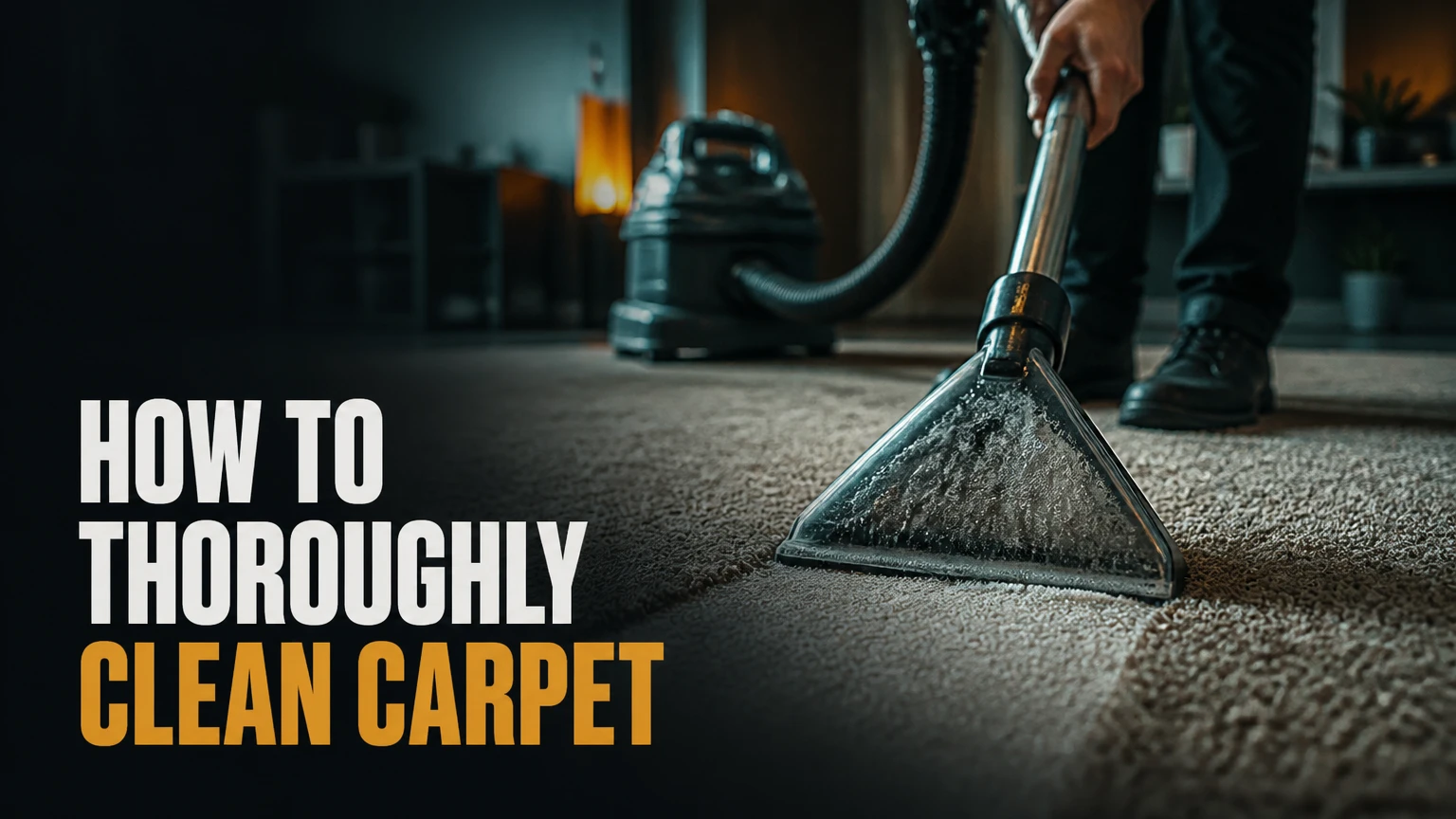
Carpet is thoroughly cleaned by removing dry soil first, dissolving oily residue with a fiber-safe pre-spray, agitating carefully, rinsing with controlled moisture, and drying the pile quickly. For most synthetic wall-to-wall carpet, the complete process takes 2-4 hours of work plus 6-12 hours of drying; the most important success factor is avoiding over-wetting.
Key facts at a glance
- Dry vacuuming should happen before any water or cleaning solution touches the carpet.
- A 10-15 minute pre-spray dwell time usually loosens oily traffic soil without allowing the solution to dry.
- Hot water extraction gives the deepest soil removal on moisture-tolerant synthetic carpet when the operator follows with dry vacuum passes.
- Wool, jute, sisal, silk, and carpet with unstable dye require a label check and usually specialist care.
- Carpet should feel dry, not cool or damp, before furniture returns, typically within 6-12 hours after careful extraction.
- More detergent does not produce a cleaner carpet; leftover surfactant can attract new soil.
How to thoroughly clean carpet safely
A thorough carpet cleaning follows five controlled stages: inspect, dry vacuum, pre-treat and agitate, extract and rinse, then groom and dry. The sequence matters because dry particulate soil is easier to remove before moisture binds it into mud, while pre-spray chemistry needs time and mechanical action before extraction can carry suspended soil away.
Carpet fibers react differently to water, heat, alkalinity, solvents, and agitation. Nylon and solution-dyed synthetic fibers generally tolerate more cleaning options than wool, viscose, jute, or sisal, but the manufacturer’s care label takes priority over a generic recipe. Test every chemical in a hidden area and stop if color transfers to a white cloth.
The underlying cleaning model is often called TACT: time gives chemistry a chance to work, agitation separates soil from fibers, chemical action suspends oils and particles, and temperature increases cleaning efficiency. Home equipment controls these variables less precisely than a truck-mounted system, so slower preparation and disciplined drying compensate for weaker suction.
Before you start
| Item | Typical quantity or setting | Purpose |
|---|---|---|
| HEPA or sealed vacuum | 2-4 slow passes per direction | Removes loose dry soil |
| Carpet pre-spray | Label dilution, usually 0.5-1 L per 10 m² | Suspends oily soil |
| White microfiber towels | 4-8 towels per room | Testing and blotting |
| Portable extractor | Fresh-water tank, clean filter, upholstery tool | Rinses and recovers solution |
| Carpet rake | 1 rake for each cleaned area | Aligns pile and exposes dampness |
| Air movers or fans | 1-2 per average room | Accelerates evaporation |
| Shoe covers or clean socks | 1 pair per person | Prevents re-soiling |
Remove toys, cables, pet bowls, floor lamps, and small furniture first. Place waterproof foil, plastic tabs, or furniture blocks under the legs of heavy items that cannot move. Do not put wood furniture directly onto wet carpet, because dyes or finishes can transfer while the floor remains damp.
Check the carpet label, identify visible stains, and photograph existing damage. Note loose seams, ripples, frayed edges, faded areas, and discoloration before cleaning. A cleaning process cannot restore fiber loss, sun fading, permanent dye damage, or backing failure.
Step 1: Inspect and dry-vacuum the carpet
Vacuum the entire carpet slowly before applying liquid, using overlapping passes in two directions and a crevice tool along edges. Dry vacuuming removes abrasive grit, hair, dust, and other particulate soil that would otherwise combine with pre-spray and form a harder-to-remove slurry.
Set the vacuum height so the brush contacts the pile without stalling. Make one north-south pass, then one east-west pass, moving at roughly 30-60 centimeters per second over visibly dirty lanes. Empty the canister or replace the bag when airflow drops, since weak suction leaves soil in the backing.
Use the crevice attachment around baseboards, stair edges, radiator covers, and beneath furniture edges. Vacuum pet-hair concentrations repeatedly rather than flooding them with cleaner. Hair and dry grit are mechanical contaminants; detergent does not dissolve them.
You’ll know Step 1 worked when: the vacuum collects noticeably less material on a second pass, and the pile does not release visible dust when lightly tapped.
Common mistake: using a fast single pass. Speed leaves embedded grit behind and forces the extractor to remove a larger wet soil load.
When should you stop and avoid DIY cleaning?
Stop before wet cleaning if the carpet has severe rippling, delamination, loose seams, active water damage, mold growth, unstable dye, or an unknown natural fiber. Professional inspection is also appropriate when urine has penetrated the pad, because surface cleaning may improve appearance while leaving odor compounds below the carpet.
Step 2: Pre-treat stains and allow controlled dwell time
Treat individual stains before applying general pre-spray, then apply the manufacturer-approved carpet pre-spray evenly to a manageable section. Allow approximately 10-15 minutes of dwell time, keeping the area wet but never allowing the solution to dry on the fiber.
Blot liquid spills with white towels first. Apply a small amount of spotter to the towel or stain, working from the outside toward the center. Do not combine products, especially oxidizers, acids, alkaline cleaners, ammonia, and bleach. Chemical mixing can damage fibers or generate hazardous vapors.
Match the product to the stain. An enzyme product is intended for protein-based pet residue, while a solvent-based product may address greasy contamination and an oxygen-based product may affect organic color stains. Product labels, fiber restrictions, and colorfastness testing matter more than a universal household formula.
For general soil, use the lowest effective label dilution. Excess detergent leaves surfactant in the pile, and that sticky residue can cause rapid re-soiling. A pump sprayer gives more even coverage than pouring solution from a bucket, where concentrated wet spots can penetrate the backing.
You’ll know Step 2 worked when: oily traffic lanes look slightly softened or gray rather than sharply crusted, and a white towel picks up soil without picking up carpet dye.
Common mistake: soaking stains until the backing is wet. Deep moisture increases wicking, odor, and drying risk without guaranteeing removal.
Step 3: Agitate without damaging the pile
Agitate the pre-sprayed carpet with a carpet rake, soft brush, or counter-rotating brush machine suited to the carpet construction. Work in small sections of about 2-4 square meters, using overlapping passes that distribute chemistry rather than grinding the pile.
Agitation helps surfactants surround oily soil so the extractor can suspend and remove it. Use lighter pressure on cut pile, loop pile, wool, and older carpet; aggressive brushing can fuzz cut fibers, snag loops, or spread a softened stain.
Never use a household rotary scrubber with a hard brush on carpet unless the manufacturer specifically permits it. A machine designed for hard floors can distort pile tips and drive liquid toward the backing. Manual agitation is slower but safer for a single room.
You’ll know Step 3 worked when: the pile feels evenly conditioned, traffic lanes lose some grayness, and no tufts or loops stand loose after brushing.
Common mistake: agitating a spot until it looks better while wet. Wet appearance can hide color loss and fiber distortion that becomes obvious after drying.
Step 4: Extract, rinse, and remove suspended soil
Fill the extractor with clean water and the correct rinse product at the label dilution, then clean one small section at a time. Make one slow wet pass, immediately followed by two or three slower vacuum-only passes; recovery quality depends more on moisture removal than on repeatedly spraying water.
Use warm water within the machine and carpet manufacturer’s limits. “Steam cleaning” is commonly used for hot water extraction, but a home extractor usually produces water extraction rather than true steam, and excessive heat can set some stains, distort fibers, or damage adhesives.
Keep the wand or machine moving while spraying. Overlap each pass by approximately 25 percent, and empty the recovery tank when suction changes or dirty water reaches the specified limit. Dirty recovery water confirms soil removal, but clear water alone does not prove that all residue is gone.
For a heavily soiled synthetic carpet, a second rinse pass with minimal moisture can remove remaining detergent. Do not keep flushing indefinitely. Once the recovered water is relatively clear and the carpet is visibly clean, additional water can create more drying risk than cleaning benefit.
You’ll know Step 4 worked when: the carpet has an even appearance, the extractor recovers visibly dirty water during early passes, and no section feels squelchy underfoot.
Common mistake: making many wet passes and too few dry passes. The result is overwetting, longer drying, possible odor, and moisture reaching the pad or backing.
Step 5: Groom and dry the carpet completely
Groom the pile in one direction, place fans or air movers across the surface, and improve ventilation with air conditioning or a dehumidifier. Carpet should dry within about 6-12 hours after careful residential extraction; 12-24 hours indicates unusually high humidity, dense pile, limited airflow, or excessive moisture.
Open windows only when outdoor air is drier than indoor air. In humid weather, a dehumidifier often works better than an open window. Keep household traffic off the carpet until it is dry, because footsteps can flatten damp pile and transfer soil into softened fibers.
Check the carpet at several points, including room edges and areas near furniture. The center may feel dry while the backing remains damp. Return furniture only after the carpet and protective blocks are dry, and avoid replacing rugs until the floor is fully moisture-free.
You’ll know Step 5 worked when: the carpet feels room-temperature and dry, has no musty odor, shows consistent pile direction, and does not leave moisture on a clean white towel pressed into the surface.
Common mistake: turning off airflow once the carpet looks dry. Moisture hidden near the backing can continue evaporating for hours.
What does each cleaning method suit?
Hot water extraction is usually the strongest choice for heavily soiled, moisture-tolerant synthetic carpet, while low-moisture methods suit routine maintenance and spaces that cannot remain closed. Dry compound cleaning protects water-sensitive fibers better, but it cannot match extraction for deeply embedded wet contamination.
| Method | Typical drying time | Best use | Main limitation |
|---|---|---|---|
| Hot water extraction | 6-12 hours | Heavy soil, allergens, annual deep cleaning | Overwetting if recovery is poor |
| Encapsulation cleaning | 20-60 minutes | Commercial interim cleaning, moderate soil | Requires thorough post-vacuuming |
| Dry compound cleaning | 0-2 hours | Sisal, jute, low-moisture settings | Limited deep soil removal |
| Bonnet cleaning | 30-90 minutes | Surface appearance in commercial areas | Can push soil toward the base |
| Portable shampoo extraction | 6-24 hours | Budget residential cleaning | Lower heat and suction than truck mounts |
Encapsulation uses a polymer detergent that dries into brittle crystals around soil, which regular vacuuming removes. The method is valuable for commercial corridors because it minimizes downtime, but it is not a substitute for periodic restorative extraction where sand, grease, or pad-level contamination has accumulated.
Bonnet cleaning is a surface process. It can brighten a commercial carpet quickly, yet repeated rotary action may distort cut-pile tips and leave deeper soil untouched. It is a poor choice when the objective is allergen, urine, or backing-level removal.
Which carpet fibers need different treatment?
Synthetic nylon, polyester, and polypropylene carpet generally tolerates controlled water extraction, but dye stability, backing construction, and stain-resistant treatments still determine the safe procedure. Wool and plant-based fibers require lower moisture, gentler agitation, and chemistry designed for natural fibers.
| Fiber or material | Typical tolerance | Preferred approach | Avoid |
|---|---|---|---|
| Nylon | Moderate-to-high moisture tolerance | Low-residue extraction after testing | Strong bleach and excessive heat |
| Polyester | High stain resistance, oily soil retention | Mild pre-spray and thorough rinse | Heavy detergent left in pile |
| Polypropylene | Good water tolerance | Controlled extraction and fast drying | High heat that may distort fiber |
| Wool | Low-to-moderate moisture tolerance | Wool-safe specialist cleaning | Strong alkali, saturation, hard brushing |
| Jute or sisal | Water-sensitive | Dry compound or specialist low-moisture work | Wet shampooing and prolonged dwell |
| Viscose or silk | Highly sensitive | Specialist assessment only | DIY extraction and aggressive agitation |
Natural fibers can shrink, bleed, brown, or distort when saturated. The broad pH ranges sometimes repeated online are not permission to use any product within those numbers; wool-safe product formulation, temperature, moisture level, and drying speed matter together.
Area rugs deserve separate caution. A rug may have a different backing, fringe, dye system, or construction from wall-to-wall carpet. Never assume a carpet extractor is safe for an oriental, hand-knotted, viscose, silk, or antique rug.
How much time and money does deep cleaning require?
A typical DIY deep clean costs $50-$90 for one rental day, including approximately $30-$50 for the machine and $20-$40 for cleaning solution. A professional residential visit commonly costs about $0.20-$0.50 per square foot, with a small-room minimum often increasing the effective price.
| Cleaning scenario | Typical labor time | Typical total cost | Drying window |
|---|---|---|---|
| One 12-by-12-foot room, DIY | 2-3 hours | $50-$90 | 6-12 hours |
| Two to three rooms, DIY | 3-5 hours | $70-$130 | 8-18 hours |
| Professional residential visit | 1-3 hours | $30-$80 per room | 6-12 hours |
| Commercial interim cleaning | Scheduled by area | $0.05-$0.15 per sq. ft. | 20-60 minutes |
| Professional wool or delicate rug | 1-3 weeks including handling | Quote required | Method-dependent |
Prices vary by region, stairs, furniture movement, stain treatment, minimum charges, and carpet condition. A low advertised room price may exclude urine decontamination, heavy furniture, protector, travel, or difficult access.
Professional equipment usually provides stronger heat, agitation, and vacuum recovery than rental equipment. DIY cleaning can be appropriate for one moderately soiled synthetic room, but professional work becomes more economical when the carpet is large, heavily contaminated, delicate, or difficult to dry.
Common mistakes and how to fix them
| Failure mode | What happened | Safer recovery |
|---|---|---|
| Musty smell | Pad or backing stayed damp | Increase airflow, run a dehumidifier, and inspect after 24 hours |
| Rapid re-soiling | Detergent residue remained | Perform a controlled low-moisture rinse, then extract thoroughly |
| Stain reappeared | Soil wicked upward from backing | Blot, extract the spot, apply a clean towel with weight, and dry rapidly |
| Brown or yellow marks | Cellulosic material or slow drying surfaced | Stop aggressive cleaning and request specialist treatment |
| Carpet rippled | Backing absorbed excessive moisture | Dry immediately and arrange professional carpet stretching if ripples persist |
| Color loss | Dye or finish reacted to chemistry | Stop treatment, rinse only if product instructions permit, and document damage |
Stain wicking occurs when moisture dissolves material below the visible stain and carries it toward the tips as the carpet dries. A clean towel weighted over the spot can absorb rising moisture, but repeated wetting usually worsens the cycle.
Brown discoloration is especially associated with cellulosic fibers, jute backing, high alkalinity, or slow drying. Household vinegar is not a universal neutralizer, and spraying acid onto an unknown carpet can create another chemical reaction. A trained technician should select any acidic browning treatment.
Ripples are not reliably solved by heating or waiting. Some carpet tightens as it dries, but persistent buckling usually requires professional power stretching, and severe backing failure may require replacement.
How should you clean carpet in special situations?
Pet urine and feces
Remove solids, blot liquid, and use a labeled enzymatic product compatible with the fiber. Surface extraction may remove odor temporarily, but urine that reaches the pad or subfloor often requires subsurface treatment or pad replacement.
Do not use ammonia-based cleaners on urine. The smell can resemble urine and may encourage repeat marking. Use a moisture meter or professional inspection when odor remains after the carpet surface is dry.
High-traffic apartment carpet
Use frequent dry vacuuming at entryways and weekly vacuuming elsewhere, then schedule low-moisture encapsulation when rapid reopening matters. Plan hot water extraction during a vacancy or when 6-12 hours of restricted access is practical.
Entry mats reduce the amount of grit reaching the carpet. They do not replace extraction, because oily residue and fine particles still accumulate in traffic lanes.
Wool, jute, silk, and expensive rugs
Avoid supermarket spotters unless the label explicitly approves the material. A specialist should inspect dye stability, construction, backing, fringe, and prior treatments before selecting low-pressure, low-temperature, or dry-cleaning methods.
Stairs and carpet near wood flooring
Use less solution on stair edges and protect adjacent wood with towels or plastic sheeting. Keep liquid away from tack strips, seams, vents, and floor transitions, where moisture can damage wood, adhesives, or metal fasteners.
How often should carpet be thoroughly cleaned?
Most residential carpet benefits from deep cleaning every 12-18 months, with shorter intervals for pets, children, allergies, entry-level traffic, or visible lane soil. High-traffic commercial carpet may need interim cleaning every 1-6 months and restorative extraction approximately annually.
A practical schedule combines daily or weekly dry soil removal with targeted spill treatment and periodic deep cleaning. Cleaning frequency should respond to measured soil, odor, appearance, occupant sensitivity, and manufacturer guidance rather than a fixed calendar alone.
Vacuum entryways and traffic lanes more often than low-use rooms. Replace or clean vacuum filters as directed, because restricted airflow reduces removal at the point where dry soil is easiest to capture.
FAQ
Can I thoroughly clean carpet without a machine?
Yes, a small area can be cleaned with dry vacuuming, fiber-safe spot treatment, towels, a soft brush, and careful low-moisture blotting. Hand cleaning is unsuitable for large or heavily soiled rooms because it provides weak extraction and can leave uneven moisture. Use a machine or hire a professional for broad-area rinsing.
Should I use hot water or cold water on carpet?
Use warm water within the carpet, equipment, and chemical manufacturer’s limits, rather than assuming the hottest water is safest. Excessive heat can affect dyes, adhesives, stain treatments, and natural fibers. Controlled temperature combined with dwell time, agitation, and strong recovery usually cleans better than heat alone.
Why does carpet look clean but smell after drying?
A smell after drying usually indicates residue, pet contamination below the surface, damp backing, or moisture trapped in the pad. Increase ventilation and dehumidification, then inspect the pad if odor remains after 24 hours. Additional detergent often worsens the problem by adding more residue.
Can baking soda deep-clean carpet?
Baking soda can absorb some surface odor, but it does not extract embedded soil or remove pad-level urine. Fine powder may also burden a vacuum or remain in dense pile. Dry vacuuming, appropriate spot chemistry, and extraction provide a more complete cleaning process.
Is carpet cleaning safe for babies and pets?
Carpet cleaning is generally safer when products are used at label dilution, the area is ventilated, and children and animals stay off the carpet until it is completely dry. Remove food and water bowls, prevent licking of damp fibers, and select low-residue products approved for the carpet material.
When should I hire a professional carpet cleaner?
Hire a professional for wool, silk, viscose, jute, severe urine, flooding, mold, unstable dye, extensive stains, ripples, or carpet covered across multiple rooms. Professional inspection is also worthwhile when the carpet warranty specifies hot water extraction or when rental equipment cannot remove moisture effectively.
The bottom line
Thoroughly clean carpet by inspecting the fiber, dry-vacuuming slowly, applying measured pre-spray for 10-15 minutes, agitating gently, extracting with one wet pass and two or three dry passes, then grooming and drying with airflow. For synthetic carpet, that sequence provides the best balance of soil removal and risk control. For wool, jute, silk, viscose, severe pet contamination, or damaged backing, professional cleaning is the safer choice. Use this process to thoroughly clean carpet without turning a cosmetic improvement into moisture, residue, or fiber damage.