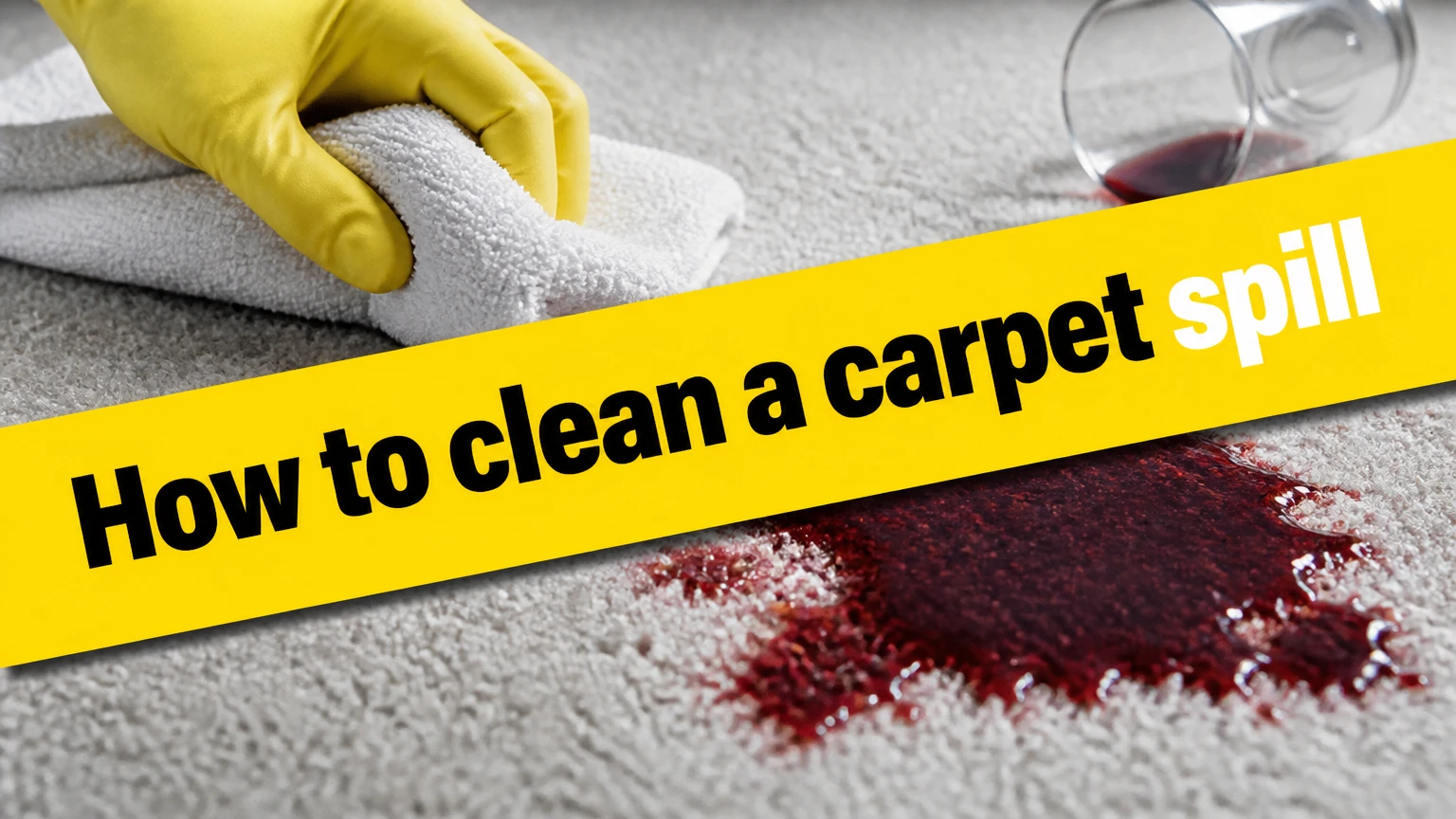
To clean a carpet spill, remove solids, blot liquid from the outside toward the center, apply a small amount of fiber-safe cleaner, rinse, and dry the area completely. Begin within 15 minutes when possible, use white towels, avoid rubbing and flooding, and match the cleaner to both the spill and carpet fiber.
Key facts at a glance
- Blotting removes liquid while rubbing spreads contamination and damages carpet fibers.
- A fresh spill usually needs less cleaner than a dried stain because the contaminant has not bonded deeply.
- Use cold water for blood, egg, and other protein spills; use lukewarm water for sugary drinks and most food residues.
- Test every cleaner in an inconspicuous area before treating visible carpet.
- A carpet spot generally dries in 2-8 hours with airflow, but saturated padding can require 24-48 hours.
- Never mix bleach, ammonia, vinegar, hydrogen peroxide, or commercial carpet chemicals.
Before you start cleaning a carpet spill
Gather two or more white absorbent towels, a spoon or dull scraper, a spray bottle of water, a small bowl, mild clear dish detergent, and a vacuum cleaner. Typical spot treatment takes 10-20 minutes of active work and costs less than $5 when the spill is fresh.
Materials and conditions
| Requirement | Typical amount or setting | Why it matters |
|---|---|---|
| White towels | 4-8 towels, 30 x 30 cm each | Shows color transfer and prevents dye bleeding |
| Mild dish detergent | 1/4 teaspoon per 240 ml water | Limits soap residue in carpet pile |
| Water | 120-240 ml per small spot | Controls moisture and backing damage |
| Active treatment time | 10-20 minutes | Allows repeated blotting before drying |
| Drying time | 2-8 hours with a fan | Reduces wicking, odor, and mildew risk |
Check the carpet label if available. Nylon and polyester carpet commonly tolerate careful water-based spot cleaning, while wool, silk, viscose, jute, and antique rugs require more conservative treatment. A carpet labeled “S” or “solvent only” should not receive a water-based solution.
How to clean a carpet spill step by step
The safest sequence is contain, remove, blot, treat, rinse, and dry. The order matters because adding cleaning solution before extracting excess liquid can push the contaminant farther into the backing.
Step 1: Contain the spill
Stop foot traffic and place clean towels around the outside edge of the wet area. If the spill is spreading, use dry towels as a temporary boundary and work toward the center.
For a liquid spill, do not immediately pour water over it. Dilution can help some water-soluble residues, but excess water also enlarges the wet zone and increases the chance of wicking into the pad.
Success checkpoint: The spill is no longer expanding, and the surrounding carpet remains dry.
Common mistake: Placing a wet towel over a large area. A saturated towel transfers liquid outward instead of containing it.
Step 2: Remove solids before adding liquid
Lift thick or semi-solid material with a spoon, plastic card, or dull knife. Hold the tool nearly parallel to the carpet and work from the outside toward the center.
For mud, allow the surface to dry before vacuuming loose particles. Scraping wet mud can grind mineral grit into the pile. For wax, harden the material with a sealed ice pack, lift what you can, then address the remaining film separately.
Success checkpoint: No raised material remains, and the carpet pile has not been aggressively brushed.
Common mistake: Scrubbing food or mud into the fibers. Mechanical friction turns a surface deposit into a deeper contamination.
Step 3: Blot with dry white towels
Place a folded white towel over the spill and press straight down for 10-20 seconds. Lift the towel vertically, inspect the transfer, rotate to a dry section, and repeat until the towel shows little or no moisture.
Use your palm for a small spot. For a larger wet area, place a waterproof barrier over the towel and add a flat, stable weight for 5-10 minutes. Do not use a heavy object directly on damp carpet because dye, rust, or dirt can transfer.
Success checkpoint: Fresh towel sections remain mostly dry after firm pressure.
Common mistake: Rubbing back and forth. Rubbing can fuzz cut-pile fibers, distort looped carpet, and drive liquid into the backing.
Step 4: Choose and test the cleaner
Identify the contaminant before choosing a product. Water-based cleaners suit sugar, mud, and many food spills; enzymatic products suit organic residues; solvent spotters suit oil and ink; oxygen-based products may affect dyes and should be tested carefully.
Apply one drop or a small mist of the proposed cleaner to a hidden area. Wait 10 minutes, blot it with a white towel, and inspect for color transfer, lightening, roughness, or a sticky finish.
The Carpet and Rug Institute advises following carpet manufacturer instructions and testing cleaning products before use. That guidance matters because “carpet” includes synthetic, wool, plant-fiber, and blended materials with different dye and backing systems.
Success checkpoint: The test area has no visible color change or texture damage after drying.
Common mistake: Testing only for immediate discoloration. Some browning, stiffness, or dye migration appears after the treated area dries.
Step 5: Apply a small amount of solution
For a small synthetic-carpet food or drink spill, mix 1/4 teaspoon of clear, mild dish detergent with 1 cup, or 240 ml, of lukewarm water. Dampen a white cloth or lightly mist the stain rather than saturating the carpet.
Work from the outer edge toward the center using short downward presses. Allow 3-5 minutes of dwell time, unless the product label specifies a different period. Keep the solution on the fibers, not underneath them.
Success checkpoint: The stain becomes lighter without forming a larger wet ring.
Common mistake: Increasing detergent concentration when the mark resists. More soap often creates a sticky residue that attracts soil after drying.
Step 6: Rinse out cleaner residue
Mist a small amount of plain water onto the treated area and blot with a clean towel. Repeat once or twice with fresh, lightly damp towels until the towel no longer feels soapy.
Rinsing is especially important with dish detergent and concentrated carpet shampoos. Residue can leave a crunchy texture, create rapid resoiling, or pull dissolved soil back to the surface as the carpet dries.
Success checkpoint: The carpet feels clean rather than slick or tacky.
Common mistake: Pouring water to “flush” a spot. Household carpet lacks the extraction power needed to remove large amounts of added water reliably.
Step 7: Extract and dry the carpet
Cover the damp area with a thick, dry white towel and press for 1-2 minutes. Replace the towel when it becomes damp. Then aim a fan across the carpet, open windows where humidity permits, and keep people and pets away until the pile is fully dry.
A small surface spot commonly dries in 2-8 hours. Carpet with wet underlay may take 24-48 hours and needs professional assessment if it remains wet, smells musty, or feels wet at the edges.
Vacuum only after the area is dry. Vacuuming damp carpet can flatten pile, spread residue, and stress the backing.
Success checkpoint: The carpet feels dry at the surface and base, has no cool dampness, and shows no spreading ring.
Common mistake: Applying a hairdryer on high heat. Heat can set protein residues, distort synthetic fibers, and produce uneven drying.
Which cleaner matches the spill?
The correct cleaner depends on whether the contaminant is water-soluble, oily, protein-based, pigmented, or biologically contaminated. A universal mixture is less reliable than a classification approach because coffee, grease, blood, and pet urine require different chemical actions.
| Spill type | First treatment | Water or product setting | Avoid |
|---|---|---|---|
| Water, soda, juice | Blot, then mild detergent solution | Lukewarm water, 1/4 tsp detergent per cup | Flooding and colored towels |
| Coffee or tea | Blot, then detergent solution | Cool or lukewarm water | Heat and aggressive rubbing |
| Blood or egg | Blot, then cold water and labeled cleaner | Cold water, below 30°C / 85°F | Hot water, steam, ammonia |
| Grease or oil | Scrape, blot, then carpet-safe solvent | Product label setting | Dish soap overload and open flames |
| Milk or vomit | Remove solids, blot, then enzyme cleaner | Cool water, label-directed dwell | Heat and perfume-only deodorizer |
| Pet urine | Blot, then enzyme product deep enough to reach contamination | Product label setting, often several hours | Vinegar alone and ammonia |
| Red wine or berries | Blot, then tested oxygen-based spotter | Cool water, short controlled dwell | Un |
| tested bleach or peroxide | |||
| Wax or gum | Harden, lift, then treat residue | Minimal moisture or approved solvent | Cutting carpet fibers |
Does vinegar clean carpet spills?
White vinegar is not a universal carpet stain remover. A diluted vinegar solution may reduce some alkaline odors on colorfast synthetic carpet, but vinegar does not reliably remove grease, pigment, or the uric-acid crystals associated with old pet urine, and acidic products can damage wool, viscose, or natural dyes.
If a manufacturer permits it, use no stronger than 1 part white vinegar to 3 parts water, test first, apply sparingly, and rinse afterward. Never combine vinegar with bleach, ammonia, hydrogen peroxide, or unknown commercial chemicals. Chemical mixtures can release irritating or toxic gases.
Is baking soda safe for a carpet spill?
Dry baking soda can absorb a small amount of surface moisture or odor, but it is not a complete stain remover. Avoid making a wet baking-soda paste on carpet unless the manufacturer approves it, because powder can lodge in the pile and alkaline residue can alter dyes or interact unpredictably with other products.
For an oily spot, first lift solids and blot. A carpet-approved solvent or low-residue detergent is usually more predictable than baking soda. Vacuum dry powder thoroughly only after it has remained dry.
How do spill treatments compare?
DIY detergent works best for fresh, light, water-soluble spills. Enzymatic cleaners are better for biological residues, oxygen products address some colored stains, solvent products address oily contamination, and extraction is the strongest option when liquid has reached the pad.
| Method | Typical cost | Typical active time | Best use | Main limitation |
|---|---|---|---|---|
| Water and mild detergent | Under $1 | 10-20 minutes | Fresh juice, soda, mud | Weak on oil and old pigment |
| Enzymatic spot cleaner | $8-$25 per bottle | 15 minutes to 24 hours | Urine, vomit, milk | Requires label-directed dwell |
| Oxygen-based spotter | $6-$20 per bottle | 5-15 minutes | Tested red wine, berries | May lighten unstable dyes |
| Solvent spot cleaner | $8-$25 per bottle | 1-10 minutes | Oil, ink, adhesive | Fumes, flammability, backing risk |
| Rental extractor | $30-$60 per day | 1-3 hours | Several large spots | Overwetting is common |
| Professional extraction | $100-$300 minimum | 2-5 hours onsite | Deep or widespread contamination | Requires scheduling and drying |
Hot-water extraction is often called steam cleaning, although many machines primarily spray heated water and vacuum it back out. Professional equipment can remove more moisture and dissolved soil than hand blotting, but poor technique can still overwet carpet or leave residue.
Low-moisture encapsulation uses a polymer detergent that surrounds soil as it dries, after which vacuuming removes the brittle residue. This method reduces drying time, but it is less suitable for a spill that has saturated the pad.
When should you use an enzymatic cleaner?
Use an enzymatic carpet cleaner for urine, feces, vomit, blood, milk, and other biological residues when the product label identifies the relevant contaminant. Enzymes work only when they contact the residue for the specified dwell period, so a quick surface mist may remove odor temporarily without treating the source.
Blot fresh liquid first. Apply enough labeled product to reach the depth of the original contamination, but do not saturate flooring beneath the carpet. Keep the area damp for the stated dwell time, then extract or blot according to the instructions.
An enzyme product is not automatically safe for wool, silk, viscose, or dyed rugs. Product labels differ, and some contain surfactants, fragrances, or oxidizers in addition to enzymes. Test first.
How do you remove a dried or old carpet spill?
A dried spill needs controlled rehydration, scraping, and repeated extraction rather than aggressive scrubbing. Moisten the residue with the smallest amount of compatible solution, wait 5-10 minutes, loosen it gently, and blot several times before evaluating the result.
Old stains may have changed the fiber dye, not merely deposited soil. Cleaning can remove residue while leaving a permanent color alteration, especially with hair dye, red food coloring, rust, and some medications.
For dried milk, vomit, or urine, use an appropriate enzyme cleaner and follow the label. For old oil, ink, nail polish, or adhesive, use only a carpet-labeled solvent and provide ventilation. Never use acetone, paint thinner, or household bleach unless the carpet manufacturer explicitly approves the product.
What changes for different carpet fibers?
Carpet fiber determines chemical tolerance, dye stability, and resistance to heat. Nylon and polypropylene usually tolerate carefully tested water-based products, polyester resists many water-based stains but can retain oily soil, and wool requires low-moisture, pH-controlled treatment.
| Fiber or material | Typical strength | Safer spot approach | Products to avoid or restrict |
|---|---|---|---|
| Nylon | Durable, common in homes | Tested mild detergent, prompt blotting | High heat and strong alkalines |
| Polyester | Hydrophobic, colorfast in many products | Low-moisture detergent, rinse well | Heavy oil and greasy residue |
| Polypropylene | Moisture-resistant, often used outdoors | Mild detergent after debris removal | Strong solvents and high heat |
| Wool | Protein fiber, absorbent | Cool water, wool-safe product, minimal moisture | Bleach, ammonia, strong alkali |
| Silk or viscose | Delicate, texture-sensitive | Professional rug cleaning | Water saturation, rubbing, peroxide |
| Jute or sisal | Plant fiber, prone to browning | Dry methods or specialist advice | Flooding and prolonged dampness |
Woolmark and carpet manufacturers commonly recommend pH-neutral or wool-specific products for wool textiles. The popular advice to use vinegar on every carpet is unsafe here because acidity, moisture, and dye instability can combine to produce color change or browning.
How do you fix common carpet spill failures?
Most failed spot treatments result from excess moisture, incorrect chemistry, or incomplete extraction. Diagnose the failure after drying rather than repeatedly adding product to a spot that is already saturated.
The stain returns after drying
A returning mark usually indicates wicking. Dissolved soil or liquid remains in the backing or pad, then moves upward as moisture evaporates from the surface.
Lightly re-dampen the surface with compatible cleaner or water, place a thick white towel over it, and apply pressure for 10-20 minutes. Repeat extraction and dry with airflow. If the ring returns again, the pad may require professional extraction or replacement.
The carpet feels crunchy or sticky
Crunchiness usually indicates dried detergent or mineral residue. A sticky surface attracts new soil and can make a clean spot look dirty within days.
Use a small amount of plain water, blot repeatedly with fresh towels, and dry fully. Do not add more detergent. If the area remains tacky after two rinsing attempts, a professional low-residue rinse may be more effective than continued home treatment.
The spill smells after cleaning
Persistent odor means organic contamination may remain below the visible pile. Surface deodorizer cannot reliably remove urine, milk, or vomit that has entered the backing.
Use a tested enzyme cleaner at the depth specified by the label, or arrange professional inspection with ultraviolet detection for suspected pet urine. Do not seal the carpet under plastic for an unspecified period, because trapped moisture can damage backing and flooring.
A light ring surrounds the spot
A ring can form when dissolved soil migrates to the drying boundary. The problem is more likely after over-wetting or incomplete rinsing.
Treat the entire visible boundary with minimal compatible solution, blend outward without scrubbing, extract evenly, and accelerate drying. Repeatedly treating only the center can make the boundary more obvious.
When should a professional clean the carpet?
Call a professional when a spill covers more than about 0.5 square metres, reaches the pad, involves sewage or large amounts of urine, remains wet beyond 24 hours, or has caused dye bleeding. Professional extraction is also appropriate for wool, silk, viscose, antique rugs, expensive hand-knotted carpets, and stains that resist two careful treatment attempts.
| Situation | Home spot treatment | Professional response |
|---|---|---|
| 10 cm soda spill | Usually appropriate | Usually unnecessary |
| 30 cm fresh coffee spill | Appropriate if colorfast | Useful after failed treatment |
| 1 square metre pet urine | Risk of pad contamination | Deep extraction and odor treatment |
| Floodwater or sewage | Do not handle as ordinary stain | Water-damage remediation |
| Wool red wine spill | Minimal blotting only | Specialist rug or wool technician |
| Dye transfer or bleach mark | Cleaning cannot restore dye | Repair, dyeing, or replacement assessment |
Professional prices vary by region, access, carpet condition, and minimum callout. Typical residential service ranges from $40-$80 per room when bundled, with $100-$300 minimum charges common. Ask whether the quote includes furniture movement, pretreatment, extraction, deodorizing, and return visits.
How can you prevent another carpet spill?
Keep white towels, a spoon, mild detergent, and a tested carpet spotter together in a labeled container. Record the carpet fiber and manufacturer cleaning code before an emergency occurs, because product selection becomes slower after a large spill.
Use washable mats near dining tables, pet bowls, entry doors, and craft areas. Vacuum high-traffic carpet weekly, because dry soil can combine with a new spill and create a darker, larger mark.
The most useful practitioner rule is simple: use less liquid than seems necessary, then repeat the blotting cycle. Carpet cleaning is usually safer when moisture is added in measured increments and removed before the backing becomes wet.
Frequently asked questions
Can I use dish soap on every carpet?
No. Mild clear dish soap is suitable for many fresh spills on colorfast synthetic carpet, but it is not appropriate for every fiber or cleaning code. Use only 1/4 teaspoon per cup of water, test first, apply sparingly, and rinse away residue. Wool, silk, viscose, and solvent-only carpets need different treatment.
Should I use cold or hot water on carpet stains?
Use cold water for blood, egg, milk, and other protein residues because heat can set protein. Use lukewarm water for many sugary drinks and food residues. Avoid very hot water unless the carpet manufacturer and cleaning product specifically permit it, because heat can affect dyes, adhesives, and synthetic fibers.
Can hydrogen peroxide remove red wine from carpet?
A tested oxygen-based product containing hydrogen peroxide may lighten some red wine or berry stains on stable synthetic carpet. Hydrogen peroxide can also bleach or alter carpet dyes, so test in a hidden location, follow the product label, and avoid it on wool, silk, viscose, or uncertain fibers.
Why should carpet stains be blotted instead of rubbed?
Blotting transfers liquid from the carpet into an absorbent towel without applying sideways friction. Rubbing can spread the contaminant, distort looped fibers, create fuzzy pile, and force liquid into the backing. Firm downward pressure with repeated towel changes is more effective than vigorous scrubbing.
How long can a wet carpet stay damp?
A small spot should normally dry within 2-8 hours with ventilation. Carpet that remains damp for 24 hours, smells musty, or feels wet through the pile may have saturated padding or flooring. Stop adding cleaner, increase airflow, and seek professional extraction or water-damage advice.
Will professional cleaning remove every carpet spill?
No. Professional extraction can remove soil and residue, but it cannot always reverse dye loss, bleach damage, fiber distortion, rust, or permanent chemical discoloration. A technician should inspect the fiber, dye, backing, and stain history before promising complete removal.
The bottom line
To clean a carpet spill, remove solids, blot from the outside inward, use a tested cleaner matched to the contaminant, rinse lightly, and dry with airflow. Fast action, controlled moisture, and correct fiber identification matter more than a strong homemade chemical mixture. For deep urine, floodwater, delicate fibers, or recurring stains, professional extraction is the safer choice.