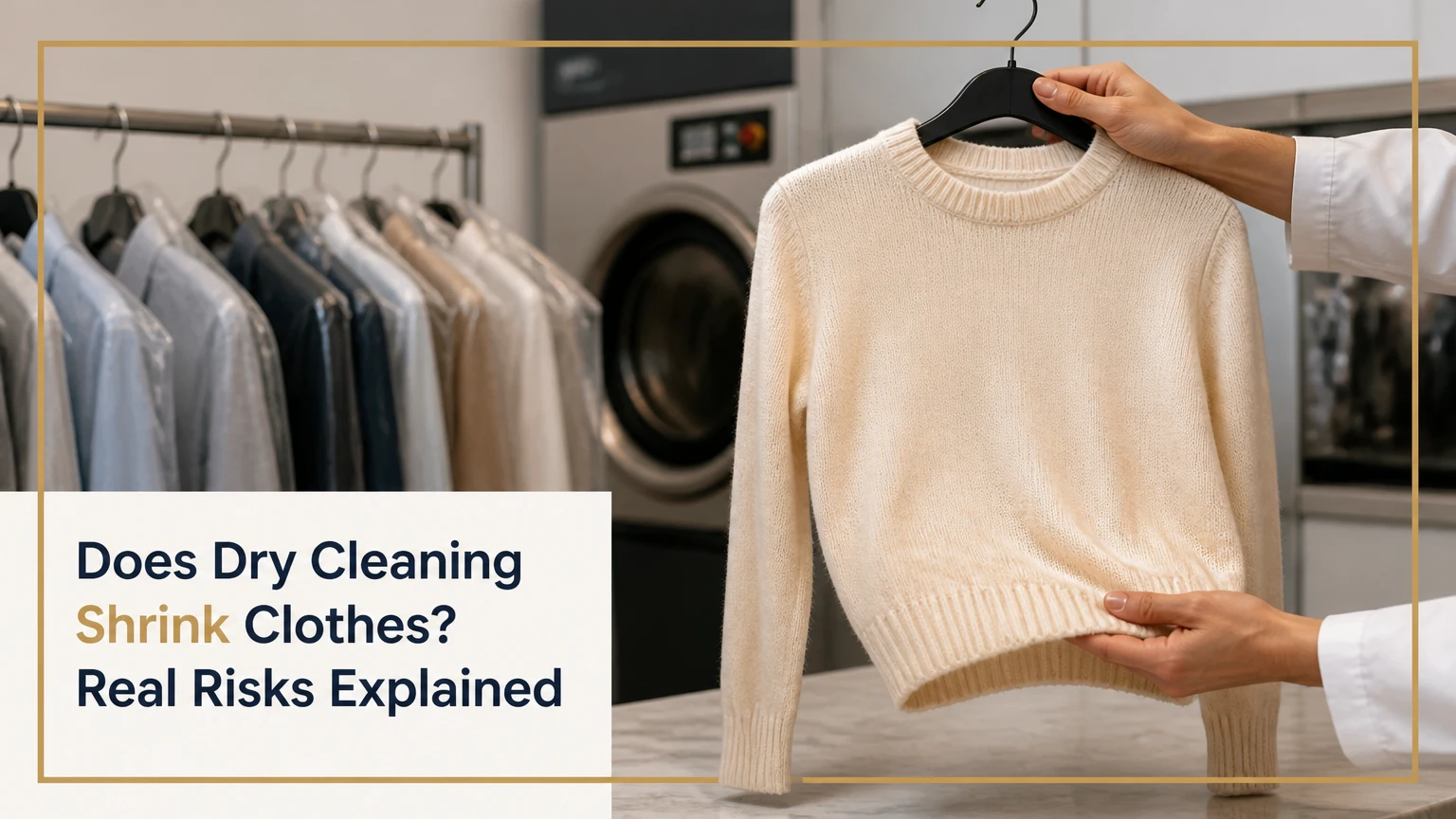
Dry cleaning usually does not shrink clothes because professional solvent cleaning avoids the water, agitation, and high-temperature tumble drying that cause most laundering shrinkage. However, a garment can change size or shape after dry cleaning because of excessive heat, moisture in the process, fiber felting, lining distortion, manufacturing defects, or pre-existing relaxation that becomes noticeable during finishing.
Key Facts at a Glance
- Standard solvent dry cleaning normally causes little measurable shrinkage in a properly made, correctly labeled garment.
- Wool and cashmere can felt and contract when moisture, heat, pressure, and agitation combine, even during a solvent-based process.
- Cotton, linen, rayon, and viscose may change dimensions when moisture or heat reaches fibers that were not fully stabilized during manufacturing.
- A garment that feels smaller may have distorted pressing, a shrunken lining, or changed seam position rather than a uniformly smaller outer fabric.
- The care label specifies the manufacturer’s tested cleaning method, but “dry clean” does not guarantee zero dimensional change.
- Measure the garment before and after cleaning because memory is less reliable than matching sleeve, chest, inseam, and length measurements.
How Does Dry Cleaning Avoid Ordinary Laundry Shrinkage?
Dry cleaning uses a liquid solvent instead of an aqueous wash bath, so fibers generally do not absorb and swell with water in the same way they do during conventional laundering. A dry-cleaning machine circulates solvent, extracts it, dries the garment with controlled warm air, and finishes the item with steam, pressure, or shaped forms.
The phrase “dry cleaning” is misleading because the garment becomes wet with solvent. The Drycleaning and Laundry Institute summarizes the distinction with the phrase, “There is no such thing as ‘dry’ cleaning.” The relevant difference is the cleaning liquid, not whether the garment stays dry.
Water-based washing can relax tensions introduced during spinning, weaving, knitting, dyeing, and garment construction. Heat then accelerates contraction, while tumbling and friction can lock wool fibers together through felting. Solvent cleaning reduces those particular mechanisms, but it does not eliminate heat, pressure, steam, moisture contamination, or manufacturing instability.
The common explanation that all dry-cleaning solvents are completely water-free is too absolute. Modern solvent systems are designed to control water, and professional equipment may add carefully managed moisture for cleaning performance. Poor moisture control can increase risk, particularly for wool, rayon, and other fibers sensitive to wet processing.
What Happens During a Professional Cleaning Cycle?
A professional garment passes through several operations, and shrinkage risk can arise outside the solvent wash itself. The following sequence describes a typical plant process, although equipment, solvent, cleaning time, and finishing methods vary by cleaner.
| Stage | Typical operation | Main dimensional risk |
|---|---|---|
| Inspection | Record stains, damage, buttons, labels, and fiber content | Existing damage may be mistaken for new shrinkage |
| Pre-spotting | Apply stain agents, steam, suction, or controlled mechanical action | Local moisture can alter sensitive fibers |
| Sorting | Separate by color, weight, construction, and soil type | Poor sorting increases abrasion and dye transfer |
| Solvent cleaning | Tumble garments in a sealed drum with solvent | Heat, agitation, and unsuitable chemistry can affect shape |
| Extraction | Spin out solvent, often at high speed | Creasing can set if garments remain compressed |
| Drying and recovery | Circulate warm air and recover solvent vapor | Excess temperature can contract fibers or components |
| Finishing | Press, steam, block, or shape the garment | Heat and tension can create apparent size change |
Professional dry-cleaning dryers commonly operate with warm air rather than domestic-dryer temperatures, but exact settings depend on solvent, machine design, load, and fabric. A cleaner must use the lowest effective temperature and enough airflow to remove residual solvent without overheating the garment.
Finishing can make a garment appear smaller without causing true fiber contraction. For example, a trouser leg pressed with an altered crease can measure shorter across the crease, while a jacket steamed aggressively over a form can shift the shoulder or sleeve pitch.
Can Dry Cleaning Shrink Wool and Cashmere?
Dry cleaning can shrink wool and cashmere in unusual conditions, but properly controlled solvent cleaning is normally less likely to felt these fibers than water washing. Wool contracts when its surface scales interlock through moisture, heat, pressure, and repeated movement, so a solvent cycle with contamination or poor temperature control can still create risk.
The most important distinction is between uniform shrinkage and felting. Uniform shrinkage reduces length and width relatively consistently. Felting produces a denser, firmer fabric with a fuzzy or matted surface, and the garment may become both smaller and less flexible.
Cashmere is especially vulnerable to aggressive handling because its fine fibers and soft construction tolerate less abrasion. A cashmere sweater should not be cleaned repeatedly merely to refresh it. Airing, brushing with a suitable garment brush, and treating isolated stains can reduce unnecessary cycles.
| Wool-based item | Typical preferred care | Main warning sign after cleaning |
|---|---|---|
| Tailored wool suit | Label-directed solvent cleaning, limited frequency | Jacket length or sleeve pitch changes |
| Merino sweater | Label-directed cleaning, often gentle solvent or hand wash | Dense handle, shorter sleeves, felting |
| Cashmere knit | Infrequent professional cleaning or approved hand wash | Firm texture, pilling, reduced drape |
| Wool overcoat | Professional cleaning when visibly soiled | Lining pulls, hem rises, or shell puckers |
| Wool trousers | Professional cleaning with correct pressing | Inseam, rise, or crease position changes |
A useful practitioner rule is to inspect the garment’s texture as well as its measurements. A sweater that is 2% shorter but still soft may have relaxed during finishing; a sweater that is 5% shorter, denser, and rougher has more likely felted.
Which Fabrics Are Most Vulnerable to Size or Shape Changes?
Rayon, viscose, wool, cotton, and linen generally present more dimensional risk than stable polyester or nylon, although construction and finishing can matter more than fiber name alone. Silk can tolerate professional cleaning well, but dyes, water spotting, heat, and delicate surface finishes create separate risks.
“Dry clean only” does not mean every fiber will shrink in solvent. It means the manufacturer identifies professional dry cleaning as the approved care method for the complete garment, including fabric, dye, lining, interfacing, trims, and construction.
| Fiber or material | Solvent-cleaning risk | Water and heat risk | Practical care decision |
|---|---|---|---|
| Wool | Low when controlled, higher if felting conditions occur | High when hot, wet, and agitated | Follow label; avoid domestic hot washing |
| Cashmere | Low to moderate, depending on handling | High for felting and distortion | Clean sparingly; use a specialist |
| Cotton | Low to moderate | Moderate to high, especially with hot drying | Cold wash when label permits; air dry |
| Linen | Low to moderate | Moderate, with notable wet relaxation | Use label method; reshape while damp |
| Rayon or viscose | Moderate | High for water distortion and shrinkage | Prefer professional care unless label permits washing |
| Silk | Low to moderate | Moderate for dye bleeding and water marks | Use an experienced cleaner |
| Polyester | Low | Low, but high heat can deform finishes | Avoid excessive dryer temperature |
| Nylon or elastane blends | Low | Moderate if overheated | Keep away from high heat and solvent incompatibility |
Fabric blends complicate predictions. A polyester outer shell may remain stable while a rayon lining contracts, creating bubbling or pulling. A cotton garment with elastane may retain width but lose recovery after heat exposure. The finished garment must therefore be assessed as a system.
Why Can a Garment Shrink After Dry Cleaning?
A garment may shrink after dry cleaning because of heat, uncontrolled moisture, felting, component mismatch, or inaccurate expectations about its original dimensions. The solvent itself is often not the sole cause, and the visible result can originate in the lining, interfacing, fusible adhesive, or finishing stage.
Common causes include:
- Excessive drying temperature: Heat can contract unstable natural fibers, rayon, and some garment components.
- Moisture contamination: Water carried into a solvent bath can increase wet-processing effects on sensitive fibers.
- Felting: Wool fibers can lock together when moisture, heat, pressure, and movement overlap.
- Lining shrinkage: A polyester, acetate, rayon, or cotton lining may respond differently from the outer shell.
- Steam or pressing distortion: Finishing can change length, crease placement, sleeve angle, or jacket balance.
- Pre-existing relaxation: A garment may have stretched during wear, then return toward its manufactured dimensions during cleaning.
- Manufacturing instability: Poorly stabilized fabric can shrink during its first professional treatment even when the cleaner follows the label.
The care label does not make a defective garment immune to change. Under the U.S. Federal Trade Commission Care Labeling Rule, manufacturers and importers must provide care instructions, but the label is not a promise that a garment will experience zero dimensional change.
How Can You Tell Whether It Really Shrunk?
Measure the garment before and after cleaning, using the same flat surface, tape, and measurement points. Compare chest width, body length, shoulder width, sleeve length, waist, rise, and inseam rather than relying on how the garment feels.
| Measurement | How to measure | What a change may indicate |
|---|---|---|
| Jacket chest | Armpit seam to armpit seam, doubled | Shell or lining contraction |
| Jacket length | High shoulder point to hem | Body shrinkage or altered pressing |
| Sleeve length | Shoulder seam to cuff edge | Sleeve setting or shoulder distortion |
| Trouser inseam | Crotch seam to hem | Leg shrinkage or changed hem position |
| Sweater body | Underarm to underarm, doubled | Knit relaxation, felting, or width change |
| Waist | Across waistband, doubled | Waistband contraction or altered pressing |
Photograph the item beside a ruler before handing it over when the garment is expensive or difficult to replace. Save the receipt, care label, fiber-content label, and any written notes about stains or pre-existing damage.
How Can You Reduce the Risk of Dry-Cleaning Shrinkage?
You can reduce risk by reading the entire care label, choosing a cleaner familiar with the garment’s fiber and construction, and identifying vulnerable details before service. A cleaner cannot guarantee zero change, but accurate inspection, suitable chemistry, controlled drying, and restrained finishing greatly reduce preventable damage.
Use this checklist:
- Tell the cleaner whether the garment has been washed, altered, stretched, or exposed to rain.
- Point out silk trim, leather, beads, sequins, bonded areas, pleats, and unusual linings.
- Ask whether the item will receive solvent cleaning, professional wet cleaning, or another method.
- Request a test or specialist assessment for vintage clothing, rayon velvet, cashmere, and unstable dyes.
- Avoid cleaning a suit after every wear; air it for several hours and spot-treat where appropriate.
- Remove plastic covering soon after pickup so residual odor and moisture can dissipate.
- Do not place a freshly cleaned garment immediately beside a heater or in a hot car.
- Check measurements, seams, lining, surface texture, and color before removing the receipt.
One counterintuitive point matters: more cleaning is not automatically better care. Repeated solvent exposure, stain treatment, pressing, and abrasion can wear fibers and surface finishes even when the garment never visibly shrinks.
What Does Dry Cleaning Cost and How Long Does It Take?
Typical U.S. retail dry-cleaning service costs about $3-$6 for a dress shirt, $6.50-$11 for trousers, $18-$28 for a two-piece suit, and $20-$35 for a winter overcoat. Standard turnaround is commonly 2-3 business days, while rush service may add roughly 20%-50% depending on the shop and location.
Prices vary with region, garment construction, stain treatment, household pickup service, and specialty finishing. The ranges below are practical retail estimates, not a national price schedule.
| Garment | Typical U.S. price | Typical turnaround |
|---|---|---|
| Dress shirt | $3-$6 | 2-3 business days |
| Trousers or skirt | $6.50-$11 | 2-3 business days |
| Sweater or knitwear | $10-$14 | 2-4 business days |
| Two-piece suit | $18-$28 | 2-4 business days |
| Standard dress | $14-$22 | 3-5 business days |
| Winter overcoat | $20-$35 | 3-7 business days |
Ask for a written estimate when a garment has oil paint, wax, adhesive, heavy perspiration, mold, extensive beadwork, or a delicate finish. Stain removal can require additional operations and can create more localized risk than routine cleaning.
Is Dry Cleaning Better Than Washing at Home?
Dry cleaning is generally better for tailored construction, oil-based soil, and garments whose labels prohibit water, while cold home laundering is usually better for washable cotton, towels, underwear, and water-soluble perspiration. The correct choice depends on fiber, construction, soil type, and the complete care label.
| Decision factor | Professional dry cleaning | Cold home laundering | Professional wet cleaning |
|---|---|---|---|
| Cleaning liquid | Organic solvent or silicone fluid | Water and detergent | Water and controlled detergent |
| Strongest soil profile | Oils, grease, cosmetics | Sweat, salt, food, water-soluble dirt | Sweat and many washable soils |
| Main shrinkage risk | Heat, moisture, felting, finishing | Water, agitation, tumble drying | Incorrect moisture, tension, or drying |
| Best garment examples | Wool suit, structured coat, silk dress | Cotton T-shirt, washable denim | Some wool, rayon, and tailored items |
| Typical consumer cost | $3-$35 per item | Often under $1 per load | Usually service-priced |
| Main limitation | Solvent cleaning may not remove salts fully | Can damage dry-clean-only construction | Requires specialized equipment and skill |
Professional wet cleaning is not the same as putting a dry-clean-only jacket in a household washer. It uses programmed water levels, mechanical action, detergent, drying, and reshaping. A reputable cleaner chooses that method only when the garment’s materials and construction can tolerate it.
When Is Home Laundering a Reasonable Alternative?
Home laundering is reasonable when the care label permits washing, the garment has no unstable lining or bonded structure, and the owner can control water temperature, agitation, and drying. Cold washing followed by flat or line drying usually creates less shrinkage than hot washing followed by a domestic tumble-dryer cycle.
Do not override a dry-clean-only label for a lined jacket, pleated formalwear, rayon tailoring, embellished garment, leather-trimmed item, or piece with fused interfacing. The outer fabric may survive while the inner construction buckles.
Can a Shrunken Garment Be Fixed?
A mildly shrunken knit may regain some length through careful blocking, but severe felting, heat damage, lining contraction, and distorted tailoring are rarely reversible. Stretching cannot restore fibers that have permanently felted or reconstruct a jacket whose interfacing has bubbled.
For a washable knit, use the following cautious method:
- Fill a basin with lukewarm water and add a small amount of wool detergent.
- Soak for 15-30 minutes without rubbing or twisting.
- Press water out through a towel rather than wringing the garment.
- Lay the item flat and compare it with a known-good measurement.
- Ease it gradually toward the original dimensions.
- Dry it flat away from direct heat, maintaining the shape.
Avoid conditioner-based “unshrinking” recipes on silk, tailored garments, unstable dyes, or dry-clean-only fabrics. Water may create a second problem, including rings, bleeding, puckering, or adhesive failure.
A professional cleaner should inspect tailored clothing. Take photographs, measurements, the receipt, and the original care label, then request an explanation before attempting home treatment.
What Should You Do After Suspected Cleaner Damage?
Stop wearing or altering the garment, document the change, and return it promptly to the cleaner for inspection. A credible assessment should distinguish true dimensional shrinkage from pressing distortion, lining contraction, felting, pre-existing damage, or an incorrect original measurement.
Use this process:
- Photograph the garment from front, back, and side.
- Record post-cleaning measurements at repeatable points.
- Compare the care label with the service ticket.
- Describe when you first noticed the problem.
- Ask whether the cleaner recorded pre-existing damage at intake.
- Request reblocking, repressing, or specialist evaluation where appropriate.
- Keep written records if reimbursement or an insurance claim becomes necessary.
A cleaner may reasonably decline responsibility when the garment’s label specified a method that caused an unavoidable reaction, the item was already unstable, or measurements show no meaningful change. Conversely, excessive heat, solvent misuse, unapproved water treatment, or obvious finishing damage supports a stronger complaint.
Which Cleaning Method Fits Each Common Garment?
The best method depends on construction and soil, not on the word “delicate” alone. A washable cotton shirt usually gains nothing from solvent cleaning, while a structured wool jacket can suffer permanent distortion in a home washer even if its outer fabric appears robust.
| Garment situation | Preferred first choice | Avoid | Reason |
|---|---|---|---|
| Wool business suit | Label-directed professional cleaning | Household washer and hot dryer | Protects canvas, lining, and shape |
| Cotton T-shirt | Cold machine wash and air dry | High-heat tumble drying | Controls ordinary cotton shrinkage |
| Cashmere sweater | Infrequent specialist cleaning or approved hand wash | Hot water and vigorous rubbing | Reduces felting and abrasion |
| Silk blouse | Experienced cleaner using label method | Uncontrolled spot water | Limits rings and dye migration |
| Rayon dress | Label-directed professional service | Home washing without approval | Rayon can distort when wet |
| Linen shirt | Cold wash if label permits, reshape damp | High-heat drying | Linen relaxes and creases easily |
| Beaded eveningwear | Specialist cleaner assessment | Standard household washing | Trim and adhesive may fail |
| Denim jeans | Cold wash, air dry when permitted | Frequent high heat | Preserves color and dimensions |
Frequently Asked Questions
Does dry cleaning shrink cotton clothes?
Dry cleaning usually causes less cotton shrinkage than hot water washing and tumble drying, but cotton can still change dimensions if the garment encounters moisture, heat, or unstable finishing. Check the label first. For washable cotton, cold washing and air drying generally cost less and provide better control than routine solvent cleaning.
Does dry cleaning shrink silk?
Professional dry cleaning can preserve many silk garments, but silk may suffer from water spotting, dye bleeding, surface glazing, or heat damage. Silk clothing with printed dyes, coatings, pleats, or bonded details needs an experienced cleaner. Never assume a silk garment is risk-free merely because solvent is used.
Can dry cleaning shrink rayon or viscose?
Rayon and viscose can change size or shape after dry cleaning, particularly when heat, moisture, or aggressive finishing affects the fabric. These fibers are more dimensionally unstable than polyester. Follow the exact label and tell the cleaner about previous washing, rain exposure, or visible rippling before service.
How often should a suit be dry cleaned?
A suit should generally be dry cleaned only when visibly soiled, noticeably odorous, or exposed to a stain that home brushing cannot remove. Many frequently worn suits need cleaning several times per year rather than after every use. Airing, brushing, rotating jackets, and prompt spot treatment reduce cleaning frequency.
Does dry cleaning remove sweat and odor?
Dry cleaning removes oils, cosmetics, and many greasy soils effectively, but water-soluble sweat salts and some odor compounds may respond better to professional wet cleaning or laundering. Tell the cleaner whether the problem is oil, perspiration, food, smoke, or mildew, because soil chemistry influences method selection.
Can I claim compensation if dry cleaning shrinks my clothes?
You can request compensation, but the outcome depends on evidence, the care label, the garment’s condition at intake, and the cleaner’s local policy or liability terms. Measurements, photographs, receipts, and a prompt written complaint improve your position. An independent textile specialist may help with expensive garments.
The Bottom Line
Does dry cleaning shrink clothes? Usually no, when a qualified cleaner follows the care label and controls solvent, moisture, drying temperature, and finishing pressure. Shrinkage or apparent size change remains possible, especially with wool, cashmere, rayon, viscose, unstable linings, and poorly manufactured garments. Measure valuable clothing, clean it only when necessary, and use the garment’s fiber content and construction to choose between solvent cleaning, professional wet cleaning, and approved home laundering.