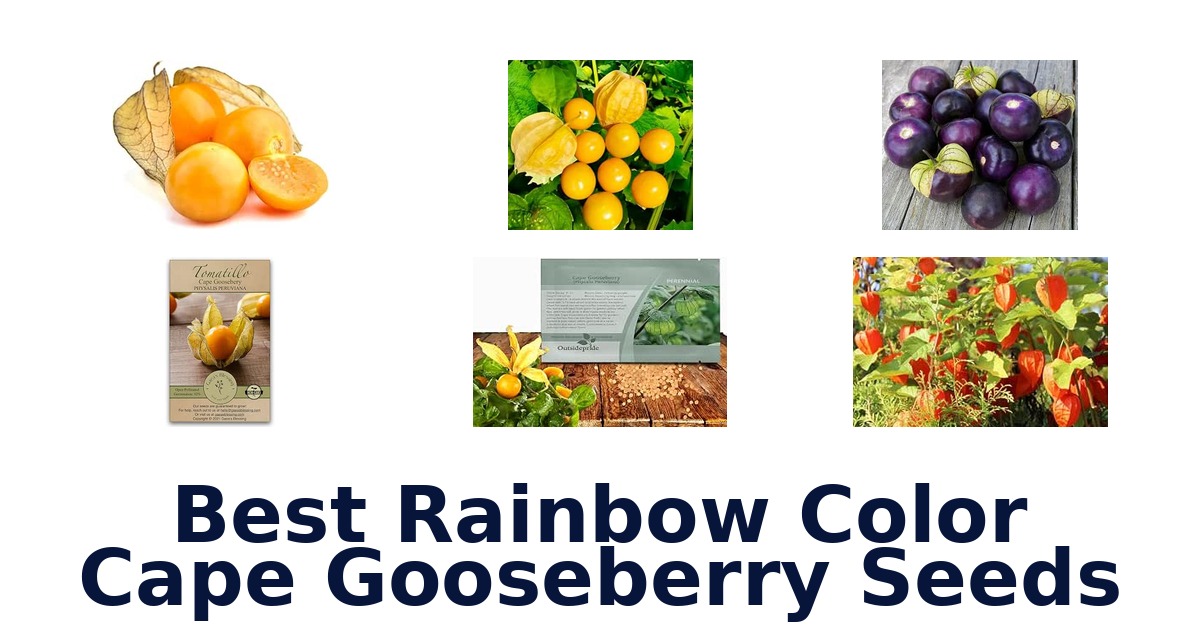
A strong choice for gardeners seeking unusual cape gooseberry colors is CEMEHA SEEDS Purple Cape Gooseberry, the only listing that specifically describes purple berries. This roundup compares that distinct option with golden-fruited cape gooseberry seeds, plus listings whose names or descriptions make their plant identity less certain. The phrase rainbow color does not match a documented multicolor seed mix here: the supplied details support purple or golden fruit, not a plant that produces a rainbow of colors.
Check the botanical description and expected fruit color before ordering, then match the packet size and growing guidance to your plans. For the broadest documented color distinction, start with the purple listing; for familiar golden berries, consider the listings that identify Physalis peruviana and provide planting details.
CEMEHA SEEDS Purple Cape Gooseberry is the clearest match for a search focused on color: its listing specifies purple berries, a strawberry flavor, and approximately 150 seeds. It leads because no other product in this group describes a purple-fruited variety. The listings do not establish a rainbow-colored mix, so treat this as a choice between a documented purple option and several golden or yellow-fruited listings, not as proof of multiple colors from one packet.
Our Top Picks
 Best Overall
The listing explicitly identifies purple berries, gives an approximate 150-seed count, and describes an early-maturing variety with a sweet strawberry flavor.
View on Amazon Best Growing Notes
This goldenberry listing gives a germination temperature of 65–70°F and mentions balcony, patio, and indoor-light growing, useful details for planning.
View on Amazon Best Hawaii Type
The description identifies Giant Poha Berry and says its smooth, waxy orange fruits are sweet-tart and used for jam; the listing states 100 seeds.
View on Amazon- Best Indoor Starting Seeds Of Strength Cape Gooseberry
- Largest Listed Packet Outsidepride Cape Gooseberry
Compare the Cape Gooseberry Seed Options
| # | Product | Material Feature | Material Features | Buy |
|---|---|---|---|---|
| 1 | 1. CEMEHA Purple Cape GooseberryBest Overall | GMO Free | GMO Free | View on Amazon |
| 2 | 2. BULBORIUM Large FruitBest Growing Notes | Heirloom | Heirloom | View on Amazon |
| 3 | 3. Physalis Peruviana Giant PohaBest Hawaii Type | — | — | View on Amazon |
| 4 |  4. Seeds Of Strength Cape GooseberryBest Indoor Starting | Heirloom | Heirloom | View on Amazon |
| 5 |  5. Outsidepride Cape GooseberryLargest Listed Packet | Heirloom | Heirloom | View on Amazon |
| 6 |  6. Wily Fox Cape GooseberryFlexible Container and Indoor Growing | — | — | View on Amazon |
| 7 |  7. BULBORIUM Heirloom Ground CherryLow-Maintenance Summer Fruit | Heirloom | Heirloom | View on Amazon |
| 8 |  8. Wivolibe Ground CherryHome Garden Snack and Dessert Crop | GMO Free, Heirloom, Organic | GMO Free, Heirloom, Organic | View on Amazon |
| 9 |  9. Gaea's Blessing Cape GooseberryOpen-Pollinated Salsa Gardeners | GMO Free, Heirloom | GMO Free, Heirloom | View on Amazon |
| 10 |  10. Mixrug Gooseberry Tree SeedsLarge Landscape Seed Buyers | GMO Free, Heirloom | GMO Free, Heirloom | View on Amazon |
Detailed Reviews: Best Rainbow Color Cape Gooseberry Seeds
#1 · Best Overall
1. CEMEHA Purple Cape Gooseberry
- Material Feature: GMO Free
- Material Features: GMO Free
Best for: Compact Purple Berry Growers.
Why it ranks #1: The listing explicitly identifies purple berries, gives an approximate 150-seed count, and describes an early-maturing variety with a sweet strawberry flavor.
An early-maturing purple variety with creeping stems measuring 20–25 inches gives this CEMEHA SEEDS listing a distinct color and growth profile. The description adds small, round berries with a sweet strawberry flavor, a combination that may appeal to growers seeking a compact-spreading plant and fruit described differently from typical golden varieties.
The listed 20–25-inch creeping stems help growers anticipate a spreading rather than upright habit when choosing a planting location. The description gives berry dimensions of 0.2–0.5 inches and weights of 0.2–0.4 ounces, offering a concrete sense of the small fruit. It calls the variety early maturing and describes seedling sowing in April or direct outdoor sowing after spring. English planting instructions are said to appear on the package, supporting growers who want printed guidance.
- Purple berry variety
- Early-maturing description
- Creeping stems are stated to reach 20–25 inches
- Package is said to include English planting instructions
- The described berries are small, at 0.2–0.5 inches in diameter.
Skip it if you want larger fruit than the listed 0.2–0.5-inch berries; the CEMEHA description specifies a small-fruited variety.
A fit for gardeners interested in purple, early-maturing fruit and able to accommodate creeping stems. The listed berry size is small, so consider that detail if fruit dimensions matter more than the unusual color or strawberry-flavor description.
Full product details
| Brand | CEMEHA SEEDS |
|---|---|
| Color | Purple |
| Manufacturer | CEMEHA SEEDS |
| Material Feature | GMO Free |
| Material Features | GMO Free |
| Special Features | Yield |
| Care Instructions | water |
| Special Feature | Yield |
Listed on Amazon as: Seeds Purple Cape Gooseberry Goldenberry Groung Cherry Physalis Non GMO Vegetable for Planting
View on Amazon#2 · Best Growing Notes
2. BULBORIUM Large Fruit
- Material Feature: Heirloom
- Material Features: Heirloom
Best for: Indoor and Patio Seed Starters.
Why it ranks #2: This goldenberry listing gives a germination temperature of 65–70°F and mentions balcony, patio, and indoor-light growing, useful details for planning.
A stated 65–70°F germination range gives indoor starters a clear temperature target, while the listing also names balconies, patios, aerogardens, and winter grow-light setups. BULBORIUM’s heirloom seeds suit growers planning a small-space start and wanting guidance on early conditions rather than a purely outdoor planting option.
Sow the seeds about an inch apart, maintain the listed 65–70°F range until germination, and keep the soil moist without overwatering. The directions also call for adequate light from a sunny window or grow light, giving indoor growers a practical starting routine. The listing describes the plant as perennial but grown as an annual in most of the USA, and says fruit keeps for several months in its husk. The stated seed quantity is 100 pieces.
- Lists a 65–70°F germination temperature
- Names balconies, patios, aerogardens, and winter indoor growing
- Heirloom seed designation
- Fruit is said to store for several months in its husk
- The listing gives a specific germination temperature range that growers need to maintain.
Skip it if you need a fully specified outdoor-only growing plan; this listing emphasizes indoor light options and does not provide a complete outdoor calendar.
A fit for balcony and indoor growers who can manage the stated germination temperature, moisture, and light needs. Its multi-month husk storage detail may also appeal to harvest planners, though the listing does not give a full outdoor schedule.
Full product details
| Brand | BULBORIUM |
|---|---|
| Item Weight | 3 g |
| Manufacturer | AMERICAN GROWN SEED CO INC |
| Material Feature | Heirloom |
| Material Features | Heirloom |
| Special Features | High Germination Rate |
| Special Feature | High Germination Rate |
Listed on Amazon as: 100PCS Cape Gooseberry Seeds Large Fruit Goldenberry Berry Seeds
View on Amazon#3 · Best Hawaii Type
3. Physalis Peruviana Giant Poha
Best for: Poha Berry Kitchen Growers.
Why it ranks #3: The description identifies Giant Poha Berry and says its smooth, waxy orange fruits are sweet-tart and used for jam; the listing states 100 seeds.
The listing identifies this Physalis peruviana seed as Giant Poha Berry and describes sweet-tart fruit with smooth, waxy orange skin. That flavor profile gives cooks a clear reason to consider it: the fruit is described as suitable for jam and as an addition to salads, rather than only as an ornamental garden plant.
The supplied description connects the fuzzy-leaved Poha Berry bush with berries described as sweet and tart, giving growers a specific harvest use to anticipate. It calls out jam and salad use, with jam also suggested as a glaze for pork, so the crop has both preserving and meal applications. The title lists 100 seeds, while the additional description gives a conflicting seed count; buyers should rely on the title’s stated quantity cautiously. No sowing or care schedule is supplied here.
- Identified as Physalis peruviana and Giant Poha Berry
- Description mentions fuzzy-leaved bushes
- Fruit is described as sweet-tart with smooth, waxy orange skin
- Suggested for jam, salad, and a pork glaze
- The listing conflicts on seed quantity: the title says 100, while the description says 500.
Skip it if you need clear sowing and care directions or an unambiguous seed count; this listing provides neither consistently.
A possible match for growers prioritizing Poha Berry culinary uses, especially jam, salads, or a pork glaze. Consider the conflicting quantity information and the absence of supplied growing instructions before choosing it for a tightly planned seed-starting schedule.
Full product details
| Brand | Physalis Peruviana |
|---|---|
| Color | Yellow |
| Item Form | plant_seed |
| Item Package Weight | 0.01 kg |
| Manufacturer | Unbranded |
| Package Weight | 0.01 kg |
Listed on Amazon as: Cape Gooseberry,Giant Poha Berry,100 SEEDS (Physalis Peruviana) ,Ground Cherry
View on Amazon#4 · Best Indoor Starting
4. Seeds Of Strength Cape Gooseberry
- Material Feature: Heirloom
- Material Features: Heirloom
Best for: Decorative Harvest and Preserving.
Why it ranks #4: The listing provides indoor-starting directions, including sowing six to eight weeks before frost and planting seeds one-quarter inch deep.
Lantern-like husks that look attractive in arrangements paired with sweet golden berries give this Seeds Of Strength packet a dual ornamental and food-garden focus. The listing identifies uses from fresh eating to preserves, desserts, and recipes, making it suited to growers who want both display value and a usable harvest.
The supplied indoor-starting directions recommend sowing six to eight weeks before the last expected frost in seed trays or small pots, at a quarter-inch depth. Starting two or three seeds per cell and thinning to the strongest gives growers a defined early workflow, while the listed 70–75°F range sets a target for germination. The plant is described as a tender perennial in Zones 8–11 and an annual elsewhere, producing from summer through fall. The packet is stated to contain 100+ seeds.
- 100+ seeds are stated in the listing
- Lantern-like husks are described as suitable for arrangements
- Fruit is listed for fresh eating, preserves, and desserts
- Indoor-starting timing, depth, and temperature are provided
- The plant is described as a tender perennial only in Zones 8–11 and an annual elsewhere.
Skip it if you want a perennial crop outside Zones 8–11; the listing says it is grown as an annual elsewhere.
Consider this for indoor seed starters seeking clear timing and sowing guidance, plus fruit for decorative arrangements and kitchen use. The tender-perennial classification applies to Zones 8–11; growers elsewhere should expect the listing’s annual treatment.
Full product details
| Brand | Seeds Of Strength |
|---|---|
| Color | green |
| Manufacturer | Seeds Of Strength |
| Material Feature | Heirloom |
| Material Features | Heirloom |
| Special Features | High Germination Rate |
| Special Feature | High Germination Rate |
Listed on Amazon as: Premium Cape Gooseberry Seeds (Physalis peruviana) – 100+Seeds Yellow Sweet
View on Amazon#5 · Largest Listed Packet
5. Outsidepride Cape Gooseberry
- Material Feature: Heirloom
- Material Features: Heirloom
Best for: Pollinator-Friendly Garden Beds.
Why it ranks #5: Its title specifies 1,000 seeds and the listing describes edible golden pods, yellow-purple blooms, and suitability for USDA zones 8–11.
Yellow-to-purple blooms on plants stated to grow up to two feet tall give this Outsidepride Cape Gooseberry listing an ornamental role alongside its golden berries. The flowers are described as attracting bees, butterflies, and hummingbirds, making the packet relevant to gardeners who want edible planting to contribute to a pollinator-friendly space.
The listed height of up to two feet helps gardeners assess the plant’s scale, while the yellow-to-purple blooms and golden pods offer distinct visual features through the growing period. Outsidepride specifies USDA Zones 8–11 and full-sun conditions in its supplied feature text, helping growers judge climate and site suitability. The product is described as perennial and drought-tolerant, with well-drained care instructions. Its pollinator appeal is specifically associated with bees, butterflies, and hummingbirds.
- Plants are stated to grow up to two feet tall
- Blooms range from yellow to purple
- Golden berries and lantern-shaped husks are described
- Flowers are said to attract bees, butterflies, and hummingbirds
- The listed USDA suitability is limited to Zones 8–11.
Skip it if you garden outside USDA Zones 8–11; Wily Fox’s listing may fit better if you need seeds explicitly described for containers or indoor sunny spots.
A fit for Zone 8–11 gardeners combining edible Cape Gooseberry planting with pollinator interest and decorative blooms. Check that the listed full-sun and well-drained conditions suit your site; its stated zone range is a meaningful boundary.
Full product details
| Brand | Outsidepride |
|---|---|
| Color | Yellow |
| Item Weight | 4.54 g |
| Manufacturer | Outsidepride |
| Part Number | OUT-2228 |
| Material Feature | Heirloom |
| Material Features | Heirloom |
| Special Features | Extended Bloom Time |
| Care Instructions | well-drained |
| Special Feature | Extended Bloom Time |
| Style Name | Cape Gooseberry |
#6
6. Wily Fox Cape Gooseberry
Best for: Flexible Container and Indoor Growing.
Why it ranks #6: This product identifies Physalis peruviana and offers non-GMO heirloom seeds, with listed uses including gardens, containers, raised beds, and indoor sunny spots.
Wily Fox explicitly lists outdoor gardens, containers, raised beds, and sunny indoor spots, giving growers several stated ways to place these non-GMO heirloom Cape Gooseberry seeds. That flexibility is the clearest distinction in the supplied details, especially for gardeners deciding between a conventional bed and a smaller or indoor growing setup.
The range of named growing settings—garden beds, containers, raised beds, and sunny indoor locations—helps growers match the seeds to available space. The listing also identifies the seeds as non-GMO and heirloom, which may matter to shoppers seeking those stated seed attributes. It claims high germination and vigorous growth, along with robust plants and abundant harvests, but provides no numerical germination rate or specific sowing schedule. The practical setup and timing therefore require growers to source details beyond the supplied product information.
- Listed for outdoor gardens, containers, and raised beds
- Sunny indoor growing is also mentioned
- Identified as non-GMO and heirloom
- High germination and vigorous growth are claimed
- The supplied information gives no specific sowing schedule or numerical germination rate.
Skip it if you need exact sowing depth, spacing, or a numerical germination figure; Seeds Of Strength supplies indoor-starting details and a stated temperature range.
A reasonable match for growers choosing among beds, containers, raised beds, or a sunny indoor spot and who value the stated non-GMO heirloom attributes. It is less informative for anyone requiring a precise sowing protocol before buying.
Full product details
| Brand | Wily Fox |
|---|---|
| Color | Yellow |
| Manufacturer | Wily Fox |
Listed on Amazon as: Premium Cape Gooseberry Seeds (Physalis peruviana) – 100+ Non-GMO Heirloom Seeds for Planting – Sweet, Tangy Ground Cherries with High Germination Rate
View on Amazon#7
7. BULBORIUM Heirloom Ground Cherry
- Material Feature: Heirloom
- Material Features: Heirloom
Best for: Low-Maintenance Summer Fruit.
Why it ranks #7: The listing describes edible husk cherries, full sun, medium watering, and summer fruit, but supplies fewer specific planting details than higher-ranked options.
An upright growth habit and edible husk cherries harvested in summer make this BULBORIUM packet a straightforward option for growers seeking a defined seasonal fruit crop. The listing calls the plant low-maintenance, with medium watering and full-sun exposure, and notes that its fruit can be eaten fresh or made into preserves.
The medium-watering guidance gives growers a manageable care expectation, while the full-sun requirement helps identify a suitable planting spot. Its upright growth habit offers a different placement profile from sprawling plants, and summer fruiting provides a seasonal harvest window. The listing describes the husk cherries as usable raw, cooked, or in jams and jellies, so the crop can serve both fresh eating and kitchen projects. The seeds are identified as heirloom.
- Upright growth habit
- Edible husk cherries are listed for summer
- Medium watering and full sun are specified
- Fruit can be eaten raw, cooked, or made into jams and jellies
- The listed growing guidance calls for full sun, limiting suitability for shaded sites.
Skip it if you have a shaded planting area; the full-sun requirement may suit you less than a crop specifically suited to partial shade.
Choose this packet if you have a sunny spot and want summer husk cherries for fresh eating or preserves, with medium watering rather than a highly detailed care regimen. Its full-sun requirement is the key site consideration.
Full product details
| Brand | BULBORIUM |
|---|---|
| Item Weight | 3 g |
| Manufacturer | AMERICAN GROWN SEED CO INC |
| Material Feature | Heirloom |
| Material Features | Heirloom |
| Special Features | Low Maintenance |
| Special Feature | Low Maintenance |
Listed on Amazon as: 100PCS Cape Gooseberry Seeds Rare Fruit Spring Ground Cherry-Heirloom Seeds
View on Amazon#8
8. Wivolibe Ground Cherry
- Material Feature: GMO Free, Heirloom, Organic
- Material Features: GMO Free, Heirloom, Organic
Best for: Home Garden Snack and Dessert Crop.
Why it ranks #8: It offers 100-plus non-GMO heirloom seeds and describes sweet, husk-wrapped fruit, but identifies Physalis pruinosa rather than the peruviana species in several listings.
More than 100 non-GMO heirloom seeds and a list of fresh snacking, jams, pies, and desserts position this Wivolibe packet for home growers planning both a planting patch and varied uses for its harvest. The listing describes sweet, tropical-flavored husk-wrapped fruit under the Ground Cherry name.
The stated 100+ seed quantity gives growers material for establishing a patch, while the non-GMO heirloom description identifies the seed attributes emphasized by the listing. Its fruit is described as small and wrapped in husks, with suggested uses spanning fresh snacks, jams, pies, and desserts. That range supports planning for both immediate eating and kitchen preparation. The supplied details do not provide planting depth, timing, or spacing, so buyers seeking a step-by-step sowing routine will need additional guidance.
- More than 100 seeds are stated
- Non-GMO heirloom designation
- Husk-wrapped fruit is described as sweet and tropical in flavor
- Suggested for snacking, jams, pies, and desserts
- No planting depth, timing, or spacing is supplied in the provided details.
Skip it if you need a specific seed-starting calendar; Seeds Of Strength lists indoor timing, planting depth, cell spacing, and temperature.
Choose this if you want a generous stated quantity of non-GMO heirloom seeds and plan to use fruit for snacks or desserts. The product information highlights culinary uses but leaves planting timing and technique unspecified.
Full product details
| Brand | Wivolibe |
|---|---|
| Color | Yellow |
| Manufacturer | Wivolibe |
| Material Feature | GMO Free, Heirloom, Organic |
| Material Features | GMO Free, Heirloom, Organic |
| Special Features | High Germination Rate, Non-GMO |
| Special Feature | High Germination Rate, Non-GMO |
Listed on Amazon as: 100+ Ground Cherry Seeds, Cape Gooseberry Seeds for Planting, Non-GMO Heirloom, Easy-Grow Annual for Home Garden, Containers & Patios
View on Amazon#9
9. Gaea's Blessing Cape Gooseberry
- Material Feature: GMO Free, Heirloom
- Material Features: GMO Free, Heirloom
Best for: Open-Pollinated Salsa Gardeners.
Why it ranks #9: The title identifies Cape Gooseberry and the listing states non-GMO, open-pollinated, heirloom, untreated seeds, but gives little variety-specific growing information.
Non-GMO, open-pollinated, heirloom, and untreated are the seed attributes emphasized by Gaea’s Blessing, while the listing connects Cape Gooseberry with citrusy, sweet-tart fruit and salsa verde. That combination suits gardeners interested in a culinary crop and in clearly stated seed characteristics for fresh or cooked dishes.
The listing links the fruit’s citrusy, sweet-tart flavor with fresh salsa and cooked sauces, including Mexican-style chili verde, giving growers specific kitchen uses to plan around. It identifies the seeds as non-GMO, open-pollinated, heirloom, and untreated, useful distinctions for buyers prioritizing those attributes. The description says the plants grow like tomatoes and mature rather quickly, but supplies no planting depth, spacing, or calendar in the provided facts. Buyers wanting a precise sowing workflow will need more information.
- Non-GMO, open-pollinated, heirloom, and untreated are stated
- Fruit is described as citrusy and sweet-tart
- Salsa verde and cooked sauces are named uses
- Growth is compared with tomatoes and described as relatively quick to mature
- No planting depth, spacing, or sowing calendar is provided in the supplied details.
Skip it if you need detailed planting measurements and timing; Seeds Of Strength provides indoor-starting depth, timing, spacing, and temperature guidance.
A fit for gardeners who prioritize the stated seed attributes and want Cape Gooseberry fruit for salsa or cooked sauces. Its culinary description is more detailed than its growing instructions, so plan to obtain sowing specifics separately.
Full product details
| Brand | Gaea's Blessing |
|---|---|
| Color | Cape Gooseberry |
| Manufacturer | Gaea's Blessing |
| Material Feature | GMO Free, Heirloom |
| Material Features | GMO Free, Heirloom |
Listed on Amazon as: Gaea's Blessing Seeds – Tomatillo Seeds – Non-GMO Heirloom Seeds with Easy to Follow Planting Instructions – Open-Pollinated and Untreated (Cape Gooseberry)
View on Amazon#10
10. Mixrug Gooseberry Tree Seeds
- Material Feature: GMO Free, Heirloom
- Material Features: GMO Free, Heirloom
Best for: Large Landscape Seed Buyers.
Why it ranks #10: This listing claims 25–30-foot trees and focuses on zones 10–12, claims that do not align with the compact edible cape gooseberry use case.
The listing claims these seeds can produce plants 25–30 feet tall, making scale the clearest stated consideration for this Mixrug product. It also names full sun to partial shade and USDA Zones 10–12, giving growers some site parameters to weigh before considering these purported perennial ground cherry seeds for a landscape.
The stated 25–30-foot mature height points toward a large planting footprint, so growers should evaluate available space before choosing this listing. Its full-sun-to-partial-shade range provides flexibility in placement, while the stated Zones 10–12 and moderate water requirement help define the listed growing conditions. The description says plants become drought-tolerant once mature. The title identifies 10 seeds, but the unusually large tree-height claim is the key point to verify against the intended crop before committing to a garden plan.
- Title states a quantity of 10 seeds
- Lists USDA Zones 10–12
- Full sun to partial shade is specified
- Drought tolerance is claimed once mature
- The listing claims plants reach 25–30 feet, a substantial space requirement.
Skip it if you have limited planting space or want a compact crop; Wivolibe describes home-garden ground cherry seeds without this listing’s extreme height claim.
Only consider this if you have room for the listed 25–30-foot plants and your site fits the stated Zones 10–12 conditions. The scale claim is a critical fit question for gardeners seeking ordinary home-plot fruit planting.
Full product details
| Brand | Mixrug |
|---|---|
| Color | Mix |
| Manufacturer | Mixrug |
| Material Feature | GMO Free, Heirloom |
| Material Features | GMO Free, Heirloom |
| Special Features | Air Purification, Attracts Pollinators, Fragrant, High Germination Rate, Low Maintenance |
| Special Feature | Air Purification, Attracts Pollinators, Fragrant, High Germination Rate, Low Maintenance |
Listed on Amazon as: Gape Gooseberry Trees Seeds for Planting, 10pcs Perennial Ground Cherry Gooseberry Fruits Seeds Plants, Non-GMO Heirloom Open Pollinated Sweet Fruits Plants for Home Garden Outdoors
View on AmazonWhat rainbow color means for these seeds
None of these listings verifies a rainbow-colored fruit mix; the documented color choices are purple, yellow, or golden/orange. CEMEHA SEEDS Purple Cape Gooseberry describes small purple berries, while several other listings identify golden or yellow fruit. The Outsidepride description adds yellow-to-purple blooms, but its berry pods are described as golden, so bloom color should not be mistaken for fruit color.
Before buying, distinguish the color of flowers, husks, and ripe berries, and look for a specific variety name rather than relying on a broad keyword. A packet labeled cape gooseberry may produce familiar golden fruit, not a blend of colors.
If the desired outcome is a garden with several colors, the supplied listings do not establish that one packet can deliver it; choosing separately identified varieties is the more cautious approach.
Check the species before treating ground cherry as cape gooseberry
A ground-cherry label does not guarantee the same species or fruit type as cape gooseberry. Several products explicitly name Physalis peruviana, while Wivolibe names Physalis pruinosa and describes its seeds as ground cherry. Both listings use overlapping common names, but the product data does not establish that the plants are interchangeable in size, flavor, or growing requirements.
Mixrug is an even greater mismatch: its title says gooseberry trees and its description claims mature heights of 25–30 feet, unlike the other listings’ garden-plant framing. Check the botanical name and the specific fruit description if you want purple berries or a particular cape gooseberry variety.
This simple identity check helps avoid buying based on common-name overlap alone, especially when the intended purpose is growing edible fruit rather than selecting a plant by a broad marketplace label.
How to Choose Cape Gooseberry Seeds
Expected fruit color and identity
Look for a listing that names the fruit color and, when color matters, the variety or botanical identity. CEMEHA SEEDS Purple Cape Gooseberry describes purple berries measuring 6–12 mm, while Outsidepride describes golden pods and BULBORIUM Large Fruit is titled for goldenberry. Seeds Of Strength also identifies yellow sweet fruit.
These are distinct descriptions, not evidence of a single rainbow-producing variety. Choose CEMEHA SEEDS Purple Cape Gooseberry when purple fruit is the priority; choose a golden-fruited listing when you want the more commonly described yellow or orange harvest.
If the listing only says ground cherry, read its species and fruit details before assuming it matches cape gooseberry.
Packet quantity
Compare the stated seed count with the number of plants you plan to start, while remembering that counts are not a germination guarantee. Outsidepride lists 1,000 seeds, CEMEHA SEEDS lists approximately 150, and Seeds Of Strength and Wily Fox each describe 100-plus seeds. BULBORIUM listings and Physalis Peruviana Giant Poha are titled as 100-seed packets.
A larger stated quantity suits gardeners planning a larger sowing or keeping seed for repeated starts, while a smaller packet may better suit a limited trial. Because germination outcomes are not established consistently across the products, do not assume that the largest packet will yield a particular number of healthy plants.
Planting guidance and growing setting
Prefer listings with directions that fit your climate and setup, rather than relying on a broad easy-growing claim. BULBORIUM Large Fruit specifies 65–70°F until germination and mentions balconies, patios, and growing under lights. Seeds Of Strength recommends starting indoors six to eight weeks before the last expected frost, sowing one-quarter inch deep, and thinning two to three seeds per cell.
BULBORIUM Heirloom Ground Cherry instead notes full sun and medium watering; Outsidepride lists USDA zones 8–Indoor starters may favor the explicit timing and depth from Seeds Of Strength, while growers using lights may find BULBORIUM Large Fruit’s temperature guidance more directly useful.
Match zone information to your own conditions.
Which Cape Gooseberry Seeds Should You Choose?
For a specifically purple-fruited option, choose CEMEHA Purple Cape Gooseberry: it is the only listing that describes purple berries and gives an approximate 150-seed count. For golden fruit with clear temperature guidance and indoor-light possibilities, choose BULBORIUM Large Fruit. Gardeners prioritizing a larger stated quantity can consider Outsidepride Cape Gooseberry, listed at 1,000 seeds, while Seeds Of Strength Cape Gooseberry is a fit if you want explicit indoor-starting timing and sowing depth.
If species identity matters, favor listings that name Physalis peruviana and check the description closely. None of these products substantiates a rainbow-color mix, so do not buy expecting one packet to produce several fruit colors.
Avoid Mixrug Gooseberry Tree Seeds for this purpose: its tree-height claims make it the least suitable match.
Frequently Asked Questions
Will cape gooseberry plants produce fruit in containers or indoors?
They may grow in containers, but the listings do not guarantee indoor fruiting. One listing explicitly mentions containers and patios, while the golden-fruit option describes indoor-light possibilities. Check each product’s growing directions and provide suitable growing conditions; the product titles alone cannot establish that a plant will fruit indoors.
When should cape gooseberry seeds be started, and how long do they take to germinate?
Follow the timing and germination guidance on the specific packet, since the supplied listings do not give a general start date or germination period. Seeds Of Strength is identified as providing indoor-starting timing and sowing depth, so its instructions can guide your planting rather than assuming one schedule applies to every listing.
Do purple cape gooseberries taste different from golden varieties?
The supplied product information does not support a reliable taste comparison between purple and golden fruit. CEMEHA describes its purple berries as strawberry-flavored, while other listings describe golden or yellow fruit with sweet or tangy flavors. Those descriptions do not establish how the varieties compare when grown and tasted.
How can I check whether a listing identifies the species?
Look for the botanical name Physalis peruviana in the product title or description, then confirm it in the full listing before ordering. Some titles name this species explicitly, while others use common names such as ground cherry or cape gooseberry. Common names alone do not verify species identity.
Does one packet promise fruit in multiple colors?
No listing in this group establishes that a packet contains a rainbow-colored mix. The products describe a purple option and several golden or yellow-fruited options, but that is not evidence that one packet will produce multiple fruit colors. Choose based on the documented fruit description and verify details in the listing.
Final Words
For a specifically purple-fruited option, choose CEMEHA, the only listing here that describes purple berries and gives an approximate seed count. Choose BULBORIUM for golden fruit with temperature guidance and indoor-light possibilities, or Outsidepride if its stated quantity suits your priorities. Check species details and growing instructions before ordering.
No listing substantiates a rainbow mix, so treat these as distinct options, not a multicolor packet.