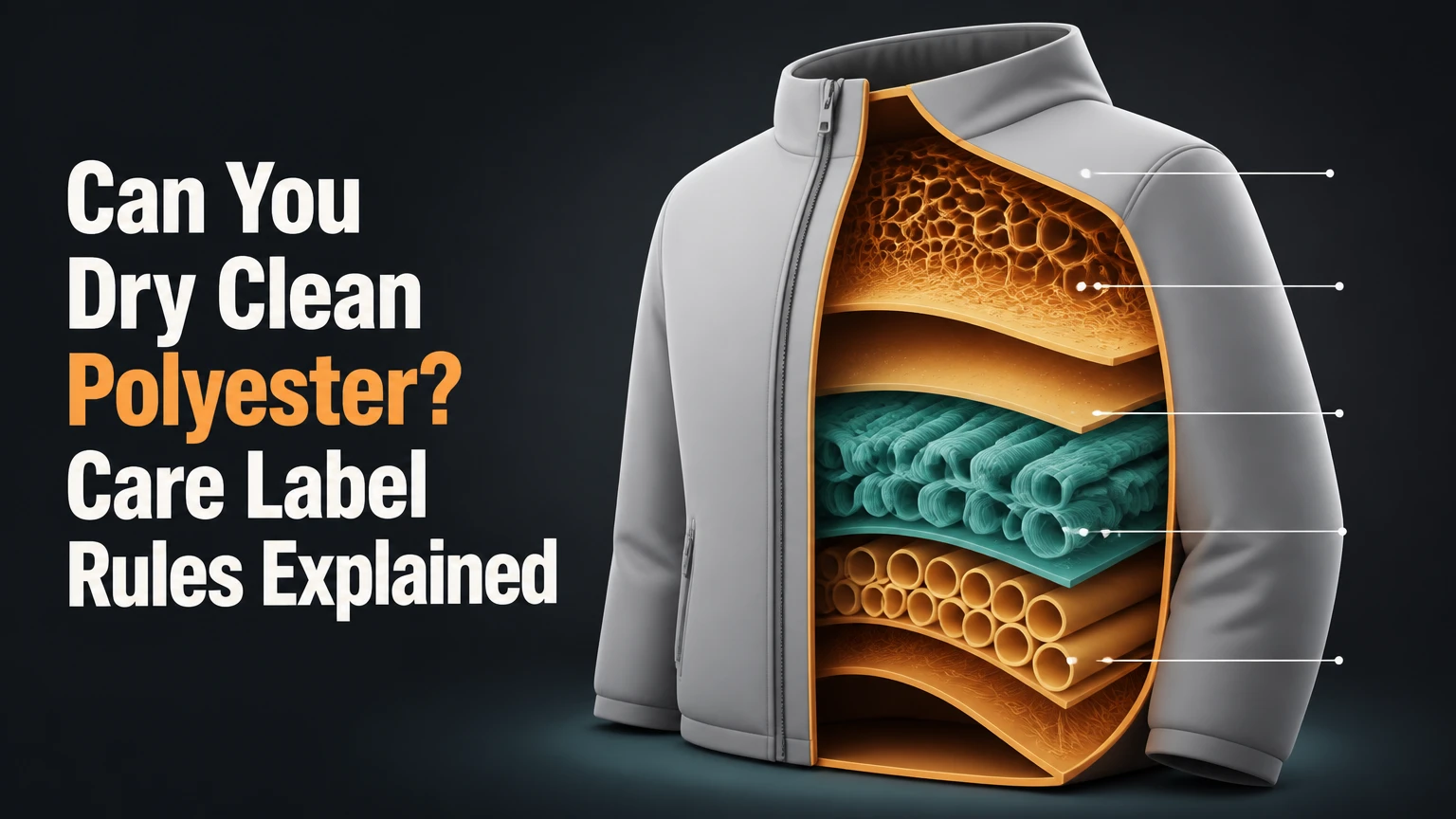
Yes, you can dry clean polyester, and professional dry cleaning is often appropriate for lined, structured, embellished, or “Dry Clean Only” garments. Many unlined polyester shirts, trousers, and activewear pieces are machine-washable, so the care label, garment construction, trim, stain type, and desired finish determine the safest cleaning method.
Key facts at a glance
- Polyester fiber is usually durable, colorfast, and resistant to shrinking, but polyester garments can still be damaged by heat, friction, adhesives, or unsuitable trims.
- “Dry Clean Only” applies to the complete garment, not merely its polyester fiber content.
- Water-based washing usually removes sweat, salt, and sugary spills more effectively than solvent cleaning.
- Dry cleaning is usually better for oil, grease, makeup, structured jackets, pleats, linings, and delicate embellishments.
- Typical polyester dry-cleaning prices range from about $5-$9 for a shirt or skirt and $12-$25 for many dresses, trousers, blazers, and suits.
- Never apply a hot iron directly over an unidentified stain because heat can permanently set some residues into synthetic fibers.
Can You Dry Clean Polyester?
Polyester can be dry cleaned because the fiber tolerates common professional solvent-cleaning processes when the garment is correctly inspected and finished. Dry cleaning is the safer choice for a polyester item marked “Dry Clean Only,” or for a garment whose lining, interfacing, pleats, beading, sequins, or shape could fail in a washing machine.
Polyester itself is a synthetic polymer commonly produced as polyethylene terephthalate, or PET. The fiber resists ordinary water-related shrinkage, but that does not make every polyester garment washable. A blazer may contain wool shoulder pads, glued interfacings, acetate lining, foam, or heat-sensitive buttons that determine the care method.
The most reliable rule is simple: follow the care label for the finished garment. A “Dry Clean” instruction identifies a permitted professional method, while “Dry Clean Only” means home washing may create a foreseeable risk of distortion, color transfer, trim damage, or loss of shape.
What Is Polyester?
Polyester is a petroleum-derived synthetic fiber valued for durability, quick drying, wrinkle resistance, and dimensional stability. Polyester fabric can be woven, knitted, brushed, pleated, coated, printed, or blended with fibers such as cotton, wool, elastane, rayon, or silk.
Polyester fibers do not behave exactly like every polyester textile. A tightly woven suiting fabric is more stable than a lightweight knitted jersey. A polyester satin can develop water marks or surface changes, while a matte polyester crepe may tolerate gentle laundering. Heat-set pleats can relax, and elastane blended into stretch fabric can deteriorate under repeated high heat.
Polyester also retains oily body soils more readily than some natural fibers because its relatively low moisture absorbency leaves oils near the fiber surface. That property explains why a polyester blouse may look clean after washing yet retain an underarm odor unless the detergent and rinse process remove the oil thoroughly.
Does polyester shrink in dry cleaning?
Polyester fiber usually shrinks very little during correctly performed dry cleaning, but the complete garment can still change shape. Heat, steam, agitation, tension, coating failure, or a different fiber in the blend may cause puckering, pleat loss, or distortion.
Dry cleaning does not guarantee zero damage. Poorly fused interfacing can bubble, weak dyes can bleed, and decorative glue can soften. Professional inspection reduces those risks; it does not eliminate them.
How Does Dry Cleaning Polyester Work?
Professional dry cleaning uses a liquid solvent rather than a conventional water-and-detergent wash. The cleaner inspects the polyester garment, identifies the fabric and trim, pre-treats suitable stains, cleans it in a controlled machine, extracts the solvent, dries the item, and finishes it with steam or pressing.
The solvent dissolves many oil-based soils while causing less swelling of the textile than water. Mechanical action remains important, so cleaning strength depends on solvent choice, filtration, moisture control, temperature, cycle length, and pre-spotting. Water-soluble substances such as perspiration salts, some soft drinks, and certain food residues may need a water-based treatment.
A typical professional workflow is:
- Inspection and tagging: The cleaner records existing damage, loose fasteners, stains, color risks, and label instructions.
- Stain identification: The customer should identify whether the mark came from oil, ink, wine, sweat, makeup, food, or an unknown source.
- Pre-spotting: A technician applies a compatible spotting agent and tests an inconspicuous area when necessary.
- Solvent cleaning: The garment receives controlled agitation in a sealed drum.
- Extraction and drying: The machine removes and recovers solvent before circulating temperature-controlled air.
- Post-spotting: Remaining marks receive additional treatment if the fabric and dye can tolerate it.
- Finishing: Steam, a press, a form finisher, or hand pressing restores shape without excessive surface pressure.
- Final inspection: The cleaner checks odor, stains, buttons, seams, color, and presentation before packaging.
Which professional cleaning method fits polyester?
The best method depends on the garment, stain, trim, and label rather than on polyester alone. Traditional chlorinated solvents, hydrocarbon solvents, silicone-based systems such as GreenEarth, and professional wet cleaning each create different trade-offs.
| Method | Best polyester use | Main strength | Main limitation |
|---|---|---|---|
| Perchloroethylene, or PERC | Robust tailored garments with oily soil | Strong grease and oil removal | May affect some plastics, coatings, or adhesives |
| Hydrocarbon solvent | Delicate synthetic garments and mixed trims | Lower cleaning aggressiveness and gentle handling | May need stronger pre-spotting for heavy soil |
| Silicone-based solvent, including GreenEarth | Delicate chiffon, satin, and decorated items | Mild solvent environment and low water exposure | Availability and stain performance vary by cleaner |
| Professional wet cleaning | Sportswear, washable polyester, and water-soluble soil | Water and detergent handle sweat and salts well | Can affect shape, dye, interfacing, or pleats if poorly controlled |
The cleaner, not the customer, should select the solvent after examining the item. Ask which process the business recommends and mention any sequins, heat-transfer graphics, faux leather, foam, or glued details.
Can Polyester Be Washed at Home?
Many unlined polyester garments can be washed at home in cold or lukewarm water on a gentle cycle, then air-dried or tumble-dried on low heat. Home laundering is usually preferable for washable T-shirts, fleece, underwear, washable trousers, and performance clothing because water-based detergent removes sweat and salt better than dry-cleaning solvent.
Check the label before washing. Turn printed or dark polyester garments inside out, close zippers, separate colors, use a moderate detergent dose, and avoid chlorine bleach unless the manufacturer specifically permits it. High heat can set wrinkles, flatten textures, damage elastane, or create shine even when the polyester fiber does not visibly shrink.
| Polyester item | Usually preferred method | Typical home setting | Main reason |
|---|---|---|---|
| Unlined blouse | Home washing if label permits | Cold, gentle cycle, low heat or air-dry | Low structural risk and regular body soil |
| Stretch activewear | Home washing | Cold water, mild detergent, air-dry | Removes sweat and protects elastane |
| Tailored blazer | Professional cleaning | Cleaner-selected process | Lining and interfacing control shape |
| Pleated chiffon dress | Label-directed professional service | No home agitation unless expressly allowed | Pleats and delicate surface can distort |
| Polyester curtain | Professional wet or dry cleaning | Depends on lining and finish | Size, weight, and hanging shape complicate washing |
A “Dry Clean” label does not always mean washing is forbidden, but experimentation is risky when the item is expensive, fitted, lined, pleated, or difficult to replace. The manufacturer has evaluated the garment as a construction, not just as a fiber sample.
Which Polyester Garments Need Professional Cleaning?
Polyester suits, blazers, lined dresses, pleated garments, formalwear, and pieces with delicate decoration generally need professional cleaning. Basic unlined polyester clothing usually does not need routine dry cleaning if the label allows machine washing.
Professional service is especially appropriate in these cases:
- Suits and blazers: Shoulder pads, sleeve heads, lining, canvas, and fusible interfacing can pucker or bubble.
- Formal dresses: Multiple layers, boning, appliqués, beads, sequins, and pressed pleats need controlled handling.
- Polyester chiffon: Fine yarns snag easily, and aggressive rubbing can create pulls or fuzzy areas.
- Polyester satin: Surface pressure and heat can produce shine, water marks, or nap-like changes.
- Pleated skirts: Washing and drying can relax permanent pleats or shift the waistband.
- Curtains and blankets: Large items may overload a domestic washer and dry unevenly.
- Blended fabrics: Wool, silk, rayon, acetate, and elastane introduce additional shrinkage and finish risks.
A professional cleaner should be told about invisible repairs, old stains, loose trim, and previous cleaning problems. These details change the risk assessment.
What about polyester sportswear and activewear?
Polyester sportswear is usually better washed at home than dry cleaned, provided the care label allows it. Water, detergent, and suitable enzyme action remove perspiration, deodorant residue, and salt more effectively than a solvent cycle designed primarily for oily soil.
Wash activewear promptly in cool water, avoid fabric softener, and air-dry when possible. Fabric softener can coat performance fibers and reduce moisture transport. Dry cleaning also does not repair delaminated waterproof membranes, stretched elastic, peeling logos, or odor trapped in degraded polyurethane coatings.
What about polyester dresses, satin, and chiffon?
Polyester dresses, satin, and chiffon can be dry cleaned, but decorative elements and surface finish determine the process. Ask the cleaner to inspect beads, sequins, rhinestones, metallic thread, feathers, faux leather, and glued appliqués because solvent, heat, or tumbling may loosen or discolor them.
A hand-finished or low-mechanical-action process may be more suitable than a standard cycle. For a valuable gown, request a written assessment of stain-removal and trim risks before authorizing treatment.
How Should You Prepare Polyester for Cleaning?
Prepare polyester by reading the complete care label, checking for hidden damage, emptying pockets, securing removable parts, and identifying every stain. Do not rub aggressively, add random chemicals, or iron the mark before professional treatment.
Use this preparation sequence:
- Photograph the garment and existing marks before drop-off.
- Point out each stain and state its source and approximate age.
- Identify embellishments, glued trim, heat-transfer prints, and weak seams.
- Remove belts and detachable accessories unless the label says they should remain attached.
- Keep the garment away from heat until the cleaner assesses it.
- Tell the cleaner whether a home product, stain stick, bleach, or solvent has already been used.
Stain history matters because oil, protein, tannin, dye, and adhesive residues respond to different treatments. A fresh unknown stain is safer to assess than an old mark that has been rubbed, chemically treated, and heat-set.
Which stains does dry cleaning remove best?
Dry cleaning is particularly effective against oil, grease, cosmetic residue, many oily food marks, and petroleum-based grime. Professional wet cleaning is often stronger against sweat salts, water-based beverages, mud, and some detergent-soluble food residues.
| Stain or soil | Often effective first approach | What to avoid | Customer instruction |
|---|---|---|---|
| Cooking oil | Solvent cleaning and oil spotting agent | Hot ironing | Name the oil and avoid rubbing |
| Foundation makeup | Solvent-compatible pre-spotting | Water rubbing that spreads pigment | Tell the cleaner the cosmetic brand if known |
| Sweat and deodorant | Controlled wet cleaning or laundering | Repeated solvent-only cleaning | State whether odor remains after washing |
| Coffee or juice | Water-based spotting or wet cleaning | Chlorine bleach on colored polyester | Blot fresh liquid without friction |
| Ink | Professional solvent and dye assessment | Alcohol experiments on printed fabric | Identify the pen type if known |
| Candle wax | Solid removal followed by solvent treatment | Direct high heat | Do not scrape with a sharp blade |
No cleaning method guarantees complete stain removal. Dye transfer, aged oxidation, fiber damage, and heat-setting may make a mark permanent.
How Much Does Polyester Dry Cleaning Cost?
Typical United States prices are about $5-$8 for a polyester shirt or blouse, $6-$12 for trousers or skirts, $12-$25 for a dress, and $15-$30 for a blazer or suit component. Formal gowns, heavily decorated pieces, curtains, and blankets commonly cost $50-$150 or more.
Prices vary by city, cleaner, garment weight, lining, stain treatment, rush service, and decoration. A cleaner may quote a gown after inspection rather than use a posted per-item price.
| Item | Typical United States price | Typical turnaround | Common price increase |
|---|---|---|---|
| Polyester shirt or blouse | $5-$8 | 1-2 days | Heavy stains or hand finishing |
| Trousers or skirt | $6-$12 | 1-2 days | Pleats, lining, or repair |
| Blazer or suit jacket | $15-$30 | 1-3 days | Shoulder structure and stain work |
| Casual polyester dress | $12-$25 | 1-3 days | Multiple layers or satin finish |
| Formal or embellished gown | $50-$150+ | 3-14 days | Beading, sequins, testing, packaging |
| Curtain or large blanket | $25-$100+ | 3-10 days | Size, weight, lining, and drying space |
The actual machine cycle may take roughly 30-45 minutes, but customer turnaround includes tagging, queue time, pre-spotting, finishing, inspection, and packaging. Same-day service is possible in some shops, but it is not appropriate for every delicate item.
Dry Cleaning or Washing: Which Should You Choose?
Choose dry cleaning for structure, decoration, oily stains, and “Dry Clean Only” labels. Choose home washing for washable, unlined polyester basics and activewear with sweat or water-soluble soil.
| Decision factor | Dry cleaning | Home washing | Professional wet cleaning |
|---|---|---|---|
| Typical small-item cost | $5-$12 | About $0.50-$2 per load share | Often $8-$20+ |
| Best soil type | Oil, grease, makeup | Sweat, salt, light food soil | Sweat, drinks, water-soluble soil |
| Shape protection | Strong for tailoring | Weak to moderate | Moderate to strong with trained handling |
| Water exposure | Low | High | Controlled, water-based |
| Best garment example | Lined polyester blazer | Washable athletic shirt | Structured washable dress |
| Main failure risk | Trim or adhesive solvent damage | Heat, friction, pilling, distortion | Water marks, shrinkage, or interfacing change |
Dry cleaning is not automatically more hygienic or more effective. Solvent cleaning can leave water-soluble perspiration residues, while home washing can ruin a jacket’s internal construction. The winning method matches the soil and the garment architecture.
Is home dry cleaning a safe substitute?
Home dry-cleaning kits are limited refresh and spot-treatment systems, not equivalent replacements for a professional dry-cleaning machine. A dryer-activated kit can reduce light odor and wrinkles, but it cannot inspect hidden damage, separately treat different stain chemistries, or reproduce professional pressing.
Do not use a home kit on a valuable gown, heavily stained blazer, garment with unstable decoration, or item marked “Dry Clean Only” unless the manufacturer specifically permits that product. The kit’s solvent exposure, moisture level, and heat cycle may not match the garment’s tested care method.
What Problems Can Occur After Polyester Dry Cleaning?
Common post-cleaning problems include lingering odor, shiny patches, color change, bubbling interfacing, lost pleats, and remaining stains. Each problem points to a different cause, so immediate reinspection is more useful than washing the garment again.
- Solvent odor: Hang the garment in moving air for several hours and contact the cleaner if the smell remains strong or causes irritation.
- Shiny surface: Excessive pressure or heat may flatten polyester filaments. Return the item promptly for professional re-finishing.
- Bubbling or puckering: The lining or fusible interfacing may have reacted to heat, moisture, or solvent. Washing usually makes the problem worse.
- Lost pleats: Pleats may require specialized re-pressing, and some heat-set effects cannot be restored.
- Color change: Dye bleeding, migration, or finish loss may be irreversible. Compare the garment with pre-cleaning photographs.
- Remaining stain: Ask what treatment was attempted and whether further work risks fiber or dye damage.
Polyester can melt at temperatures far above normal clothing-care settings, but the melting point is not a safe ironing target. Surface fibers can flatten, glaze, or distort at much lower temperatures, especially under pressure, so use the label’s lowest recommended setting and a pressing cloth.
How can you prevent heat damage?
Prevent heat damage by using low temperatures, short exposure, steam at a controlled distance, and a pressing cloth between the iron and polyester. Never press directly over an oily, adhesive, cosmetic, or unknown stain.
The safest home sequence is to test an inside seam, turn the garment inside out, keep the iron moving, and stop when wrinkles release. A garment steamer is often gentler than direct ironing, but steam can still affect pleats, coatings, and glued trim.
How Often Should Polyester Be Dry Cleaned?
Dry clean a polyester suit or blazer when the care label requires it, after visible staining, or when odor and soil remain after airing. Routine cleaning after every wear is usually unnecessary and can add cost and solvent, heat, and finishing exposure.
For a business suit worn over a shirt, many cleaners use a practical interval of roughly 4-6 wears, combined with airing and spot treatment between services. The correct interval depends on perspiration, climate, contact with skin, smoke exposure, and whether the garment is brushed and aired after use.
Washable polyester basics should generally be laundered when soiled rather than sent to a cleaner. Frequent solvent cleaning does not make activewear cleaner when the primary contamination is sweat and salt.
FAQ
Can you dry clean 100% polyester?
Yes, 100% polyester can be dry cleaned, but the care label and construction still control the decision. A 100% polyester blazer may contain fragile lining, foam, glue, or trim, while a 100% polyester T-shirt may be safely machine-washed. Fiber percentage alone cannot establish the correct method.
Can you dry clean polyester with elastane?
Polyester blended with elastane can often be professionally cleaned, but repeated heat, harsh chemicals, and extended drying may reduce stretch recovery. Follow the label, avoid high-temperature home drying, and tell the cleaner that the garment contains stretch fiber. Activewear is usually better laundered in cool water.
Can you steam polyester?
You can steam many polyester garments, provided the label permits steaming and the steamer does not touch delicate trim. Hold the steamer several centimeters away, support the garment, and test an inside area first. Excessive steam can relax pleats, affect coatings, or loosen glued decorations.
Can you put polyester in a dryer?
You can tumble-dry some polyester garments on low heat when the care label permits it. High heat can create permanent wrinkles, damage elastane, flatten fleece, or distort prints and coatings. Remove polyester promptly at the end of the cycle and air-dry structured or delicate garments.
Does dry cleaning remove polyester odor?
Dry cleaning can reduce odors caused by oily smoke, cosmetics, and some surface soils, but solvent cleaning may not remove sweat salts and water-soluble odor compounds as effectively as laundering. Persistent activewear odor usually requires detergent-based washing, adequate rinsing, and complete drying.
Should you dry clean polyester curtains?
Polyester curtains should be professionally cleaned when they are lined, weighted, coated, large, pleated, or labeled for dry cleaning. Unlined washable curtains may be laundered at home, but a domestic washer can cause severe wrinkling and uneven drying. Check the label before removing hooks or heading tape.
The Bottom Line
Yes, you can dry clean polyester, but the correct method depends on the complete garment rather than the fiber name alone. Use professional dry cleaning for “Dry Clean Only” items, tailoring, formalwear, pleats, delicate trims, and oily stains; use cold-water laundering for label-approved basics and activewear. Read the care label, identify the stain, control heat, and tell the cleaner about every decoration or previous treatment.