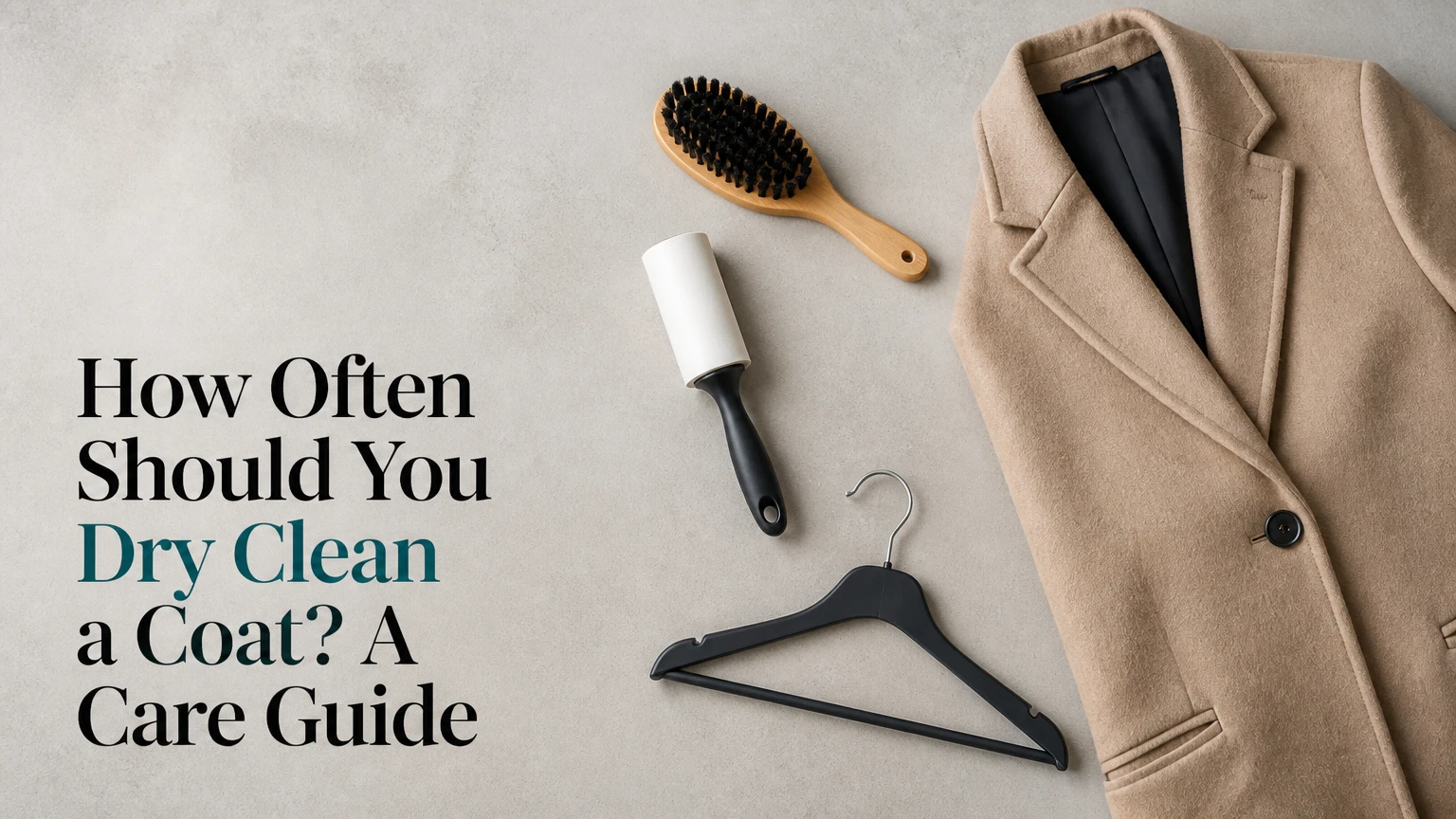
Most coats need professional cleaning once per season or once a year, not after every wear. Dry clean a coat when the care label requires it, when visible soil or persistent odor remains, or before long-term storage; wool and cashmere often need only end-of-season cleaning, while daily-use coats may need a mid-season service.
Key Facts at a Glance
- A lightly used wool coat typically needs professional cleaning once at the end of winter.
- A coat worn most days in rain, smoke, public transit, or heavy pollution may need cleaning twice per season.
- The sewn-in care label takes priority over a generic dry-cleaning schedule.
- Down and puffer coats commonly require professional wet cleaning or machine washing rather than traditional solvent cleaning.
- Remove a coat from the cleaner’s plastic cover and store it in a breathable garment bag after the solvent odor has dissipated.
- Clean a coat before storage only when it is dry, visibly soiled, stained, or noticeably odorous.
How Often Should You Dry Clean a Coat?
The practical starting point is once per season, with a second cleaning only when use or contamination justifies it. A wool overcoat worn twice a week in a dry office may need one end-of-season service, whereas the same coat worn every day through wet, salty streets may need cleaning during winter and again before storage.
A calendar alone cannot determine the right interval. Cleaning frequency depends on fiber, lining, interlinings, finish, climate, contact with skin, and the kind of soil present. Oil, body sebum, food grease, and cosmetics respond well to solvent cleaning, while sweat salts and many sugary spills are water-soluble and may require professional wet cleaning or targeted treatment.
The care label supplies the first instruction. In the United States, the Federal Trade Commission Care Labeling Rule requires manufacturers and importers to provide cleaning instructions that are reliable for the garment. “Dry clean” identifies a suitable method, but it does not mean the coat must be cleaned every fixed number of wears.
A practical frequency scale
| Coat situation | Typical service interval | Action trigger | Storage recommendation |
|---|---|---|---|
| Occasional wear, no soil | Once yearly | End of season | Breathable cotton bag |
| Two to three wears weekly | Once per season | Collar or cuff buildup | Clean before storage |
| Daily urban wear | Two times per season | Mid-season grime or odor | Clean after final wear |
| Smoke, food, pet, or mold exposure | Promptly, usually within days | Persistent odor or visible contamination | Isolate until assessed |
| Formal coat used five or fewer times | After visible soil or odor | Stain, makeup, or spilled drink | Inspect before storage |
The table gives typical practice, not a universal prescription. A single oil stain can justify immediate professional treatment, while ten short, clean wears may not justify a full cleaning cycle.
Why Does Coat Material Change the Schedule?
Coat material changes the schedule because fibers, dyes, coatings, fillings, and construction tolerate moisture, heat, agitation, and solvents differently. Wool and cashmere usually benefit from infrequent cleaning, while leather, suede, down, laminated fabrics, and technical shells need specialized processes that may differ from ordinary dry cleaning.
Natural wool fibers have a scaly surface and often resist light dust and odor better than smooth synthetic linings. Cashmere is softer and more vulnerable to abrasion, pilling, distortion, and aggressive spot treatment, so repeated cleaning should not be used as a substitute for brushing and airing.
The word “dry clean” also hides important differences. A cleaner may use perchloroethylene, a hydrocarbon solvent, a silicone-based solvent, professional wet cleaning, or another approved process. The operator should select the process after reading the label and assessing the garment.
Frequency by fabric and construction
| Coat material or type | Typical frequency | Preferred first care | Main risk |
|---|---|---|---|
| Wool melton | Once per season or yearly | Brush and air between wears | Heat distortion and finish wear |
| Cashmere | Yearly, or when soiled | Soft garment brush and careful airing | Abrasion, pilling, shrinkage |
| Cotton trench coat | Once or twice per season | Follow label; inspect water-repellent finish | Water marks and finish loss |
| Polyester or nylon shell | Per label, often seasonal | Machine wash if explicitly allowed | Delamination or coating damage |
| Down or puffer | As needed, commonly yearly | Professional down cleaning or label-approved wash | Clumping and loss of loft |
| Leather or suede | Every 1-2 years, or when soiled | Specialist leather or suede cleaner | Drying, color change, stiffness |
| Faux leather | Per label, often spot care | Damp cloth only if permitted | Peeling or cracking |
| Shearling or fur | Specialist assessment | Airing and professional specialty care | Matting and hide shrinkage |
How often should wool and cashmere coats be cleaned?
A wool or cashmere coat generally needs cleaning once at the end of its wearing season, with an additional service only for visible soil, persistent odor, or heavy daily use. Brush the coat after wear, empty pockets, and air it fully before deciding that solvent cleaning is necessary.
Never use the generic “one or two times per season” rule without checking construction. A cashmere coat with a fragile nap, leather trim, glued decoration, or contrast lining may need a cleaner experienced with luxury fibers. A wool coat with a heavily soiled lining may require more attention than its outer surface suggests.
One practitioner rule matters here: clean the coat before storage if the garment contains body oils, food residue, road salt, or cosmetic transfer. Invisible soil can attract insects and oxidize during months in a closet.
How Does Wear Frequency Change the Interval?
Daily wear can reduce a coat’s practical cleaning interval from once yearly to twice per season because collars, cuffs, pockets, and linings receive repeated contact with skin, hair products, bags, vehicle seats, and outdoor pollution. Infrequent wear does not require cleaning merely because a date has passed.
A commuter who wears one coat six days a week should inspect it every two to three weeks. Look at the inside collar, sleeve ends, pocket openings, front closure, and hem. These areas reveal soil earlier than the broad body panels.
| Wearing pattern | Inspection frequency | Likely professional interval | Between-cleaning care |
|---|---|---|---|
| One to five wears yearly | Before and after each season | Only when soiled | Air on a broad hanger |
| One to two wears weekly | Monthly | Yearly or end of season | Brush after use |
| Three to four wears weekly | Every two weeks | Once or twice yearly | Rotate with another coat |
| Five to seven wears weekly | Weekly | Twice per season | Brush, air, and treat stains promptly |
| Outdoor work or wet climate | After contaminated wear | As needed, often two or more | Dry thoroughly before closet storage |
Frequent cleaning is not always the best answer. Rotating two coats can halve the contact time, allow moisture to evaporate, and reduce compression of wool fibers. A clean, dry coat that receives regular brushing often lasts longer than a coat sent to a cleaner after every few wears.
What Should You Do When a Coat Gets Stained?
Blot a fresh spill, remove solid material without rubbing, and tell the cleaner what caused the stain. Professional stain removal works best when the cleaner knows whether the mark is oil, wine, coffee, salt, ink, makeup, mud, or an unknown substance.
Do not iron, tumble-dry, scrub, or apply a household solvent to a stained coat. Heat can set some colorants and proteins, while rubbing can flatten a wool nap, spread grease, or create a lighter patch on suede. Home remedies can also react with dyes and water-repellent finishes.
Safe first response by stain type
| Stain or contamination | Immediate action | Avoid | Professional timing |
|---|---|---|---|
| Wet coffee or wine | Blot with white absorbent cloth | Rubbing and colored towels | Same day to 48 hours |
| Grease or makeup | Lift excess with a blunt edge | Water and dish soap on wool | Within several days |
| Wet mud | Let dry completely | Wiping while wet | At next cleaning if no mark remains |
| Road salt | Brush dry residue gently | Saturating the panel | Promptly if white lines persist |
| Ink | Isolate the garment | Alcohol or hairspray | As soon as possible |
| Pet vomit or food | Remove solids, blot, ventilate | Sealing in plastic while wet | Same day |
Salt deserves special care. Sodium chloride and other deicing residues can leave rings and attract moisture, but vinegar mixtures are not universally safe for dyed wool, silk linings, leather, or coated textiles. A cleaner can select a controlled aqueous treatment and test colorfastness first.
Which Cleaning Method Is Right for a Coat?
The correct cleaning method is the one specified by the care label and matched to the coat’s fiber, construction, and soil. Traditional solvent dry cleaning is useful for oily contamination, professional wet cleaning often handles sweat and water-soluble soil better, and down, leather, suede, and technical garments require specialist handling.
| Method | Best suited to | Typical strength | Important limitation |
|---|---|---|---|
| Perchloroethylene solvent | Structured wool and oily soil | Strong grease removal | Odor, regulatory, and trim compatibility concerns |
| Hydrocarbon solvent | Delicate dyes and some trims | Milder solvent action | Slower and less effective on heavy oil |
| Silicone-based solvent | Selected delicate garments | Lower water exposure | Limited local availability |
| Professional wet cleaning | Sweat, salt, water-soluble food soil | Controlled water and detergent | Skilled finishing is essential |
| Down-specific laundering | Filled puffers | Restores loft when dried correctly | Poor drying leaves clumps or odor |
| Leather or suede specialty cleaning | Hides and nubuck | Material-specific treatment | Color and texture can change |
Perchloroethylene, often called perc, remains effective for many garments, but the best cleaner is not automatically the one using the strongest solvent. A solvent that removes grease efficiently can still be unsuitable for a plastic button, adhesive trim, printed lining, water-repellent coating, or unstable dye.
What should you ask a dry cleaner?
Ask whether the cleaner has handled the exact material and whether the coat will be cleaned and finished in-house. Mention prior stains, repairs, loose buttons, peeling coatings, fragrance sensitivity, and any concern about leather trim.
Ask these specific questions:
- Which process will you use for this fabric and care label?
- Can you clean the lining and outer shell without damaging the finish?
- Will you pre-treat the visible stain, and is stain removal guaranteed?
- How will you dry and reshape a structured coat?
- What happens if the dye bleeds, the coating peels, or a button breaks?
- Will the coat be returned in a breathable cover after airing?
A reputable cleaner should inspect the coat before accepting it. That inspection protects both parties because pre-existing damage, weak seams, delamination, and brittle trim can worsen during any cleaning process.
Should a Down Coat Be Dry Cleaned?
A down coat should not automatically be dry cleaned. Most down and puffer garments require the exact washing and drying method on the label, often professional laundering with a down-safe detergent and prolonged low-temperature drying; some manufacturers permit or require a specialized dry-cleaning process.
Solvent cleaning can reduce natural oils in down or affect water-resistant shell finishes, while inadequate drying can leave feather clusters damp inside the baffles. Damp filling can develop odor and lose loft. A professional down cleaner uses controlled extraction and repeated drying checks rather than treating the garment like a wool overcoat.
Synthetic-filled puffers also vary. Polyester insulation may tolerate machine washing, but glued baffles, seam tape, laminated shells, faux fur, or membrane coatings can make home washing unsafe. Remove detachable trims only when the label permits it.
How Should Leather, Suede, Shearling, and Fur Be Handled?
Leather, suede, shearling, and fur should go to a specialist rather than an ordinary neighborhood dry cleaner unless that cleaner explicitly lists the relevant service. These materials combine a surface finish with a hide or pelt that can stiffen, shrink, bleed, lose oils, or change texture during cleaning.
Leather cleaning is usually followed by conditioning, but too much conditioner can darken or soften the hide. Suede requires nap restoration and controlled drying. Shearling has both wool and leather surfaces, so treating only the visible fleece does not address contamination in the hide.
Do not put these garments in a household washing machine, use a steam shower to saturate them, or apply vinegar, alcohol, oil, or waterproofing spray without a compatibility test. For fur, use a furrier or cleaner trained in pelts, because heat and moisture can damage the leather beneath the hair.
When Should a Coat Be Cleaned Before Storage?
Clean a coat before storage when the final inspection finds visible soil, body odor, food residue, makeup, road salt, or dampness that cannot be resolved by airing. A spotless coat worn briefly in dry conditions may need only brushing and ventilation before storage.
Storage timing affects results. Allow professional cleaning to finish completely, inspect the coat at pickup, and let residual odor dissipate in a ventilated room before placing it in a closet. Never store a damp coat or one with active mildew.
A pre-storage checklist
- Empty all pockets, including ticket stubs, gloves, and tissues.
- Brush dried dirt from the nap with a suitable garment brush.
- Inspect cuffs, collar, hem, lining, and pocket edges under bright light.
- Report stains before cleaning, including the substance and approximate age.
- Replace missing buttons and repair loose seams before storage.
- Use a broad, shaped hanger that supports the shoulders.
- Choose a breathable cotton or nonwoven cover, not a sealed plastic bag.
- Store in a cool, dry, dark closet with space around the garment.
The common warning about plastic covers needs precision. Short-term transport plastic is not inherently destructive, but a sealed cover can restrict airflow and trap residual moisture, especially in a humid closet. Remove it after collection and use a breathable cover for long-term storage.
How Much Does Coat Cleaning Cost?
Typical coat cleaning costs about $20-$50 for an ordinary wool, cotton, or synthetic overcoat in the United States, while cashmere, down, leather, suede, and heavily structured garments often cost more. Local labor rates, garment length, stain treatment, pressing, pickup service, and specialty processes determine the final price.
| Garment or service | Typical price range | Typical turnaround | Main price driver |
|---|---|---|---|
| Wool or synthetic overcoat | $20-$50 | 2-4 business days | Length and finishing |
| Cashmere or luxury blend | $35-$60 | 3-7 business days | Fiber sensitivity and inspection |
| Down or puffer cleaning | $25-$60 | 3-7 business days | Drying time and loft restoration |
| Trench coat | $25-$60 | 2-5 business days | Lining, belt, and stain work |
| Leather or suede specialty service | $60-$120 | 1-3 weeks | Hide treatment and refinishing |
| Rush service | Base price plus 20%-50% | Same day to 48 hours | Capacity and risk management |
These are typical planning ranges, not a guaranteed local price. Ask whether stain treatment, pressing, repairs, and reproofing are included. A very low quote may cover only a basic cycle and may not include the finishing needed to restore lapels, collars, cuffs, or shoulder shape.
How long does professional coat cleaning take?
Standard professional coat cleaning commonly takes two to four business days, although down, leather, suede, severe stains, repairs, and specialty finishing may require one to three weeks. Same-day service is possible for some wool coats, but speed does not guarantee safe stain removal or complete drying.
Turnaround also includes inspection and finishing. A coat that emerges clean but has flattened lapels, a twisted lining, or residual moisture has not received complete service.
What Alternatives Can Reduce Dry Cleaning?
Brushing, airing, spot treatment, and rotation can reduce full cleaning frequency, but they cannot replace professional treatment for embedded oil, persistent odor, contamination, or a care label that requires specialized cleaning. Washing is an alternative only when the manufacturer explicitly permits it or a qualified cleaner recommends it.
| Alternative | Suitable use | Time or frequency | Do not use when |
|---|---|---|---|
| Garment brushing | Dust and surface soil | 2-5 minutes after wear | Nap is fragile or heavily matted |
| Airing | Light odor and residual humidity | 6-24 hours | Smoke or biological contamination persists |
| Professional spot treatment | Small isolated marks | Same day to several days | Dye is unstable or stain is unknown |
| Machine washing | Label-approved washable coats | Per care label | Structured coat says dry clean only |
| Professional wet cleaning | Wool and selected tailored garments | 2-5 business days | Cleaner lacks finishing experience |
| Home dry-cleaning kit | Light refresh for simple garments | Per product instructions | Structured coats, stains, down, leather |
Home dryer kits are poor substitutes for professional cleaning on tailored coats. They do not reproduce solvent filtration, stain-specific pre-treatment, vacuum extraction, blocking, pressing, or reshaping. They may freshen a simple, washable layer, but they cannot correct a damaged shoulder or set-in grease stain.
Steam can relax wrinkles and help a wool coat air out, but a handheld steamer should not soak the garment or be used on leather, suede, glued trim, or coatings without label approval. Keep the steamer moving and test an inconspicuous area.
What Common Coat-Care Mistakes Cause Damage?
The most damaging mistakes are cleaning by calendar alone, treating every material as wool, rubbing stains, storing damp garments, and assuming a dry cleaner can reverse every stain. Correcting the care method usually extends garment life more effectively than increasing cleaning frequency.
Mistake 1: Cleaning after every few wears
Frequent processing adds mechanical action, heat, solvent exposure, and pressing stress. Clean when soil or odor warrants it, then brush and air the coat between services.
Mistake 2: Ignoring the lining
A clean outer shell can conceal a dirty lining. Inspect the collar, underarms, sleeve lining, and pocket bags because body oils and cosmetics often accumulate there first.
Mistake 3: Applying water to a water-sensitive mark
Water can create rings, mobilize dyes, shrink wool, and damage interlinings. Blot only, then disclose the stain to the cleaner.
Mistake 4: Storing a coat in a tight plastic bag
Plastic is useful for transport but unsuitable for months of closet storage when it restricts airflow. Use a breathable cover and leave space around the hanger.
Mistake 5: Expecting every stain to disappear
Aged tannin stains, ink, dye transfer, bleach marks, and heat-set residues may be permanent. A cleaner can often improve appearance, but no ethical cleaner should guarantee complete removal without inspecting the garment.
Mistake 6: Choosing a cleaner by price alone
A cleaner experienced with tailored wool may not be equipped for leather, down, fur, or waterproof membranes. Match the cleaner’s specialty to the coat’s construction.
How Should Different Wearers Set a Schedule?
Different wearers need different schedules because exposure, rotation, climate, and contamination vary. A single-coat commuter often needs two seasonal services, while a person rotating several coats may need only one annual cleaning for each garment.
- Daily urban commuter: Brush after use, air overnight, inspect weekly, and plan for mid-season and end-of-season service if the coat encounters rain, salt, transit grime, or food odors.
- Minimalist with one luxury coat: Rotate whenever possible, avoid unnecessary spot chemicals, and arrange one careful end-of-season cleaning unless visible soil appears sooner.
- Parent or pet owner: Choose washable outerwear when possible, remove hair with a lint tool, and address food or biological contamination promptly rather than waiting for seasonal service.
- Office wearer: A wool coat worn between a car and a heated office may need annual cleaning if the collar and lining remain clean.
- Wet or coastal climate resident: Dry the garment fully after each wet outing and inspect for mildew odor; moisture management matters more than a fixed number of wears.
- Smoke-exposed wearer: Ventilation may reduce light odor, but persistent smoke requires professional assessment because odor compounds can penetrate lining and padding.
FAQ
Can I dry clean a coat more than twice in one season?
Yes, but repeated cleaning should respond to a specific problem such as heavy soil, smoke, bodily contamination, or a significant spill. Three or more services in one season may increase wear on fibers, dyes, coatings, buttons, and interlinings, so ask whether targeted treatment or professional wet cleaning can solve the problem with less stress.
Should I dry clean a new coat before wearing it?
Usually no. A new coat does not need cleaning unless it has a strong persistent odor, visible manufacturing residue, warehouse contamination, or a care concern. Air the garment first, remove loose fibers with a brush, and keep the receipt and tags until you confirm that the fit and construction are satisfactory.
Does dry cleaning remove sweat and body odor?
Dry cleaning can remove oily body soil and some odor, but sweat salts are water-soluble and may respond better to professional wet cleaning or controlled aqueous treatment. Persistent odor can also reside in the lining, padding, or moisture-damaged areas, so tell the cleaner where the odor is strongest.
Can rain damage a dry-clean-only wool coat?
Light rain usually does not require immediate cleaning if the coat dries naturally and shows no marks. Hang the coat on a broad hanger in moving air, keep it away from direct heat, and do not rub water rings; seek professional treatment if the fabric shrinks, distorts, develops rings, or remains damp.
How can I tell whether a coat needs cleaning?
Inspect the collar, cuffs, lining, hem, pockets, and front panels under bright light. Cleaning is justified by visible soil, persistent odor after airing, greasy or stiff fabric, makeup transfer, road salt, or a stain that has not lifted with gentle surface brushing.
Is dry cleaning environmentally friendly?
The environmental profile depends on the solvent, equipment, energy use, waste controls, transport, and local regulation. Perc systems can be tightly controlled and effective, while hydrocarbon, silicone, carbon dioxide, and professional wet-cleaning systems have different trade-offs; ask the cleaner which process is used and how solvent waste is managed.
The Bottom Line
For most coats, dry clean once at the end of the wearing season, then add a mid-season service only when daily use, visible soil, persistent odor, salt, smoke, or spills justify it. Check the care label before choosing a method, because down, leather, suede, shearling, fur, and technical shells may require specialty cleaning rather than standard solvent service. The answer to “how often should you dry clean a coat” is therefore condition-based: clean when the material and contamination require it, not after every routine wear.