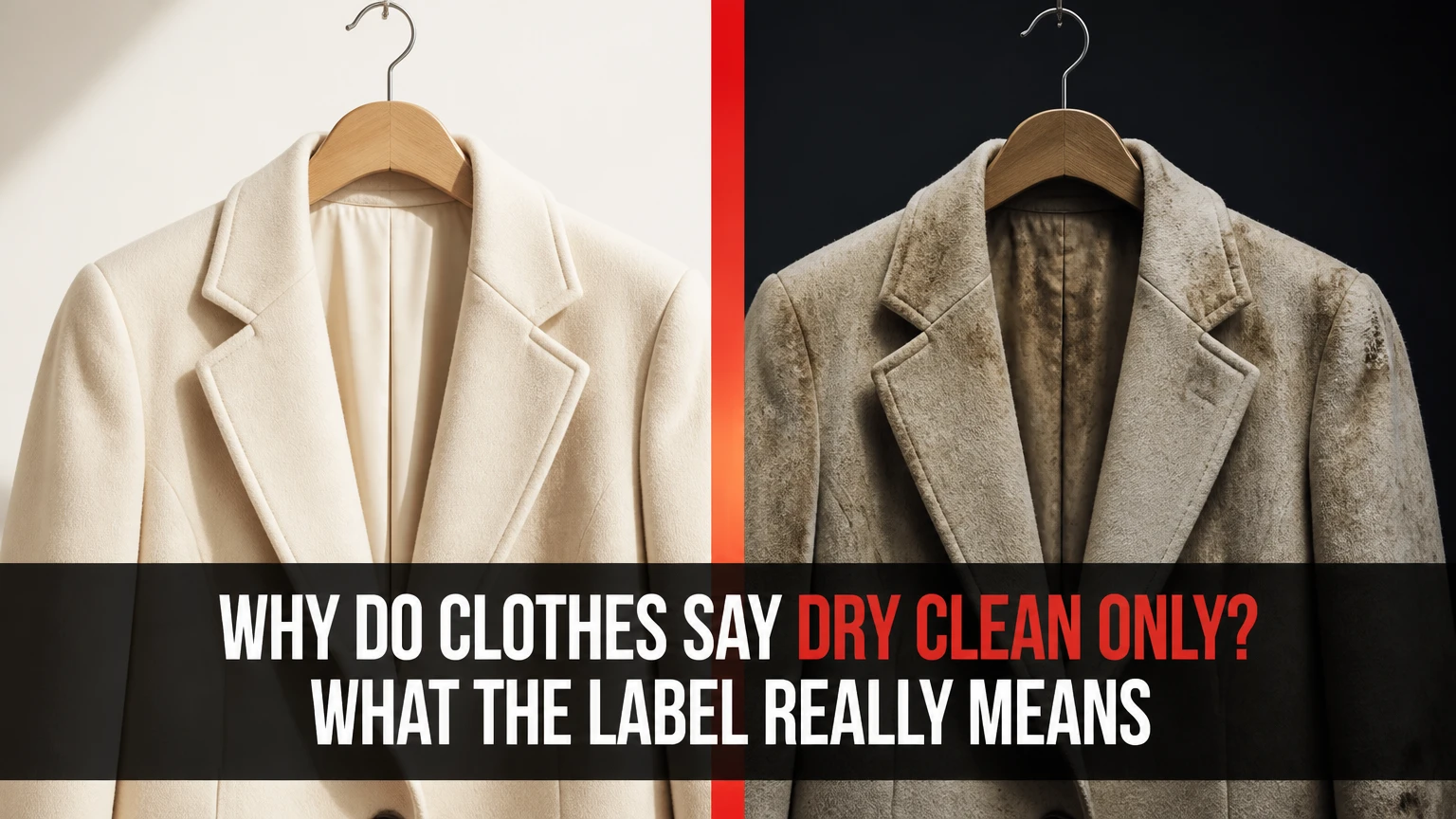
Clothes say “Dry Clean Only” because water, detergent, agitation, heat, or drying may damage the garment’s fibers, dyes, shape, lining, or bonded construction. The label is a manufacturer’s risk warning, not proof that every fiber is water-sensitive. It means the maker recommends professional solvent cleaning because the garment was designed and tested around that method.
Key Facts at a Glance
- “Dry Clean Only” means the manufacturer does not recommend routine home washing for that garment.
- Dry cleaning uses a liquid solvent, so “dry” means water-free or low-water cleaning, not an absence of liquid.
- Garment construction, especially fusible interlinings, shoulder pads, pleats, coatings, and glued trims, can be more vulnerable than the outer fabric.
- A care label is a cleaning recommendation, while the dry-cleaning circle and its letters communicate permitted professional processes.
- Professional wet cleaning can be safer than solvent cleaning for some wool, silk, and structured garments when the operator controls water, agitation, and drying.
- A dry cleaner cannot guarantee removal of every stain because heat, age, oxidation, and previous treatments can permanently alter fibers and dyes.
Why Do Clothes Say Dry Clean Only?
Clothes say “Dry Clean Only” when the complete garment has a higher risk of damage in a domestic washer than in a controlled professional process. Manufacturers consider fiber behavior, dye stability, seam construction, linings, adhesives, surface finishes, and the garment’s intended shape rather than evaluating the face fabric alone.
A wool jacket illustrates the issue. Wool fibers can felt when moisture, heat, alkalinity, and mechanical movement combine. A silk blouse may survive careful hand washing, yet its dye can form water rings or bleed, while a lining may shrink at a different rate from the silk shell.
The word “only” matters because the recommendation applies to the finished garment. A label does not necessarily mean that the fiber itself can never touch water. It means the manufacturer is limiting the approved consumer-care route because the manufacturer cannot control how a household will wash, rinse, spin, dry, or press the item.
What risk is the label trying to prevent?
The main risks are shrinkage, felting, color migration, loss of finish, distortion, puckering, and separation of bonded layers. A garment can emerge clean but still become unwearable if its lapels curl, its hem twists, or its lining hangs below the outer shell.
The U.S. Federal Trade Commission Care Labeling Rule requires manufacturers and importers selling covered textile products in the United States to attach care instructions that provide a reasonable basis for the stated recommendation. The rule does not make home washing physically impossible, but it gives the label practical importance when a consumer seeks a remedy for damage.
Why Can Water Ruin a Garment?
Water can ruin clothing because different fibers, dyes, yarns, and internal components respond differently to moisture and movement. The most vulnerable garments combine a sensitive outer textile with a lining, adhesive, coating, trim, or tailored structure that cannot dry and recover evenly.
Water itself is not automatically harsher than solvent. The damaging combination is often water plus temperature, detergent alkalinity, agitation, spin extraction, or tumble drying. Cotton towels tolerate that combination because they are stable, washable structures. A beaded silk dress does not.
Fiber and construction risks
| Garment component | Typical water-related risk | Visible result | Safer control |
|---|---|---|---|
| Wool fiber | Felting at 30-40°C with agitation | Smaller, denser, rougher fabric | Cold controlled cleaning and flat shaping |
| Silk dye | Dye migration or tide marks after spot cleaning | Rings, streaks, uneven color | Whole-garment assessment before treatment |
| Rayon or viscose | Swelling and weak wet strength | Stretching, shrinkage, surface distortion | Professional evaluation, low mechanical action |
| Fusible interfacing | Adhesive softening or bubbling near heat | Blisters, ripples, detached layers | Controlled solvent or specialist wet cleaning |
| Pleated polyester | Heat can relax permanent pleats | Lost or uneven pleats | Low-temperature finishing |
| Leather trim | Water absorption and stiffening | Dark edges, tide lines, stiffness | Leather specialist cleaning |
| Sequins or glued beads | Adhesive or coating sensitivity | Loose trim, melted surfaces | Trim-specific inspection |
| Waterproof coating | Detergent and heat can strip finish | Reduced water repellency | Approved reproofing after cleaning |
Why does the lining matter?
A lining matters because it can shrink, stretch, or release dye at a different rate from the shell. Tailored jackets often contain canvas, shoulder pads, sleeve heads, chest pieces, and fusible interlinings. A washer applies forces to all those layers at once, while a cleaner can select a process and finish the jacket over a form.
A garment may therefore carry a dry-clean-only label even when its face fabric is polyester or cotton. The hidden construction, rather than the visible fiber content, can determine the recommendation.
How Does Professional Dry Cleaning Work?
Professional dry cleaning cleans garments in a liquid solvent with controlled mechanical action, temperature, filtration, extraction, and finishing. The process usually takes 24-48 hours for standard service, although stain complexity, pressing queues, specialty materials, and local collection schedules can extend the time.
What happens inside a dry-cleaning shop?
- Inspection and tagging: Staff record the customer order, inspect seams and trims, identify visible stains, and note pre-existing damage.
- Fiber and construction assessment: The cleaner checks care symbols, color contrast, lining, coatings, ornamentation, and previous repairs.
- Pretreatment: A technician applies a targeted agent to oil, protein, tannin, ink, or particulate stains. One agent cannot safely treat every stain.
- Solvent cleaning: The garment enters a sealed drum containing liquid solvent. The drum tumbles at a controlled speed, then drains and filters the solvent.
- Extraction: High-speed spinning removes most retained solvent without the same water swelling associated with laundering.
- Drying: Warm filtered air vaporizes residual solvent. Typical machine air temperatures are approximately 49-60°C, depending on equipment and garment requirements.
- Post-spotting: Remaining marks receive controlled local treatment, although some stains are permanent after oxidation or heat.
- Finishing: Steam, vacuum, irons, and form pressers restore shape, seams, lapels, pleats, and drape.
- Final inspection: Staff check odor, stains, missing buttons, trim, and presentation before packaging.
The workflow explains why a home dry-cleaning kit is not equivalent to a professional cleaner. A kit can refresh fabric in a dryer and reduce some odors, but it cannot reproduce solvent filtration, stain classification, pressing, form shaping, or post-spotting.
Which Solvents Are Used?
Dry-cleaning solvent choice affects grease removal, odor, fiber compatibility, environmental controls, cycle time, and equipment requirements. Perchloroethylene, hydrocarbon solvents, liquid silicone systems, and carbon dioxide systems each have different trade-offs.
| Solvent or system | Main strength | Main limitation | Typical availability |
|---|---|---|---|
| Perchloroethylene, or perc | Strong performance on oily soil | Regulated emissions and worker-exposure concerns | Declining in many markets |
| Hydrocarbon solvent | Gentle handling and familiar equipment | Longer cycles and flammability controls | Common alternative service |
| Liquid silicone systems | Low-aggression treatment for color and synthetics | Higher service and equipment costs | Specialty or branded cleaners |
| Liquid carbon dioxide | Low residue and solvent recovery | Expensive, specialized machinery | Uncommon commercial option |
| Professional wet cleaning | No organic solvent residue | Requires skilled moisture and drying control | Increasingly available |
The U.S. Environmental Protection Agency has treated perc as a hazardous air pollutant and has established regulations for dry-cleaning facilities. Local rules differ, so consumers should ask a cleaner which process is used rather than assuming every shop uses the same chemistry.
A strong solvent odor is not a reliable quality test. Odor can result from solvent handling, ventilation, finishing products, or incomplete aeration, and a faint smell does not prove that one process is safer.
How Do Care Symbols Change the Instruction?
Care symbols add limits to the written label. The circle identifies professional cleaning, while letters inside the circle identify solvent families or process restrictions under the ISO 3758 care-symbol system used by GINETEX and other national labeling schemes.
| Symbol description | Meaning | Consumer action | Important limit |
|---|---|---|---|
| Plain circle | Professional dry cleaning permitted | Take to a qualified cleaner | Does not specify every solvent |
| Circle with P | Professional cleaning with specified solvent class | Show symbol to cleaner | Cleaner must follow solvent and process limits |
| Circle with F | Professional cleaning with hydrocarbon-type solvent | Use a cleaner offering that process | Usually indicates a gentler solvent category |
| Circle with W | Professional wet cleaning | Use trained wet-cleaning service | Not the same as household washing |
| Crossed-out circle | Do not dry clean | Avoid solvent dry cleaning | Another permitted method may appear |
| Circle with bars | Restricted mechanical or moisture process | Ask cleaner to interpret bars | Bars can limit agitation or moisture |
A crossed-out circle does not automatically mean “wash at home.” The washing tub, triangle, square, or crossed symbols elsewhere on the label provide separate instructions for water washing, bleaching, drying, and ironing.
Can You Wash Dry-Clean-Only Clothing at Home?
You can sometimes wash a dry-clean-only item without immediate damage, but the label makes home washing a risk decision rather than a recommended procedure. The risk is lower for an unlined, colorfast, non-pleated garment with no coating or glued trim, and higher for tailored, embellished, vintage, or layered clothing.
Before taking the risk, inspect five features:
- Construction: Is the item unlined and free of padding, interfacing, or glued layers?
- Color: Does a hidden seam release color when dabbed with a damp white cloth?
- Surface: Does the garment contain sequins, flocking, leather, metallic yarn, or a water-repellent finish?
- Shape: Do pleats, sharp tailoring, or structured shoulders define its appearance?
- Value: Would replacing the item cost more than a professional cleaning and inspection?
If all risk indicators are low, hand washing may be possible, but the manufacturer’s warranty position remains different from the cleaner’s professional assessment. Never transfer a dry-clean-only item directly into a hot wash cycle or tumble dryer.
Which fabrics usually require extra caution?
Wool, cashmere, silk, rayon, acetate, velvet, leather, suede, heavily embellished textiles, and garments with fused tailoring deserve extra caution. Fiber labels alone do not decide the method because a washable polyester shell can still contain a fragile coating or adhesive.
A professional cleaner should inspect vintage clothing, bridalwear, formalwear, military uniforms, and garments with unknown previous repairs before treatment. Old dyes, degraded elastic, and brittle coatings can fail during any cleaning method.
How Do the Alternatives Compare?
Professional dry cleaning is usually the safer choice for solvent-compatible tailored or embellished garments, while professional wet cleaning can suit some washable fibers and structured items when a trained operator controls shrinkage and shape. Home methods cost less but transfer nearly all failure risk to the owner.
| Method | Typical turnaround | Typical cost range | Best candidate | Main failure risk |
|---|---|---|---|---|
| Professional dry cleaning | 24-48 hours | $5-$25 per item | Suits, silk dresses, lined coats | Solvent-sensitive trim or weak dyes |
| Professional wet cleaning | 24-72 hours | $8-$30 per item | Selected wool, cashmere, cotton | Shrinkage or shape loss |
| Home dry-cleaning kit | 20-40 minutes | $8-$18 per kit | Light odor and surface refresh | Deep stains remain |
| Careful hand washing | 30-60 minutes plus drying | $1-$4 in detergent | Unlined, colorfast knits | Stretching, bleeding, felting |
| Ordinary machine washing | 30-90 minutes | $0.50-$2 per load | Explicitly washable basics | High agitation and heat damage |
Home kits are refreshers, not full substitutes for professional cleaning. They are poor choices for oil-heavy stains, visible mud, perspiration buildup, mildew, set-in food, and garments that need pressing or structural reshaping.
Is professional wet cleaning safer?
Professional wet cleaning can be safer when the garment tolerates water and the operator controls temperature, detergent concentration, agitation, extraction, and drying geometry. It is not automatically safer because water-sensitive dyes, rayon, fused components, and mismatched layers can still fail.
Ask the cleaner whether the facility offers professional wet cleaning, whether the garment will be tested first, and how the item will be blocked or pressed afterward. The method should follow the garment, not the cleaner’s preferred machine.
What Does Dry Cleaning Typically Cost?
Typical dry-cleaning prices range from $5-$25 for ordinary garments in the United States, with suits, formalwear, heavy coats, leather, and intricate trims costing more. Prices vary by region, garment size, stain treatment, pressing, pickup service, and whether the item needs specialty handling.
| Garment | Typical U.S. range | Typical Bangladesh range | Typical standard time |
|---|---|---|---|
| Shirt or blouse | $5-$12 | ৳400-৳800 | 24-48 hours |
| Two-piece suit | $15-$30 | ৳1,200-৳2,500 | 48-72 hours |
| Dress or evening gown | $15-$60+ | ৳1,500-৳4,000+ | 3-10 days |
| Coat or heavy jacket | $15-$35 | ৳1,000-৳3,000 | 48-96 hours |
| Wedding dress | $100-$300+ | ৳5,000-৳20,000+ | 1-4 weeks |
The Bangladesh figures are broad illustrative ranges, not universal prices. Express same-day service commonly adds approximately 20%-50%, while heavy beadwork, oil stains, leather panels, and restoration work can add separate charges.
How Often Should Dry-Clean-Only Clothes Be Cleaned?
Clean dry-clean-only clothing when it is visibly soiled, retains odor after airing, develops a stain, or has accumulated body oils, rather than after every wear. A suit worn over a shirt may need professional cleaning once or twice per season, while a silk blouse worn directly against skin may need it sooner.
Use a clothes brush to remove surface dust, air garments for several hours after wearing, and hang jackets on broad wooden or shaped hangers. Spotting a stain promptly usually produces a better result than repeated full cleaning.
Professional insight: over-cleaning can shorten a garment’s life because repeated solvent exposure, pressing, abrasion, and stain treatment gradually affect dyes, coatings, and delicate trims. Under-cleaning can also cause damage because aged perspiration, deodorant, and food oils oxidize and become harder to remove.
What Can Dry Cleaning Fail to Remove?
Dry cleaning can struggle with water-based stains, aged protein stains, dye transfer, oxidation, ink, scorching, mildew discoloration, and marks that have been heat-set in a dryer. Solvent is particularly effective against oily soil, but no cleaning fluid reverses every chemical change in a fiber.
Tell the cleaner exactly what caused the stain and whether anyone used water, soap, bleach, alcohol, heat, or a stain pen. A vague description such as “food” gives less treatment information than “tomato sauce, treated with dish soap, then tumble-dried.”
Never rub a stain. Blot wet material with a clean absorbent cloth, remove solids with a dull edge, and keep the garment away from heat until assessed. Rubbing spreads the substance and can abrade the surface, while heat can set proteins and dyes.
What should you do with plastic packaging?
Remove thin cleaner bags when you get home and store garments in breathable fabric covers. Plastic packaging can trap residual moisture and cleaning vapors, while long-term storage in a humid, sealed environment encourages odor, mildew, and yellowing.
Keep garments in a cool, dry, dark cupboard with space between hangers. Fold heavy knits rather than hanging them, because prolonged hanger pressure can stretch shoulders even when the cleaning method was correct.
What Should You Do After a Home-Washing Mistake?
After accidentally washing a dry-clean-only garment, stop applying heat, do not wring it, and take photographs of the care label and damage before attempting recovery. A cleaner may restore shape or reduce distortion, but shrinkage, dye bleeding, and adhesive failure are often permanent.
For wool that has become slightly misshapen, a specialist may be able to reblock the garment while damp. Home conditioner treatments sometimes relax fibers, but they cannot reliably reverse severe felting and may leave residues or alter color.
Water rings on silk are especially risky to correct locally. Do not keep adding water to chase a mark unless the care professional recommends a whole-garment treatment, because repeated spot wetting can enlarge the ring or move the dye.
How Should You Choose a Cleaner?
Choose a cleaner by matching the facility’s process to the garment’s fiber, construction, trim, and stain history. Ask who handles specialty items, whether the shop tests unstable dyes, which solvent or wet-cleaning system it uses, and whether it accepts liability for items that already show weakness.
Use this checklist before handing over a valuable garment:
- Photograph the garment, label, stains, and existing damage.
- Point out loose beads, missing buttons, frayed seams, and discoloration.
- State the stain source and every product already applied.
- Ask for a specialty quote for leather, suede, bridalwear, vintage garments, or heavy ornament.
- Confirm the expected process and collection date.
- Inspect the item at pickup before removing the receipt or order tag.
A cleaner should explain limitations instead of promising perfect restoration. That conversation is a quality signal.
Expert Rules That Prevent Expensive Damage
Treat construction as seriously as fiber content. The polyester label on a tailored jacket does not reveal whether the shoulder pads, fusible chest piece, or lining can tolerate laundering.
Do not use a home dryer to test a garment. Heat can set stains, relax pleats, shrink wool, soften adhesives, and make later professional recovery less effective.
Cleaning and pressing are separate services. A garment may be clean but still require form pressing to recover lapel roll, trouser crease, pleats, or jacket shape.
Do not confuse “dry clean” with “dry clean only.” Some labels permit either professional cleaning or a carefully selected alternative, while “only” communicates the manufacturer’s narrowest recommended route.
FAQ
Does dry cleaning mean clothes never touch liquid?
No. Dry cleaning immerses garments in liquid solvent, but the process uses little or no water as the cleaning medium. The solvent is drained, extracted, and dried from the garment inside a controlled machine, which is why the method is called dry rather than wet cleaning.
Why do some washable fabrics still say dry clean only?
Washable fibers can appear in garments labeled dry clean only because linings, adhesives, coatings, pleats, trims, or tailored layers may not tolerate household laundering. The care instruction applies to the finished product, so the construction can determine the label even when the shell is cotton or polyester.
Can a dry cleaner remove sweat and deodorant marks?
A dry cleaner can often reduce oily body soil and deodorant residue, but aged discoloration may remain after oxidation or chemical reaction with dye. Tell the cleaner the stain’s source and age, and do not apply bleach, alcohol, or heat before professional inspection.
Is a dry-cleaning kit safe for a silk dress?
A home kit may refresh a lightly worn, unlined silk item, but it is not a safe universal treatment for a silk dress. Beading, unstable dyes, water-sensitive marks, lining, and structural seams require inspection, while deep oil or food stains usually need professional pretreatment.
Should you dry-clean a suit after every wear?
Usually not. Air a suit after wearing, brush surface dust away, and clean it when it has visible soil, persistent odor, or a stain. A suit worn with a shirt commonly needs professional cleaning once or twice per season, although heavy use and direct skin contact shorten that interval.
What is the safest response to a crossed-out dry-cleaning circle?
Do not send a garment with a crossed-out circle for ordinary solvent dry cleaning. Read the complete label for permitted washing or wet-cleaning instructions, then ask a professional cleaner to assess dyes, trims, coatings, and construction before choosing an alternative.
The Bottom Line
Clothes say “Dry Clean Only” because the manufacturer believes household water, agitation, detergent, heat, or drying could damage the garment’s fibers or construction. The instruction is strongest for tailored, lined, embellished, coated, pleated, vintage, and color-sensitive items. When deciding whether to take a risk, consider the complete garment rather than its face-fabric label, and ask a qualified cleaner about solvent cleaning or professional wet cleaning. A careful decision protects both the garment and its shape.