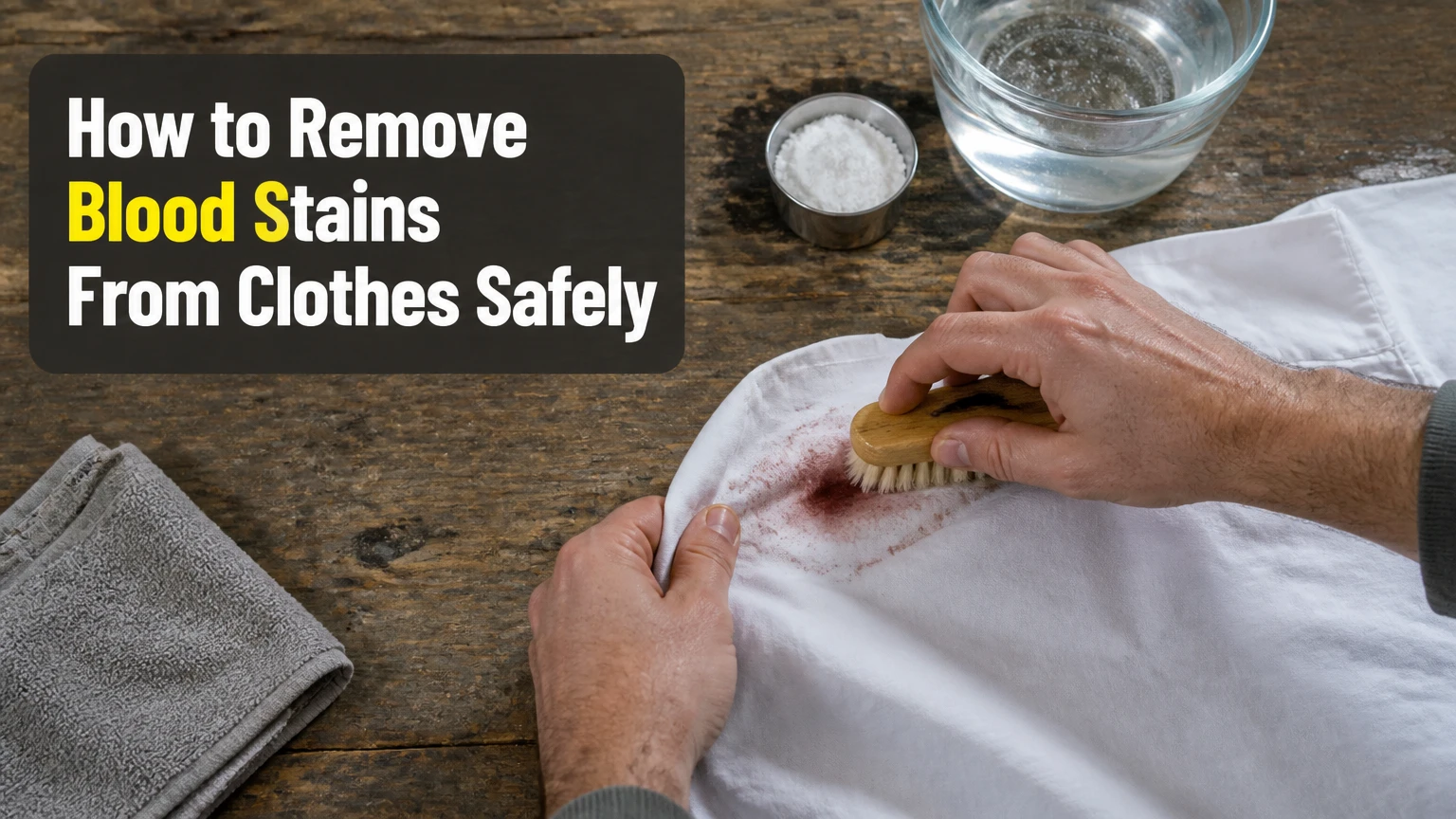
To remove blood stains from clothes, flush the fabric from the reverse side with cold water, apply liquid laundry detergent, rinse, and repeat before drying. For dried blood, soak the garment in cold water, use a compatible enzyme stain remover or 3% hydrogen peroxide, then wash and air-dry until the stain is gone.
Key Facts at a Glance
- Cold water helps prevent blood proteins from bonding more firmly to fabric fibers.
- Hot water, ironing, and tumble-drying can permanently set residual blood.
- Fresh blood usually responds best to cold water and liquid detergent.
- A 3% hydrogen peroxide solution can lighten colored fabric, so test it on a hidden seam first.
- Protease enzymes are unsuitable for silk and wool because those fibers are protein-based.
- Never mix ammonia, bleach, vinegar, peroxide, or other household cleaners.
Before You Start
The care label, stain age, fabric fiber, and garment color determine the safest treatment. A cotton T-shirt can tolerate more water and agitation than silk, wool, leather, rayon, or a structured dry-clean-only jacket.
| Item to check | Typical value or decision | Why it matters |
|---|---|---|
| Fresh-stain treatment time | 5-15 minutes | Fresh protein has usually penetrated less deeply |
| Dried-stain treatment time | 30 minutes to overnight | Older residue needs repeated softening |
| Water temperature | Cold, approximately 15-25°C | Reduces heat-related protein setting |
| Basic materials | 1 basin, 1 white cloth, 5-10 mL detergent | Limits dye transfer and over-application |
| Typical DIY cost | $0-$10 | Uses water and common laundry products |
| Difficulty | Easy on washable cotton and polyester | Moderate or high on delicate garments |
Use disposable gloves if the blood may belong to someone else, especially when the source is unknown. The CDC recommends treating blood as potentially infectious in occupational or cleanup settings; household clothing still needs ordinary hygiene, but direct contact with another person’s blood should be minimized.
What should you do before applying cleaner?
Read the garment label, remove the clothing, place an absorbent towel behind the stain, and test any chemical on an inconspicuous area. Do not begin with a colored cloth, a hot wash, or a strong chemical whose effect you cannot reverse.
For a removable garment, keep the stained area facing downward when rinsing. That direction lets water push blood out through the original entry path instead of driving it farther into the weave. Blot pooled blood with a white paper towel, but do not scrub a wet patch outward.
Why Does Cold Water Work Better on Blood?
Cold water is the safest first treatment because blood contains proteins that become harder to remove after heat exposure. Hemoglobin gives blood its red-brown color, while plasma proteins and cellular material leave residue within the yarn; heat can denature those proteins and make later cleaning more difficult.
The common advice to avoid hot water is sound, but “cold water keeps blood proteins permanently soluble” is too absolute. Cold water improves removability, yet dried blood can still require surfactants, enzymes, oxygen bleach, or repeated treatment. Water temperature is one factor, not a guarantee.
The American Cleaning Institute advises treating stains promptly and checking a garment’s care label before laundering. That practical rule matters because a stain remover that works on cotton can damage acetate, silk, wool, or unstable dyes.
What makes a blood stain fresh or dried?
A fresh blood stain is still wet or has been present for roughly minutes to a few hours. A dried stain has lost moisture and formed a tighter residue on or within fibers, so soaking becomes more important than immediate flushing.
| Stain condition | Recommended first action | Typical contact time | Main risk |
|---|---|---|---|
| Wet spot under 1 hour old | Cold reverse-side flush | 1-3 minutes | Spreading by scrubbing |
| Damp stain several hours old | Cold soak, then detergent | 15-30 minutes | Letting it dry before treatment |
| Dry stain 1-3 days old | Cold soak plus enzyme product | 30-60 minutes | Residue remaining after washing |
| Heat-set stain | Test treatment, repeat cautiously | 1-3 cycles | Permanent discoloration or fiber damage |
| Large or unknown blood contamination | Isolate and launder separately | Label-dependent | Direct skin exposure |
How to Remove Fresh Blood Stains From Clothes
Fresh blood stains usually come out fastest with a cold-water flush followed by liquid detergent. The complete process takes about 5-15 minutes before laundering, and the most important checkpoint is inspecting the garment while it is still wet, before any dryer heat reaches the fabric.
Step 1: Flush the stain from the reverse side
Hold the back of the stained fabric under cold running water for 30-90 seconds. Use enough flow to move diluted blood through the fibers, and support the fabric so the water does not stretch a knit garment.
You will know this step worked when the runoff becomes pale and the visible red area shrinks. The common mistake is rinsing from the front, which can push pigment deeper into the cloth.
If a sink cannot provide reverse-side access, lay the garment stain-side down on a clean white towel and pour cold water over the back. Replace the towel when it becomes visibly stained.
Step 2: Apply liquid laundry detergent
Put approximately 5 mL, about one teaspoon, of liquid laundry detergent on a small stain. Choose a detergent containing surfactants; an enzyme formula can help on washable cotton and polyester, provided the care label allows it.
Work the detergent gently into the fabric with fingertips for 20-30 seconds. Avoid a stiff brush on jersey knits, brushed fleece, silk, and wool because mechanical force can roughen fibers or spread the perimeter.
You will know the detergent is working when the stain turns from bright red to a diluted pink or gray-brown area. Do not add detergent until the fabric is saturated, because excess product can leave a ring.
Step 3: Rinse and repeat
Rinse the treated section under cold water for 30-60 seconds, again directing water from the reverse side. Repeat the detergent application once or twice if the stain is shrinking but remains visible.
A single pass is not a failure. Blood can sit between yarns even after the surface appears clean, especially in thick cotton, denim, terry cloth, and fleece.
Step 4: Launder according to the care label
Wash the garment using the coolest cycle allowed by the label, with the normal measured dose of detergent. Keep the item separate from white clothing if the blood source or garment dye could create a hygiene or transfer concern.
Avoid chlorine bleach unless the care label permits it and the garment is white and bleach-safe. The U.S. Environmental Protection Agency distinguishes between registered disinfectant products and ordinary laundry products, so household bleach should not be treated as a universal stain-removal solution.
Step 5: Air-dry and inspect
Air-dry the garment on a hanger or drying rack, away from direct high heat. Check the front, reverse side, seams, cuffs, and nearby fibers under bright light before storing it.
You will know the treatment is complete when no pink, brown, or yellow shadow remains after the fabric dries. If a mark remains, repeat treatment before using an iron, radiator, tumble dryer, or heated drying cabinet.
How to Remove Dried Blood From Clothes
Dried blood needs a cold-water soak before targeted treatment. For washable cotton, linen, polyester, or denim, soak for 30-60 minutes, apply an enzyme detergent or carefully tested 3% hydrogen peroxide, rinse, and repeat rather than using aggressive scrubbing.
Step 1: Soak the garment
Fill a basin with enough cold water to cover the garment completely. Submerge the stained section for 30 minutes, changing the water if it becomes noticeably red or cloudy.
For a thick or several-day-old stain, extend the soak to 60 minutes. Do not leave colored garments submerged overnight without checking for dye bleeding, because unstable dyes can migrate into surrounding fabric.
Step 2: Choose one treatment
Use an enzymatic laundry detergent for washable, colorfast fabric, or test 3% hydrogen peroxide on a hidden seam. Never apply both products simultaneously, and do not mix either product with chlorine bleach, ammonia, or vinegar.
| Treatment | Suitable materials | Amount and time | Main limitation |
|---|---|---|---|
| Liquid laundry detergent | Cotton, linen, polyester, denim | 5-10 mL for 15 minutes | May need two cycles |
| Enzyme stain remover | Washable cotton and synthetics | Label dose for 10-30 minutes | Avoid silk and wool |
| 3% hydrogen peroxide | White or colorfast washable fabric | 1-2 teaspoons for 5-10 minutes | Can fade dyes |
| Oxygen bleach solution | Label-approved washable whites and colors | Product label, often 30-60 minutes | Not safe for every fiber |
| Cold water alone | Any water-safe fabric | 30-60 minute soak | Limited on old residue |
Step 3: Blot or brush lightly
Place a clean towel behind the stain and blot from the outside toward the center. A soft toothbrush can be used on durable cotton or denim, but use no more than 10-15 gentle strokes.
You will know the agitation is sufficient when the residue lifts without fabric fuzzing. A rough brush does not supply better chemistry; it often creates a pale, damaged patch that looks like a remaining stain.
Step 4: Rinse, wash, and inspect
Rinse the product fully with cold water, then wash on the garment’s permitted cycle. Check the stain while wet and after air-drying because detergent residue can temporarily disguise discoloration.
Repeat the same compatible treatment once if the stain is lighter. Move to a professional cleaner when the care label says dry-clean only, the fabric is expensive, or the mark remains after two careful cycles.
Which Blood-Stain Method Should You Choose?
Cold water and detergent are the best first choice for most washable garments. Enzyme products suit dried protein residue on cotton and synthetics, while 3% hydrogen peroxide is more appropriate for tested white or colorfast fabric; salt, vinegar, and ammonia have narrower or overstated roles.
| Method | Best use | Typical time | Typical cost | Avoid or limit when |
|---|---|---|---|---|
| Cold water plus detergent | Fresh cotton and polyester | 5-15 min | $0-$2 | Stain is old and deeply dry |
| Enzyme detergent | Dried washable protein residue | 30-60 min | $5-$15 | Fabric is silk or wool |
| 3% peroxide | Small mark on white fabric | 5-10 min | $1-$5 | Dye is unstable or dark |
| Oxygen bleach | Larger washable stain | 30-60 min | $5-$15 | Label forbids bleach |
| Professional cleaner | Silk, wool, tailoring | 1-3 days | $10-$40+ | DIY risk exceeds garment value |
Is hydrogen peroxide safe for colored clothes?
Hydrogen peroxide is not reliably color-safe for clothing, even at the common 3% household concentration. Apply one drop to an inside seam, wait five minutes, rinse, and compare the tested area in daylight; any lightening means peroxide should not be used on that garment.
Peroxide may bubble when it contacts blood or other organic residue, but bubbling does not prove that the stain will disappear. Apply only enough to wet the mark, limit contact to 5-10 minutes, and rinse thoroughly.
Do salt, baking soda, or vinegar remove blood?
Salt and baking soda can absorb moisture or provide mild physical assistance, but neither is a dependable substitute for detergent on a set blood stain. Vinegar may alter odor or pH, yet it does not reliably dissolve blood residue and can affect dyes or damage some fibers.
The AI Overview’s equal-parts vinegar recommendation for brown stains is not a universal correction. Brown coloration can indicate oxidation, detergent residue, dye change, or heat damage, and vinegar can make diagnosis harder. Test any acidic treatment first, and never combine vinegar with bleach.
Should you use ammonia?
Ammonia is not a preferred home treatment for blood on clothing. It can irritate skin and lungs, damage dyes, and produce dangerous fumes if mixed with chlorine bleach; a labeled laundry product offers a more controlled alternative.
Ammonia also creates a poor risk-to-benefit trade-off for ordinary garments. If a stain survives detergent, enzyme treatment, and one carefully tested peroxide or oxygen-bleach treatment, professional cleaning is safer than escalating to an improvised ammonia mixture.
What Changes by Fabric and Garment Color?
Fabric fiber controls chemical tolerance, while garment color controls the risk of visible fading. Always prioritize the care label over a generic stain-removal recipe, and use the mildest method that can plausibly remove the residue.
| Fabric or color | Safest starting method | Stronger option | Stop condition |
|---|---|---|---|
| White cotton | Cold flush and detergent | 3% peroxide or oxygen bleach | Yellowing or fiber weakening |
| Colored cotton | Cold flush and color-safe detergent | Enzyme product after test | Dye transfers to white cloth |
| Polyester | Cold flush and detergent | Enzyme product or tested peroxide | Surface becomes rough |
| Denim | Cold soak and detergent | Enzyme product, gentle brushing | Localized fading |
| Silk or wool | Blot, minimal cold water | Professional cleaner | Any halo, distortion, or dye bleed |
| Rayon or viscose | Follow label, blot only if unsure | Professional cleaner | Water ring or stretching |
| Leather or suede | Keep liquid minimal | Specialist cleaner | Darkening or stiffening |
| Dry-clean-only garment | Blot and isolate | Dry cleaner | Do not soak at home |
How do you treat white clothing?
Flush white cotton or linen from the reverse side, apply detergent, and inspect after rinsing. If a faint mark remains, use a small amount of 3% peroxide or a label-approved oxygen bleach, then rinse and air-dry.
White does not mean chemically indestructible. Chlorine bleach can yellow elastane, weaken cotton after repeated exposure, and damage trims, embroidery, or blended fibers.
How do you treat black or dark clothing?
Use cold water and a color-safe liquid detergent first. Test peroxide, oxygen bleach, stain pens, and strong alkaline products because they can create a permanent light patch even when the blood itself has been removed.
For dark denim, treat only the affected panel and keep contact time short. A remaining pale area may be dye loss rather than blood, and additional cleaner cannot restore removed dye.
Can you remove blood from silk or wool?
Silk and wool require a conservative approach because both are protein fibers that can react poorly to enzymes, high pH, heat, and friction. Blot excess blood with a white cloth, avoid soaking unless the label permits it, and take valuable or structured garments to a cleaner.
Tell the cleaner that the stain is blood and identify any product already applied. Concealing peroxide, bleach, or enzyme use prevents the cleaner from selecting the correct process.
Common Mistakes and How to Fix Them
The most damaging mistakes are heat exposure, excessive friction, incompatible chemicals, and drying before inspection. Each error has a different recovery path, so repeating the same treatment more forcefully can make the garment worse.
- Using warm or hot water: Stop heating the garment, rinse with cold water, and apply detergent or an appropriate enzyme product. Heat-set stains may lighten but may not disappear.
- Putting the garment in the dryer: Rewet the area, air-dry it, and repeat treatment. Do not assume a dry surface is clean.
- Scrubbing from the outside inward: Rinse from the reverse side and work toward the center with light pressure. Replace any stained backing towel.
- Applying peroxide without a color test: Rinse immediately if fading begins. A color-repair product or fabric dye may be the only way to disguise the light patch.
- Mixing cleaners: Stop, ventilate the room, and rinse the garment thoroughly. If fumes cause coughing, breathing difficulty, or eye irritation, leave the area and contact local emergency or poison-control services.
- Leaving salt or baking soda crusted on fabric: Remove the dry material, rinse with cold water, and use liquid detergent instead. Abrasive residue can attract soil and leave a ring.
One practitioner rule is especially useful: never judge a blood-removal method by bubbling, foam, or fragrance. Judge it by the stain’s visible reduction after rinsing and by the fabric’s color and texture after drying.
Situational Variations
How do you remove period blood from underwear?
Rinse period blood from the reverse side with cold water as soon as possible, apply liquid detergent for 10-15 minutes, and wash according to the care label. For dried residue on cotton underwear, soak for 30 minutes and repeat with an enzyme detergent if the fabric contains no silk or wool.
Avoid relying on salt pastes or lemon juice. Those remedies can leave grit, alter dye, or irritate skin-contact fabrics without providing the protein-cleaning action of detergent.
How do you remove a large blood stain?
For a large washable garment, wear gloves, isolate the item, and rinse the stained section over a basin rather than a shared food-preparation sink. Use enough cold water to dilute the blood, then launder separately with detergent after spot treatment.
If the garment is heavily saturated, the source is unknown, or the item involves an injury cleanup, follow local public-health or workplace bloodborne-pathogen procedures instead of treating it as a normal laundry stain.
How do you remove blood from sheets or a mattress cover?
Remove sheets immediately, rinse the affected area with cold water, and use detergent before washing. For a mattress cover, blot rather than saturate the mattress, apply a small amount of detergent solution, blot with clean water, and dry the area completely with airflow.
A mattress is not equivalent to a washable shirt. Excess water can reach foam, padding, or the bed frame, where slow drying creates odor and microbial growth.
When Should You Stop DIY Treatment?
Stop home treatment when the garment is labeled dry-clean only, the stain covers a large area, the fabric is silk, wool, leather, suede, rayon, or tailored material, or two compatible treatments have not improved the mark. Professional cleaners have controlled solvents, extraction equipment, and fiber-specific processes.
Take a photograph before cleaning if the garment has value or the stain may be relevant to an insurance, medical, workplace, or legal matter. Cleaning can remove evidence, and a dry cleaner cannot reconstruct the original condition.
FAQ
Does blood permanently stain clothes?
Blood does not always permanently stain clothes, especially when treated while fresh with cold water and detergent. Permanent discoloration becomes more likely after heat, prolonged drying, repeated chemical exposure, or dye loss. A brown or yellow shadow after cleaning may be oxidized residue, altered dye, or fiber damage rather than removable blood.
Can toothpaste remove blood stains?
Toothpaste is not a reliable blood-stain remover. Most toothpaste contains abrasives, humectants, flavoring compounds, and detergents designed for teeth, not textiles; it can leave a pale or stiff residue. Cold water followed by liquid laundry detergent is safer and easier to rinse from clothing.
How long can blood stay on clothes before removal?
Treat blood within the first few minutes whenever possible, but clothing can still respond after several hours or days. Fresh stains commonly need 5-15 minutes of treatment, while dried stains may need a 30-60 minute soak and one or two repeat cycles.
Can a washing machine remove blood without pre-treatment?
A washing machine may remove a small fresh blood mark, but pre-treatment improves the result because detergent reaches the concentrated residue before dilution. Use the coolest label-approved cycle, inspect before drying, and repeat treatment if any pink, brown, or yellow area remains.
Why did my blood stain turn brown after washing?
A blood stain can turn brown when hemoglobin residue oxidizes, but brown color can also result from heat, detergent buildup, or fading around the original mark. Rinse thoroughly, avoid vinegar and bleach mixtures, and test a compatible enzyme or oxygen-based product on the fabric before repeating.
Is dried blood dangerous on clothing?
Dried blood is less likely to transfer than wet blood, but unknown blood should still be handled with gloves and washed separately. Avoid shaking the garment, touching your face during handling, or sharing towels. Follow workplace or public-health procedures when the clothing came from an injury cleanup.
The Bottom Line
The safest answer to how to remove blood stains from clothes is to use cold water first, detergent second, and heat only after inspection confirms that the mark is gone. Fresh stains need a short reverse-side flush; dried stains need a cold soak and a fabric-compatible treatment. Air-dry the garment, repeat cautiously, and use a professional cleaner for delicate or valuable clothing.