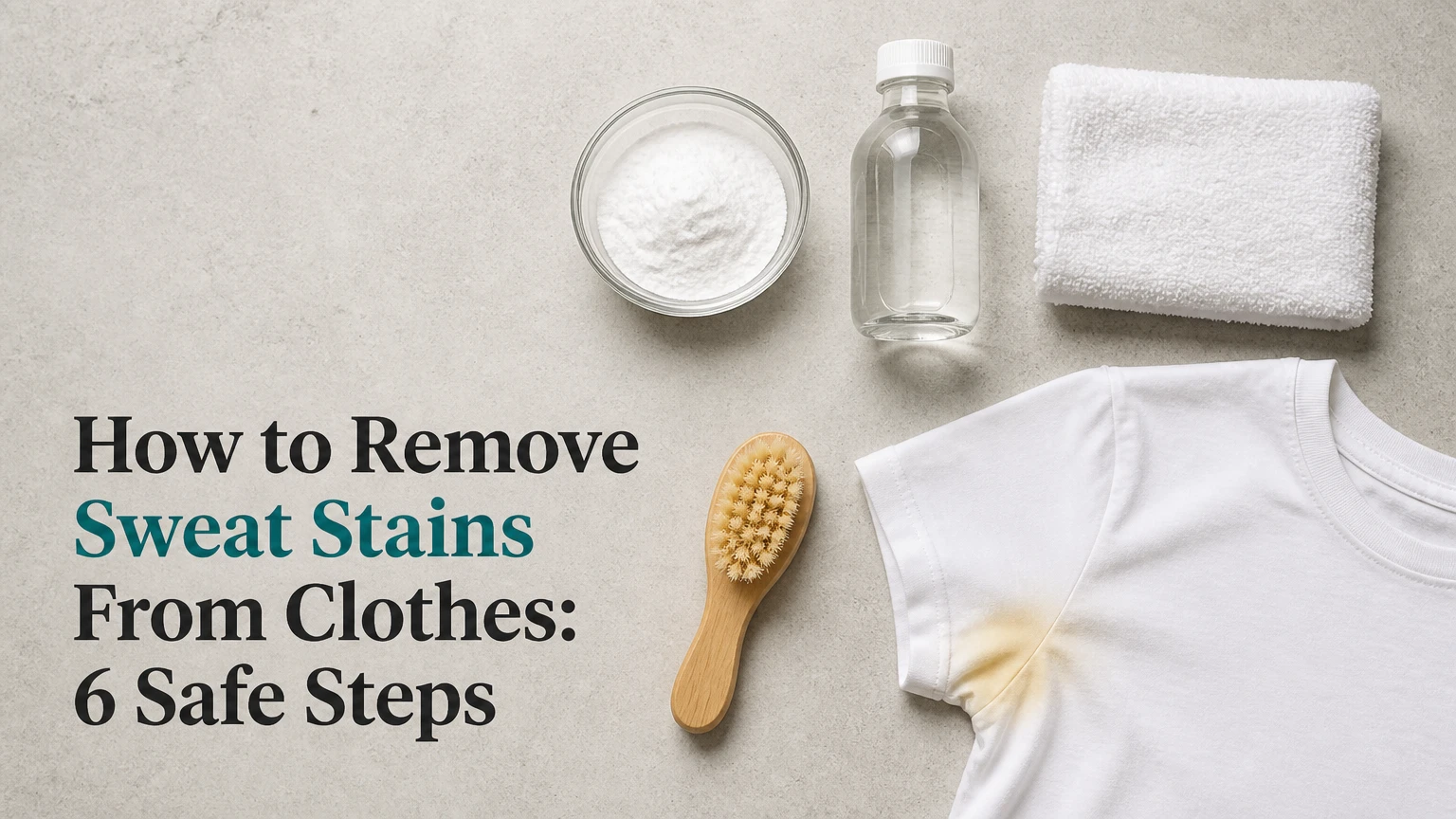
To remove sweat stains from clothes, flush the underarm area with cool water, pretreat with detergent or a suitable oxygen-based product, wait 15-60 minutes, then wash according to the care label. Inspect the damp garment before drying, because dryer heat can set remaining discoloration and make later treatment harder.
Key Facts at a Glance
- Yellow underarm marks usually contain sweat residue, skin oils, detergent deposits, and antiperspirant ingredients.
- Enzyme detergent is useful for protein and body-oil residue, while oxygen bleach is usually better for discoloration on washable, colorfast fabric.
- A 3% hydrogen peroxide paste can help white cotton, but it may lighten dyes and should be patch-tested first.
- Dryer heat, ironing, and chlorine bleach can worsen some sweat and antiperspirant stains.
- Polyester often retains odor because oil and product residue bind readily to hydrophobic synthetic fibers.
- Never mix vinegar, hydrogen peroxide, chlorine bleach, or ammonia in the same treatment.
Why Do Sweat Stains Turn Yellow?
Sweat stains turn yellow when perspiration residue combines with skin oils, antiperspirant or deodorant ingredients, detergent deposits, and dirt. Fresh sweat is often colorless, but repeated wear allows these materials to dry inside the weave, where oxidation and heat can produce a yellow or gray-brown appearance.
Human sweat is primarily water and dissolved salts, but it also contains small amounts of proteins, fatty acids, urea, and other organic compounds. Antiperspirants commonly use aluminum-based active ingredients to reduce wetness. Those ingredients can remain in the underarm area, although yellowing is not caused by aluminum alone and does not appear on every garment.
A practical distinction matters:
- Wet-looking or salty marks: usually recent perspiration and mineral residue.
- Yellow, stiff buildup: often a mixture of body oil, antiperspirant, detergent, and oxidized residue.
- White or chalky transfer: commonly deodorant or antiperspirant product.
- Persistent odor in polyester: often oil and odor compounds retained in synthetic fibers.
The American Cleaning Institute advises following the garment care label and testing stain-removal products on an inconspicuous area first. That guidance matters because fiber damage and dye loss cannot be reversed by a second wash.
How Does Sweat-Stain Removal Work?
Sweat-stain removal works by combining water, surfactants, enzymes, and, when appropriate, oxygen-based oxidation. No single household ingredient removes every component equally well, so the best method depends on whether the garment has fresh residue, yellow pigment, oily buildup, or trapped odor.
Laundry detergent contains surfactants that surround oily particles and help suspend them in wash water. Enzymes such as protease target protein-based soil, while lipase can help with some fats and body oils. Oxygen bleach releases an oxygen-based bleaching agent in water and can break down colored molecules without the same dye-stripping action as chlorine bleach, although “color-safe” does not mean safe for every dye.
Acidic products such as diluted white vinegar can help with some mineral deposits and odor-related residue, but vinegar is not a universal yellow-stain remover. It also should not be treated as a disinfectant for all laundry situations.
Which treatment matches the stain?
| Stain condition | Main residue | First choice | Typical contact time |
|---|---|---|---|
| Fresh damp mark | Sweat, salt, light oil | Cool-water flush plus liquid detergent | 10-15 minutes |
| Yellow cotton underarm | Oxidized residue and product buildup | Oxygen bleach soak | 1-6 hours |
| Greasy stiff collar or armpit | Skin oil and antiperspirant | Liquid detergent or enzyme detergent | 15-30 minutes |
| Returning odor in polyester | Retained oil and odor compounds | Sports detergent or enzyme detergent | 15-30 minutes |
| Mineral or acidic odor residue | Salts and product deposits | Diluted white vinegar rinse | 15-30 minutes |
Before You Start
Prepare the garment and treatment before applying anything. The minimum setup is a care label, a clean towel, cool or lukewarm water, liquid laundry detergent, and a soft toothbrush or soft laundry brush.
| Requirement | Typical amount or setting | Why it matters |
|---|---|---|
| Treatment time | 30-90 minutes for a standard attempt | Allows pretreatment to work before washing |
| Water temperature | Cool to lukewarm, about 20-40°C | Reduces premature setting and protects sensitive fibers |
| Liquid detergent | 1-2 teaspoons for one underarm area | Provides surfactants and possibly enzymes |
| Soft brush | 1 clean toothbrush or fabric brush | Limits abrasion during agitation |
| Oxygen bleach soak | Product-label dose in 4-15 liters of water | Concentration varies by formulation |
| Spot test | 5-10 minutes on hidden fabric | Detects dye bleeding or lightening |
Read the label before treating the garment. “Dry clean only,” silk, wool, leather, acetate, heavily decorated fabric, and garments containing substantial elastane require more restraint than ordinary cotton.
How to Remove Sweat Stains From Clothes
Use the following six-step process for washable cotton, cotton blends, and many polyester garments. The total time is typically 30-90 minutes for a fresh or moderate stain, while an older stain may need two or three cycles.
Step 1: Check the Label and Test the Treatment
Check the care label, then test the selected solution on an inside seam or hem for 5-10 minutes. Rinse and allow the area to dry before proceeding if the garment has a dark, unstable, or unusual dye.
Use a white cloth during the test. If color transfers to the cloth, avoid peroxide and oxygen bleach unless the product label specifically permits them.
You will know this step worked when: the test area shows no fading, color transfer, texture change, or ring after drying.
Common mistake: Treating the visible stain before checking whether the dye itself is unstable.
Step 2: Flush the Underarm Area
Turn the garment inside out and rinse the back of the stained area with cool running water for about 30-60 seconds. Flushing from the reverse side helps push loosened residue away from the fabric rather than deeper into the garment.
For a crusty deposit, lift the dry surface with the edge of a spoon or a dull butter knife. Do not scrape hard enough to pull threads.
You will know this step worked when: the fabric feels less stiff and loose residue no longer flakes from the surface.
Common mistake: Starting with hot water. Heat can make some protein and oily residues more difficult to remove, although the idea that every hot rinse permanently “cooks” sweat is too absolute. The care label and stain composition determine the risk.
Step 3: Apply Liquid Detergent or Enzyme Pretreatment
Apply 1-2 teaspoons of liquid laundry detergent directly to each underarm area. Choose an enzyme-containing detergent when the garment has body odor, protein residue, or visible oily buildup.
Gently work the detergent into the fibers with your fingers or a soft toothbrush. Let it sit for 15-30 minutes, but do not allow it to dry on the garment.
You will know this step worked when: the treated area feels slick rather than waxy or crusted, and odor decreases after a short rinse.
Common mistake: Using extra detergent. Excess detergent can leave a film that traps body oil, particularly when the washer is overloaded or the water is hard.
Step 4: Treat Set-In Yellowing
For washable, colorfast whites and suitable colored garments, dissolve oxygen bleach according to the product label and soak the garment for 1-6 hours. A common powder formulation uses roughly 2 tablespoons per gallon, but product concentrations differ, so the package directions take priority.
For white cotton only, a 3% hydrogen peroxide paste can be an alternative. Mix two parts 3% peroxide, one part liquid dish soap, and one part baking soda, apply a thin layer for 30-60 minutes, then rinse thoroughly. Use gloves and keep the mixture away from eyes.
Hydrogen peroxide is less predictable on dyed clothing than oxygen bleach marketed for colors. Never store the mixed paste in a sealed container, and never combine peroxide with vinegar or chlorine bleach.
You will know this step worked when: yellowing visibly fades before the main wash and the fabric no longer has a greasy film.
Common mistake: Leaving peroxide or oxygen bleach on a dark garment for hours without testing.
Step 5: Rinse and Wash at the Label Temperature
Rinse the pretreatment out with cool or lukewarm water. Wash the garment using the warmest temperature allowed by the care label, with the correct detergent dose and enough water for the load.
A warm wash can improve removal of oil and detergent residue when the fabric permits it. Cold washing is safer for some dyes and fibers, but it may require stronger pretreatment for oily stains.
Avoid fabric softener on polyester activewear. Fabric softener can coat synthetic fibers, reducing absorbency and making future odor removal more difficult.
You will know this step worked when: the wet garment has no visible yellow ring and the underarm area smells neutral rather than perfumed over.
Common mistake: Washing a heavily stained shirt in a tightly packed drum. Clothing needs mechanical movement and water exchange for suspended soil to leave the fabric.
Step 6: Inspect Before Drying
Inspect the garment while it is still wet and under bright light. If yellowing or odor remains, repeat the pretreatment rather than placing the garment in a dryer or ironing it.
Air-dry the garment only after the stain has disappeared. Sunlight can gradually brighten some white cotton, but prolonged direct sunlight can fade dyes and weaken certain fibers.
You will know this step worked when: the dry fabric has an even color, normal flexibility, and no returning odor when warmed by your hand.
Common mistake: Assuming a faint damp stain is gone because it becomes harder to see in the wash water.
Which Sweat-Stain Method Should You Choose?
Oxygen bleach is the strongest general option for yellowing on washable, colorfast fabric. Enzyme detergent is the better first choice for fresh body soil and odor, while diluted vinegar has a narrower role in reducing mineral residue or odor.
| Method | Best material | Typical time | Main limitation |
|---|---|---|---|
| Liquid enzyme detergent | Cotton, polyester, washable blends | 15-30 minutes | May not remove old yellow pigment alone |
| Oxygen bleach soak | White cotton and colorfast washable fabric | 1-6 hours | Requires dye testing and label compliance |
| 3% peroxide paste | White cotton, heavy localized yellowing | 30-60 minutes | Can lighten dyes or damage sensitive finishes |
| Diluted white vinegar | Some washable fabrics with mineral residue or odor | 15-30 minutes | Weak against deep yellow oily buildup |
| Dish soap spot treatment | Greasy product residue | 10-20 minutes | Must be rinsed thoroughly before washing |
When is oxygen bleach the best choice?
Oxygen bleach is the best choice for an older yellow stain on washable white cotton or a colorfast cotton blend. It is slower than a spot paste, but soaking gives the oxidizing agent more time to reach residue throughout the underarm area.
Do not assume every oxygen bleach product has the same strength. Powdered sodium percarbonate products, premixed liquids, and laundry boosters have different instructions. Follow the package dosage rather than combining products to make a stronger solution.
Oxygen bleach is not appropriate for every textile. Avoid it on wool, silk, leather, and garments with uncertain dye stability unless the manufacturer gives explicit permission.
When should you use peroxide and dish soap?
Use a 3% peroxide and dish soap paste on localized yellowing in white cotton after a hidden-area test. Dish soap helps loosen oily residue, while peroxide can reduce visible yellow color; baking soda contributes mild physical cleaning but is not the main chemical remover.
This method is not a reliable choice for black clothing, silk, wool, or garments with delicate printed graphics. Apply a thin layer, keep the contact time within 30-60 minutes, and rinse completely before laundering.
When is vinegar useful?
Diluted white vinegar is useful when a washable garment has a light mineral or product residue and a persistent sour or stale odor. Mix one part distilled white vinegar with four parts water, apply or soak for about 15-30 minutes, then rinse and wash.
Vinegar usually performs poorly against old, oily yellow underarm buildup. Never mix vinegar with chlorine bleach because the combination can release hazardous chlorine gas. Do not mix vinegar with hydrogen peroxide either; use separate treatments with a complete rinse between them.
How Should You Treat Different Fabrics and Colors?
Fabric construction changes both the treatment strength and the amount of agitation a garment can tolerate. Cotton generally accepts more aggressive washing, while silk, wool, dark dyes, and elastane require lower-risk methods.
| Garment type | Preferred treatment | Avoid | Washing guidance |
|---|---|---|---|
| White cotton shirt | Enzyme detergent, oxygen bleach, or tested 3% peroxide | Chlorine bleach as a first response | Warmest label-approved cycle |
| Colored cotton | Enzyme detergent, color-safe oxygen bleach after testing | Unchecked peroxide exposure | Cold or warm label-approved cycle |
| Polyester sportswear | Sports detergent or liquid enzyme detergent | Fabric softener and heavy oils | Cool or warm cycle, rinse thoroughly |
| Black or dark clothing | Detergent, diluted vinegar rinse if suitable | Peroxide and untested oxygen bleach | Inside out, cool cycle |
| Wool | Wool detergent and gentle hand wash | Peroxide, oxygen bleach, vigorous brushing | Lukewarm water, lay flat |
| Silk | Professional cleaner or silk detergent | Baking soda paste, peroxide, soaking unless permitted | Follow silk-care instructions |
| Spandex or elastane blend | Mild detergent and short pretreatment | High heat, chlorine bleach, prolonged soaking | Air-dry away from high heat |
Polyester and athletic clothing
Polyester activewear often keeps odor after ordinary washing because body oils and antiperspirant residue adhere to its relatively hydrophobic surface. A sports detergent or enzyme liquid detergent can help, but repeated hot washing may damage stretch fibers and elastic recovery.
Pretreat the armpits for 15-30 minutes, wash without fabric softener, and rinse thoroughly. If odor returns only when the garment warms, repeat the oil-removal process rather than applying fragrance, which masks rather than removes the source.
Dark and printed garments
Dark clothes need a low-oxidation strategy. Start with liquid detergent, a soft brush, and a short contact time; use diluted vinegar only after checking the care label and dye stability.
Do not use a peroxide paste simply because a yellow stain is visible. Peroxide can remove dye along with the discoloration, leaving a pale orange or pink patch that is more noticeable than the original mark.
Wool, silk, and dry-clean-only clothing
Wool and silk should not receive the standard peroxide, baking soda, or oxygen bleach treatment. Blot fresh moisture, avoid rubbing, and send valuable or dry-clean-only garments to a professional cleaner, identifying the stain as perspiration and antiperspirant residue.
Professional cleaning cannot always reverse discoloration that has weakened fibers. Perspiration can damage silk fibers over time, so prompt cleaning is more important than repeated home experiments.
What If the Stain Is Fresh, Old, or Already Dried?
Fresh sweat marks usually need detergent and prompt washing, while old yellow stains may require an oxygen bleach soak and repeated treatment. A dried stain is not automatically permanent, but heat exposure, fiber damage, and dye loss reduce the chance of complete recovery.
| Stain age or history | Recommended first action | Typical duration | Expected difficulty |
|---|---|---|---|
| Less than 24 hours old | Cool flush and liquid detergent | 20-40 minutes | Low |
| Several days old | Enzyme pretreatment, then wash | 30-60 minutes | Moderate |
| Older yellow buildup | Oxygen bleach soak after testing | 1-6 hours | Moderate to high |
| Previously tumble-dried | Repeat oxygen or enzyme treatment | 2-3 cycles | High |
| Stiff, waxy residue | Detergent plus gentle brushing | 30-60 minutes | Moderate |
| Faded or weakened fabric | Professional assessment | Varies | Very high |
Old stains often need more than one cycle because the visible yellow color may be distributed through several layers of fabric. Stop if the garment becomes thin, rough, or visibly lighter.
Common Mistakes and How to Fix Them
Using chlorine bleach first
Chlorine bleach can react unpredictably with organic soil, dyes, and product residue. It may intensify yellowing on some garments rather than remove it.
Fix: Rinse thoroughly, then use a detergent or oxygen-based treatment appropriate for the fabric. Never add chlorine bleach to a garment that still contains vinegar, peroxide, or another chemical.
Drying before inspection
A dryer can make residual oil, pigment, and antiperspirant deposits harder to remove. Heat does not guarantee permanent setting in every case, but it removes your safest opportunity to retreat a damp garment.
Fix: Air-dry after the stain is gone. If the garment already went through the dryer, repeat a tested pretreatment and inspect after washing.
Scrubbing with a hard brush
Abrasive scrubbing can break fibers, create fuzz, and produce a lighter patch that resembles a stain. Underarm fabric is especially vulnerable in thin shirts and stretch garments.
Fix: Use a soft toothbrush, short strokes, and moderate pressure. Let chemistry and soaking time do more of the work.
Overloading detergent
More detergent does not equal more cleaning. Residual detergent can combine with body oil and hard-water minerals, creating a stiff film.
Fix: Measure the detergent for the load size and water hardness. Add an extra rinse only when residue remains.
Masking odor with fragrance
Scented beads and fabric softener can leave a coating that traps oils, especially in sportswear. A garment may smell clean at room temperature and become odorous when warmed.
Fix: Remove oil and residue with enzyme detergent, wash without softener, and dry fully before storage.
How Can You Prevent New Sweat Stains?
Prevent new sweat stains by rinsing heavily worn shirts promptly, allowing antiperspirant to dry before dressing, and keeping body-oil residue from accumulating in the underarm weave. Prevention is more effective than repeated bleaching because chemical treatment cannot restore fibers already weakened by acidic or alkaline residue.
Use these practical routines:
- Rinse after heavy sweating. A 30-second cool rinse reduces the amount of residue that dries in the fabric.
- Let antiperspirant dry. Waiting several minutes before dressing reduces wet product transfer.
- Do not reuse damp activewear. Hang it open until washing, rather than leaving it compressed in a gym bag.
- Skip fabric softener on performance fabrics. Sports detergents work better when fibers are not coated.
- Wash within 24-48 hours when possible. Fresh body soil is easier to remove than repeatedly dried buildup.
- Treat the underarms before the whole load. A small amount of detergent applied early can prevent a visible ring.
What Are the Typical Time and Costs?
A basic detergent treatment costs little if laundry detergent is already available, while an oxygen bleach soak or peroxide paste usually adds only a small household-product cost. The major variable is labor and repeat cycles, not the amount of chemical used.
| Treatment | Typical household cost | Active time | Total elapsed time |
|---|---|---|---|
| Liquid detergent pretreatment | $0.10-$0.50 | 5 minutes | 30-60 minutes |
| Oxygen bleach soak | $0.25-$1.00 per garment | 10 minutes | 1-6 hours |
| Peroxide paste | $0.25-$1.00 | 10 minutes | 30-60 minutes |
| Diluted vinegar rinse | $0.10-$0.50 | 5 minutes | 15-30 minutes |
| Professional cleaning | $5-$20 per garment, typical | Drop-off and pickup | 1-7 days |
Prices vary by country, product size, and cleaner. Household costs are typical estimates, not fixed retail prices.
When Should You Stop and Use a Professional Cleaner?
Use a professional cleaner for dry-clean-only clothing, expensive tailoring, silk, wool, vintage garments, unstable dyes, or stains accompanied by fabric thinning. A cleaner can assess whether the problem is removable residue or permanent chemical damage before applying a stronger process.
Tell the cleaner how long the stain has been present and whether the garment has been washed, dried, bleached, or treated with vinegar. Chemical history affects the next safe treatment.
A professional cleaner may remove residue without restoring the original color. Yellowing that results from fiber oxidation, dye change, or perspiration damage may be permanent even when the garment is otherwise clean.
Frequently Asked Questions
Does baking soda remove sweat stains by itself?
Baking soda alone usually does not remove a deep sweat stain because it lacks the surfactants needed to emulsify body oils and the oxidation needed to reduce yellow pigment. Baking soda can thicken a peroxide paste and provide mild abrasion, but detergent or oxygen bleach should perform the primary cleaning.
Can lemon juice remove yellow underarm stains?
Lemon juice may provide mild acidity, but it is less controlled than a labeled laundry product and can contribute to lightening when exposed to sunlight. Use a tested oxygen bleach or detergent treatment instead, especially on dyed fabric, and never assume natural ingredients are automatically fiber-safe.
Why do sweat stains appear after washing?
Sweat stains can remain hidden while fabric is wet, then become visible as the garment dries. Residual detergent, hard-water minerals, body oil, and antiperspirant may also redeposit during washing when the load is overloaded or poorly rinsed. Pretreat the area and inspect it before drying.
Can deodorant stains and sweat stains be treated the same way?
Deodorant transfer and sweat stains overlap but are not identical. White, waxy transfer responds well to liquid detergent or a small amount of dish soap, while yellow underarm buildup may need enzymes or oxygen bleach. Identify the residue before choosing an oxidizing treatment.
How many times can you repeat a sweat-stain treatment?
Repeat a mild detergent treatment two or three times if the fabric remains intact and the dye is stable. Limit peroxide or oxygen bleach to the product instructions and stop when the garment becomes rough, thin, faded, or misshapen. Repeated chemical exposure can cause more damage than the original stain.
The Bottom Line
The safest way to remove sweat stains from clothes is to flush the area, pretreat with liquid or enzyme detergent, use oxygen bleach for tested colorfast fabric when yellowing remains, wash at the care-label temperature, and inspect before drying. Choose gentler methods for dark, elastic, wool, silk, vintage, and dry-clean-only garments.