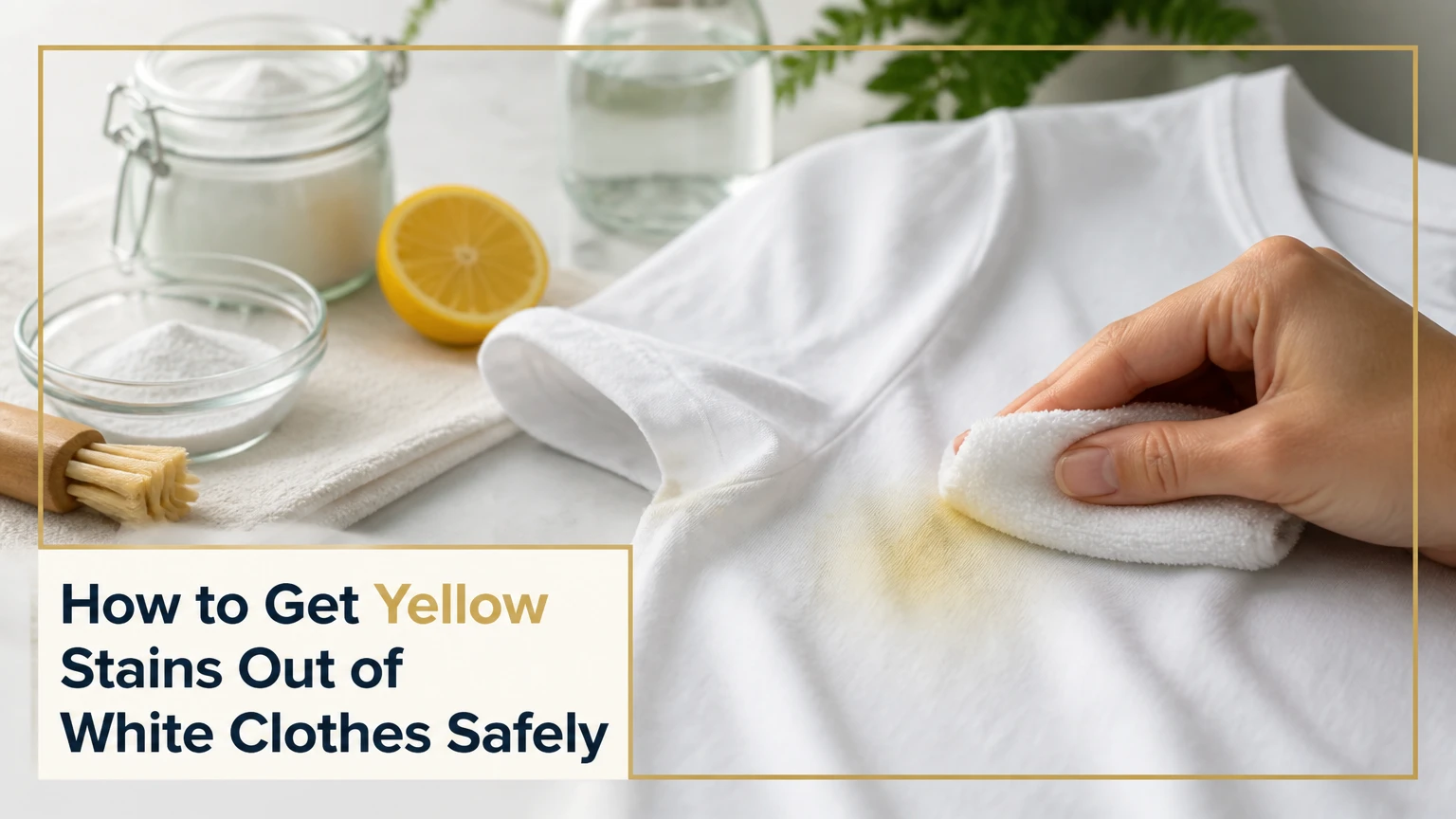
To get yellow stains out of white clothes, pretreat the affected area, soak washable fabric in oxygen bleach according to its label, then wash with enzyme detergent and inspect before drying. Fresh sweat stains may need 20-30 minutes, while old armpit or storage yellowing often needs one to three treatment cycles.
Key Facts at a Glance
- Yellow armpit stains usually contain sweat residue, skin oil, deodorant ingredients, and antiperspirant buildup.
- Oxygen bleach based on sodium percarbonate is usually safer for washable white cotton than chlorine bleach.
- Dryer heat can set remaining organic residue, so inspect the garment while it is still wet.
- A 3% hydrogen peroxide solution can brighten localized stains, but it requires a fabric test and careful rinsing.
- Vinegar can loosen mineral and deodorant residue, but vinegar alone rarely removes deeply oxidized yellowing.
- Silk, wool, leather trim, and heirloom garments need different care and may require a cleaner.
What Causes Yellow Stains on White Clothes?
Yellow stains on white clothes come from several residues, and identifying the source determines which treatment has the best chance of working. Underarm marks commonly combine sweat proteins, sebum, deodorant film, and aluminum-antiperspirant residue; all-over yellowing more often results from oxidation, detergent buildup, poor rinsing, or long-term storage.
Sweat itself is mostly water and dissolved salts, but the skin releases proteins, lipids, and other organic compounds. Microbial activity and repeated drying can alter those compounds. Antiperspirant salts can bind with perspiration and fabric residue, creating a stiff film that traps additional oils.
White garments stored for months can also yellow because oxygen, light, residual body oils, and acidic or alkaline storage conditions change the color of organic residues. Sunscreen, perfume, food, rust-containing water, and fabric softener buildup create different problems and should not automatically receive the same treatment.
Which Stain Pattern Do You Have?
| Stain pattern | Likely residue | Best first treatment | Typical dwell time |
|---|---|---|---|
| Yellow semicircles under the arms | Sweat, oil, antiperspirant salts | Enzyme detergent or oxygen bleach | 20 minutes to 6 hours |
| Yellow collar and cuffs | Sebum, sunscreen, detergent film | Liquid laundry detergent and oxygen bleach | 15-60 minutes |
| Uniform yellowing after storage | Oxidized organic residue | Oxygen bleach soak | 2-6 hours |
| Orange-brown spots near buttons or water lines | Iron or rust minerals | Fabric-safe rust remover | Product-specific |
| Pale yellow perfume or lotion patches | Fragrance oils, emollients | Degreasing detergent pretreatment | 10-30 minutes |
| Yellow food-colored marks | Turmeric, curry, dyes, oils | Dish detergent, then oxygen bleach if washable | 10-60 minutes |
A yellow mark that feels waxy or stiff is usually residue-heavy rather than simply discolored. A soft, evenly yellowed garment may need oxidation treatment instead. Rust-colored spots require separate handling because oxygen bleach can leave mineral discoloration unchanged.
How Does Yellow-Stain Removal Work?
Yellow-stain removal combines surfactant cleaning, enzymatic digestion, oxidation, and mild acid dissolution. Surfactants surround oily material and suspend it in wash water, protease enzymes break down protein residue, lipase enzymes target fats, and oxygen bleach changes many stain molecules so they no longer absorb visible light.
Each mechanism has a boundary. Enzymes work best on fresh biological residue and become less effective at very high temperatures. Oxygen bleach can brighten cotton and many synthetic whites, but it cannot reliably remove rust. Acids can loosen mineral deposits, yet acid does not replace detergent when the stain is mainly body oil.
The American Cleaning Institute explains that surfactants help water wet fabric and lift soils, while enzymes target specific soil types. That distinction matters: adding more baking soda does not turn a mineral stain into an oil stain treatment, and soaking longer cannot make an unsuitable chemical remove rust.
Which Treatment Fits the Stain?
| Treatment | Main active mechanism | Best material or stain | Typical time | Main limitation |
|---|---|---|---|---|
| Oxygen bleach powder | Oxidation from sodium percarbonate | Washable cotton, linen, many polyester whites | 1-6 hours | Not a rust remover |
| Enzyme laundry detergent | Protease and lipase activity | Fresh sweat, oil, collar soil | 15-30 minutes | Poor on mineral crust |
| 3% hydrogen peroxide | Local oxidation | Small organic stains on sturdy whites | 15-45 minutes | May affect dyes, finishes, or delicate fibers |
| Liquid dish detergent | Degreasing surfactants | Oily sunscreen, lotion, sebum | 10-20 minutes | Must be rinsed thoroughly |
| White vinegar solution | Mild acid dissolution | Mineral film and odor residue | 15-30 minutes | Weak standalone whitener |
| Commercial rust remover | Chelation or reducing chemistry | Orange-brown iron stains | Label-directed | Can damage some fibers and finishes |
What Should You Do Before Treating the Garment?
Before treating a yellow stain, read the care label, identify the fiber, remove loose residue, and test the chosen product on an inside seam. Check whether the garment contains elastane, wool, silk, adhesive trim, metallic decoration, or a water-sensitive finish, because those features reduce the safe treatment range.
Before You Start
- Time: 45 minutes for a fresh localized stain; up to 6 hours for an oxygen bleach soak.
- Difficulty: Moderate for machine-washable cotton; high for silk, wool, lace, and structured garments.
- Typical cost: About $0.25-$2 per garment, depending on product and soak volume.
- Materials: Oxygen bleach, enzyme laundry detergent, a basin, clean water, measuring spoon, white towel, and soft nylon brush.
- Optional materials: 3% hydrogen peroxide, liquid dish detergent, white vinegar, and a colorfastness test cloth.
- Prerequisite: The garment must be washable with the selected product according to its care label.
- Safety: Wear gloves, ventilate the room, and never combine chlorine bleach with vinegar, ammonia, peroxide, or other cleaners.
Do not begin with chlorine bleach simply because the garment is white. Chlorine hypochlorite can weaken cotton, yellow elastane, damage optical brighteners, and react unpredictably with protein residue. It may whiten some cleanable stains, but it is a poor first-line choice for sweat-soiled underarms.
How to Get Yellow Stains Out of White Clothes Step by Step
The most dependable process has six stages: remove surface residue, pretreat the stain, soak with a suitable oxygen product, wash with detergent, inspect while wet, and air-dry only after the mark is gone. Total treatment time is usually 45 minutes to 6 hours, and stain age is the main factor controlling repetition.
Step 1: Remove Surface Residue
Turn the garment inside out and rinse the yellowed area under cool or lukewarm running water for 30-60 seconds. Use a blunt spoon or the edge of a plastic card to lift crusted deodorant without scraping the weave.
Avoid hot water at this stage if the mark contains fresh sweat, blood, milk, or other protein-rich material. Heat can make some proteins bind more firmly to fibers before detergent has dispersed them.
Success checkpoint: The fabric surface feels less waxy and no visible flakes remain.
Common mistake: Rubbing a dry crust aggressively, which pushes residue deeper and abrades cotton fibers.
Step 2: Pretreat With Enzyme Detergent
Apply enough liquid enzyme detergent to cover the stained area, usually 5-10 milliliters for one underarm panel. Gently work the detergent into the fabric with your fingers or a soft nylon brush, then leave it for 15-30 minutes.
Enzyme detergents are particularly useful when the stain is fresh and greasy. Protease targets protein soils, while lipase targets fats; the exact formula varies by brand, so follow the product label rather than assuming every detergent contains both enzymes.
Success checkpoint: The yellow area looks damp and evenly coated, not saturated with undiluted product.
Common mistake: Letting detergent dry on the garment, which can leave a concentrated residue and create a second stain.
Step 3: Prepare an Oxygen Bleach Soak
Dissolve oxygen bleach in water using the product label as the controlling measurement. A typical household concentration is approximately 1 scoop, often 30-60 grams, in 4 liters of warm water, but scoop sizes and formulas differ substantially.
Use warm water unless the label specifies another temperature. Oxygen bleach does not universally require hot water, and very hot water can shrink cotton, damage elastic, or set certain soils. Sodium percarbonate releases hydrogen peroxide in water, with activity influenced by concentration, temperature, alkalinity, and time.
Submerge the garment completely for 1-6 hours. Check the fabric after the first hour, and do not extend the soak beyond the label’s maximum.
Success checkpoint: The solution reaches every yellowed panel and the garment remains fully submerged.
Common mistake: Sprinkling powder directly onto dry fabric, which can create concentrated light spots or undissolved residue.
Step 4: Wash With Enzyme Detergent
Wash the garment at the warmest temperature permitted by its care label. Use the recommended amount of enzyme detergent, select a full rinse when available, and avoid fabric softener because softener can coat fibers and reduce soil release.
For cotton white shirts, a 40-60°C wash may be appropriate when the label permits it. Polyester shirts often clean effectively at 30-40°C because excessive heat can set finishes, deform fibers, or accelerate elastane damage.
Success checkpoint: The garment smells clean and the yellow area is visibly lighter before drying.
Common mistake: Adding chlorine bleach to the same load after an oxygen bleach treatment without a complete rinse.
Step 5: Inspect Before Drying
Examine the garment in bright natural or white light while it is still wet. Compare the treated area with an unstained section, and check the inside and outside of the fabric.
If any yellow remains, repeat the oxygen bleach treatment once the garment has been rinsed. Do not tumble-dry, iron, or place the garment on a hot radiator until the stain has disappeared, because heat can make residual organic discoloration more difficult to remove.
Success checkpoint: No yellow or brown shadow remains when the cloth is wet.
Common mistake: Trusting a damp garment that looks clean, then discovering a set stain after high-heat drying.
Step 6: Rinse and Air-Dry
Run an extra rinse if the fabric feels stiff or slippery after washing. Air-dry the garment in indirect or moderate sunlight unless the care label prohibits sunlight or the fabric contains finishes that may fade or degrade.
Sunlight can help brighten some white cotton and linen after washing, but ultraviolet exposure is not a reliable substitute for soil removal. Strong direct sun can weaken fibers and yellow some plastics or elastane components.
Success checkpoint: The fabric feels flexible, contains no chemical odor, and dries without a visible halo.
Common mistake: Leaving wet white clothing in a humid pile, where mildew can create a new yellow or gray discoloration.
Which Yellow-Stain Method Should You Choose?
Oxygen bleach is the best general-purpose option for washable white cotton and linen, while enzyme detergent is the gentlest practical first step for fresh sweat. Hydrogen peroxide can help with a small localized mark, but vinegar and sunlight are supporting methods rather than dependable solutions for old, dark underarm stains.
| Situation | Recommended method | Quantity or setting | Time | Expected result |
|---|---|---|---|---|
| Fresh sweat on cotton | Enzyme detergent pretreatment | 5-10 mL on stain | 15-30 minutes | Often removed in one wash |
| Old armpit yellowing on cotton | Oxygen bleach soak | Label dose, typically 1 scoop per 4 L | 1-6 hours | Usually lightens over 1-3 cycles |
| Small organic mark on sturdy white fabric | 3% peroxide treatment | Apply enough to wet stain | 15-45 minutes | May remove localized yellowing |
| Stiff deodorant film | Diluted white vinegar rinse | 1 part vinegar to 3 parts water | 15-30 minutes | Loosens mineral residue |
| Yellowed white sheets | Oxygen bleach wash or soak | Label dose in warm water | 2-6 hours | Brightening depends on fabric age |
| Silk, wool, lace, or tailored clothing | Professional cleaner | Tell cleaner it is sweat-based | Cleaner-directed | Lowest risk of fiber damage |
Can Baking Soda and Hydrogen Peroxide Remove Pit Stains?
A paste made with 3% hydrogen peroxide, baking soda, and a small amount of detergent can lighten some organic underarm stains on sturdy, washable whites, but the mixture is not universally safe or superior to oxygen bleach. Use a small quantity, test first, avoid colored trims, and rinse thoroughly.
A practical starting formula is 2 tablespoons of baking soda, 1 tablespoon of 3% hydrogen peroxide, and 1 teaspoon of liquid laundry detergent. Apply it for 15-30 minutes, not automatically 60 minutes, then rinse and wash. Do not store the mixture in a sealed container, and do not combine peroxide with vinegar or chlorine bleach.
Baking soda mainly changes alkalinity and provides mild physical assistance. Hydrogen peroxide performs the oxidation. The paste can dry into fibers if left too long, and repeated use may affect elastane, coatings, or delicate finishes.
Does Vinegar Remove Yellow Sweat Stains?
White vinegar can loosen mineral and antiperspirant residue, but vinegar alone usually does not remove deeply oxidized sweat yellowing. Dilute one part 5% white vinegar with three parts water, apply to the stiff or crusted area for 15-30 minutes, rinse thoroughly, and then wash with detergent.
Vinegar is an acid, so it may help disrupt alkaline mineral deposits. It does not provide the same oxidation effect as sodium percarbonate or hydrogen peroxide, and its odor does not prove that the stain has been removed.
Never pour vinegar into a load that contains chlorine bleach. Also avoid mixing vinegar directly with hydrogen peroxide, because the combination can form irritating peracetic acid under some conditions.
Can Lemon Juice and Sunlight Whiten White Clothes?
Lemon juice and sunlight can modestly brighten some white cotton or linen garments, but the method is slower and less predictable than oxygen bleach. Use it only on care-label-approved natural fibers, rinse the lemon residue out, and limit exposure to roughly 1-2 hours rather than leaving clothing in intense sun all day.
Acidic lemon juice may loosen some residues, while ultraviolet light can alter certain color compounds. The method is ineffective against many polyester underarm stains and does not remove oily soil unless detergent has already cleaned the garment.
Do not use lemon juice on silk, wool, elastane-heavy blends, or garments with colored embroidery. Acid and ultraviolet exposure can damage sensitive fibers or produce uneven lightening.
How Do Fabric Type and Stain Age Change the Method?
Fabric type determines chemical tolerance, while stain age determines how many treatment cycles may be realistic. Washable cotton and linen tolerate oxygen bleach best; polyester may need degreasing and repeated rinsing; silk, wool, and embellished garments should avoid home bleaching unless the care label explicitly permits it.
| Fabric | Safer first choice | Avoid or limit | Maximum practical home approach |
|---|---|---|---|
| Cotton | Enzyme detergent, oxygen bleach | Chlorine bleach on sweat residue | One 1-6 hour oxygen soak, then repeat if needed |
| Linen | Enzyme detergent, oxygen bleach | Aggressive brushing and high heat | Warm wash and controlled oxygen soak |
| Polyester | Liquid detergent, oxygen bleach test | Very hot water and excessive heat | 30-40°C wash, localized pretreatment |
| Cotton-elastane | Mild detergent, short oxygen soak | Long hot soaks and chlorine bleach | Test seam, then one short treatment |
| Silk | Professional cleaning | Peroxide, oxygen bleach, lemon, scrubbing | Cleaner assessment |
| Wool | Wool detergent and professional cleaning | Enzymes, alkaline pastes, oxygen bleach | Follow wool-label instructions |
| Lace or heirloom textile | Specialist cleaning | Brushing, soaking, peroxide | Professional conservation cleaning |
A stain less than 24 hours old often responds to detergent pretreatment and one wash. A stain dried repeatedly over several weeks may need two or three oxygen bleach cycles. A decades-old yellowed heirloom can be permanent because the fiber, finish, and residue have chemically changed.
How Do You Treat Yellowed White Sheets?
For washable cotton sheets, dissolve oxygen bleach according to the label in a large basin or washing machine, soak for 2-6 hours, then wash with enzyme detergent and an extra rinse. Check seams, elastic, printed labels, and mattress-contact areas before treating the entire sheet.
Sheets often carry body oil across broad areas rather than only underarm residue. Use enough water for complete movement, avoid overloading the washer, and do not combine oxygen bleach with chlorine bleach. If yellowing remains after two treatments, professional textile cleaning may be safer than increasing concentration.
What If the Yellow Stain Does Not Come Out?
A yellow stain that remains after one treatment may be oxidized, mineral-bound, oily, or caused by a substance the selected cleaner cannot dissolve. Repeat the correct method once, then reassess the stain pattern instead of continuously increasing product concentration or scrubbing pressure.
The Stain Turns Brown
Brown or orange discoloration often indicates iron or rust minerals rather than a failed sweat treatment. Stop using oxygen bleach, rinse the garment thoroughly, and use a commercial rust remover approved for the specific fiber; test first because some rust removers damage rayon, acetate, dyes, and finishes.
White vinegar is not a dependable substitute for a dedicated rust remover. Acid may shift mineral residue but can leave the iron compound in the fabric.
The Fabric Feels Stiff
Stiffness usually means deodorant salts, detergent, or incomplete rinsing remain in the fibers. Rinse the affected area in warm water, apply diluted white vinegar for 15-30 minutes if the care label permits, rinse again, and wash with the correct detergent dose.
Do not use vinegar as a routine softener in every load. Repeated acid exposure can affect elastic components and does not replace proper detergent rinsing.
The Stain Lightens but Leaves a Halo
A halo indicates uneven product coverage, migration of dissolved soil, or yellowing outside the original visible area. Treat the full panel or garment zone rather than painting only the darkest center, and use enough solution to wet the surrounding fibers evenly.
A soft brush can distribute detergent, but hard bristles and circular scrubbing can fuzz cotton and distort knitted fabric.
The Garment Has a Chemical Odor
Rinse the garment through a complete water cycle and air-dry it in ventilation. Do not add another cleaner to neutralize the smell, because improvised combinations can generate heat, fumes, or irritating compounds.
If a garment was exposed to chlorine bleach and vinegar, ammonia, or peroxide together, leave the area, ventilate the space if safe, and contact local poison-control or emergency services for exposure guidance.
How Can You Prevent Yellow Armpit Stains?
Prevent yellow armpit stains by allowing antiperspirant to dry before dressing, rinsing sweaty white garments promptly, and washing body-oil areas before residue accumulates. Prevention works because it interrupts the repeated cycle of sweat, product film, heat, and oxidation that makes old stains difficult to reverse.
Use these laundry practices:
- Allow liquid or roll-on antiperspirant to dry completely, often 5-10 minutes, before putting on a shirt.
- Rinse sweaty white clothing within 24 hours when possible.
- Apply a small amount of enzyme detergent to underarms before the wash.
- Use the warmest label-approved cycle, not the hottest available cycle.
- Do not overload the washer, because poor water movement leaves detergent and soil behind.
- Skip fabric softener on heavily soiled underarm areas.
- Dry only after inspection.
- Store fully clean, completely dry clothing in a breathable space.
Changing antiperspirant can help some people, but aluminum is not the only factor. Skin oil, product fragrance, washing conditions, water minerals, and garment fiber all influence the final stain.
How Much Time and Money Does Treatment Require?
Typical home treatment costs $0.25-$2 per garment and takes 45 minutes to 6 hours, excluding the wash cycle and drying. The cheapest approach is enzyme detergent or diluted vinegar already in the home, while oxygen bleach provides a more consistent result for broad, washable white garments.
| Approach | Typical product cost per garment | Active treatment time | Best use |
|---|---|---|---|
| Enzyme detergent pretreatment | $0.10-$0.50 | 15-30 minutes | Fresh sweat and collar soil |
| Oxygen bleach soak | $0.25-$1.50 | 1-6 hours | Old underarm stains and overall yellowing |
| Peroxide paste | $0.25-$1.00 | 15-45 minutes | Small localized organic marks |
| Vinegar rinse | $0.10-$0.40 | 15-30 minutes | Stiff residue and mineral film |
| Professional cleaner | $8-$30 typical per item | 1-7 days | Silk, wool, tailoring, heirlooms |
The least expensive method is not always the lowest-cost decision. Repeatedly damaging elastane or silk with unsuitable chemicals can cost more than professional cleaning, especially for a tailored shirt, wedding garment, or vintage textile.
Common Mistakes and How to Fix Them
- Drying before inspection: Rewash or soak the garment before applying more heat. Do not assume the mark is permanent after one failed wash.
- Using chlorine bleach first: Rinse thoroughly, stop adding chemicals, and switch to a label-approved oxygen bleach method if the fabric remains sound.
- Using undiluted vinegar: Rinse the garment and use the recommended dilution. Stronger acid does not guarantee better stain removal.
- Scrubbing with a hard brush: Stop when the fabric begins to fuzz. Distribute detergent with fingers or a soft nylon brush instead.
- Overdosing detergent: Run an extra rinse. Excess detergent can trap soil and leave a dull, stiff film.
- Treating rust as sweat: Use a fiber-compatible rust remover, not repeated peroxide or oxygen bleach.
- Mixing cleaning products: Rinse completely before changing products. Never combine chlorine bleach with acids, ammonia, or peroxide.
A practitioner’s rule is simple: increase coverage before increasing concentration. Many apparent treatment failures occur because the solution reaches only the visible center while body oil extends beyond it.
FAQ
Will hydrogen peroxide bleach white cotton?
Three percent hydrogen peroxide can brighten some white cotton stains, particularly localized organic residue, but results vary with stain age and fabric finish. Test an inside seam, wet the stain for 15-45 minutes, rinse, and wash. Do not assume peroxide is safe for silk, wool, elastane, dyes, or decorative trims.
Can I remove yellow stains from clothes without bleach?
You can treat fresh yellowing without bleach by using enzyme detergent, liquid dish detergent for oily residue, thorough rinsing, and a label-approved warm wash. These methods work best before the stain oxidizes. Old, dark underarm yellowing often responds more reliably to oxygen bleach than to vinegar, baking soda, or sunlight alone.
Why do white shirts turn yellow after washing?
White shirts can turn yellow after washing when body oil, antiperspirant residue, detergent film, hard-water minerals, or chlorine bleach remains in the fibers. Excess detergent and overloaded machines reduce rinsing efficiency. Heat then oxidizes or fixes the remaining residue, making the discoloration more visible.
Does baking soda whiten clothes?
Baking soda can improve washing conditions by increasing alkalinity and helping suspend some odors and soils, but baking soda is not a complete bleach. It may support detergent or a peroxide paste on sturdy white fabric, yet it will not reliably remove rust, heavy oil, or deeply oxidized yellowing by itself.
How many times can I soak a shirt in oxygen bleach?
A washable cotton shirt can typically receive one oxygen bleach soak, followed by a repeat treatment if the care label and fabric condition permit. Use the product’s maximum concentration and soak time, usually no more than 6 hours. Stop if elastane, prints, stitching, or the fabric surface shows damage.
Should I take an old yellowed garment to a dry cleaner?
Take silk, wool, lace, tailored clothing, heirlooms, and garments with uncertain fiber content to a professional cleaner before home treatment. Tell the cleaner the discoloration may contain sweat, antiperspirant, body oil, or storage oxidation. Professional assessment is especially appropriate when the garment has already been exposed to bleach or heat.
The Bottom Line
To get yellow stains out of white clothes, start with enzyme detergent for fresh sweat and use a label-directed oxygen bleach soak for old underarm or storage yellowing on washable cotton and linen. Treat rust separately, protect synthetic and delicate fibers, and inspect every garment before drying.