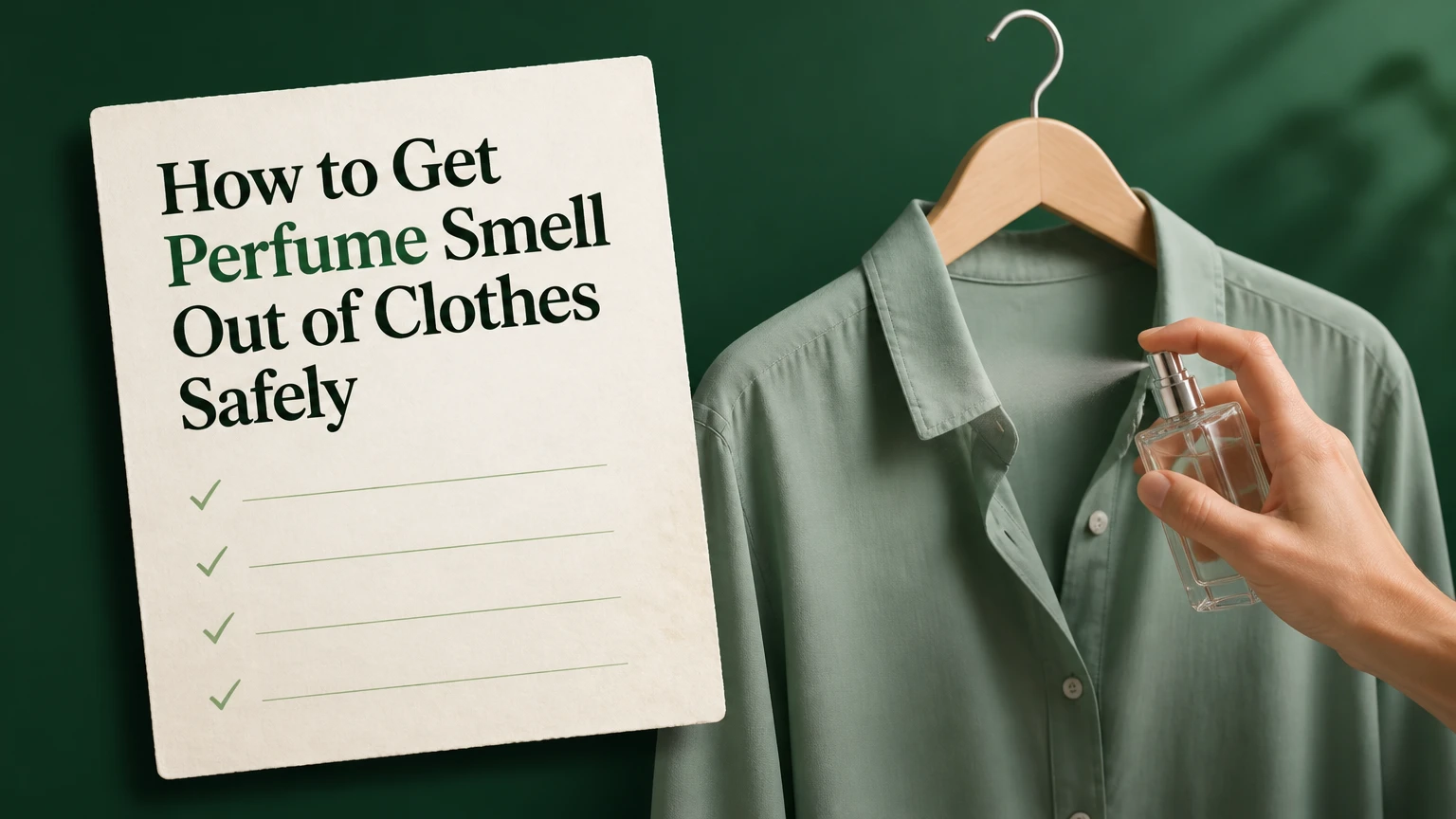
To get perfume smell out of clothes, air the garment first, pretest a diluted cleaning solution, then wash with fragrance-free detergent and an extra rinse. Avoid machine drying until the odor is gone. The most important variable is fabric type, because polyester retains oily fragrance compounds differently from cotton, wool, silk, and rayon.
Key Facts at a Glance
- Perfume odor usually comes from fragrance oils and slow-evaporating fixatives left after the alcohol carrier disappears.
- Fragrance-free detergent and thorough rinsing remove residue more reliably than adding another scented product.
- White vinegar may reduce some odors, but vinegar does not reliably dissolve perfume oils and should not be treated as a universal degreaser.
- A dryer can make residual fragrance harder to remove by heating the remaining oils and fixatives.
- Polyester, nylon, and elastane often need repeated treatment because synthetic fibers retain oily compounds.
- Dry-clean-only, silk, structured wool, leather, and heavily embellished garments require a lower-risk method or professional cleaning.
Why Does Perfume Smell Stay in Clothes?
Perfume smell stays in clothes because the alcohol and water carrier evaporate first, while less-volatile fragrance ingredients remain on or inside the textile. Perfume formulas commonly contain aromatic molecules, essential oils or fragrance oils, and fixatives that slow evaporation, so a garment can smell strongly after the visible spray has disappeared.
The residue is not one chemical with one removal method. Some components evaporate during outdoor airing; others need detergent surfactants to suspend oily material in wash water. Baking soda can reduce certain odors on a surface, but it does not reliably extract every perfume ingredient from a fiber.
The AI Overview correctly identifies synthetic fibers as frequent odor retainers, but its explanation needs qualification. Cotton absorbs liquids into porous spaces, while polyester is a relatively nonpolar polymer that can retain hydrophobic fragrance ingredients near and within the fiber surface. Wool and silk can also hold scent, but their protein fibers are more vulnerable to alkaline products, heat, agitation, and prolonged soaking.
What Actually Removes Fragrance Residue?
Surfactants in laundry detergent are the main household removal tool because they surround oily soil and help carry it into rinse water. Airflow handles volatile ingredients, while repeated rinsing removes loosened residue that remains suspended in the wash.
Vinegar is acidic and can alter some odor conditions, but acetic acid is not a specialist solvent for perfume oils. Vinegar and baking soda used together largely neutralize each other, producing carbon dioxide, water, and a diluted salt solution. Use them in separate stages only when the fabric-care label allows, not as a more powerful combined cleaner.
Before You Start: Materials, Time, and Safety
The standard method takes about 2-4 hours of active and waiting time, excluding overnight airing, and costs approximately $0-$8 using household laundry supplies. Check the care label, remove detachable accessories, and test every solution on an inner seam before treating the visible garment.
| Item | Typical amount | Purpose | Main limitation |
|---|---|---|---|
| Fragrance-free liquid detergent | Label dose, usually 1-2 tablespoons for a small load | Suspends oily residue | Excess detergent can leave film |
| White distilled vinegar | 1/2 cup in 2-3 gallons of water | Optional odor rinse or soak aid | Does not reliably dissolve perfume oils |
| Baking soda | 1/2 cup for a full washable load | Mild odor absorption and water alkalinity | Can leave powder residue |
| Activated charcoal | 100-300 g in an open bowl | Absorbs airborne odor in a container | Does not clean residue touching fabric |
| Clean towel | 1-2 towels | Blotting and controlled drying | A scented towel can transfer odor |
| Large basin | 4-8 quarts | Hand soaking | Must be cleaned of detergent fragrance |
Do not combine vinegar with chlorine bleach, oxygen bleach, ammonia, or other cleaning chemicals. Never pour dish soap into a washing machine unless the appliance and product instructions specifically permit it, because concentrated dishwashing liquid can create excessive suds and trigger leaks or poor rinsing.
How to Get Perfume Smell Out of Clothes in Four Steps
The safest general sequence is air, pretest, wash, rinse, and inspect before drying. Four steps usually take 30-60 minutes of work plus 1-3 days of air exposure for heavy fragrance buildup, and success depends more on preventing heat exposure than on using a stronger chemical.
Step 1: Air the Garment Before Washing
Hang the garment outdoors in moving air for 6-24 hours, or place it near an open window for 12-24 hours when outdoor humidity, pollution, or weather makes outside airing unsuitable. Turn the garment inside out so air reaches the lining, collar, cuffs, underarms, and pockets.
Bright sunlight may help volatile odor compounds dissipate, but direct sun can fade dark dyes and weaken some fibers. Use shade with strong airflow for black, navy, red, vintage, silk, and delicate garments. Do not seal a freshly sprayed garment in a plastic bag, because trapped vapor keeps the odor concentrated.
You will know Step 1 helped when: the odor is weaker on the outside and stronger in seams, lining, or thick areas.
Common mistake: spraying air freshener or fabric refresher over the perfume. Added fragrance creates a larger odor mixture and can increase residue.
Step 2: Pretest and Pre-soak Washable Clothing
Fill a clean basin with cool or lukewarm water and add 1 teaspoon of fragrance-free liquid detergent per gallon. Submerge the garment for 15-30 minutes, gently pressing the fabric without aggressive rubbing. Rinse once, then inspect the water and the garment for dye bleeding, rings, or texture changes.
A vinegar soak is optional for sturdy, colorfast cotton or polyester. If used, add 1/2 cup of white distilled vinegar to 2-3 gallons of water for 15-30 minutes, then rinse before detergent washing. Do not use an undiluted vinegar spot treatment, and avoid vinegar on acetate, some rayon garments, leather, and textiles with unstable dyes.
You will know Step 2 helped when: the garment smells less intense while wet and shows no dye transfer or surface change after rinsing.
Common mistake: following the AI Overview’s one-cup vinegar recommendation without considering basin size. A full cup in a small sink can create an unnecessarily acidic bath and does not guarantee oil removal.
Step 3: Wash With Fragrance-Free Detergent
Wash the garment at the warmest temperature permitted by the care label, using fragrance-free detergent at the manufacturer’s dose. Select a normal or heavy-soil cycle only when the fabric and garment construction allow it. Place one or two garments in the machine instead of overloading the drum so water can circulate through the fibers.
For a standard cotton or polyester load, 1/2 cup of baking soda in the drum is optional. Baking soda can support odor control, but it is not a substitute for detergent and is less useful against a concentrated perfume oil deposit. Do not add fabric softener, scent beads, dryer sheets, or perfume boosters during the removal wash.
You will know Step 3 helped when: the garment smells neutral or only faintly scented immediately after washing, before any dryer heat is applied.
Common mistake: using more detergent. Excess surfactant can remain in fabric, attract soil, and make the garment smell chemically clean rather than odor-free.
Step 4: Rinse, Inspect, and Air-Dry
Run an extra rinse, then smell the garment while it is still damp and again after 15 minutes of air exposure. Hang it in moving air until completely dry. Do not use a tumble dryer while a clear perfume odor remains, because heat can drive oily residue deeper into fibers and make later treatment more difficult.
A garment that smells faintly of vinegar while wet does not necessarily retain vinegar after drying. If the vinegar smell remains once dry, run a fragrance-free wash and rinse rather than adding another scented product.
You will know Step 4 worked when: the dry garment smells neutral at the collar, seams, lining, and fabric surface, not only at the easiest-to-air areas.
Common mistake: judging success from the first sniff after washing. Wet textiles suppress or alter odor perception, so final inspection must happen after complete air-drying.
Which Perfume-Removal Method Is Best?
The best method depends on fabric, odor intensity, and whether washing is allowed. Outdoor airing is lowest risk for light odor, detergent washing is the main removal method for washable garments, and professional dry cleaning is safer for structured or delicate clothing.
| Method | Best fabric or situation | Typical time | Typical cost | Main risk |
|---|---|---|---|---|
| Airing in shade | Silk, wool, light perfume odor | 6-72 hours | $0-$2 | Slow odor reduction |
| Fragrance-free detergent wash | Cotton, linen, polyester | 45-120 minutes | $0.25-$2 | Heat or overloading |
| Diluted vinegar pre-soak | Colorfast cotton or polyester | 15-30 minutes | $0.10-$1 | Dye or finish sensitivity |
| Baking soda in wash | Washable fabrics with mild residual odor | 1 wash cycle | $0.10-$0.75 | Powder residue |
| Charcoal container | Dry-clean-only garments between cleanings | 24-72 hours | $3-$15 | Limited effect on fabric residue |
| Professional dry cleaning | Structured wool, silk tailoring, lined garments | 2-5 days | $8-$35 | Added cost and possible solvent scent |
Does Vinegar Remove Perfume Smell?
Diluted white vinegar can reduce some residual odor, but vinegar alone is not dependable for heavy perfume because acetic acid does not function as a complete solvent for fragrance oils and fixatives. Use vinegar as an optional pre-soak or rinse aid on colorfast washable fabrics, then rinse and wash with fragrance-free detergent.
Does Baking Soda Remove Fragrance From Clothing?
Baking soda can absorb or reduce some surface odor, but it rarely removes a concentrated perfume deposit from polyester, lining, or thick fabric by itself. Add 1/2 cup to a standard washable load when appropriate, and follow with an extra rinse; do not expect baking soda to replace detergent, ventilation, or professional cleaning.
Is Ozone a Safe Home Solution?
Home ozone generators are not a preferred clothing-treatment method because ozone can irritate the lungs, damage elastomers and dyes, and create secondary oxidation products. The U.S. Environmental Protection Agency warns that ozone generators are not reliable odor-removal devices at concentrations considered safe for occupied indoor spaces. Ozone treatment belongs in controlled professional restoration settings, not a bedroom or laundry room.
Enzyme sprays also require realistic expectations. Laundry enzymes target soils such as proteins, starches, and fats; many perfume odorants are not enzyme substrates. A labeled textile odor product may help, but test for color change and never spray an unknown formulation on silk, leather, or dry-clean-only tailoring.
How Does Fabric Type Change the Treatment?
Fabric type changes the safe water temperature, agitation level, drying method, and tolerance for alkaline or acidic solutions. Cotton and polyester usually tolerate the standard sequence, while wool, silk, acetate, rayon, and garments with adhesives require shorter exposure and less mechanical stress.
| Fabric or construction | Recommended first treatment | Avoid | Typical repeat limit at home |
|---|---|---|---|
| Cotton or linen | Fragrance-free detergent, warm label-safe wash | Chlorine bleach on colored fabric | 2-3 cycles |
| Polyester or nylon | Airing, detergent wash, extra rinse | High dryer heat and fabric softener | 2-4 cycles |
| Wool | Shade airing, cool hand wash if label permits | Hot water, baking soda, vigorous rubbing | 1 gentle wash |
| Silk | Shade airing, professional cleaner if persistent | Vinegar soak, alkaline powders, direct sun | 0-1 home wash |
| Rayon or viscose | Airing, label-approved cool wash | Long soaking, wringing, heat | 1 gentle wash |
| Structured suit or lined coat | Airing, then dry cleaner | Basin soaking and machine agitation | 0 home washes |
| Leather or suede | Outdoor airing in shade | Water, vinegar, detergent | 0 home washes |
How Do You Treat Polyester and Nylon?
Polyester and nylon often need the most patience because oily fragrance ingredients can remain after a normal wash. Air the garment for 24 hours, wash with fragrance-free detergent at the label temperature, add an extra rinse, and repeat once only after full air-drying confirms the odor remains.
Athletic clothing needs extra care because elastane, waterproof finishes, and bonded seams can degrade with heat or aggressive chemicals. Skip vinegar and baking soda if the manufacturer warns against them, and do not use fabric softener because it can coat performance fibers and impair moisture transport.
How Do You Treat Wool and Silk?
Wool and silk should receive shade airing first, followed by label-approved cool hand washing or professional cleaning. Use a pH-balanced detergent made for the fiber, avoid prolonged soaking, and press water out with a towel instead of wringing.
Silk can develop water marks, color bleeding, or a changed hand after an improvised soak. A silk blouse with perfume on the neckline is a strong candidate for a professional cleaner, particularly when the garment has lining, interfacing, beads, or a dry-clean-only label.
Can You Remove Perfume Without Washing?
You can reduce perfume smell without washing by airing the garment and placing it in a clean container with activated charcoal nearby, but no-wash methods mainly remove airborne volatile compounds rather than residue bonded to fabric. Use them for dry-clean-only clothing, light odor, or a temporary improvement before professional cleaning.
Place the garment on a broad hanger in a clean, shaded, ventilated room for 24-72 hours. For container treatment, put the garment in a large plastic storage bin without pressing it against the sides, then place 100-300 grams of activated charcoal in an open bowl beside it. Keep charcoal and baking soda off the fabric, and leave the container slightly ventilated if condensation develops.
Do not use coffee grounds, scented sachets, essential oils, or dryer sheets. Those materials add volatile compounds and can transfer stains, while charcoal only works on odor in the surrounding air. Thick collars, padded shoulders, and linings may still require cleaning.
How Do You Handle Dry-Clean-Only Clothing?
Dry-clean-only clothing should be aired in shade for 24-72 hours, then taken to a cleaner if the odor persists. Tell the cleaner that the garment has perfume residue, identify the sprayed areas, and mention any fragrance sensitivity so the garment is not returned with a scented finishing product.
Do not soak tailored jackets, wool coats, silk dresses, acetate linings, velvet, leather, or embellished garments at home. Water can cause shrinkage, puckering, dye migration, adhesive failure, or permanent rings even when the outer fabric appears washable.
A sealed container with charcoal can reduce ambient odor while you arrange cleaning. It cannot remove perfume oil embedded in a lining or trapped under a collar. The garment needs professional attention when odor returns immediately after airing, when an oily mark is visible, or when the item has high replacement value.
What If Perfume Left an Oily or Dark Mark?
An oily perfume mark needs stain treatment as well as odor removal, because washing away smell without removing the deposit can leave a recurring scent. Blot fresh residue with a white absorbent cloth, apply a small amount of label-compatible liquid laundry detergent to washable fabric, wait 5-10 minutes, and rinse from the reverse side.
Do not scrub silk, wool, velvet, leather, or a dry-clean-only garment. Do not use chlorine bleach to target perfume oil; bleach may damage dye while leaving the oily material in place. If a ring remains after one careful wash, stop repeating home treatments and use a professional cleaner.
Perfume sprayed on a garment can also damage finish, dye, or synthetic coatings independently of odor. A shiny patch, color change, stiff area, or sticky surface is a fabric-finish problem, not merely a smell problem.
Common Mistakes and How to Fix Them
| Mistake | Why it fails | Recovery |
|---|---|---|
| Tumble-drying while odor remains | Heat can set oily residue and intensify odor | Air-dry, then repeat one label-safe wash |
| Mixing vinegar and baking soda | Neutralization reduces their separate functions | Rinse thoroughly and choose one controlled treatment |
| Adding fabric softener | Fragrance and coating can mask or trap residue | Wash with fragrance-free detergent and extra rinse |
| Using undiluted dish soap in a washer | Excess foam can impair rinsing and cause overflow | Run rinse cycles, then hand-pretest any spot treatment |
| Overloading the drum | Poor water contact leaves odor in seams and folds | Rewash a smaller load |
| Using direct sun on dark or delicate fabric | UV exposure can fade dyes and weaken fibers | Use shade and moving air |
| Spraying alcohol or perfume remover randomly | Solvents can dissolve finishes or spread stains | Blot, stop chemical use, and consult the care label |
The most common practitioner error is treating odor intensity as proof that a stronger chemical is needed. Fragrance is often concentrated in collars, cuffs, linings, and folded seams, so better exposure and rinsing can outperform harsher chemistry.
A second counterintuitive point is that a garment can smell clean immediately after scented detergent yet release perfume again when warmed by body heat. Judge the result after complete drying and several hours of wear, not directly after a fragranced wash.
A third rule is to change one variable at a time. If vinegar, baking soda, detergent, enzyme spray, and heat are used together, a damaged finish or persistent smell becomes difficult to diagnose.
How Long and How Much Does Removal Take?
Light perfume odor typically improves after 6-24 hours of airing and one fragrance-free wash. Heavy buildup on polyester, vintage clothing, or garments stored in a perfume-saturated closet may require 48-72 hours of airing plus two carefully separated wash cycles.
| Situation | Expected treatment time | Household cost | Professional option |
|---|---|---|---|
| One lightly sprayed cotton shirt | 6-24 hours plus 1 wash | $0.25-$2 | Usually unnecessary |
| Polyester jacket with heavy odor | 24-72 hours plus 1-2 washes | $1-$5 | $10-$25 |
| Wool sweater | 24-48 hours airing or 1 gentle wash | $0-$4 | $8-$20 |
| Silk blouse with visible mark | 24 hours airing before evaluation | $0-$3 | $10-$30 |
| Structured coat or suit | 24-72 hours before cleaning | $0-$5 | $15-$35 |
| Several thrifted garments | 2-5 days for sorting and treatment | $3-$15 | $30-$100 total |
These are typical household and cleaner ranges, not fixed prices. Local labor, garment size, lining, stain severity, and rush service affect the final bill.
How Should Sensitive-Skin Households Remove Fragrance?
Sensitive-skin households should use ventilation, fragrance-free detergent, clean storage, and an extra rinse rather than masking products. Wash recently treated clothing separately from ordinary laundry, wear gloves when handling concentrated cleaners, and avoid ozone, essential oils, and heavily scented laundry additives.
The American Academy of Dermatology Association lists fragrance as a common trigger for contact dermatitis, but odor sensitivity and allergic skin reactions are not identical conditions. A person may react to trace fragrance residue without having a classic allergy, so the practical goal is minimizing residue and re-exposure rather than diagnosing the cause at home.
If clothing causes hives, swelling, breathing difficulty, or repeated dermatitis, stop wearing it and seek medical advice. Cleaning cannot make a garment safe for every person when the fiber finish, dye, or storage environment is also contributing to irritation.
What Should You Do With Thrifted or Vintage Clothes?
Thrifted and vintage clothing should be aired separately for 48-72 hours, inspected for dye bleeding and fragile seams, then treated according to fiber and construction. Older garments may contain accumulated perfume, smoke, storage odor, or degraded finish, so repeated aggressive washing can cause more damage than the original smell.
For washable cotton, use a small-load fragrance-free wash and an extra rinse. For wool, silk, rayon, beading, leather, or lined pieces, use shade airing and a specialist cleaner. Clean the closet or storage bin too, because perfume absorbed by wood, cardboard, or untreated fabric can transfer back to the garment.
Never place a valuable vintage garment in direct midday sun or seal it while damp. Both practices can create fading, mildew, or permanent odor.
FAQ
Will Perfume Smell Eventually Leave Clothes on Its Own?
Light perfume odor often fades after 24-72 hours of moving air, but heavy fragrance residue may remain for weeks in polyester, linings, and thick fabrics. Airing removes volatile components, not necessarily oily fixatives. Washable garments usually need fragrance-free detergent and an extra rinse after airing.
Can I Use Rubbing Alcohol to Remove Perfume From Fabric?
Rubbing alcohol is not a universal fabric-safe perfume remover. Alcohol may dissolve or spread some fragrance ingredients, but it can also affect dyes, coatings, acetate, and synthetic finishes. Never apply it broadly without checking the care label and testing an inconspicuous seam.
Should I Wash Perfume-Scented Clothes in Hot Water?
Use the warmest temperature allowed by the care label, not automatically hot water. Warm water can improve detergent performance on washable cotton, but high heat can shrink wool, damage silk, fade dye, degrade elastane, or set oily residue during drying. The dryer is the greater risk when odor remains.
Why Does Perfume Return After Washing?
Perfume can return after washing when fragrance remains in seams, lining, padding, or synthetic fibers and is released by body heat. Scented detergent can also mask the original odor temporarily. Rewash a smaller load with fragrance-free detergent, add an extra rinse, and air-dry completely before evaluating it.
Can Freezing Clothes Remove Perfume Smell?
Freezing may temporarily slow evaporation but does not reliably remove perfume oils or fixatives from fabric. Condensation during thawing can also create moisture problems. Airflow, label-safe washing, rinsing, and professional cleaning are more dependable approaches.
When Should I Stop Treating a Garment at Home?
Stop home treatment after one or two unsuccessful label-safe cycles, or immediately when color bleeding, rings, stiffness, shrinkage, or finish damage appears. Dry-clean-only, silk, leather, structured wool, and valuable vintage garments should go to a qualified cleaner when airing does not solve the odor.
The Bottom Line
To get perfume smell out of clothes, start with 6-24 hours of moving-air exposure, wash washable garments with fragrance-free detergent, add an extra rinse, and inspect the garment only after air-drying. Use diluted vinegar or baking soda as optional supporting treatments, not as substitutes for detergent. Avoid heat, fragrance masking, chemical mixtures, and home ozone. For silk, structured wool, leather, embellished clothing, or persistent oily residue, professional cleaning is the safer decision.