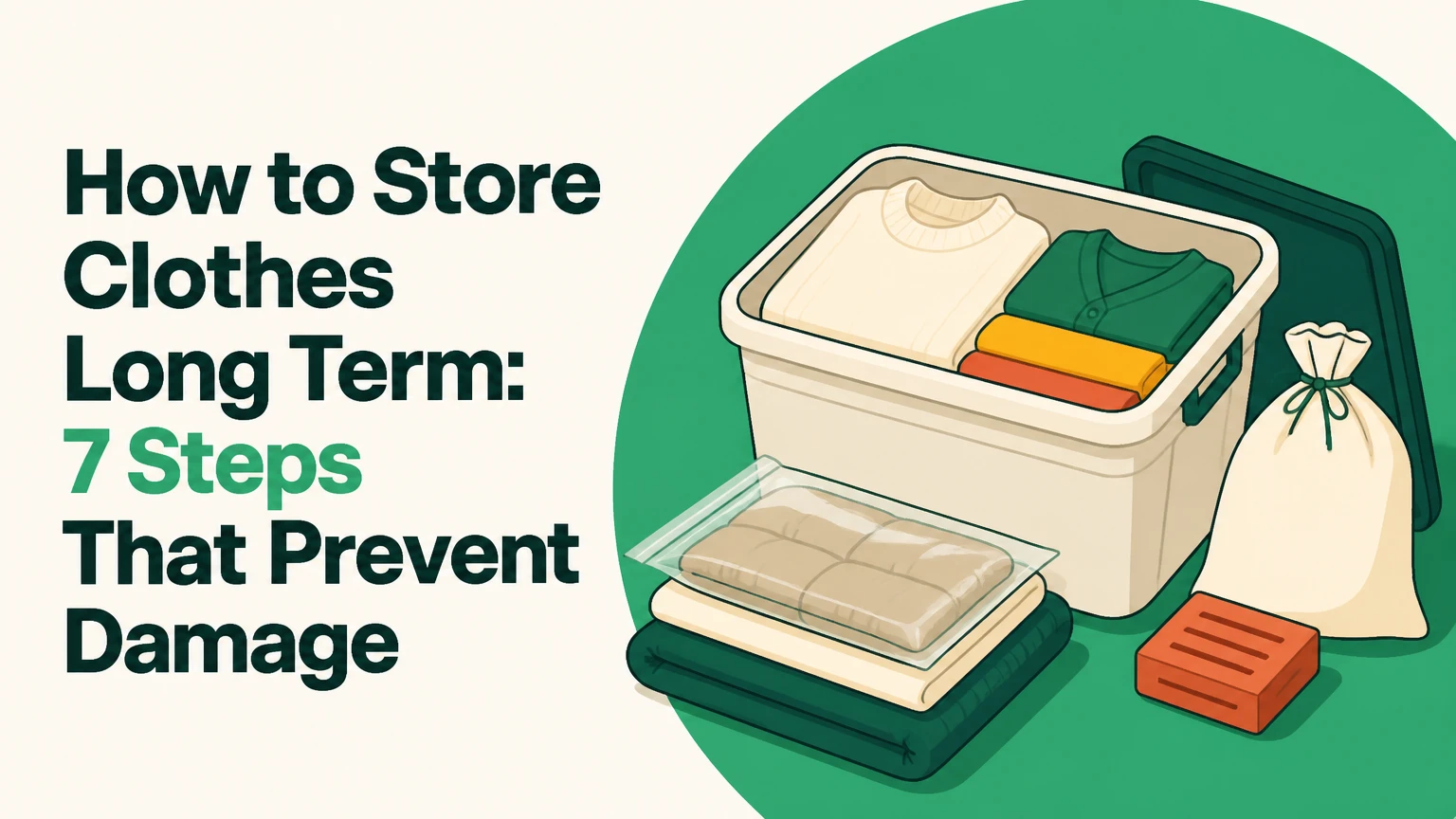
To store clothes long term, clean and completely dry every garment, repair and sort it by material, choose a container that matches the fabric, protect it from pests and light, and place it in a cool, stable, dry room. Inspect stored clothing every six to twelve months, because early moisture, pest, or odor detection prevents permanent damage.
Key Facts at a Glance
- Long-term clothing storage means protecting garments for roughly six months or longer.
- Clean clothing before storage because body oils, perfume, food, and perspiration can oxidize into permanent stains.
- A sealed plastic bin protects against dust and many pests, but residual moisture inside the bin can cause mildew.
- Knits, wool, cashmere, padded garments, and heavy embellishments usually retain their shape better when folded.
- Store clothing away from direct sunlight, damp floors, garages, uninsulated attics, and areas with large temperature swings.
- Household storage works best around 30%-50% relative humidity; 40%-50% is a useful target for valuable textiles when it can be maintained reliably.
What Does Long-Term Clothing Storage Protect Against?
Long-term clothing storage protects textiles from insects, mold, ultraviolet light, dust, staining, abrasion, and unstable temperature or humidity. Wool, silk, cashmere, fur, feathers, cotton, linen, rayon, polyester, leather, and blended fabrics deteriorate through different mechanisms, so one container type cannot protect every garment equally.
Clothes moth larvae target animal fibers such as wool, cashmere, silk, and fur, while carpet beetle larvae can damage natural fibers and stored lint. Moisture supports mold and mildew, especially when clothing enters a closed container slightly damp. Ultraviolet exposure fades dyes and weakens some fibers, while heat accelerates chemical aging and can soften adhesives, elastic, and plastic trims.
Long-term storage does not make an unclean or unstable garment safe. A container only changes the surrounding conditions. It cannot remove sweat residue, stop an active infestation, or compensate for a wet basement.
Before You Start
| Requirement | Typical amount or range | Practical standard |
|---|---|---|
| Preparation time | 60-90 minutes per 10-15 garments | Includes inspection, folding, labeling, and packing |
| Relative humidity | 30%-50% RH | Use a hygrometer; avoid persistently damp rooms |
| Storage supplies | 1 bin per 8-15 folded garments | Leave room for air movement and inspection |
| Cleaning time | 24-48 hours drying | Thick wool and padded items may need longer |
| Minimum floor clearance | 10-15 cm | Keep containers above minor leaks and cold floors |
| Inspection interval | Every 6-12 months | Inspect sooner after flooding, roof leaks, or pest activity |
How Do You Store Clothes Long Term?
The safest process has seven steps: clean and dry the garments, inspect and repair them, sort by fiber and weight, select the correct support, pack with appropriate materials, choose a stable location, and inspect the collection periodically. The most important control is complete dryness before sealing, because trapped moisture can damage an entire container of clothing.
Step 1: Wash and Dry Every Garment Completely
Wash or professionally clean every garment according to its care label, including clothing that appears spotless. Invisible perspiration, skin oil, deodorant, food residue, and fragrance can oxidize during storage, producing yellow or brown discoloration and attracting insects.
Do not put a garment into a sealed bin immediately after washing. Air-dry cotton, linen, and synthetics until seams, waistbands, pockets, cuffs, and padding feel completely dry. Thick wool, denim, fleece, and down may need 24-48 hours in a dry room with moving air.
Dry-clean-only clothing should be professionally cleaned before storage, then removed from the disposable plastic cleaner’s bag. Allow solvent odors to dissipate according to the cleaner’s instructions and use a breathable garment cover. The thin plastic bag is designed for transport, not multi-month preservation.
You will know Step 1 worked when: no cool, damp sensation remains at thick seams, and a clean garment has no food, body-oil, or perfume odor.
Common mistake: storing clothing after a short tumble-dry cycle while pockets or layered linings remain damp.
Step 2: Inspect, Sort, and Repair the Collection
Inspect every garment before packing it. Empty pockets, remove receipts and tissues, close zippers, fasten hooks, and check for moth cases, shed fibers, stains, rust, and active insect damage. Photograph valuable garments and record existing marks so later changes are identifiable.
Sort clothing by both material and physical weight. Keep wool and cashmere separate from heavily scented items, and keep garments with metal decorations away from damp conditions. Separating categories also reduces the number of times delicate textiles are handled during retrieval.
Repair loose hems, broken zippers, missing buttons, and weakened seams before storage. A small tear can enlarge when a garment is folded, stacked, or pulled from a crowded container. Never store an item with an active infestation alongside clean clothing.
You will know Step 2 worked when: each garment has a condition record, empty pockets, secure fastenings, and a designated storage method.
Common mistake: postponing repairs because the garment will not be worn soon. Storage preserves existing condition; it does not stabilize structural damage.
Step 3: Fold Flexible and Heavy Garments
Fold sweaters, knits, cashmere, wool, jeans, padded coats, sequined pieces, and heavily embellished garments. Long-term hanging places continuous stress on shoulder seams and can create hanger marks, especially in stretch knits and heavy eveningwear.
Fold along existing seams rather than forcing sharp creases across printed areas or fragile embellishment. Place acid-free tissue between sequins, embroidery, dark and light fabrics, or garments with rough fasteners. Loosely roll soft, low-risk items when a deep fold would damage a print, but do not tightly compress structured clothing.
Use a clean, flat surface and avoid stacking more garments than can be lifted without dragging the bottom layers. A typical plastic bin should contain fewer than 15 folded adult garments, depending on fabric thickness.
You will know Step 3 worked when: folded garments retain their natural shape and the stack can be removed without pulling or crushing individual pieces.
Common mistake: placing heavy sweaters on wire hangers before storage. Thin hangers create shoulder points and permanent distortion.
Step 4: Hang Structured Garments Correctly
Hang tailored coats, blazers, suits, structured dresses, and some wrinkle-prone linen garments when their construction benefits from vertical support. Use broad, contoured wooden or molded hangers that fill the shoulder area; use padded hangers for delicate silk or easily marked fabrics.
Avoid hanging leather, fur, wet garments, heavy beaded gowns, and loosely knitted garments without specialist advice. Leather needs controlled humidity and enough support to prevent sharp folds, while fur requires professional cold storage for long-term preservation. A breathable cotton or Tyvek-style garment cover protects against dust without creating the stagnant environment of a plastic cover.
Leave approximately 2-5 cm between hanging garments. Do not place a garment bag directly against an exterior wall where condensation can form.
You will know Step 4 worked when: the hanger supports the garment at its shoulders, the hem hangs freely, and no fabric is compressed against neighboring items.
Common mistake: using a narrow hanger because it saves rail space. Space efficiency is not worth shoulder deformation.
Step 5: Add Pest and Moisture Protection
Use prevention rather than fragrance as the main pest strategy. Vacuum the closet or storage area, remove lint and pet hair, clean the floor, and inspect nearby wool rugs, upholstery, and baseboards. Store garments only after confirming that no insects or larvae are present.
Silica gel packets can capture small amounts of residual humidity inside a sealed container, but silica gel does not regulate a damp room or replace a dehumidifier. Use several fresh packets sized for the container, keep them away from children and pets, and replace or recharge them according to the product instructions.
Do not scatter cedar chips, lavender, or essential oils directly on clothing. Their odors may transfer, oils can stain, and their pest-repellent performance is inconsistent. Mothballs contain pesticide chemicals and should only be used exactly as the product label permits, usually in an airtight container; they are unsafe for open closets and can expose people or animals to harmful vapors.
You will know Step 5 worked when: the storage area is clean, no live pest evidence exists, and moisture-control products are contained rather than touching fabric.
Common mistake: assuming a strongly scented product proves that moth protection exists. Odor is not a reliable measure of insect control.
Step 6: Pack Clothes in a Suitable Container
Choose a container according to the garment’s vulnerability, not merely the available shelf space. Pack clean clothing loosely enough that the lid does not press against the top layer, and place tissue around sharp hardware, fragile trims, or dark dyes that might transfer.
Plastic polypropylene bins with latching lids provide strong dust, splash, and pest protection. They are useful for seasonal cotton, polyester, fleece, denim, and washable outerwear, provided every garment is dry. Breathable cotton or canvas covers work better for hanging wool, silk, linen, and tailored clothing in a dry, pest-free room.
Archival boxes made from acid-free or buffered board are appropriate for many cellulose-based textiles, while protein fibers such as silk and wool often require unbuffered acid-free tissue. Preservation specifications vary, so valuable wedding gowns, uniforms, quilts, and historic clothing deserve a textile conservator’s assessment.
| Container or method | Typical cost | Best use | Main limitation |
|---|---|---|---|
| Polypropylene latching bin | $8-$25 each | Cotton, polyester, denim, fleece | Traps moisture if garments are damp |
| Cotton or canvas cover | $8-$30 each | Wool coats, silk dresses, tailored clothing | Offers little flood or insect protection |
| Vacuum storage bag | $3-$10 each | Shorter-term synthetic blankets and robust polyester | Compression damages loft and shape |
| Archival preservation box | $30-$75 each | Wedding gowns, heirlooms, historic textiles | Requires careful tissue packing and space |
| Professional textile storage | $20-$100+ monthly | Fur, museum textiles, high-value garments | Costs more than household storage |
Step 7: Label and Inspect the Storage
Label each container on two sides with garment categories, date packed, cleaning status, and any known condition issue. A simple inventory such as “wool sweaters, cleaned October 2026, inspect October 2027” prevents unnecessary searching and handling.
Inspect clothing every six to twelve months. Open the container in a dry room, check for odor, dampness, discoloration, webbing, larvae, and failed elastic, then re-fold garments along different lines if they have remained compressed. Repack only when the textiles and container are completely dry.
Inspect immediately after a roof leak, flood, plumbing failure, heat-wave event, or known moth sighting. A storage schedule cannot compensate for a changed environment.
You will know Step 7 worked when: every container has an inventory, the contents remain odor-free and dry, and early damage can be identified before it spreads.
Common mistake: checking only the outside of the box. Mold and pests often begin inside folds, seams, collars, and pockets.
Which Storage Container Should You Choose?
A latching polypropylene bin is the practical choice for clean, dry, washable everyday clothing, while an archival box is better for heirlooms and a breathable cover is better for garments that need hanging. Vacuum bags are a space-saving option for selected synthetic items, not a universal long-term solution.
| Garment type | Preferred method | Avoid | Reason |
|---|---|---|---|
| Cotton T-shirts | Folded polypropylene bin | Damp cardboard | Cotton tolerates folding but absorbs moisture |
| Wool sweater | Folded archival box or breathable shelf | Long-term vacuum compression | Compression and pests can damage wool fibers |
| Silk dress | Padded hanger and breathable cover | Direct sunlight and plastic film | Silk creases easily and is light-sensitive |
| Down jacket | Uncompressed hanging or large breathable bag | Vacuum bag for long-term storage | Compression reduces loft and stresses filling |
| Leather jacket | Broad hanger in controlled room | Tight folding and humid bins | Folds can become permanent and mold can develop |
| Wedding gown | Archival box with tissue | Ordinary plastic tote | Embellishments and dyes need stable support |
| Jeans | Folded latching bin | Overfilled stack | Denim is durable but develops deep compression creases |
| Fur coat | Professional cold storage | Home attic or garage | Temperature, humidity, and pest control are difficult to stabilize |
Are Vacuum Bags Safe for Long-Term Clothing Storage?
Vacuum bags are generally unsuitable for long-term storage of wool, cashmere, silk, leather, fur, down, structured tailoring, and embellished clothing. Vacuum compression removes space but also applies sustained pressure, flattens loft, creates hard creases, and can stress coatings, padding, and fragile trims.
Vacuum bags can work for robust synthetic blankets, polyester fleece, and some seasonal polyester garments when the manufacturer permits extended compression. Release the vacuum periodically if the items remain stored for many months, and check that the plastic has not become brittle or sealed around sharp hardware.
Vacuum bags are not automatically waterproof. Their seals can fail, and condensation can remain inside. A raised latching bin offers better secondary protection against leaks and crushing.
Is Cardboard Safe for Stored Clothes?
Ordinary moving boxes are poor long-term textile containers because they can absorb humidity, transfer acids or contaminants, collapse under weight, and provide access for insects. Cardboard itself is not always harmful, but preservation storage requires acid-free, lignin-controlled board with suitable tissue.
Use clean archival boxes for valuable clothing. For ordinary seasonal garments, a polypropylene bin in a dry room is usually more practical and provides better resistance to spills.
Where Should You Store Clothes for Several Years?
The best location is a dark, stable, elevated indoor space with low humidity and minimal temperature fluctuation, such as an interior bedroom closet or conditioned storage room. Avoid basements, garages, sheds, exterior-wall cupboards, and uninsulated attics because their moisture and temperature conditions change quickly.
A typical household target is 30%-50% relative humidity, measured with a digital hygrometer. The 40%-50% range is useful for valuable textiles, but maintaining a stable moderate range is more important than chasing an exact number. Persistent humidity above 60% increases mold risk, while very dry heated air can make some fibers and finishes brittle.
Keep containers off concrete floors and at least 10-15 cm above the floor on shelving or a pallet. Protect clothing from ultraviolet light, heating vents, plumbing lines, roof leaks, and exterior walls. A self-storage unit should be climate-controlled, clean, and free from visible pest evidence.
How Much Does Long-Term Clothing Storage Cost?
Typical household long-term clothing storage costs $8-$75 per container, excluding cleaning, shelving, and climate control. Ordinary seasonal storage can remain inexpensive, while archival preservation or professional fur storage costs substantially more because materials and environmental controls are specialized.
| Expense | Typical price | Typical quantity | When it is justified |
|---|---|---|---|
| Polypropylene bin | $8-$25 | 1 per 8-15 garments | Seasonal everyday wardrobe |
| Hygrometer | $8-$25 | 1 per storage room | Any room with uncertain humidity |
| Acid-free tissue | $10-$30 per pack | Several sheets per garment | Silk, heirlooms, embellishments |
| Professional cleaning | $8-$40 per garment | 1 per dry-clean-only item | Suits, wool coats, formalwear |
| Archival box | $30-$75 | 1 per gown or heirloom | Wedding clothing and historic pieces |
| Climate-controlled unit | $50-$250 monthly | Unit-dependent | Large collections or relocation |
These are typical consumer ranges, not fixed national prices. Cleaning prices vary by region and garment construction, while professional preservation can exceed the archival-box cost for heavily beaded or historically significant pieces.
What Are the Most Common Long-Term Storage Mistakes?
The most damaging mistakes are sealing damp clothing, overpacking containers, leaving garments in dry-cleaning plastic, using poor hangers, and ignoring the storage environment. Each mistake creates a different failure mode, so the correct fix depends on whether the problem is moisture, compression, pests, light, or chemical residue.
- Sealing clothing before it is fully dry: Remove the garments, spread them indoors in dry moving air, and re-pack only after seams and linings are dry.
- Overfilling a bin: Reduce the load until the lid closes without pressure and folded garments can be lifted individually.
- Using plastic dry-cleaning bags: Replace them with breathable covers after cleaning odors have dissipated.
- Using wire hangers: Transfer garments to broad, shaped hangers before shoulder distortion develops.
- Storing against a damp wall or floor: Move containers to elevated shelving in an interior room and measure humidity.
- Applying mothballs in an open closet: Remove the product, ventilate the area, and follow local disposal and label instructions.
- Using scented oils directly on fabric: Stop the treatment and check for oily marks or dye changes before cleaning.
- Leaving sunlight on transparent bins: Move the bins into a dark room because clear plastic does not block all ultraviolet exposure.
A practitioner’s rule is to solve the room before buying more containers. A sealed box in a damp basement remains a damp microclimate, and more desiccant cannot reliably correct the surrounding building conditions.
How Do You Store Special Garments?
Special garments require material-specific storage because wool, leather, down, silk, and heirlooms respond differently to compression, humidity, light, and support. The correct approach is usually lower handling, stable conditions, breathable materials, and professional care when replacement would be costly.
Seasonal Clothing
For seasonal clothing, clean and dry all garments, fold washable items into labeled polypropylene bins, and store the bins on elevated shelves in an interior closet. Keep coats and tailored pieces on broad hangers under breathable covers if the closet has room.
Pack one season per container rather than mixing unrelated categories. A label showing contents and date makes the next changeover faster and reduces unnecessary unpacking.
Wedding Gowns and Heirlooms
Wedding gowns and heirloom textiles should be cleaned by a specialist familiar with the garment’s dyes, trims, and age, then packed in an acid-free archival box with appropriate tissue. Support the bodice and folds with generous tissue, avoid sharp creases, and never store the box in an attic or basement.
Buffered tissue is often used with cellulose fibers, while unbuffered acid-free tissue is commonly preferred around protein fibers and some dyed or weighted silk. Because textile chemistry varies, a textile conservator or reputable gown-preservation specialist should select materials for irreplaceable pieces.
Professional preservation cannot reverse every existing stain. Its value is in controlled cleaning, support, and documented packing.
Leather and Fur
Leather clothing should remain supported on a broad hanger in a cool, stable, dry room, with enough space for air circulation. Do not fold leather tightly, place it in an airtight plastic bin, or apply household oils without following the manufacturer’s care guidance.
Fur is a specialist case. Professional furriers commonly recommend cold storage with controlled humidity because household closets, attics, and garages allow pest and moisture fluctuations that can damage pelts and leather backing.
Down and Puffer Garments
Store down and synthetic puffers uncompressed, ideally hanging or in a large breathable bag. Long compression reduces loft, and down that remains compressed can take longer to recover or develop odor if moisture is present.
Clean the garment according to its care label before storage, then dry it thoroughly. Feel around baffles and cuffs, where retained moisture is easy to miss.
Baby Clothes and Small Garments
Baby clothes should be washed with a residue-free detergent, dried fully, and stored in small labeled groups by size and season. Use acid-free tissue for keepsakes and a clean latching bin for ordinary cotton clothing.
Avoid storing baby garments with mothballs, perfume sachets, or essential oils. Infants are especially sensitive to residues and strong volatile chemicals, so odor-free materials are the safer choice.
How Do You Fix Musty, Yellowed, or Infested Clothes?
Musty clothing should be isolated, dried, and assessed for mold before laundering, while yellowed clothing should be treated according to its fiber and dye stability. Clothing with active insects should be isolated from clean garments, and valuable or visibly moldy textiles should go to a specialist rather than a household washer.
- Musty odor without visible mold: Air the garment in a shaded, dry, well-ventilated area, then launder or professionally clean it according to the care label. Direct sun can fade dyes, so ventilation is safer for colored textiles.
- Visible mold or fuzzy growth: Seal the item away from other clothing and avoid brushing it indoors. A conservator or textile-cleaning specialist should assess valuable pieces.
- Yellow stains: Do not assume chlorine bleach is safe. Test a hidden area and use an oxygen-based product only when the care label and dye permit it.
- Moth or carpet beetle evidence: Isolate the garment, inspect neighboring textiles, vacuum the storage area, and obtain professional treatment for valuable items. Freezing can kill some insect stages when performed in a controlled, sealed process, but a single household freezer cycle is not a universal guarantee.
- Deep creases: Use a steamer only when the care label permits it, keep the nozzle from delicate surfaces, and allow the garment to dry before repacking.
- Chemical odor from mothballs: Remove the garment from the treated area and ventilate it according to the pesticide label. Do not place mothball-treated clothing near children, pets, food, or open living areas.
FAQ
Can You Store Clothes in Plastic Bins for Years?
Yes, plastic bins can store clothes for years when the garments are clean, fully dry, loosely packed, and kept in a stable indoor environment. Polypropylene bins reduce dust and pest access, but they do not fix high room humidity. Check the contents every six to twelve months and replace cracked or warped bins.
Should Clothes Be Stored With the Sleeves Inside or Outside?
Fold sleeves naturally across the garment rather than forcing them into tight internal bundles. For jackets and coats, preserve the shoulder shape with a suitable hanger or tissue support. For sweaters, folding sleeves across the torso reduces stress at the armholes and avoids the pointed shoulders caused by narrow hangers.
How Long Can Clothes Stay in Vacuum Bags?
Robust synthetic garments can often remain vacuum-packed for several months, but manufacturers may not guarantee multi-year compression. Wool, cashmere, silk, leather, fur, down, structured tailoring, and embellished garments should remain uncompressed. Open the bag if moisture, odor, plastic stress, or permanent creasing appears.
Do Cedar Blocks Prevent Clothes Moths?
Cedar blocks may provide a mild odor and limited deterrence in a confined space, but they do not replace cleaning, vacuuming, inspection, or sealed protection. Cedar effectiveness declines as the scent dissipates, and cedar oil can contact or stain fabric. Treat prevention as an integrated cleaning and monitoring system.
Is It Better to Roll or Fold Clothes for Storage?
Folding is better for sweaters, knits, tailored garments, and most long-term storage because rolling can create pressure at the outer layers and stress structured parts. Loose rolling can reduce sharp creases in selected T-shirts and synthetic garments, but it should not be tight enough to compress fibers or trap moisture.
Should You Wash Clothes Again After Long-Term Storage?
Wash clothing after storage when it has a musty odor, visible residue, pest contamination, or a care label requiring laundering before wear. Clean, dry garments from a stable container usually need only airing and inspection. Rewash delicate or heirloom textiles only through an approved specialist process.
The Bottom Line
The reliable way to store clothes long term is to clean and dry every item, repair damage, fold or hang according to garment construction, use the right container, and control the storage room. Polypropylene bins suit ordinary dry seasonal clothing, archival boxes suit irreplaceable textiles, and breathable covers suit hanging garments. Keep all clothing dark, elevated, dry, and inspectable, then check it every six to twelve months. When deciding how to store clothes long term, material suitability and environmental stability matter more than maximum compression or the lowest container price.