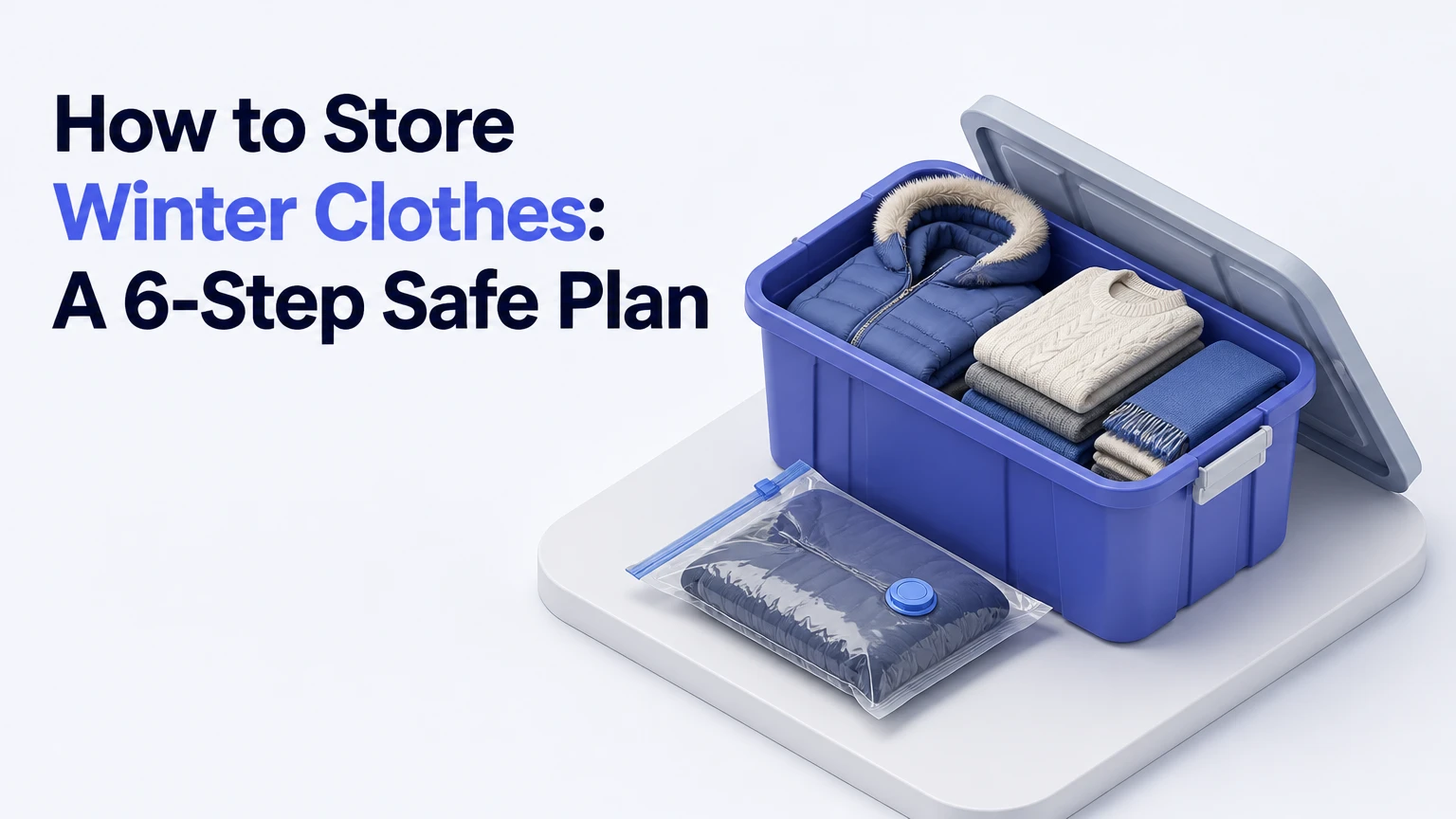
To store winter clothes safely, clean every garment according to its care label, dry it completely, inspect it for pests or damage, fold or hang it according to its fiber and structure, then place it in a suitable container in a cool, dry, dark location. The process usually takes 2-4 hours for an average household and protects clothing best when moisture control comes first.
Key Facts at a Glance
- Clean and completely dry winter clothing before packing because body oils, food residue, and moisture promote staining, moth damage, and mildew.
- Fold sweaters, knits, down jackets, and padded garments instead of hanging them for months.
- Use lidded plastic containers for reliable pest and moisture protection, but pack only dry clothing and avoid sealing in damp air.
- Use breathable cotton or canvas garment bags for structured wool coats when the storage room is dry and pest-free.
- Keep stored textiles away from attic heat, basement dampness, direct light, pipes, and exterior walls.
- Mothballs are pesticides, not ordinary air fresheners. They work only as their label directs and can expose people and pets to harmful vapors.
Before You Start
An average seasonal clothing changeover requires 2-4 hours, moderate effort, and approximately $10-$80 in supplies, depending on the number and type of garments. The most important prerequisite is a clean, dry storage location with no active leak, condensation, mold, or insect evidence.
| Requirement | Typical amount or range | Practical specification |
|---|---|---|
| Time for one adult wardrobe | 2-4 hours | Includes cleaning already completed, inspection, packing, and labeling |
| Plastic storage containers | 2-5 containers | Common 40-70 liter sizes fit folded sweaters and trousers |
| Acid-free tissue paper | 10-30 sheets | Useful for cashmere, silk lining, embroidery, and dark-to-light color separation |
| Cotton garment bags | 1-3 bags | Use for wool coats, suits, and structured jackets |
| Labels and marker | 1 set | Record owner, contents, cleaning status, and packing month |
| Humidity meter | $8-$25 typical | Place one near the containers, especially in a basement or closet |
| Pest-monitoring traps | 1-2 per room | Use as monitoring devices, not as a substitute for cleaning |
Do not begin by buying vacuum bags. First identify the fibers, care instructions, storage location, and likely moisture exposure. A cheap container used in a damp basement can damage a wardrobe more quickly than a breathable bag used in a dry bedroom.
Step 1: Sort the Winter Wardrobe
Sort winter clothing into keep, donate, repair, and discard groups before cleaning or packing. Removing unworn, damaged, and duplicate pieces reduces storage volume and prevents a stain or pest problem from traveling through the entire collection.
Empty the wardrobe, coat hooks, entry bench, laundry baskets, and shoe area. Check pockets for tissues, food wrappers, lip balm, receipts, and gloves. Pair scarves and gloves, match removable hoods to coats, and place accessories with the garment they belong to.
Use these sorting questions:
- Did someone wear the item during the last cold season?
- Does the garment still fit its owner and intended activity?
- Can a tailor, cobbler, or cleaner repair it at a reasonable cost?
- Does the item have mold, active larvae, or a persistent odor that needs professional treatment?
- Will the garment be needed during a mild-weather trip or early cold spell?
Do not store a garment that needs repair without labeling the repair. A coat with a broken zipper can remain untouched for six months when its defect is hidden inside a full container.
Success checkpoint: every item has a destination and every retained item has a cleaning or repair decision.
Common mistake: packing “maybe” items without a review date. Put uncertain pieces in a separate, dated box and reassess them before the next seasonal changeover.
Step 2: Clean, Treat, and Dry Every Item
Clean winter clothes using the care label before storage, then dry them fully before folding or enclosing them. Perfume, skin oils, perspiration, food residue, and salt from road exposure can become permanent stains or provide food for clothes moths and carpet beetle larvae.
Wash washable garments with the recommended detergent and water temperature. Do not use extra detergent to make clothing “cleaner,” because residue can attract soil and make fibers stiff. Dry-clean-only coats should go to a cleaner, while leather, suede, shearling, and fur trim require specialist care rather than a washing machine.
The American Cleaning Institute recommends following garment care labels because fiber blends, dyes, finishes, and construction determine safe washing and drying conditions. The Federal Trade Commission’s care-label rule also requires manufacturers to provide reliable care instructions for covered textile products in the United States.
After cleaning, dry garments until seams, cuffs, pockets, waistbands, linings, and padded areas feel completely dry. A thick puffer can need 1-3 hours in a dryer on the permitted setting, with periodic redistribution, while a heavy wool coat may need 24-48 hours of air drying in a ventilated room.
| Garment type | Cleaning approach | Drying and storage instruction |
|---|---|---|
| Merino or wool sweater | Hand wash or approved wool cycle | Dry flat; fold with tissue; never store damp |
| Cashmere | Care-label wash or professional cleaner | Dry flat away from direct sun; use a sealed clean bin |
| Down jacket | Care-label wash with down detergent | Tumble dry fully with dryer balls if permitted; store uncompressed |
| Wool coat | Professional cleaning when labeled | Air thoroughly; hang on a broad hanger inside a cotton bag |
| Fleece or polyester ski pants | Machine wash on label setting | Dry completely; folding or short-term compression is usually acceptable |
| Leather or suede boots | Brush, condition, or use specialist cleaner | Dry at room temperature; stuff with acid-free paper; avoid plastic wrapping |
Disinfectant is not automatically necessary. Vacuuming dust and hair, wiping hard surfaces, and allowing the area to dry usually addresses routine housekeeping; never spray disinfectant directly onto clothing, leather, wool, or storage tissue.
Success checkpoint: no garment feels cool, clammy, or heavy at seams and inner layers.
Common mistake: storing a coat immediately after professional cleaning while residual cleaning solvent or trapped moisture remains. Air it according to the cleaner’s instructions before enclosure.
Step 3: Inspect for Stains, Pests, and Damage
Inspect every garment under bright, indirect light before storage, because early detection is easier to manage than an infestation discovered next autumn. Look for live insects, larvae, shed skins, webbing, bald patches, frass-like debris, grease marks, and small irregular holes around collars, cuffs, and hidden seams.
Clothes moth larvae prefer dark, undisturbed areas and animal fibers such as wool, cashmere, fur, and feathers. Carpet beetle larvae can damage wool, hair, feathers, and other protein-based materials. Adult moths flying around a room are not the only warning sign; larvae and damage inside rarely moved garments matter more.
Quarantine suspicious items in sealed plastic bags. Do not place an affected sweater back into a shared canvas box while you investigate. Wash or dry-clean appropriate garments, and ask a textile conservator or pest professional about fragile, valuable, or non-washable pieces.
Freezing can treat some infested textiles when performed correctly, but a household freezer is not suitable for every material. A common museum-style approach uses a sealed bag, a stable freezer near or below 0°F (-18°C), at least 72 hours, and controlled thawing while still sealed; repeat cycles may be recommended because eggs can be more resistant. Confirm the treatment with a conservator for antiques, fur, adhesives, leather, or garments with complex trims.
Success checkpoint: retained garments show no unexplained holes, larvae, webbing, or active odor source.
Common mistake: relying on cedar alone. Cedar scent may repel some adult moths, but cedar does not reliably eliminate an established larval infestation and loses effectiveness as its volatile oils dissipate.
Step 4: Choose the Right Container
Choose storage containers according to fiber, garment shape, pest risk, and room humidity. Lidded polypropylene or polyethylene bins provide the most predictable barrier against household pests, while breathable cotton bags are better for structured garments in a genuinely dry, monitored closet.
Avoid cardboard for a six-to-nine-month storage cycle in basements, garages, and exterior closets. Cardboard absorbs moisture, weakens under load, and provides folds and seams where insects can remain undisturbed. It can be acceptable for short-term transport in a dry room, but it is a poor default for seasonal textile storage.
| Container | Typical cost | Best use | Main limitation |
|---|---|---|---|
| 40-70 L lidded plastic bin | $8-$25 each | Sweaters, fleece, jeans, accessories | Can trap moisture if clothing is not fully dry |
| Cotton or canvas garment bag | $10-$25 each | Wool coats, suits, structured jackets | Does not stop moisture or determined fabric pests |
| Breathable fabric storage box | $15-$40 per set | Folded knitwear in a dry closet | Vulnerable to dampness and insects |
| Vacuum storage bag | $2-$8 each typical | Fleece, polyester blankets, bulky synthetic layers | Reduces loft and can create deep creases |
| Acid-free archival box | $20-$60 each typical | Heirloom textiles and delicate accessories | Costs more and needs a dry, stable location |
| Plastic boot box or ventilated shoe container | $8-$20 each | Clean, dry boots and shoes | Footwear still needs shape support and air-out time |
Use containers with smooth interiors and secure lids. A “waterproof” tote is not a guarantee against condensation, roof leaks, flooding, or humid air sealed inside. Place a small desiccant pack in a bin only as supplemental moisture control, never as permission to pack clothing before it is dry.
Which storage method is best for each garment?
Folded storage in a clean lidded bin is the best general method for sweaters, knitwear, down, and most casual winter clothing. Broad padded hangers inside breathable garment bags suit structured wool coats, tailoring, and jackets that need to retain their shape.
| Garment | Preferred position | Container choice | Compression verdict |
|---|---|---|---|
| Cashmere sweater | Folded flat | Lidded plastic bin with tissue | Avoid vacuum compression |
| Down jacket | Loose or lightly folded | Large bin or breathable bag | Preserve loft; do not vacuum-seal |
| Wool overcoat | Hanging on broad hanger | Cotton garment bag | Avoid wire hangers and tight covers |
| Fleece blanket | Folded | Plastic bin or vacuum bag | Short-term compression is generally suitable |
| Leather jacket | Broad hanger | Breathable garment bag | Do not vacuum-seal or plastic-wrap |
| Ski trousers | Folded | Plastic bin | Compression is acceptable if fully dry |
| Knitted hat and gloves | Folded or nested loosely | Small labeled bin | Avoid overfilling and crushing |
Vacuum bags can save substantial space, but compression is not neutral. It flattens down insulation, increases wrinkles, and can stress elastic, laminated fabric, foam, and delicate knit structures. The popular claim that vacuum bags compress all clothing by 75% is a variable marketing estimate, not a dependable result for thick coats.
Success checkpoint: the container closes without forcing the lid, and garments are not packed so tightly that air cannot move during inspection.
Common mistake: using a single huge tote. Smaller bins, usually 40-70 liters, are easier to lift, label, inspect, and keep below their safe stacking load.
Step 5: Fold, Hang, and Pack Correctly
Fold knitwear and padded garments loosely, support delicate materials with acid-free tissue, and hang only structured items on broad, shaped hangers. Fasten buttons, zippers, and snaps before storage so coats retain their form and hardware does not snag adjacent fabric.
Fold sweaters horizontally rather than hanging them from shoulder seams. Gravity can stretch wet or heavy knits, create shoulder points, and distort ribbed cuffs. Place tissue between dark and light garments if dye transfer or surface friction is a concern, and avoid folding a garment along the same crease every season.
For a wool coat, empty pockets, close fasteners, brush away surface soil, and use a hanger wide enough to support the shoulders. Leave space around the coat inside its bag. Plastic dry-cleaning covers should be removed because they are designed for transport, not long-term textile storage.
Pack by category and owner, not randomly. A useful system is one bin for knitwear, one for casual layers, one for accessories, and one for bulky synthetic outerwear. Keep boots separate from clean clothing because residual dirt, oils, and odor from footwear can transfer.
Write the contents on two sides and the lid. Include the packing date, cleaning status, and any repair needed. A simple inventory note prevents unnecessary unpacking and makes it easier to find gloves or a travel coat during an unexpected cold week.
Success checkpoint: every bin has room for easy removal, a readable label, and no garment is bearing a sharp fold, heavy object, or compressed shoulder.
Common mistake: storing moth repellents directly against fabric. Keep cedar products or other labeled repellents in a holder or separate sachet so oils do not stain fibers.
Step 6: Store Containers in a Stable Location
Store winter clothing in a cool, dry, dark, elevated location with stable temperature and low exposure to leaks, condensation, and pests. A living-area closet or climate-controlled storage room is safer than an uninsulated attic or damp basement.
Textile conservators commonly favor stable conditions over extreme temperature targets. The National Park Service advises museums to control temperature, relative humidity, light, pests, and pollutants according to collection needs; household wardrobes do not require museum-grade equipment, but the same risk factors apply.
A practical household target is approximately 40%-55% relative humidity, measured with a hygrometer. The frequently repeated 50°F-65°F temperature range can work for a dedicated storage room, but stability matters more than achieving a narrow number. Avoid locations that repeatedly exceed about 80°F, experience condensation, or sit beside heating appliances.
| Storage location | Typical risk | Acceptable use | Required control |
|---|---|---|---|
| Bedroom closet | Low to moderate | Best for wool, cashmere, and coats | Keep dark, ventilated, and below 55% RH |
| Under-bed area | Moderate dust exposure | Good for lidded bins | Raise bins above floor and check for condensation |
| Dry basement | Humidity and pests | Suitable for sealed bins | Use hygrometer; keep bins 10-15 cm above floor |
| Uninsulated attic | Heat, light, temperature swings | Suitable only for robust synthetics | Avoid wool, leather, down, and heirlooms |
| Garage | Dust, fumes, temperature changes | Short seasonal storage for washable synthetics | Keep away from chemicals, tires, and leaks |
| Climate-controlled unit | Lower environmental risk | Best for valuable or multi-year storage | Inspect provider humidity and pest policies |
Never place clothing containers directly on a basement floor. Use shelving or a raised platform, leave a gap from exterior walls, and keep textiles away from water heaters, pipes, windows, and stored fuel or solvents.
Check containers after two weeks, then once every four to eight weeks. Look for condensation, musty odor, pest traps showing activity, lid distortion, or water intrusion. Early inspection is an information advantage: a damp bin with one affected sweater is manageable, while a neglected stack can spread odor and larvae.
What Should You Do in a Small Apartment?
Small-apartment storage works best with low-profile lidded bins under a bed, inside a wardrobe, or on a stable high shelf, while vacuum bags remain limited to durable synthetic items. Keep frequently needed accessories in a smaller front-access bin rather than reopening every container.
Use vertical space only when containers remain within safe lifting height. A 40-liter bin is easier to remove from beneath a bed than a 100-liter tote filled with dense jeans and boots. Store coats on existing closet rails after the seasonal swap and use one labeled bin for knitwear.
Do not use a balcony, unconditioned locker, or exterior utility closet for cashmere, down, leather, or wool. Temperature cycling can produce condensation inside sealed containers even when no water leak exists.
Can You Store Winter Clothes in a Basement or Attic?
A dry, monitored basement can hold winter clothing in sealed, elevated plastic bins, but an uninsulated attic is usually unsuitable for natural fibers because heat and humidity fluctuate sharply. A location is acceptable only when a hygrometer confirms stable conditions and the area has no mold, leaks, or active pests.
For basement storage, run a dehumidifier if needed, maintain airflow, and keep bins off the floor. For attic storage, use the space only for washable polyester fleece, acrylic accessories, or similar robust items, and protect them from roof leaks and radiant heat.
How Do You Prevent Moths and Carpet Beetles?
The most reliable household pest-prevention sequence is clean clothing, inspection, vacuumed storage areas, sealed containers, and periodic monitoring. Cedar and lavender sachets may provide odor or limited repellency, but neither replaces laundering, dry cleaning, or an airtight container.
Mothballs require special caution. The United States Environmental Protection Agency classifies mothballs as pesticide products whose labels specify permitted use; placing them loose in an open closet can expose people and pets to vapors while failing to reach an effective concentration. Never use mothballs near food, children, pets, or unsealed living areas, and never use them outside the labeled instructions.
If you find larvae, isolate the affected items and vacuum the surrounding closet, baseboards, shelf joints, and carpet edges. Wash or professionally clean suitable garments, dispose of heavily damaged low-value items, and repeat inspection after several weeks because one treatment may not remove every life stage.
Common Problems and How to Fix Them
| Problem after storage | Likely cause | Immediate response | Prevention next cycle |
|---|---|---|---|
| Musty smell | Trapped moisture or poor airflow | Remove, air in shade, and assess for mildew | Dry longer; lower room humidity; use a clean dry bin |
| White or green spotting | Mold or mildew growth | Isolate; do not brush indoors; seek textile advice | Stop using damp location and inspect for leaks |
| Flattened puffer | Long compression or dense packing | Tumble dry only if label permits; restore gradually | Store loose and preserve loft |
| Deep sweater wrinkles | Tight folds or overfilled bin | Steam on approved setting and reshape flat | Fold loosely; keep bin below full capacity |
| Small holes or webbing | Moth or beetle larvae | Quarantine and clean; inspect nearby items | Seal bins and use monitoring traps |
| Yellowing or dye transfer | Residue, light, or unstable dyes | Professional textile cleaning for valuable items | Clean before packing; store dark with tissue |
| Leather stiffness | Low humidity, heat, or improper wrap | Use a leather specialist | Store in breathable cover, away from attic heat |
Do not put musty garments straight into the dryer without checking for mold, because heat can set some odors and may damage finishes. Do not expose valuable textiles to four to six hours of direct sunlight as a default remedy; ultraviolet light fades dyes and weakens fibers. Shade, ventilation, and appropriate professional cleaning are safer.
How Much Time and Money Does Seasonal Storage Take?
Typical seasonal storage costs $10-$80 for household supplies and takes 2-4 hours, excluding laundering or professional cleaning. A wardrobe with several wool coats, leather items, or cashmere pieces can cost more because specialist cleaning commonly ranges from $10-$40 per garment, depending on location and construction.
| Storage plan | Typical supply cost | Packing time | Suitable wardrobe |
|---|---|---|---|
| Basic household plan | $10-$30 | 2-3 hours | Washable synthetics, fleece, jeans, acrylic knits |
| Family bin system | $35-$100 | 3-6 hours | Four or more people with labeled category bins |
| Fine-fiber plan | $60-$180 | 4-8 hours | Cashmere, wool tailoring, down, leather, heirlooms |
| Climate-controlled unit | $40-$250 monthly typical | 2-5 hours | Multi-year storage or homes with environmental problems |
These are planning ranges, not universal retail prices. Professional cleaning, repairs, delivery, shelving, and storage-unit insurance can change the total substantially.
FAQ
Should winter sweaters be stored folded or hanging?
Winter sweaters should be stored folded because their weight can stretch shoulder seams and distort the neckline when they hang for months. Fold each sweater with the arms aligned, place heavier knits at the bottom, and avoid stacking so tightly that the container lid presses down on the top garment.
Is it safe to store clothes in vacuum bags?
Vacuum bags are generally suitable for fleece, polyester blankets, and durable synthetic ski clothing when the items are clean and fully dry. They are a poor choice for down, wool, cashmere, leather, shearling, structured coats, and garments with elastic or foam because compression can reduce loft, crease fibers, or stress construction.
How long can winter clothes stay in storage?
Winter clothes can typically remain packed for six to nine months between seasonal changes when they are clean, dry, protected from pests, and stored in stable conditions. Inspect containers every four to eight weeks in a basement, garage, or other higher-risk location, and repack immediately if condensation or odor appears.
Should I use cedar or lavender with stored clothing?
Cedar or lavender sachets can provide a mild scent and may discourage some insects, but they do not replace cleaning, inspection, or sealed storage. Keep sachets from direct fabric contact, replace them when their scent fades, and use a labeled pesticide only according to its legal instructions.
How should I store winter boots for summer?
Clean and dry winter boots before storage, remove insoles if the manufacturer permits, and restore their shape with boot trees or acid-free paper. Store leather and suede boots upright in breathable bags, away from heat and plastic wrap; keep salt stains and dampness untreated because both can permanently damage the material.
What is the safest way to store a down jacket?
Clean the down jacket according to its care label, dry it completely until all filling is lofted, and store it loosely folded or hanging in a large breathable space. Avoid vacuum sealing for the entire off-season because prolonged compression can flatten insulation and create hard-to-reverse creases in the shell.
The Bottom Line
The safest way to store winter clothes is to clean, dry, inspect, and sort them before choosing a container that matches each material. Use folded storage for knitwear and down, broad hangers for structured coats, sealed plastic bins where pests or dampness are concerns, and breathable bags only in dry, stable rooms. Check the storage area during the season instead of waiting for the next wardrobe change. A careful how to store winter clothes routine prevents most odors, stains, stretching, mildew, and insect damage before they become expensive repairs.