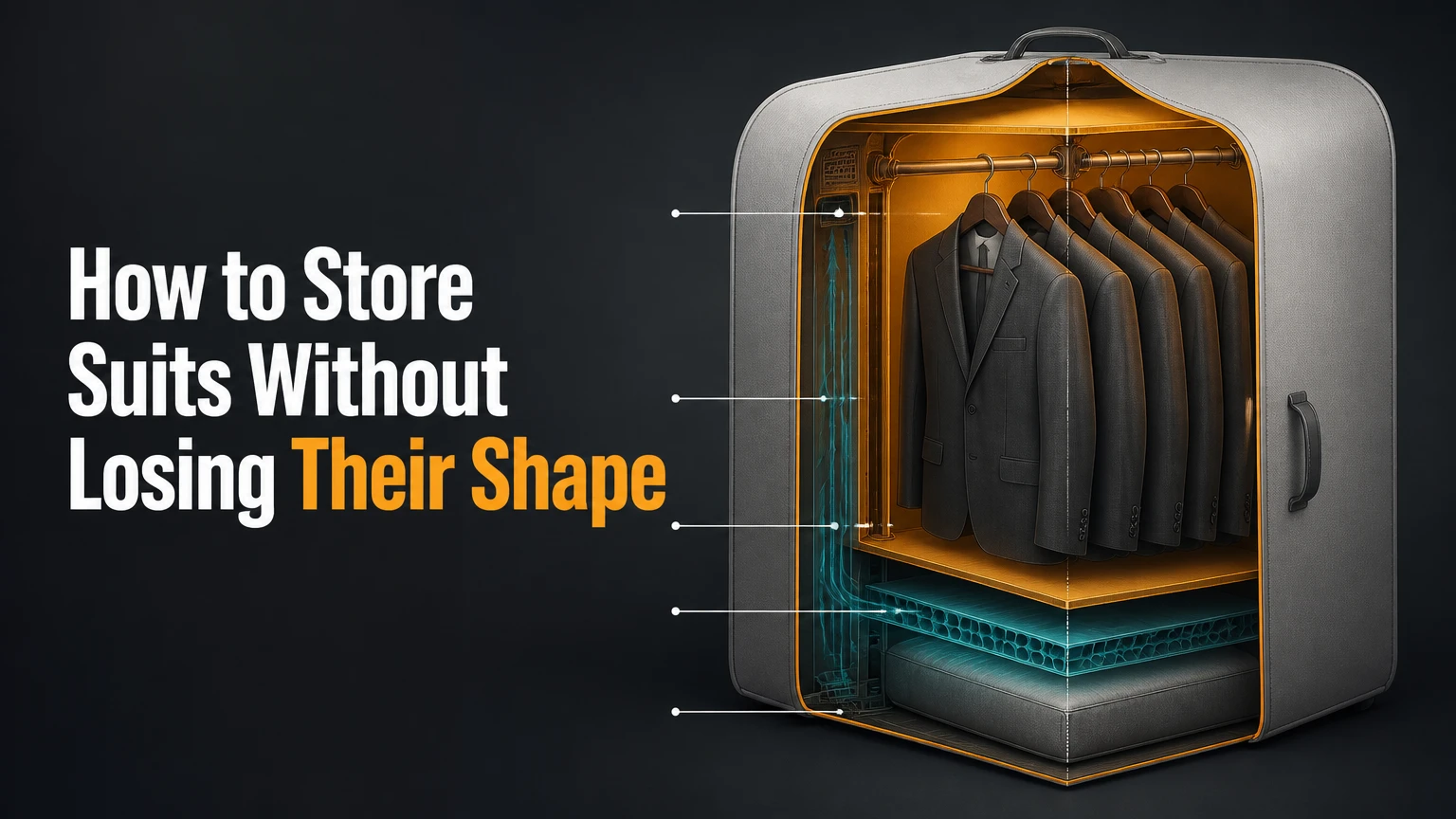
To store suits correctly, clean and dry each garment, place the jacket and trousers on a broad contoured hanger, cover them with a breathable garment bag, and keep them in a dark, dry, uncrowded closet. A suitable environment is typically 15-21°C and 40-50% relative humidity, with at least 2.5 cm between hanging garments.
Key Facts at a Glance
- A suit should be stored clean, completely dry, and free of food, sweat, and body oils.
- A jacket needs a broad contoured hanger that supports the shoulder line without forcing it outward.
- Cotton or canvas garment bags protect suits from dust while allowing moisture to escape.
- Plastic dry-cleaner bags are for temporary transport, not seasonal or long-term storage.
- A closet should remain dark, ventilated, and uncrowded, with approximately 2.5 cm of clearance between garments.
- A hygrometer is more reliable than touch for checking whether a storage space is too humid.
Before You Start
Suit storage takes approximately 15-30 minutes of active preparation, plus 12-24 hours of airing after wear. The difficulty is low, but storage quality depends heavily on removing moisture and using a hanger that supports the jacket’s shoulders.
| Item | Typical quantity | Typical cost | Purpose |
|---|---|---|---|
| Contoured wooden hanger | 1 per jacket | $15-$60 | Supports shoulders and chest |
| Trouser hanger or hanger bar | 1 per pair | $5-$25 | Preserves the leg crease |
| Horsehair garment brush | 1 | $15-$40 | Removes dust and loose debris |
| Breathable cotton or canvas bag | 1 per suit | $15-$45 | Blocks dust while allowing airflow |
| Digital hygrometer | 1 per closet | $8-$25 | Measures relative humidity |
| Acid-free tissue paper | 2-4 sheets | $5-$15 per pack | Limits crease pressure during folding |
Check the care label before cleaning. A tailored jacket can contain wool, silk, linen, horsehair canvas, fusible interlinings, shoulder pads, and adhesives that react differently to water, heat, and solvents.
How Should You Prepare a Suit for Storage?
Prepare a suit by emptying every pocket, brushing the fabric, airing the garments, inspecting for stains, and cleaning them before storage. The preparation sequence matters because trapped moisture and organic residue create more damage over time than ordinary dust.
Step 1: Empty and Inspect Every Pocket
Remove coins, keys, receipts, business cards, pens, wallets, and phone chargers from the jacket and trousers. Pocket contents add weight to small areas, which can stretch pocket bags, distort the front panels, and create permanent bulges during long storage.
Turn pockets partially inside out and check for crumbs, tissues, lip balm, and loose paper. Inspect cuffs, trouser hems, underarms, collar edges, and the area beneath the lapels because those locations collect skin oils and food particles.
Success checkpoint: Every pocket lies flat and feels empty when lifted.
Common mistake: Leaving a pen or receipt inside a pocket because the suit will be worn again soon. Ink and paper residue become harder to remove after heat, humidity, and time.
Step 2: Brush and Air the Garments
Use a clean natural-bristle garment brush, preferably horsehair, and brush from the shoulders toward the hem with moderate pressure. Brush wool, cashmere, and wool blends after wear because surface grit can abrade fibers and organic residue can attract clothes moths.
Hang the jacket and trousers separately in a ventilated room for 12-24 hours. Keep them away from radiators, steamy bathrooms, cooking vapors, and direct window sunlight. The fabric should feel dry and lose body odor before it enters a bag or closet.
Success checkpoint: The suit has no damp feel, visible surface debris, or strong wear odor.
Common mistake: Putting a worn suit straight into a closed garment bag. The bag slows evaporation and can hold perspiration against the lining.
Step 3: Clean Stains Before Storage
Treat a fresh liquid spill by blotting with a clean, absorbent cloth rather than rubbing. Do not apply water, detergent, stain remover, or alcohol unless the care label and fabric allow it, because rings, color loss, and adhesive damage can result.
Take a suit with oil, wine, food, perspiration, ink, mildew, or an unidentified stain to a cleaner experienced with tailored garments. Tell the cleaner what caused the mark and when it occurred. Professional dry cleaning should be occasional rather than automatic after every wear; many wool suits need airing and brushing between cleanings, while the care label remains the controlling instruction.
Success checkpoint: No visible stain, food residue, or unexplained odor remains before storage.
Common mistake: Storing a stained suit because the mark looks minor. Aged oils oxidize and become more difficult to remove without aggressive treatment.
Which Hanger Is Best for a Suit?
A broad, contoured wooden hanger is the best general choice for a tailored jacket because it supports the shoulder line, chest, and collar. The hanger should approximate the jacket’s shoulder width without extending sharply beyond the shoulder seam or forcing the sleeve head outward.
A hanger that is too narrow allows the shoulder to collapse toward the neck. A hanger that is too wide pushes the sleeve cap outward and can create stress marks at the armhole. Measure from shoulder seam to shoulder seam across the back, then choose the closest compatible hanger size.
| Hanger type | Typical shoulder width | Suit effect | Best use |
|---|---|---|---|
| Contoured wooden | 5.0-6.5 cm shoulder profile | Supports padding and jacket shape | Daily and seasonal storage |
| Thick molded plastic | 3.5-5.0 cm profile | Acceptable support when strongly contoured | Budget wardrobes |
| Thin plastic | 1.0-2.5 cm profile | Creates shoulder collapse and creases | Avoid for tailored jackets |
| Wire hanger | Under 1.0 cm profile | Produces sharp shoulder deformation | Avoid for suits |
| Padded hanger | 3.0-5.0 cm profile | Soft support, but may compress structure | Lightweight jackets and travel |
Use the hanger’s trouser bar or a separate clamp hanger for trousers. If using clamps, place them on the waistband’s inside seam or use tissue between the clamp and fabric to prevent impressions.
Practitioner rule: The jacket hanger should support the garment at the shoulders, not merely suspend it from the neck. If the shoulder seam falls beyond the hanger edge, the hanger is too small.
Should You Use a Garment Bag?
Use a breathable cotton, canvas, or quality non-woven garment bag for seasonal storage, dusty closets, and valuable suits. Leave the suit uncovered or use a short breathable cover for garments worn every few days, because frequent removal from a full-length bag can create unnecessary handling and compression.
A plastic dry-cleaner bag is suitable only for short transport. Remove it when you return home, allow the suit to air, and replace it with breathable protection if dust control is necessary.
| Cover option | Air exchange | Dust protection | Recommended duration | Main limitation |
|---|---|---|---|---|
| Cotton garment bag | High | High | 1-12 months | Costs $15-$45 |
| Canvas garment bag | High | Very high | 1-24 months | Uses more closet space |
| Non-woven polypropylene | Moderate to high | High | 1-12 months | Quality varies by construction |
| Plastic dry-cleaner bag | Very low | High | Under 48 hours | Traps moisture and odors |
| No cover | Maximum | Low | Daily rotation | Exposes fabric to dust and light |
Choose a bag long enough to keep the trouser hems from touching the closet floor. Avoid airtight garment containers unless a textile conservator specifies them for a controlled archival system.
What Temperature and Humidity Should a Suit Closet Have?
Keep a suit storage area cool, stable, and moderately dry, with a typical target of 15-21°C and 40-50% relative humidity. Stability matters because repeated swings encourage condensation, stress natural fibers, and create conditions favorable to mold.
Place a digital hygrometer at the closet’s center rather than directly beside a vent or dehumidifier. If humidity remains above 60%, improve ventilation or use a room dehumidifier; if the closet is below roughly 30% for long periods, monitor brittle linings and dry natural fibers.
| Storage condition | Typical reading | Risk | Corrective action |
|---|---|---|---|
| Cool and controlled | 15-21°C, 40-50% RH | Low environmental risk | Maintain conditions |
| Warm and humid | 22-28°C, 60-75% RH | Mold, odor, moth activity | Dehumidify and ventilate |
| Basement closet | 15-22°C, 65-80% RH | Dampness and mildew | Relocate or control humidity |
| Sunny wardrobe | 18-25°C, 35-55% RH | UV fading and heat exposure | Move away from windows |
| Unheated loft | 5-35°C seasonal swing | Condensation and fiber stress | Use a stable interior room |
Do not store suits against a cold exterior wall, beside plumbing, under a roof leak, or directly above a damp floor. Clothing moths and mold are environmental problems, so cedar alone cannot compensate for soiled fabric or excessive humidity.
How Much Space Should Hang Between Suits?
Leave approximately 2.5 cm of usable air space between hanging garment bags and more space when the closet is deep or poorly ventilated. Packed garments rub against one another, crush lapels, flatten chest canvas, and retain humidity after wear.
Arrange suits by rotation rather than pushing every garment to one side. Keep heavier wool jackets away from delicate silk blends, and avoid stacking bags tightly on a single rod. A wooden rod rated for the load is safer than a thin wire closet rod when storing several heavy suits.
Inspect the closet monthly. Look for compressed shoulders, creased lapels, damp smells, droppings, webbing, larvae cases, and fading near the opening.
How Do You Store a Suit Long Term?
For long-term suit storage, clean and air the suit, hang the jacket on a correctly sized contoured hanger, align the trousers with their original crease, cover both pieces with a breathable bag, and place them in a dark, stable closet. Recheck the garments every one to three months.
Button the jacket’s middle button loosely if doing so keeps the front aligned, but do not force buttons through stretched buttonholes. Fold trousers along the pressed crease, hang them from the waistband or drape them over a wide trouser bar, and keep the jacket and trousers together so the set remains matched.
Fabric-Specific Adjustments
Wool and cashmere benefit from brushing, airing, low light, and protection from moths. Linen wrinkles easily and should hang with generous space; pressing is safer before storage than aggressive folding. Silk requires low light and a smooth, breathable cover because abrasion and dye fading are common risks.
Velvet and corduroy should hang where the pile will not be crushed by neighboring garments. Cotton suits tolerate more handling but can still mildew when stored damp. Synthetic blends resist moth damage better than animal fibers, yet their linings and stains still require careful cleaning.
Can You Fold a Suit Instead of Hanging It?
Fold a suit only when a suitable hanger is unavailable, during travel, or when a small storage space makes hanging impossible. Folding is less protective for long-term storage because repeated pressure can flatten shoulder padding and create sharp creases in the jacket front.
For a temporary folded setup, turn one shoulder inside out, nest the other shoulder into it, fold the jacket lengthwise, and place acid-free tissue inside the chest and between major folds. Keep the folded suit in a breathable box or fabric container, never under heavy objects, and refold it differently after several weeks.
| Storage method | Practical duration | Space requirement | Crease risk | Suitable scenario |
|---|---|---|---|---|
| Hanger and breathable bag | 1-24 months | 45-60 cm vertical depth | Low | Seasonal closet |
| Folded in tissue-lined box | 1-4 weeks | 15-30 cm shelf height | Moderate | Small apartment |
| Suitcase fold | Up to 72 hours | 10-20 cm case depth | High | Travel transit |
| Vacuum bag | Not recommended | 5-10 cm compressed depth | Very high | Avoid for tailored suits |
A folded box is not a substitute for a climate-controlled wardrobe when storing an expensive bespoke jacket for years. Under-bed storage also exposes garments to floor-level dust, temperature swings, and accidental compression.
How Do You Prevent Moths, Mold, and Odors?
Prevent moth damage by storing suits clean, brushing them after wear, inspecting dark closet corners, and reducing humidity. Prevent mold by keeping garments dry and maintaining airflow; perfume, cedar, and scented sachets do not remove moisture or contaminated residue.
Clothes moth larvae are attracted to keratin-containing animal fibers and organic contamination such as perspiration, skin flakes, and food oils. Cedar blocks may discourage some insects while their scent remains strong, but their effect diminishes over time and they should not touch the fabric directly. Avoid naphthalene or paradichlorobenzene mothballs around occupied living spaces unless the product label and ventilation requirements are followed exactly.
Use sealed pest traps outside garment bags to monitor activity, not as a complete treatment. If you find larvae, webbing, or multiple damaged garments, isolate the suit in a clean bag and obtain professional textile or pest-control advice.
What Are the Best Storage Options for Different Situations?
The best storage method depends on access frequency, available closet space, fabric value, and environmental control. A breathable bag on a fitted wooden hanger is the strongest general solution, while folded storage is a compromise for travel or severe space limits.
| User situation | Recommended setup | Typical cost | Inspection interval | Limitation |
|---|---|---|---|---|
| Daily business rotation | Open closet, contoured hanger | $15-$60 per suit | Monthly | More dust and light exposure |
| Seasonal wool suits | Breathable bag, dark closet | $30-$105 per suit | Every 1-3 months | Requires closet volume |
| Small apartment | Tissue-lined breathable box | $20-$60 per suit | Every 2-4 weeks | Higher crease risk |
| Frequent business travel | Folding travel bag, hanger on arrival | $40-$180 | Each trip | Compression during transit |
| Bespoke collection | Fitted hangers, cotton bags, hygrometer | $50-$130 per suit | Monthly | Highest storage cost |
Small Closet Variation
Use slim but strongly contoured hangers, rotate suits by season, and keep no more than one garment bag per hanger position. Store the least-used suits in a separate breathable box only when the closet cannot maintain shoulder clearance.
Humid Climate Variation
Measure humidity for seven consecutive days before choosing a storage location. In a humid coastal home, an interior air-conditioned closet with a dehumidifier is safer than a basement, even if the basement feels cooler.
Self-Storage Variation
Avoid ordinary non-climate-controlled storage units for wool, silk, or bespoke suits. Temperature swings, roof leaks, dust, and pest exposure create risks that a garment bag cannot correct. Use a climate-controlled unit, keep garments off the floor, and inspect them at least monthly.
What Does Suit Storage Cost?
A basic storage setup costs approximately $25-$85 for one suit, while a premium setup with a fitted hanger, cotton bag, brush, and humidity monitor typically costs $55-$130. Professional cleaning commonly costs $15-$35 per suit, but local prices vary by construction, stain complexity, and region.
| Setup level | Components | Typical one-suit cost | Best value for |
|---|---|---|---|
| Basic | Plastic-free hanger, fabric bag | $25-$60 | Occasional suit owner |
| Practical | Wooden hanger, cotton bag, brush | $45-$105 | Business wardrobe |
| Climate-aware | Practical setup plus hygrometer | $55-$130 | Humid or changing home |
| Bespoke care | Fitted hanger, premium bag, cleaning | $70-$165 | Luxury or handmade suit |
The most useful first purchase is usually the correct hanger, followed by a breathable cover. A costly cedar wardrobe cannot rescue a suit stored wet, stained, or compressed against other garments.
Common Mistakes and How to Fix Them
Leaving the Plastic Dry-Cleaner Bag On
Problem: Residual moisture and cleaning vapors remain near the fabric, while plastic prevents normal air exchange.
Fix: Remove the plastic immediately after transport, air the suit for 12-24 hours, and replace it with a breathable bag.
Using a Wire or Narrow Plastic Hanger
Problem: The shoulder line collapses or develops pointed hanger bumps.
Fix: Transfer the jacket to a broad contoured hanger. A tailor can reshape severe distortion with controlled steam and pressing.
Storing the Suit Dirty
Problem: Body oils and food residue can oxidize, discolor cloth, and attract larvae.
Fix: Blot fresh spills, follow the care label, and use a specialist cleaner for persistent or unknown stains.
Overcrowding the Closet
Problem: Compressed garments lose airflow and develop crushed lapels and wrinkles.
Fix: Maintain roughly 2.5 cm between bags and move seasonal pieces elsewhere.
Exposing the Suit to Sunlight
Problem: Ultraviolet exposure fades dyes unevenly, especially near shoulders and sleeve ends.
Fix: Use a dark closet or opaque breathable cover, while avoiding airtight plastic.
Applying Direct Heat
Problem: An iron or hot dryer can glaze wool, shrink natural fibers, or damage fusible components.
Fix: Use a pressing cloth and low heat only when the care label permits it. For valuable tailoring, use a professional presser.
How Do You Fix Odors, Wrinkles, or Shoulder Damage?
Remove a musty suit from the closet, isolate it from clean garments, and determine whether the odor indicates surface contamination or active mildew. Do not seal a damp garment for transport, spray perfume over it, or return it to the same humid closet.
For light wrinkles, hang the suit in a ventilated room and allow gravity to work for 12-24 hours. A garment steamer may relax wool when held several centimeters away, but excessive moisture can disturb fusing, shape, and delicate surfaces. Bathroom steam is less controlled and should not replace professional pressing for expensive tailoring.
For shoulder dimples, stop using the narrow hanger and take the jacket to a tailor or experienced cleaner. Severe puckering may involve the pad, canvas, sleeve head, or adhesive, so steaming one area at home can worsen the shape.
For visible mold, extensive odor, or spreading discoloration, keep the garment away from other textiles and consult a professional cleaner or textile conservator. Direct sunlight may fade cloth and does not reliably replace remediation.
How Often Should You Check Stored Suits?
Check frequently worn suits monthly and seasonal suits every one to three months. A basic inspection should include the collar, underarms, cuffs, trouser hems, pockets, lining, hanger fit, bag condition, and the closet’s humidity reading.
Brush the garment again if dust accumulates, replace cedar when its scent has faded, and rotate the suit’s position if one shoulder remains compressed. Reclean only when the garment is soiled or the care professional recommends it; unnecessary solvent exposure can shorten the life of some fabrics and finishes.
FAQ
Can I Store a Suit in a Suitcase?
Store a suit in a suitcase for travel or a short transition period, not as a permanent wardrobe solution. Fold the jacket using the nested-shoulder method, add acid-free tissue at pressure points, avoid compression, and hang the suit immediately after arrival. Air it for several hours before wearing or covering it.
Should I Button a Suit Jacket During Storage?
Button a jacket loosely only when the front remains naturally aligned and the buttonhole is not stretched. Do not fasten every button tightly, because tension can pull the front edge and distort the lapels. The hanger should provide the primary support.
Can I Use Cedar Instead of a Garment Bag?
Cedar can supplement a breathable garment bag, but it cannot replace cleaning, airflow, or humidity control. Keep cedar blocks or rings from touching the fabric because oils may transfer. Replace or lightly sand them according to the product instructions when the scent becomes faint.
How Long Can a Suit Stay in a Dry-Cleaning Bag?
A suit should remain in a plastic dry-cleaning bag only during short transport, with approximately 48 hours as an upper practical limit. Remove the bag at home, air the garment fully, and use a cotton, canvas, or non-woven cover for storage.
How Should I Store a Three-Piece Suit?
Store the jacket on a contoured hanger, hang the trousers from the waistband or crease bar, and keep the waistcoat on a separate shaped hanger or a smooth hanger with adequate support. Use one breathable bag large enough for the complete set without crushing the vest or trouser legs.
Is a Basement Safe for Suit Storage?
A basement is safe only when its humidity remains controlled, the area is free of leaks, and garments are raised away from the floor. Measure relative humidity with a hygrometer for a week. If readings stay above 60%, choose a drier interior closet or add reliable dehumidification.
The Bottom Line
The correct way to store suits is to clean and dry each garment, brush away debris, use a fitted contoured hanger, protect the suit with a breathable bag, and maintain a dark, uncrowded closet at approximately 15-21°C and 40-50% relative humidity. For how to store suits successfully, prioritize shoulder support and moisture control before buying premium storage accessories.