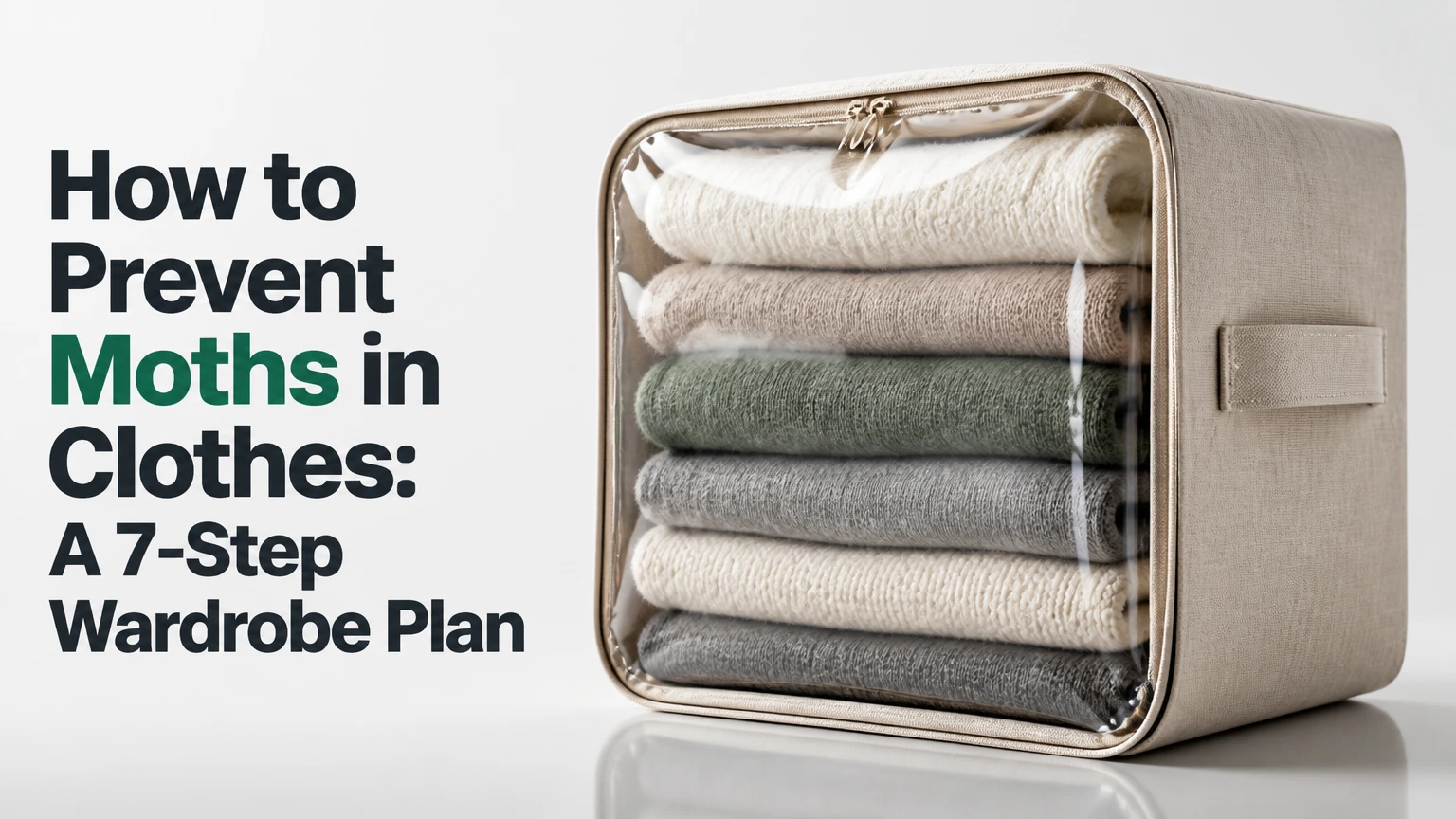
To prevent moths in clothes, clean animal-fiber garments before storage, vacuum every closet harborage, seal textiles in moth-resistant containers, and monitor with species-specific pheromone traps. The decisive factor is removing larvae and eggs, not chasing adult moths, because clothes moth larvae create the holes while adults generally do not feed on fabric.
Key facts at a glance
- Webbing clothes moth larvae feed mainly on keratin-rich wool, cashmere, fur, feathers, and other animal fibers.
- A clean garment is less attractive than a soiled garment carrying sweat, skin cells, hair, or food residue.
- Freezing infested textiles at 0°F (-18°C) or colder for seven days is a more conservative home-treatment interval than 72 hours.
- Pheromone traps capture adult male clothes moths and help detect activity, but they do not remove larvae or eggs.
- Cedar and lavender may repel moths temporarily, but scent alone cannot protect an accessible cashmere sweater indefinitely.
- Mothballs work only inside an airtight container and are pesticides, not casual closet deodorizers.
Which Moths Damage Clothing?
Webbing clothes moths, Tineola bisselliella, and casemaking clothes moths, Tinea pellionella, are the main fabric-damaging species in homes. Adults are usually 5-8 millimeters long and pale gold or brown, while larvae are cream-colored caterpillars that remain hidden in dark, undisturbed textiles.
Clothes moth larvae prefer keratin, a protein in wool, cashmere, fur, feathers, and animal hair. Silk can also be damaged, especially when soiled, although clothes moth feeding preferences vary with the textile and available nutrients. Synthetic polyester and nylon are not typical food sources, but blends containing wool or clothing contaminated with organic residue can still attract larvae.
The University of California Statewide Integrated Pest Management Program summarizes the central distinction plainly: “Clothes moth larvae damage fabrics.” Adult clothes moths have reduced, nonfunctional mouthparts, so an adult flying from a wardrobe is evidence of a possible breeding population rather than the direct cause of a hole.
What attracts clothes moth larvae?
Sweat, body oils, hair, skin scales, food spills, and pet hair increase the nutritional value of a garment. The University of Kentucky Entomology program identifies soiled textiles as especially vulnerable because residue supplies nutrients that clean fibers lack.
A garment worn once can carry enough residue to justify cleaning or airing before long-term storage. The risk is highest when a stained wool item remains compressed in a dark drawer for several months.
How Does a Clothes Moth Infestation Start?
A clothes moth infestation starts when an adult female finds a dark, stable food source and lays eggs near suitable fibers. The complete life cycle can take from roughly one month to more than a year, depending on temperature, humidity, food quality, and species.
Larvae cause the visible damage. They may remain inside folded garments, beneath collars, under furniture, along carpet edges, or inside lint deposits, where routine hanging inspections will not find them.
Clothes moths favor still air and low-disturbance areas. A frequently opened wardrobe is less favorable than a sealed storage trunk, an unused guest-room closet, or a wool rug hidden beneath furniture.
Clothes moths versus carpet beetles
Carpet beetle larvae cause many holes blamed on moths. Carpet beetle larvae are often hairy and may leave shed skins, whereas clothes moth larvae produce silk webbing, tunnels, cases, or granular frass near feeding sites.
| Sign | Clothes moth | Carpet beetle | Mechanical damage |
|---|---|---|---|
| Adult appearance | Pale gold, 5-8 mm | Small patterned beetle, 2-5 mm | No insect present |
| Larval evidence | Silk webbing, cases, frass | Hairy larva, shed skins | Abrasion or pulled threads |
| Common location | Dark closets, wool folds | Window edges, vents, lint | Cuffs, seams, furniture contact |
| Main food source | Wool, fur, feathers | Wool, fur, feathers, lint | Zippers, rough surfaces, washing |
| Best confirmation | Species-specific pheromone trap | Inspection or pest professional | Textile repair inspection |
Correct identification matters because a clothes moth trap will not solve a carpet beetle infestation. Inspect the surrounding room before buying multiple products.
How to Prevent Moths in Clothes
A reliable prevention routine has seven actions: clean garments, inspect vulnerable textiles, vacuum the storage environment, treat questionable items, seal seasonal clothing, monitor activity, and repeat inspections on a schedule. Prevention works best when physical exclusion and cleanliness carry the load, while repellents and traps provide secondary protection.
Before you start
| Requirement | Typical amount or range | Practical specification |
|---|---|---|
| Time | 2-4 hours initially | Add treatment time for washing, freezing, or cleaning |
| Cost | $20-$120 | Depends on bins, traps, and professional services |
| Tools | 4-6 items | Vacuum, crevice tool, labels, sealed bags, flashlight |
| Storage | 1 bin per 15-25 folded garments | Use gasketed polypropylene or polyethylene containers |
| Monitoring | 1 trap per closet zone | Follow the manufacturer’s coverage instructions |
| Difficulty | Moderate | Higher for rugs, upholstery, and heirloom textiles |
Step 1: Remove and sort every textile
Empty the closet, drawers, trunk, and nearby shelves completely. Sort garments into clean, washable, dry-clean-only, freezer-safe, damaged, and non-textile items.
Inspect wool coats, cashmere, silk, fur trim, feather products, felt hats, wool blankets, rugs, and natural-bristle brushes. Use a bright flashlight along seams, pocket edges, hems, collars, and folds because larvae and webbing can be almost invisible.
You will know the step worked when: every animal-fiber item has a treatment or storage decision.
Common mistake: inspecting only the garment with the largest hole. A hidden blanket, rug, or felt item can preserve the infestation.
Step 2: Clean the closet and surrounding room
Vacuum shelf joints, drawer runners, baseboards, carpet edges, floor cracks, vents, and the underside of heavy furniture. Move wardrobes and sofas far enough to reach lint and hair accumulation behind them.
Empty the vacuum outside immediately, preferably into a sealed bag. Wiping hard surfaces with detergent removes residue and debris, but white vinegar is not a validated clothes moth insecticide and should not replace vacuuming or textile treatment.
The British Pest Control Association recommends environmental cleaning because larvae can live outside clothing, including in carpets and accumulated lint. Steam may help on compatible surfaces, but excessive heat or moisture can damage wood, adhesives, finishes, and upholstery.
You will know the step worked when: no lint, hair, webbing, or frass remains along edges and recesses.
Common mistake: cleaning shelves while leaving a wool rug, piano felt, or pet bed untreated.
Step 3: Launder or dry-clean vulnerable garments
Wash washable items according to the care label, using the warmest safe cycle, then dry them completely. A 140°F wash may kill susceptible life stages, but not every textile, machine, or cycle reaches that temperature for a validated exposure period, so do not force high heat onto wool, silk, or garments labeled cold wash.
Professional dry cleaning is appropriate for tailored wool, cashmere, structured garments, and valuable textiles. Dry cleaning substantially reduces infestation risk, but “instant” destruction of every egg and life stage should not be assumed without confirmation from the cleaner’s treatment protocol.
| Textile situation | Preferred treatment | Typical timing | Important limitation |
|---|---|---|---|
| Cotton or durable washable blend | Care-label wash and full drying | 1 cycle, 1-3 hours | Heat must suit the fiber |
| Wool sweater | Professional cleaning or approved freezing | 1-3 days service, or 7 days frozen | Avoid hot water and agitation |
| Silk garment | Professional cleaning | 1-3 days typical | Heat can shrink or distort silk |
| Fur or feather item | Specialist cleaner | 1-2 weeks typical | Home washing can cause irreversible damage |
| Wool rug | Professional rug treatment | 1-3 weeks typical | Treat the room and underside too |
You will know the step worked when: each stored garment is clean, fully dry, and free of fresh webbing or frass.
Common mistake: returning a worn sweater to the closet because it “smells clean.” Body oils may remain after brief wear.
Step 4: Freeze items that cannot be washed
Freezing is useful for small, dry, moisture-tolerant items such as wool accessories, yarn, and some blankets. Seal the item in a clean polyethylene bag, remove excess air without crushing it, and place it in a freezer maintained at 0°F (-18°C) or colder for seven consecutive days.
The 72-hour interval often repeated online is not a universal guarantee because the item’s center may cool slowly and eggs can tolerate unfavorable conditions. A seven-day interval provides a more conservative household procedure. After removal, allow the sealed bag to reach room temperature before opening, which prevents condensation from settling on the textile.
Do not freeze damp garments, leather without specialist guidance, glued items, delicate antiques, or anything whose manufacturer prohibits freezing.
You will know the step worked when: the entire item has remained sealed through the full seven-day period and shows no live larvae after inspection.
Common mistake: opening the bag immediately after removal. Condensation can create a new mold problem.
Step 5: Store clean clothing in sealed containers
Use rigid plastic bins with intact gaskets for seasonal clothing, especially wool and cashmere. Heavy vacuum bags can work for soft goods when the seal remains airtight, but compression may crease structured garments and can stress delicate fibers.
Fold garments loosely enough to avoid permanent creases, place a clean label on each container, and keep bins off damp floors. Airtight storage prevents adult moths from reaching the textile, but only after the garment is clean and free of larvae.
| Storage method | Entry resistance | Typical cost | Best use | Main weakness |
|---|---|---|---|---|
| Gasketed plastic bin | High | $12-$35 each | Sweaters, blankets, seasonal clothes | Requires shelf or floor space |
| Vacuum storage bag | High when intact | $5-$15 each | Soft coats, bedding, yarn | Seal failure and compression |
| Zippered garment bag | Medium | $8-$30 each | Suits and dresses in active use | Zippers and seams are not fully airtight |
| Canvas or fabric box | Low | $10-$40 each | Short-term dust control | Larvae can enter through the weave |
| Open hanger storage | None | $0-$10 | Frequently worn clothing | Does not block moth access |
You will know the step worked when: the container closes continuously around its gasket and no textile remains exposed.
Common mistake: placing cedar blocks inside an unsealed fabric box and treating that as moth-proof storage.
Step 6: Install and read pheromone traps
Place clothes moth pheromone traps inside the wardrobe or room, away from strong airflow and out of children’s reach. Follow the product label for coverage and replacement, which is commonly every 8-12 weeks.
Pheromone traps primarily capture adult males. A catch confirms activity, but an empty trap does not prove the absence of females, larvae, eggs, or the wrong moth species. Record the date, trap location, and count so a rising catch becomes visible over time.
You will know the step worked when: the trap is positioned according to its label and inspection dates are recorded monthly.
Common mistake: using pantry-moth traps for clothes moths. The pheromone is species-specific.
Step 7: Repeat inspections on a fixed schedule
Inspect stored animal-fiber garments every 1-3 months, with monthly checks during warm periods or after finding a moth. Examine hems, seams, folds, and the floor beneath the storage area.
Re-vacuum closet edges monthly during an active problem, then reduce to every 2-3 months after two consecutive clean inspections. Keep a simple log of trap catches, treated items, cleaning dates, and newly discovered damage.
The most effective practitioner rule is simple: prevention fails when the wardrobe is cleaned once but the room is never revisited.
Which Prevention Products Actually Work?
Sealed containers and textile cleaning provide the strongest prevention because they remove food residue or block access. Pheromone traps provide detection, while cedar and lavender offer limited, temporary repellency rather than dependable eradication.
| Product or method | Primary function | Typical duration | Suitable for children or pets |
|---|---|---|---|
| Gasketed storage bin | Physical exclusion | Until seal failure | Yes, when used as directed |
| Clothes moth pheromone trap | Male monitoring | 8-12 weeks | Usually, if inaccessible |
| Cedar block or sachet | Limited odor-based deterrence | 1-3 months of noticeable scent | Keep oils away from pets |
| Lavender sachet | Limited deterrence | 1-3 months | Not an insecticide |
| Mothball containing naphthalene or paradichlorobenzene | Toxic fumigation | Until product sublimates | No open-room use |
| Professional pest treatment | Population reduction | Depends on follow-up | Follow re-entry instructions |
Do cedar and lavender prevent clothes moths?
Cedar and lavender may reduce moth activity while their volatile scent remains strong, but household sachets do not reliably kill larvae or protect a garment that is already infested. Cedar should be treated as a supplementary deterrent inside clean, sealed storage, not as a substitute for cleaning and inspection.
Cedar effectiveness declines as the surface dries and the odor fades. Light sanding can expose fresh wood on some products, but adding essential oil may stain textiles and create respiratory or skin risks, especially for cats and other sensitive animals.
The honest limitation is important: a strongly scented closet can still contain active larvae. Fragrance is not a treatment endpoint.
Are mothballs safe in a closet?
Mothballs are pesticides that release toxic vapor, and they should be used only exactly as the product label permits. The US Environmental Protection Agency states that mothballs are intended for airtight containers, not open closets, because vapor escaping into a room can expose people and pets.
Mothballs do not work effectively in an open wardrobe because the concentration cannot remain high enough for reliable fumigation. Never place them beside loose clothing, in bedrooms, near food, or where children or animals can touch them. Air out treated garments according to the label before use.
What Does Clothes Moth Prevention Cost?
Basic prevention typically costs $20-$60 for traps, cleaning supplies, and a few storage bags. A larger wardrobe may cost $80-$250 for multiple gasketed bins, while professional treatment for valuable garments, rugs, or an established infestation commonly ranges from $100 to several hundred dollars depending on location and textile volume.
| Prevention task | Typical price range | Typical time | Cost-saving choice |
|---|---|---|---|
| DIY closet vacuuming | $0-$15 | 30-90 minutes | Use an existing crevice tool |
| Four pheromone traps | $12-$30 | 10 minutes setup | Buy only clothes-moth-specific traps |
| One gasketed bin | $12-$35 | 5 minutes | Match bin size to seasonal use |
| Professional garment cleaning | $8-$40 per item | 1-3 days | Prioritize natural-fiber items |
| Specialist rug treatment | $100-$500+ | 1-3 weeks | Obtain an inspection first |
| Pest-control inspection | $75-$200 typical | 30-90 minutes | Request species identification |
Prices vary by region, garment size, and service level. Spending on storage before identifying the source can waste money if the infestation is actually carpet beetles.
Why Are New Holes Appearing After Cleaning?
New holes after cleaning usually indicate an untreated harborage, surviving eggs or larvae, reinfestation from a rug or upholstered item, or a different cause of textile damage. Reinspect wool carpets under furniture, felt piano components, feather-filled furnishings, pet bedding, closet cracks, and the underside of drawers.
Compare the timing carefully. A hole discovered after treatment may be old damage that became visible during laundering; it does not prove that larvae survived. Look for fresh silk webbing, frass, shed skins, or live larvae rather than relying on hole count alone.
Call a licensed pest professional when moth catches continue for 6-8 weeks, multiple rooms show damage, a large rug is involved, or valuable fur and antique textiles are at risk. Ask for identification, treatment scope, follow-up visits, and instructions for handling treated items.
Common prevention failures
- Treating adult moths instead of the environment: Vacuum and process textiles because larvae create the damage.
- Using vinegar as an insecticide: Vinegar cleans some surfaces but does not provide dependable egg or larval control.
- Freezing for only a few hours: The center of a folded item may not remain cold long enough.
- Storing damp clothing: Moisture can produce mildew inside sealed containers.
- Leaving the room untreated: Wool rugs, lint, and pet bedding can sustain the life cycle.
- Overcrowding active storage: Tight folds reduce inspection visibility and create protected dark zones.
Which Protocol Fits Your Home?
For renters
Use reversible methods first: vacuum baseboards and closet joints, clean vulnerable garments, install labeled pheromone traps, and store seasonal wool in gasketed bins. Avoid spraying walls or using fumigants unless a licensed professional and the product label authorize the treatment.
For cashmere and luxury wardrobes
Process every item before long-term storage, including garments worn briefly. Use professional cleaning for structured cashmere, silk, fur, and couture pieces, then store each item in a clean sealed bag or gasketed container with room for inspection.
For homes with children or pets
Prioritize cleaning, freezing where appropriate, sealed storage, and inaccessible pheromone traps. Avoid loose mothballs and concentrated essential oils, because “natural” does not mean harmless to cats, dogs, infants, or people with respiratory sensitivities.
For a low-budget wardrobe
Start with vacuuming, washing safe garments, sunlight and inspection where compatible, and a small number of species-specific traps. Buy rigid containers only for high-risk wool, cashmere, blankets, and items that will remain untouched for several months.
FAQ
Can clothes moths live in synthetic clothing?
Clothes moth larvae generally cannot digest clean polyester, nylon, or acrylic as their primary food. Synthetic garments can still shelter larvae when they contain wool or are contaminated with sweat, hair, food, or natural-fiber lint. Clean blended garments should be stored dry and inspected with nearby animal-fiber items.
Does sunlight kill clothes moth eggs?
Direct sunlight and heat may stress exposed larvae and eggs, but sunlight is not a controlled, reliable treatment. Fabric temperature, exposure time, shadowed folds, and local weather vary too widely. Use laundering, professional cleaning, or the seven-day freezer method for a more dependable household process.
How often should I wash wool clothes to prevent moths?
Wash or professionally clean wool clothes after repeated wear, visible soiling, spills, or before seasonal storage. Washing frequency depends on the garment and care label, but every worn item should be clean and completely dry before sealing. Frequent washing that damages wool is counterproductive.
Can clothes moths enter vacuum-sealed bags?
Clothes moths cannot reach clothing while a vacuum bag remains completely sealed and intact. A puncture, open valve, failed zipper, or textile caught in the closure can create an entry route. Check seals whenever containers are moved, and replace bags with leaks or brittle plastic.
Do clothes moths bite people?
Clothes moths do not bite people. Adult clothes moths and their larvae are not human parasites, although shed fibers, dust, pesticides, or mold in an infested storage area can irritate sensitive individuals. Any skin bites attributed to moths usually require investigation for another insect.
The Bottom Line
To prevent moths in clothes, clean every animal-fiber garment before storage, vacuum the room rather than only the wardrobe, treat questionable textiles using care-label washing, professional cleaning, or seven-day freezing at 0°F (-18°C), and seal seasonal items in intact containers. Use pheromone traps for detection, not eradication, and treat cedar, lavender, and mothballs according to their real limitations.