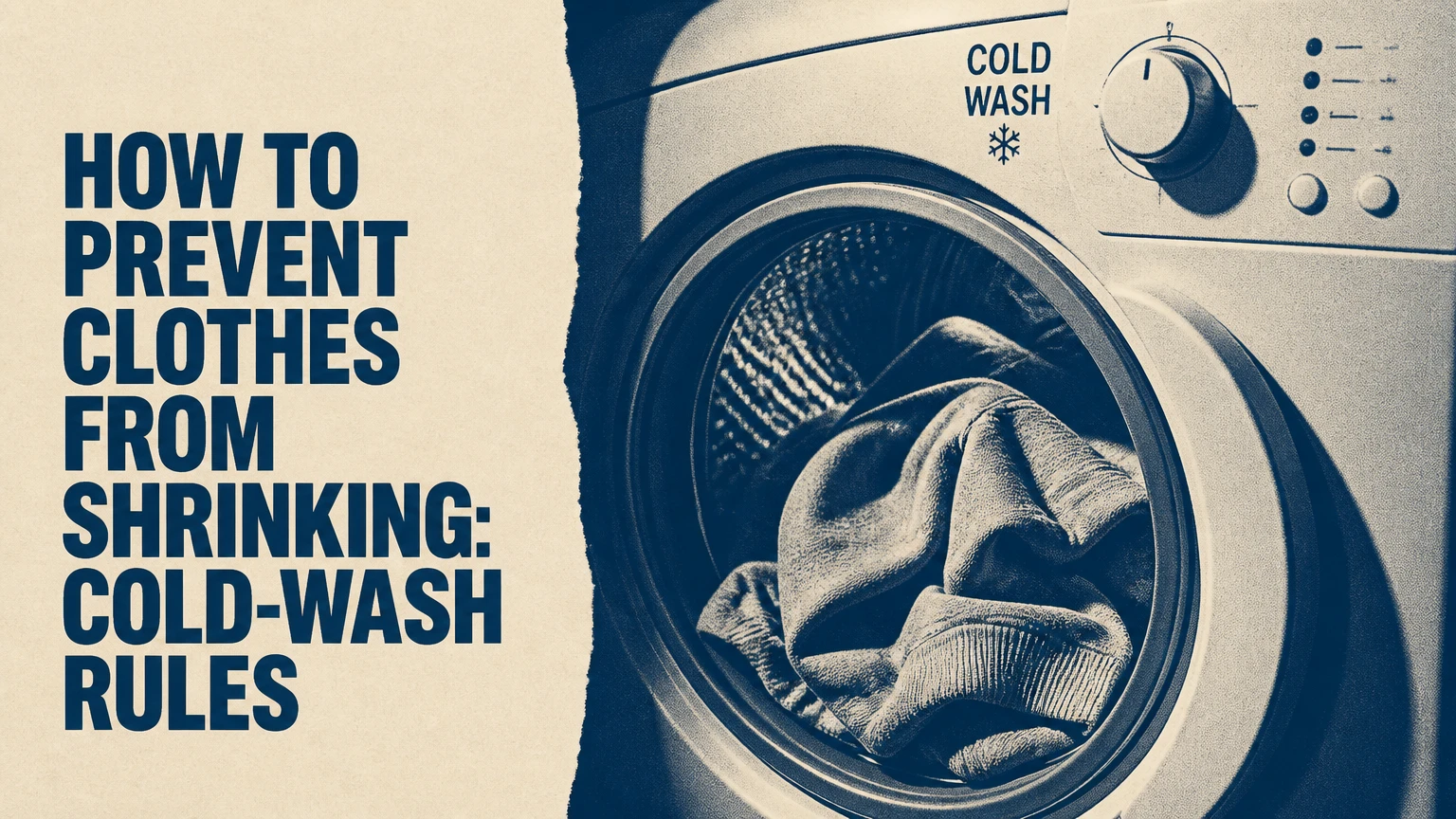
To prevent clothes from shrinking, wash garments at the lowest temperature allowed by the care label, use gentle agitation, avoid overloading, and air-dry or tumble-dry briefly on low heat. The most important control is drying: prolonged high heat can permanently reduce cotton, wool, rayon, and some synthetic garments.
Key facts at a glance
- Water, heat, moisture, and mechanical agitation can all change garment dimensions.
- Cold water lowers shrinkage risk, but it cannot reverse previous heat damage or prevent every first-wash change.
- Wool, cashmere, and other animal-hair fibers require low agitation and flat drying because felting can be permanent.
- A dryer’s low-heat or air-dry setting is safer than high heat, but flat drying remains the lowest-risk option for delicate garments.
- “Pre-shrunk” usually means the manufacturer reduced expected shrinkage, not that the garment is shrink-proof.
- Care labels describe the maximum safe treatment. A gentler method is usually acceptable, but a harsher method can invalidate the garment’s expected dimensions.
What Causes Clothes to Shrink?
Clothes shrink when fibers, yarns, or fabric loops move into a tighter configuration during laundering or drying. Cotton and linen commonly undergo relaxation and consolidation shrinkage, wool can felt through heat and agitation, and rayon or viscose can contract because the regenerated cellulose fibers become unstable when wet.
Shrinkage is not always uniform. A T-shirt may become shorter while retaining much of its width, whereas denim can tighten across the waist and inseam. Knitted garments may lose length because loops compress, while woven shirts may change through both fiber relaxation and seam distortion.
The first wash often produces the largest dimensional change because manufacturing leaves fibers and yarns under tension. Later washes can still cause gradual change when garments encounter repeated heat, friction, detergent stress, or overdrying.
How does shrinkage happen?
Three mechanisms explain most laundry-related shrinkage:
- Relaxation shrinkage: Fibers and yarns return toward a less-stretched state after water and heat release manufacturing tension.
- Felting shrinkage: Scaled animal fibers, especially wool, interlock under moisture, heat, pressure, and agitation.
- Thermal or consolidation shrinkage: Heat causes some polymers or fabric structures to contract, especially when manufacturers have not fully heat-set the material.
A fourth issue, distortion, looks like shrinkage but results from stretching or compression in one direction. Hanging a saturated sweater can lengthen the shoulders and narrow the body, making the garment appear to have changed size even when its total fiber length has not uniformly decreased.
How to Prevent Clothes From Shrinking
The safest routine takes approximately 60-90 minutes for a machine wash followed by air drying, although drying time varies from 2 hours for a thin synthetic top to 24 hours for a dense wool sweater. The procedure requires a washing machine or basin, detergent, a drying rack or suitable hanger, and the garment’s care label.
Before you start
| Requirement | Typical specification | Why it matters |
|---|---|---|
| Water temperature | Cold, approximately 15-30°C | Reduces heat-driven relaxation |
| Detergent | 5-15 mL liquid detergent per small load | Limits residue and excess friction |
| Load size | Drum filled to 2/3 capacity | Leaves room for gentle movement |
| Spin speed | 400-800 rpm for delicates | Reduces compression and distortion |
| Drying equipment | 60 cm or wider rack for knits | Supports the garment evenly |
| Inspection time | 2 minutes per garment | Finds stains and label restrictions first |
Step 1: Sort garments by fabric and weight
Separate wool, cashmere, silk, rayon, cotton, linen, denim, towels, and synthetic sportswear before selecting a cycle. Also separate heavy items from lightweight knits because a wet pair of jeans can create substantially more friction and pulling than a thin T-shirt.
Turn dark printed shirts and knitwear inside out. Close zippers, fasten hooks, empty pockets, and place small delicate items inside a mesh bag. Do not put a cashmere sweater in a mixed load simply because the wash temperature is cold.
You will know sorting worked when: the load contains garments with similar care-label instructions, weight, and color-fastness risk.
Common mistake: sorting only by color. A dark towel and dark wool sweater may share a color but require completely different agitation and drying methods.
Step 2: Read the care label before washing
Use the care label as the garment’s controlling specification. A wash-tub symbol identifies washing, dots indicate temperature, a crossed triangle prohibits bleach, a square with a circle identifies tumble drying, and a crossed square with a circle means do not tumble dry.
“Dry clean” does not automatically mean that water will shrink the garment, but it signals that the manufacturer expects a controlled solvent or professional process. “Hand wash” indicates a lower mechanical load, while “lay flat to dry” warns that hanging may distort the wet fabric.
The U.S. Federal Trade Commission’s Care Labeling Rule requires manufacturers and importers to provide reliable care instructions for garments sold in the United States. The label does not promise zero shrinkage; it identifies a cleaning method that should not damage the garment when followed correctly.
You will know the label was interpreted correctly when: you can identify the maximum temperature, permitted wash method, and permitted drying method before adding water.
Common mistake: treating “cold wash” as permission to use a high-spin cycle and hot dryer. Temperature is only one part of the care process.
Step 3: Wash at the lowest suitable temperature
Select cold water, normally 15-30°C, unless the care label specifies another temperature for hygiene or cleaning performance. Cold water lowers the rate of fiber relaxation and reduces the chance that heat will combine with agitation to tighten the fabric.
Cold water cannot prevent shrinkage that occurs from tumbling, felting, or a garment’s first relaxation cycle. A cotton shirt can still change dimensions in a cold wash if the dryer later runs at high heat.
For heavily soiled washable items, pretreat stains instead of raising the whole wash temperature. Apply a small amount of detergent to the stain, wait 5-10 minutes, then wash according to the label.
You will know the temperature choice worked when: the machine display remains at cold or no higher than the label’s stated maximum.
Common mistake: using warm water because it feels more effective. Modern detergents are formulated to clean many everyday loads at lower temperatures, while heat adds avoidable dimensional risk.
Step 4: Choose gentle agitation and a moderate spin
Use a delicate, wool, hand-wash, or low-agitation cycle for garments vulnerable to shrinkage. A typical delicate cycle runs for 20-45 minutes and uses less mechanical action than a standard cotton cycle.
Select 400-800 rpm for wool, cashmere, rayon, silk, and loosely knitted garments. Cotton T-shirts and denim can usually tolerate 800-1,200 rpm when the label permits machine washing, but lower spin speeds reduce extraction and may lengthen drying.
Do not assume a short cycle is always safer. A short, aggressive cycle can distort a garment more than a longer cycle with gentle movement. The relevant variables are agitation intensity, water temperature, load weight, and spin force.
You will know the setting worked when: the garment leaves the drum damp but not tightly twisted, compressed, or visibly misshapen.
Common mistake: choosing the fastest spin to save drying time. Excessive water extraction can crease or compress delicate structures, especially when the item is packed tightly against other laundry.
Step 5: Use the right detergent in the right amount
Use a mild liquid detergent and measure approximately 5-15 mL for a small load, adjusting for product concentration and water hardness. Too much detergent can leave residue that stiffens fibers and encourages additional rinsing or handling.
Use a wool or cashmere detergent for animal fibers. Many ordinary detergents contain enzymes or higher alkalinity intended for cotton and synthetic stains; those formulas can weaken or roughen protein fibers over repeated washes.
Avoid fabric softener on towels, moisture-wicking sportswear, flame-resistant workwear, and many elastane blends. Softener coats fibers and can reduce absorbency or interfere with the finish that controls stretch and recovery.
You will know the detergent choice worked when: the garment feels clean without a slippery coating, stiff residue, or strong fragrance after rinsing.
Common mistake: adding more detergent to compensate for a full machine. Overloading prevents adequate rinsing and creates more friction, while extra detergent does not solve the underlying load problem.
Step 6: Remove garments promptly and reshape them
Take laundry out of the washer as soon as the cycle ends. Wet fabric remains flexible, so this is the best time to restore shoulder width, sleeve length, hems, collars, and side seams before drying fixes an unwanted shape.
Never wring wool, cashmere, silk, or rayon. Press water out with clean hands, then place the garment on a towel and roll it once to absorb excess moisture. For washable cotton and linen, a gentle shake can release folds without stretching seams.
You will know reshaping worked when: the side seams lie straight, the sleeves match, and the garment’s hem is level before drying.
Common mistake: leaving wet clothes in the drum overnight. The main risk is not only odor. Creases, compression, and uneven stretching become harder to remove once the fabric dries.
Step 7: Dry with no heat or the lowest permitted heat
Lay knitwear, wool, cashmere, rayon, viscose, and heavy stretch garments flat on a clean drying rack. Shape the item to its original measurements rather than pulling only the hem, because localized stretching can create a permanently uneven garment.
Hang lightweight woven shirts on a broad or padded hanger when the label allows. Dry them in shade with good airflow, away from radiators and direct midday sun. Use a dryer only when the label permits it, selecting low heat, delicate, or moisture-sensing operation and removing garments while slightly damp.
You will know drying worked when: the garment reaches room-dry condition without feeling hot, shrinking at the hem, or developing tightened seams.
Common mistake: treating “air dry” as a single method. A sweater hung from a narrow wire hanger can stretch at the shoulders, while a rayon dress may lose its shape under its own wet weight.
Which Fabrics Shrink Most Easily?
Natural cellulose fibers, regenerated cellulose fibers, and animal-hair fibers require the most careful handling, but construction and finishing also determine risk. A tightly woven, pretreated cotton shirt may change less than a loosely knitted cotton sweater, even though both contain cotton.
| Fabric or blend | Typical risk | Wash setting | Drying recommendation |
|---|---|---|---|
| 100% cotton jersey | Medium to high | Cold, gentle, 800-1,000 rpm | Flat or low tumble |
| Cotton-polyester blend | Low to medium | Cold or 30°C, normal cycle | Low tumble, remove damp |
| Linen | Medium to high | Cold, gentle, 600-800 rpm | Line dry in shade |
| Wool or cashmere | Very high if mishandled | Cold, wool cycle, 400-600 rpm | Flat dry, no heat |
| Rayon or viscose | High when wet | Cold, delicate, 400-600 rpm | Flat dry, reshape |
| Silk | Medium | Cold hand wash if labeled | Flat or supported shade dry |
| Polyester or nylon | Low to medium | Cold or label maximum | Low tumble or air dry |
| Elastane blend | Medium | Cold, gentle, no bleach | Air dry, avoid high heat |
| Raw or rigid denim | Medium to high | Cold, inside out | Hang or flat dry |
How should cotton, linen, and denim be washed?
Cotton, linen, and denim should generally be washed in cold water with moderate agitation, then air-dried or dried briefly on low heat. These fabrics can tolerate more mechanical action than wool, but high dryer heat and complete overdrying remain the most common causes of avoidable size loss.
Cotton jersey often contracts in length because knitted loops relax and tighten. Linen can become stiff after air drying, but stiffness is not the same as permanent shrinkage; light steam or pressing usually restores hand feel. Denim may shrink across the inseam and waistband, especially when it is rigid, untreated, or labeled “shrink-to-fit.”
Wash dark denim inside out, use a 600-800 rpm spin when practical, and remove it before it becomes fully dry in a hot drum. A damp garment can be reshaped more easily than a garment that has been baked dry.
Why do wool and cashmere shrink so easily?
Wool and cashmere shrink through felting when moisture, heat, pressure, and agitation cause their microscopic scales to interlock. Felting is different from ordinary relaxation shrinkage because the fibers bind into a denser structure, and severe felting usually cannot be reversed completely.
Wash only when the label permits it. Use cold water, a wool detergent, minimal agitation, and a short spin; avoid rubbing cuffs, twisting the body, or changing the water temperature suddenly. Lay the item flat on a towel or rack, supporting the full body and sleeves.
The Woolmark Company recommends following the garment label because fiber diameter, yarn construction, finishing, and blend composition change the safe method. A fine merino base layer and a chunky cashmere cardigan are not interchangeable, even when both are labeled wool or cashmere.
How should rayon and viscose be handled?
Rayon and viscose should be washed cold on a delicate cycle or by hand when the label permits, then dried flat without twisting. These regenerated cellulose fibers can lose strength while wet, so rough agitation and hanging can cause both shrinkage and permanent distortion.
Support the garment from underneath when transferring it from the washer to the rack. Do not use a narrow hanger while it is saturated, and do not pull sharply on the neckline to restore length.
A rayon blouse that has become shorter may recover some length while damp, but heat-set distortion or severe wet stretching may remain. Professional cleaning is safer when the label says dry clean only.
Does Cold Water Stop Clothes From Shrinking?
Cold water reduces shrinkage risk, but cold water alone does not guarantee stable garment dimensions. Drying temperature, tumble duration, agitation, spin speed, fiber type, garment construction, and previous finishing determine whether a cold-washed item changes size.
A cold wash is most effective when paired with low agitation and controlled drying. For example, cold water followed by a high-heat, 90-minute dryer cycle can still shrink cotton, damage elastane, or felt wool. Conversely, a warm wash followed by flat drying may cause less change in a robust, stabilized cotton garment, though the warm setting still carries more risk.
Water temperature is therefore a risk-control setting, not a complete prevention strategy.
Which Drying Method Has the Lowest Shrinkage Risk?
Flat air drying has the lowest shrinkage and distortion risk for wool, cashmere, rayon, viscose, silk, and heavy knits. Low-heat tumble drying is a practical second choice for permitted garments, while high-heat tumble drying creates the greatest avoidable risk.
| Drying method | Typical temperature | Typical duration | Best use | Main risk |
|---|---|---|---|---|
| Flat air drying | 18-25°C room air | 4-24 hours | Wool, rayon, cashmere | Slow drying, limited space |
| Line drying in shade | 18-30°C air | 2-12 hours | Linen, cotton, woven shirts | Wet-weight stretching |
| Low tumble | 40-55°C drum air | 30-60 minutes | Cotton blends, synthetics | Overdrying if ignored |
| Air fluff, no heat | Approximately 20-30°C | 20-40 minutes | Removing lint and soft creases | Mechanical friction |
| High tumble | 55-75°C drum air | 30-90 minutes | Only label-approved sturdy items | Shrinkage, heat damage |
| Radiator or heater drying | Surface temperatures above 50°C | 1-8 hours | Not recommended | Uneven heat and hardening |
The phrase “air dry” does not mean zero risk. Direct sunlight can fade dyes, strong wind can stretch lightweight fabrics, and a crowded rack slows evaporation enough to create odor. Airflow around the whole garment matters.
Does Pre-Shrunk Mean Shrink-Proof?
Pre-shrunk means the manufacturer has treated or stabilized the textile to reduce expected shrinkage before sale; it does not mean the garment cannot become smaller. Residual change varies by fiber, construction, finishing process, and laundering conditions, so a pre-shrunk cotton garment still needs label-compliant washing and drying.
A practical rule is to assume that pre-shrunk cotton may still change by approximately 1-3% under harsh care, while untreated or shrink-to-fit cotton can change more. The exact percentage is not universal and should not replace the manufacturer’s instructions.
Check the garment’s finished measurements when buying premium clothing. For a 70 cm shirt length, a 3% reduction equals approximately 2.1 cm, which is noticeable even though the garment has not lost a full size.
What Are the Most Common Shrinkage Mistakes?
Most preventable shrinkage comes from heat exposure after washing, not from cold-water washing itself. The following mistakes also create distortion that consumers often misidentify as shrinkage.
- Using the dryer until garments are bone dry: Remove permitted items while slightly damp and finish them on a rack.
- Overloading the drum: Keep the load near two-thirds full so clothes can move without dense compression.
- Mixing heavy and delicate items: Wash towels, jeans, and sweaters in separate loads.
- Hanging saturated knitwear: Lay wet wool, cashmere, and rayon flat to prevent shoulder and hem distortion.
- Ignoring the care label after buying a “washable” garment: “Machine washable” does not specify that every cycle or dryer temperature is safe.
- Changing water temperature abruptly for wool: Avoid moving wool from hot wash water to cold rinse water or the reverse.
- Using high heat on elastane: Spandex and elastane can lose recovery when repeatedly exposed to high dryer temperatures.
- Assuming a stiff fabric has shrunk: Air-dried linen and cotton can feel rigid while retaining nearly the same dimensions.
Expert laundry rules of thumb
- Control the dryer before the washer. A cold wash paired with an overheated, extended dryer often causes more change than a label-permitted warm wash followed by careful air drying.
- Measure the garment before its first wash. Record chest width, body length, sleeve length, and inseam; measurements identify whether the problem is uniform shrinkage or localized distortion.
- Treat wet handling as part of washing. A garment can leave the machine at the correct dimensions and become misshapen during carrying, wringing, or hanging.
What Routine Works for Busy Households?
Busy households can reduce shrinkage with a repeatable three-load system: cold everyday clothing, cold delicate clothing, and label-specific specialty items. Set a phone reminder or use a dryer moisture sensor so permitted garments do not remain in a hot drum after drying is complete.
For routine clothing, use cold water, a normal or gentle cycle, moderate spin, and low tumble or rack drying. Wash wool, cashmere, silk, rayon, and structured garments separately because the time spent reading labels and reshaping them prevents expensive replacement.
A typical household cost is lowest when a foldable drying rack replaces frequent dryer use. A basic rack commonly costs approximately $15-$40, while mesh laundry bags often cost $5-$15 per pack; professional cleaning typically costs about $5-$20 per garment, depending on region and construction.
| Care option | Typical time | Typical household cost | Shrinkage control | Suitable garments |
|---|---|---|---|---|
| Cold machine wash plus rack | 60-90 minutes active cycle, 2-24 hours drying | $0.20-$1.00 per load | Very high | Cotton, linen, blends, knits |
| Cold wash plus low tumble | 60-120 minutes total | $0.50-$2.00 per load | Moderate to high | Label-approved cotton and synthetics |
| Basin hand wash plus flat dry | 15-30 minutes active, 4-24 hours drying | $0.10-$0.75 per item | Very high | Wool, cashmere, silk |
| Professional dry cleaning | 1-3 days typical turnaround | $5-$20 per garment | High when correctly processed | Dry-clean-only tailoring and silk |
| High-heat standard laundry | 60-150 minutes | $0.50-$2.50 per load | Low | Only sturdy, label-approved items |
Can a Shrunken Garment Be Restored?
A mildly shrunken cotton, wool, or rayon garment may recover some dimensions through lukewarm soaking, careful reshaping, and flat drying, but restoration is not guaranteed. Felting, melted or heat-set synthetic damage, severe seam distortion, and repeated overdrying usually cannot be fully reversed.
Try recovery only after checking the fiber content and care label. Do not use a conditioner soak on a dry-clean-only garment, embellished item, tailored jacket, or fabric with unstable dyes.
A cautious relaxation method
- Fill a basin with lukewarm water, approximately 25-30°C.
- Add about 5 mL of wool wash for wool or a small amount of mild detergent for washable cotton and rayon.
- Soak the garment for 20-30 minutes without rubbing.
- Press out water without wringing or twisting.
- Roll the garment in a clean towel for 1-2 minutes.
- Lay it flat and compare it with prewash measurements or a similar garment.
- Ease the length and width outward in small increments, working across the whole garment.
- Pin or weight the edges on a towel and leave it flat until completely dry.
Hair conditioner or baby shampoo is sometimes used to soften fibers during a recovery soak, but the method is not a guaranteed textile repair and can leave residue. Rinse only if the product instructions or fabric label requires it, because repeated handling while wet can create further distortion.
What Should You Do If Shrinkage Already Happened?
Stop applying heat and measure the garment before attempting any repair. Record body length, chest width, sleeve length, waistband, and inseam, then compare the measurements with the original size or a known equivalent item.
If all measurements decreased slightly, relaxation recovery may help. If only the sleeves, shoulders, or hem changed, the garment may be distorted rather than uniformly shrunken. If wool has become dense, stiff, and noticeably smaller, felting has probably occurred and a professional cleaner may offer limited reshaping but cannot promise the original dimensions.
Synthetic thermal damage requires a different expectation. Polyester, nylon, and elastane can sometimes recover from temporary creasing, but heat-induced deformation or loss of stretch generally cannot be removed with soaking.
How Can You Prevent Shrinkage While Traveling?
Travelers should pack a small bottle of measured detergent, one mesh bag, and a lightweight flat-drying solution such as a clean towel. Wash sink-safe garments in cool water, press them inside the towel, and dry them flat or over a broad support in an air-conditioned room.
Avoid hotel radiators, hair dryers held close to fabric, and high-heat communal dryers. If a dryer is unavoidable, use the lowest permitted heat for 10-20 minutes, inspect the garment, and repeat only while it remains slightly damp.
Travel laundry creates higher risk because garments are often washed quickly, wrung by hand, and dried under uneven heat. Gentle pressure removes water more safely than twisting.
Frequently Asked Questions
Can washing clothes inside out prevent shrinkage?
Turning clothes inside out protects prints, dyes, and surface finishes, but it does not prevent fiber shrinkage by itself. Shrinkage depends mainly on temperature, agitation, drying heat, fiber type, and construction. Inside-out washing is useful as a supporting practice, especially for printed cotton shirts and dark denim.
Should you wash new clothes before wearing them?
Wash new washable clothes before wearing them according to the care label because the first laundering cycle may release manufacturing tension, excess dye, and finishing chemicals. Measure expensive garments before washing if size stability matters. Treat “pre-shrunk” clothing as reduced-risk clothing, not dimensionally permanent clothing.
Can fabric softener cause clothes to shrink?
Fabric softener is not a primary cause of fiber shrinkage, but it can create residue, reduce absorbency, and interfere with performance finishes. The main shrinkage drivers remain heat, moisture, agitation, and fiber relaxation. Avoid softener on wool unless the product specifically supports wool care, and avoid it on technical sportswear.
Do dryer sheets prevent clothes from shrinking?
Dryer sheets do not prevent shrinkage because they do not control dryer temperature or drying duration. Dryer heat and overdrying determine most tumble-related dimensional change. A moisture-sensing low-heat cycle, prompt removal, and air finishing are more effective controls.
How often should clothes be washed to reduce shrinkage?
Wash garments only as often as soil, odor, sweat, and hygiene require, because every wash and dry cycle adds mechanical and thermal stress. Outer layers may need airing or spot cleaning between wears, while underwear, workout clothing, and heavily soiled items require more frequent washing.
Is dry cleaning safer than washing?
Dry cleaning can be safer for garments labeled dry clean only, especially tailored wool, silk, rayon blends, and structured clothing, but it is not automatically risk-free. Heat, moisture, pressing, solvents, and finishing equipment can still alter dimensions. Use a reputable cleaner and identify previous shrinkage or delicate trims before processing.
The Bottom Line
To prevent clothes from shrinking, follow the care label, wash at the lowest suitable temperature, reduce agitation and spin speed for delicate fibers, and control drying heat more carefully than wash temperature. Cold water helps, but flat drying is the safest option for wool, cashmere, rayon, viscose, silk, and heavy knits.
For everyday cotton, linen, denim, and blends, use a two-thirds-full load, measured mild detergent, cold water, moderate spin, and low tumble or shade drying. For a garment that has already shrunk, stop using heat, measure the change, and attempt gentle relaxation only when the fabric and label permit it. Consistent handling prevents more damage than any single laundry product or additive.