To unshrink clothes, wet the garment in lukewarm water with a small amount of conditioner or wool-safe detergent, remove excess water without wringing, then reshape it flat to measured dimensions while it dries. The method can restore relaxed cotton, wool, and knitted garments, but severe felting, melted synthetics, and damaged seams usually cannot be reversed at home.
Key Facts at a Glance
- Fabric conditioner lubricates fibers during reshaping, but it does not reverse permanent molecular damage.
- Lukewarm water around 20-30°C is safer than hot water for wool, cashmere, silk, and mixed-fiber garments.
- Flat drying with measurements and rust-free pins is more reliable than stretching a garment while it hangs.
- Cotton and wool usually respond better than polyester, acrylic, elastane, or severely felted wool.
- White vinegar may reduce odor and mineral residue, but it is not a dependable fabric sanitizer or unshrinking chemical.
- A garment that shrank more than one to two sizes, developed dense felting, or has distorted seams may need professional reblocking or replacement.
Why Do Clothes Shrink?
Clothes shrink when moisture, heat, agitation, and tension alter the arrangement of fibers or yarns. Cotton and linen commonly contract because manufacturing stretches fibers and stabilizes fabric under tension; wool can felt when scales on the fiber surface interlock under moisture, heat, and friction.
Shrinkage is not one uniform process. A cotton T-shirt that is 5% smaller after a hot dryer has a different problem from a wool sweater that has become dense, stiff, and half its original size. The first may respond to controlled wet reshaping. The second may have permanent felting.
The Four Main Shrinkage Mechanisms
| Mechanism | Common fibers | Visible sign | Home recovery outlook |
|---|---|---|---|
| Relaxation shrinkage | Cotton, linen, rayon | Even reduction in length or width | Moderate to good |
| Felting shrinkage | Wool, cashmere, alpaca | Dense, short, stiff, fuzzy surface | Poor after severe felting |
| Heat-setting | Polyester, acrylic, nylon | Smooth, fixed smaller shape | Low |
| Structure distortion | Knits, lined garments, denim | Twisted seams or uneven panels | Depends on construction |
Relaxation shrinkage is often partly recoverable because the fibers can become pliable again when wet. Felting is harder because mechanical agitation has locked animal-fiber scales together. Heat-set synthetic fibers may remain in their new shape, especially after a high-temperature dryer.
A practical rule helps: if the fabric feels flexible and the shrinkage is even, attempt gentle reshaping. If the fabric feels compacted, board-like, shiny, melted, or structurally twisted, stop before pulling harder.
What Do You Need Before You Start?
Prepare a clean basin, lukewarm water, a clean towel, a flat drying surface, a tape measure, and rust-free pins or smooth weights. The typical household cost is $0-$8 when these supplies are already available, and the active treatment takes 20-40 minutes before a drying period of 12-24 hours.
| Requirement | Typical specification | Why it matters |
|---|---|---|
| Water | 20-30°C, clean and lukewarm | Softens fibers without adding thermal shrinkage |
| Conditioner | 5-15 ml per 4 liters of water | Adds slip during manual reshaping |
| Towel | 1-2 absorbent cotton towels | Removes water without twisting |
| Measuring tools | Tape measure and original size reference | Prevents over-stretching |
| Drying surface | Flat table, mesh rack, or blocking mat | Preserves the intended shape |
| Pins or weights | Rust-free pins or 0.5-1 kg smooth weights | Holds dimensions during drying |
Check the care label first. A “dry clean only” label, leather trim, glued decoration, structured lining, or unstable dye increases the risk of water damage. Test a hidden seam with a damp white cloth. If color transfers, avoid soaking and use a professional cleaner.
Measure the garment before treatment if you have a similar item or the original measurements. Record total length, chest or waist width, sleeve length, shoulder width, and inseam. Measure knits flat, without pulling them into shape.
How Do You Unshrink Clothes With Conditioner?
The conditioner soak method is the most practical first attempt for washable cotton, wool, cashmere, and knitted garments. Mix 5-15 ml of conditioner or baby shampoo into 4 liters of lukewarm water, soak the item for 20-30 minutes, then reshape it flat to its measured target size and air-dry completely.
Hair conditioner does not dissolve textile bonds or chemically restore a garment. Its surfactants and lubricating ingredients reduce friction between fibers, while water makes the yarn structure more pliable. The actual recovery comes from controlled mechanical reshaping, not from the conditioner alone.
Step 1: Record the Target Measurements
Lay the dry garment flat and measure the dimensions that changed. Write down the desired chest width, body length, sleeve length, shoulder width, waist width, or inseam before adding water.
Use a comparable garment only when it has a similar cut and fabric weight. A loose cotton shirt cannot provide a reliable target for a fitted merino sweater. For a sweater, mark the original neck-to-hem and armpit-to-armpit measurements on paper or a blocking mat.
Success checkpoint: You have a written target for every dimension that needs recovery.
Common mistake: Pulling toward an approximate visual shape without measuring, which often produces one long sleeve or a crooked hem.
Step 2: Mix a Lukewarm Relaxing Bath
Fill a basin with enough water to cover the garment without crowding it. Add 5 ml of conditioner per 4 liters for fine wool or silk, or up to 15 ml per 4 liters for robust cotton and dense knits.
Stir the mixture before adding the garment. Concentrated conditioner placed directly on fabric can create oily spots or uneven softening. Avoid hot water, laundry detergent with enzymes, bleach, and fabric softener containing heavy fragrance when treating protein fibers.
Success checkpoint: The solution is evenly mixed and feels lukewarm, never hot.
Common mistake: Increasing the conditioner quantity to force a better result. Excess product creates residue without increasing fiber recovery.
Step 3: Soak the Garment Without Agitation
Place the garment fully under the water and press it down gently until all areas are saturated. Leave it undisturbed for 20-30 minutes, or 30-45 minutes for a dense wool sweater that remains stiff after the first half hour.
Do not scrub, knead, brush, or rub the fabric. Agitation is the action that worsens felting in wool. Silk, rayon, and loosely dyed garments should receive the shortest soak and the least handling.
Success checkpoint: The garment feels uniformly wet and more pliable, with no dry seams or cuffs.
Common mistake: Leaving wool submerged for several hours, which increases handling risk and can encourage dye migration.
Step 4: Remove Water Without Wringing
Drain the basin and lift the garment with both hands so its wet weight does not stretch the shoulders. Press it gently against the basin wall, then place it on a towel.
Roll the towel around the garment and press along the roll. Unroll it after 5-10 minutes, replacing the towel if the fabric remains saturated. Never twist a wet sweater, pull it from one shoulder, or use a spin cycle unless the care label specifically permits it.
Success checkpoint: The fabric is damp and flexible, but water does not pool beneath it.
Common mistake: Trying to speed the process with a dryer, radiator, hair dryer, or direct sunlight.
Step 5: Reshape the Garment Flat
Place the damp garment on a dry towel, blocking mat, or clean mesh rack. Smooth the center first, then adjust the shoulders, side seams, sleeves, hem, waistband, neckline, and cuffs.
Stretch gradually in small increments. For a shrunken shirt, pull opposite side seams evenly. For a knit sweater, widen the chest before lengthening the body, because pulling the hem first can make the garment narrow and elongated.
Success checkpoint: The garment reaches its target dimensions within about 1 cm, and both sides remain symmetrical.
Common mistake: Pulling from narrow straps, collars, cuffs, or button bands, which can distort attachment points.
Step 6: Anchor and Air-Dry Completely
Pin the edges with rust-free T-pins or place smooth weights outside the fabric edge. Keep pins perpendicular to the edge and avoid forcing them through delicate silk, fine cashmere, or waterproof finishes.
Allow 12-24 hours of flat drying at normal room temperature. Turn the garment once only if the underside remains damp, and reposition it without stretching a partially dry section.
Success checkpoint: The garment is fully dry, retains the target measurements, and has no damp waistband or thick seam.
Common mistake: Removing the anchors while the center feels dry even though cuffs, seams, or collar remain wet.
Which Unshrinking Method Works Best for Each Fabric?
The best method depends on fiber behavior and garment construction. Conditioner soaking is the first choice for washable wool, cashmere, cotton, and knits; steam suits small, localized changes in woven fabric; professional reblocking is safer for expensive or severely felted garments.
| Fabric or garment | Recommended first method | Water and heat limit | Typical recovery |
|---|---|---|---|
| Cotton T-shirt | Conditioner soak and flat stretch | 20-30°C; no dryer | Moderate, often 1-5% |
| Wool sweater | Wool-safe soak and blocking | Cool to lukewarm; no agitation | Moderate before felting |
| Cashmere | Short soak and gentle blocking | 20-25°C; minimal handling | Moderate for mild shrinkage |
| Silk blouse | Professional cleaning or careful damp blocking | Cool water; no rubbing | Low to moderate |
| Rayon or viscose | Damp reshape while supported | Cool water; no hanging | Low to moderate |
| Linen shirt | Steam and flat reshaping | Medium steam; avoid scorching | Moderate for minor shrinkage |
| Polyester or acrylic | Steam test, then gentle reshape | Low to medium heat | Low |
| Denim jeans | Damp targeted stretching | Cool water; no high heat | Moderate in waist or thighs |
Can You Unshrink Cotton?
Cotton garments can often regain some length or width after dryer shrinkage, especially when the fabric remains soft and the seams are undistorted. Use the conditioner soak method, but expect partial rather than exact restoration because cotton yarns may have permanently contracted.
Cotton T-shirts and jersey knits usually respond better than rigid woven cotton. Stretch the body horizontally and vertically in alternating passes, checking the fabric after each pass. Do not pull a printed area aggressively because the print can crack or separate from the fibers.
Can You Unshrink Wool and Cashmere?
Wool and cashmere respond best to a short, low-agitation soak followed by careful blocking while damp. Mild relaxation shrinkage may improve substantially, but dense felting cannot reliably be reversed because interlocked fiber scales have changed the fabric structure.
Use a wool-safe detergent or a small amount of conditioner. Cashmere needs less pressure than ordinary wool because its fine fibers and loose knit can stretch permanently. If the garment is valuable, has leather details, or has shrunk by more than one size, request wet cleaning and reblocking from a cleaner experienced with knitwear.
Can You Unshrink Rayon, Linen, and Denim?
Rayon and viscose require supported reshaping because wet fibers lose strength and can elongate or distort. Linen and denim tolerate firmer handling, with steam or damp stretching often helping minor shrinkage around the body, waistband, or sleeves.
Never hang wet rayon. A hanger concentrates the garment’s weight at the shoulders and can create permanent points or a stretched neckline. For denim, dampen only the tight area, wear the jeans briefly over clothing if appropriate, then remove them and air-dry flat instead of using body heat as the primary stretching method.
Can You Unshrink Polyester, Acrylic, or Elastane?
Synthetic garments rarely return fully after heat-setting because thermoplastic fibers can stabilize in a contracted shape. A steamer may relax wrinkles or produce a small temporary improvement, but high heat can create shine, melting, glazing, or permanent distortion.
Acrylic is especially vulnerable to heat and can develop a fuzzy, hardened, or misshapen surface. Elastane-containing clothing can lose recovery if exposed to excessive heat, solvents, or repeated force. Use cool water and gentle handling, and treat any improvement as limited.
Should You Use Vinegar, Steam, or a Commercial Relaxant?
Vinegar, steam, and commercial relaxants have different roles, and none is a universal substitute for measured reshaping. Steam is useful for localized shrinkage in robust woven garments, conditioner is more useful for damp knit blocking, and a commercial wool relaxant may justify its cost for a valuable garment when the label permits it.
| Method | Typical cost | Treatment time | Best use | Main limitation |
|---|---|---|---|---|
| Conditioner soak | $0.50-$3 | 20-45 minutes plus drying | Cotton, wool, cashmere knits | Requires careful manual blocking |
| White vinegar bath | $0.25-$2 | 20-30 minutes plus drying | Odor or mineral residue | Does not reliably reverse shrinkage |
| Handheld steamer | $20-$100 purchase | 10-20 minutes | Linen, denim, woven cotton | Can scorch or create temporary results |
| Wool relaxant | $10-$25 | 30-60 minutes | Valuable wool or cashmere | Product availability and label limits |
| Professional reblocking | $25-$100 typical | 2-7 days | Luxury or severely misshapen knitwear | Higher cost and no guaranteed restoration |
White vinegar is mildly acidic and can help remove alkaline residue or reduce odor, but vinegar should not be described as a sanitizer for ordinary laundry. Never mix vinegar with chlorine bleach, and do not assume vinegar can loosen felted wool.
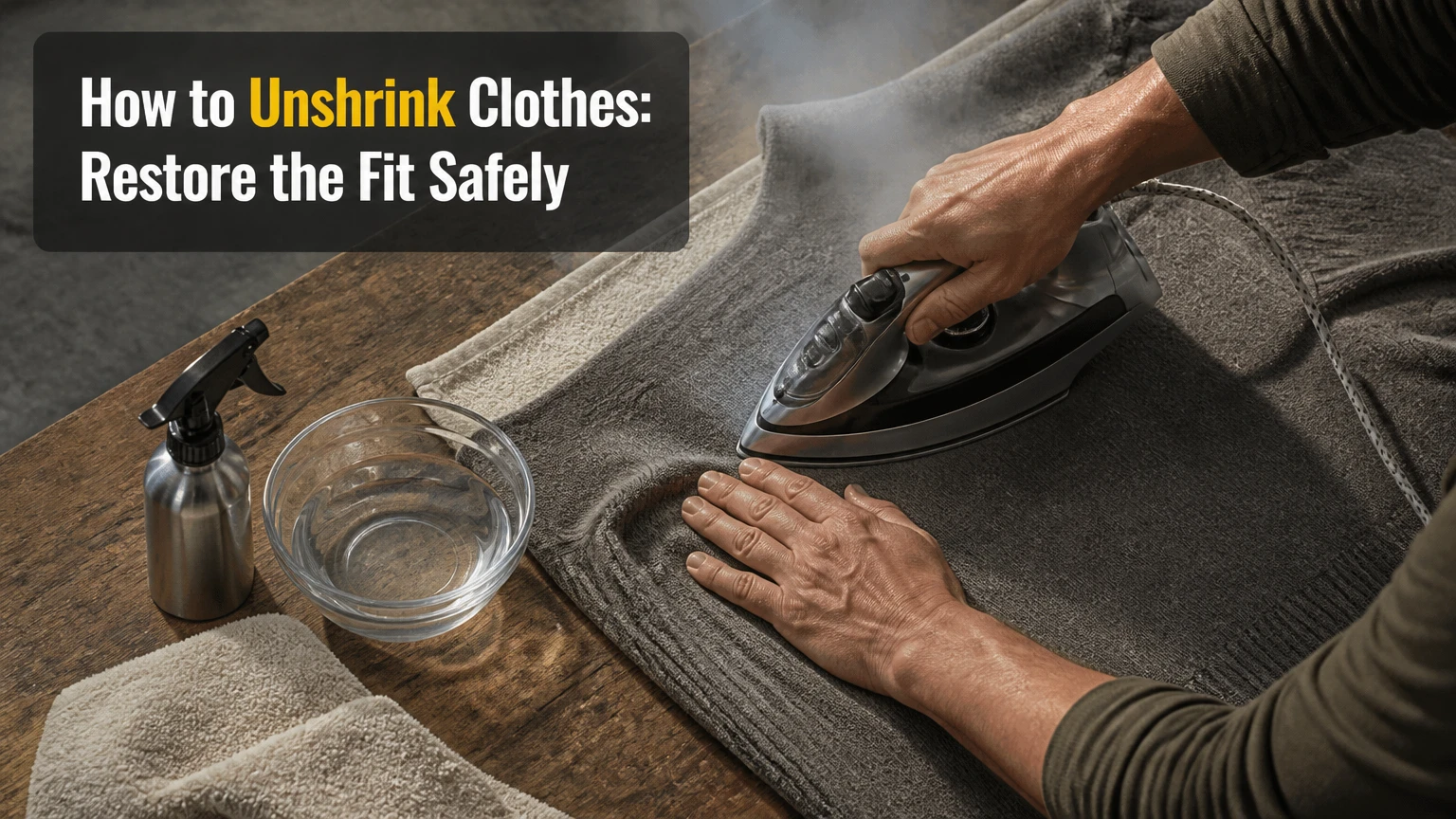
Steam can be applied from a few centimeters away while the fabric is supported on a flat surface. Avoid pressing an iron directly onto wool, silk, rayon, or synthetic fabric unless the care label allows it and a pressing cloth is used. Heat relaxes some temporary distortions, but it can also set a new shape.
Commercial products vary. Follow the manufacturer’s dilution and rinse instructions, test a hidden area for colorfastness, and do not use a wool product on silk, acetate, coated fabric, or garments with incompatible trims without checking the label.
How Do You Steam a Slightly Shrunken Garment?
Steam a slightly shrunken linen, denim, or structured cotton garment while supporting the fabric and stretching one measured section at a time. Work in 5-10 cm areas, keep the steamer moving, and allow the fabric to cool in its expanded position before checking the dimensions.
Hang a sturdy woven garment only when the fabric is not heavy enough to sag. For a shirt, steam the sleeve or side panel from the inside, pull gently along the grain, and stop when the target measurement is reached. For trousers, steam the waistband or thigh while the garment lies flat whenever possible.
Steam is not the preferred first treatment for a wool sweater. Hanging wet or heavily steamed knitwear can lengthen the shoulders while leaving the body narrow. Use flat blocking instead.
When Can a Shrunken Garment Not Be Recovered?
A garment is unlikely to return to its original size when fibers have felted densely, synthetics have melted or heat-set, seams have puckered, or linings and outer fabric have shrunk at different rates. Repeated soaking and pulling cannot repair broken fibers, distorted construction, or a damaged finish.
Stop home treatment when any of these conditions appears:
- Wool has become noticeably denser, shorter, and stiffer across the entire garment.
- The outer fabric shrank but the lining, zipper, or interfacing did not.
- The garment has shiny patches, melted fibers, or a hardened synthetic surface.
- Seams twist, pockets pull open, or the shoulder line no longer matches.
- Dye bleeds strongly during a hidden-area test.
- The care label prohibits water and the garment has tailored construction.
A professional cleaner may perform reblocking, which involves controlled cleaning, shaping, drying, and sometimes steam finishing on a form or blocking board. Reblocking can improve dimensions and symmetry, but it cannot guarantee restoration after severe felting.
What Common Mistakes Make Shrinkage Worse?
The most damaging mistakes are adding heat, agitating animal fibers, and stretching wet fabric from isolated points. Recovery depends on even support, moderate moisture, and gradual force, not on pulling as hard as possible.
| Mistake | Result | Immediate correction |
|---|---|---|
| Hot water | Additional wool or cotton contraction | Stop and cool the garment gradually |
| Wringing | Twisted seams and misshapen knit structure | Press water out with towels |
| Hanging wet knitwear | Stretched shoulders and narrow body | Lay flat and realign seams |
| Direct iron on synthetics | Shine, melting, or glazing | Remove heat and let the area cool |
| Excess conditioner | Greasy or slippery residue | Rinse briefly in lukewarm water |
| Uneven pinning | Crooked hems and mismatched sleeves | Re-wet and measure both sides |
An uneven result is usually recoverable if the garment is still flexible. Re-wet only the short or distorted area with plain lukewarm water, smooth the neighboring section, and reshape against a measured template. Do not keep pulling a dry area because dry force can stress seams without moving the whole fabric structure.
How Long Does Unshrinking Take, and What Does It Cost?
A home treatment usually requires 20-45 minutes of active work and 12-24 hours of flat drying. Typical supply cost ranges from $0.50-$8, while professional reblocking commonly costs $25-$100 depending on fiber, construction, location, and garment value.
Treat the time estimate as a process range rather than a promise. Thick wool, layered denim, and heavy cotton dry slowly at seams and waistbands. A garment that feels dry on the surface can still contract as its interior moisture leaves.
A practical cost decision is based on replacement value. Home treatment is reasonable for a $10 cotton shirt with mild, even shrinkage. A $200 cashmere sweater with severe shrinkage merits a cleaner’s assessment before any DIY experiment, particularly if the garment has a shaped shoulder, decorative trim, or a dry-clean-only label.
How Can You Prevent Clothes From Shrinking Again?
Prevent repeat shrinkage by following the care label, washing in cool water, reducing agitation, and air-drying garments that contain wool, cotton, rayon, or elastane. The dryer is the most common source of avoidable heat shrinkage, especially when a garment is left tumbling after it is already dry.
Use these fabric-specific rules:
- Wash wool and cashmere on a wool cycle or by hand with wool detergent.
- Keep water temperature at or below the care-label maximum.
- Reduce spin speed for delicate knits and support them during removal.
- Reshape sweaters flat while damp.
- Dry cotton, linen, and rayon away from direct high heat.
- Remove garments from the dryer while slightly damp when tumble drying is allowed.
- Avoid mixing heavy denim, towels, and delicate knits in one load.
- Measure a valuable knit before its first wash and compare dimensions afterward.
The care label communicates the manufacturer’s tested maintenance limits, but labels cannot predict every household machine. A dryer’s sensor setting may still expose a garment to enough heat for additional contraction, so low heat and prompt removal remain safer choices.
What If the Garment Shrinks Again After Treatment?
A garment that shrinks again usually dried without enough support, remained unevenly wet, or experienced another heat cycle. Re-wet the item, repeat the towel-roll method, restore the measured dimensions, and leave it anchored until every thick seam is completely dry.
Do not add more conditioner automatically. Extra product cannot compensate for an incorrect target size, a hanging knit, or permanent felting. If the same garment contracts after two careful treatments, the fibers or construction probably cannot hold the desired dimensions.
For a localized problem, use a spray bottle containing plain lukewarm water rather than soaking the entire garment. Dampen the short sleeve, cuff, waistband, or hem, reshape it against the matching side, and support both sections during drying.
FAQ About Unshrinking Clothes
Does hair conditioner really unshrink clothes?
Hair conditioner can help relax and lubricate wet fibers so a garment becomes easier to reshape, especially wool, cashmere, cotton knits, and some rayon fabrics. Conditioner does not reverse chemical damage or restore felted wool automatically. The measurable recovery comes from stretching the damp garment evenly and drying it in the desired shape.
Can I unshrink clothes without conditioner?
Yes. Plain lukewarm water can make many fibers pliable enough for careful blocking, and a small amount of wool-safe detergent can replace conditioner for wool garments. Conditioner is optional because it improves slip rather than creating the stretch. Avoid using an unfamiliar product on silk, unstable dyes, coated fabric, or dry-clean-only clothing.
Can I wear shrunken jeans to stretch them back?
Wearing damp jeans can expand a tight waistband or thigh area temporarily, but body movement does not reliably restore the original dimensions. Dampen only the tight section, stretch it gradually, then air-dry the jeans flat. High dryer heat after this process can contract cotton denim again.
Does boiling water unshrink a sweater?
Boiling water should not be used to unshrink a sweater. High heat and agitation can increase wool felting, contract cotton, damage dyes, and distort synthetic fibers. Use cool or lukewarm water, keep the garment still during soaking, and reshape it flat with measured targets.
Can a dry cleaner fix a severely shrunken sweater?
A specialist dry cleaner may improve a severely shrunken sweater through wet cleaning and reblocking, particularly when the garment is valuable and the fibers are not fully felted. The cleaner cannot reliably restore melted synthetics, broken yarns, or densely interlocked wool. Ask whether the cleaner has experience reblocking cashmere and wool knitwear.
How do I know whether a garment shrank or was always the wrong size?
Compare the garment with its original measurements, purchase measurements, or a matching item from the same size range. Even shrinkage across length and width suggests fiber contraction. A garment with unchanged sleeve length but a twisted side seam may have construction distortion rather than simple shrinkage, requiring alteration or professional assessment.
The Bottom Line
To unshrink clothes, use lukewarm water, minimal agitation, controlled stretching, and flat drying with measured dimensions. Conditioner can make fibers easier to manipulate, but it cannot reverse felting, melted synthetics, damaged seams, or every form of permanent shrinkage. Start with the fabric label, use the gentlest suitable method, and choose professional reblocking when the garment’s value or construction makes experimentation risky.