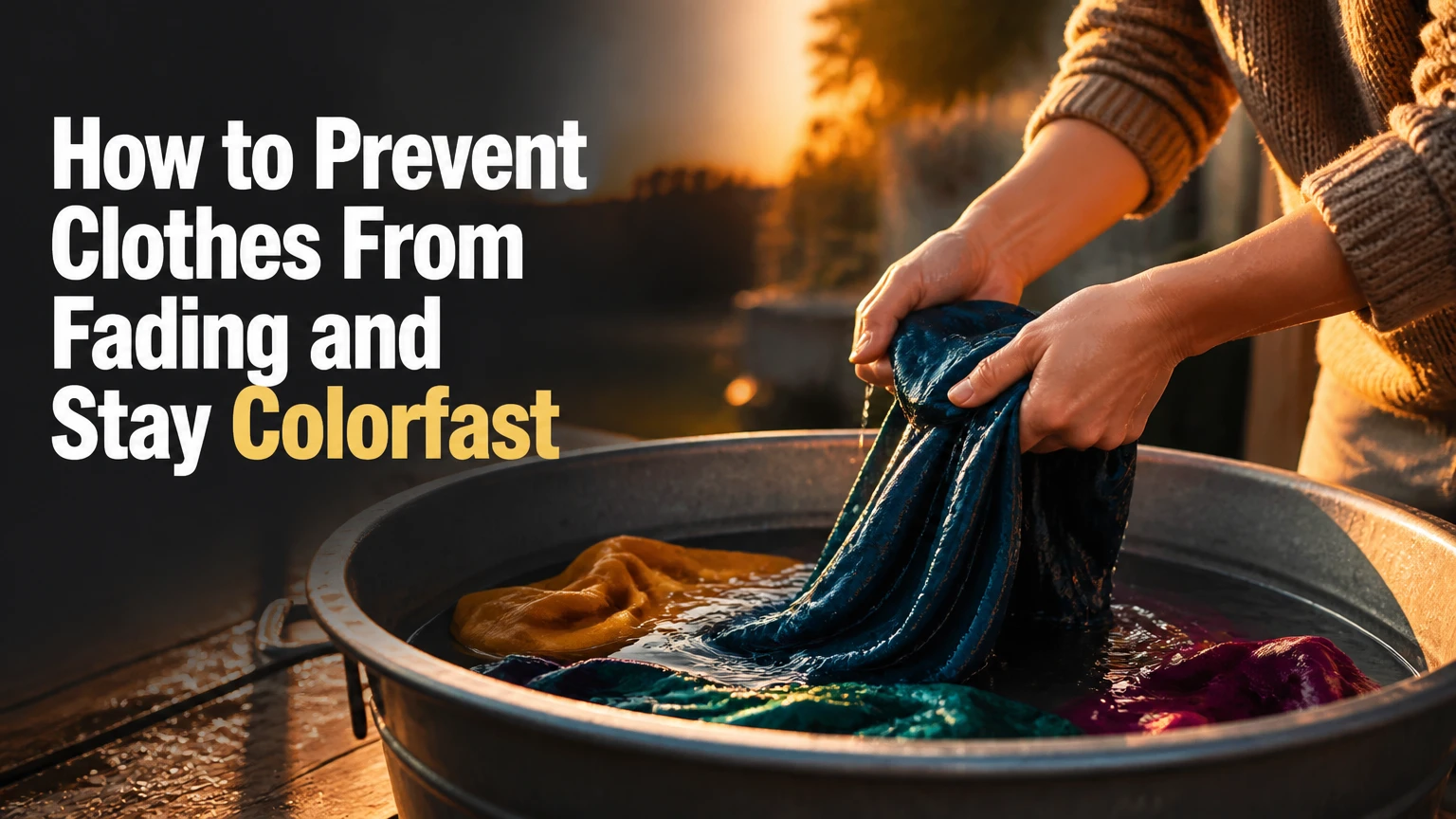
To prevent clothes from fading, wash colored garments inside out in cold or cool water with a measured color-safe detergent, reduce friction, and dry them away from direct sunlight. Wash only when needed, avoid chlorine bleach and excessive heat, and follow the garment’s care label because fiber type and dye method determine the safest settings.
Key facts at a glance
- Cold water reduces dye bleeding and fiber stress, but it does not chemically “seal” fabric fibers.
- Turning garments inside out protects the visible surface from abrasion during washing and drying.
- Direct ultraviolet light can fade dyes even when a garment is never washed.
- White vinegar removes some alkaline residue and odors, but it is not a dependable dye-setting treatment.
- Chlorine bleach can permanently remove color; oxygen bleach is safer only when the care label permits it.
- The most reliable color-preservation routine is fewer washes, less friction, low heat, and shade.
Why Do Clothes Fade?
Clothes fade when dye is removed, chemically altered, or visually obscured by fiber damage. Washing can cause dye bleeding, detergent and water can mobilize loosely fixed color, friction can abrade the fiber surface, and ultraviolet radiation can break down dye molecules during wear or storage.
True fading is different from dullness. A black cotton shirt may look gray because repeated tumbling has roughened its surface, because detergent residue is scattering light, or because black dye has genuinely left the fiber. Each cause needs a different fix.
The three main mechanisms are:
- Dye bleeding: Unfixed or loosely bonded dye dissolves into wash water and transfers to other garments.
- Abrasion: Agitation, zippers, buttons, and heavy garments break or roughen surface fibers. The resulting fuzz scatters reflected light.
- Photodegradation: UV radiation changes dye molecules, especially in fabrics left in direct sun or displayed near bright windows.
Heat accelerates several of these processes, but temperature is only one variable. A hot, gentle wash may cause less surface damage than a cold, overloaded wash with aggressive tumbling.
How to Prevent Clothes From Fading: The Six-Step Routine
The following process takes about 5 minutes of preparation, 30-60 minutes in a typical washing machine, and 2-24 hours of drying, depending on fabric thickness and humidity. The routine costs little beyond ordinary detergent, and reduced washing frequency usually saves water and energy.
Before you start
| Requirement | Typical value | Practical test |
|---|---|---|
| Preparation time | 5-10 minutes | Sort, inspect, close fasteners |
| Wash temperature | 15-30°C | Use cold or cool setting |
| Detergent dose | 15-30 mL liquid | Follow soil level and label |
| Drying time | 2-24 hours | Use rack, shade, and airflow |
| Machine load | 70-85% full | Leave a hand-width of loose space |
Step 1: Sort by color, weight, and soil
Separate darks, lights, whites, and strongly colored new garments before washing. Keep heavy denim, towels, hoodies, and canvas away from lightweight T-shirts, rayon, modal, and fine knits because unequal weight increases rubbing and can stretch delicate fibers.
Wash red, navy, black, and heavily dyed new items separately for the first two or three washes. A white cotton cloth dampened with cool water can test a suspicious garment: press it on an inside seam for 10 seconds and check for transferred color.
Close zippers, fasten hooks, empty pockets, and turn printed or dyed garments inside out. A closed zipper cannot scrape neighboring fabric as freely, while the inside-out position moves much of the abrasion away from the visible surface.
You will know sorting worked when: the wash contains garments with similar color intensity, weight, and soil level.
Common mistake: sorting only by color while mixing towels with thin shirts.
Step 2: Choose cold or cool water
Set the machine to cold, approximately 15-20°C, for ordinary darks, prints, denim, and lightly soiled colored clothing. Use cool water up to about 30°C when a garment is oily, heavily worn, or unlikely to clean adequately in cold water.
Cold water reduces dye solubility, shrinkage, and heat-related fiber stress. It does not lock dye inside the textile, and it does not remove every type of soil. Body oil, sunscreen, cooking grease, and some stains require a suitable detergent and sufficient mechanical action.
Use the warmest temperature permitted by the care label when hygiene or stain removal matters more than maximum color retention. Underwear, towels, bedding, and garments contaminated with bodily fluids may need warmer washing, especially when recommended by the label or a health authority.
You will know the setting worked when: the garment is clean without bleeding, shrinkage, or a harsh hot-laundry smell.
Common mistake: choosing cold water but adding too much detergent, which leaves residue and creates dullness.
| Laundry situation | Recommended temperature | Reason | Avoid |
|---|---|---|---|
| Black T-shirts | 15-20°C | Limits bleeding and abrasion-related dullness | 40°C+ routine washing |
| Dark denim | 15-20°C | Reduces indigo loss | Hot soaking |
| Oily workwear | 30-40°C if label allows | Improves grease removal | Cold-only washing for heavy oil |
| Bright athletic polyester | 15-30°C | Protects dye and elastane | Chlorine bleach |
| Towels with dark clothing | 40-60°C if label allows | Hygiene and soil removal | Mixing with lightweight darks |
| Wool or silk | 15-30°C | Protects protein fibers | Hot water and agitation |
Step 3: Reduce agitation and friction
Choose a delicate, gentle, or normal low-agitation cycle according to the garment’s soil level. A short cycle is useful for lightly worn clothing, but a speed wash cannot replace adequate cleaning for sweat, grease, or embedded dirt.
Avoid rigid rules such as filling every drum to exactly 75 percent. The better test is garment movement: a front-loader needs loose space at the top of the drum, and a top-loader should not be packed so tightly that clothing cannot circulate. An overloaded load increases compression and rubbing; a nearly empty load can cause harsh impact and tangling.
Select a moderate spin speed for dark and delicate garments. Around 600-900 revolutions per minute is typically gentler than 1,200-1,600 rpm, although slower spinning leaves more water for drying.
Place bras, hosiery, printed shirts, and small delicate items in mesh bags. Do not put every garment in a bag because restricted movement can prevent proper cleaning.
You will know the setting worked when: garments emerge separated rather than tightly knotted, and printed surfaces show no new cracking.
Common mistake: using a short cycle with a tightly packed drum.
Step 4: Use the right detergent in the right amount
Choose a liquid detergent labeled color-safe for most darks and bright clothing. Liquid formulas dissolve readily in cold water, while powder can perform well but may leave visible residue when overdosed or used in a cold, short cycle.
Pods offer consistent premeasured dosing, but one pod may be excessive for a small, lightly soiled load and insufficient for a large, dirty load. Do not cut or puncture pods. Measure liquid detergent instead of filling the dispenser to its maximum line by habit.
Avoid chlorine bleach on colored garments unless the manufacturer specifically permits it. Oxygen-based bleach may be suitable for some washable colors, but test an inconspicuous area and follow the product label because “color-safe” does not mean risk-free for every dye.
Fabric softener can leave a coating that reduces absorbency and traps odor, especially in towels and athletic polyester. The coating does not preserve dye, and repeated residue can make dark garments appear less clear.
| Product type | Typical dose per load | Best use | Color limitation |
|---|---|---|---|
| Liquid color-safe detergent | 15-30 mL | Cold washing, darks, prints | Excess dose leaves residue |
| Powder detergent | 20-45 g | Hard soil and warm cycles | May not dissolve fully in cold water |
| Laundry pod | 1 pod | Standard medium load | Poor dose control for small loads |
| Oxygen bleach | 15-30 g | Label-approved stain removal | Can alter unstable dyes |
| Chlorine bleach | 0 mL for colors | Whites only when label allows | Permanently strips many dyes |
You will know the setting worked when: the garment smells clean, feels flexible, and shows no white streaks after drying.
Common mistake: assuming more detergent means cleaner color. Excess surfactant and builder residue can produce dull fabric.
Step 5: Pre-treat stains instead of rewashing repeatedly
Apply a small amount of liquid detergent or a labeled stain remover to the stain, then wait 5-15 minutes before washing. Blot oil rather than spreading it, and rinse blood or protein stains with cool water before laundering.
Repeated full wash cycles cause more abrasion than targeted pre-treatment. A shirt worn for two hours without sweat or visible soil may need airing rather than another wash.
Do not mix chlorine bleach with vinegar, ammonia, or acidic cleaners. The combination can generate dangerous gases. If using vinegar, add it only to the rinse compartment and never combine it with bleach.
White vinegar can help remove alkaline detergent residue and mineral deposits, but it does not reliably “set” modern garment dyes. Commercial dye fixatives such as Retayne are more appropriate for some new, bleeding cotton and other washable fabrics, but they cannot repair UV-destroyed pigment or restore color already removed.
You will know the setting worked when: the stain lightens before the wash and the garment needs no second or third cycle.
Common mistake: drying a stained or dye-transferred item before checking it, which can set some stains more firmly.
Step 6: Dry with low heat and limited light
Air-dry colored garments indoors or outdoors in shade, with airflow around the fabric. Direct midday sunlight can fade susceptible dyes, especially black, navy, red, and fluorescent colors, even when the fabric is completely clean.
If using a dryer, choose low heat or air fluff and remove garments as soon as they are dry. High heat increases shrinkage, weakens elastane, and accelerates surface wear. Do not assume that a shorter high-heat cycle is gentler than a longer low-heat cycle.
Reshape knits and lay heavy sweaters flat rather than hanging them wet. Hang woven shirts on broad hangers to avoid shoulder distortion, and turn dark garments inside out before rack drying if the room receives strong light.
Levi Strauss & Co. gives a particularly useful denim rule: “The more you wash your jeans, the more they fade.” The point is not to avoid hygiene; it is to wash denim when it is dirty and spot-clean minor marks between washes.
You will know the setting worked when: the garment dries evenly without a baked smell, hard creases, or color change at exposed edges.
Common mistake: drying black clothing on a sunny windowsill because the air indoors feels cool.
| Drying method | Typical time | Color risk | Best application |
|---|---|---|---|
| Indoor rack with airflow | 4-24 hours | Low | Darks, prints, denim |
| Outdoor shade line | 2-8 hours | Low to moderate | Cotton and linen |
| Dryer, low heat | 30-60 minutes | Moderate | Everyday washable garments |
| Dryer, high heat | 20-45 minutes | High | Only label-approved whites |
| Air-fluff cycle | 20-40 minutes | Low | Removing wrinkles without heat |
| Flat drying | 8-24 hours | Low | Wool, cashmere, heavy knits |
Which Detergent and Treatment Protect Color Best?
A liquid color-safe detergent is the best default for most households because it dissolves easily in cold water and allows accurate dosing. A dye fixative is a specialist treatment for a new garment that visibly bleeds, while vinegar is mainly a residue and odor treatment rather than a dependable color-preservation chemical.
| Option | Typical cost per load or treatment | Effective for | Not effective for |
|---|---|---|---|
| Liquid color-safe detergent | $0.15-$0.60 per load | Routine dye and soil control | UV-destroyed color |
| Powder detergent | $0.10-$0.40 per load | Heavy soil in warm water | Cold overdosed loads |
| White vinegar rinse | $0.05-$0.30 per load | Mineral residue and odors | Permanently fixing every dye |
| Commercial dye fixative | $2-$5 per treatment | Some loose dyes on new items | Restoring faded pigment |
| Oxygen bleach | $0.10-$0.50 per load | Label-approved stains | Guaranteed protection for unstable colors |
What Causes Black Clothes to Turn Gray?
Black clothes usually turn gray because abrasion roughens the fiber surface, detergent residue dulls the fabric, or black dye has gradually been removed. Washing inside out, reducing dryer heat, using less detergent, and avoiding heavy items in the same load often improve appearance when pigment loss is not permanent.
Wash black garments with other soft darks, not towels or abrasive denim. Choose liquid detergent, use a moderate cycle, and inspect the garment after air drying. A gray cast that disappears after an extra rinse suggests residue; a gray cast concentrated on elbows, seat areas, or seams indicates wear.
Dye-restoring products and black fabric dye can help cotton and some cellulose-rich garments, but results vary by fiber, stitching, labels, and synthetic blends. Polyester often requires a different dye chemistry and may not accept household cotton dye evenly.
A dye bath cannot reverse UV oxidation or reconstruct abraded fibers. It changes the garment’s color; it does not restore the original surface condition.
Common Mistakes That Accelerate Fading
Washing every garment after one brief wear
Overwashing creates more cumulative friction than most people realize. Air out lightly worn outer layers and spot-clean isolated marks, but wash underwear, workout clothing, and visibly soiled garments after use.
Leaving zippers and hook fasteners open
Metal and molded plastic fasteners scrape nearby fabric during agitation. Close zippers and hooks, then turn the garment inside out before loading.
Using sunlight as a disinfecting shortcut
Sunlight can reduce moisture and some odors, but UV exposure also degrades susceptible dyes. Use shade and airflow when the priority is color retention.
Overloading the machine
A compressed drum prevents detergent distribution and garment movement. If the load forms a dense, immovable mass, remove one or two bulky items.
Using bleach on colored fabric
Chlorine bleach is an oxidizing agent that can destroy or alter dye molecules. Read the care label and use a small hidden-area test for any alternative whitening product.
Ignoring water hardness
Hard-water minerals can combine with detergent and leave a dull deposit. An extra rinse, correct detergent dosing, or a manufacturer-approved water-softening additive may help, but do not treat vinegar as a universal cure.
How Should You Adapt the Routine for Different Fabrics?
Fiber content, dye type, fabric construction, and finish determine the safest color-care method. Cotton and linen tolerate more mechanical treatment than wool and silk, while elastane and some technical finishes deteriorate under heat even when their color remains stable.
Denim
Wash jeans inside out in cold water every 5-10 wears, or sooner when sweat, soil, or odor requires it. Use a gentle detergent, avoid long hot soaks, and air-dry jeans in shade.
Dark indigo denim commonly releases excess dye during early washes. Wash it alone or with similarly dark garments until the rinse water becomes noticeably clearer. Do not use a dye fixative unless the product is labeled for the specific fiber and finish.
Polyester and athletic clothing
Use 15-30°C water, a moderate liquid detergent dose, and low heat. Avoid chlorine bleach and excessive fabric softener because both can damage performance finishes or trap odors.
Turn screen-printed athletic garments inside out. High dryer heat can crack prints and degrade elastane even when the base polyester remains colorfast.
Wool, cashmere, and silk
Use the care label as the primary authority. Hand wash or select a wool or delicate cycle in cool water, use a pH-appropriate detergent, avoid wringing, and dry flat when directed.
Silk may lose color through prolonged soaking, strong alkalinity, or rubbing. Professional cleaning is safer for structured silk garments, unstable dyes, tailored jackets, and pieces labeled dry clean only.
Bright cotton and linen
Separate new reds, purples, deep blues, and saturated greens for the first washes. Cold washing reduces bleeding, while shade drying limits UV exposure and protects printed surfaces.
| Fabric or garment | Wash setting | Drying method | Main risk |
|---|---|---|---|
| Cotton T-shirt | 15-30°C, gentle or normal | Low heat or shade | Abrasion and shrinkage |
| Stretch denim | 15-20°C, low spin | Air dry in shade | Indigo loss and elastane damage |
| Polyester sportswear | 15-30°C, moderate cycle | Low heat | Finish and elastane degradation |
| Merino wool | 15-30°C, wool cycle | Flat dry | Felting and dye bleeding |
| Silk blouse | Cool hand wash if labeled | Flat or professional clean | Water marks and rubbing |
| Linen shirt | 15-30°C, gentle cycle | Shade line dry | Creasing and UV fading |
What Should You Do After Dye Transfer?
Do not put a dye-transferred garment in the dryer. Rewash it immediately, separately, with the warmest label-approved water and a commercial color-run remover or suitable oxygen-based product.
First, remove the garment from the load and keep it wet. Check the care label, test the treatment on an inside seam, and avoid chlorine bleach unless the label explicitly allows it. A second wash may remove loose transfer, but heat can make the unwanted color harder to lift.
If the transfer remains, stop experimenting with multiple chemicals. A professional cleaner can assess fiber type and dye stability, particularly for silk, wool, acetate, leather trim, or a garment with contrast panels.
| Problem | Likely cause | First response | Do not do |
|---|---|---|---|
| Pink tint on white cotton | Red dye transfer | Rewash with color-run remover | Dry first |
| Gray film on black shirt | Detergent or mineral residue | Run an extra rinse | Add more detergent |
| White streaks on dark fabric | Undissolved product | Rewash with less liquid detergent | Scrub aggressively |
| Faded shoulder area | UV exposure | Move storage away from window | Attempt bleach |
| Pale elbow or seat area | Surface abrasion | Reduce friction and heat | Expect vinegar to restore dye |
| Uneven black dye | Permanent pigment loss | Consider compatible fabric dye | Use cotton dye on polyester blindly |
How Much Does Color-Preserving Laundry Cost?
A basic color-preserving routine costs approximately $0.15-$0.60 per ordinary load when using standard liquid detergent, while indoor rack drying adds no direct energy cost. Specialist dye-fixative treatments typically cost $2-$5 per garment or treatment, and professional cleaning commonly costs more according to garment type and local pricing.
The lowest-cost improvements are sorting, inside-out washing, lower dryer heat, shade drying, and washing less often when hygiene permits. Product upgrades matter less than consistent control of friction, heat, detergent quantity, and UV exposure.
Typical monthly costs vary widely:
- Basic home routine: $3-$12 for 20 loads of liquid detergent.
- Color-care detergent routine: $6-$20 for 20 loads.
- Occasional dye fixative: $2-$5 per affected new garment.
- Professional care: often $5-$25 or more per structured or delicate garment, depending on location.
Prices are typical retail ranges, not fixed local rates. Water, electricity, drying equipment, and detergent concentration change the total.
The Bottom Line
The most reliable way to prevent clothes from fading is to wash less often, sort by color and weight, turn garments inside out, use 15-30°C water, measure color-safe detergent, reduce agitation, and dry with low heat away from direct sunlight. These controls address dye bleeding, abrasion, residue, and UV damage together.
Do not rely on vinegar, salt, or a cold setting as a universal dye fix. Cold water helps, but the garment’s fiber, dye stability, care label, soil level, and drying environment determine the complete routine. Apply the least aggressive method that still removes the actual soil.
Frequently Asked Questions
Does salt stop clothes from fading?
Salt is not a reliable general-purpose treatment for preventing fading in finished clothing. Some dyeing processes use salt to help certain dyes bond with cellulose fibers during manufacture, but adding table salt to a household wash does not consistently lock existing garment dye in place. Cold water, reduced friction, and shade drying are more dependable.
Should you wash new clothes before wearing them?
Wash new clothes before wearing them when possible because garments may contain finishing agents, loose dye, dust, or residues from manufacturing and retail handling. Test strongly colored new items separately or with similar darks for the first two or three washes, especially red, navy, black, and indigo garments.
Can hand washing prevent fading better than a machine?
Hand washing can reduce fading when the garment is lightly agitated, kept in cool water, and rinsed without twisting. It can cause more damage if the fabric is rubbed, wrung, soaked for hours, or washed with too much detergent. A gentle machine cycle may be safer and more consistent for durable washable garments.
Does fabric softener prevent color loss?
Fabric softener does not prevent dye loss. It deposits conditioning ingredients on fibers, which may make fabric feel smoother, but repeated use can reduce towel absorbency and trap odor in synthetic sportswear. Color-safe detergent, low heat, and less abrasion provide more meaningful protection.
Can faded clothes be restored?
Some faded cotton, rayon, linen, and other cellulose-rich garments can be recolored with a compatible fabric dye, but restoration is not guaranteed. Dye cannot reverse UV damage, repair pilling, or restore weakened fibers. Synthetic blends, thread, labels, prints, and trims may absorb replacement dye unevenly.
Is dry cleaning better for preventing fading?
Dry cleaning can reduce water-related bleeding and shrinkage for garments labeled dry clean only, but it does not eliminate fading. Solvents, pressing heat, light exposure, and repeated mechanical handling can still affect color. Follow the care label and use professional cleaning for tailored, embellished, silk, wool, or structurally complex pieces.