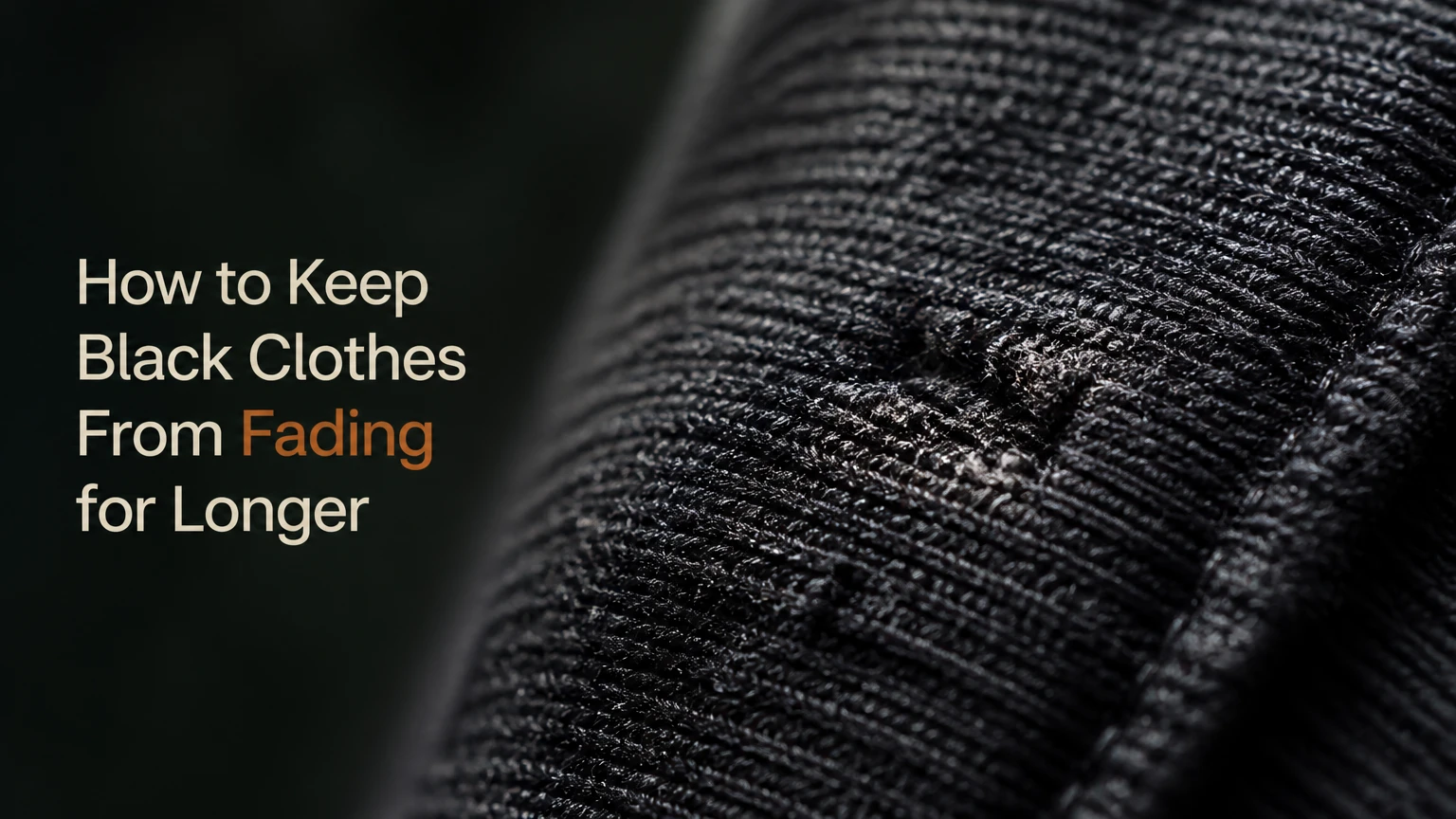
To keep black clothes from fading, wash them less often in cold water with a mild detergent, turn them inside out, reduce friction, and dry them away from direct sunlight. The most effective routine is cold gentle washing, a lightly loaded drum, thorough detergent dissolution, and low-heat or shaded drying.
Key Facts at a Glance
- Black clothing fades through dye loss, surface abrasion, lint accumulation, detergent residue, and ultraviolet exposure.
- Cold water reduces dye bleeding and fiber stress, but cold washing cannot restore dye that has already left the fabric.
- Turning garments inside out protects the visible surface from drum friction, zippers, buttons, and rough textiles.
- Liquid detergent is useful when it dissolves completely; powder detergent is not automatically damaging or abrasive.
- Vinegar and table salt are not dependable dye fixatives for finished black garments.
- Air-drying in shade usually causes less color damage than direct sunlight or repeated high-heat tumble drying.
Why Do Black Clothes Fade?
Black clothes fade because dye is removed, fibers are abraded, or the dark surface becomes covered with lint and residue. Washing adds water, detergent, heat, and friction, while sunlight adds ultraviolet radiation that can permanently degrade dye molecules.
Dye loss is most noticeable in loosely dyed cotton, denim, linen, and rayon. Mechanical wear can make a garment look gray even when much of its original dye remains. Repeated rubbing raises tiny fiber fragments, called fibrils, on the surface; those fragments scatter light instead of presenting a smooth, dark face.
A garment can therefore look faded for different reasons. A black T-shirt with pale crease lines may have abrasion, while a uniformly lighter shirt may have lost dye. Gray fuzz usually indicates lint or fiber damage rather than chemical bleaching.
What damages black fabric during laundry?
| Cause | Typical source | Visible symptom | Best prevention |
|---|---|---|---|
| Dye bleeding | Warm water, long cycles, unstable dye | Overall lighter color | Cold, short cycle |
| Surface abrasion | Drum movement, rough garments, closures | Gray sheen or pale creases | Inside-out washing |
| UV degradation | Sunlight, bright windows | Uneven or permanent fading | Shade drying |
| Lint transfer | Towels, fleece, light fabrics | Dusty gray coating | Wash with dark smooth fabrics |
| Detergent residue | Overdosing, hard water, poor rinsing | White streaks or chalky patches | Correct dose and extra rinse |
| Heat stress | Hot wash or high dryer heat | Dullness, shrinkage, weakened fibers | Low-temperature care |
The distinction matters because a lint-coated shirt can often be cleaned, but chemically faded dye cannot be washed back into place. Surface abrasion may be reduced in appearance, yet heavily fibrillated fabric is permanently changed.
How to Keep Black Clothes From Fading
The most reliable method combines six controls: wash only when needed, separate dark loads, protect the garment face, use cold water and modest agitation, avoid overloading, and dry with little heat or ultraviolet exposure. Each control addresses a different source of color loss.
Before You Start
| Requirement | Typical value | Why it matters |
|---|---|---|
| Preparation time | 5-10 minutes | Sorting and fastening |
| Washing time | 30-60 minutes | Depends on cycle and machine |
| Drying time | 4-24 hours air-drying | Depends on fabric and humidity |
| Detergent cost | $0.10-$0.40 per load | Typical liquid detergent range |
| Water temperature | 15-30°C, or 59-86°F | Lower thermal and bleeding risk |
| Load size | About two-thirds full | Leaves room for rinsing and movement |
Check the care label before using any general routine. A label that says “dry clean only,” “hand wash,” or “wash separately” overrides a standard machine cycle. Test an unfamiliar garment by pressing a damp white cloth against an inside seam for 10 seconds; visible black transfer signals limited colorfastness.
Step 1: Wash Black Garments Only With Suitable Dark Items
Sort black clothing with black, charcoal, and similarly dark navy garments. Keep towels, pale cotton, fleece, flannel, and heavily linting fabrics out of the load because loose fibers can cover black fabric and create a gray appearance.
Separate very dirty workwear from lightly worn shirts. Grease, sunscreen, deodorant, and body oil require stronger cleaning, but combining those items with delicate black knitwear forces the entire load into a harsher wash.
Wash new black garments separately for the first one or two cycles if they release visible dye. A colorfastness test gives better evidence than the garment’s age or price.
You will know sorting worked when: the rinse water is not carrying obvious lint from towels or fleece.
Common mistake: grouping every dark item together, including a shedding black fleece with smooth black dress shirts.
Step 2: Turn Clothes Inside Out and Secure Closures
Turn T-shirts, jeans, hoodies, trousers, and printed garments inside out before washing. Close zippers, snaps, and hooks, and fasten buttons loosely enough to avoid pulling the fabric.
Inside-out washing places the interior surface against much of the machine’s movement, protecting the outward-facing weave, printed graphics, and dyed nap. Zippers and hook fasteners can abrade nearby fibers even when they belong to the same garment.
Use a mesh laundry bag for lightweight black lingerie, thin knits, and garments with straps. Do not pack a bag tightly; compression increases creasing and prevents proper rinsing.
You will know preparation worked when: no exposed zipper teeth or hooks can scrape another garment.
Common mistake: turning jeans inside out but leaving a metal belt buckle or open zipper free to strike the fabric.
Step 3: Select Cold Water and the Mildest Suitable Cycle
Choose cold water, usually 15-30°C, for routine black laundry. Select a gentle, delicate, or normal-low-agitation cycle according to the care label, and use the lowest spin speed that still produces a practical drying time.
Cold water limits thermal movement of dye and generally reduces shrinkage. A gentle cycle reduces rubbing, but an extremely short or weak cycle may leave oil and deodorant behind, requiring another wash that creates additional wear.
For ordinary cotton T-shirts, a standard cycle on cold may clean better than an inadequate delicate cycle. For wool, rayon, silk, and fine knits, use the label’s hand-wash or wool setting.
You will know the setting worked when: the garment is clean without a roughened surface, stretched seams, or strong color in the drain water.
Common mistake: choosing hot water because black clothing appears heavily soiled when pre-treating the stain would have been gentler.
Step 4: Keep the Drum Below About Two-Thirds Full
Load the washer to roughly two-thirds of its usable volume, not to the top of the opening. A lightly loaded drum gives detergent solution space to circulate and allows the machine to rinse away loosened soil and residue.
There is no universal “70 percent” setting because washer shapes and fabrics vary. The practical test is whether a flat hand fits between the dry laundry and the top of a front-loader drum, or whether a top-loader has visible room for garments to move without compression.
Underloading is not always better. A single heavy pair of jeans may strike the drum unevenly, while a balanced load reduces impact and improves extraction.
You will know loading worked when: garments move freely, the washer does not repeatedly rebalance, and no item emerges with concentrated detergent marks.
Common mistake: filling the machine tightly to save time, then extending fabric contact and reducing rinse quality.
Step 5: Dose a Fully Dissolving Detergent
Use a mild liquid detergent or a powder detergent that the manufacturer approves for the selected water temperature. The detergent’s ability to dissolve completely and remove soil matters more than whether the label says “dark.”
Dark-clothing detergents may omit optical brighteners and may contain ingredients intended to reduce surface dulling. They are optional, not magical. Standard detergent can protect black clothing when the dose matches the load, the water hardness, and the soil level.
Powder detergent is not inherently abrasive. Undissolved powder can leave alkaline residue, especially in cold water or an overloaded washer, but properly dosed powder in a suitable machine is not equivalent to sandpaper.
Use the smallest dose that cleans the load. Excess detergent traps residue in dense cotton, fleece, and elastane blends, making black fabric look pale or streaked.
You will know dosing worked when: the garment smells clean rather than strongly perfumed and has no pale patches after drying.
Common mistake: adding extra detergent to compensate for hard water without checking the product instructions or using an added rinse.
Step 6: Dry Black Clothing in Shade With Minimal Heat
Air-dry black garments indoors or outdoors in shade, away from direct sun and hot radiators. If a dryer is necessary, use low heat or an air-only cycle, remove garments promptly, and follow the care label for elastane and synthetic fibers.
Wet fabric can be especially vulnerable to sunlight because UV exposure reaches the dye while the garment remains stretched and damp. A shaded rack, indoor drying line, or ventilated room reduces that exposure.
Do not leave wet black laundry in the washer for hours. Stagnant moisture can create odor and encourage mildew, leading to repeat washing and more abrasion. Shake garments out, reshape knits, and hang structured garments on broad hangers or a drying rack.
You will know drying worked when: the garment reaches dryness without a hot, brittle hand feel, shine, or distorted seams.
Common mistake: placing black jeans or shirts in direct midday sunlight because outdoor drying seems faster.
Which Detergent and Additives Protect Dark Colors?
A properly dosed mild detergent is the best default for black clothes; a specialty dark detergent is optional, while vinegar and salt should not be treated as reliable dye-locking chemicals. Detergent removes soil that can make fabric look dull, but no detergent can permanently prevent poor dye fixation or UV damage.
| Option | Typical cost per load | Best use | Important limitation |
|---|---|---|---|
| Standard liquid detergent | $0.10-$0.30 | Routine cotton and synthetics | May contain brighteners |
| Dark-color liquid detergent | $0.20-$0.60 | Frequent black laundry | Higher cost, benefits vary by formula |
| Powder detergent | $0.05-$0.25 | Warm-water or well-dissolved loads | Can leave residue in cold, hard water |
| Oxygen bleach | $0.15-$0.50 | Label-approved stain treatment | May alter unstable black dyes |
| Distilled white vinegar | $0.05-$0.20 | Occasional residue or odor rinse | Does not reliably fix garment dye |
| Table salt | Under $0.05 | Limited household experiment | Not a dependable post-dye fixative |
Do vinegar or salt stop black clothes from fading?
Vinegar and salt do not reliably prevent fading in already manufactured black clothing. Salt can influence some dyeing processes before or during textile coloration, but adding salt to a finished wash does not recreate the controlled chemistry, concentration, temperature, and time used in a dye house.
Vinegar is acidic, while most laundry detergents are alkaline. Adding vinegar to the same compartment or wash can reduce detergent performance, and repeated use may affect elastic components or machine seals depending on concentration and appliance guidance. It may help with odor or residue in an occasional rinse, but it cannot replace proper washing settings.
Never mix vinegar with chlorine bleach. The combination can produce dangerous chlorine gas.
When is a dye fixative appropriate?
A commercial dye fixative is most useful when a product specifically identifies the garment or dye type it supports, or when applying fresh dye according to the manufacturer’s instructions. A fixative may reduce bleeding during a controlled treatment, but it cannot attach missing dye to a faded finished garment.
Run a hidden colorfastness test first. Follow the label’s dilution, soak time, water temperature, and rinsing instructions, because a 20-minute soak at room temperature is not a universal formula. Dye fixatives also do not repair abrasion, lint, sun damage, or weakened fibers.
How Do Settings Change by Fabric?
Fabric type determines the safest temperature, agitation, spin, and drying method. Cotton and denim usually tolerate more mechanical cleaning than wool or rayon, while elastane blends can lose shape under excessive heat.
| Fabric or garment | Wash setting | Spin guidance | Drying choice |
|---|---|---|---|
| Cotton T-shirt | Cold normal or gentle | Low-medium | Shade line-dry or low heat |
| Black denim | Cold gentle, infrequent | Low-medium | Hang dry inside out |
| Merino wool | Wool or hand wash, cold | Lowest available | Flat dry in shade |
| Rayon or viscose | Label-specific, often cold gentle | Low | Flat or shaped dry |
| Polyester activewear | Cold synthetic cycle | Medium | Air-dry, no fabric softener |
| Nylon lingerie | Cold delicate in mesh bag | Low | Drip-dry in shade |
| Elastane blend | Cold, low agitation | Low-medium | Air-dry or lowest label-approved heat |
How should black jeans be washed?
Wash black jeans only when they are visibly dirty, smell persistently, or have absorbed sweat and body oils. Turn them inside out, close the zipper, use cold water and a mild dose of detergent, then hang them inside out in shade.
Spot-clean small marks between full washes with a damp cloth and a small amount of suitable detergent. Freezing jeans is not a substitute for washing because it does not reliably remove oils, soil, or odor-producing residue.
Avoid high dryer heat. Heat can shrink denim, stress elastane, and accelerate the worn appearance at seams, pockets, and knees.
How should black wool and activewear be washed?
Wash black wool on a wool cycle or by hand in cool water, using wool detergent and minimal agitation. Press out water without wringing, reshape the garment, and dry it flat because hanging wet wool can stretch shoulders and hems.
Wash black polyester or nylon activewear promptly after heavy sweating, using cold water and a low-agitation synthetic cycle. Avoid chlorine bleach and routine fabric softener, which can interfere with moisture-management finishes. Air-drying usually preserves elastane better than repeated heated drying.
Is Hand Washing Better Than Machine Washing?
Hand washing is gentler only when the garment is handled with little rubbing, twisting, and wringing. A modern gentle machine cycle can be safer than rough hand washing because the machine provides controlled movement and extraction.
| Method | Typical time | Friction level | Best for |
|---|---|---|---|
| Cold gentle machine cycle | 30-60 minutes | Low-medium | Cotton, denim, synthetics |
| Hand wash in basin | 10-20 minutes plus drying | Low to high | Wool, silk, fragile trims |
| Professional dry cleaning | 1-3 days | Low water abrasion | Label-required tailoring |
| High-heat normal cycle | 45-90 minutes | High | Rarely appropriate for black clothing |
Hand washing becomes damaging when the wearer scrubs collar stains, wrings the garment tightly, or repeatedly rubs a dark surface against itself. For a washable black cotton shirt, cold machine washing inside out is often the more repeatable option.
How Often Should Black Clothes Be Washed?
Wash black garments when soil, odor, sweat, body oil, or stains require cleaning, not automatically after every brief wear. A typical lightly worn sweater may need cleaning after 3-5 wears, while underwear, socks, gym clothing, and heavily sweaty shirts generally require washing after each use.
Air clothing between wears and spot-clean small marks. Do not use reduced washing frequency to justify wearing items with persistent body odor or visible soil, because accumulated oil can discolor fabric and attract more aggressive stain treatment later.
| Garment | Typical washing interval | Condition that shortens interval |
|---|---|---|
| T-shirt | After 1-2 wears | Sweat, deodorant, sunscreen |
| Jeans | After 3-10 wears | Mud, food, strong odor |
| Sweater | After 3-5 wears | Body odor or visible soil |
| Blazer | After several wears | Stains or smoke exposure |
| Sportswear | After every workout | Heavy perspiration |
| Underwear and socks | After every wear | No exception for hygiene |
Common Mistakes and How to Fix Them
| Problem | Likely cause | Recovery action | Prevention |
|---|---|---|---|
| White streaks | Excess detergent or hard-water residue | Rewash without detergent and add an extra rinse | Reduce dose |
| Gray fuzz | Towels, fleece, or lint shedding | Air-fluff briefly, then use a lint roller | Sort by lint behavior |
| Pale crease lines | Repeated abrasion | Remove surface lint, but accept permanent wear if fibers are damaged | Inside-out washing |
| Strong sour odor | Damp storage or washer buildup | Rewash with suitable detergent and dry immediately | Leave door open after cycles |
| Uneven fading | Sun exposure or unstable dye | Re-dye only after checking fiber content | Shade-dry |
| Shrinkage or shine | High heat or pressing | Reshape while damp; do not expect full reversal | Low-temperature drying |
Why do black clothes have white or gray streaks?
White or gray streaks usually come from undissolved detergent, mineral deposits, lint, or surface fibrillation rather than immediate dye loss. Rewash the garment inside out without detergent on a suitable rinse cycle, then dry it away from sunlight.
If the streaks disappear, residue was the likely cause. For persistent mineral buildup, a washer-cleaning routine and a detergent dose adjusted to local water hardness may help. Do not add chlorine bleach to black clothing while troubleshooting pale marks.
Can a fabric shaver fix faded-looking black clothing?
A fabric shaver can improve black clothing covered with pills or gray fuzz, but it cannot restore dye or repair thin fabric. Use the lowest setting on a dry, flat garment and test an inconspicuous area first.
Do not shave printed graphics, loose knits, lace, or fragile wool without checking the tool’s effect. Removing too many fibers creates holes and makes the garment less durable.
Can Already Faded Black Clothes Become Black Again?
Already faded black clothing can regain visual depth only through recoloring, not through a special wash cycle. An in-washer or immersion dye may work on cotton, linen, rayon, and some nylon, but results depend on fiber content, original dye, stitching, trims, and the product’s compatibility.
| Garment condition | Realistic remedy | Typical time | Expected result |
|---|---|---|---|
| Lint-covered black cotton | Lint removal and rinse | 10-20 minutes | Darker-looking surface |
| Detergent-coated shirt | Residue rinse | 30-60 minutes | Streak reduction |
| Uniformly dye-faded cotton | Compatible black fabric dye | 1-3 hours | Moderate to strong recoloring |
| Abraded knee or collar | No true repair | Not applicable | Wear remains visible |
| Sun-faded synthetic | Synthetic-compatible dye, if available | 1-3 hours | Variable, often limited |
| Wool with color loss | Professional textile specialist | 1-3 days | Variable, risk of shrinkage |
Read the dye package carefully. “Black” dye does not guarantee the original shade, and polyester generally requires a different dye system and higher heat than cotton. Protect the washing machine from dye residue as instructed, and never dye a garment with trims or prints unless uneven color is acceptable.
What Is the Lowest-Effort Routine?
A busy household can preserve black clothing with four repeatable rules: wash only when needed, turn garments inside out, use cold water and correct detergent dosing, and dry them in shade. This routine takes approximately 5 minutes of sorting and adds little or no material cost.
A premium wardrobe benefits from hand washing or a label-approved delicate cycle, mesh bags for fragile pieces, and air-drying away from direct light. A denim owner should extend wash intervals and avoid heated tumble drying.
A low-impact household can use cold water, a concentrated detergent at the label’s minimum effective dose, full but not compressed loads, and line-drying. Avoiding unnecessary washes reduces both energy use and mechanical wear.
Expert Rules That Prevent Most Fading
- Treat friction as a separate problem from dye chemistry. A garment can lose its dark appearance through fiber damage even when little dye appears in the water. Reducing rubbing protects the visible surface more effectively than adding household ingredients.
- Clean soil before it becomes a reason for harsh washing. Sunscreen, sebum, and deodorant can accumulate at collars and underarms. Spot-treating those areas with compatible detergent often protects color better than repeatedly washing the whole garment on a hot cycle.
- Use the care label as a risk boundary, not a suggestion. A black viscose dress and a black cotton T-shirt may have identical color but completely different tolerance for water, agitation, and heat.
- Do not chase a perfectly empty rinse basin. Some loose dye may leave a new garment during early washes without indicating a defective item. The practical goal is stable appearance and no transfer under the garment’s care conditions.
FAQ
Does washing black clothes in cold water really help?
Cold water usually reduces dye bleeding, shrinkage, and heat-related fiber stress compared with hot water. Cold washing cannot stop abrasion, remove UV damage, or restore lost pigment, so the benefit is greatest when combined with inside-out washing, moderate loading, and shade drying.
Should black clothes be washed separately from other colors?
Black clothing should be separated from light fabrics and high-lint items, but black garments can usually share a load with charcoal, navy, and other colorfast dark clothing. Wash a new or visibly bleeding garment separately until a damp white-cloth test shows minimal transfer.
Are dark detergents worth the extra cost?
Dark detergents may be worthwhile for a wardrobe washed frequently, particularly when the formula avoids optical brighteners and dissolves well in cold water. They are not essential. A standard detergent used at the correct dose, with low friction and shade drying, can protect black clothing effectively.
Can sunlight fade black clothes in one day?
Strong sunlight can begin degrading exposed dye during a single drying session, although visible change depends on dye chemistry, exposure duration, fabric, and prior wear. Repeated direct exposure causes the larger cumulative effect. Dry black clothing indoors or in shade whenever practical.
Why do black clothes fade faster at the knees and collar?
Knees, collars, cuffs, and seat areas receive more rubbing, bending, skin oils, and stain treatment than low-contact areas. The resulting pale appearance often combines fiber abrasion with localized cleaning, so reducing friction and spot-treating gently can slow further damage.
Is it safe to add vinegar to every black load?
Routine vinegar use is unnecessary for color protection and does not reliably fix black dye. Occasional use may help with odor or residue, but detergent and appliance instructions should take priority. Never combine vinegar with chlorine bleach, and use an extra rinse when residue is the actual problem.
The Bottom Line
The best answer to how to keep black clothes from fading is to reduce both dye loss and surface wear: wash garments only when needed, sort them with low-lint dark fabrics, turn them inside out, use cold water and a properly dosed mild detergent, leave room in the drum, and dry them in shade with minimal heat. Salt and vinegar cannot substitute for that routine, and recoloring is the only practical option when dye has already disappeared.