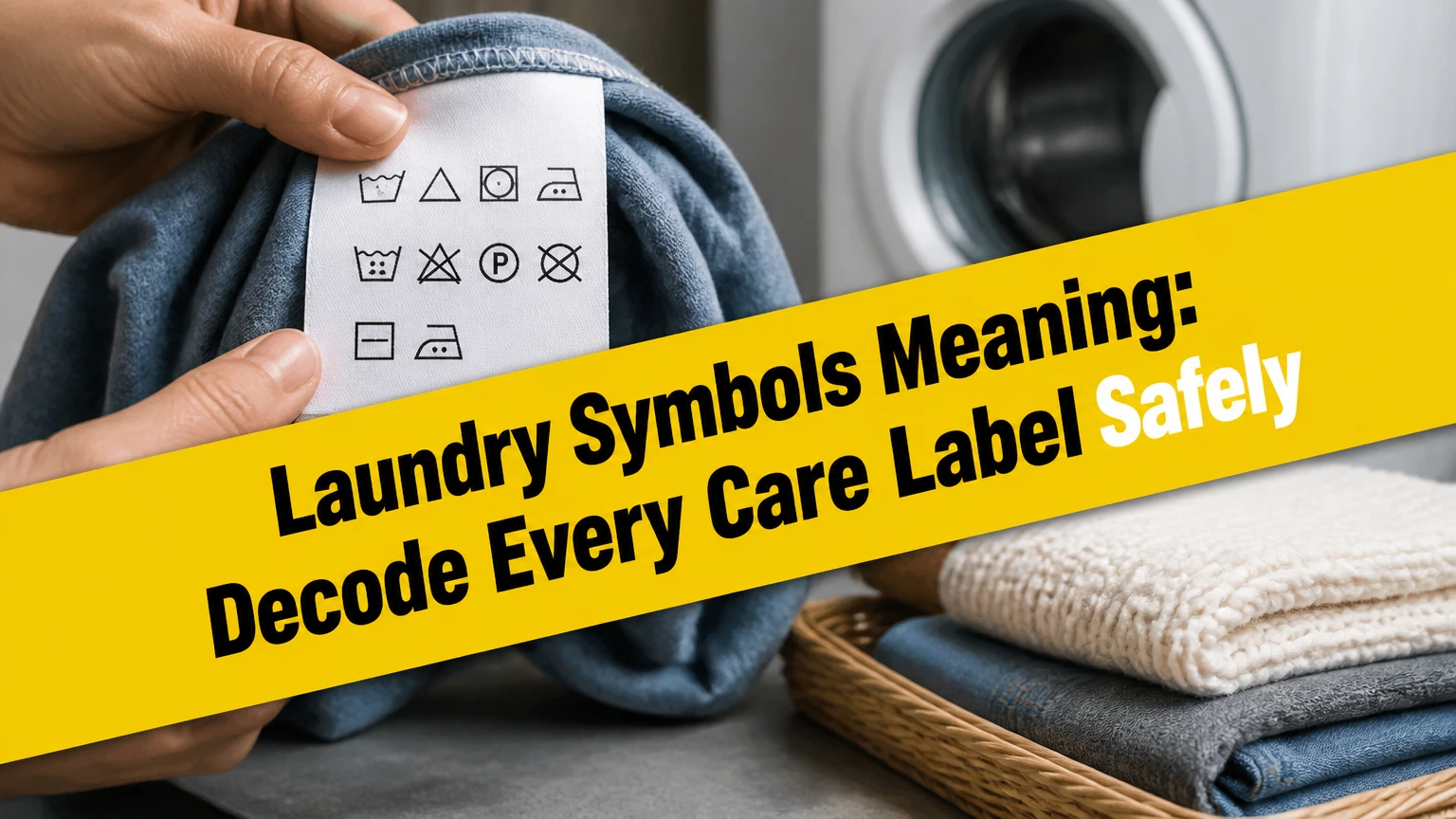
Laundry symbols are standardized care instructions that tell you how to wash, bleach, dry, iron, or professionally clean a textile. The five main symbols are a washtub, triangle, square, iron, and circle, while dots, numbers, bars, and X marks specify temperature, cycle intensity, or prohibited methods.
Key facts at a glance
- A washtub controls washing temperature and mechanical action.
- A triangle identifies which bleaching agents are permitted.
- A square describes natural drying or tumble drying.
- An iron symbol shows the maximum pressing temperature.
- A circle gives professional-cleaning instructions; a crossed circle means do not dry-clean.
- The safest setting is the most conservative instruction when symbols or fabric information conflict.
What Do Laundry Symbols Mean?
Laundry symbols are a visual language for textile care. Manufacturers place the symbols in a usual sequence: washing, bleaching, drying, ironing, and professional cleaning, although local regulations and label designs can vary.
The system is associated internationally with GINETEX, the International Association for Textile Care Labelling, and with national or regional standards such as ASTM care-label conventions in the United States. The symbols communicate maximum treatment limits, not performance targets. A garment labeled for 60°C may tolerate that temperature, but a colder wash usually reduces fading, fiber wear, and energy use.
The Federal Trade Commission describes the US requirement directly: “The Rule requires manufacturers and importers to attach care instructions to clothing.” A care label is therefore a garment-specific instruction, not merely a suggestion from a detergent brand.
How the five symbol families work
Each base shape answers a different care question. Modifiers then narrow the permitted treatment.
| Shape | Care category | Main question answered | Typical example |
|---|---|---|---|
| Washtub | Washing | Can water and machine action be used? | Machine wash at 40°C |
| Triangle | Bleaching | Which whitening chemicals are safe? | Oxygen bleach only |
| Square | Drying | How should moisture be removed? | Line dry in shade |
| Iron | Ironing | How much pressing heat is allowed? | Low-temperature ironing |
| Circle | Professional cleaning | Which commercial process is allowed? | Dry-clean with hydrocarbon solvent |
The sequence helps prevent a common mistake: reading the circle as a washing instruction. A circle addresses professional cleaning, while a crossed-out circle prohibits that route. Neither symbol alone confirms that home washing is safe.
How Do Dots, Numbers, Bars, and X Marks Change Meaning?
Dots and numbers indicate the maximum heat, bars reduce mechanical stress, and an X prohibits the treatment shown. A symbol without a bar generally permits the standard process for that care category, but the fabric, construction, and regional standard still matter.
Dots are common in North American labels and numbers are common in many international labels. A label showing “30” inside a washtub communicates a maximum wash temperature of 30°C, while one dot inside the same tub commonly communicates the same limit.
| Modifier | Meaning | Practical machine choice | Main risk if ignored |
|---|---|---|---|
| One dot | Low temperature | Cold or low-heat setting | Shrinkage, dye loss, melting |
| Two dots | Moderate temperature | Warm or medium setting | Fiber weakening and distortion |
| Three dots | High temperature | Hot setting where permitted | Fading, shrinkage, elastic damage |
| One bar below symbol | Reduced agitation | Permanent-press cycle | Creasing and seam stress |
| Two bars below symbol | Minimal agitation | Delicate or gentle cycle | Stretching and surface abrasion |
| X over symbol | Prohibited process | Select another care route | Permanent garment damage |
The label expresses a ceiling. If the garment permits 40°C, washing at 20-30°C can be gentler, provided detergent performance and hygiene requirements remain suitable. Bars are not decorative: a normal cycle can subject a delicate item to more agitation and spinning than its construction can tolerate.
What Do Washing Symbols on Clothing Mean?
A washing symbol is a washtub, and its contents indicate the permitted temperature or hand washing method. A plain tub generally means machine washing on a normal cycle, while bars, a hand, or an X modify the water and mechanical-action instruction.
The wash symbol does not specify detergent dosage, load size, or stain-treatment chemistry. Those decisions remain separate. Turn printed numbers into the same unit used by the washer, and select a cycle no harsher than the label permits.
| Washtub symbol | Maximum temperature | Cycle or method | Typical garments |
|---|---|---|---|
| Tub with 30 | 30°C / 86°F | Normal wash unless barred | Dark cotton, printed shirts |
| Tub with 40 | 40°C / 104°F | Normal or reduced-action wash | Everyday cotton, polyester blends |
| Tub with 60 | 60°C / 140°F | Normal wash if unbarred | Durable white cotton, towels |
| Tub with hand | Usually 40°C / 104°F or lower | Hand wash, no aggressive wringing | Wool, lingerie, delicate knits |
| Tub with one bar | Label temperature | Permanent-press or reduced-action cycle | Easy-care synthetics |
| Tub with two bars | Label temperature | Delicate or gentle cycle | Fine knits, lace, fragile blends |
| Tub with X | No water washing | Use a permitted professional route | Structured or solvent-only items |
What does a hand in the washtub mean?
A hand inside the washtub means hand wash only, usually at a maximum of 40°C, with limited soaking and gentle handling. Fill a basin, dissolve mild detergent, immerse the garment, press water through the fabric, rinse, and support the wet item during removal.
Do not twist wool, silk, or fine knits. Rolling the item in a clean towel removes excess water with less distortion than wringing. A hand-wash label does not automatically mean dry-clean only, and it does not authorize a washing-machine “hand-wash” cycle unless the manufacturer specifically permits that interpretation.
What does a crossed-out washtub mean?
A crossed-out washtub means do not wash with water, either by machine or by hand. Check the circle symbol and the fiber content before choosing professional cleaning, because the crossed tub does not by itself identify the correct solvent or cleaning process.
What Do Bleaching Symbols Mean?
A triangle determines whether bleaching is allowed and which type is acceptable. An empty triangle generally permits chlorine or non-chlorine bleach, a triangle with two diagonal lines permits non-chlorine oxygen bleach, and a crossed triangle prohibits all bleaching.
Bleach compatibility depends on both the label and the product formula. “Color-safe” marketing is not a substitute for the triangle instruction, especially on dark dyes, elastane, wool, silk, and coated fabrics.
| Triangle symbol | Permitted product | Chlorine bleach? | Suitable example |
|---|---|---|---|
| Empty triangle | Any bleach within product directions | Yes | White cotton towels |
| Triangle with two diagonal lines | Oxygen or other non-chlorine bleach | No | Colored cotton shirt |
| Triangle with CL | Chlorine bleach, older marking | Yes | Older white-workwear label |
| Crossed triangle | No bleach | No | Elastane, dyed wool, delicate prints |
Pretreat stains only after checking the triangle. If bleaching is prohibited, use a compatible detergent or enzyme pretreatment after testing an inconspicuous area. Never mix chlorine bleach with ammonia, acids, or oxygen products.
How Should Clothes Be Dried According to the Label?
A square describes natural drying, while a circle inside a square describes tumble drying. Dots inside the tumble-dry symbol set the heat level, bars reduce the cycle intensity, and an X means the garment should not enter a dryer at any heat.
Drying causes more irreversible damage than many wash cycles because heat combines with tumbling, tension, and repeated impact. Air drying is usually the lower-risk choice when the label allows it, but some garments require controlled tumble drying to maintain loft or shape.
| Drying symbol | Instruction | Typical time | Main precaution |
|---|---|---|---|
| Circle in square, no dots | Tumble dry, normal heat | 45-60 minutes | Remove promptly |
| One dot in circle | Tumble dry, low heat | 35-55 minutes | Avoid high-heat completion |
| Two dots in circle | Tumble dry, medium heat | 40-60 minutes | Check elastic and prints |
| Three dots in circle | Tumble dry, high heat | 45-70 minutes | Use only when explicitly allowed |
| Filled circle in square | Tumble dry without heat | 30-60 minutes | Requires airflow, not heat |
| Crossed circle in square | Do not tumble dry | 0 minutes | Line dry, drip dry, or flat dry |
| Square with vertical lines | Drip dry | 4-24 hours | Do not wring |
| Square with horizontal line | Flat dry | 6-24 hours | Shape while damp |
What are line-dry, drip-dry, flat-dry, and shade symbols?
A square with a curved upper line means line dry, a square with vertical lines means drip dry, and a square with a horizontal line means flat dry. Diagonal lines in the square’s upper corner add a shade requirement, which limits direct sunlight and reduces UV fading.
Flat drying matters for heavy or elastic materials. A wet wool sweater on a hanger can lengthen at the shoulders because water increases its weight while the hanger concentrates force at two points. Place the garment on a dry towel or mesh rack, reshape the seams, and turn it once during drying.
What Do Ironing Symbols Mean?
An iron symbol shows the maximum soleplate temperature: one dot is low, two dots are medium, and three dots are high. A crossed iron prohibits ironing, while crossed steam lines mean ironing is allowed without steam.
| Iron symbol | Maximum temperature | Common fabric examples | Safer technique |
|---|---|---|---|
| One dot | 110°C / 230°F | Acrylic, acetate, nylon | Press from the reverse side |
| Two dots | 150°C / 300°F | Wool, polyester, silk with care | Use a pressing cloth |
| Three dots | 200°C / 390°F | Cotton, linen | Iron while slightly damp |
| Crossed iron | No ironing | Heat-sensitive coatings | Hang or steam only if allowed |
| Crossed steam lines | No steam | Some synthetics and finishes | Dry iron at permitted heat |
Ironing temperature refers to the soleplate, not the garment’s internal temperature. A pressing cloth reduces direct heat and shine on dark wool, rayon, and synthetic blends. Test printed areas from the reverse side because a permitted temperature can still damage raised ink or bonded decoration.
What Do Circle Symbols for Dry Cleaning Mean?
A circle identifies professional cleaning, and letters inside the circle guide the cleaner toward a solvent or process family. “P” and “F” are common solvent codes, “W” indicates professional wet cleaning, and a crossed circle means do not dry-clean.
Letter meanings vary by standard and country, so cleaners should interpret the complete label rather than rely on a consumer chart. Perchloroethylene, often called perc, is regulated differently across jurisdictions, and a “P” label does not guarantee that every cleaner will use that solvent.
| Circle symbol | Process indication | Home washing implied? | Important limitation |
|---|---|---|---|
| Empty circle | Professional cleaning required | No | Cleaner selects process by material |
| Circle with P | Professional cleaning using permitted P solvents | No | Solvent rules vary by country |
| Circle with F | Hydrocarbon solvent family | No | Often used for more delicate items |
| Circle with W | Professional wet cleaning | No | Not the same as home washing |
| Circle with A | Any permitted solvent, older or uncommon code | No | Confirm current local practice |
| Crossed circle | Do not dry-clean | Not necessarily | Follow wash or wet-clean instructions |
An empty circle does not mean “do not wash.” It means professional cleaning is indicated, while the washtub tells you whether water washing is also permitted. When a garment has both a washable tub and a circle, the manufacturer may be identifying alternative care routes rather than requiring both.
Should You Wash, Air-Dry, or Use a Professional Cleaner?
Choose the least aggressive route that satisfies the label and the garment’s construction. Home washing is usually cheapest, air drying generally reduces heat damage, and professional cleaning is appropriate when the label or structured design rules out safe home care.
Professional cleaning is not automatically gentler. Solvents can affect plastic coatings, faux leather, adhesive trims, waterproof membranes, and some decorative finishes. Conversely, a tailored wool jacket may lose shape in a home washer even when the outer fabric appears washable.
| Care route | Typical direct cost | Typical elapsed time | Best use | Main failure risk |
|---|---|---|---|---|
| Home machine wash | $0.20-$1.50 per load | 30-90 minutes | Cotton, polyester, durable blends | Agitation and color transfer |
| Hand wash and flat dry | $0.50-$2.00 per item | 6-24 hours | Wool, lace, delicate knits | Stretching during handling |
| Low-heat tumble dry | $0.50-$2.00 per load | 35-70 minutes | Label-approved basics | Shrinkage and elastic fatigue |
| Line or shade dry | $0-$1.00 per item | 4-24 hours | Activewear, wool, silk | Stiffness, fading, stretching |
| Professional dry cleaning | Typically $5-$20+ per garment | 1-3 days | Suits, coats, structured dresses | Solvent or trim incompatibility |
| Professional wet cleaning | Typically $8-$25 per garment | 1-3 days | Items labeled with W | Moisture-related distortion |
Prices and times are typical consumer ranges, not universal rates. Geography, garment size, pressing, stain treatment, rush service, and cleaner equipment change the total.
How Do You Read a Confusing Care Label?
Read the label as a complete instruction set, then follow the most restrictive applicable limit. If a washable garment also has a low-heat drying symbol, washing may be routine but high-heat drying is not permitted.
Use this sequence:
- Identify the fiber and construction. Check for wool, silk, rayon, elastane, coated fabric, bonded seams, sequins, or underwires.
- Read the washtub. Record the temperature and count the bars beneath it.
- Read the triangle. Decide whether bleach is allowed, restricted to oxygen products, or prohibited.
- Read the square. Select tumble heat or a natural-drying method.
- Read the iron. Match dots and avoid steam when the lines are crossed.
- Read the circle. Give the cleaner every letter and prohibition.
- Resolve conflicts conservatively. Choose cold water, low agitation, no bleach, air drying, and no ironing until the manufacturer or cleaner confirms otherwise.
The care label can be incomplete or damaged. Photograph an intact label before cutting it out, search the brand’s care instructions using the garment style number, and contact the manufacturer when a high-value item has contradictory symbols.
What if the label and fabric seem to disagree?
Follow the label unless the label is obviously misprinted, but treat unusual fabric behavior as a warning. Rayon may be washable yet distort when wet, elastane may tolerate cold washing but deteriorate under repeated heat, and wool may be labeled hand-washable while still requiring flat drying.
Decorative components often control the care method. A cotton dress with glued rhinestones, foam cups, or a laminated finish may need gentler treatment than the fiber content alone suggests.
Which Settings Work Best for Wool, Silk, and Activewear?
Wool and silk need low mechanical stress, activewear needs low heat and residue control, and cotton can tolerate the widest range of settings when the label permits it. Fiber content predicts vulnerability, but the care symbols remain the final garment-specific authority.
| Garment or fiber | Wash starting point | Drying starting point | Avoid | Typical reason |
|---|---|---|---|---|
| Merino wool | Cold, hand or delicate cycle | Flat dry | Hot wash, wringing | Felting and length distortion |
| Silk blouse | Cold hand wash if allowed | Drip or flat dry in shade | Chlorine bleach, high heat | Water spots and weakened fibers |
| Cotton T-shirt | Cold or 30°C normal cycle | Low heat or line dry | Excessive hot drying | Shrinkage and print cracking |
| Polyester activewear | Cold, gentle cycle | Low heat or line dry | Fabric softener, high heat | Coating and elastane stress |
| Linen shirt | 30-40°C normal cycle | Line dry | Prolonged high heat | Shrinkage and deep creases |
| Elastane leggings | Cold, delicate cycle | Air dry | Hot dryer, chlorine bleach | Loss of stretch recovery |
A practical activewear rule is to avoid fabric softener even when the label does not expressly prohibit it. Softener can coat performance fibers and reduce moisture transport, while high heat can weaken elastane over repeated cycles.
What Are the Most Common Laundry-Symbol Mistakes?
The most damaging errors are treating a maximum temperature as a required temperature, substituting a gentle dryer setting for a crossed-out dryer, and hanging garments that require flat drying. Each mistake combines a symbol misunderstanding with a physical mechanism that can permanently change the garment.
Mistake 1: Treating “40” as the only safe wash setting
A 40°C maximum does not require a 40°C wash. Cold or 30°C washing is often safer for dark colors and blended fabrics, provided the detergent and hygiene needs are appropriate.
Mistake 2: Using low heat despite a crossed-out dryer
A crossed-out tumble-dry symbol prohibits the dryer, not merely high heat. Tumble movement can stretch straps, damage underwires, distort bonded seams, and abrade silk even when the air is cool.
Mistake 3: Hanging a sweater marked flat dry
A hanger concentrates the wet garment’s weight at the shoulders. Flat drying distributes that load and preserves the original dimensions.
Mistake 4: Assuming oxygen bleach is safe for every color
Oxygen bleach is milder than chlorine bleach but can still alter unstable dyes and finishes. Follow the triangle, dilute the product according to its label, and patch-test an inconspicuous area.
Mistake 5: Drying a stained garment before checking the result
Heat can set some stains and make color transfer harder to reverse. Inspect the item while damp, repeat compatible treatment, and dry only after the stain has improved.
Mistake 6: Applying a generic internet chart to a regional label
European, US, Canadian, Japanese, and Australian care systems use related shapes but may differ in temperature notation, professional-cleaning codes, or symbol details. Match the chart to the country of sale whenever possible.
How Can You Fix Common Fabric Damage?
Act before heat or extended drying sets the problem. Rewash color transfer while the garment is damp, reshape stretched knits during flat drying, and stop using heat on any item that has shrunk or lost elasticity.
For mild cotton or wool shrinkage, a 20-30 minute soak in lukewarm water with a small amount of hair conditioner is a commonly attempted home method, but results are uncertain and fiber damage may be permanent. Gently press out water, never wring, and reshape on a flat towel.
For color bleeding, keep the garment wet, separate it from other items, and rewash using a suitable detergent or color-transfer remover. Do not place it in a dryer until the color has been corrected. Chlorine bleach can worsen the result and is forbidden by many colored-garment labels.
For heat-damaged elastane, vinyl, or bonded fabric, recovery is rarely reliable. Stop further tumble drying and consult the manufacturer or a textile-care professional before applying solvents or ironing.
What Is the Safest Default Laundry Routine?
Use cold water, the gentlest permitted cycle, no bleach, low heat or air drying, and no ironing until the label establishes a less restrictive limit. This default reduces avoidable heat, agitation, and chemical exposure, but it does not replace a symbol that specifically requires professional care.
Sort by color, fiber behavior, and cycle severity rather than color alone. Place delicate items in a mesh bag, close zippers, turn printed garments inside out, and avoid overloading the washer because excess compression reduces rinsing and increases abrasion.
A simple workflow is:
- Separate lights, darks, reds, and lint-shedding fabrics.
- Sub-sort hand-wash, delicate, and normal-cycle items.
- Pretreat stains according to the bleach triangle.
- Select temperature from the tub and heat from the dryer square.
- Remove air-dry items immediately after washing.
- Reshape wool, knits, and molded garments before drying.
- Inspect the result before ironing or storing.
Laundry Symbols FAQ
Does a higher dot count always mean a better wash?
No. A higher dot count means the textile may tolerate a higher maximum temperature, not that hotter washing cleans it better. Cold or warm washing often preserves dye, elastic, coatings, and fiber strength, while heavily soiled or hygiene-sensitive items may require the highest labeled setting.
Does a circle mean dry-clean only?
A blank circle indicates professional cleaning, but it does not alone prove that home washing is forbidden. Check the complete label for a washtub, an X, and fabric-specific warnings. A crossed-out circle means do not dry-clean, even if another care route is permitted.
Can I use a washing-machine delicate cycle for a hand-wash item?
Not automatically. A hand symbol specifies hand washing, and machine cycles still apply mechanical action that can stretch or felt sensitive fibers. Use a machine only when the garment maker explicitly confirms that its delicate or wool program is an acceptable equivalent.
What does a square with two diagonal lines mean?
Two diagonal lines in the upper corner of a square mean dry in the shade. The garment may still be line dried, drip dried, or flat dried according to the other lines inside the square, but direct sunlight should be avoided to limit fading.
Are laundry symbols the same in every country?
The basic shapes are widely recognizable, but details vary by regional standard and labeling law. Temperature numbers, professional-cleaning letters, and natural-drying graphics may differ. When a garment was imported, use the manufacturer’s country-specific instructions rather than relying on a generic US or European chart.
Is air drying always safer than tumble drying?
Air drying usually reduces heat shrinkage and elastic fatigue, but it can stretch a wet knit if the garment is hung incorrectly. Follow the square symbol: flat dry heavy knits, drip dry items that must not be wrung, and line dry only when the construction can support its wet weight.
The Bottom Line
Laundry symbols meaning becomes straightforward when each shape is read as a care category and each modifier is treated as a limit. Match the washtub to water temperature and agitation, the triangle to bleach chemistry, the square to drying method and heat, the iron to pressing temperature, and the circle to professional-cleaning requirements. When uncertain, choose the least aggressive permitted process and verify conflicting instructions with the garment manufacturer.