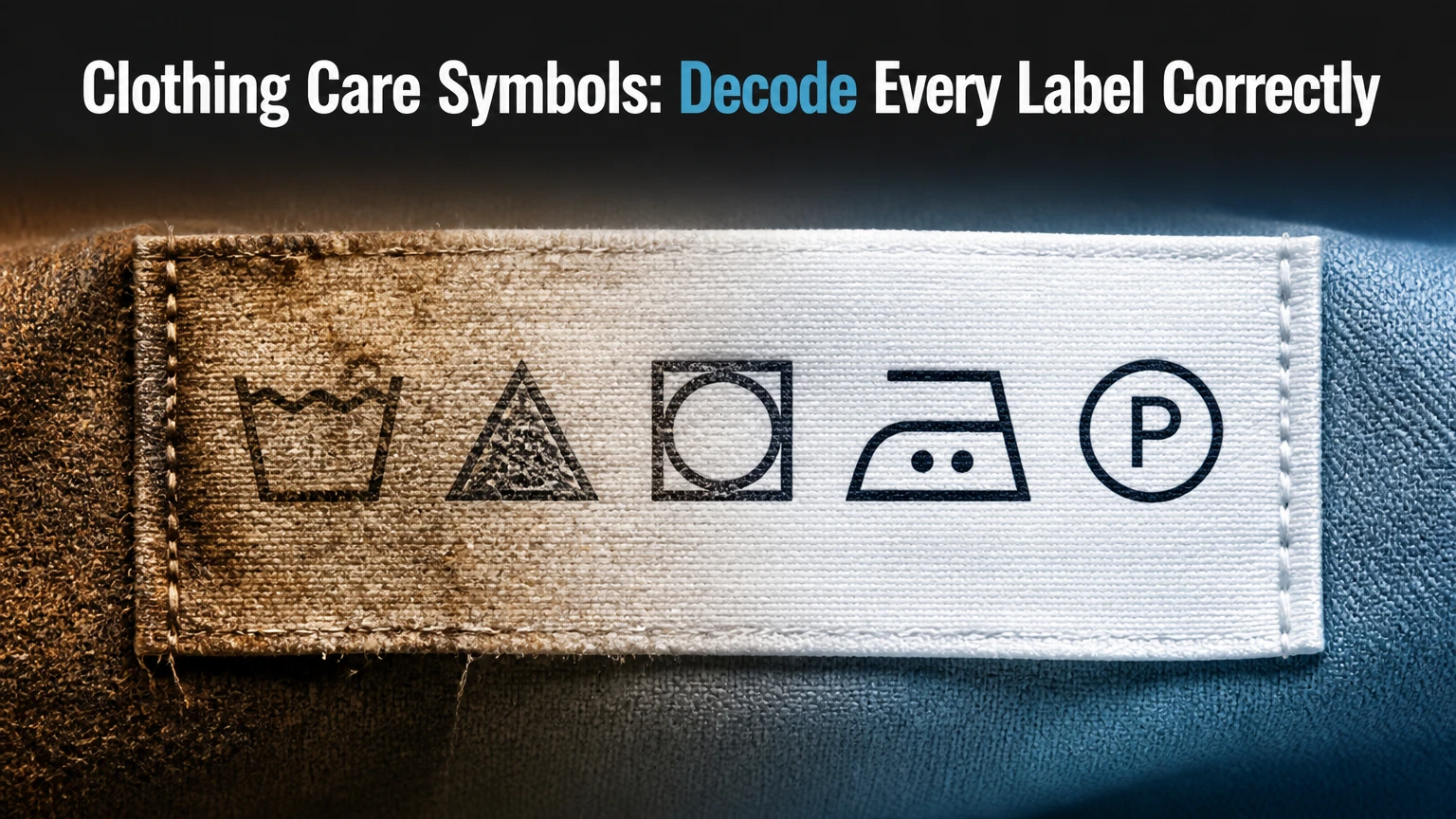
Clothing care symbols are standardized pictograms on textile labels that state the maximum safe treatment for washing, bleaching, drying, ironing, and professional care. The symbol shape identifies the process, while numbers, dots, lines, and crossed-out marks modify temperature, mechanical action, or permission. Read the complete symbol sequence before selecting a cycle.
Key facts
- The washtub represents washing, the triangle represents bleaching, the square represents drying, the iron represents ironing, and the circle represents professional care.
- A crossed-out symbol prohibits only the process shown, not every form of garment care.
- A care-label temperature is generally a maximum limit, so a cooler setting is usually permissible when cleaning performance remains adequate.
- One or two bars under a washtub reduce mechanical action and commonly require a permanent-press or delicate cycle.
- A circle inside a square means tumble drying; a plain circle means professional cleaning.
- ISO 3758 defines the international care-symbol system, while regional rules and trademark practices can alter labels.
What Are Clothing Care Symbols?
Clothing care symbols are visual instructions that translate textile-processing limits into a compact label. The accepted terms include care symbols, laundry symbols, textile-care symbols, and care-label symbols. “Graphtextiles” is not the standard name for the system.
The symbols communicate the treatment a garment can withstand without unacceptable shrinkage, color loss, distortion, seam damage, or surface change. They do not guarantee that a stain will disappear, and they do not identify the best possible treatment in every situation.
ISO 3758:2023 provides the international framework for care labelling using symbols. GINETEX administers the internationally recognized trademark system used in many markets, while the American Society for Testing and Materials, commonly called ASTM International, publishes relevant US care-label standards and guidance. A label may therefore look familiar while using different regulatory wording or symbol conventions.
What do the five basic shapes mean?
The five core shapes identify the process before any internal mark is interpreted.
| Shape | Process | Typical question answered | Example |
|---|---|---|---|
| Washtub | Washing | Can water and mechanical washing be used? | Tub with 40 means wash at 40°C maximum |
| Triangle | Bleaching | Is chemical bleaching permitted? | Triangle with two lines means non-chlorine bleach |
| Square | Drying | How may moisture be removed? | Square with one horizontal line means dry flat |
| Iron | Ironing | How much heat is permitted? | Iron with two dots means medium heat |
| Circle | Professional care | May a cleaner use a specified process? | Circle with P indicates a professional solvent category |
The order commonly printed on labels is washing, bleaching, drying, ironing, and professional care. A missing symbol does not automatically mean the process is safe. It means the manufacturer has not supplied that instruction in the visible sequence.
How Do You Decode a Care Label?
To decode a care label, identify the process shape, read its temperature or solvent modifier, check bars and internal lines, and obey any crossed-out mark. Start with the most restrictive instruction because one prohibited treatment can cause irreversible damage even when other processes are allowed.
- Identify the shape. Determine whether the instruction concerns water washing, bleach, drying, ironing, or professional cleaning.
- Read numbers or dots. A number inside a tub states a maximum temperature in Celsius. Dots express a temperature category.
- Count bars beneath the symbol. No bar usually means normal mechanical action, one bar means reduced action, and two bars mean very gentle action.
- Check internal lines. Lines inside a square describe natural drying, while lines beneath an iron can restrict steam.
- Treat an X as a prohibition. A crossed-out tub means do not wash. A crossed-out triangle means do not bleach.
- Apply the strictest practical combination. For example, a 30°C tub with two bars requires a low-temperature delicate cycle, not a normal 30°C cycle.
Care symbols describe the garment’s permitted processing boundary, not necessarily the setting that gives the best result. A heavily soiled cotton shirt marked 60°C can often be washed at 30°C, but lower heat may not remove body oils or pathogens as effectively.
What Do Washing Symbols Mean?
Washing symbols show whether a garment may be washed in water, how hot the water may be, and how much agitation the textile can tolerate. The tub is the most important symbol for routine laundry because temperature and mechanical action independently affect fiber damage.
| Washing symbol feature | Meaning | Maximum or action | Typical setting |
|---|---|---|---|
| Tub with 30 | Machine wash | 30°C maximum | Cold or 30°C mixed-fabric cycle |
| Tub with 40 | Machine wash | 40°C maximum | 30-40°C cotton or synthetic cycle |
| Tub with 60 | Machine wash | 60°C maximum | 40-60°C cotton cycle when needed |
| One bar under tub | Reduced action | Lower agitation and spin | Permanent-press or easy-care cycle |
| Two bars under tub | Very reduced action | Gentle agitation and spin | Delicate or wool cycle |
| Hand in tub | Hand wash | Temperature shown, often 30°C or 40°C | Short soak, minimal rubbing |
| Crossed-out tub | Do not wash | No water-washing process | Professional assessment |
How do temperature dots work?
Temperature dots are category markers, not universal exact temperatures across every process. In the ISO laundry convention, one dot generally indicates 30°C, two dots 40°C, three dots 50°C, four dots 60°C, five dots 70°C, and six dots 95°C; the exact printed number takes priority when both systems differ.
Ironing dots use a separate heat scale: one dot is approximately 110°C, two dots 150°C, and three dots 200°C at the iron soleplate. The two dot systems should never be merged. A single dot in a washtub is not an 110°C wash instruction.
What do underlines under a tub change?
Underlines reduce mechanical stress rather than lowering the stated water temperature. One bar normally calls for a permanent-press or reduced-action cycle, while two bars call for a delicate or very gentle cycle with reduced agitation and spin.
A 40°C tub with one bar can tolerate 40°C water but not the same tumbling and spin force as an unlined 40°C tub. A frequent professional mistake is selecting the correct temperature while ignoring the cycle architecture. That still stretches knits, roughens printed surfaces, and increases pilling.
What Do Bleaching Symbols Mean?
The triangle identifies bleaching instructions. An empty triangle permits any permitted textile bleach, a triangle with two diagonal lines allows non-chlorine oxygen bleach, and a crossed-out triangle prohibits bleaching with chlorine, oxygen, or other chemical whitening products.
| Triangle mark | Permitted treatment | Common product category | Main risk if ignored |
|---|---|---|---|
| Empty triangle | Any bleach allowed | Chlorine or oxygen bleach | Excess oxidation on weak fibers |
| Two diagonal lines | Non-chlorine bleach only | Oxygen, color-safe bleach | Chlorine yellowing or fiber damage |
| Crossed-out triangle | No bleach | Detergent without bleach additives | Color loss, weakening, or spots |
| No visible triangle | Follow supplied label text | Manufacturer-specific instruction | Incorrect assumption about bleach safety |
Oxygen bleach is not automatically harmless. Concentration, soaking time, dye stability, and water temperature still matter. Chlorine bleach can weaken elastane, nylon, wool, silk, and some garment finishes even when a stain appears to require stronger treatment.
Test an unfamiliar colorfastness situation on an inside seam, but do not interpret a successful spot test as permission for repeated bleaching. Oxidation damage can accumulate invisibly before a seam or elastic component fails.
How Should You Interpret Drying Symbols?
Drying symbols use a square as their outer shape. A circle inside the square governs tumble drying, while lines inside an empty square describe natural drying by hanging, dripping, or laying flat.
| Square symbol feature | Meaning | Suitable method | Main control |
|---|---|---|---|
| Square with circle | Tumble dry permitted | Dryer | Dot count controls heat |
| Square with crossed-out circle | Do not tumble dry | Line, drip, or flat dry | Avoid heated drum action |
| Square with one vertical line | Line dry | Hang vertically | Support garment while wet |
| Square with two or more vertical lines | Drip dry | Hang without wringing | Let excess water drain |
| Square with one horizontal line | Dry flat | Lay on a level surface | Prevent stretching |
| Square with diagonal corner line | Dry in shade | Shade line or flat drying | Reduce UV fading |
A square with a circle and one dot usually indicates low tumble-drying heat. Two dots indicate normal heat in many systems, but the appliance’s “low” and “medium” labels do not always correspond perfectly to ISO categories. Select the lowest effective dryer temperature and remove the garment while slightly damp when shape retention matters.
Is tumble drying the same as dry cleaning?
Tumble drying and dry cleaning are different processes. Tumble drying uses a rotating drum, air, and controlled heat to remove water; dry cleaning uses a professional liquid solvent or professional wet-cleaning process and is represented by a plain circle.
Confusing the two symbols is especially damaging for tailored garments. A circle inside a square permits a home dryer under the stated conditions, whereas a plain circle directs professional-care handling. A crossed-out circle inside a square prohibits tumble drying but does not necessarily prohibit professional cleaning.
What Do Ironing Symbols Mean?
The iron symbol specifies the maximum heat level, and dots indicate approximate temperature classes. One dot represents low heat near 110°C, two dots medium heat near 150°C, and three dots high heat near 200°C; use the garment label and iron manufacturer’s settings together.
| Iron mark | Approximate maximum | Common textile examples | Safer practice |
|---|---|---|---|
| One dot | 110°C | Acetate, acrylic, nylon | Iron inside out through a pressing cloth |
| Two dots | 150°C | Polyester, wool, silk blends | Use low pressure and test a hidden area |
| Three dots | 200°C | Cotton, linen | Iron while slightly damp if permitted |
| Crossed-out iron | Do not iron | Heat-sensitive finishes or fabrics | Reshape while damp or use professional advice |
| Crossed-out steam symbol | No steam | Water-sensitive surfaces | Use a dry iron at the allowed temperature |
The iron temperature is a ceiling, not a target. Direct contact can create shine on wool, melt thermoplastic synthetics, or transfer adhesive from prints before the thermostat visibly reaches its maximum.
What Do Professional-Care Circles Mean?
Professional-care circles tell a dry cleaner which process category is suitable, rather than giving consumers a solvent recipe. A plain circle generally indicates professional dry cleaning, letters identify permitted solvent families, and a W indicates professional wet cleaning.
| Circle mark | Meaning | Who interprets it | Consumer action |
|---|---|---|---|
| Empty circle | Professional dry cleaning allowed | Dry cleaner | Present garment and label |
| Circle with P | Professional solvent category P | Dry cleaner | Do not select solvent yourself |
| Circle with F | Professional hydrocarbon solvent category | Dry cleaner | Tell cleaner about stains and trims |
| Circle with W | Professional wet cleaning | Wet-cleaning specialist | Request professional wet cleaning |
| Crossed-out circle | Do not dry clean | Consumer and cleaner | Use another permitted method |
P commonly refers to a professional solvent category that can include tetrachloroethylene and specified hydrocarbons under the applicable standard. F indicates a different, more restricted hydrocarbon-solvent category. Actual solvent selection depends on the current standard, machine, garment construction, dyes, buttons, interlinings, and local regulations.
The label does not promise stain removal. Oil-based stains often respond well to professional solvent cleaning, while water-soluble food or beverage stains may need pretreatment and may not disappear if heat has set them.
Which Washing Method Fits Each Label?
The best washing method is the least aggressive process that removes the actual soil. Normal cycles clean efficiently but create greater agitation, permanent-press cycles reduce creasing and stress, and delicate or hand-wash cycles protect fragile structures at the cost of lower mechanical cleaning.
| Method | Typical temperature | Typical duration | Mechanical action | Best use |
|---|---|---|---|---|
| Normal cotton cycle | 30-60°C | 60-150 minutes | High agitation, higher spin | Towels, sturdy cotton, denim |
| Permanent press | 30-40°C | 45-100 minutes | Reduced agitation and spin | Polyester shirts, blended trousers |
| Delicate cycle | 20-30°C | 30-70 minutes | Gentle action, low spin | Lace, viscose, fine synthetics |
| Hand wash | 20-40°C | 5-20 minutes of handling | Minimal manipulation | Silk, embellished items, fragile knits |
| Professional cleaning | No home-water temperature | 1-3 days typical turnaround | Specialist process | Structured jackets, tailored coats |
Professional cleaning is not automatically gentler. Solvents can affect coatings, plastics, prints, and hidden adhesives, while water can distort structured garments. Follow the circle instruction and disclose stains, repairs, and previous treatments to the cleaner.
How Do You Choose a Setting Below the Maximum?
Choose a cooler temperature, shorter cycle, lower spin, and air-drying method when the garment is lightly soiled and the label permits that process. Lower heat reduces energy use and often slows fading, shrinkage, elastane degradation, and surface abrasion, but hygiene and stain-removal requirements can justify a higher permitted setting.
A practical decision sequence is:
- Classify the soil. Everyday dust needs less intensity than grease, body oils, fecal matter, or infectious contamination.
- Protect the color. Turn dark garments inside out and use a detergent designed for colors.
- Match agitation to the label. Never replace a two-bar delicate cycle with a normal cycle simply because both use 30°C water.
- Use the lowest effective spin. High spin shortens drying time but can crease or stretch viscose, wool, and knitwear.
- Air dry when the square permits it. Shape the garment before drying, especially shoulder seams, cuffs, and waistbands.
A lower temperature is an alternative to the labeled maximum, not an alternative to a prohibited process. A garment marked do not tumble dry still requires air drying even when the dryer is set to low heat.
What Are the Most Common Care-Label Mistakes?
Most laundry damage comes from combining individually permissible settings into an excessively aggressive program. Correct temperature alone does not protect a garment when agitation, spin, bleach, steam, or drying heat violates another part of the label.
- Ignoring bars: A one-bar tub washed on a normal cycle may develop pilling, seam distortion, or stretched elastic.
- Confusing circles: A square with a circle means tumble drying, while a plain circle means professional care.
- Using chlorine bleach on nylon: Chlorine can weaken nylon and elastane even when the fabric is white.
- Drying knits vertically: Waterlogged wool or viscose can lengthen under its own weight; dry flat when the square requires it.
- Ironing prints directly: Heat can soften or transfer graphics, especially on polyurethane-backed designs.
- Overloading the drum: A full drum reduces water movement and increases rubbing, leaving detergent residue and uneven cleaning.
- Leaving wet laundry in the machine: Typical odor development begins within several hours in warm, poorly ventilated conditions.
How can you recover from laundry damage?
Act quickly, but do not apply a second aggressive treatment before identifying the cause. A garment that has been heat-set, melted, or chemically weakened may not be restorable.
| Failure | First response | Typical recovery outlook | Avoid |
|---|---|---|---|
| Dye transfer | Rewash before drying with color-run remover | Often reversible if still wet | Dryer heat |
| Wool shrinkage | Reshape damp fabric and dry flat | Partial recovery may occur | Hot water and force |
| Cotton shrinkage | Rewet and gently stretch | Limited, fiber-dependent recovery | Repeated hot drying |
| Melted polyester | Stop heating and trim only loose damage | Usually irreversible | More ironing |
| Iron shine on wool | Steam lightly from reverse side | Often improves | Direct high heat |
| Detergent residue | Rinse with correct load size | Usually reversible | Excess detergent |
Baby shampoo is sometimes suggested for relaxed wool, but evidence and results vary by fiber, knitting, and finishing treatment. Do not stretch aggressively, because distortion can become permanent even when some length returns.
What Should You Do When a Label Is Missing or Conflicting?
When a care label is missing, unreadable, or inconsistent with the fabric, use the most conservative plausible treatment and inspect construction before washing. Cold water, a short gentle cycle, low spin, and flat or shaded drying reduce risk, but they cannot guarantee safety for an unknown textile.
Use these safeguards:
- Check the fiber-content label, product page, or manufacturer instructions.
- Inspect for lining, fusible interlining, leather trim, sequins, bonded seams, and color-blocked panels.
- Test water and colorfastness on an inconspicuous area.
- Avoid bleach, high heat, and tumble drying until the material is identified.
- For vintage, tailored, beaded, or sentimental garments, obtain a cleaner’s assessment.
Fiber content does not replace the care label. A “100% cotton” garment may contain resin finishes, unstable dyes, printed coatings, or construction details that require gentler care than plain cotton fabric.
How Can You Extend Garment Life?
The most reliable garment-care strategy is to wash less often when odor and soil do not require washing, use the lowest effective mechanical action, and prevent heat damage. Airing, spot cleaning, brushing, and prompt stain treatment reduce full laundering without overriding hygiene needs.
Turn dark clothing inside out, close zippers, empty pockets, and wash similar textures together. Mesh bags can reduce snagging, but they do not convert a normal cycle into a delicate cycle. Separate lint-producing towels from synthetic performance fabrics, which readily attract loose fibers.
For sustainability, cold or 30°C washing and air drying often reduce energy consumption compared with hot washing and heated tumble drying. The environmental result also depends on detergent, machine efficiency, load size, drying climate, and garment lifespan. Extending a garment’s usable life can matter more than optimizing a single wash.
Frequently Asked Questions
Can I wash a garment marked dry clean only?
No, not safely by default. A plain circle directs professional care because water, agitation, or drying may distort the garment, bleed dyes, shrink fibers, or damage interlinings. Some cleaners may recommend hand washing after inspecting the item, but that decision depends on construction and cannot be inferred from fiber content alone.
What does a crossed-out triangle mean?
A crossed-out triangle means do not bleach. Avoid chlorine bleach, oxygen bleach, whitening soaks, and detergents containing bleaching agents unless the manufacturer provides a separate exception. Use a suitable detergent and treat stains with a method confirmed for the garment’s fiber and dye.
Is 30°C always safer than 40°C?
No. Temperature is only one source of damage. A 30°C normal cycle can abrade a delicate garment more than a 40°C gentle cycle, while repeated low-temperature washing may leave grease or body oils behind. Match temperature, agitation, spin, detergent, and drying method as a complete system.
What does a square with a circle and two dots mean?
A square containing a circle with two dots means tumble drying is allowed at the standard or medium heat category defined by the applicable care-symbol system. Remove the garment promptly, avoid over-drying, and choose a lower appliance setting when the fabric or finish is heat-sensitive.
Can I use fabric softener on every washable garment?
No. Fabric softener can reduce absorbency in towels, affect moisture-management finishes, coat microfiber surfaces, and interfere with flame-resistant or performance textiles. Follow the garment and detergent-maker instructions, and omit softener when the item’s technical finish or care guidance advises against it.
Do clothing care symbols apply worldwide?
The core pictograms are widely harmonized through ISO 3758, but legal labeling requirements, trademark administration, terminology, and appliance conventions vary by market. GINETEX systems are common in Europe and elsewhere, while ASTM standards influence US practice. When a local text instruction conflicts with a familiar symbol, follow the manufacturer’s complete instructions and seek clarification.
The Bottom Line
Clothing care symbols convert washing, bleaching, drying, ironing, and professional-cleaning limits into a standardized visual language. Read the shape first, then the temperature, dots, bars, internal lines, and crossed-out marks; treat every instruction as part of one combined process. The safest routine uses the lowest effective temperature and mechanical action, avoids prohibited treatments, and air-dries whenever the label permits it. Understanding clothing care symbols prevents avoidable shrinkage, fading, pilling, melting, and distortion while preserving the garment’s intended performance.