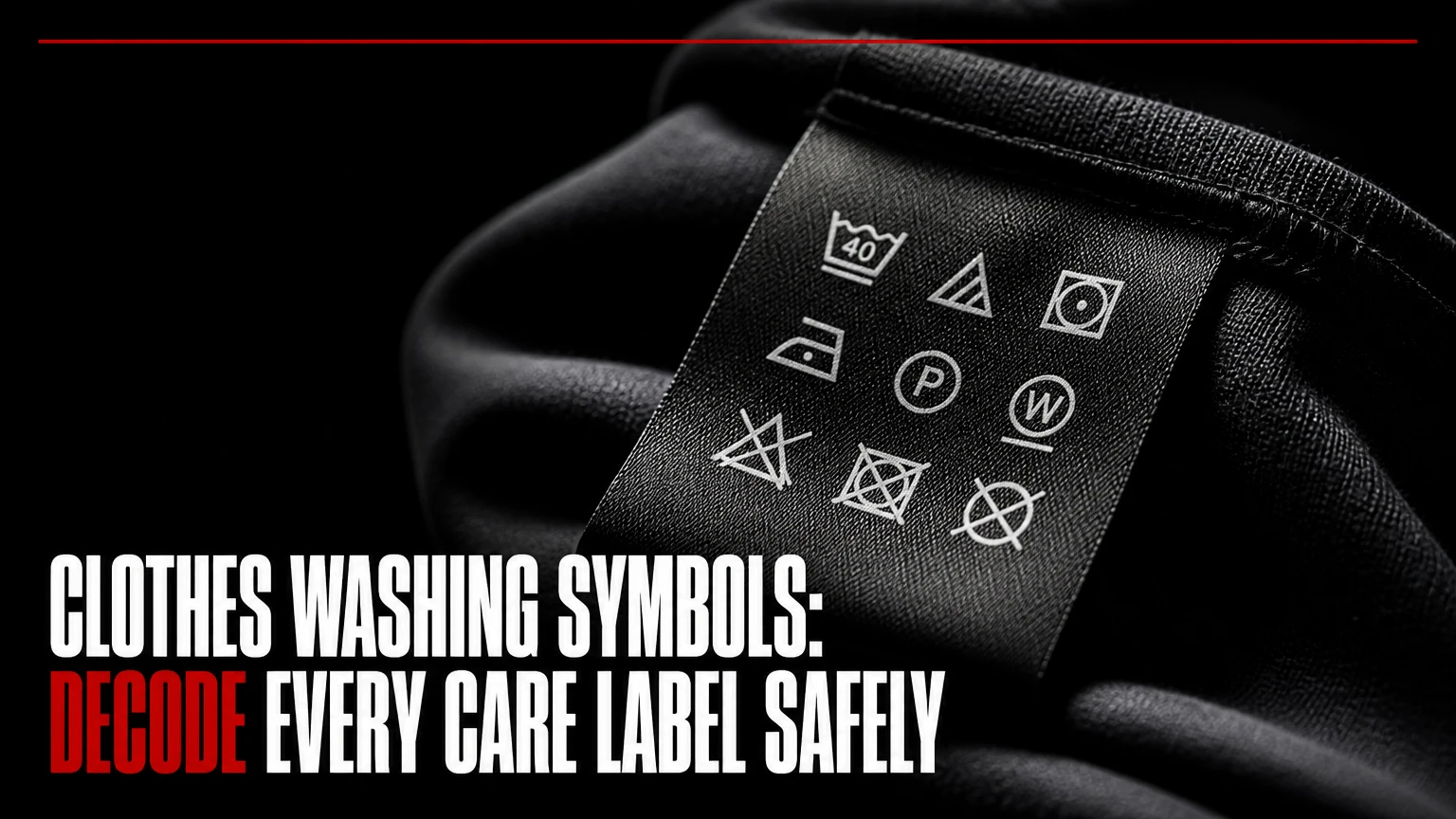
Clothes washing symbols are standardized care-label icons that specify how a garment may be washed, bleached, dried, ironed, or professionally cleaned. Read the symbol shape first, then its dots, lines, letters, or cross. The safest routine follows the most restrictive instruction on the label and uses a lower temperature when the standard is unclear.
Key facts
- Care labels normally appear in this order: washing, bleaching, drying, ironing, and professional care.
- A cross through a symbol means do not perform that treatment.
- Dots indicate heat or water-temperature limits, while lines under a symbol indicate a gentler process.
- A square means drying; a circle inside the square means tumble drying.
- A circle identifies professional cleaning, while letters specify permitted cleaning processes or solvents.
- Garment care symbols describe tested treatment limits, not guaranteed stain removal or perfect color retention.
What Are Clothes Washing Symbols?
Clothes washing symbols are a visual language printed or sewn into garments to communicate care limits across languages. The five main categories are a washtub for washing, triangle for bleaching, square for drying, iron for ironing, and circle for professional care.
The symbols protect different parts of a garment’s construction. Water temperature affects dye stability and shrinkage, agitation creates abrasion, heat weakens elastane, and solvent choice can damage coatings, adhesives, or surface finishes. A label therefore describes a treatment combination rather than the fiber name alone.
The system is international, but its exact presentation depends on the market. GINETEX administers the familiar care-symbol trademark system used widely in Europe, while ASTM International publishes textile-care labeling standards used in North America. The United States Federal Trade Commission also requires manufacturers and importers to provide care instructions under the Care Labeling Rule.
A symbol is a maximum limit. A garment labeled for 40°C washing can usually be washed at 30°C, but a garment labeled for 30°C should not be routinely washed at 40°C.
How Do You Read a Care Label?
Read a care label from left to right, beginning with the symbol shape and then checking modifiers. The standard sequence is washing, bleaching, drying, ironing, and professional care, although small labels may omit categories that do not apply.
Use this five-step method
- Find the complete label. Check the side seam, back neck, waistband, or a printed inner panel. Some garments use a second label for fiber composition and country of manufacture.
- Identify the shape. A tub concerns water washing; a triangle concerns bleach; a square concerns drying; an iron concerns pressing; a circle concerns professional care.
- Read temperature marks. Numbers state degrees Celsius in many systems. Dots represent heat levels, but their exact values depend on the symbol category and regional standard.
- Check lines and crosses. One line generally reduces mechanical action, two lines indicate a more delicate process, and a cross prohibits the treatment.
- Follow the strictest instruction. If a blouse is machine washable but must dry flat, machine wash it and then avoid the dryer.
A care label should be interpreted alongside fiber content, garment structure, trims, and color. A cotton shirt with glued lettering needs more caution than a plain woven cotton shirt with the same wash symbol.
What Do the Washing Symbols on Clothes Mean?
The washtub symbol describes water-based laundering, including machine washing and hand washing. The number or dots set the maximum water temperature, while lines under the tub reduce agitation and spinning.
| Washing icon feature | Meaning | Practical setting | Typical garments |
|---|---|---|---|
| Empty tub | Machine wash permitted | Normal cycle at labeled temperature | Cotton T-shirts, towels |
| Tub with one line | Reduced mechanical action | Permanent-press or synthetics cycle | Polyester shirts, blends |
| Tub with two lines | Very gentle mechanical action | Delicate or wool cycle | Lace, fine knits, rayon |
| Hand in tub | Hand wash | Cool or warm water, gentle handling | Silk blends, decorated garments |
| Crossed tub | Do not wash in water | Professional care or spot treatment | Structured tailoring, solvent-sensitive pieces |
| “30” or one dot | Maximum 30°C, about 86°F | Cold wash | Dark colors, elastane garments |
| “40” or two dots in some systems | Maximum 40°C, about 104°F | Warm wash | Everyday synthetics and cottons |
| “60” or a higher number | Maximum 60°C, about 140°F | Hot wash when needed | Durable whites, towels, bedding |
Temperature conventions require care. The AI Overview’s simple one-dot, two-dot, three-dot progression is useful as a general guide, but it is not universal for every label system. Numeric temperatures are more precise, and a wash symbol with no number or dots may rely on the standard used in that country.
What does one line under the wash tub mean?
One line under a wash tub means reduced agitation and reduced spinning, normally corresponding to permanent press or synthetic-cycle treatment. The setting protects fabrics that crease, stretch, or lose shape under a full-strength cotton cycle.
A permanent-press cycle often uses moderate agitation, a cooler rinse, and a controlled spin. It is not the same as cold water. Water temperature and mechanical intensity are separate instructions, so check both.
What does two lines under the wash tub mean?
Two lines under a wash tub indicate a very gentle cycle with limited agitation and spinning. Use a delicate, wool, or equivalent low-action program, depending on the garment’s fiber and the washing-machine manual.
The symbol does not automatically mean “hand wash.” It means the garment may tolerate a machine process with especially low mechanical action. Place loose or fragile garments in a mesh bag and avoid overloading the drum.
Is a hand-wash garment safe in a washing machine?
A hand-wash garment is not guaranteed to be safe in a washing machine, even on a delicate setting. Hand washing removes the high-speed agitation and twisting that can distort wool, silk, lace, beading, and loosely constructed knits.
Use water at or below the label temperature, dissolve detergent before adding the garment, soak for the product’s recommended period, and press water out without wringing. A towel roll can remove moisture before reshaping.
What Do Bleaching Symbols Mean?
The triangle symbol states whether bleaching is allowed and which type is suitable. An empty triangle permits chlorine or non-chlorine bleach under the product’s instructions, a triangle with two diagonal lines permits non-chlorine oxygen bleach, and a crossed triangle prohibits bleach.
| Triangle symbol | Bleach instruction | Suitable approach | Main risk |
|---|---|---|---|
| Empty triangle | Any bleach permitted | Use chlorine or oxygen bleach as directed | Overconcentration can weaken fibers |
| Triangle with two diagonal lines | Non-chlorine bleach only | Use color-safe oxygen bleach | Chlorine can strip dye or damage elastane |
| Crossed triangle | Do not bleach | Use detergent and approved stain treatment | Yellowing, holes, or permanent fading |
| No bleach symbol shown | Follow label wording | Treat cautiously until confirmed | Missing information is not permission |
Never mix chlorine bleach with ammonia, acids, vinegar, or acidic toilet products. Chemical reactions can release hazardous gases. Chlorine bleach is particularly risky for wool, silk, nylon, spandex, and garments containing metallic trims.
“Color-safe” does not mean harmless to every fabric. Oxygen bleach can still affect dyes, finishes, and printed surfaces, so test a hidden area when the label allows non-chlorine bleach but the garment is valuable.
What Do Drying Symbols Mean?
Drying symbols use a square, with a circle inside the square indicating tumble drying. Dots set dryer heat, lines describe gentler tumble treatment, and a plain square with lines or a curved mark describes air drying.
| Drying symbol feature | Meaning | Recommended action | Typical consequence if ignored |
|---|---|---|---|
| Square with circle | Tumble dry permitted | Use the labeled heat level | Excess heat can shrink or deform |
| Circle with one dot | Low dryer heat | Low-temperature or delicate setting | Elastane and synthetics may weaken |
| Circle with two dots | Medium dryer heat | Medium heat for durable blends | Repeated heat can fade and thin fabric |
| Circle with three dots | High dryer heat | High heat only when labeled | Greater shrinkage and fiber breakdown |
| Crossed square with circle | Do not tumble dry | Line dry, drip dry, or dry flat | Shrinkage, melting, or distortion |
| Square with one horizontal line | Dry flat | Support garment horizontally | Wet weight can stretch shoulders |
| Square with three vertical lines | Drip dry | Hang while water drains naturally | Wringing can deform fabric |
| Square with curved line | Line dry | Hang on a suitable line or hanger | Direct sun can fade sensitive dyes |
| Square with corner shading | Dry in shade | Air dry away from direct sunlight | UV exposure can bleach colors |
A filled circle inside the tumble-dry symbol is commonly associated with no heat or air-fluff drying in some labeling systems. Because conventions vary, follow the garment’s written instructions or manufacturer guidance when the icon is unfamiliar.
Why does “dry flat” matter?
“Dry flat” matters because wet fabric becomes heavier and more deformable, allowing gravity to stretch shoulders, cuffs, and side seams. Wool, cashmere, viscose, and loosely knitted garments are especially vulnerable.
After washing, support the garment from underneath, press out water with a towel, reshape the body and sleeves, and place it on a ventilated horizontal rack. Do not hang a heavy wet sweater from its shoulders.
Can you tumble dry clothes marked line dry?
You should not routinely tumble dry clothing marked for line drying because the label has not authorized the dryer’s heat and repeated mechanical action. A short, unheated air-fluff cycle may be acceptable for some garments, but only when the fabric, trims, and care instructions support it.
Air drying usually takes 4-24 hours, depending on humidity, airflow, fabric weight, and garment density. Turn dark garments inside out and avoid direct sun when the label specifies shade drying.
What Do Ironing Symbols Mean?
The iron symbol indicates the maximum soleplate temperature, represented by one, two, or three dots. One dot is low heat, two dots are medium heat, and three dots are high heat, while a crossed iron prohibits ironing.
| Iron feature | Approximate maximum | Suitable examples | Technique |
|---|---|---|---|
| One dot | 110°C, 230°F | Acrylic, acetate, nylon | Press briefly through a cloth |
| Two dots | 150°C, 300°F | Polyester, wool blends | Use moderate heat and controlled steam |
| Three dots | 200°C, 390°F | Cotton, linen | Iron while slightly damp when allowed |
| Crossed iron | No ironing | Heat-sensitive finishes, some coated fabrics | Use hanging or approved steaming |
| Crossed steam marks | No steam | Certain synthetics and coated textiles | Dry iron at permitted temperature |
These temperatures are approximate label-system limits, not a guarantee that every iron dial uses identical calibration. Start below the maximum, especially on dark synthetics, transfer prints, laminated fabrics, and garments with fusible interfacing.
A crossed steam symbol means avoid steam, not necessarily all ironing. A crossed iron means avoid both direct ironing and heated pressing.
What Does the Circle on a Clothing Label Mean?
A circle identifies professional cleaning, including dry cleaning or professional wet cleaning, and letters inside the circle communicate permitted process parameters. A crossed circle means do not dry clean, although the garment may still have separate washing or wet-cleaning instructions.
| Circle marking | Meaning | Decision | Important limitation |
|---|---|---|---|
| Empty circle | Professional dry cleaning permitted in common systems | Consult cleaner | The cleaner chooses a compatible solvent |
| “A” | Any listed professional dry-cleaning solvent | Professional dry clean | Not used identically in every regional system |
| “P” | Perchloroethylene or specified hydrocarbon process | Tell cleaner to follow label | Cleaner must inspect trims and finishes |
| “F” | Hydrocarbon solvent process | Use a cleaner equipped for that process | Solvent is not interchangeable with “P” |
| “W” | Professional wet cleaning | Use a specialist wet cleaner | Not equivalent to home washing |
| Crossed circle | Do not dry clean | Use permitted home-care method | Solvents may damage coatings or adhesives |
Letters are process instructions for trained cleaners, not consumer instructions for buying solvent. A professional cleaner also examines shrinkage risk, colorfastness, buttons, sequins, glued components, and lining compatibility.
“Dry clean only” does not mean dry cleaning removes every stain. Oil-based stains often respond well, but water-based stains, aged perspiration, and dye transfer may need additional treatment. Tell the cleaner what caused the stain and when it occurred.
Which Laundry Cycle Should You Choose?
The correct cycle is determined by the care label’s mechanical-action instruction, the garment’s construction, and the soil level. Normal cycles clean more aggressively, permanent-press cycles reduce creasing, and delicate cycles protect fragile structures while accepting weaker cleaning and higher residual moisture.
| Cycle | Mechanical action | Typical duration | Best use | Main trade-off |
|---|---|---|---|---|
| Normal or cotton | High agitation and extraction | 30-60 minutes | Towels, denim, sheets | More abrasion and creasing |
| Permanent press | Moderate agitation and controlled spin | 40-75 minutes | Polyester shirts, blends | Less aggressive stain removal |
| Delicate | Low agitation and slower spin | 25-45 minutes | Lace, rayon, fine synthetics | More water remains in garments |
| Wool cycle | Very low agitation and temperature control | 30-50 minutes | Machine-washable wool | Requires correct detergent |
| Hand wash | Manual soaking and pressing | 15-30 minutes | Silk, fragile decoration | Cannot replace professional care |
A longer program is not automatically harsher. Some modern eco cycles use lower temperatures and longer soaking, while short cycles can use stronger agitation. Read the machine manual rather than judging intensity by minutes alone.
How Should You Sort Clothes by Their Symbols?
Sort clothes by color, soil level, temperature limit, mechanical action, and drying method. A practical household load groups similar garments, not merely garments of the same color.
- Separate whites, darks, bright colors, and items likely to bleed.
- Remove heavily soiled workwear from lightly worn clothing.
- Group 30°C garments with other 30°C garments when possible.
- Keep hand-wash, wool, and two-line delicate items out of normal loads.
- Separate lint producers, such as towels, from lint-attracting dark synthetics.
- Close zippers, empty pockets, fasten hooks, and turn printed garments inside out.
- Transfer garments to the drying method stated on each label.
A load containing one dry-flat wool sweater and several tumble-dry cotton shirts has conflicting drying requirements. Wash them only if their washing instructions align, then remove the sweater before drying the cotton items.
What Are Typical Laundry Times and Costs?
Typical home laundering costs about $0.20-$0.60 per load for water, detergent, and electricity, excluding the purchase and maintenance of appliances. Professional dry cleaning commonly costs $5-$20 per garment and takes 24-72 hours, although prices vary by city, garment construction, rush service, and stain treatment.
| Care method | Typical processing time | Typical direct cost | Main resource |
|---|---|---|---|
| Normal machine wash | 30-60 minutes | $0.20-$0.60 per load | Water, electricity, detergent |
| Delicate machine wash | 25-45 minutes | $0.20-$0.60 per load | Lower agitation, longer drying |
| Hand wash and towel press | 15-30 minutes | $0.10-$0.50 per item | Manual labor and drying space |
| Air or flat dry | 4-24 hours | About $0-$0.10 per item | Space and airflow |
| Tumble dry | 45-90 minutes | $0.30-$0.90 per load | Electricity or gas |
| Professional dry cleaning | 24-72 hours | $5-$20 per garment | Solvent process and finishing |
These are typical planning ranges, not universal prices. Energy rates, dryer type, load size, local cleaners, and garment thickness can move the total substantially.
Which Care Rules Protect Garments Most?
Low temperature, low mechanical action, and air drying usually reduce cumulative wear, but the best choice remains the least aggressive method that removes the actual soil. Washing every garment at maximum temperature can accelerate dye loss, elastane damage, and fabric abrasion without improving routine cleaning.
Two practitioner rules prevent many failures:
- Heat is often the hidden cause of shrinkage. Water, dryer, and ironing heat can combine, so a cotton garment washed hot and tumble dried high experiences more dimensional stress than either treatment alone.
- Spin speed is a separate risk from water temperature. A low-temperature normal cycle can still stretch a loosely knitted garment through high-speed extraction.
- Care labels describe survivability, not ideal preservation. A garment authorized for high-heat drying may last longer with low heat or air drying, provided the lower-impact method does not create mildew or shape problems.
The lowest-impact routine is usually a cool wash, correct detergent dose, full but not crowded drum, and air drying when the garment can dry quickly and completely. An underfilled or overfilled machine can both increase mechanical wear.
What Should You Do When Symbols Conflict?
When care symbols conflict, follow the most restrictive instruction and check the manufacturer’s written guidance. For example, a jacket may permit a 30°C wash but prohibit tumble drying, while a decorated top may permit low-temperature ironing but prohibit steam.
Use these priority rules:
- A crossed symbol overrides a general permission.
- The lower temperature overrides a higher temperature.
- Two underlines override one underline.
- Dry-flat instructions override hanging for heavy knits.
- A professional-care instruction does not authorize home washing.
- Fiber content cannot override an explicit treatment prohibition.
For vintage clothing, handmade garments, leather details, bonded seams, sequins, and unknown fibers, test a hidden area or consult a textile conservator. The label may be incomplete, replaced, or written for a previous version of the garment.
How Can You Fix Common Laundry Mistakes?
Most laundry damage cannot be fully reversed, but prompt, low-stress treatment can sometimes restore shape or reduce visible effects. Stop the damaging process, avoid adding heat, and assess whether the problem affects the fiber, dye, finish, or garment construction.
| Mistake | Likely damage | First response | Recovery outlook |
|---|---|---|---|
| Tumble drying a wool sweater | Shrinkage and felting | Rewet, reshape, dry flat | Partial recovery only |
| Wringing a knit garment | Stretching and distortion | Roll in towel, reshape flat | Often reversible if mild |
| Chlorine bleaching spandex | Yellowing or fiber breakdown | Rinse thoroughly, stop bleaching | Chemical damage is usually permanent |
| Ironing a synthetic print | Gloss, melting, adhesion loss | Stop heat immediately | Surface damage may remain |
| Washing a dry-clean-only blazer | Lining or structure distortion | Do not tumble dry, seek cleaner | Restoration depends on construction |
| Hanging wet viscose | Shoulder and length stretching | Rewet and reshape flat | Mild distortion may improve |
Conditioner-based shrinkage remedies are inconsistent and can leave residues. A safer recovery attempt for a shrunken knit is lukewarm water, a small amount of mild detergent or wool wash, gentle towel pressing, and gradual reshaping on a flat surface. Do not pull aggressively.
Bleach holes, melted fibers, broken elastane, and delaminated coatings generally cannot be repaired by rewashing. A tailor may conceal or reconstruct the garment, but the original material strength will not return.
How Do You Handle Unclear or Missing Labels?
Treat an unclear or missing label as a lower-confidence care problem, not as permission for a normal hot wash. Identify the fiber, inspect construction and trims, and begin with the coolest, gentlest method that can meet the cleaning need.
For a plain cotton T-shirt, a cool machine wash and air drying are a reasonable conservative starting point. For silk, wool, viscose, leather-trimmed items, lined tailoring, or garments with adhesive decoration, hand testing or professional advice is safer.
Photograph the remaining symbols before cutting out an itchy label. Manufacturer websites may provide care instructions using a style number, product name, or season code, but substitute instructions from a similar-looking garment are unreliable.
FAQ About Clothes Washing Symbols
Do laundry symbols mean the garment must be washed that way?
Laundry symbols usually state the maximum treatment the manufacturer supports, not the only possible method. Washing below the listed temperature and drying with less heat are generally more conservative, but substituting home washing for professional cleaning can damage structure, lining, adhesives, or finishes.
What does a bucket with a cross mean?
A bucket or washtub with a cross means do not wash the garment in water. The item may require professional dry cleaning, professional wet cleaning, or another method stated in accompanying text. Do not assume that hand washing is a safe alternative.
What does a square with a circle and a cross mean?
A square containing a crossed circle means do not tumble dry. Use the label’s permitted air-drying method, such as line drying, drip drying, drying in shade, or drying flat. Removing excess water with a low-speed spin is acceptable only when the washing instructions permit it.
Are three dots always the hottest setting?
Three dots generally indicate the highest heat level within that symbol category, but the exact temperature can vary by standard and appliance. Numeric temperatures provide stronger guidance than dots. Always treat a garment’s specific number as the controlling limit when both marks appear.
Can I use fabric softener when the label allows machine washing?
Machine-wash permission does not automatically approve fabric softener. Softener can reduce absorbency in towels, affect moisture-wicking finishes, and coat some performance textiles. Follow the garment and detergent manufacturer’s instructions, and avoid softener on technical sportswear unless explicitly approved.
Does “dry clean” mean professional cleaning is mandatory?
A circle indicates a professional-care process, and “dry clean only” makes that process the intended method. A garment marked “dry clean” rather than “dry clean only” may have other permitted instructions, but the complete label and garment construction determine whether home washing is safe.
The Bottom Line
Clothes washing symbols translate garment-care limits into five categories: washing, bleaching, drying, ironing, and professional care. Read the shape, then the temperature dots or numbers, lines, letters, and crosses. When uncertain, choose the lower temperature, gentler mechanical action, and least damaging drying method, while treating professional-care instructions as genuine restrictions rather than suggestions.