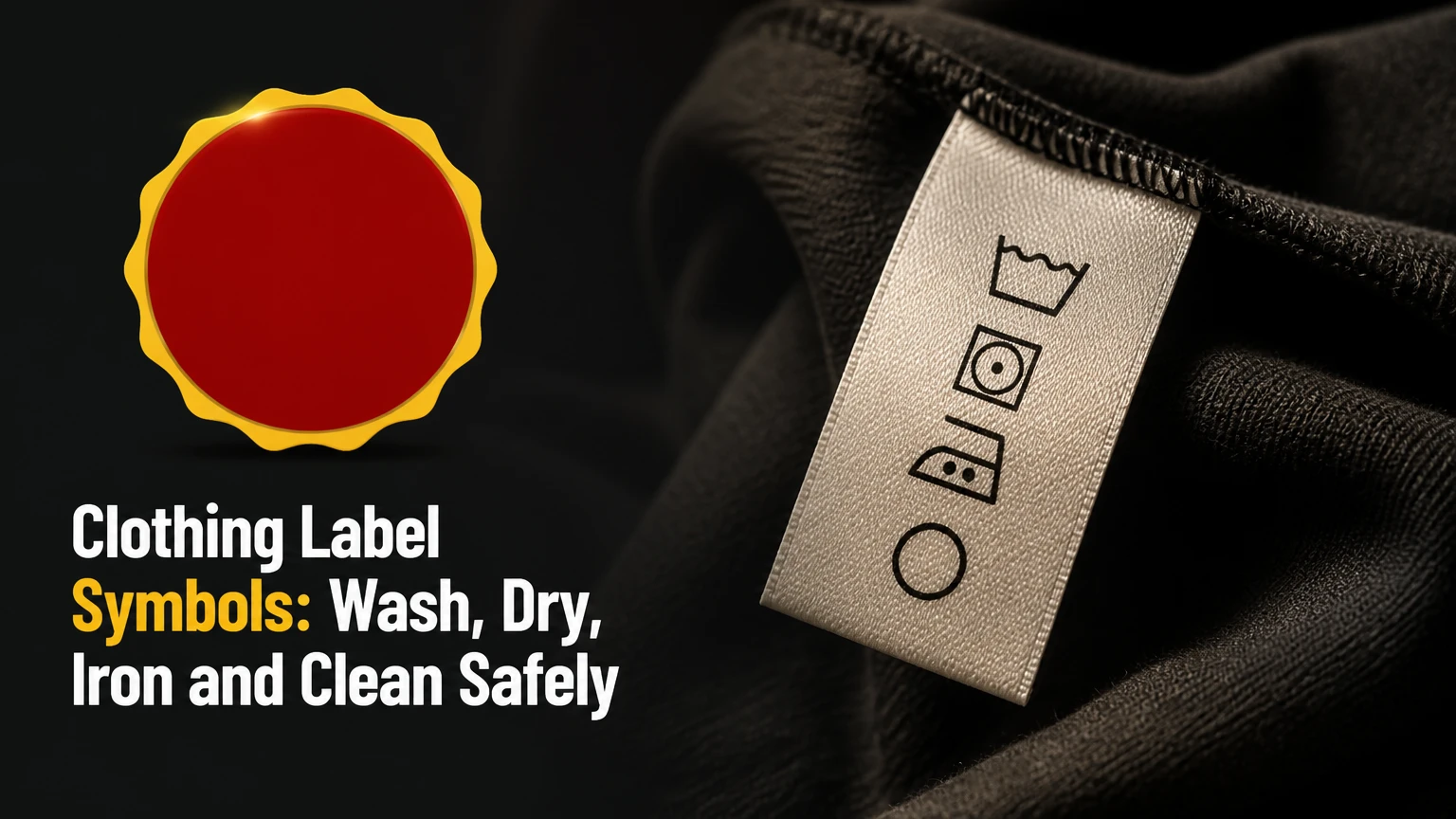
Clothing label symbols, formally called textile care symbols or care instructions, tell you how a garment may be washed, bleached, dried, ironed, and professionally cleaned. Read the symbols from left to right, identify the maximum permitted treatment, and follow the strictest instruction when fabrics, linings, trims, or finishes differ.
Key Facts at a Glance
- The washtub symbol controls washing, the triangle controls bleaching, and the square controls drying.
- A circle identifies professional cleaning, while an iron identifies pressing temperature.
- A cross through any care symbol means the related process is prohibited.
- Dots indicate heat levels in many ASTM-style labels; numbers commonly indicate degrees Celsius in ISO and GINETEX systems.
- One or two bars below a tub or drying symbol require a gentler mechanical cycle.
- Care instructions specify tested maximum conditions, so a cooler and gentler setting is usually the lower-risk choice.
What Do Clothing Label Symbols Mean?
Clothing label symbols are standardized pictograms that translate textile-care limits into a compact visual language. The five principal symbols are a washtub for washing, a triangle for bleaching, a square for drying, an iron for pressing, and a circle for professional cleaning.
The symbols do not describe the garment’s fiber content, country of origin, size, or environmental credentials. A separate label may identify cotton, polyester, wool, elastane, recycled fibers, or certification schemes such as OEKO-TEX. Fiber content helps explain behavior, but the care label remains the garment manufacturer’s tested maintenance instruction.
The system is organized by treatment sequence:
- Washing
- Bleaching
- Drying
- Ironing
- Professional cleaning
The order matters because each stage can change the next decision. For example, a garment marked for low-temperature tumble drying may still require a cool iron, while a garment that cannot be washed may need professional cleaning instead.
How Are Care Symbols Standardized?
Care symbols are governed by regional and international systems rather than by one single worldwide authority. ISO 3758 describes textile care labelling through graphic symbols, GINETEX licenses the familiar care-symbol system in many markets, and ASTM International publishes care-label guidance used in the United States.
The systems overlap substantially, but they are not identical in every detail. International labels often place a Celsius number inside the washtub, whereas US labels frequently use dots. A label sold across markets may include symbols plus words such as “Machine Wash Cold” to reduce ambiguity.
The US Federal Trade Commission states in its consumer guidance that manufacturers and importers must “attach care instructions to clothing.” The FTC Care Labeling Rule also requires a reasonable basis for instructions, which means a brand should not assign a care process without support from testing or reliable technical evidence.
How Do You Read the Five Main Symbols?
The shape identifies the process, and the internal mark modifies its temperature, intensity, or chemical requirement. Start with the shape, then check crosses, dots, numbers, bars, and internal lines.
| Symbol family | Main shape | What it controls | Common modifiers |
|---|---|---|---|
| Washing | Washtub | Water washing method | Temperature, hand icon, one or two bars, cross |
| Bleaching | Triangle | Chlorine or oxygen bleach | Empty, diagonal stripes, cross |
| Drying | Square | Tumble or natural drying | Circle, dots, bars, vertical or horizontal lines |
| Ironing | Iron | Pressing temperature and steam | One to three dots, crossed steam, cross |
| Professional cleaning | Circle | Dry or wet cleaning | P, F, A, W, cross |
A cross is a prohibition, not a suggestion. A garment marked with a crossed-out iron should not receive direct contact from a heated iron, even if the fabric appears wrinkled.
What Does the Washtub Symbol Mean?
The washtub tells you whether water washing is allowed and which maximum temperature and cycle intensity are permitted. A plain tub generally permits machine washing, a hand inside the tub means hand washing, and a crossed tub means no water washing.
| Washtub mark | Meaning | Typical machine setting | Main risk if ignored |
|---|---|---|---|
| Tub with 30 | Wash at maximum 30°C | Cold or 30°C cycle | Shrinkage or dye bleeding above limit |
| Tub with two dots | Maximum temperature represented by the applicable standard | Warm or moderate cycle | Fiber distortion from excess heat |
| Tub with hand | Hand wash only | No machine agitation | Felting, stretching, seam damage |
| Tub with one bar | Reduced mechanical action | Permanent-press or easy-care cycle | Wrinkling and elastic damage |
| Tub with two bars | Very gentle mechanical action | Delicate or wool cycle | Shape loss and surface abrasion |
| Tub with cross | Do not wash in water | Professional assessment | Irreversible distortion or finish loss |
Temperature markings need careful interpretation. In an ISO-style label, “30” means a maximum wash temperature of 30°C. In an ASTM-style label, one dot commonly indicates cold or 30°C-equivalent care, but the exact interpretation should follow the applicable label system and accompanying text.
A hand-wash symbol does not universally mean “maximum 40°C.” The permitted temperature may be printed as a number, represented by a standard-specific convention, or supplemented by written instructions. Use the lowest practical temperature when the label gives no clear number.
What Do Bars Under the Tub Mean?
Bars under the washtub reduce agitation and, in many systems, limit spin intensity. One bar indicates a reduced-action cycle; two bars indicate a very gentle cycle. Bars do not lower the stated water temperature by themselves.
This distinction matters for viscose, lace, coated textiles, and garments containing elastane. A 30°C normal cycle can be more damaging than a 40°C gentle cycle because mechanical action, not water temperature alone, causes stretching, abrasion, or surface fuzz.
What Does the Triangle on a Clothing Label Mean?
The triangle controls chemical bleaching. An empty triangle permits any bleach under the applicable care system, a triangle with two diagonal lines permits non-chlorine oxygen bleach, and a crossed triangle prohibits bleaching.
| Triangle mark | Permitted treatment | Suitable product category | Important limitation |
|---|---|---|---|
| Empty triangle | Any bleach | Chlorine or oxygen bleach | Test unstable dyes before use |
| Triangle with two diagonal lines | Non-chlorine bleach only | Oxygen-based bleach | Chlorine bleach can strip color |
| Triangle with cross | No bleach | No whitening bleach | Use detergent and stain treatment only |
The striped triangle is not a mild version of the empty triangle. It specifically excludes chlorine-based bleach, which can weaken fibers, yellow protein fibers, and permanently alter dyes.
Never infer bleach permission from a white color alone. Optical brighteners, fluorescent finishes, elastane, printed graphics, and resin treatments can react differently from the base fabric. Apply a stain remover to a hidden area first when the label permits bleaching but the garment has a valuable or unstable finish.
How Do You Interpret the Square Drying Symbols?
The square describes natural drying or tumble drying. A square containing a circle permits tumble drying, dots set heat, bars below the square reduce cycle intensity, and lines inside the square describe air-drying orientation.
| Drying mark | Meaning | Practical action | Common garment example |
|---|---|---|---|
| Square with circle, one dot | Tumble dry low | Use low heat | Synthetic blouse |
| Square with circle, two dots | Tumble dry medium | Use medium heat | Cotton sweatshirt |
| Square with circle, three dots | Tumble dry high | Use high heat only when specified | Heavy cotton towel |
| Square with circle, cross | Do not tumble dry | Line dry or dry flat | Heat-sensitive knit |
| Square with one vertical line | Line dry | Hang on a line or suitable hanger | Woven shirt |
| Square with three vertical lines | Drip dry | Hang while very wet | Lightweight washable fabric |
| Square with one horizontal line | Dry flat | Support garment horizontally | Wool knit |
| Square with diagonal corner line | Dry in shade | Keep away from direct sun | Dark dyed garment |
A square with a circle is often misread as permission to use any dryer program. The circle only establishes tumble drying; the dots establish the heat ceiling. A crossed-out tumble symbol requires air drying even if the garment feels durable.
Drying orientation protects shape. Wet wool, viscose, and heavy knits can lengthen under their own weight, so dry-flat instructions prevent gravity from distorting shoulders, hems, and ribbing. Shade-dry instructions protect dyes and elastane from prolonged ultraviolet exposure.
What Is the Difference Between Line Dry, Drip Dry, and Dry Flat?
Line drying supports a garment while it dries, drip drying allows water to drain with minimal handling, and dry-flat instructions require horizontal support. These methods are not interchangeable for garments whose weight or construction changes when saturated.
A practical sequence is to remove excess water without twisting, reshape seams and panels, then use the orientation shown inside the square. For a knit sweater, place it on a clean towel or mesh rack rather than a narrow hanger, which can create shoulder points.
What Do Iron Dots and Crosses Mean?
The iron symbol controls the maximum soleplate temperature. One dot indicates low heat, two dots medium heat, and three dots high heat; a crossed iron prohibits ironing, while crossed steam indicates that steam must not be used.
| Iron mark | Maximum temperature | Typical material examples | Safer practice |
|---|---|---|---|
| One dot | 110°C / 230°F | Acrylic, nylon, acetate | Use a pressing cloth |
| Two dots | 150°C / 300°F | Polyester, wool, silk blends | Use moderate heat |
| Three dots | 200°C / 390°F | Cotton, linen | Press promptly, avoid scorching |
| Iron with crossed steam | Temperature still applies | Heat-tolerant fabric without steam | Turn steam off |
| Iron with cross | No direct ironing | Heat-sensitive coating or trim | Use approved alternative |
The dots describe the iron setting, not necessarily the ideal result. A polyester shirt may tolerate two dots but still develop shine under pressure, especially in dark colors. Press from the reverse side or use a thin cloth between the iron and fabric when the care label permits ironing.
A steamer is not automatically safe when ironing is prohibited. Steam introduces heat and moisture, and it can soften adhesive interlinings, distort pleats, or mark water-sensitive finishes. Keep the steamer away from the surface and follow the manufacturer’s written instructions when a label bans ironing.
What Does the Circle Mean for Professional Cleaning?
The circle indicates professional cleaning, including dry cleaning or professional wet cleaning. Letters inside the circle identify solvent families or methods for the cleaner, while a crossed circle means do not dry clean.
| Circle mark | Cleaning instruction | Solvent or process | Consumer decision |
|---|---|---|---|
| Circle with P | Professional dry cleaning | Perchloroethylene or approved hydrocarbon solvents | Take to a cleaner familiar with P care |
| Circle with F | Professional dry cleaning | Hydrocarbon solvents | Tell cleaner the label specifies F |
| Circle with A | Any permitted solvent in applicable system | Broad solvent class | Cleaner selects process |
| Circle with W | Professional wet cleaning | Controlled water-based process | Do not substitute home washing |
| Circle with cross | Do not dry clean | No conventional dry-cleaning process | Ask brand for an alternative |
The letters are process instructions for cleaners, not consumer washing directions. “P” does not mean the garment contains polyester, and “F” does not mean the textile is flammable in ordinary use.
“Dry clean” and “dry-clean only” are also different claims in consumer language. A circle means professional cleaning is allowed, but it does not necessarily prove that home washing is safe. If the label gives both a washing symbol and a professional-cleaning symbol, follow the complete combination. If it says “dry clean only” or shows a crossed tub, do not experiment with home laundering.
Are US and International Care Symbols Different?
US ASTM-style labels commonly use dots for temperature, while ISO and GINETEX labels commonly use Celsius numbers in the washtub. The main shapes remain recognizable across regions, but drying details, bleach graphics, and written explanations may differ.
| Feature | ASTM-style US convention | ISO or GINETEX convention | Reading consequence |
|---|---|---|---|
| Wash temperature | Dots often indicate heat level | Numbers such as 30 or 40 indicate °C | Check whether the label uses dots or numbers |
| Iron temperature | One to three dots | One to three dots | Interpretation is broadly familiar |
| Bleach | Triangle variants | Triangle variants | Diagonal stripes generally mean oxygen bleach |
| Natural drying | Square with internal lines | Square with internal lines | Orientation remains important |
| Professional cleaning | Circle with solvent letters | Circle with solvent letters | Cleaner should interpret the letter |
| Written backup | Common on US labels | Common on international labels | Use text when symbols are unclear |
The most reliable approach is not to convert every symbol mechanically. Identify the standard presentation, read any accompanying words, and choose the lower temperature and gentler cycle when uncertainty remains.
What Is the Strictest-Symbol Rule?
The strictest instruction controls when a garment contains multiple fabrics, a lining, or attached components. A cotton shell does not make a jacket machine washable if its fused interfacing, leather trim, or acetate lining requires professional cleaning.
Use the most restrictive component as the decision point. Examples include:
- A washable polyester shell with a non-washable foam print should not enter a normal wash.
- A silk garment with a cotton lining still requires silk-level handling if the silk sets the limit.
- A removable belt may have separate care instructions and should be detached before cleaning.
- Waterproof membranes can lose seam-seal performance under heat even when the face fabric tolerates it.
How Much Do Different Care Choices Cost?
Home washing typically costs a fraction of a dollar per load before labor, while professional cleaning commonly costs about $5-$20 per garment and takes approximately 2-4 days. Actual prices vary by city, garment construction, stain treatment, pickup service, and cleaner.
| Care route | Typical direct cost | Typical timeframe | Best fit |
|---|---|---|---|
| Cold machine wash | $0.10-$0.60 per load | 1-2 hours | Durable washable basics |
| Hand wash and air dry | $0.05-$0.40 per item | 12-48 hours | Delicates and knits |
| Laundromat wash and dry | $3-$8 per load | 1-2 hours | No home machines |
| Shirt dry cleaning | $5-$12 per item | 2-4 days | Structured shirts and suits |
| Coat or tailored jacket cleaning | $12-$30 per item | 3-7 days | Structured outerwear |
| Specialty restoration | $25-$150+ per item | 1-4 weeks | Dye transfer, mold, or severe shrinkage |
A “dry-clean-only” purchase has a recurring ownership cost, not merely a cleaning instruction. For weekly wear, calculate roughly four cleaning events per month and compare that expense with a washable alternative made from a similar fabric.
The cheapest process is not always the lowest total cost. A $0.40 wash that damages a $120 jacket is more expensive than a $12 professional cleaning appointment.
Which Settings Are Safest for Common Fabrics?
The label takes priority over generic fiber advice because construction, dye, finishing, and garment shape affect performance. Fiber names provide a starting hypothesis, not permission to override the care symbols.
| Fabric or construction | Frequent risk | Conservative care starting point | Avoid unless label permits |
|---|---|---|---|
| Wool knit | Felting and shrinkage | Cool hand wash or wool cycle, dry flat | Hot water, vigorous spin, high heat |
| Silk | Water marks and abrasion | Hand wash only when explicitly allowed | Chlorine bleach and direct high heat |
| Viscose or rayon | Stretching while wet | Gentle cool wash, reshape, dry flat | Twisting, hanging saturated |
| Elastane blend | Loss of recovery | Cool gentle wash, low heat or air dry | High heat and repeated hot drying |
| Polyester | Heat shine and odor retention | Cool or moderate wash, low tumble heat | High iron temperature |
| Linen | Creasing and shrinkage | Label-permitted warm wash, air dry | Excessive high-heat drying |
| Waterproof shell | Coating and seam damage | Technical wash, low heat if specified | Fabric softener and unauthorized ironing |
| Printed garment | Graphic cracking or transfer | Inside out, cool gentle cycle | High heat and harsh bleach |
Sportswear deserves special care because detergent residue, fabric softener, and heat can reduce wicking or damage elastomeric fibers. Fabric softener can coat performance fibers, while high dryer heat accelerates loss of stretch in leggings and swimwear.
What Common Care-Label Mistakes Ruin Clothes?
Most laundry damage comes from ignoring heat, mechanical action, or chemical restrictions rather than from misunderstanding the basic symbol shapes. The following recovery rules address the most common failures.
- Using a normal cycle when one or two bars appear.
Switch to permanent-press or delicate settings, reduce the load, and avoid high spin. If the garment has already stretched, reshape it damp and dry it flat. - Treating an oxygen-bleach triangle as permission for chlorine bleach.
Stop using chlorine immediately, rinse thoroughly, and check whether color loss or fiber weakening has occurred. Dye stripping is usually permanent. - Tumble drying a crossed-out square with a circle.
Remove the garment while damp if possible, reshape it, and air dry. Heat-set shrinkage cannot reliably be reversed. - Hanging a saturated knit marked dry flat.
Lay the garment on a towel, align the side seams, and restore the original dimensions. Do not pull sleeves or hems while the knit is dripping wet. - Ironing a coated print or synthetic fabric at three dots.
Stop when shine or melting appears, then use a reverse-side pressing cloth at the lowest permitted setting. A damaged coating may not recover. - Assuming a white garment can take bleach.
Check the triangle first. Optical brighteners, elastane, wool, silk, and resin finishes can all be damaged despite the garment’s color.
Can Shrunk Clothing Be Recovered?
Minor shrinkage can sometimes be reduced by soaking a washable garment in lukewarm water, gently relaxing the fibers, and reshaping it while damp. The method is most plausible for some knits and cellulosic fibers, but it cannot restore every fabric or reverse heat-set structural change.
Do not use hair conditioner as a guaranteed repair treatment. It may temporarily lubricate fibers, but it can leave residue and will not repair melted synthetics, fused interfacing, felted wool, or distorted adhesive construction. For valuable clothing, stop further treatment and consult a textile conservator or specialist cleaner.
How Should You Apply the Symbols Before Washing?
Read the complete label before sorting the garment, then use the most restrictive instruction to select water temperature, cycle, bleach, drying, and pressing. A two-minute inspection prevents many irreversible errors.
Follow this sequence:
- Separate the garment by care category.
Group normal, reduced-action, delicate, hand-wash, and professional-cleaning items separately. Do not sort only by color. - Check temperature and cycle bars.
Select the stated maximum temperature, then match the bar count to normal, permanent-press, or delicate action. - Inspect the triangle.
Use no bleach unless the symbol permits it. Choose oxygen bleach only when diagonal stripes appear. - Choose the drying method before washing.
Confirm that you have a drying rack, flat surface, hanger, or shade area required by the square symbol. - Turn and prepare the garment.
Close zippers, fasten hooks, empty pockets, remove detachable trims, and turn printed garments inside out. - Use compatible detergent and load size.
Measure detergent according to water hardness and soil level; overloading increases abrasion and leaves residue. - Reshape immediately after the cycle.
Remove delicate garments promptly, align seams, and begin the specified air-drying method. - Press only within the iron limit.
Use the lowest effective setting, and keep steam off when the label crosses out steam.
You will know the process worked when the garment retains its original dimensions, surface texture, color, and trim adhesion after drying. The most frequent mistake is choosing the correct temperature but the wrong mechanical cycle.
What Should Designers and Manufacturers Put on a Care Label?
Apparel manufacturers should assign care instructions from testing the finished garment, not from fiber composition alone. Testing should account for shrinkage, colorfastness, seam performance, trim adhesion, print durability, and the behavior of linings and coatings.
A compliant label normally needs:
- Washing instructions, including maximum temperature and cycle severity
- Bleaching permission or prohibition
- Drying method and heat limit
- Ironing temperature and steam restriction
- Professional-cleaning method where applicable
- Durable, legible attachment to the garment
- Written instructions where symbols alone could confuse users
- Market-specific information required by local law
The US FTC Care Labeling Rule applies to manufacturers and importers of textile wearing apparel sold in the United States. Brands selling internationally should also review the applicable ISO, GINETEX licensing, EU, UK, Canadian, or national requirements rather than copying a US label without adaptation.
Symbols are not a substitute for accessibility. High-contrast printing, adequate character size, durable inks, and concise text such as “Machine Wash Cold” improve comprehension for users who cannot easily distinguish pictograms.
Frequently Asked Questions
What Does a Crossed-Out Circle on a Clothing Label Mean?
A crossed-out circle means do not use conventional professional dry cleaning. The instruction does not automatically mean that home washing is safe, because the garment may also have a crossed-out washtub or another restrictive symbol. Check the complete care sequence and ask the brand or a specialist cleaner about an alternative process.
Can I Wash a Garment Marked Dry Clean?
You should not assume that a garment marked for dry cleaning can be safely washed at home. Water can shrink wool, distort tailored construction, bleed unstable dyes, and damage adhesive interlinings. If the label also provides a hand-wash or machine-wash instruction, that instruction may be used under its stated limits, but “dry clean only” requires professional cleaning.
What Does a Bucket With Two Lines Under It Mean?
A washtub with two horizontal bars means a very gentle wash cycle with reduced mechanical action. Use the lowest appropriate spin, avoid overloading, and remove the garment promptly. The bars do not independently specify water temperature, so follow the number or dot inside the tub as well.
What Does a Square With a Circle and a Cross Mean?
A square containing a crossed-out circle means do not tumble dry. Use the natural-drying method shown elsewhere, such as line dry, drip dry, or dry flat. Tumble-dryer heat and rotation can shrink, stretch, melt, or delaminate garments that carry this prohibition.
Are Laundry Symbols Universal Worldwide?
Laundry symbols are broadly standardized, but presentation and temperature conventions vary by market. ISO and GINETEX labels commonly use Celsius numbers for washing, while ASTM-style US labels often use dots. Written care instructions and the complete label should resolve uncertainty when a garment crosses international borders.
Which Care Symbol Matters Most?
No single symbol always matters most. The highest-risk restriction is the one that limits the process you are about to perform, such as a crossed tumble symbol before drying or a crossed triangle before applying bleach. For mixed construction, follow the strictest instruction attached to the least tolerant component.
The Bottom Line
Clothing label symbols provide a compact, standardized maintenance plan: the washtub governs washing, the triangle governs bleach, the square governs drying, the iron governs pressing, and the circle governs professional cleaning. Use the stated temperature, respect crosses and bars, choose the gentlest compatible process, and treat the strictest component instruction as controlling. Careful reading of clothing label symbols protects fit, color, surface finish, and the garment’s long-term value.