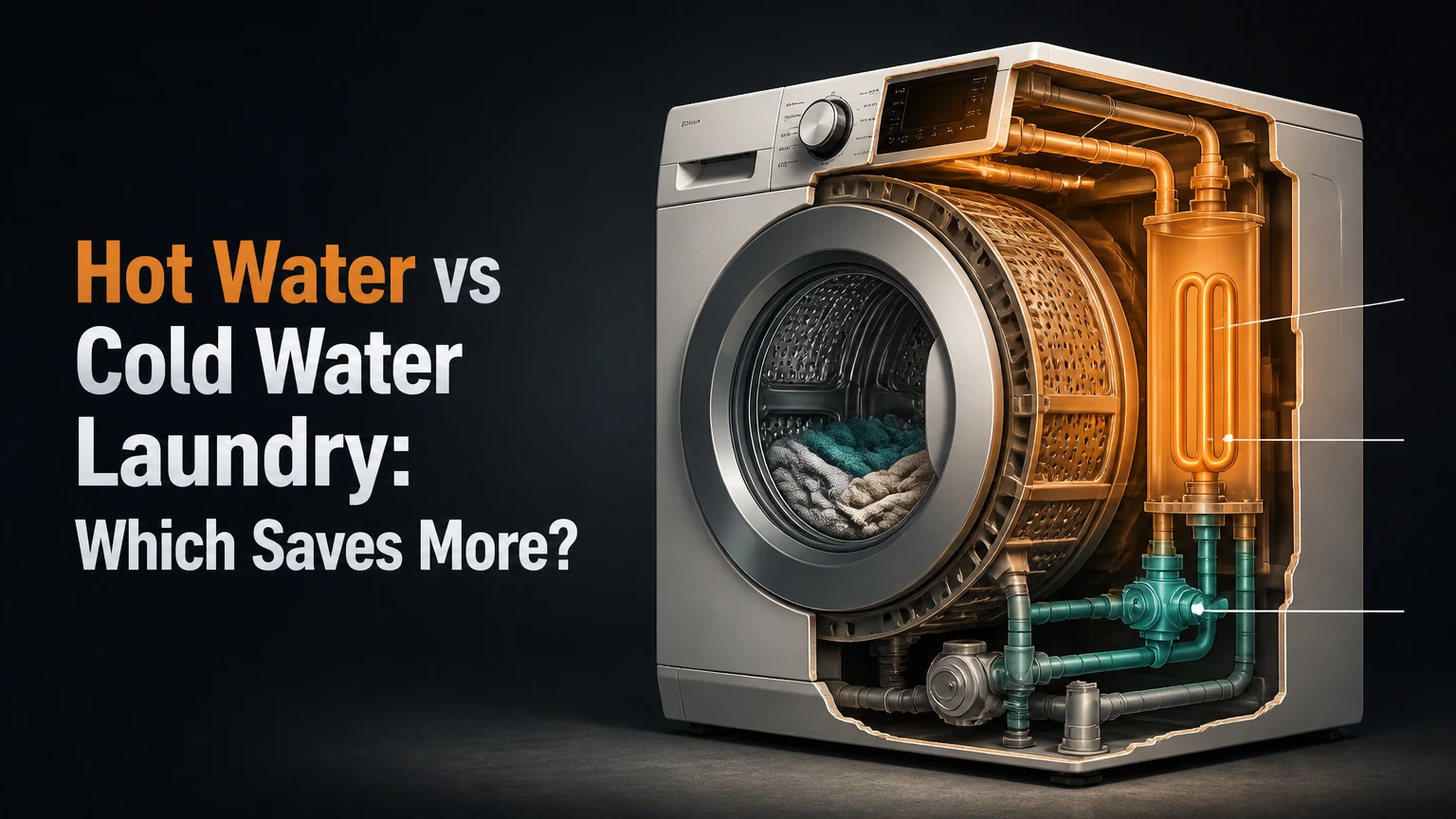
For most everyday laundry, cold water is the better default because modern detergent, mechanical action, and adequate cycle time remove ordinary soil while reducing fading, shrinkage, fiber wear, and energy use. Hot water is the better choice for oily stains, durable white cotton, towels, and some hygiene-focused loads, but a hot setting alone does not guarantee disinfection.
Key Facts at a Glance
- Cold-water washing generally uses less energy because the washer does not heat the incoming water.
- Hot water improves removal of many oils and greasy soils, but heat can set blood, milk, egg, and other protein stains.
- Washing-machine temperature labels are not universal; “hot” may produce far less than 130°F at the drum.
- Laundry detergent, agitation, cycle duration, soil type, and drying method affect cleaning as much as water temperature.
- Clothing-care labels take priority over general temperature rules, especially for wool, silk, elastane, and dark dyes.
- A certified sanitize cycle, suitable bleach, or a validated healthcare process is more reliable for microbial reduction than simply selecting hot.
Hot Water vs Cold Water Laundry: What Is the Difference?
Hot-water laundry uses elevated water temperature to improve oil mobility and accelerate some detergent reactions, while cold-water laundry depends more heavily on detergent chemistry, agitation, and time. Neither setting cleans every soil better. The correct choice depends on the stain, textile, color, hygiene objective, and garment-care label.
Washer manufacturers use different definitions. In North American household machines, cold may mean tap-cold water, often about 50-80°F depending on season and plumbing. Warm commonly falls near 80-100°F, while hot can range from approximately 100-140°F. These are practical ranges, not universal standards.
A washer connected only to cold plumbing may heat water internally, mix hot and cold water, or use the incoming temperature with little adjustment. The actual temperature at the fabric can differ from the dial because of fill volume, plumbing distance, thermostat settings, and heat loss.
What Do Cold, Warm, Hot, and Tap Cold Mean?
| Washer label | Typical water range | Main laundry effect | Common use |
|---|---|---|---|
| Tap cold | 50-80°F, 10-27°C | Lowest energy use; strongest dye protection | Darks, colors, lightly soiled garments |
| Cold | 60-80°F, 16-27°C | Relies on cold-water detergent and agitation | Everyday mixed laundry |
| Warm | 80-100°F, 27-38°C | Moderate grease removal with less dye stress | Synthetic blends, moderate soil |
| Hot | 100-140°F, 38-60°C | Better oil mobility; greater shrinkage risk | Durable whites, towels, greasy workwear |
The supplied 130°F definition describes a high-temperature wash, not every machine’s ordinary hot setting. A household “hot” cycle may never reach 130°F, and a 130°F wash may damage fabrics without providing a validated sanitizing process.
How Does Water Temperature Affect Cleaning?
Water temperature changes cleaning by affecting soil viscosity, detergent performance, dye movement, and fiber stress. Hot water liquefies some oils and softens waxy deposits, whereas cold water reduces dye transfer and helps preserve dimensional stability. Mechanical agitation and detergent concentration determine whether those chemical advantages become visible results.
Laundry cleaning follows the Sinner principle: time, temperature, chemical action, and mechanical action work together. When temperature decreases, a longer cycle, stronger detergent formulation, greater agitation, or better pretreatment can compensate. Modern washers often use longer cycles and concentrated detergents to make cold washing effective.
Cold water does not “rely entirely” on surfactants. Enzymes, surfactants, builders, polymers, agitation, rinsing, and time all contribute. Cold-active detergent enzymes can lose effectiveness at very low temperatures, but ordinary cold cycles remain suitable for many everyday soils when the product label supports them.
When Does Hot Water Clean Better?
Hot water usually cleans better when the dominant soil is oily, waxy, or heavily embedded in durable fabric. Examples include cooking grease on cotton aprons, body oils on white undershirts, and petroleum-based grime on work garments. Heat lowers the viscosity of many fats, allowing detergent and agitation to disperse them more effectively.
Hot water is not automatically better for every stain. Blood, egg, milk, sweat proteins, and some grass stains can become harder to remove when exposed to heat before pretreatment. Hot water also accelerates dye bleeding and can tighten or shrink animal fibers.
A useful practitioner rule is to identify the soil before choosing temperature. Heat helps greasy soil; cool water protects protein-stained fabric during the first treatment. The detergent label and garment label then determine the safest final cycle.
How Much Energy Does Each Setting Use?
Cold washing typically uses approximately 0.05-0.15 kilowatt-hours for water heating, while a hot load can use about 1-3 kWh for heating in a conventional household machine. Actual totals depend on water volume, incoming temperature, heater efficiency, gas or electric water heating, and the selected cycle.
ENERGY STAR states that heating water accounts for about 90% of the energy used by a washing machine. The statement explains why cold washing can reduce operating cost even when the cold cycle runs longer. The U.S. Department of Energy also recommends cold-water washing when practical.
| Scenario, typical household values | Cold wash | Warm wash | Hot wash |
|---|---|---|---|
| Energy used for water heating | 0.05-0.15 kWh | 0.3-0.8 kWh | 1-3 kWh |
| Cycle duration | 30-75 minutes | 40-90 minutes | 60-120 minutes |
| Heating cost at $0.16/kWh | $0.01-$0.02 | $0.05-$0.13 | $0.16-$0.48 |
| Heating cost for 300 loads | $3-$6 | $15-$38 | $48-$144 |
These are typical heating estimates, not a universal utility bill. A gas water heater, high-efficiency washer, small load, or low local electricity price can produce a different result. The full cost also includes water, detergent, drying, and machine maintenance.
Which Temperature Is Best for Each Fabric?
Cold water is the safest general setting for dark colors, bright dyes, denim, elastane, wool, silk, and technical synthetics. Warm or hot water can suit durable cotton and linen when the care label permits it, but repeated heat increases shrinkage, color loss, and elastic fatigue.
| Fabric or item | Recommended temperature | Cycle and detergent guidance | Main risk |
|---|---|---|---|
| Dark cotton | Cold, 60-80°F | Inside out; liquid detergent; normal cycle | Fading and dye transfer |
| White cotton sheets | Warm or hot, 90-120°F | Heavy-duty detergent; complete drying | Shrinkage and fiber wear |
| Towels | Warm, 90-110°F | Moderate detergent; avoid excess softener | Odor, stiffness, shrinkage |
| Wool | Cold, 60-80°F | Wool detergent; wool or hand-wash cycle | Felting and deformation |
| Silk | Cold, 60-75°F | Mild detergent; delicate cycle | Dye bleed and abrasion |
| Polyester activewear | Cold, 60-80°F | Sports detergent; no fabric softener | Odor retention and elastic damage |
| Elastane or spandex | Cold, 60-80°F | Gentle cycle; air-dry or low heat | Loss of stretch |
| Denim | Cold, 60-80°F | Wash inside out; low agitation | Fading and stiffness |
Care labels override general recommendations. A “dry clean,” “hand wash,” or “cold wash only” instruction reflects the garment’s dye, construction, finish, or fiber behavior, not merely a preference for lower utility costs.
Does Hot Water Shrink Clothes?
Hot water can shrink clothes, especially cotton, wool, rayon, and other fibers whose yarns or structures relax during washing. The combination of hot washing and high-temperature tumble drying usually creates more dimensional change than washing alone.
Pre-shrunk cotton can still contract, particularly during the first few wash cycles. Wool presents a separate risk: heat, moisture, alkalinity, and agitation can cause felting, which is often irreversible. Elastane may not visibly shrink, but repeated heat can degrade its recovery.
Cold washing reduces risk but does not prevent all shrinkage. A hot dryer, aggressive spin, and mechanical agitation can still alter fit. For a valuable garment, measure it before washing and follow the label rather than relying on a temperature shortcut.
What Should You Wash in Cold Water?
Cold water suits most lightly or moderately soiled everyday clothes, especially colored garments, dark denim, activewear, underwear made from elastic blends, and delicate textiles. Cold water also makes sense when the main objective is to reduce energy use and preserve garment color.
Use a cold-compatible detergent at the dosage printed for the load size and water hardness. Do not compensate for low temperature by adding extra detergent, because excess product can leave surfactant residue, trap odor, and promote buildup in the washer.
Cold water is less effective when grease is substantial, detergent cannot dissolve at the incoming temperature, or the load is packed too tightly for mechanical action. In those cases, pretreatment, a warm cycle, a longer program, or a smaller load is often more useful than simply adding soap.
What Should You Wash in Warm or Hot Water?
Warm water is a practical middle setting for synthetic blends, moderately dirty cotton, kitchen textiles, and garments carrying body oil but requiring more color protection than a hot cycle provides. Warm water often supplies enough thermal assistance without the full shrinkage and dye risk of high heat.
Hot water is appropriate for durable, colorfast cotton towels, cleaning cloths, white cotton bedding, and heavily oily workwear when the care label allows it. Hot water should not be the default for wool, silk, elastane, dark dyes, or garments with printed graphics.
Temperature is only one part of hygiene. The American Cleaning Institute distinguishes ordinary cleaning from sanitization, and a washer’s certified sanitize program may use controlled temperature, exposure time, and additional steps. A normal hot cycle does not automatically kill 99.9% of bacteria.
Does Hot Water Sanitize Laundry?
A hot wash can reduce some microorganisms, but selecting “hot” does not guarantee a specific kill rate. Reliable sanitization requires a defined temperature-time process, a validated appliance cycle, or a compatible chemical disinfectant used according to its label.
The National Sanitation Foundation, now NSF, evaluates certain residential laundry sanitization claims under defined test conditions. A machine labeled with a certified sanitize cycle is more informative than an ordinary hot setting because the claim relates to a specified program rather than an assumed water temperature.
For household hygiene, wash according to the item’s care label, use the washer’s certified sanitize cycle when appropriate, and dry completely. Chlorine bleach can disinfect some bleach-safe whites, while oxygen bleach can help with stains and odors but should not be treated as an equivalent disinfectant unless its label makes that claim.
People managing contagious illness, healthcare contamination, or heavily soiled diapers should follow public-health or product-label instructions. Household laundry advice cannot replace a regulated infection-control protocol.
How Should You Choose a Temperature for Stains?
Choose the pretreatment temperature from the soil type, not from the garment’s color alone. Flush fresh blood and other protein stains with cool water, treat grease before washing, and use the warmest label-approved cycle after the stain has been loosened.
| Stain type | First treatment | Final wash temperature | Important limitation |
|---|---|---|---|
| Blood | Rinse with cold water; apply enzyme product | Cold, then repeat if needed | Heat can fix protein residue |
| Egg or milk | Cold rinse; enzyme detergent | Cold or warm | Do not start with hot water |
| Cooking oil | Blot; apply liquid detergent or degreaser | Warm, label permitting | Hot water alone may spread grease |
| Mud or clay | Remove dry soil; rinse | Warm or cold | Do not grind wet grit into fibers |
| Grass | Enzyme detergent or oxygen bleach, label permitting | Cold or warm | Test dye stability first |
| Ink | Blot; use labeled solvent treatment | Cold | Solvent may damage finishes |
| Sweat odor | Pretreat; detergent designed for odor | Cold or warm | Fabric softener can trap odor |
| Mildew | Launder promptly; use compatible bleach product | Warm or hot, label permitting | Do not mix bleach and vinegar |
Hydrogen peroxide is not a universal stain remedy. It can bleach dyes and weaken some fibers, so test a hidden area and follow the product instructions. Never mix peroxide, chlorine bleach, vinegar, or ammonia.
Can Hot Water Set a Blood Stain?
Hot water can set blood proteins and make removal more difficult, especially when the stain has not been flushed or treated. Rinse the reverse side with cold water, apply an enzyme detergent or stain product, allow the stated dwell time, and inspect the garment before drying.
Do not place a stained item in the dryer until the mark is gone. Dryer heat can make residual discoloration much harder to remove. Repeat treatment rather than increasing wash temperature blindly.
How Do You Wash Laundry Correctly?
A reliable laundry process has six steps: read labels, sort by color and weight, pretreat stains, select the lowest effective temperature, dose detergent accurately, and dry according to the textile. A normal load usually takes 5-10 minutes to prepare and 30-120 minutes to wash, depending on the cycle.
- Read the care label. Separate hand-wash, wool, silk, dry-clean, and cold-only garments.
- Sort the load. Keep darks, bright colors, whites, towels, and heavy denim from delicate items.
- Inspect and pretreat. Identify oil, protein, dye, soil, or odor before adding water.
- Load loosely. Fill a front-loader to about three-quarters full, or leave a hand’s width at the top of a top-loader.
- Select temperature and cycle. Use cold for color and elastic protection, warm for moderate soil, and hot only for durable, label-approved items.
- Dose detergent. Follow the product’s load and hardness instructions. High-efficiency machines require HE detergent.
- Dry promptly. Remove laundry after the cycle, then use line drying, low heat, or the label-approved setting.
The success checkpoint is simple: clothes should smell neutral, show no visible soil, and feel free of slick residue after drying. A sour smell, stiff fabric, or repeated rewash indicates a load-size, detergent, drainage, or machine-maintenance problem.
Which Detergent Works in Cold Water?
Cold-water detergent works best when its surfactants and enzymes are formulated for low-temperature performance. Liquid detergent generally dissolves readily in cold water, while powder can perform well but may leave undissolved particles in very cold water or overloaded machines.
Use the smallest manufacturer-recommended dose that matches soil level, load size, and water hardness. More detergent does not produce proportionally cleaner clothes. It can reduce rinsing efficiency and feed residue buildup.
For powder detergent in very cold tap water, dissolve the measured dose in a small amount of warm water only when the product and washer instructions permit it. Do not pour concentrated detergent directly onto delicate fabric.
What Are the Main Problems With Each Setting?
Hot water’s main problems are shrinkage, fading, elastic damage, protein-stain setting, higher energy use, and accelerated wear. Cold water’s main problems are weaker grease removal, reduced enzyme activity at very low temperatures, and occasional detergent residue when the load is overloaded or the product is poorly matched.
Why Does Cold Laundry Smell Bad?
Cold laundry can smell bad when oily soil, body odor, or detergent residue remains in the fabric, particularly in polyester activewear. Overloading, leaving wet clothes in the drum, low-temperature cycles, and fabric softener buildup can all contribute.
Treat odor at the source. Use a suitable detergent, reduce the load, skip fabric softener on technical garments, and remove clothing promptly. If the washer itself smells, clean the gasket, dispenser, filter, and drum according to the manufacturer’s maintenance instructions.
Do not automatically pour vinegar into every cleaning cycle. Whirlpool, LG, Samsung, and other manufacturers commonly warn against unapproved additives because acids can affect seals, hoses, finishes, or warranty conditions. A washer-cleaner tablet approved for the appliance is the safer default.
What Does Tap Cold Mean in Winter?
Tap cold means the machine uses incoming household water without deliberately heating it to a controlled temperature. In winter, that supply may fall below 60°F, which can slow detergent dissolution and reduce the effectiveness of some enzyme systems.
Tap-cold water does not normally mean the washer mixes in hot water to maintain 65-75°F. Some machines have adaptive or temperature-controlled programs, but the feature must be stated in the owner’s manual. A “cold” button is not a universal regulated temperature.
Use a cold-water detergent, avoid overloading, and choose warm water for greasy or heavily soiled loads when the textile permits it. That approach is more dependable than assuming the washer will correct the incoming temperature.
Which Setting Should Different Households Choose?
Most households can wash approximately 70-90% of their clothing on cold, reserving warm or hot cycles for specific soils, textiles, and hygiene requirements. The exact percentage depends on climate, occupational exposure, children, pets, fabric mix, and access to a certified sanitize cycle.
| Household situation | Default setting | Exception | Reason |
|---|---|---|---|
| Budget-focused household | Cold | Warm for grease | Reduces water-heating cost |
| Frequent gym use | Cold | Warm for persistent body oil | Protects elastane and polyester |
| Household with infants | Cold for ordinary clothes | Label-approved warm or sanitize for diapers | Separates routine cleaning from hygiene control |
| Allergy-sensitive bedding | Warm or hot, label permitting | Certified sanitize cycle when needed | Uses controlled process for allergens and microbes |
| Mechanic or cook | Warm | Hot for durable cotton, label permitting | Improves oily-soil removal |
| Wool and silk wardrobe | Cold delicate cycle | No hot substitute | Prevents felting, distortion, and dye damage |
Dust mites and allergens complicate bedding advice. Washing at a high temperature can help, but not every mattress cover, pillow, or comforter tolerates 130°F. Follow the textile label, wash the item thoroughly, and dry it completely; use allergen-barrier covers when laundering cannot safely provide the required control.
Which Should You Choose?
Choose cold water for ordinary clothing, darks, bright colors, denim, activewear, wool, silk, and any garment marked cold wash. Choose warm water for moderate body oil, kitchen textiles, and mixed durable loads. Choose hot water only for label-approved, colorfast, durable items with grease, heavy soil, or a defined hygiene purpose.
A decision rule works better than an absolute temperature rule:
- Check the label. Remove hot water from consideration if the garment prohibits it.
- Identify the dominant soil. Use cold first for protein stains and warm for grease.
- Protect the textile. Select cold for dyes, elastic, wool, silk, and technical finishes.
- Define the hygiene goal. Use a certified sanitize cycle or labeled bleach product when ordinary cleaning is insufficient.
- Optimize the machine. Use the correct detergent, avoid overloading, and dry promptly.
The best everyday answer to hot water vs cold water laundry is cold water for most loads, with warm or hot water reserved for a clearly identified cleaning or hygiene advantage.
Frequently Asked Questions
Is cold water enough to clean underwear?
Cold water can clean ordinary underwear when the detergent, cycle, and garment label support it, especially when underwear is not heavily soiled. Warm or hot water may be preferable for persistent body oils or illness-related contamination, but temperature alone does not sanitize fabric. Use a certified cycle or labeled disinfecting product when a specific hygiene claim is required.
Should towels be washed in hot water?
Towels can be washed in warm or hot water when their cotton construction and care label permit it. Warm water often provides sufficient soil and odor removal with less shrinkage and energy use than hot water. Avoid excessive detergent and fabric softener, because both can reduce absorbency and leave residue that contributes to musty odors.
Can I wash jeans in hot water?
Most jeans should be washed in cold water, inside out, because heat and agitation accelerate indigo fading and can alter fit. Hot water is appropriate only when the care label permits it and a specific heavy-soil problem justifies the risk. Low-temperature drying or air drying provides additional protection against shrinkage.
Does cold water prevent color bleeding?
Cold water reduces the likelihood and severity of dye bleeding, but it cannot prevent unstable dyes from transferring. Sort new dark garments, wash them inside out, use a dye-trapping sheet if desired, and avoid long soaking. A colorfastness test on an inside seam provides better evidence than assuming every dark garment is stable.
Is warm water better than cold water for everyday laundry?
Warm water is better than cold water when a load has moderate grease or body-oil soil and the textiles are durable and colorfast. Cold water is better for most lightly soiled clothing because it protects dyes, elastic, and fibers while lowering water-heating energy. Detergent formulation and cycle time can outweigh the temperature difference.
How often should a washing machine be cleaned?
Clean a washing machine at least monthly when it receives frequent cold, low-temperature, or heavily soiled loads, and clean it sooner if the drum smells or leaves residue. Follow the manufacturer’s procedure for the gasket, dispenser, filter, and tub-clean cycle. Use an approved washer cleaner rather than mixing household acids and bleach.
Conclusion: Cold water is the practical default for most laundry because it protects fabrics and minimizes water-heating energy. Hot water remains useful for durable, label-approved items with grease or defined hygiene needs, but the answer to hot water vs cold water laundry should always begin with the soil, textile, detergent, and required level of microbial control.