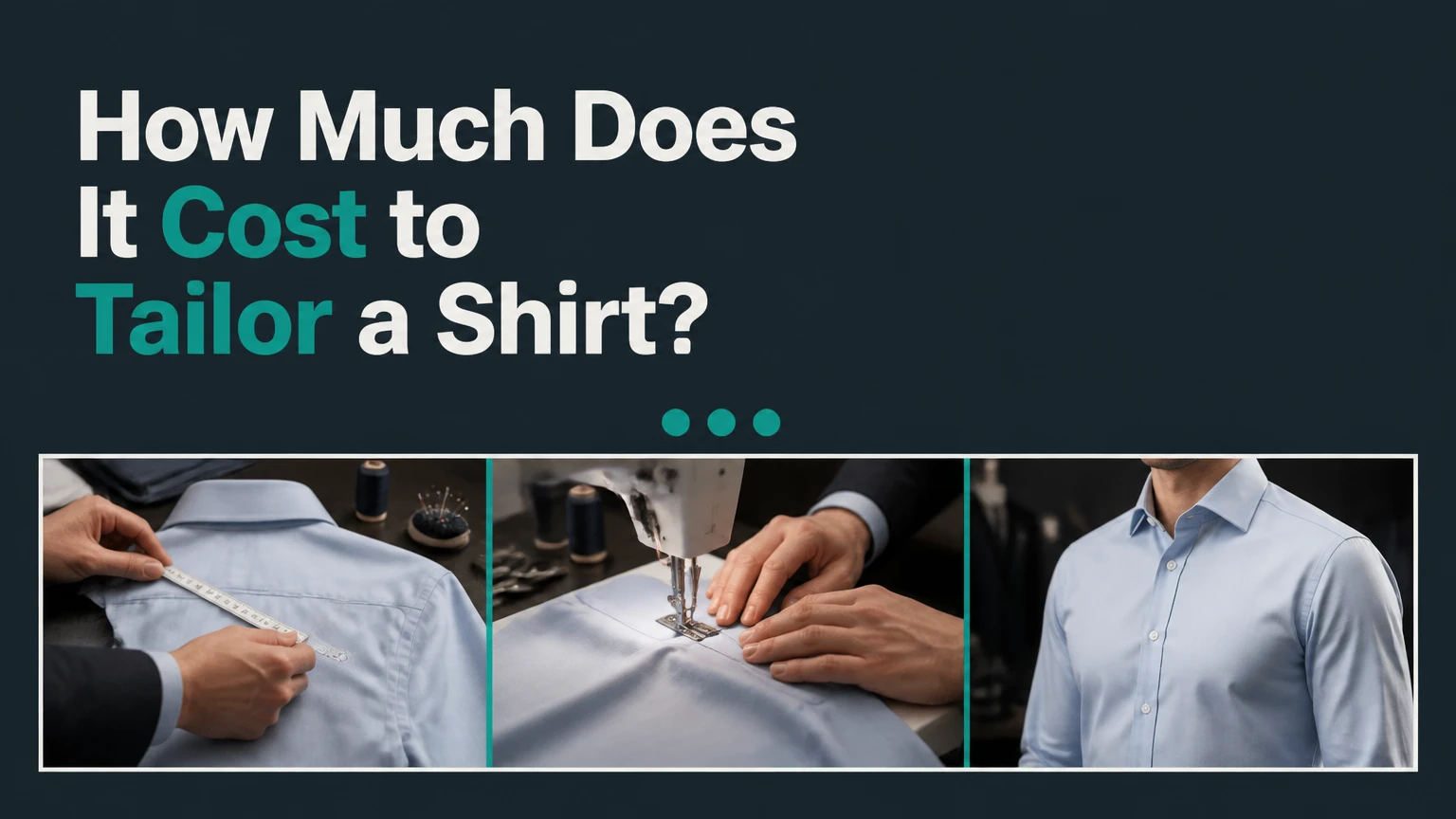
Tailoring a shirt costs about $15-$60 for common alterations, such as taking in the side seams, shortening sleeves, or reducing the hem. A made-to-measure shirt typically costs $50-$275, while a fully bespoke shirt usually costs $350-$900 or more. Location, fabric, construction, and the complexity of the fit determine the final price.
Key Facts at a Glance
- Taking in a shirt at the side seams typically costs $15-$45 and takes 3-7 days.
- Shortening sleeves from the cuff commonly costs $15-$45; shortening from the shoulder can cost $75-$160 or more.
- A shirt can usually be made smaller, but making it larger is limited by seam allowance and fabric availability.
- Made-to-measure shirts generally cost $50-$275 and require about 3-6 weeks.
- Bespoke shirts generally cost $350-$900 or more, with 2-4 fittings over 6-12 weeks.
- A shirt should fit correctly at the shoulders and collar before you pay for torso alterations.
What Does a Shirt Tailor Actually Change?
A shirt tailor modifies existing construction points to improve proportion, comfort, and drape. The most common adjustment areas are the side seams, back darts, sleeves, cuffs, collar, shoulders, and bottom hem.
The side seams control torso width. A tailor can remove excess fabric there, but the amount depends on the shirt’s original cut and the shape of its side panels. Back darts create a closer waist without fully reshaping the side seams. Sleeve tapering reduces excess width around the upper arm and forearm, while sleeve shortening changes the relationship between the cuff and the wearer’s wrist.
Shoulder work is different. The shoulder seam establishes the shirt’s basic balance, so moving it often requires removing the sleeve, altering the armhole, and resetting the sleeve. That extra construction work explains why shoulder alterations cost substantially more than a hem adjustment.
A tailor normally evaluates shoulder slope, collar position, chest tension, waist width, sleeve pitch, and hem length together. Correcting only the waist can make a shirt appear slimmer while leaving the shoulders visibly oversized.
How Much Do Common Shirt Alterations Cost?
Common shirt alterations cost $15-$60 each, although bundled work may reduce the per-adjustment price. The table below gives typical United States prices for ordinary cotton or cotton-blend shirts at an independent alterations shop.
| Alteration | Typical Cost | Typical Time | Construction Difficulty |
|---|---|---|---|
| Take in side seams | $15-$45 | 3-7 days | Low to moderate |
| Add back darts | $15-$30 | 3-7 days | Low |
| Shorten shirt hem | $15-$35 | 3-7 days | Low |
| Shorten sleeves from cuff | $15-$45 | 3-7 days | Moderate |
| Taper sleeves | $20-$55 | 3-7 days | Moderate |
| Replace a button | $3-$10 | Same day to 3 days | Low |
| Move or replace buttons | $10-$30 | 3-7 days | Low to moderate |
| Shorten sleeves from shoulder | $75-$160+ | 7-14 days | High |
| Alter collar or collar stand | $40-$100+ | 7-14 days | High |
| Reshape shoulders or armholes | $60-$150+ | 7-14 days | High |
Prices increase when the shirt has French cuffs, a curved hem, contrasting topstitching, unusual construction, silk, delicate embroidery, or a difficult pattern. A shirt with matching stripes or checks also takes longer because the tailor must preserve visual alignment across the seams.
Which Shirt Alteration Usually Gives the Best Value?
Taking in the side seams usually gives the best value when the shoulders and collar already fit. A $20-$35 torso adjustment can transform a loose ready-to-wear shirt without the cost of a custom garment.
A tailor can remove excess width from the waist, chest, or both, but aggressive tapering reduces mobility. A practical rule is to request enough room for the shirt to close smoothly while sitting, reaching forward, and crossing the arms. The standing fitting alone is insufficient.
Back darts may cost less than full side-seam work, especially when the shirt already has a clean side profile. Darts create a visible design feature, however, and may look inappropriate on a very casual shirt or a shirt with a prominent back pattern.
What Determines the Final Tailoring Price?
Tailoring prices reflect labor time, risk, and the number of construction details that must be preserved. A simple hem can be measured, cut, and resewn quickly; shoulder work may require disassembly, alteration of the armhole, sleeve resetting, and pressing.
The main price factors are:
- Alteration location: Sleeves and side seams are usually cheaper than shoulders, collar stands, or armholes.
- Garment construction: A fused commercial shirt is often faster to alter than a heavily structured or hand-finished shirt.
- Fabric: Silk, linen, velvet, and slippery rayon require more control than stable poplin.
- Pattern matching: Plaids, stripes, and engineered prints increase cutting and alignment time.
- Details: Monograms, buttonholes, French cuffs, gussets, and decorative stitching complicate changes.
- Location: Tailors in New York, San Francisco, London, or other high-rent markets often charge more than shops in smaller cities.
- Urgency: Same-day or next-day service may add approximately 25%-100%, depending on the shop.
- Fitting difficulty: Asymmetric shoulders, forward posture, muscular arms, and unusual torso proportions require more assessment.
A tailor may quote a package price rather than adding each alteration separately. Ask whether the quote includes fitting, pressing, replacement buttons, and a second adjustment.
Can a Tailor Make a Shirt Bigger?
A tailor can sometimes make a shirt larger, but enlargement is usually limited to the fabric stored inside the original seams. Most ready-to-wear shirts contain only a small seam allowance, so a tailor may gain about 0.25-0.5 inch per seam, if adequate allowance exists.
Letting out a shirt is more difficult than taking it in because fabric cannot be created where none exists. A tailor may add side panels, gussets, or matching fabric, but the result can change the shirt’s appearance and may cost more than replacement.
| Enlargement Method | Usable Gain | Typical Cost | Main Limitation |
|---|---|---|---|
| Let out side seams | 0.25-0.5 inch per side | $20-$50 | Depends on seam allowance |
| Let out back seam | 0.25-0.5 inch total | $20-$45 | Often changes back balance |
| Add side panels | 1-3 inches total | $60-$150+ | Matching fabric is difficult |
| Add a back gusset | 1-3 inches total | $60-$140+ | Visible design change |
| Replace buttons with wider spacing | 0.5-1 inch visual gain | $10-$30 | Does not add actual ease |
A tailor should inspect the inside seams before promising enlargement. Shirts with flat-felled seams, narrow seam allowances, or serged edges often provide little usable fabric. Vintage shirts may have extra allowance, but age-related weakening can make the seams unsafe to release.
How Does the Shirt-Tailoring Process Work?
A standard shirt alteration involves assessment, pinning, marking, sewing, pressing, and final verification. Simple side-seam or hem work may require one fitting and 3-7 days, while shoulder reconstruction usually requires 7-14 days and a second fitting.
Step 1: Prepare and Assess the Shirt
Wash or dry-clean the shirt according to its care label before fitting, especially if the garment is new. Cotton, linen, and viscose can change dimensions after laundering, and a tailor should work from the shirt’s stable size rather than its factory-new dimensions.
Wear the undergarment and shoes normally used with the shirt. Bring the shirt buttoned and unbuttoned if the fit problem changes between those positions.
Step 2: Pin the Excess Fabric
The tailor pins the side seams, sleeves, darts, or hem while you stand naturally. The tailor should inspect the shirt from the front, back, and side because excess fabric often appears differently across those views.
Move during pinning. Sit down, reach forward, cross your arms, and raise both arms. You should be able to perform these movements without button strain or sleeve restriction.
Step 3: Mark the New Seam or Hem
The tailor transfers the pin lines into chalk or temporary thread markings. At this point, confirm the requested amount, whether the original hem shape should remain, and whether the shirt must retain a tucked or untucked appearance.
Do not approve an aggressive taper based only on a mirror view. A shirt that looks sharp while standing can pull across the stomach when seated.
Step 4: Deconstruct and Sew
The tailor opens only the seams necessary for the alteration, removes excess fabric where appropriate, and sews a new line. Shoulder and collar work may require removing buttons, cuffs, sleeves, or collar components before the new proportions can be established.
Thread color, stitch density, seam finish, and topstitching should match the original garment. A technically correct alteration can still look poor if the new stitching is visibly different.
Step 5: Press and Check the Finished Fit
Pressing sets the new seam and restores the shirt’s shape. Inspect the collar, shoulder seam, sleeve hang, button alignment, hem curve, and pattern continuity before accepting the work.
The finished shirt should close without diagonal pulling, sit evenly across both shoulders, and allow normal movement. If the shirt has asymmetric shoulders, the two sides may not look identical, but they should hang correctly on the body.
Alteration, Replacement, MTM, or Bespoke: Which Costs Less?
Alteration is usually the least expensive option when a shirt already fits at the shoulders and collar. Replacement becomes more economical when the shirt needs several complex changes or when its original fabric and construction are poor.
Made-to-measure modifies an existing pattern block using your measurements and selected design details. Bespoke tailoring creates a new pattern for one person, generally with more fittings and greater control over posture and asymmetry.
| Option | Typical Price | Typical Lead Time | Fittings | Best Use |
|---|---|---|---|---|
| Ready-to-wear plus alteration | $35-$150 total | 3-14 days | 1-2 | Standard body with one fit problem |
| Premium ready-to-wear plus alteration | $100-$300 total | 3-14 days | 1-2 | Better fabric and construction |
| Made-to-measure | $50-$275 | 3-6 weeks | 1-2 | Unusual proportions or custom details |
| Entry-level bespoke | $350-$600 | 6-10 weeks | 2-3 | Detailed fit and pattern adjustment |
| Luxury bespoke | $600-$900+ | 8-12 weeks | 3-4 | Maximum customization and handwork |
The price overlap between low-cost MTM and premium alterations matters. A $75 MTM shirt may be sensible for a recurring fit issue, but it may not outperform a well-made $40 shirt altered at the side seams.
Bespoke is not automatically better for every wearer. Bespoke construction is difficult to justify for casual shirts, rapidly changing body measurements, or garments worn only a few times. Its strongest advantage appears when posture, asymmetry, or repeated wardrobe use makes standard blocks consistently fail.
When Is Tailoring Cheaper Than Buying a New Shirt?
Tailoring is usually cheaper than replacement when one or two low-cost alterations solve the problem and the shirt has durable fabric. Replacement is usually cheaper when the shirt requires shoulder, collar, sleeve-head, and torso reconstruction at the same time.
Use this practical calculation:
Alteration cost + original shirt price = total fitted-shirt cost.
For example, a $35 shirt plus a $25 side-seam alteration costs $60. That can be reasonable if the shirt has a collar, fabric, and pattern you prefer. A $25 clearance shirt requiring $90 in shoulder and sleeve reconstruction costs $115 before any fit guarantee, so replacement is usually more rational.
Sentimental value changes the calculation. A tailor may preserve a wedding shirt, vintage garment, or limited-edition fabric even when the labor exceeds the retail value. Tell the tailor whether preservation matters before discussing the cheapest method.
Which Shirt Features Should a Tailor Alter?
A tailor should alter the torso first when the shoulders, collar, and armholes fit correctly. The collar and shoulder line establish visual proportion, while the waist and hem can usually be refined with lower-risk work.
| Fit Feature | Acceptable Starting Condition | Common Adjustment | Warning Sign |
|---|---|---|---|
| Collar | Closes with 1-2 fingers of space | Collar replacement or stand change | Tight neck despite loose torso |
| Shoulder seam | Ends near shoulder edge | Shoulder reset | Seam drops more than 0.5-1 inch |
| Chest | Buttons close without pulling | Side-seam adjustment | Horizontal wrinkles at buttons |
| Waist | 1-3 inches of excess fabric | Side seams or darts | Taper blocks sitting movement |
| Sleeve length | Cuff reaches wrist bone | Cuff shortening | Shortening leaves wrong placket position |
| Shirt hem | Desired tuck or untucked length | Hem shortening | Curved hem becomes visibly uneven |
A tailor can usually shorten sleeves from the cuff when the cuff and placket are proportioned normally. Shortening from the shoulder preserves cuff details but requires more labor and may alter sleeve pitch, so it is reserved for cases where cuff shortening would make the sleeve construction look wrong.
Collar changes are possible but often expensive. Replacing a collar can require matching the collar stand, button position, interlining, and topstitching. If the collar is fundamentally wrong, buying a different shirt may produce a cleaner result.
How Should You Prepare for a Shirt Fitting?
Prepare a shirt for tailoring by laundering it, wearing normal underlayers, and identifying the exact activities the garment must support. Bring the shirt’s care instructions and explain whether you wear it tucked, untucked, under a jacket, or with a tie.
Use this fitting checklist:
- Wash the shirt at least once, and twice for shrink-prone cotton when the care label permits.
- Bring the trousers, jacket, or shoes normally worn with the shirt.
- State whether comfort, a slim silhouette, or formal appearance has priority.
- Ask the tailor to mark both sides separately if your shoulders or posture differ.
- Sit, reach, bend, and cross your arms before approving the pins.
- Confirm the alteration price and pickup date in writing.
- Ask whether a follow-up adjustment is included.
Do not bring a wet, heavily wrinkled, or stretched shirt. Distorted fabric can produce inaccurate pinning and an uneven final hem.
What Are the Most Common Shirt-Tailoring Mistakes?
The most common tailoring mistakes involve shrinking, excessive tapering, poor starting fit, and unrealistic expectations about enlargement. Each mistake either creates a new fit problem or makes the alteration financially unreasonable.
Shrinking the Shirt After Alteration
Cotton and linen can shrink after washing, particularly when exposed to high heat. Prewash the shirt before fitting, then follow the same laundering method after alteration.
Tapering Beyond Functional Ease
A slim shirt still needs room for breathing, sitting, and arm movement. During fitting, button the shirt, sit down, and reach toward a steering wheel position; pulling across the buttons indicates insufficient ease.
Altering a Shirt With Bad Shoulders
A tailor can improve a poor shoulder fit, but the price and risk rise sharply. If the shoulder seam is more than about 0.5-1 inch beyond the natural shoulder, start by pricing a replacement or MTM shirt rather than assuming side-seam tapering will solve it.
Ignoring Pattern Direction
Stripes, checks, and engineered motifs reveal inaccurate seam work immediately. Ask whether the tailor can preserve alignment before authorizing the alteration.
Assuming Every Fabric Behaves the Same
Silk can shift under the needle, linen can crease permanently, and stretch fabric requires a compatible stitch and thread setup. A tailor should test delicate or elastic materials before cutting the finished garment.
Choosing the Cheapest Quote Without Comparing Scope
A $20 quote may cover only side seams, while a $45 quote may include fitting, pressing, and a second check. Compare the work included, not only the headline price.
Which Option Fits Your Situation?
Choose ordinary alterations for a shirt that fits at the neck and shoulders but is loose through the body. A budget professional can often achieve a strong result with a $20-$35 side-seam adjustment and careful fitting.
Choose MTM when standard shirts repeatedly fail because of a long torso, muscular chest, narrow waist, very tall frame, or unusual sleeve length. MTM provides more control over measurements and design details without the full cost or lead time of bespoke work.
Choose bespoke when the wearer has significant asymmetry, a pronounced posture issue, or a long-term need for a precise formal wardrobe. Bespoke also makes sense when pattern reuse, hand finishing, fabric selection, and multiple fittings justify the higher investment.
Choose replacement when the collar and shoulders are wrong, the fabric is weak, or the alteration estimate exceeds approximately 50%-70% of the price of a comparable replacement shirt. That threshold is a practical budgeting rule, not a fixed industry standard.
What Should You Ask a Tailor Before Approving Work?
Ask the tailor which construction point causes the fit problem, what the proposed alteration will change, and whether the original proportions can be preserved. A reliable consultation should produce a specific scope, price, and completion date rather than a vague promise of a better fit.
Ask these questions:
- Which area is causing the poor fit: shoulders, chest, waist, sleeves, or hem?
- Can the shirt be enlarged, or is there insufficient seam allowance?
- Will the alteration preserve the original hem curve and pattern alignment?
- Does sleeve shortening require work at the cuff or shoulder?
- Will the collar or armhole need to be reconstructed?
- Is pressing included in the quoted price?
- What happens if a second adjustment is needed?
- Can the tailor complete the work before the required wearing date?
A skilled tailor should explain trade-offs in plain language. Be cautious when a shop promises a dramatic size change without inspecting the seams or asks you to approve a skin-tight fit while standing motionless.
Frequently Asked Questions
How Much Does It Cost to Shorten Shirt Sleeves?
Shortening shirt sleeves from the cuff typically costs $15-$45 and takes 3-7 days. Shortening from the shoulder costs about $75-$160 or more because the tailor must remove and reset the sleeve, alter the armhole relationship, and preserve the shoulder construction.
Can a Tailor Make a Shirt Slimmer Without Adding Darts?
Yes, a tailor can usually make a shirt slimmer by taking in the side seams. Side-seam work typically costs $15-$45, while back darts cost about $15-$30. Side seams create a cleaner appearance when the shirt has enough panel width and the wearer wants a gradual taper.
How Long Do Shirt Alterations Take?
Basic shirt alterations generally take 3-7 days, while complex shoulder, collar, or armhole work usually takes 7-14 days. Rush service may be available for an additional charge, but the tailor should confirm whether the compressed schedule affects fitting or pressing.
Is Made-to-Measure Better Than Altering a Shirt?
Made-to-measure is better when a wearer has recurring proportion problems that side seams and sleeve adjustments cannot solve. Alteration is better when the existing shirt already fits at the collar and shoulders, because a $15-$60 adjustment can solve a localized issue without a new custom order.
Can a Tailor Change a Shirt Collar?
A tailor can change or reshape some shirt collars, but collar work typically costs $40-$100 or more and may require altering the collar stand, interlining, button position, and topstitching. Replacing the shirt is often more economical when the collar is the primary reason the garment looks wrong.
Is It Worth Tailoring a Cheap Shirt?
Tailoring a cheap shirt is worthwhile when the fabric is durable, the shirt has sentimental value, or one inexpensive alteration fixes the fit. For a low-quality shirt requiring more than 50%-70% of replacement cost in alterations, buying a better-fitting replacement usually provides better value.
The Bottom Line
The answer to how much does it cost to tailor a shirt is usually $15-$60 for a common alteration, $50-$275 for made-to-measure, or $350-$900 or more for bespoke construction. Start with the collar and shoulders, identify the specific fit problem, and compare the alteration estimate with the cost of a replacement. For most ready-to-wear shirts, a properly fitted side-seam adjustment delivers the best balance of price, speed, and visible improvement.