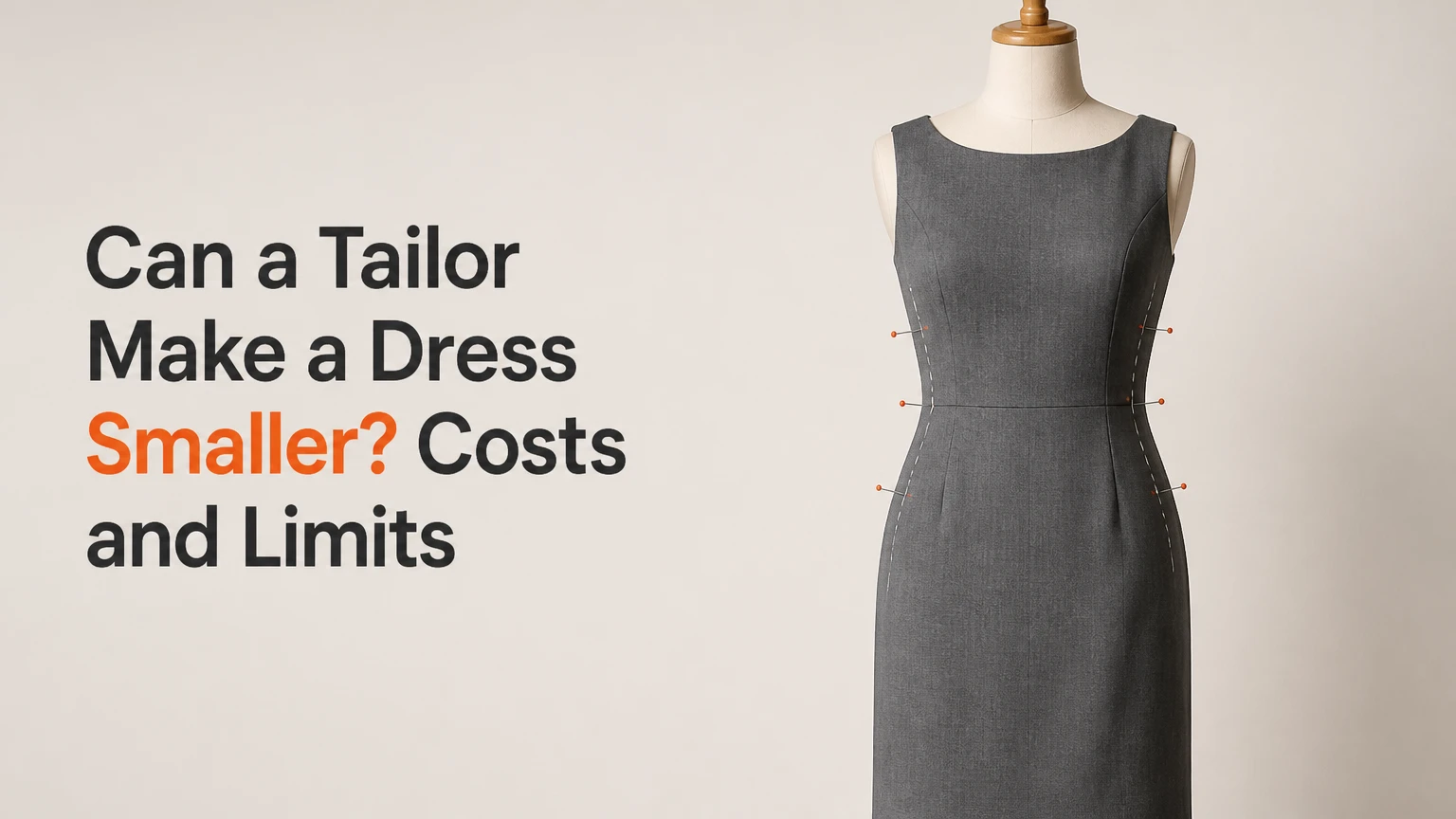
Yes, a professional tailor or dressmaker can make a dress smaller by taking in its seams, reshaping darts, shortening straps, or altering the center back. Most dresses can be reduced modestly without changing their design, but a large size reduction may require a recut, zipper relocation, or extensive reconstruction.
Key facts at a glance
- Taking in a dress is usually practical when the garment is one or two sizes too large and has usable seam allowance.
- A typical dress alteration costs about $25-$100 for simple seams and $75-$250 or more for formal gowns.
- The tailor should fit the dress over the exact bra, shapewear, shoes, and clothing planned for the event.
- A dress can be taken in at the sides, waist, princess seams, darts, shoulders, straps, or center back.
- Taking in is usually easier than letting out because extra fabric can be removed, while larger sizing requires hidden seam allowance.
- A dress that is three or more sizes too large may need a recut, and the original proportions may not survive intact.
Can a Tailor Make a Dress Smaller?
A tailor can make a dress smaller when the garment’s construction allows the excess fabric to be removed without damaging its proportions. The usual procedure is called taking in: the tailor creates new seam lines, removes or folds away excess material, and preserves the original neckline, hem, closures, and silhouette where possible.
A dressmaker may alter a loose waist without changing the bust or hips, or distribute the reduction through several seams for a smoother result. The correct method depends on where the dress is loose, how it is lined, whether it stretches, and how much seam allowance exists inside the garment.
The answer is less favorable when the dress is several sizes too large, has no internal seam allowance, contains fixed pockets, or uses a one-piece printed or beaded design. Those conditions do not make alteration impossible, but they raise labor, cost, and distortion risk.
What does “taking in” a dress mean?
Taking in means sewing a new seam farther into the garment so the finished circumference becomes smaller. A tailor may remove the excess fabric or leave a controlled allowance inside the new seam if future adjustment might be useful.
Taking in is different from shrinking. Shrinking changes the textile through heat, moisture, or agitation and is unpredictable for most dresses. Tailoring changes the garment’s pattern and construction, which gives the professional control over the finished measurements.
How Many Sizes Can a Dress Be Taken In?
A dress can commonly be taken in one or two sizes, but size labels are too inconsistent to determine the true limit. A better test compares the wearer’s bust, waist, and hip measurements with the garment’s finished measurements and examines the available seam allowance.
The often-repeated “two-size rule” is a useful screening guideline, not a technical standard. A simple woven shift dress may tolerate more reduction than a fitted gown with boning, molded cups, pockets, lace placement, or a fixed zipper.
| Reduction needed | Usually feasible method | Main risk | Typical decision |
|---|---|---|---|
| 1-2 inches total | Side seams or darts | Minor proportion change | Usually straightforward |
| 3-5 inches total | Multiple seams, waist, straps, or back | Closure and armhole distortion | Often practical after fitting |
| 1-2 dress sizes | Distributed reshaping | Pockets, lining, and neckline may shift | Common professional alteration |
| 3-4 dress sizes | Partial or complete recut | Original silhouette may disappear | Feasible only for suitable garments |
| 5 or more sizes | Pattern reconstruction | Labor can exceed replacement value | Rarely economical |
A tailor should measure the dress rather than rely on the label. For example, reducing a 42-inch bust to 40 inches requires 2 inches of total reduction, not 2 inches at each side seam. Dividing that change across four vertical seams may create a smoother shape than removing all 2 inches from the side seams.
When does a dress need a recut?
A recut becomes appropriate when ordinary seam adjustments cannot preserve the relationship between the bust, waist, hips, neckline, armholes, hem, and closures. The professional may remove the dress’s panels, use them as fabric, and redraw or overlay a smaller pattern.
A recut is more realistic for a plain, stable fabric with broad panels and minimal detailing. It is much less attractive for a beaded wedding gown, a directional print, a dress with engineered pleats, or a garment whose pockets and zipper are positioned for the original size.
A large reduction can technically succeed while still looking wrong. The finished dress may have a neckline that sits too high, pockets that move toward the back, an armhole that cuts into the body, or a waistline that no longer aligns with the wearer’s natural waist.
Which Parts of a Dress Can a Tailor Make Smaller?
A tailor chooses the alteration site according to the fit problem, not simply the location with the most visible excess. Distributing the change through the dress’s existing construction usually protects the silhouette better than removing a large amount from one seam.
| Loose area or symptom | Likely alteration | Construction affected |
|---|---|---|
| Loose bust and waist | Side seams or princess seams | Outer shell and lining |
| Waist gaping | Existing darts or new darts | Bodice shaping |
| Low, slipping neckline | Shoulder or strap shortening | Armholes and neckline |
| Loose center back | Center-back seam or zipper relocation | Zipper and lining |
| Sagging upper back | Back darts or shoulder adjustment | Back panel and armhole |
| Excess at hips | Side seams below the waist | Skirt or lower dress panels |
| Uneven fit on one side | One-sided seam correction | Asymmetrical balance |
| Loose strapless bodice | Side seams, darts, or internal support | Boning, cups, and facing |
Side seams
Side-seam alteration is the most common approach for a dress that is broadly too large. The tailor normally removes a balanced amount from the left and right sides, then blends the new seam into an unaffected section.
Side seams are not always the best location. Removing too much near the bust can flatten shaping, narrow the armhole, or make the zipper pull toward the side. A skilled fitter checks the garment from the front, side, and back before deciding how much belongs at each seam.
Princess seams
Princess seams run vertically through the bust area and provide several shaping lines. They are useful on fitted dresses because a tailor can distribute the reduction across the bust and waist while preserving a smooth contour.
Princess-seam work becomes difficult when the seams contain lace, piping, topstitching, or beadwork. The tailor may need to remove decorative elements before opening the seam and restore them afterward.
Darts and waist shaping
Darts can correct localized looseness, including a gaping lower back or excess fabric near the waist. Deepening an existing dart is normally cleaner than adding a new dart in a visible location, although the tailor may transfer the shaping when the original dart would become too large.
Darts cannot solve every fit issue. A dress that is too wide through the shoulders or too long from shoulder to waist requires a broader adjustment.
Shoulders and straps
Shortening straps or lifting the shoulder line can stop a neckline from falling forward and can reduce excess fabric across the upper bodice. Shoulder alterations also change armhole depth, sleeve position, and bust placement, so they should be fitted before the waist is finalized.
Strap shortening is often inexpensive for a simple dress. It becomes more involved when straps contain beading, elastic, lace, a wide facing, or a built-in bra structure.
Center back and zipper
A center-back seam can absorb some of the reduction when side pockets, printed motifs, or side-seam details must remain undisturbed. The zipper may need to be removed, shortened, or reinstalled after the new seam is sewn.
A rigid zipper can buckle when surrounding fabric is tightened too aggressively. The fitter should close the zipper during the fitting and check whether the tape lies flat from neckline to waist and hip.
How Does a Tailor Make a Dress Smaller?
A professional dress alteration normally takes one fitting, one construction session, and a final try-on, although lined, embellished, or bridal garments may require several appointments. The process preserves the garment by adjusting structural seams rather than simply cutting away visible fabric.
Step 1: Inspect the construction
The tailor checks the fabric, lining, seam allowance, stitch quality, closures, hem, pockets, boning, cups, elastic, and embellishments. The inspection determines whether the dress can be altered safely and whether the quoted price reflects hidden work.
Look inside the garment before approving the job. A serged seam with only 1/4 inch of allowance may provide little room for adjustment, while a structured vintage dress may contain 1 inch or more that can be used.
Step 2: Attend the fitting in final accessories
Wear the bra, shapewear, petticoat, and shoes intended for the finished outfit. A different bra can change bust projection, and a different shoe can alter the apparent hem length by several inches.
The tailor usually turns the dress inside out, pins excess fabric along candidate seams, and marks a smooth new line. Pinning should follow the body’s shape rather than create a straight wedge that ends abruptly.
Step 3: Test movement before cutting
Sit, walk, raise the arms, bend, climb a step, and imitate the event’s expected movement. A formal dress should also be tested with the planned undergarments and any bustle or crinoline.
A dress that looks perfect while standing may restrict breathing when seated or pull across the hips during a stride. The final seam should allow the closure to lie flat without excessive stress.
Step 4: Open and alter the seams
The tailor unpicks the original stitching where necessary, separates the lining from the shell, and sews the new seam line. A lined dress requires coordinated changes to both layers, while a stretch dress may need a stretch-compatible stitch, needle, thread, and machine tension.
The tailor may leave a small internal allowance instead of trimming immediately. That choice provides a limited possibility of letting the dress out later, although it cannot compensate for every future body change.
Step 5: Finish and press the garment
Excess fabric is trimmed only after the new fit is confirmed. Raw edges may receive an overlock finish, zigzag stitch, bias binding, or another treatment appropriate to the textile.
Pressing sets the seam and removes handling marks. Delicate fabrics need controlled temperature and a pressing cloth because shine, water marks, and permanent needle holes can appear after careless finishing.
Step 6: Complete the final fitting
The final appointment confirms that the neckline, bust, waist, hips, hem, lining, zipper, and decorative details remain aligned. The wearer should check comfort in motion rather than judge the garment only in a mirror.
What Does It Cost to Make a Dress Smaller?
Making a dress smaller typically costs $25-$100 for simple side or waist work and $75-$250 or more for a formal gown. Local labor rates, fabric behavior, lining, zipper work, boning, lace, bead removal, rush timing, and the number of fitting areas determine the final quote.
These are typical United States price ranges, not fixed national rates. A tailor may charge by operation, by hour, or by the entire project, and metropolitan bridal specialists generally charge more than neighborhood alteration shops.
| Alteration | Typical cost | Typical time | Main price driver |
|---|---|---|---|
| Shorten plain straps | $15-$45 | 2-5 days | Strap construction |
| Take in an unlined casual dress | $25-$65 | 3-7 days | Number of seams |
| Take in a lined fitted dress | $40-$120 | 5-14 days | Lining and closure |
| Move or alter a zipper | $35-$100 | 5-14 days | Zipper type and seam |
| Alter a stretch dress | $35-$100 | 5-10 days | Knit handling and testing |
| Take in a formal gown | $75-$250+ | 2-4 weeks | Layers, boning, trim |
| Recut a gown several sizes | $300-$600+ | 4-8 weeks | Pattern reconstruction |
Rush work may add 25%-100%, depending on the shop’s schedule. A quote should identify whether pressing, lining, zipper removal, beadwork, final fitting, and tax are included.
Is altering a cheap dress worth the cost?
Alteration is usually worthwhile when the garment has sentimental value, difficult-to-replace fabric, or a retail value that comfortably exceeds the alteration estimate. Replacing a $35 dress is often financially better than paying $80 to reconstruct it, unless the replacement cannot provide the same fit or design.
Ask for an inspection and written estimate before work begins. Compare the total with the dress price, return deadline, replacement availability, and the cost of correcting a failed alteration.
Which Fabrics and Dress Designs Are Easiest to Alter?
Stable woven fabrics with clear seams are generally easiest to reduce, while slippery, highly elastic, transparent, or heavily decorated materials demand more specialized work. Construction often matters as much as fiber content: a simple polyester crepe may be easier than a densely embellished cotton dress.
| Fabric or design | Alteration difficulty | Typical issue | Best professional approach |
|---|---|---|---|
| Cotton, linen, wool | Low to medium | Press marks or shrinkage | Standard seam alteration |
| Polyester crepe or satin | Medium to high | Shine and needle marks | Fine needle and pressing cloth |
| Chiffon or organza | High | Slippage and fraying | Stabilized handling and narrow seams |
| Jersey or spandex knit | Medium to high | Puckering and lost stretch | Stretch stitch and correct needle |
| Lace overlay | High | Pattern mismatch | Separate overlay and shell |
| Sequins or beads | Very high | Broken trim and labor | Remove and hand-reapply details |
| Corset or boned gown | Very high | Support and balance changes | Bridal specialist and multiple fittings |
| Fixed pockets or pleats | High | Misaligned proportions | Preserve design lines during planning |
Can a tailor make a satin or silk dress smaller?
A tailor can reduce a satin or silk dress, but the material exposes mistakes more readily than a stable matte woven fabric. Satin can show pressing shine, seam impressions, skipped stitches, and puckering, while silk can reveal needle holes after the original seam is opened.
Choose a professional who regularly handles the specific fabric. A test on an inconspicuous area can reveal whether the needle, thread, tension, and pressing method are suitable.
Can a tailor make a stretchy dress smaller?
A tailor can make a stretchy dress smaller if the new seams preserve the garment’s required stretch and recovery. The alteration may require a ballpoint or stretch needle, polyester thread, a narrow zigzag, or a coverstitch-compatible finish rather than a rigid straight seam.
The fitter should measure the dress both relaxed and stretched. Removing too much fabric can create a garment that fits while standing but restricts walking, sitting, or breathing.
Is It Easier to Make a Dress Smaller or Larger?
Making a dress smaller is generally easier than making it larger because taking in removes excess material, while letting out depends on hidden seam allowance. The exception occurs when the dress has narrow seams, fragile fabric, or a design that cannot absorb the reduction without distortion.
| Change requested | Material requirement | Typical complexity | Usual result |
|---|---|---|---|
| Smaller at side seams | Existing excess fabric | Low to medium | Reliable on simple dresses |
| Smaller at shoulders | Bodice reshaping | Medium | Good if neckline is flexible |
| Larger at seams | Hidden seam allowance | Medium to high | Limited by interior fabric |
| Larger with added panels | Matching fabric | High | Visible if fabric differs |
| Smaller by recutting | Pattern reconstruction | Very high | Possible but expensive |
| Larger through gussets | New matching inserts | High | Design-dependent |
A dress that is slightly too large is usually a safer purchase than one that is already too tight. A tight garment cannot be enlarged if there is no allowance, matching material, or compatible trim.
Can a Formal or Wedding Dress Be Made Smaller?
A formal or wedding dress can be made smaller, but bridal alterations often involve several independent layers, lining, boning, cups, lace, beadwork, and a train. A bridal specialist should evaluate the gown before purchase and schedule the first fitting roughly 8-12 weeks before the event when possible.
Simple reductions may involve the side seams and lining. More complex work can require removing lace appliqués, opening the zipper, adjusting a corset, reshaping cups, resetting straps, preserving the bustle, and hand-sewing decorations over the new seams.
A final fitting should occur close enough to the event to reflect the intended body measurements but early enough to correct a problem. Many shops schedule a first structural fitting, a second refinement fitting, and a final hem or pickup appointment.
What Should You Check Before Paying for Alterations?
Check the garment’s measurements, interior allowance, fabric condition, closures, and return policy before authorizing permanent work. A professional should explain where the new seams will go, what details may move, and whether the alteration can be reversed.
Use this inspection list:
- Measure the garment at the bust, waist, and hips.
- Compare those numbers with your body measurements and intended undergarments.
- Turn the dress inside out and inspect seam allowance.
- Check whether side pockets, pleats, vents, and prints can remain aligned.
- Look for fabric damage, stretched elastic, weakened seams, and old stitch holes.
- Ask whether the lining and outer shell will be altered separately.
- Confirm the price, completion date, fitting count, and rush fee.
- Ask what happens if the final fit is not correct.
A tailor cannot create fabric that is absent. If the dress has been cut with minimal allowance, the professional may need to use darts, center-back work, straps, or added panels instead of simply moving every seam inward.
What Common Problems Happen After a Dress Is Taken In?
Post-alteration problems usually result from excessive reduction, incorrect tension, poor seam blending, or failure to coordinate the lining with the outer shell. Most issues are easier to correct when reported promptly, before the garment is worn, washed, or trimmed further.
| Visible problem | Likely cause | Possible correction |
|---|---|---|
| Wavy side seam | Stretch tension or uneven stitching | Restitch with suitable settings |
| Zipper buckles | Too much reduction near closure | Redistribute adjustment |
| Neckline gaps | Shoulder or bust balance issue | Refine darts or shoulder |
| Lining pulls upward | Lining is tighter than shell | Release or reset lining |
| Armhole cuts in | Excess taken from upper bodice | Let out or reshape armhole |
| Pattern no longer matches | Seam moved through motif | Reposition seam or recut panel |
| Beads cluster at seam | Trim not redistributed | Remove and hand-reset beads |
Why does a zipper bulge after alteration?
A zipper can bulge when the surrounding seams are tightened more than the zipper tape and fabric can accommodate. The rigid closure then becomes the shortest or most stressed path, producing waves along the center back.
A tailor may release part of the side-seam reduction, redistribute shaping into darts, or reset the zipper with correct ease. Do not force the zipper closed repeatedly because that can damage teeth and weaken the seam.
Why does a dress feel tight only when sitting?
A dress may feel acceptable while standing but become tight when sitting because the hips and abdomen require additional circumference and the fabric must travel upward. Stretch garments also need recovery room so the fabric can move without permanent distortion.
During the fitting, sit for at least two minutes, walk several steps, raise both arms, and breathe normally. A formal garment should permit the movements required at the event, not merely produce a smooth standing photograph.
Can You Make a Dress Smaller Without a Tailor?
You can make a dress appear smaller temporarily with a belt, fashion tape, adjustable straps, temporary hand stitches, or carefully placed safety pins, but these methods do not replace structural tailoring. They are suitable for short wear and low-stress areas, not for a wedding gown, slippery satin, or a garment under constant movement.
Machine alteration at home is realistic when the dress has simple seams, stable woven fabric, no lining complication, and enough sewing experience to preserve seam transitions. Test on an inside seam first, pin while wearing the correct undergarments, and avoid cutting until the new fit survives movement.
Do not deliberately wash a dress hot to shrink it. Cotton, wool, rayon, silk, elastic, interfacing, and lining can shrink at different rates, creating puckering, distortion, or permanent damage.
How Do You Choose a Tailor for This Job?
Choose an alterations professional who has handled the dress’s fabric and construction, then ask to see examples of comparable work. A bridal gown, stretch knit, silk slip, and beaded evening dress require different equipment and techniques.
Ask these questions:
- Have you altered this fabric before?
- Where will you remove the excess?
- Will the lining, cups, boning, and zipper be altered separately?
- How much seam allowance will remain?
- Can pockets, pleats, lace, and pattern alignment stay in place?
- How many fittings are included?
- What is the completion date?
- What is the total price if beadwork or zipper work becomes necessary?
A tailor who promises that every dress can be reduced by a fixed number of sizes without inspection is giving an unreliable answer. Fit depends on measurements and construction, not the label alone.
Frequently Asked Questions
Can a tailor make a dress smaller at the waist only?
Yes, a tailor can reduce a dress at the waist only by adjusting side seams, waist darts, princess seams, or a center-back seam. The correct method depends on whether the dress is also loose at the bust or hips. Excessive waist reduction can create drag lines, so the tailor should blend the new seam gradually into surrounding measurements.
Can a tailor alter a dress with a zipper?
Yes, a tailor can alter a dress with a zipper, although the closure may need to be removed and reinstalled. A side zipper often permits side-seam work, while a center-back zipper may require back-seam adjustment. The tailor should check that the zipper remains flat and closes without strain after fitting.
How long do dress alterations usually take?
Simple dress alterations typically take 3-7 days, while lined dresses often require 1-2 weeks. Formal gowns commonly need 2-4 weeks, and a major recut can take 4-8 weeks. Event clothing should be booked earlier because fitting availability, hand-applied trim, and final body changes can extend the schedule.
Should I buy a dress that is too big?
Buying a dress that is slightly too big is usually safer than buying one that is too small, provided the shoulders, armholes, bust, and fabric are suitable. A tailor can often remove excess material, but enlarging a garment requires seam allowance or matching fabric that may not exist.
Can a tailor fix a gaping neckline?
A tailor can often fix a gaping neckline by shortening the shoulders or straps, adjusting darts, taking in the neckline seam, adding a discreet snap, or changing the facing. The best solution depends on whether the gap comes from excess width, incorrect shoulder balance, bust shaping, or the garment’s original pattern.
Can a dress be made smaller after it has been washed?
A dress can be altered after washing if the fabric remains stable and undamaged. Washing may change the garment’s measurements, so the dress should be cleaned according to its care label before the final fitting. Do not use heat as a substitute for tailoring because uneven shrinkage can permanently distort the shell and lining.
The Bottom Line
A tailor can make a dress smaller, and taking in one or two sizes is commonly achievable when the garment has suitable seams, stable fabric, and enough internal allowance. The best result comes from distributing the reduction across the correct structural areas, testing movement in the final undergarments, and confirming the cost before cutting.
Large reductions, beading, lace, boning, stretch fabric, fixed pockets, and fragile silk require specialist judgment. If the estimate approaches the replacement price, compare both options honestly. For the target question, can a tailor make a dress smaller, the answer is yes, but the garment’s construction determines whether the alteration is simple, expensive, or technically unwise.