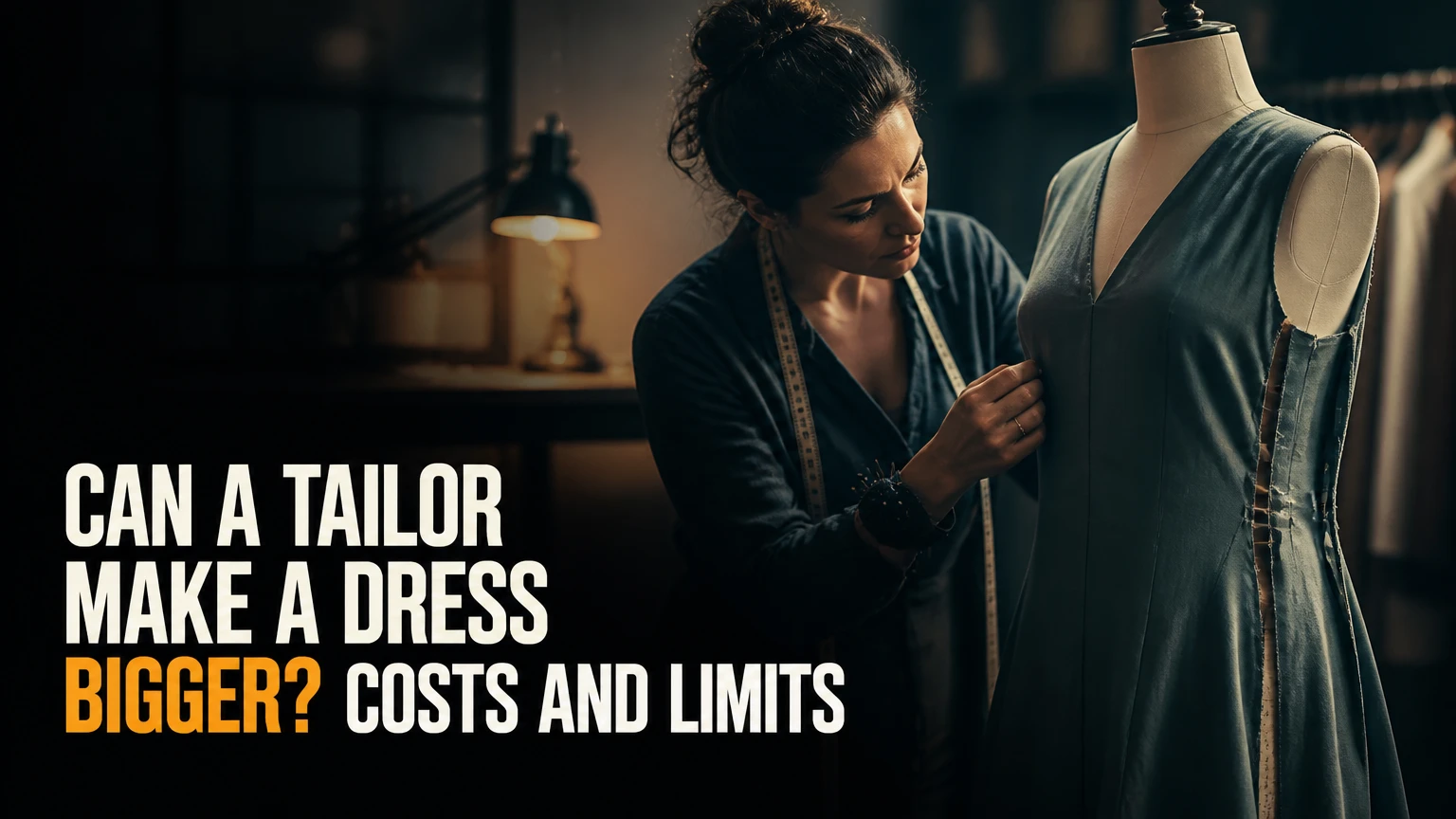
Yes, a tailor can make a dress bigger, but the practical limit depends on the dress’s seam allowance, fabric, lining, closures, and required increase. A tailor may release existing seams for a modest gain, or add panels, gussets, or a corset back when the dress lacks spare fabric. Significant enlargement can change the design and fit balance.
Key Facts at a Glance
- Dress enlargement is called letting out, while reducing a garment is called taking it in.
- Releasing side seams typically provides about 0.5-2 inches of total circumference, depending on construction.
- A dress with no usable seam allowance needs added fabric, such as side panels, gussets, or a new back closure.
- Stretch jersey can accommodate a small fit difference, but stretching cannot correct a rigid zipper, tight armhole, or distorted pattern.
- A corset-back conversion can provide roughly 2-6 inches or more across the upper body, but it changes the original closure and appearance.
- Typical alteration pricing ranges from $30-$55 for simple work to $150-$350 or more for complex bridal conversions.
Can a tailor make a dress bigger?
A tailor can make a dress bigger when the garment contains extra fabric inside its seams or can accept a well-designed fabric insertion. The easiest cases involve a structured dress with generous side-seam allowances, while the hardest cases involve lined, beaded, satin, leather, or highly patterned garments with no spare material.
“Bigger” can mean several different alterations. A dress may need more room at the bust, waist, hips, shoulders, or upper arms, and each area requires a different solution. Adding circumference at the waist does not automatically correct a tight armhole or a zipper that cannot close across the bust.
A professional tailor first identifies the smallest measurement causing the failure. The tailor then checks whether the garment’s darts, seams, lining, grain direction, closures, and decorative details can be altered without creating a second fit problem.
What does “letting out” mean?
Letting out means moving an existing seam toward the garment’s raw edge to use fabric that was previously hidden inside the seam allowance. The method preserves the exterior fabric and original style when enough allowance remains, but it cannot create fabric where the manufacturer left none.
A seam allowance is the strip between the sewn seam and the cut edge of a fabric piece. A tailor may find 1/4 inch in a low-cost dress, 1/2 inch in a better-made garment, or substantially more in some formalwear. The usable amount is smaller than the visible allowance because the new seam still needs a stable edge.
How much bigger can a dress become?
A tailor can usually enlarge a dress by about 0.5-2 inches in total circumference through seam release, although the actual result varies by seam count, fabric condition, and the amount of safe material remaining. Larger increases generally require inserted fabric or a redesigned closure.
A clothing size is not a universal measurement. One brand’s size 10 may differ from another brand’s size 10 by several inches, so a tailor measures the garment and body directly rather than promising a particular number of sizes.
| Enlargement method | Typical total gain | Main location | Design impact |
|---|---|---|---|
| Release two side seams | 0.5-2 inches | Bust, waist, hips | Low if fabric and lining match |
| Release darts or pleats | 0.5-1.5 inches | Bust or waist | May reduce shaping |
| Add side panels | 1-4 or more inches | Full garment length | Visible color or texture change possible |
| Add underarm gussets | 1-2.5 inches | Bust, armhole, upper arm | Targeted change, usually discreet |
| Convert to corset back | 2-6 or more inches | Upper torso | Original zipper or lacing changes |
These figures are typical working ranges, not guarantees. A 2-inch increase distributed around a six-seam dress is more achievable than a 2-inch increase at one tight armhole.
How does a tailor enlarge a dress?
A tailor enlarges a dress by redistributing hidden fabric, inserting new material, changing the closure, or combining two or more of those methods. The tailor must preserve seam strength, lining movement, grain direction, pattern continuity, and the relationship between the bust, waist, hip, and hem.
The process begins with a fitting, not with cutting. The tailor pins the garment while it is worn, marks the tight areas, and examines the inside for construction options. A dress that looks one size too small may need only a bust adjustment, whereas a dress that pulls horizontally at every seam needs broader enlargement.
What happens during a professional alteration?
A typical dress-enlargement appointment follows six practical stages:
- Fit assessment: You wear the dress with the intended bra, shapewear, shoes, and undergarments. The tailor records body and garment measurements at the bust, waist, hip, armhole, and upper arm.
- Construction inspection: The tailor examines side seams, center back, darts, pleats, hem depth, lining, zipper tape, seam finishes, and embellishments.
- Deficit calculation: The tailor determines how much additional circumference is required and distributes the increase across suitable seams. For example, a 1.5-inch waist deficit divided across six equivalent seams equals 1/4 inch per seam.
- Controlled deconstruction: The tailor opens only the necessary stitching, including separate lining seams when the dress is lined. Beading, boning, lace, and invisible zippers require additional handling.
- Reconstruction: New seam lines are marked, basted, fitted, and sewn. A professional leaves a stable fabric margin rather than stitching at an unstable raw edge.
- Finishing and final fitting: The lining is adjusted, raw edges are finished, the garment is pressed, and the wearer checks sitting, walking, breathing, and arm movement.
A second fitting is often needed for formalwear. The tailor can identify strain while the garment is basted, before permanent stitching makes correction more expensive.
Can the tailor use side seams?
Side-seam release is the most common enlargement method because it distributes extra room vertically and can preserve the front and back design. The method works best when the side seams run continuously through the tight area and contain enough allowance.
Side seams are less useful when they contain piping, lace, sequins, princess-cut shaping, pockets, or sharply curved construction. A tailor may need to open the lining separately, reposition a zipper, or blend the new seam gradually into the original line.
The result must be balanced on both sides. Releasing only one side seam can twist the dress, shift the center front, or move the side seam toward the back.
Can darts or pleats be released?
Darts and pleats can provide extra room when they contain deep folds that are no longer needed for shaping. Releasing a dart increases space near the dart’s endpoint, but it also makes the dress flatter and may alter the bust contour.
A dart is not simply unused fabric. The dart creates three-dimensional shape, so removing it can cause fabric pooling, a lower bust point, or diagonal wrinkles. Tailors often release only part of a dart and blend the remaining shaping into a new seam line.
Pleats can be more forgiving than darts, particularly in skirts and relaxed waistlines. Pressed pleats may retain permanent fold marks, however, and the original fabric beneath the pleat may have a different color or sheen.
Which method is best for making a dress bigger?
The best method depends on the tight location, required increase, fabric availability, and whether preserving the original appearance matters more than maximizing room. Side-seam release is the least visible option for a modest increase, while panels or a corset back are more suitable for substantial enlargement.
| Method | Best use case | Typical price | Typical time | Main limitation |
|---|---|---|---|---|
| Side-seam release | Structured day dress, 0.5-2 inch increase | $30-$110 | 3-10 days | Requires usable allowance |
| Dart or pleat release | Local bust or waist tightness | $30-$75 | 3-7 days | Changes garment shaping |
| Side fabric panels | Two or more inches, casual or color-block design | $75-$150 | 1-2 weeks | Matching fabric may be difficult |
| Underarm gussets | Tight armhole, sleeve, or upper bust | $45-$85 | 4-10 days | Does not enlarge the entire torso |
| Corset-back conversion | Bridal or formal bodice needing major room | $150-$350+ | 2-6 weeks | Changes closure and appearance |
| Hem or accessory fabric insertion | No internal allowance, exact-match priority | $75-$200 | 1-3 weeks | Requires enough donor fabric |
When are side panels the better choice?
Side panels are the better choice when the dress needs more than about 2 inches of room or has no usable internal seam allowance. A tailor opens the side seams and inserts long fabric strips, usually tapering or blending them near the armhole, waist, and hem.
Panels can look intentional in a color-blocked dress, knit dress, loose cotton style, or garment with an existing vertical design line. Exact matching is harder in satin, velvet, metallic fabric, lace, and prints because color, nap, sheen, and pattern repeat must align.
A donor dress made from the same fabric can produce a cleaner result than a supposedly similar store-bought fabric. Even the same named color can differ by dye lot, age, washing, and exposure to light.
When is an underarm gusset appropriate?
An underarm gusset is appropriate when the main problem is a restrictive armhole, upper arm, or upper-bust area rather than a uniformly tight dress. The tailor inserts a diamond, triangular, or football-shaped piece into the underarm seam to increase movement.
A gusset does not automatically add waist or hip room. It is a targeted correction for sleeves, armholes, and localized bust strain, and the insertion may be visible if the fabric has a strong sheen or directional pattern.
Should a zipper be replaced?
A zipper may need replacement or relocation when the closure is the tightest point. A tailor can move a center-back zipper outward only if the back seam contains allowance, or replace it with a longer zipper if the opening itself is too short.
A corset-back conversion is often more practical for a wedding or prom gown that needs several inches across the bodice. The tailor removes or modifies the zipper, adds a modesty panel, installs loops or eyelets, and creates lacing that allows adjustable fit.
Corset backs do not solve every problem. A skirt that is tight at the hips, a bodice with fixed boning, or a neckline that sits incorrectly may still require separate alterations.
Can a dress be made bigger without adding fabric?
A dress can sometimes be made bigger without adding fabric by releasing side seams, darts, pleats, or a seam joining separate panels. Stretch fabric may also provide limited comfort, but fabric stretch is not equivalent to a permanent size increase.
A tailor must distinguish between a dress that is tight because it lacks circumference and a dress that is tight because the pattern is unbalanced. Horizontal pulling, gaping neckline edges, raised hem, diagonal wrinkles, and a displaced bust point can indicate different problems.
| Dress construction | Likely solution | Practical increase | Risk level |
|---|---|---|---|
| Woven sheath with 1/2-inch side allowance | Release side seams | 1-2 inches | Low to moderate |
| Stretch jersey with 5-8% elastane | Fit adjustment or seam release | 0.5-1.5 inches | Moderate |
| Princess-seamed bodice | Release several vertical seams | 1-3 inches | Moderate |
| Fully lined beaded gown | Panels, gussets, or closure change | 1-4 inches | High |
| Bias-cut silk slip dress | Limited seam adjustment | 0.25-1 inch | High |
| Rigid leather or vinyl dress | Panel insertion or replacement | 1-3 inches | High |
Stretch fabric needs room to recover after movement. Overstretching can expose lining, distort printed motifs, make seams ripple, and shorten the garment visually. A tailor may recommend a larger dress rather than forcing a small knit garment beyond its recovery capacity.
Which fabrics and dress details make enlargement difficult?
Satin, silk, velvet, leather, vinyl, sequined fabric, beaded gowns, metallic textiles, and heavily printed materials are difficult to enlarge because unpicking can leave holes, marks, crushed pile, or visible color differences. Fragile fabrics also tolerate fewer corrective fittings.
Woven fabric usually offers a more predictable structural alteration than slippery or fragile fabric. A stable cotton dress with simple seams is a favorable candidate, while a bias-cut silk dress with an invisible zipper and French seams may have almost no safe margin.
Beading and lace add labor because embellishments may need removal and reattachment. Boning can restrict a bodice even after fabric is added, and the tailor may need to lengthen or reposition the boning channels.
What are the main failure modes?
The most common failures occur when a garment is enlarged beyond its pattern balance or when the tailor treats hidden fabric as fully usable. A visible crease, weakened edge, shifted seam, or mismatched lining can make an apparently larger dress uncomfortable and unattractive.
Watch for these problems:
- Permanent needle marks: Silk, satin, leather, vinyl, and some synthetic velvets may retain holes after original stitches are removed.
- Ghost lines: Sun fading, pressing, perspiration, or wear can leave a lighter or darker strip where the old seam was folded.
- Fraying: Sewing too close to the raw edge can cause a seam blowout when the wearer sits, bends, or dances.
- Pattern distortion: Floral motifs, stripes, checks, and borders may no longer align after panels or seam movement.
- Lining restraint: A larger outer shell remains tight if the lining is not enlarged by the same amount.
- Closure strain: A zipper may ripple or separate if the surrounding bodice gains room without adequate zipper tape support.
An important practitioner rule is that the old crease is often more visible from the outside than the new seam. A tailor should test a hidden section before committing to a full release, particularly on dark satin or vintage silk.
What if the dress has no seam allowance?
When a dress has no usable seam allowance, the tailor must add fabric, alter the closure, borrow material from another part of the garment, or recommend replacement. A tailor cannot release a seam past the cut edge without creating an unstable garment.
Useful sources of matching material include:
- A deep hem: If the dress is too long, 2-4 inches may be removed and converted into gussets or narrow side inserts.
- A matching belt or sash: Removable accessories often provide enough fabric for a bodice panel or underarm insert.
- Removable straps or shoulder bows: These can supply small pieces for localized corrections.
- A second identical dress: A donor garment made in the same fabric gives the best chance of matching color and surface.
- Intentional contrast: Lace, mesh, matte crepe, or satin can create a deliberate panel rather than an unsuccessful imitation.
A hem donor is not always suitable. Fabric cut from the hem may have a different fade level, and its grain direction may not work for a vertical panel. The tailor should test drape and color under the lighting where the dress will be worn.
How much does it cost to make a dress bigger?
Dress enlargement typically costs $30-$110 for releasing seams or darts, $75-$150 for side panels, $45-$85 for gussets, and $150-$350 or more for a corset-back conversion. Local labor rates, lining, fabric matching, beading, urgency, and the number of fittings can move the price outside these ranges.
These are typical United States working ranges rather than fixed industry prices. A tailor usually prices labor and risk, not merely the quantity of fabric added. An invisible alteration on a lined gown can require more time than a visibly contrasting panel on a simple cotton dress.
| Garment and alteration | Typical cost | Typical turnaround | Fittings |
|---|---|---|---|
| Unlined cotton or knit seam release | $30-$55 | 3-7 business days | 1 |
| Lined work or cocktail dress | $60-$110 | 5-14 business days | 1-2 |
| Side panels with sourced fabric | $75-$150 | 7-14 business days | 1-2 |
| Beaded or heavily structured gown | $100-$250+ | 2-4 weeks | 2-3 |
| Bridal corset-back conversion | $150-$350+ | 4-8 weeks | 2-3 |
| Rush formalwear alteration | Add 25%-100% | 1-5 days | 1-2 |
A cheap fast-fashion dress may cost less to replace than to enlarge. A designer, sentimental, vintage, or already purchased formal dress may justify the labor because replacement would be difficult or impossible.
When should you alter the dress or replace it?
Alter the dress when the increase is modest, the fabric is stable, the construction has usable allowance, or the garment has sentimental or financial value. Replace it when the dress needs several sizes, has no donor fabric, contains fragile material, or would require changes that undermine its original design.
Consider four decision factors:
- Required increase: Up to about 1 inch often suits seam release; 2-4 inches commonly requires panels or structural changes.
- Tight location: A bust-only issue may need a gusset or bust adjustment, not a larger skirt.
- Garment value: A $40 unlined dress rarely supports a $150 alteration, while a wedding gown may.
- Deadline: Bridal work may need 4-8 weeks, while ordinary seam release can take under two weeks.
Who should use a corset-back conversion?
A corset-back conversion suits a bride or formalwear client who needs adjustable upper-body room and accepts a changed back design. Lacing can accommodate body fluctuations between fittings and reduces dependence on a precisely fixed zipper measurement.
The conversion is less suitable when the dress has a prominent center-back print, delicate illusion fabric, a low back, or a skirt that is already tight. The tailor must assess the whole garment rather than treating the corset as a universal enlargement solution.
What should a vintage-dress owner do?
A vintage-dress owner should prioritize reversibility and fabric preservation. Fragile silk, rayon, lace, and early synthetic textiles may be damaged by aggressive pressing, steam, repeated unpicking, or newly stressed seams.
Removable side extensions, a separate underdress, a matching belt, or carefully placed contrast panels may protect the original textile. Ask the tailor to test heat, moisture, and stitch removal on an inconspicuous area first.
What should someone do with casual clothing?
A casual cotton, linen, denim, or jersey dress is usually the simplest candidate for enlargement, especially when the construction is unlined and the seams are easy to access. A local alterations shop can often release a seam or add a practical panel without complex relining.
Do not assume every casual dress is economical to alter. A $25 garment requiring three hours of labor, a new zipper, and custom fabric may cost more than a replacement in a larger size.
What should you bring to the tailor?
Bring the dress, the shoes and undergarments intended for wear, any matching belt or accessory, and photographs of how the dress should fit. Tell the tailor the event date, the tight locations, the desired comfort level, and whether preserving the original appearance is more important than maximizing room.
Before authorizing work, ask:
- How many inches can you safely add?
- Which seams or closures will change?
- Will the lining, boning, hem, and embellishments also need alteration?
- Can the original stitch marks or color differences remain visible?
- What fabric will be used if no matching material exists?
- What is the total price, including fittings and rush fees?
- When will the final fitting occur?
The tailor should pin or baste the proposed changes before permanent sewing. Sit down, raise your arms, walk, and breathe normally during the fitting. A dress that closes while standing may still fail at the waist or armhole in use.
Frequently Asked Questions
Can a tailor make a dress two sizes bigger?
A tailor can sometimes enlarge a dress by two sizes, but releasing ordinary seams rarely provides that much room. Two-size enlargement usually requires side panels, a gusset system, a new closure, or fabric from a matching donor garment, and the final pattern balance may differ from the original.
Can a tailor make a dress bigger at the bust only?
A tailor can enlarge a dress at the bust only by releasing bust seams, adjusting darts, adding underarm gussets, inserting a small side panel, or modifying the closure. The correct method depends on whether the tightness comes from the bust circumference, armhole depth, shoulder width, or zipper position.
Can a lined dress be made bigger?
A lined dress can be made bigger, but the tailor must enlarge or reposition the lining as well as the outer fabric. A lining that remains at its original size can pull the shell inward, create wrinkles, and place stress on the new seam, zipper, or armhole.
Can a tailor make a dress bigger after it has been hemmed?
A tailor can sometimes use fabric removed from a hem to enlarge the dress, provided the hem piece is large enough and its color and grain remain suitable. Hem fabric is especially useful for small gussets or localized panels, but it may not provide enough material for a full bodice expansion.
Is it easier to make a dress smaller than bigger?
Making a dress smaller is generally easier because a tailor removes excess fabric or moves seams inward. Making a dress bigger requires hidden allowance, added fabric, or a closure redesign, so enlargement involves more limits, more visible trade-offs, and sometimes higher labor costs.
The Bottom Line
Can a tailor make a dress bigger? Yes, when the garment has usable seam allowance, suitable fabric, or a workable design for panels, gussets, or a new closure. A modest increase of 0.5-2 inches may come from releasing seams, while a larger increase usually changes the garment’s construction.
Have the dress assessed before cutting, especially if it is lined, beaded, vintage, satin, silk, or needed for a wedding. The tailor’s answer should identify the exact tight area, safe increase, method, price, timeframe, and likely cosmetic changes rather than promising that any dress can be enlarged indefinitely.