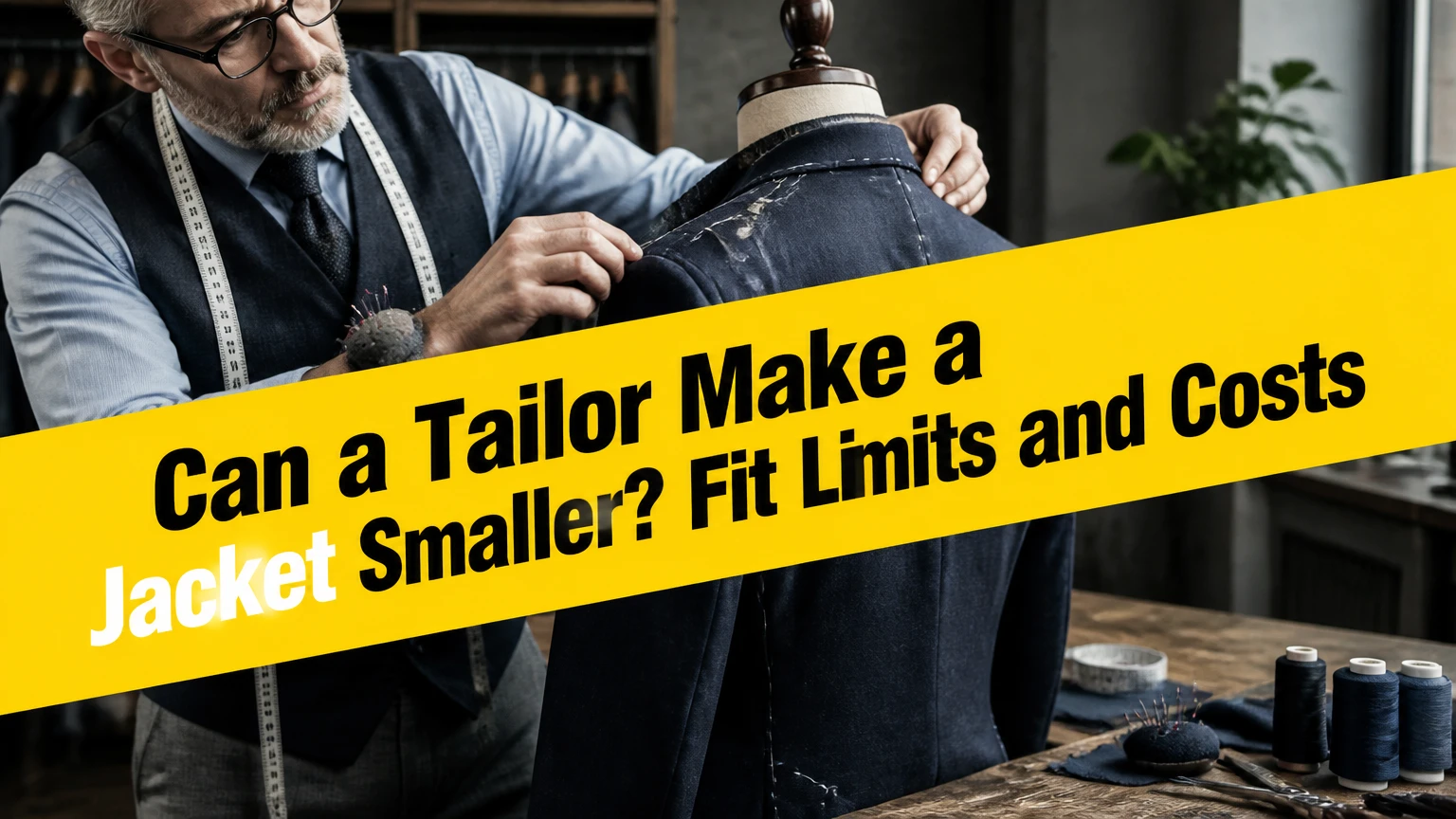
A tailor can make a jacket smaller by taking in seams, shortening selected sections, or rebuilding structural areas. Most tailored jackets can be reduced comfortably by about one size, and many can manage two sizes when the shoulders, armholes, pockets, and button stance remain proportionate. Larger reductions require careful assessment and may not be economical.
Key Facts at a Glance
- A tailor usually reduces jacket width through the side seams, center-back seam, or both.
- A jacket that is too large in the shoulders is harder and more expensive to resize than one that is loose at the waist.
- Reducing a jacket by more than two sizes often distorts pocket placement, lapel balance, armholes, and button position.
- Functional sleeve buttonholes usually require shortening the sleeve from the shoulder rather than simply cutting the cuff.
- Typical alteration prices range from $40-$90 for taking in a waist and $100-$250 for narrowing shoulders.
- A jacket must fit the shoulders and chest reasonably well before extensive tailoring is worth considering.
Can a Tailor Make a Jacket Smaller?
Yes, a tailor can usually make a jacket smaller, but the practical answer depends on where the jacket is oversized. Taking in a loose waist is routine; reducing broad shoulders, a long body, or a low armhole involves structural reconstruction and carries greater risk.
A professional tailor evaluates the jacket on your body rather than relying on the label size. A marked “40” jacket from one brand may measure differently from another brand’s “40,” so the tailor examines chest circumference, shoulder width, sleeve pitch, jacket length, button position, and the amount of usable seam allowance.
The best candidate has a good shoulder line, enough excess fabric inside the seams, and a body that is only moderately loose. A jacket with worn fabric, fused bubbling, shallow seam allowances, or badly misplaced pockets may not justify the work.
What “smaller” can mean
“Smaller” may describe several different corrections:
- Taking in the chest or waist
- Narrowing the shoulders
- Shortening sleeves
- Shortening the jacket body
- Raising or reshaping the armholes
- Moving buttons to reduce the apparent front width
- Tapering a leather or casual jacket
These alterations do not have equal difficulty. A tailor can often improve a loose torso without changing the jacket’s identity, while a major shoulder reduction can alter the entire silhouette.
How Much Smaller Can a Jacket Become?
A tailor can commonly reduce a jacket by one full size and sometimes two, provided the shoulder structure and fixed details remain balanced. A reduction greater than two sizes is technically possible on some garments, but it often produces an unnatural relationship between the lapels, pockets, buttons, sleeves, and body.
Clothing sizes are not precise engineering units. A two-size reduction might represent only several inches around the chest in one brand and a different measurement in another. Ask for finished body measurements, not a promise that the jacket will become a particular numbered size.
A practical rule is to compare the jacket’s current measurements with your target measurements:
| Measurement | Typical reduction before reassessment | Main risk after excessive reduction |
|---|---|---|
| Chest circumference | 2-4 inches | Button strain and chest wrinkles |
| Waist circumference | 2-6 inches | Side pockets tilt or gape |
| Shoulder width | 0.5-1 inch total | Distorted sleeve and collar balance |
| Jacket length | 1-1.5 inches | Pockets sit too close to the hem |
| Sleeve length | 1-2 inches at cuff | Buttons become crowded at the edge |
The numbers are typical working ranges, not guarantees. A heavily constructed blazer with patch pockets may tolerate a different adjustment from a lightweight fused suit jacket with narrow seam allowances.
Why the shoulders matter most
Shoulders establish the jacket’s frame. If the shoulder seam extends far beyond your natural shoulder, taking in only the waist leaves a triangular silhouette and can create a collar gap. If the shoulder is substantially too wide, the sleeve cap, shoulder pad, chest canvas, and armhole may all need alteration.
A small shoulder adjustment can improve fit. A large one can cost more than replacing an inexpensive jacket.
Which Jacket Areas Can Be Altered?
The torso, sleeves, and minor back adjustments are usually the most practical alterations. Shoulders, armholes, jacket length, and details near functional buttonholes require more labor because the tailor must preserve the garment’s original geometry.
| Alteration area | Typical adjustment | Typical difficulty | Main limitation |
|---|---|---|---|
| Side seams and waist | 1-4 inches total | Medium | Pocket position and lining shape |
| Center-back seam | 0.5-2 inches total | Low to medium | Back vent and pattern symmetry |
| Sleeve from cuff | Up to 2 inches | Low to medium | Buttonholes and cuff proportions |
| Sleeve from shoulder | 0.5-2 inches | High | Sleeve removal and resetting |
| Jacket hem | 1-1.5 inches | High | Pocket and vent placement |
| Shoulders | 0.5-1 inch total | Very high | Pads, sleeve heads, collar alignment |
Taking in the torso
Taking in the side seams is the most common way to reduce a jacket’s chest and waist. The tailor opens part of the lining, marks the new seam line during a fitting, bastes the adjustment, and checks whether the front hangs smoothly before permanently sewing the shell and lining.
Some jackets also use a center-back seam. That seam can refine the back shape, but it cannot always compensate for a jacket that is too large through the chest or shoulders. A tailor may divide the adjustment between side seams and the center back to preserve symmetry.
Shortening sleeves
Plain sleeves can often be shortened from the cuff. The tailor removes the lining connection, raises the hem, recreates the cuff, and resets the lining. A sleeve with working buttonholes is more complicated because cutting from the bottom may leave the buttons too close to the edge.
Shortening from the shoulder preserves the cuff but requires removing and resetting the sleeve. That procedure changes sleeve pitch and sleeve-head alignment, so the tailor must check how the arm hangs naturally rather than treating the sleeve as a simple tube.
Shortening the jacket body
A tailor can shorten a jacket, but the safe amount is limited by the pockets, vents, front curve, and button stance. Raising the hem by more than about 1-1.5 inches can make the pockets appear unusually low and can leave the lowest button too near the hem.
Length is particularly difficult on jackets with curved hems, ticket pockets, patch pockets, double vents, decorative topstitching, or heavy canvassing. A skilled tailor may recommend leaving the length alone when the body is only slightly long.
Narrowing the shoulders
Shoulder narrowing requires more than removing fabric at the shoulder seam. The tailor may detach the sleeves, remove or reshape shoulder pads, reduce the shoulder seam, adjust the sleeve head, and reconnect the lining and internal structure.
A jacket can have a narrower shoulder measurement but still look wrong if the armhole becomes cramped. The fitting must include arm movement, a relaxed standing posture, and a check for diagonal wrinkles from the collar toward the sleeve.
How Does a Tailor Resize a Jacket?
A tailor resizes a structured jacket from the inside out, using a fitting, temporary basting, controlled seam reduction, pressing, and reassembly. The tailor does not simply cut fabric from the visible outside because the lining, canvas, shoulder padding, sleeve head, vents, and pockets must remain aligned.
Step 1: Assess the garment on the body
Wear the shirt or knitwear you expect to use beneath the jacket. Keep your posture relaxed, close the jacket normally, and tell the tailor whether you need room for sitting, driving, or lifting your arms.
The tailor checks:
- Shoulder seam placement
- Collar contact with the neck
- Chest and waist ease
- Button strain
- Sleeve pitch
- Jacket length
- Pocket and vent position
- Lining condition and seam allowance
You will know the assessment is useful when the tailor explains which areas can change and which fixed details cannot move. A common mistake is requesting “two sizes smaller” without identifying the actual excess.
Step 2: Open the lining and mark the new shape
The tailor usually opens the lining at a sleeve, hem, or another inconspicuous location. Chalk marks and pins show where the shell will be reduced, while the tailor checks that the lining will still have enough ease to hang freely.
The success checkpoint is a smooth pinned silhouette without diagonal pulling. A common mistake is pinning the jacket while the wearer stands stiffly or puffs out the chest, which creates an inaccurate target shape.
Step 3: Baste and test movement
Basting temporarily holds the new seam lines before final stitching. The wearer should stand, sit, button the jacket, reach forward, raise both arms, and walk a few steps.
The jacket is ready for permanent sewing when the button area lies flat, the collar stays against the neck, and the back does not form severe horizontal or diagonal stress lines. A waist that looks excellent while standing can still be too tight when seated.
Step 4: Sew, trim, and press the shell
After approval, the tailor permanently sews the new seams and trims excess material while preserving a practical seam allowance. The tailor then presses the altered seams so the cloth takes the new shape without creating a sharp ridge.
Wool responds well to controlled steam and pressing. Synthetic cloth may retain shine or needle marks, and delicate fabrics can show every previous seam line. Cutting away too much material at this stage makes later correction difficult or impossible.
Step 5: Rebuild the lining and internal structure
The lining is resized to match the outer shell while retaining enough movement ease. Shoulder work may require repositioning pads, sleeve heads, chest pieces, and canvas so the jacket retains its original roll and drape.
The final checkpoint is a lining that does not pull at the hem or sleeves. A lining that is smaller than the shell can restrict movement and tear; a lining that is too loose can bubble inside the jacket.
Step 6: Complete the final fitting
The tailor steams and presses the jacket, checks the button stance, inspects the vents and pockets, and confirms sleeve length with your arms relaxed at your sides. Do not judge the result only from a mirror view with the jacket unbuttoned.
What Does Jacket Alteration Cost?
Typical jacket alteration prices range from $40-$90 for torso adjustments, $25-$50 for simple sleeve shortening, and $100-$250 for shoulder work. A combined downsize commonly reaches $200-$450, although city, fabric, construction, urgency, and the tailor’s specialization can change the final quote.
| Service | Typical price range | Typical turnaround | Cost driver |
|---|---|---|---|
| Take in side seams | $40-$90 | 3-7 days | Lining and vent construction |
| Shorten plain sleeves | $25-$50 | 3-5 days | Cuff detail and lining |
| Shorten sleeves from shoulder | $80-$150 | 7-14 days | Sleeve removal and resetting |
| Shorten jacket hem | $60-$120 | 5-10 days | Pockets, vents, and canvas |
| Narrow shoulders | $100-$250 | 10-14 days | Pads, sleeve heads, and armholes |
| Combined full reduction | $200-$450 | 2-3 weeks | Number of structural areas |
These figures are typical consumer ranges, not a universal price list. A tailor in New York, London, or Sydney may charge more than a mid-sized regional shop, while rush service can add a separate fee.
A useful cost test compares alteration price with replacement value. Spending $250 to rescue a well-made wool blazer with a half-canvas construction may be sensible; spending the same amount on a thin, damaged polyester jacket usually is not.
How Long Does the Work Take?
Simple torso or cuff alterations often take three to seven days, while shoulder reconstruction or several combined changes commonly takes two to three weeks. The fitting, fabric availability, pressing requirements, seasonal workload, and whether the tailor must hand-finish the lining all affect delivery time.
A tailor may request two fittings for a moderate alteration and three for structural work. Vintage garments can take longer because fragile cloth, old linings, unusual seam finishes, and previous alterations require slower handling.
Do not wear a jacket to a tailor expecting same-day structural work unless the shop explicitly offers it. A rushed shoulder or sleeve operation increases the chance of uneven seams, poor pressing, and an incorrect sleeve pitch.
Do Different Jacket Types Alter Differently?
Suit jackets, blazers, leather jackets, and insulated coats can all sometimes be made smaller, but their materials and construction create different limits. A wool blazer is usually the most predictable candidate, while a quilted coat or bonded leather jacket may be expensive or impossible to reshape cleanly.
| Jacket type | Usually feasible work | Typical difficulty | Important restriction |
|---|---|---|---|
| Wool suit jacket | Waist, sleeves, minor back shaping | Medium | Canvas and buttonholes |
| Unstructured blazer | Torso, sleeves, some length | Low to medium | Fabric may show old seams |
| Leather jacket | Side seams, sleeves, waist | Medium to high | Needle holes remain visible |
| Down coat | Limited side shaping | High | Baffles and insulation must align |
| Heavy wool overcoat | Side seams, sleeves, some length | High | Weight, lining, and padding |
| Denim or cotton jacket | Side seams, sleeves | Low to medium | Topstitching and hardware |
Leather cannot be treated like wool. Stitch holes remain after seams move, thick layers can leave ridges, and matching the original thread or edge paint may be difficult. Ask for a leather specialist rather than a general alterations counter.
Down and padded coats present another problem. Reducing the shell without rebuilding the baffles can compress insulation unevenly, create cold spots, or leave the lining tight. Replacement is often more practical for inexpensive insulated outerwear.
Should You Alter or Replace the Jacket?
Alter the jacket when the shoulders, chest, fabric quality, and construction are already sound and the needed changes are moderate. Replace it when the shoulders are substantially wrong, the fabric is damaged, the alteration cost approaches replacement cost, or fixed details would look misplaced after resizing.
| Decision factor | Altering is preferable | Replacing is preferable |
|---|---|---|
| Shoulder fit | Seam sits within 0.5 inch of shoulder edge | Shoulder extends 1 inch or more |
| Required reduction | 1-2 sizes or 2-4 inches | More than 2 sizes |
| Garment value | Quality wool, vintage, or designer piece | Damaged low-cost synthetic |
| Alteration budget | Under 40%-50% of replacement price | Over 60%-70% of replacement price |
| Construction | Full lining and usable seam allowance | Bubbling, worn cloth, or fused failure |
| Fixed details | Pockets and buttons remain balanced | Pockets or buttons become misplaced |
Buy or keep a jacket based on the shoulders first. Waist excess is usually removable, but a badly positioned shoulder affects the collar, sleeve, armhole, and overall balance at the same time.
A tailor cannot create a new pattern invisibly from every oversized garment. When the jacket is three sizes too large, replacing it with the correct shoulder and chest size usually produces a cleaner result than reconstructing the original.
What Problems Can Occur?
The most common alteration failures are collar gaps, button stress, cramped armholes, sleeve imbalance, and pockets that appear too low. Each problem usually comes from reducing one area without checking how the surrounding pattern and internal structure respond.
Collar gap after taking in the body
A collar gap appears when the back or chest is reduced without correcting the relationship between the collar, shoulders, and upper back. The collar may pull away from the neck, especially when the wearer moves or sits.
The tailor may need a separate collar or upper-back adjustment rather than more waist reduction. Tightening the torso further usually worsens the gap.
X-shaped wrinkles at the button
Diagonal X-wrinkles around the fastening point indicate inadequate chest or waist ease, a button placed poorly for the new shape, or a jacket that is being forced beyond its workable reduction. The jacket should close without severe strain when standing naturally.
Ask for a movement test before final stitching. A sharply fitted jacket that fails when seated is not a successful alteration.
Sleeve buttons too close to the hem
Functional buttonholes can become crowded when a sleeve is shortened from the bottom. A practical tailor checks the spacing between the lowest button and cuff edge rather than treating the sleeve length as the only measurement.
The usual solution is shortening from the shoulder, but that costs more and may require resetting the sleeve. Decorative faux buttonholes offer more flexibility because their position is not structurally functional.
Armholes become restrictive
Reducing the body can make the armhole feel lower or tighter if the sleeve and underarm geometry are not adjusted. Restricted armholes cause diagonal drag lines and make reaching forward uncomfortable.
The wearer should test the jacket with both arms extended and while sitting. Removing more fabric from the side seams is not always the correct fix.
Fabric shows the old seam
Dark wool and delicate fabrics may retain needle marks, shine, or a faint crease after a seam is moved. Pressing can reduce some evidence, but it cannot reliably erase every previous stitch hole.
This risk is especially relevant for leather, satin, coated synthetics, and garments altered several times. Inspect the cloth under natural light before authorizing cutting.
What Should You Ask at the Fitting?
Ask the tailor which measurements will change, how much seam allowance remains, whether the lining and canvas must be rebuilt, and which fixed details could become disproportionate. A clear fitting conversation prevents a vague request for a “smaller size” from becoming an overly tight or unbalanced jacket.
Use these questions:
- Which areas are actually too large, the shoulders, chest, waist, sleeves, or length?
- How many inches will you remove at each seam?
- Will the jacket still close comfortably while seated?
- Can the sleeve be shortened from the cuff without crowding the buttons?
- Will the collar, lapels, pockets, vents, and button stance remain balanced?
- How much seam allowance will remain for future adjustment?
- Does the lining need separate alteration?
- Will the original fabric show needle marks or pressing damage?
- How many fittings are included?
- What is the total price, including structural work and pressing?
Bring the trousers if the jacket belongs to a suit. A newly narrowed jacket can look disproportionate beside trousers with a very loose or very high rise, even when the jacket itself fits correctly.
How Can You Prepare for a Better Result?
Bring the jacket clean, bring the shoes you normally wear, and wear the shirt or sweater that will determine the required ease. Mark the intended use clearly because a formal suit, commuting blazer, motorcycle jacket, and winter coat need different movement allowances.
Do not pin the jacket yourself and do not wash it before the fitting unless the care label permits washing. Home shrinkage can be uneven, especially around fused interlinings, sleeve heads, and lining materials.
If the jacket became loose after weight loss, wait until your weight has stabilized before paying for extensive reconstruction. Temporary waist adjustments may make sense earlier, but permanent shoulder, sleeve, and length changes are better made after measurements stop changing.
FAQ
Can a tailor make a jacket smaller without cutting it?
Often, yes. A tailor may take in existing seams and preserve the removed fabric inside the seam allowance, especially for a modest waist adjustment. However, some excess must usually be trimmed or folded, and keeping too much material can create bulky seams, pocket distortion, or an uneven lining.
Can a tailor make a jacket smaller in the shoulders?
Yes, but shoulder narrowing is one of the most complex jacket alterations. The tailor may remove the sleeves, reshape the shoulder seam, adjust shoulder pads and sleeve heads, and reset the sleeves. A reduction of roughly 0.5-1 inch total is a common practical range before the armhole and collar require deeper reconstruction.
Can a tailor alter a jacket that is three sizes too big?
A tailor may be able to reduce parts of it, but a three-size reduction is often poor value and visually risky. The jacket’s pockets, lapels, buttons, armholes, and shoulder structure were drafted for a larger body. Replacement is usually better unless the garment has unusual quality, sentimental value, or a construction suitable for major reconstruction.
Can a dry cleaner make a jacket smaller?
Some dry cleaners offer basic alterations, such as simple sleeve or trouser work, but jacket downsizing requires a tailor experienced with lined and structured garments. Ask who performs the work and whether the shop handles canvassed jackets, leather, functional cuff buttons, or shoulder reconstruction before leaving an expensive garment.
Can a tailor fix a jacket that is too tight?
A tailor may let out a jacket if unused seam allowance exists, but the available increase is usually smaller than the possible reduction. A typical increase may be about 0.5-1.5 inches in a torso area, depending on the garment. Fabric cannot be added invisibly unless matching material is available.
Is it safe to shrink a jacket in the washing machine?
Machine washing is not a reliable sizing method for tailored jackets. Water, heat, agitation, and drying can shrink the shell unevenly, damage fusible interlinings, distort canvas, and tighten the lining. Use a tailor for controlled reduction and follow the garment’s care label for cleaning.
Conclusion: Can a Tailor Make a Jacket Smaller?
A tailor can make a jacket smaller, particularly when the garment fits the shoulders and chest but has excess fabric through the waist, back, sleeves, or body length. Expect the best result from a one-size reduction, and treat two sizes as a case requiring careful measurement. If the shoulders are badly oversized or the jacket needs more than two sizes removed, compare the alteration quote with replacement cost before authorizing work.