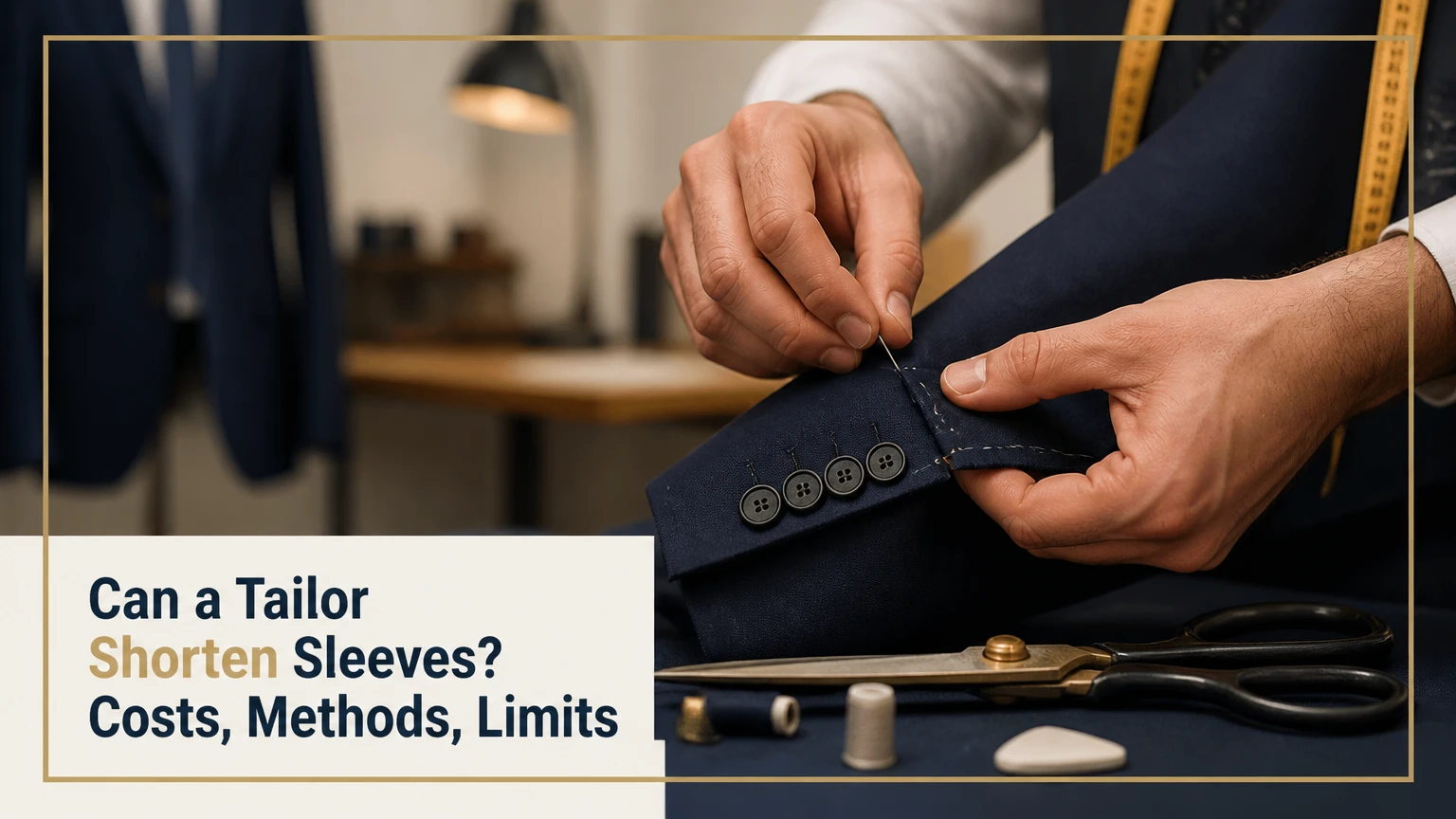
Yes, a tailor can shorten sleeves on most shirts, suit jackets, coats, denim garments, and some sweaters. The tailor chooses the alteration point based on cuffs, buttonholes, plackets, lining, fabric, and the amount to remove. Simple cuff alterations often cost $20-$60, while complex jacket work from the shoulder can cost $100-$200 or more.
Key Facts at a Glance
- A tailor usually shortens a simple sleeve from the cuff because the work is faster and less expensive.
- A jacket with functional buttonholes may require shortening from the shoulder to preserve the cuff.
- A well-fitted suit jacket sleeve usually ends at the wrist bone and allows about 0.25-0.5 inch of shirt cuff to show.
- Typical sleeve-shortening prices range from $20-$35 for shirts and $35-$200 or more for jackets.
- Removing more than about 1-2 inches can require moving a placket, changing a cuff, tapering the sleeve, or altering the sleeve cap.
- Sweaters and technical garments need specialist methods because cut edges can unravel or disturb insulation.
Can a Tailor Shorten Sleeves?
A tailor can shorten sleeves when the sleeve has enough usable construction and the new length will not damage its proportions. The alteration is routine for dress shirts, blazers with nonfunctional buttons, wool coats, casual jackets, and many lined garments.
The difficult question is not whether fabric can be removed. The difficult question is where to remove it. A tailor examines the wrist opening, cuff, sleeve placket, vents, lining, buttonholes, embroidery, zippers, insulation, and sleeve taper before recommending a method.
A good alteration preserves movement as well as appearance. If the sleeve becomes visibly tight at the forearm, the cuff feels restrictive, or diagonal wrinkles run from the armhole to the elbow, the job needs correction even if the final length looks right.
What does sleeve shortening involve?
Sleeve shortening reduces the distance between the shoulder or armhole and the sleeve opening while preserving the garment’s intended balance. The tailor normally marks the new length on the wearer, removes the required components, cuts away excess fabric, reconstructs the opening, and presses the sleeve.
Sleeve length is only one fit measurement. A sleeve can be too long because the garment is oversized through the shoulder, or it can appear too long because the wearer has a narrow frame and the sleeve hangs low. Shortening the sleeve alone cannot correct a shoulder that is too broad or an armhole that sits incorrectly.
For that reason, the fitting appointment matters. The tailor should assess the garment while the wearer stands naturally, bends the elbow, reaches forward, and lets the arms hang at the sides.
How Does a Tailor Shorten a Sleeve?
A tailor shortens a sleeve either from the cuff, from the shoulder, or through a specialist reconstruction for knitwear and technical clothing. Cuff shortening is the default because it removes fabric near the opening without disturbing the armhole, chest, or sleeve cap.
Method 1: Shortening from the cuff
Cuff shortening involves opening the original hem or detaching the cuff, removing excess material from the lower sleeve, and rebuilding the sleeve opening. On a shirt, the tailor may also move the sleeve placket, cuff buttons, gauntlet, or tab.
The lower sleeve is often wider higher up than it is at the original wrist opening. If the tailor cuts several inches from the bottom and attaches the old cuff to that wider section, the cuff may become too tight or the sleeve may form a bell shape. A skilled alteration therefore includes tapering when the sleeve seam requires it.
Cuff shortening is usually the best choice for a shirt with a plain cuff, a blazer with faux buttons, or a coat with a simple hem. It becomes less suitable when the bottom contains fixed buttonholes, decorative borders, zippers, heavy storm cuffs, or carefully placed embroidery.
Method 2: Shortening from the shoulder
Shoulder shortening removes length near the sleeve head, where the sleeve joins the armhole. The tailor detaches the sleeve, reshapes the sleeve cap if necessary, removes the excess, and resets the sleeve into the armhole.
This method preserves the original cuff, buttonholes, placket, and lower-sleeve details. It also carries greater structural risk because the sleeve cap and armhole must remain compatible. A small error can create puckering, restricted arm rotation, pulling across the chest, or a sleeve that twists while the arm hangs naturally.
Shoulder shortening is most often considered for high-quality jackets with functional surgeon’s cuffs. It is also useful when a cuff contains details that cannot be moved cleanly, although the tailor may recommend another solution if the required reduction is substantial.
Method 3: Knit and technical reconstruction
Knit sleeves cannot always be treated like woven sleeves because cutting a knitted tube can release the yarn structure. A sweater specialist may remove the ribbed cuff, shorten the knitted body, and reattach the cuff, or may unravel and re-knit the final rows.
Down jackets, ski jackets, and waterproof shells introduce different problems. The tailor must protect insulation, seam tape, waterproof coatings, elastic bindings, storm cuffs, and waterproof zippers. A standard clothing alteration shop may accept a wool coat but decline a sealed technical shell.
Which Garments Can Be Altered?
Most woven garments can have their sleeves shortened, but the cost and risk increase with lining, thickness, decoration, insulation, and fixed hardware. The garment’s construction determines the practical method more reliably than its price or brand.
| Garment | Typical method | Typical price | Typical time |
|---|---|---|---|
| Dress shirt, plain cuff | Cuff, with placket moved if needed | $20-$35 | 3-5 days |
| Blazer, faux sleeve buttons | Cuff, buttons repositioned | $35-$60 | 5-7 days |
| Suit jacket, functional buttonholes | Shoulder or specialist cuff work | $100-$200+ | 1-2 weeks |
| Wool coat, lined | Cuff or sleeve hem reconstruction | $50-$90 | 7-10 days |
| Leather jacket | Cuff or shoulder, depending on zipper | $60-$150+ | 1-3 weeks |
| Down or ski jacket | Cuff, binding, or technical seam work | $75-$180+ | 1-3 weeks |
| Sweater with ribbed cuff | Knit reconstruction | $35-$100+ | 1-3 weeks |
These are typical US alteration ranges, not universal prices. Local labor rates, fabric thickness, garment value, rush scheduling, and the presence of lining can change the estimate significantly.
Can a tailor shorten suit jacket sleeves?
A tailor can shorten most suit jacket sleeves, and the safest method depends on the cuff design. A jacket with four stitched-on buttons and no functional buttonholes is usually straightforward from the cuff; a surgeon’s cuff with open buttonholes may require shoulder alteration or a carefully planned compromise.
The target jacket sleeve commonly ends around the wrist bone, with approximately 0.25-0.5 inch of shirt cuff visible when the arms hang naturally. The exact amount depends on shirt cuff construction, personal style, jacket proportions, and whether the wearer bends or gestures frequently.
A jacket sleeve should not be judged while the arm is held rigidly forward. The tailor should check the sleeve with relaxed arms and during movement. A sleeve that looks perfect in one pose but pulls at the elbow in another may have a balance or cap problem rather than a simple length problem.
Can dress shirt sleeves be shortened?
Dress shirt sleeves can usually be shortened from the cuff, although the tailor may need to move the placket and cuff button. A small reduction may leave the placket usable, but a reduction of about 1 inch or more can make the original opening look too long or place the cuff in the wrong proportion.
French cuffs, convertible cuffs, contrasting cuffs, and shirts with mitered corners require more careful disassembly. If the shirt has a curved cuff, the tailor must preserve its shape rather than attach it to a newly cut edge without matching the original seam geometry.
A shirt sleeve should generally reach the wrist when the arm is relaxed. For a shirt worn under a jacket, a modest amount of cuff should remain visible beyond the jacket sleeve during normal standing and movement.
Can coat, leather, and denim sleeves be shortened?
Coat, leather, and denim sleeves can often be shortened, but each material changes the work. Thick wool may require bulky seam management, leather retains needle holes after stitching, and denim may need topstitching that matches the original thread color and stitch length.
A leather sleeve with a zipper, knitted cuff, or decorative seam may be best shortened from the shoulder if the lower hardware cannot be moved. A denim jacket with a simple hem can often be shortened at the cuff, but recreating a factory chain stitch or wash pattern may not be possible.
The tailor should inspect the garment before promising an invisible result. Leather and faded denim can show the previous seam line, needle marks, or color variation after alteration.
What Is the Correct Sleeve Length?
The correct sleeve length depends on garment type, wrist anatomy, shirt layering, and movement. For a conventional suit jacket, the wrist bone is a useful starting landmark, while the shirt cuff generally extends slightly beyond the jacket sleeve.
| Garment | Practical landmark | Visible layer or clearance | Movement check |
|---|---|---|---|
| Suit jacket | Wrist bone area | 0.25-0.5 inch shirt cuff | Bend elbow and reach forward |
| Dress shirt | Wrist joint | Cuff remains under jacket | Button cuff without strain |
| Casual overshirt | Wrist or hand base | 0-0.5 inch depending on style | Raise arms without exposing forearm |
| Winter coat | Wrist with gloves | 0-1 inch glove overlap | Reach into pockets |
| Motorcycle or work jacket | Wrist while riding or working | Minimal skin exposure | Hold handlebars or extend arms |
The wrist-bone guideline is not a rigid law. A short jacket sleeve can look incorrect if the jacket body is long, the shirt cuff is unusually wide, or the sleeve opening is too narrow for the wearer’s forearm.
How much can a tailor shorten sleeves?
A tailor can often remove up to about 2-3 inches from a simple cuff, but the safe amount depends on sleeve taper, placket length, cuff shape, and the location of design details. Shoulder shortening is commonly limited to about 1-1.5 inches because the armhole and sleeve-cap geometry restrict the adjustment.
Large reductions create secondary problems. The cuff may land on a wider part of the sleeve, the placket may become too short, the elbow position may shift visually, and the sleeve may no longer hang along the natural arm line.
A tailor should mark the proposed length before cutting and show the wearer the cuff position from several angles. If more than 2 inches must be removed from a jacket, ask whether the sleeve cap, forearm taper, and armhole will remain balanced.
Cuff or Shoulder: Which Method Is Better?
Cuff alteration is cheaper and safer for plain sleeve openings, while shoulder alteration is preferable when the original cuff contains functional or irreplaceable details. The better method is the one that preserves the garment’s construction with the least distortion, not automatically the method with the lowest price.
| Decision factor | From the cuff | From the shoulder |
|---|---|---|
| Typical jacket price | $35-$60 for simple cuffs | $100-$200+ |
| Common reduction | 0.5-3 inches | 0.5-1.5 inches |
| Functional buttonholes | Often unsuitable | Usually preserves them |
| Armhole disturbance | None or minimal | High |
| Turnaround | 3-10 days | 1-2 weeks |
| Best use | Plain cuffs and movable buttons | Surgeon’s cuffs and fixed details |
Shortening from the cuff usually wins for everyday value. Shortening from the shoulder wins when preserving a premium cuff is worth the added labor and structural risk.
What happens to functional sleeve buttons?
Functional sleeve buttons create a fixed design problem because the buttonholes are cut into the fabric rather than simply stitched on top. Cutting off the lower section can remove the buttonholes, leave incorrect spacing, or place the lowest button too close to the new hem.
Possible solutions include shortening from the shoulder, closing the buttonholes and converting the cuff to decorative buttons, or accepting a smaller adjustment from the cuff. The correct choice depends on the jacket’s value, the desired reduction, and the tailor’s ability to reproduce the original finish.
Do not ask a general alterations counter to cut through functional buttonholes without discussing the result. Once the fabric and buttonholes are removed, restoring the original factory arrangement may be impossible.
What Happens During a Professional Alteration?
A professional sleeve alteration begins with a fitting and ends with a movement check, not with an immediate cut. A typical cuff alteration takes roughly 30-90 minutes of hands-on work, although the shop’s calendar determines the collection date.
- Wear the garment with its intended layers. Bring the shirt, jacket, gloves, or sweater normally worn underneath. The tailor marks both sleeves because arms and shoulders can differ slightly.
- Mark the finished length. The tailor folds or pins the sleeve to the proposed position and checks the result with arms relaxed, bent, and extended.
- Inspect construction. The tailor identifies lining, plackets, vents, cuffs, buttonholes, zippers, embroidery, elastic, and seam allowances before choosing the alteration point.
- Open the sleeve. Original stitching is removed carefully so the fabric is not weakened by unnecessary cuts or needle damage.
- Cut and taper the sleeve. Excess fabric is removed with a planned seam allowance, and the forearm seam is adjusted if the new opening is wider than the original cuff.
- Rebuild the opening. The tailor reattaches the cuff, moves the placket, resets buttons, closes the lining, or reconstructs the hem according to the garment.
- Press and inspect. Steam pressing sets the new seam, while inspection checks puckering, lining length, thread tension, and symmetry.
- Try on the finished garment. Reach forward, bend the elbows, fasten the cuffs, and confirm that the sleeve remains comfortable.
The most important checkpoint is the fitting before cutting. A tailor can repair many construction issues, but excess fabric removed from a sleeve cannot be put back invisibly.
How Much Does Sleeve Shortening Cost and Take?
Typical sleeve-shortening prices run from $20-$35 for a shirt, $35-$60 for a simple blazer, $50-$90 for a lined coat, and $100-$200 or more for a jacket altered from the shoulder. Standard turnaround ranges from 3-5 days for shirts to 1-3 weeks for complex jackets, leather, knits, and technical outerwear.
| Cost driver | Typical effect | Example |
|---|---|---|
| Plain woven cuff | Adds $20-$35 | Cotton shirt with one cuff |
| Jacket lining | Adds $10-$30 | Fully lined blazer |
| Functional buttonholes | Adds $60-$150+ | Surgeon’s cuff requiring shoulder work |
| Leather or thick fabric | Adds $25-$90 | Leather jacket or heavy wool |
| Knit reconstruction | Adds $15-$65 | Sweater with ribbed cuff |
| Rush service | Adds 25%-100% | Same-week or next-day work |
Prices vary by city and shop specialization. A $25 alteration on a $35 shirt may be reasonable if the shirt fits well everywhere else, but replacing a low-cost garment can make more financial sense when the sleeve needs extensive reconstruction.
Ask for a written estimate that identifies the method, the finished length, whether tapering is included, and what happens if the garment cannot be altered as marked.
What Should You Check Before Picking Up the Garment?
Inspect the shortened sleeve for length, symmetry, comfort, construction, and interaction with other layers. A finished sleeve should look intentional when the arms hang naturally and should not become restrictive during ordinary movement.
Use this acceptance checklist:
- Compare both sleeves with the garment worn normally.
- Check that the cuff or hem sits level around the wrist.
- Bend both elbows and reach forward.
- Confirm that the lining does not extend beyond the outer sleeve.
- Fasten every cuff button, snap, zipper, or tab.
- Look for puckering near the sleeve cap and forearm seam.
- Check that the placket, vent, embroidery, and topstitching remain proportional.
- Confirm that shirt cuff exposure remains consistent when the jacket is worn.
- Make sure the sleeve does not twist toward the inside or outside.
- Ask whether the removed fabric and spare buttons were returned.
A minor difference between sleeves may be acceptable because bodies are not perfectly symmetrical. A visible twist, persistent diagonal pulling, or painful cuff is not a normal consequence of shortening and should be reported before accepting the garment.
What Problems Can Occur?
The most common sleeve-shortening failures involve proportion, taper, lining, or sleeve-cap balance rather than the cutting line itself. Each problem has a different correction, so describe the symptom precisely instead of asking generally for the sleeve to be fixed.
| Problem | Likely cause | Usual correction |
|---|---|---|
| Cuff feels tight | New opening is wider than original cuff | Let out forearm seam or adjust cuff |
| Sleeve looks bell-shaped | Tailor removed length without tapering | Narrow the lower sleeve seam |
| Placket looks too short | Cuff moved without repositioning opening | Rebuild or lengthen the placket |
| Lining hangs out | Lining was not shortened or reset | Trim and blind-stitch lining |
| Shoulder puckers | Sleeve cap was poorly reshaped | Reset and reshape sleeve cap |
| Sleeve twists | Sleeve was reattached off grain | Reposition sleeve and correct seam alignment |
A tailor can often fix a tight cuff by letting out available seam allowance, but the correction may be limited if the original sleeve has little extra fabric. A replacement cuff or button relocation may solve a shirt problem without requiring a full sleeve reconstruction.
Shoulder puckering is more serious. The sleeve may need to be removed and reset, and repeated work can leave needle marks or weaken the cloth. This is one reason to use an experienced jacket tailor for shoulder alterations.
When is shortening a sleeve a poor choice?
Sleeve shortening is a poor choice when the garment is already too small through the shoulder, the required reduction exceeds the available construction, or the alteration cost approaches the garment’s replacement value. It is also a poor choice when removing the sleeve details would destroy the garment’s intended design.
Do not use sleeve shortening to disguise a badly fitting armhole. If the shoulder seam sits far beyond the natural shoulder, shortening the sleeve may leave the armhole low and movement restricted.
Be cautious with bonded, waterproof, heavily quilted, and fragile fabrics. A specialist may be able to alter them, but a standard tailor may not be able to restore insulation, seam sealing, or surface finish after opening the garment.
Which Alternatives Should You Consider?
A tailor is usually the best option for a permanent, polished result, but alternatives can be more practical for inexpensive, temporary, or highly technical garments. The right choice depends on how much the sleeve needs to change and whether the original finish matters.
- Exchange for a different size: Choose this when the sleeve is more than 2-3 inches too long and the body also fits poorly.
- Use a removable sleeve tab: Choose this for casual shirts or coats when a small temporary reduction is acceptable.
- Roll or fold the cuff: Choose this for informal garments without a formal cuff or lining.
- Use a knit specialist: Choose this for cashmere, fine wool, ribbed cuffs, and garments where cutting could unravel the knit.
- Use an outerwear specialist: Choose this for Gore-Tex-style shells, down jackets, taped seams, and motorcycle gear.
- Replace the garment: Choose this when a $20 alteration would not correct a poor shoulder, chest, or armhole fit.
Temporary solutions cannot reproduce a tailored hem or preserve jacket balance. They are useful when the garment is seasonal, still being returned, or not valuable enough to justify permanent work.
How Do You Choose the Right Tailor?
Choose a provider based on garment specialization, not the shop’s general claim that it performs alterations. A shirt alteration specialist may handle cuffs well but decline a surgeon’s cuff, leather sleeve, or knitted sweater.
Ask these questions before authorizing work:
- Will you shorten this garment from the cuff or shoulder?
- How will you handle the placket, lining, vent, zipper, or functional buttonholes?
- Will tapering be included if the new cuff opening is wider?
- How much seam allowance will remain?
- Can I see examples of similar jackets, leather, coats, or knitwear?
- What is the total price, and what is the standard turnaround?
- Will the original buttons, cuff, and removed fabric be returned?
A specialist should explain the trade-off in plain terms and mark the proposed length while you wear the garment. A provider who promises an invisible result without examining the construction is accepting risk before measuring the job.
Frequently Asked Questions
Can a tailor shorten sleeves by 4 inches?
A tailor may be able to remove 4 inches from a simple, loose sleeve, but that amount often distorts the taper, placket, cuff position, or elbow balance. On a structured jacket, 4 inches is usually beyond a sensible alteration unless the sleeve is redesigned extensively. Exchanging the garment is often safer and less expensive.
Can sleeves be shortened without cutting the fabric?
A tailor can sometimes fold or tack fabric inside the cuff for a temporary adjustment, but a permanent clean result normally requires cutting or repositioning seams. Folding works best on casual garments with generous cuffs and hidden construction; it is unsuitable for most tailored jackets, lined coats, and sleeves with plackets.
Can a tailor shorten sleeves with zippers?
A tailor can shorten some zippered sleeves, but the zipper must be removed, repositioned, shortened, or replaced. A zipper that ends at the original cuff can prevent a simple hem alteration, while a shoulder alteration may preserve the zipper but cost more. A specialist should inspect the zipper before quoting.
Can a tailor shorten only one sleeve?
A tailor can shorten one sleeve when the wearer’s arms differ in length or shoulder position. The tailor should measure both sides separately and confirm the difference while the garment is worn. Small asymmetries are common, but a large difference may indicate uneven shoulders or a garment that is twisted.
Can a tailor make sleeves narrower as well as shorter?
A tailor can usually narrow a sleeve while shortening it, especially along the forearm seam of a shirt, blazer, or coat. Sleeve narrowing must preserve elbow movement and cuff circumference; reducing the sleeve too aggressively can cause pulling, restrict bending, and make the cuff difficult to fasten.
Is it worth shortening sleeves on an inexpensive garment?
Shortening sleeves is worthwhile when the garment fits correctly through the shoulder, chest, and body and needs a small adjustment. Replacement is usually more sensible when the garment needs major reconstruction, has poor overall proportions, or costs less than the alteration plus the risk of an unsatisfactory result.
The Bottom Line
Can a tailor shorten sleeves? Yes, in most cases, and simple cuff alterations are among the most routine clothing adjustments. Expect about $20-$35 for a shirt, $35-$60 for a basic blazer, and $100-$200 or more when a structured jacket with functional buttonholes must be shortened from the shoulder.
Bring the garment’s intended layers, ask which method the tailor recommends, confirm the finished measurement, and test movement before accepting the work. The sleeve’s cuff details, taper, lining, fabric, and required reduction determine whether the alteration is simple, specialist, or not worth performing.