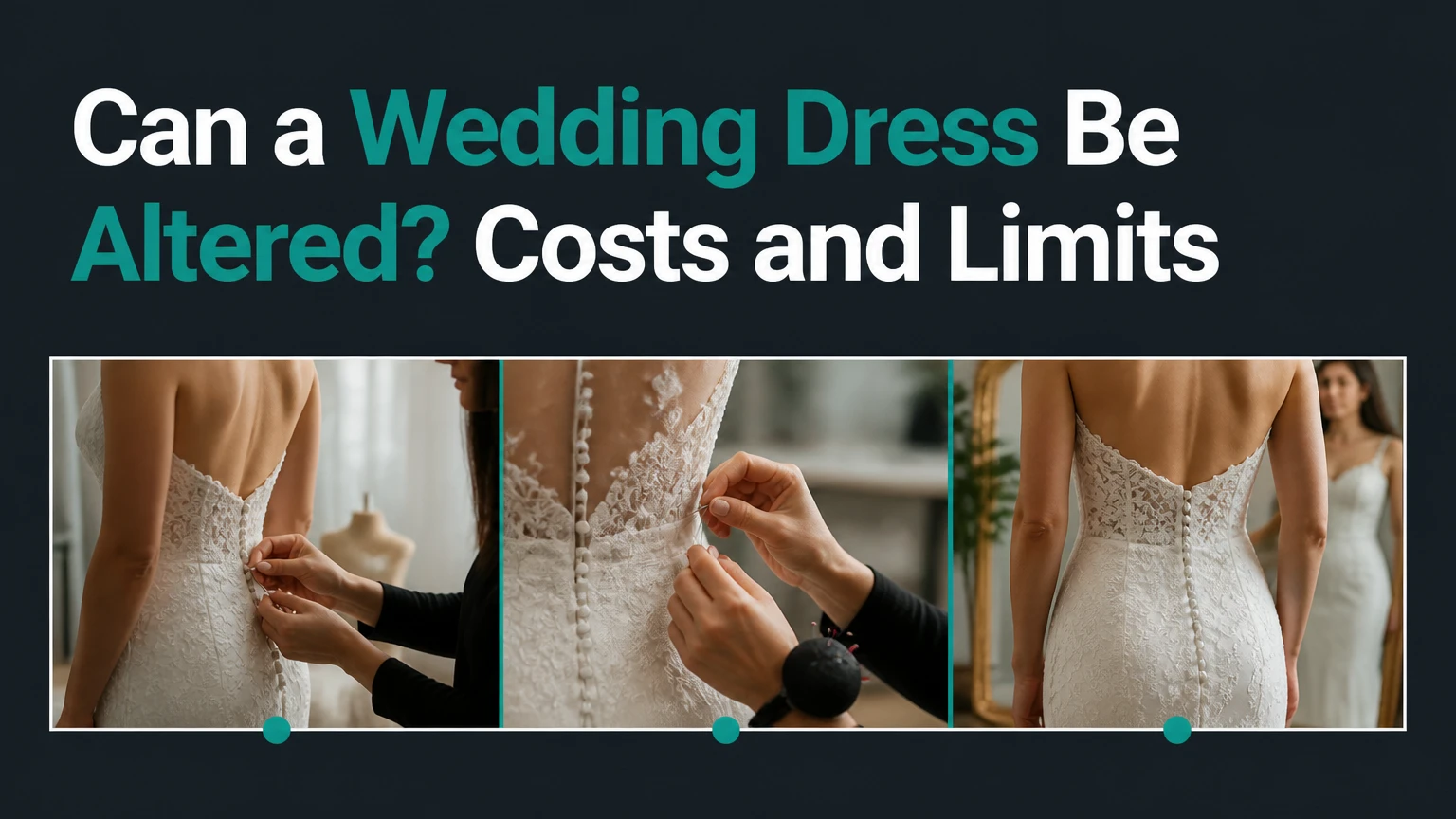
Almost every wedding dress can be altered, but not every gown can be enlarged, reshaped, or redesigned safely. A bridal seamstress can usually adjust the fit, hem, straps, support, train, and closure, while the dress’s seam allowance, fabric, lining, boning, lace, beadwork, and original construction determine the practical limits.
Key Facts at a Glance
- Taking in a wedding dress is usually easier than letting it out because excess fabric can be removed, while enlargement requires usable fabric inside the seams or added panels.
- A standard bridal alteration package typically costs $500-$1,000 or more when hemming, bodice fitting, and bustling are combined.
- Most brides need two or three fittings, with the first fitting commonly scheduled 8-12 weeks before the wedding.
- Wedding-day shoes, undergarments, shapewear, and accessories must match the items worn during every fitting.
- Lace, sequins, pearls, horsehair braid, corsetry, and multiple tulle layers increase labor because details may need to be removed and reapplied by hand.
- A bridal specialist is safer than a general clothing tailor for gowns with structured bodices, trains, delicate fabrics, or extensive embellishment.
What Are Wedding Dress Alterations?
Wedding dress alterations are specialized changes that adjust a gown’s measurements, construction, support, length, or appearance after manufacture. The work may include opening seams, removing lining sections, repositioning lace, modifying boning, reshaping cups, shortening layers, and rebuilding the gown so the finished garment follows the wearer’s body.
A mass-produced bridal gown is not cut for one exact body. Designers use standardized size charts, while brides have individual differences in bust, waist, hip, torso, shoulder, and height measurements. Alterations reconcile those differences without changing the gown’s intended silhouette.
A made-to-measure gown may need fewer fit corrections, but “custom” does not mean alteration-free. Hem length, bust support, strap placement, bustle points, and final waist shaping still commonly require an appointment. A dress that fits while standing must also allow sitting, walking, hugging, dancing, and using the restroom.
When Are Alterations Possible?
Alterations are generally possible when the gown has accessible seams, stable fabric, enough construction tolerance, and design details that can be moved or reconstructed. A professional evaluates the inside of the bodice and skirt before promising a particular change.
The strongest candidates for routine alterations include satin A-line gowns, simple crepe sheaths, unembellished ballgowns, and dresses with side seams or adjustable backs. The most demanding candidates include heavily beaded mermaids, gowns with lace motifs crossing every seam, bias-cut silk, and dresses with very narrow seam allowances.
A gown can be technically alterable yet economically impractical. If a $400 sample dress requires $900 in hand-applied lace work and structural rebuilding, replacement may be more sensible than alteration.
How Do Bridal Alterations Work?
Bridal alterations usually follow a deconstruction, fitting, and reconstruction process rather than a single line of stitching. The seamstress first identifies how the gown was assembled, pins changes on the body, protects design details, then removes and replaces components in a controlled order.
What Happens Behind the Seams?
- Inspection: The seamstress checks fabric condition, lining, seam allowances, zipper or corset construction, cups, boning, hem treatments, and embellishment placement.
- Pinning: The gown is fitted over the correct undergarments while the seamstress marks changes with pins, chalk, thread, or temporary stitching.
- Deconstruction: Lace, appliqués, lining, zipper tape, or internal channels may be detached to reach the seam that needs adjustment.
- Structural adjustment: The bodice, waist, cups, boning, straps, or closure is reshaped before the outer layers are finished.
- Layered reconstruction: Each skirt layer is cut, sewn, and finished so the hem remains even and the train retains its intended shape.
- Movement testing: The wearer sits, walks, raises her arms, rotates, and practices the bustle before final pressing.
A professional does not necessarily remove every decorative element. Experienced bridal specialists select the shortest safe route, but lace or beading that crosses a seam often must be temporarily removed.
Which Fit Changes Are Routine?
Routine bridal adjustments include taking in the bodice, refining the waist and hips, shortening straps, lifting shoulders, inserting cups, and hemming the skirt. These changes are easiest when the alteration follows existing seams and does not interrupt a lace border or beaded motif.
| Alteration | Typical change | Typical labor range | Main limitation |
|---|---|---|---|
| Bodice take-in | 0.5-2 clothing sizes | $150-$350 | Boning, zipper, and lace placement |
| Bodice let-out | 0.5-1 size, sometimes 2 | $200-$450 | Usable seam allowance or added panels |
| Strap shortening | 0.5-3 inches | $40-$100 | Beading, shoulder lace, neckline balance |
| Hemming | 1-8 inches | $150-$600 | Number of layers and decorated hem |
| Cup insertion | One pair of sewn-in cups | $40-$100 | Existing cup shape and lining access |
| Bustle installation | 3-7 attachment points | $75-$250 | Train weight and desired bustle style |
Taking in a gown is normally more predictable than letting it out. A seamstress can remove excess material, but a larger size may require matching fabric, lace, lining, and thread that the original designer no longer sells.
How Much Can a Wedding Dress Be Enlarged?
A wedding dress can often be enlarged by about one-half to one full size, and some gowns can expand by two sizes when they contain generous seam allowances or can accept matching side or back panels. Those figures are typical working ranges, not guarantees.
The limiting measurement matters. A gown that is correct at the bust but two sizes too small at the hips may be salvageable if the skirt has side-seam allowance. A bodice that is tight across the bust and waist, with no extra fabric and a rigid zipper, may not be safely enlarged.
A corset-back conversion can add adjustability, but it does not create unlimited room. The original center-back closure must be removed, modesty panels may be needed, and the new lacing must support the bodice without distorting the neckline.
Can a Dress Be Taken In Several Sizes?
A bridal gown can sometimes be taken in several sizes, but large reductions become risky when the neckline, armholes, princess seams, waistline, and decorative motifs must all move. A two-size reduction may be feasible in a simple gown; a four-size reduction can change the proportions of the entire garment.
The seamstress must preserve the relationship between the bust point, waist seam, hip line, zipper, and hem. Taking in only the side seams can create diagonal wrinkles, displaced cups, tight armholes, or a train that no longer falls behind the wearer.
Buying the closest available size is usually cheaper than planning a major reduction. Choose a gown that fits the largest important measurement, then budget for controlled adjustments elsewhere.
How Do Fabric and Embellishments Change the Job?
Fabric type and surface decoration determine the labor, equipment, and risk of bridal alterations. Plain satin or crepe allows relatively direct seam work, while lace, beading, sequins, embroidered tulle, and layered organza require detail preservation and careful pressing.
| Gown feature | Common complication | Typical added work | Practical consequence |
|---|---|---|---|
| Chantilly or floral lace | Motifs cross seams and hem | Hand removal and reapplication | Higher cost and longer lead time |
| Sequins or pearls | Needles can catch or break decoration | Selective removal before stitching | Slow machine work and hand finishing |
| Multi-layer tulle | Several separate hems require marking | Layer-by-layer cutting and finishing | A simple hem may take multiple hours |
| Heavy satin | Pressing can create shine or marks | Low-temperature pressing with cloth | Visible mistakes are difficult to hide |
| Boned corset | Internal channels resist reshaping | Channel relocation and rebinding | Fit changes affect support |
| Bias-cut silk | Fabric stretches and shifts | Stabilization and repeated fitting | Hem may settle after hanging |
A decorated hem is particularly expensive because shortening it may mean removing a lace border, cutting the skirt, and rebuilding the border at the new edge. A plain hem can be measured and sewn more directly.
One practitioner rule matters here: never judge alteration difficulty from the outside alone. Two visually similar gowns can have very different internal construction, and the lining, interlining, and boning often determine the real price.
Which Style Changes Are Realistic?
Wedding dress customization can add sleeves, straps, modesty panels, neckline depth, back details, or a different closure, but the result must respect the gown’s fabric weight and structural balance. A style change is realistic when the seamstress can source a compatible material and attach it without overloading the original construction.
Common possibilities include:
- Adding cap sleeves, detachable sleeves, straps, or an illusion neckline.
- Raising a plunging neckline with matching lace, tulle, or lining.
- Replacing a zipper with a lace-up back and a properly fitted modesty panel.
- Lowering a back, changing a sweetheart neckline, or reshaping a straight neckline.
- Adding a ribbon belt, overskirt, removable train, or matching lace appliqués.
- Inserting boning or sewn-in cups to improve support.
Neckline changes are less forgiving than strap adjustments because they alter the bust, armhole, and center-front balance together. A plunge conversion may require new lining and stabilization, while raising a neckline can be simpler if the added fabric follows an existing seam.
Sleeves also affect mobility. Tight long sleeves can restrict arm elevation during dancing, and heavy lace sleeves can pull on a lightweight bodice. Test the complete movement range before approving the final design.
How Are Trains and Bustles Altered?
A wedding dress train is usually shortened by changing the hem, reshaping the train curve, or removing excess length from selected layers. A bustle lifts the train after the ceremony with buttons, hooks, loops, ribbons, or other attachment points that distribute the train’s weight.
| Bustle style | Attachment position | Visual result | Typical use |
|---|---|---|---|
| American bustle | Outside back skirt | Train folds over the skirt | Ballgowns with visible pickup points |
| French bustle | Underside of skirt | Train tucks beneath itself | A-line and fitted gowns |
| Ballroom bustle | Multiple concealed points | Train appears nearly floor length | Formal reception dancing |
| Wrist loop | One loop at train edge | Train is carried by hand | Short transitions and photographs |
The correct bustle depends on train length, fabric weight, lining, and the gown’s decoration. A heavy cathedral train may need more than three attachment points, while a lightweight sweep train may need only two or three.
A bustle is not finished when the hooks are sewn. A designated helper must practice attaching every point in the correct order, because an incorrectly fastened bustle can pull at the waist or drag on the floor.
How Much Do Wedding Dress Alterations Cost?
Typical wedding dress alterations cost $300-$1,000 for simpler gowns and $1,000-$2,000 or more for heavily embellished, structurally complex, or extensively redesigned gowns. Local labor rates, the gown’s condition, the number of layers, and the requested deadline create larger price differences than the dress’s retail price.
| Service level | Included work | Typical price | Typical lead time |
|---|---|---|---|
| Simple adjustment | Straps, cups, minor bodice work | $100-$300 | 2-4 weeks |
| Standard package | Hem, bodice fit, bustle | $500-$1,000 | 6-10 weeks |
| Embellished gown | Lace or bead removal and replacement | $900-$1,800 | 8-14 weeks |
| Custom redesign | Sleeves, neckline, back, structural changes | $1,000-$2,500+ | 10-16 weeks |
| Rush service | Existing work completed urgently | Base price plus 20%-50% | Under 3 weeks |
Request an itemized estimate. “Bridal alterations” can mean a $75 strap adjustment or a $1,500 reconstruction, so a single package price hides important differences.
Ask whether pressing, bustle points, cup insertion, lace reapplication, rush work, and a final fitting are included. Confirm the deposit, cancellation terms, damage policy, and whether the specialist carries business insurance.
When Should Alterations Begin?
Most brides should schedule the first fitting 8-12 weeks before the wedding and reserve the seamstress several weeks earlier. A complicated gown may require a first appointment 4-6 months before the ceremony, even if the actual pinning begins later.
| Fitting | Common timing | Main work | Bride should bring |
|---|---|---|---|
| First fitting | 8-12 weeks before | Measurements, pinning, hem and bodice plan | Shoes, undergarments, gown |
| Second fitting | 4-6 weeks before | Major corrections and bustle test | Same shoes and foundation garments |
| Final fitting | 1-2 weeks before | Minor refinements, movement check, pressing | Wedding accessories and helper |
| Pickup check | 1-7 days before | Final inspection and transport plan | Garment bag and vehicle space |
Earlier scheduling is wise because bridal specialists often book months ahead. Starting the actual alterations too early can be counterproductive if body measurements change, especially around the waist, bust, or hips.
The final fitting should occur close enough to the wedding to reflect the finished body measurements but early enough to permit a small correction. A final appointment is not a reliable solution for major weight changes.
What Happens During Each Fitting?
The first fitting establishes the alteration plan, the second confirms the major construction work, and the final fitting checks comfort, appearance, and function. Every appointment should include movement, not only a stationary inspection in front of a mirror.
First Fitting
Wear the exact bra, shapewear, petticoat, and wedding shoes planned for the ceremony. The seamstress marks the hem while the gown is worn at its intended waist position, then assesses bust compression, neckline gaping, strap placement, armhole comfort, and train behavior.
Discuss the desired hem in practical terms. A floor-length hem that looks elegant in photographs may catch under a shoe while walking, while a slightly shorter front can improve mobility without visibly shortening the train.
Second Fitting
The second appointment checks the sewn bodice, revised straps, cups, boning, closure, and hem. Sit in the dress for several minutes, raise both arms, walk briskly, turn, and practice entering and exiting a chair.
This is the best time to identify a poking bone, tight armhole, rolling neckline, slipping strap, or uneven hem. Small comfort issues become large wedding-day distractions.
Final Fitting
The final appointment verifies that the gown remains secure and comfortable after the main work is complete. Practice the bustle with the person who will help after the ceremony, and photograph the attachment order for reference.
Inspect the gown under bright light. Check every hook, loop, button, zipper, seam, lace edge, and hem layer before taking it home.
Who Should Alter a Wedding Gown?
A bridal alterations specialist is the safest choice for a structured, layered, or embellished gown because bridal construction differs from ordinary dressmaking. An independent seamstress can provide excellent work, while a neighborhood tailor is suitable only when the change is genuinely simple and the tailor has formalwear experience.
| Provider | Best assignment | Typical price position | Main risk |
|---|---|---|---|
| Boutique bridal tailor | Designer-specific fitting and complex gowns | Highest, $700-$2,000+ | Limited schedule |
| Independent bridal seamstress | Custom changes and personal service | Medium, $400-$1,500 | Vetting responsibility |
| Formalwear specialist | Satin, tuxedo, evening, and simple bridal work | Medium, $300-$900 | Less bridal bustle experience |
| General clothing tailor | Basic straps or plain hems | Lowest, $75-$400 | Limited corsetry and lace skills |
Ask to see completed bridal gowns, not only everyday trousers or casual dresses. Confirm experience with the exact fabric, silhouette, closure, and bustle style.
A dry cleaner’s in-house tailor may handle a plain hem, but heavy satin, horsehair braid, lace appliqué, internal corsetry, and multi-layer tulle require specialized judgment. The cheapest quote is not the cheapest outcome if the gown needs corrective reconstruction.
What If the Gown Does Not Fit?
A gown that is too large can usually be taken in, while a gown that is too small requires a construction review before any promise is made. Stop wearing the dress until a specialist examines it if the zipper strains, seams pull horizontally, cups shift, or boning digs into the body.
Use this decision sequence:
- Measure the bust, waist, and hips in the intended undergarments.
- Compare those measurements with the gown’s finished measurements, not only the label size.
- Inspect seam allowances and determine whether lace or boning crosses the adjustment area.
- Ask about side panels, a corset-back conversion, a gusset, or a different closure.
- Obtain a written estimate before approving invasive work.
Weight loss does not always make a gown easier to fit. A large reduction can shift the waist seam away from the natural waist and change the neckline angle, so the bodice may need coordinated adjustment at several seams.
If the gown is too large shortly before the wedding, a temporary hand-tacked fit may be possible, but it should not replace proper reconstruction when the bodice carries substantial weight.
Can Alterations Be Completed in Under Three Weeks?
Wedding dress alterations can sometimes be completed in under three weeks when the change is limited, the specialist has capacity, and the gown arrives clean and structurally sound. A rush fee of roughly 20%-50% is typical in many markets, but a rush appointment cannot eliminate hand-sewing time or fabric sourcing delays.
Rush work is most realistic for:
- Plain hems with one or two uncomplicated layers.
- Strap shortening and minor side-seam adjustments.
- Cup insertion or a small waist correction.
- A simple bustle on a lightweight train.
Rush work is poor for lace reapplication, extensive beading, neckline reconstruction, corset conversion, major size changes, or custom sleeves. If the gown needs a specialty material, the delay may come from sourcing rather than sewing.
What Mistakes Damage the Result?
The most common alteration failures involve incorrect fitting conditions, unrealistic size assumptions, and insufficient movement testing. Each problem is preventable when the bride treats the fitting as a functional test rather than a photo opportunity.
- Changing shoes: A different heel height changes the hem measurement and can create a trip hazard.
- Using different undergarments: Different cup volume or shapewear compression changes the bodice fit.
- Buying too small: A motivation size may require expensive panels, closure changes, or an entirely different gown.
- Approving a standing-only fit: A dress can look smooth while standing yet pinch when seated.
- Skipping bustle practice: A technically correct bustle can still fail if the helper cannot find the attachment points.
- Ignoring discomfort: Pins, exposed boning, scratchy seams, and tight armholes rarely improve without correction.
Tell the seamstress exactly where the gown hurts or shifts. Comfort information is measurable design feedback, not a matter of being difficult.
What Should You Check Before Buying the Dress?
Before buying a wedding dress, evaluate the largest body measurement, alteration budget, hem complexity, and possible future changes. A gown that fits the hips but needs a small bodice adjustment is often a safer purchase than one that fits the waist but strains across the hips.
Ask the boutique these questions:
- What are the finished bust, waist, and hip measurements?
- How much seam allowance exists at the bust, waist, and hips?
- Is extra fabric included for future let-out work?
- Does the hem contain lace, scallops, beading, or horsehair braid?
- Can the designer provide matching lace, lining, buttons, or tulle?
- Is the gown returnable if the alteration estimate is excessive?
- Does the purchase price include a bustle or only basic pressing?
Photograph the inside seams before leaving the boutique if the salon permits it. Interior photographs help a second specialist assess whether a proposed alteration is feasible.
The Bottom Line
Can a wedding dress be altered? Yes, in most cases, especially when the required work involves hemming, taking in seams, adjusting straps, adding support, or installing a bustle. The main limits are available fabric, internal structure, decoration, silhouette, time, and budget.
Choose the closest practical size, preserve your exact wedding-day fitting conditions, and obtain a written estimate from a bridal specialist 8-12 weeks before the ceremony. A simple gown may need only routine tailoring, while a beaded or corseted gown can require extensive hand reconstruction.
Frequently Asked Questions
Can a wedding dress be altered after it has been worn?
A wedding dress can be altered after wear if the fabric remains clean, dry, and structurally sound. Perspiration, makeup, outdoor dirt, and hidden snags should be addressed before storage or reconstruction because stains can set and weakened fabric may tear during seam work. Cleaning method depends on fiber, dye, beadwork, and lining.
Can a wedding dress be altered without removing lace?
A wedding dress can sometimes be altered without removing lace when the lace does not cross the seam being changed. If a motif spans the side seam, waistline, neckline, or hem, the seamstress may need to detach and hand-sew sections back into place. The specialist should explain the proposed handling before work begins.
Should a wedding dress be altered before or after weight loss?
Major alterations should wait until body measurements are reasonably stable, although booking a specialist early is sensible. A seamstress can create a preliminary plan months ahead, then pin the final fit closer to the wedding. Intentional rapid weight loss makes a fixed zipper and rigid corset especially difficult to manage.
Can a wedding dress be shortened without losing the train?
A wedding dress can be shortened while preserving the train when the seamstress reshapes the front and side hem separately from the back. The method depends on the train’s curve, lace border, skirt layers, and intended length. A dramatic reduction may require redesigning the train rather than making a standard horizontal hem.
Is a corset back better than a zipper for fit?
A corset back provides more day-of adjustability than a zipper, particularly when measurements fluctuate slightly, but it does not solve every sizing problem. The conversion changes the gown’s appearance, requires a correctly fitted modesty panel, and must be supported by stable bodice construction. A zipper is usually cleaner for a stable, close fit.