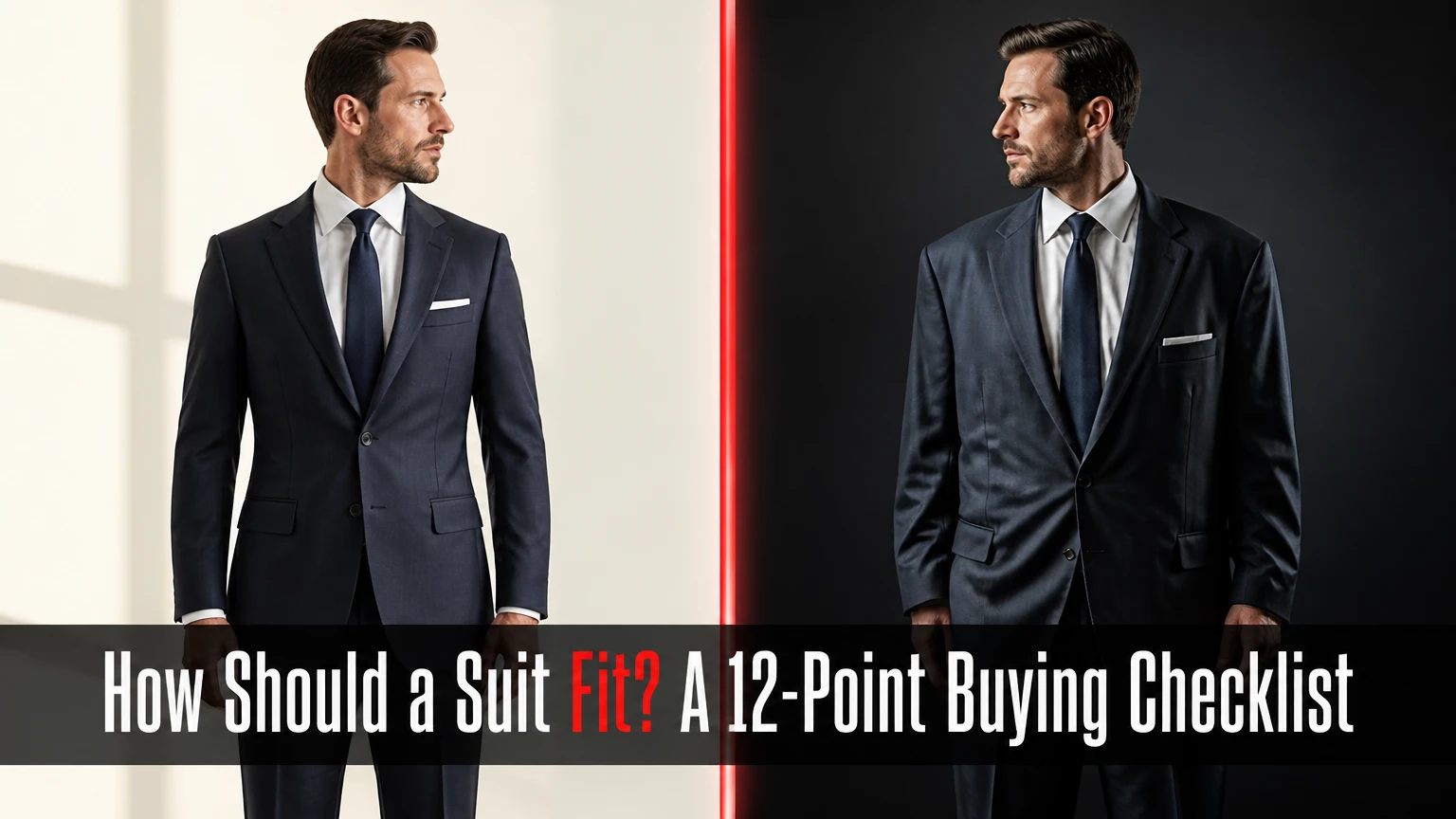
A suit should fit close to the body without restricting breathing, reaching, sitting, or normal arm movement. The shoulders should lie flat, the collar should meet the shirt without a gap, the fastened jacket should close without an X-shaped pull, sleeves should reveal about 0.25-0.5 inches of shirt cuff, and trousers should stay up without a belt.
Suit Fit at a Glance
- The shoulders are the first fit priority: the shoulder seam should finish near the end of the natural shoulder, with no divot or collapsed fabric.
- A fastened jacket should skim the torso: lapels should lie flat, and the button area should show no strong horizontal or diagonal strain.
- The jacket collar should touch the shirt collar: a persistent gap may indicate excess jacket width, posture imbalance, or an incompatible shirt collar.
- Jacket sleeves typically reveal 0.25-0.5 inches of shirt cuff: the visible amount depends on arm position and cuff construction.
- Trouser waistbands should hold the trousers without a belt: the waistband should remain secure while allowing comfortable sitting and breathing.
- A quarter or half break is the safest trouser length for most professional suits: no break looks sharper, while a full break requires careful trouser proportions.
How Should a Suit Jacket Fit?
A suit jacket fits correctly when its structure follows the wearer’s shoulders and torso while retaining enough ease for movement. Check the jacket in a shirt, with the shoes and trousers you will actually wear, because a T-shirt, oversized shirt, or different shoe height can distort the assessment.
Try the jacket with the pockets empty and the vents released from temporary stitching. Stand naturally rather than pulling the shoulders backward or holding the stomach in. A jacket that looks perfect only in an exaggerated pose is not correctly fitted for daily wear.
How Should the Shoulders Fit?
The shoulder seam should end approximately where the natural shoulder ends, and the fabric should lie flat from the neck to the sleeve head. A seam extending beyond the shoulder creates a shelf or drooping sleeve head; a seam ending inside the shoulder can create a divot and diagonal tension.
The traditional wall test is useful but imperfect. Stand normally with your back near a wall and allow the jacket to fall naturally. If the padded jacket shoulder contacts the wall well before your body, the jacket may be too large, but posture, shoulder padding, and a curved back can produce the same appearance.
| Shoulder sign | Likely cause | Recommended action |
|---|---|---|
| Seam extends 1-2 cm beyond shoulder | Jacket too large or heavily padded | Try a smaller shoulder size |
| Divot below sleeve head | Shoulder too narrow or sleeve pitch incorrect | Reject unless a specialist confirms a minor correction |
| Collar and shoulder lie flat | Correct width and compatible construction | Continue to chest and collar tests |
| Shoulder folds toward neck | Excess width, poor posture, or wrong sleeve pitch | Compare another size or brand |
Shoulder fit is the least forgiving alteration. A tailor can sometimes adjust a small amount, but changing the shoulder width often requires removing the sleeve, reshaping the sleeve head, and rebuilding the upper jacket. The practical rule is simple: buy the jacket that fits the shoulders first, then alter the waist and sleeves.
How Should the Collar Fit?
The jacket collar should rest flat against the shirt collar around the back and sides of the neck. A visible gap usually indicates excess jacket width, a collar that does not suit the wearer’s posture, or a shirt collar that is too low or too small.
Inspect the jacket from the side and rear while standing in a relaxed position. Minor movement can create a temporary gap, but a permanent opening that remains after adjusting the shirt collar is a fitting fault. Horizontal rolls below the collar can indicate excess fabric, a collar that needs adjustment, or a mismatch between jacket posture and the wearer’s forward shoulder position.
Do not diagnose every collar gap as a simple size problem. Downsizing can fix excess width, but it can also make the chest tight and the shoulder uncomfortable. A competent tailor should inspect the jacket on the body before recommending a collar alteration.
What Should You Check When the Jacket Is Buttoned?
Fasten the jacket’s main working button while standing naturally, then breathe, raise both arms, sit, and reach forward. The button should close without force, the lapels should remain mostly flat, and the jacket should not create strong diagonal folds from the button toward the chest or pockets.
On a conventional two-button jacket, fasten the top button and leave the lower button open. On a three-button jacket, the middle button is usually the working button, although the construction may be a “three-roll-two” design in which the upper lapel rolls over the top button.
A flat hand should fit between the chest and jacket without compressing the fabric. A clenched fist is not a precise universal measurement, because hand size varies, but a jacket that requires the fist test to show obvious pulling is too tight.
| Visible symptom | What it usually means | Fit decision |
|---|---|---|
| Lapels flare from chest | Chest or waist too tight | Try a larger jacket or fuller cut |
| Clear X-wrinkles at button | Excess tension around closure | Do not rely on pressing or steaming |
| Button hangs low and jacket looks boxy | Excess chest or waist room | Consider a smaller size or waist suppression |
| Side pockets gape | Trousers or jacket are tight at the hip | Move to a fuller cut |
| Smooth closure with minor natural fold | Normal wearing ease | Proceed to length and sleeve checks |
The jacket should not feel like compression clothing. A suit is closer to a structured shirt than protective equipment: it needs controlled ease so the canvas, lining, and fabric can move with the body.
How Much Room Should a Suit Jacket Have?
A suit jacket should allow one full breath, normal arm movement, and comfortable sitting without the button pulling sharply. The correct amount of ease depends on fabric weight, jacket construction, body shape, and intended use, so a fixed inch measurement is less reliable than movement tests.
For an office suit, test typing, reaching across a desk, entering a car, and sitting for 15 minutes. For a wedding suit, also test raising the arms and dancing. A jacket that passes only while standing may be too restrictive for the event.
How Long Should a Suit Jacket Be?
A suit jacket should cover most or all of the seat and create a balanced relationship between the torso and legs. With arms relaxed, the hem often falls near the base of the thumb, but the palm-and-thumb rule is only a starting point because arm length and jacket proportions vary.
View the jacket from the side and back. A jacket that ends high above the seat can make the torso look short and the legs look disproportionately long; a hem well below the seat can make the body appear compressed. Contemporary jackets may be slightly shorter, but a very short hem can prevent the jacket from covering the rear vents and seat cleanly.
| Jacket length | Typical visual result | Practical concern |
|---|---|---|
| Covers 90-100% of seat | Balanced traditional proportion | Usually easiest to wear professionally |
| Covers 75-90% of seat | Modern, slightly shorter silhouette | Works best with controlled trouser taper |
| Ends above seat curve | Fashion-forward cropped appearance | Can expose shirt and distort proportions |
| Extends well below seat | Long, conservative silhouette | May shorten the visible leg line |
Jacket length is difficult to change substantially without affecting pockets, vents, and button placement. A tailor can shorten a modest amount, but shortening several centimeters may leave the pockets too close to the hem. Confirm the length before paying for alterations.
How Should Suit Sleeves and Shirt Cuffs Fit?
The jacket sleeve should finish near the wrist bone and reveal approximately 0.25-0.5 inches of shirt cuff when the arms hang naturally. The visible cuff should remain modest rather than exposing a large section of shirt sleeve, which makes the jacket appear too short.
Arm position changes the result. A sleeve can appear shorter when the wearer bends the elbow or extends the hands forward, so assess it with the arms relaxed and then repeat the check while moving. French cuffs, thick watch cases, and shirts with unusually long sleeves can also change the visible amount.
Sleeve length is among the most useful alterations. A tailor can usually shorten or lengthen a sleeve within the available hem allowance, although working buttonholes limit how much can be changed. Functional buttonholes should be considered before final sleeve length is set.
What Is the Correct Shirt-Cuff Amount?
A visible shirt cuff of 0.25-0.5 inches is a dependable professional starting point, not a mandatory measurement for every jacket. A higher armhole, stronger shoulder padding, or a shirt with a longer sleeve pitch can alter the visual balance.
The sleeve should not cover the entire shirt cuff when the arms are relaxed. Conversely, more than about 0.75 inch may suggest a jacket sleeve that is too short or a shirt sleeve that is too long. A tailor should check both sleeves because arm length and shoulder height are often asymmetrical.
How Should Suit Trousers Fit?
Suit trousers should sit securely at the intended waist, follow the seat without clinging, and fall cleanly through the thigh and leg. The waistband should remain in position without a belt, while the wearer can sit and breathe without the waistband digging into the abdomen.
The correct waist position depends on the trouser rise and design. High-rise trousers sit closer to the natural waist; low-rise trousers sit nearer the hips. “Natural waist” is therefore not a single fixed location for every suit, and forcing low-rise trousers upward can create excess fabric and discomfort.
Check the rear seat, front rise, pockets, and thighs before judging the hem. Tight trousers may show horizontal strain beneath the fly or pull across the seat, while oversized trousers can create folds beneath the seat and excess fabric at the back of the knees.
| Trouser area | Correct condition | Failure sign |
|---|---|---|
| Waistband | Secure without belt, comfortable while seated | Waistband slides or digs in |
| Seat | Fabric follows the rear without clinging | Horizontal pulls or sagging folds |
| Front rise | Smooth closure with room to sit | Fly strain or excess front fabric |
| Side pockets | Lie flat against the hip | Pockets gape while standing |
| Thigh | Allows walking and sitting | Fabric grips or collapses into folds |
| Calf and hem | Falls cleanly over shoe | Twisting, stacking, or excessive pooling |
A tailor can usually adjust the waistband, seat, leg taper, and hem. Letting out the waist is possible only if the trousers contain sufficient seam allowance, and adding significant room to the seat or thigh is generally more limited.
Which Trouser Break Should You Choose?
A quarter or half break is the most versatile trouser length for business, interviews, and formal daytime events. No break produces a cleaner contemporary line, while a full break creates a traditional appearance but can look untidy if the trousers are too wide or long.
The break is the fold formed where the trouser hem meets the shoe. Shoe shape matters: a low-profile loafer requires a different hem appearance from a high-volume derby or boot. Trouser width also changes the result, because a wide leg needs more length to avoid looking cropped.
| Break | Hem position | Best context | Main risk |
|---|---|---|---|
| No break | Skims shoe with no fold | Slim modern suit, loafers | Looks short if trousers are narrow |
| Quarter break | Small front crease | Contemporary office, weddings | Needs accurate shoe pairing |
| Half break | Moderate crease | Most business suits | Safest general choice |
| Full break | Deep fold over shoe | Traditional tailoring | Can pool and look sloppy |
Set the hem while wearing the final shoes. A hem adjusted with sneakers may be visibly wrong with dress shoes that have a different heel and vamp height.
Which Suit Fit Is Best for Your Body and Situation?
Modern fit is usually the safest starting point because it shapes the torso without the severe restriction of many slim cuts. Classic fit suits provide more room through the chest, waist, thigh, and leg, while slim fit suits suit leaner frames when the garment still passes the movement and closure tests.
“Fit” describes the silhouette, not a guarantee of correctness. A slim jacket with the wrong shoulder or chest remains a bad fit, and a classic jacket can look sharp after the waist and sleeve length are adjusted.
| Suit cut | Typical jacket shape | Trouser shape | Best use |
|---|---|---|---|
| Slim fit | Narrower chest, higher armhole, stronger waist suppression | Narrow thigh and minimal break | Lean frame, fashion-forward event |
| Modern fit | Moderate waist suppression and balanced armhole | Tapered but mobile leg | Office, interview, wedding |
| Classic fit | Fuller chest and body with easier drape | Roomier thigh and straight leg | Traditional office, comfort, broad frame |
| Athletic fit | Larger chest and shoulder with smaller waist | Expanded seat and thigh | Muscular chest-to-waist ratio |
| Relaxed fit | Low restriction through torso and leg | Fuller leg and longer break | Comfort-focused or vintage silhouette |
How Should a Suit Fit an Athletic Build?
An athletic build usually needs chest and shoulder room without excess fabric at the waist. A jacket that fits the chest but balloons at the midsection should be altered at the side seams, whereas a jacket that fits the waist but strains at the chest is the wrong base size.
Look for athletic-fit patterns, a higher chest measurement, a pronounced jacket drop, and trousers with enough seat and thigh room. Made-to-measure becomes valuable when the chest-to-waist difference exceeds the pattern’s standard assumptions.
How Should a Suit Fit for an Interview?
An interview suit should prioritize a conservative, mobile fit with a half break, moderate lapel width, and enough chest room to sit comfortably. Navy or charcoal worsted wool in approximately Super 110s to Super 120s is a practical range because it balances professional appearance, durability, and year-round wear.
Avoid an extreme short jacket, sharply tapered trousers, and a button closure that pulls when seated. The interviewer will see the suit while the wearer sits, reaches for a handshake, and moves between rooms, not only during a posed mirror check.
Ready-to-Wear, Made-to-Measure, or Bespoke: Which Fits Best?
Ready-to-wear suits offer the lowest initial cost and fastest purchase, made-to-measure modifies an existing pattern for better body balance, and bespoke creates a new pattern with the greatest structural control. For most buyers, a well-chosen ready-to-wear suit with targeted tailoring gives the strongest cost-to-fit result.
| Purchase method | Typical price | Typical timeframe | Fittings | Best advantage |
|---|---|---|---|---|
| Ready-to-wear | $200-$800 | Same day, plus 3-7 days | 1 alteration visit | Lowest cost and immediate availability |
| Made-to-measure | $600-$1,800 | 4-8 weeks | 1-2 fittings | Better chest, waist, and posture balance |
| Bespoke | $3,000-$6,000+ | 2-4 months | 3 or more fittings | New pattern and maximum structural control |
Price ranges vary by country, cloth, tailor, and construction. A $400 ready-to-wear suit is not automatically inferior to a $1,000 made-to-measure suit if the latter uses a poor pattern or receives weak fitting supervision.
Which Alterations Matter Most?
Prioritize shoulders, collar, chest, jacket length, sleeve length, trouser seat, waist, and hem in that order. The sequence protects the garment’s structure, because shortening sleeves or taking in the waist is wasted money if the shoulders and chest are already wrong.
| Alteration | Typical cost | Typical timeframe | Suitability |
|---|---|---|---|
| Trouser hem | $15-$35 | 1-3 days | High-value, usually straightforward |
| Trouser waist adjustment | $20-$50 | 2-5 days | Useful within available seam allowance |
| Jacket sleeve shortening | $25-$70 | 3-7 days | Usually effective, buttonholes limit change |
| Jacket waist suppression | $30-$90 | 3-7 days | Effective for moderate excess fabric |
| Jacket length change | $50-$120 | 5-10 days | Limited by pockets and vents |
| Shoulder adjustment | $100-$250+ | 1-3 weeks | High risk and often poor value |
These are typical alteration ranges, not universal prices. Ask the tailor to pin the garment before work begins and request a final try-on after pressing.
What Problems Cannot a Tailor Reliably Fix?
A tailor cannot economically transform every suit into a correct fit. Shoulder width that is substantially wrong, a chest that is too small, an armhole with an incompatible pitch, and a jacket several centimeters too short are common reasons to return the garment rather than alter it.
A tailor can refine proportion, but tailoring cannot replace missing cloth or redesign the entire pattern at a reasonable ready-to-wear alteration price. The “buy large and take everything in” strategy often fails because it leaves the shoulders, armholes, pockets, and balance out of proportion.
How Can You Diagnose Common Fit Failures?
Use the failure pattern rather than a single wrinkle. One crease can come from posture or movement, but repeated strain in the same location while standing naturally identifies the more likely structural problem.
- Collar gap: check posture and shirt collar first, then have the jacket collar assessed.
- X-wrinkles at the button: increase chest or waist room; do not simply move the button.
- Sleeve twists: inspect sleeve pitch and shoulder posture rather than shortening the sleeve.
- Trouser pocket flare: choose more hip room or a fuller cut before tapering the leg.
- Excess fabric under the seat: adjust the seat or rise, not only the trouser hem.
- Jacket vent opening: check seat and jacket length; pressing cannot correct persistent tension.
- White tacking thread: remove temporary stitching from vents and pockets carefully before wearing.
Do not cut open working buttonholes or remove labels until the jacket passes the full fitting inspection. Temporary stitches can hold vents, pockets, and lapel buttonholes closed during transport, but the manufacturer’s instructions should guide removal.
A 10-Minute Suit-Fitting Procedure
A complete self-check takes approximately 10 minutes and requires a full-length mirror, the intended shirt, dress shoes, and a chair. The shoulders determine whether the jacket is worth buying; the chest and movement tests determine whether the garment can function.
- Put on the complete outfit. Wear the shirt, shoes, and belt or braces intended for the suit. Empty every pocket.
- Inspect the shoulders. Confirm that the seam ends near the natural shoulder and that the sleeve head has no divot.
- Check the collar. Look from the side and rear for a persistent shirt-to-jacket gap or deep collar rolls.
- Fasten the working button. Look for lapel flare, an X-shaped pull, or a button under obvious tension.
- Breathe and reach. Raise both arms, reach forward, and cross the arms lightly. The jacket should move without choking the neck or pulling sharply.
- Sit for one minute. The jacket should remain comfortable, and the trousers should not cut into the waist or pull across the fly.
- Check jacket length. Confirm that the hem covers the seat and remains proportionate to the legs.
- Check sleeve and cuff exposure. Aim for approximately 0.25-0.5 inches of shirt cuff with arms relaxed.
- Check trouser waist and seat. The waistband should stay up without a belt, and the rear should show no strain or sagging.
- Check the break with the final shoes. Choose no break, quarter break, half break, or full break according to the cut and occasion.
You will know the suit is a viable tailoring candidate when the shoulders, collar, and chest work before alterations, while sleeve length, waist suppression, trouser waist, and trouser hem need only moderate correction. A garment that fails the shoulder or chest test should usually be exchanged.
Suit-Fit Recommendations by Buyer
The best fit depends on how the suit will be used, how the body distributes volume, and whether a tailor is available. A first suit should favor versatility and alteration potential over a highly fashionable silhouette.
| Buyer or occasion | Recommended cut | Jacket choice | Trouser choice |
|---|---|---|---|
| First suit | Modern fit | Navy or charcoal, two-button | Quarter or half break |
| Daily corporate wear | Modern or classic | Half-canvas, Super 110s-120s wool | Half break |
| Athletic build | Athletic or MTM | Roomy chest, shaped waist | Generous seat and thigh |
| Wedding guest | Modern fit | Moderate taper, breathable wool blend if hot | Quarter break |
| Tall wearer | Modern or classic | Longer body and balanced sleeve | Half break |
| Shorter wearer | Moderate modern fit | Avoid excessive jacket length | Minimal stacking |
| Hot climate | Relaxed modern fit | Tropical wool or linen-wool blend | Lighter trouser construction |
An ultra-slim suit is not a solution for looking sharper. Excessive taper compresses the torso, causes trouser pockets to gape, and creates wrinkles that read as poor construction rather than intentional style.
A practical first-suit budget should reserve approximately $50-$150 for alterations, depending on local prices and the work required. Hemming trousers, adjusting the jacket waist, and correcting sleeve length normally create more visible improvement than expensive buttons or decorative lining.
FAQ
Should a suit be tight across the chest?
A suit should feel close across the chest but should not restrict breathing or pull at the button. Lapel flare, diagonal wrinkles, and a button under constant tension indicate insufficient room. A smooth standing fit that becomes uncomfortable when seated is also too tight for practical wear.
Should you wear a belt with a suit?
A properly fitted suit trouser should remain at the correct waist position without relying on a belt. A belt can be worn for style and support, but tightening it to hold up loose trousers creates waist gathers and distorts the jacket and shirt line.
Should suit trousers touch the shoe?
Suit trousers should meet the shoe in a controlled break rather than stop high above it or pool heavily. A quarter or half break works for most business suits, while no break suits a narrow modern leg and full break suits a fuller traditional trouser.
Can a tailor make a large suit fit perfectly?
A tailor can improve a moderately oversized suit by adjusting the waist, sleeves, trouser seat, waistband, and hem. A tailor cannot reliably correct substantially wrong shoulders, a cramped chest, a very short jacket, or a fundamentally incompatible pattern without expensive reconstruction.
Is a half-canvas suit better fitting than a fused suit?
Half-canvas construction can mold more naturally over time and usually gives the chest and lapel a stronger drape, but construction alone does not guarantee fit. A well-patterned fused suit can fit better than a poorly measured half-canvas suit, so inspect shoulders, chest, collar, and movement first.
How should a suit fit when sitting?
A suit should remain comfortable when sitting, with no sharp waistband pressure, fly strain, or jacket button pulling. Jackets naturally open or ride slightly when seated, but persistent restriction indicates insufficient ease through the chest, waist, rise, or seat.
The Bottom Line
How should a suit fit? Start with the shoulders, collar, chest, and jacket length because those areas establish the garment’s structure and are difficult to repair. Then confirm sleeve cuff exposure, trouser waist, seat, thigh, and break while wearing the actual shirt and shoes.
A sound suit should skim the body, permit normal movement, and remain comfortable while seated. Choose the best-fitting shoulders and chest available, then use a tailor for sleeves, waist suppression, trouser adjustments, and hem length. A correctly fitted suit is defined by proportion and function, not by the narrowest silhouette or the smallest size label.