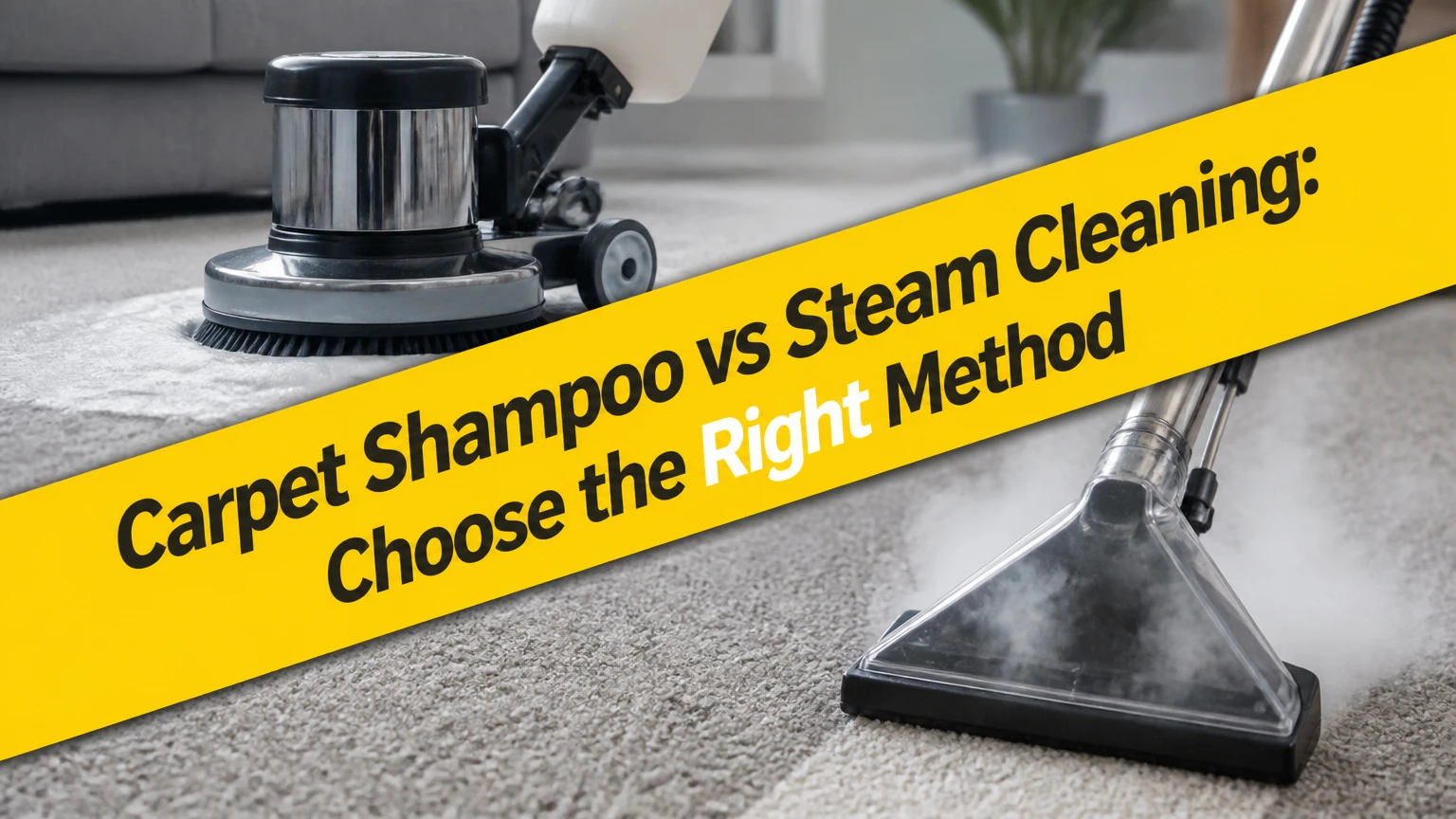
Carpet shampooing scrubs detergent through carpet fibers to suspend soil, while steam cleaning, more accurately called hot water extraction, rinses and vacuums dissolved soil from the pile. Hot water extraction is usually the better choice for residential deep cleaning, pets, and allergens; shampooing remains useful for selected low-pile synthetic carpets with heavy oily soil.
Key Facts at a Glance
- Hot water extraction removes more suspended soil because a vacuum recovery system removes rinse water, detergent, and loosened debris.
- Traditional carpet shampooing can leave more residue when detergent concentration, rinse volume, or post-cleaning vacuuming is inadequate.
- Neither method is automatically safe for every carpet, because wool, viscose, jute-backed, glued, and aged carpets require specific moisture and pH controls.
- Typical professional prices range from $100-$300 for a home, depending on room count, minimum charges, stairs, furniture, and treatment requirements.
- Extraction commonly dries in 6-12 hours, while shampooing may require 12-24 hours under comparable ventilation and moisture conditions.
- Low-moisture encapsulation is often better than shampooing for routine commercial maintenance, especially when rapid reopening matters.
What Are the Two Methods?
Carpet shampooing is a detergent-and-agitation process, whereas hot water extraction is a rinse-and-recovery process. The word “steam” describes the marketing name used by many cleaners, not the actual cleaning mechanism, because most carpet extractors inject heated water and recover it with vacuum rather than exposing carpet to dry steam.
Traditional shampoo machines apply a liquid detergent or foam and work it into carpet with cylindrical or rotary brushes. Surfactants surround oily particles, and mechanical agitation separates soil from fiber surfaces. After drying, some systems depend on vacuuming brittle detergent crystals, but conventional wet shampoo may leave dissolved residue unless the machine also rinses and extracts effectively.
Hot water extraction begins with dry vacuuming and a chemical preconditioner. A wand or portable tool injects heated solution into the pile, agitates contaminated fibers, and removes the mixture through a vacuum hose. The cleaning result depends less on heat alone than on the combined control of chemistry, dwell time, agitation, temperature, water flow, and vacuum recovery.
The Carpet and Rug Institute identifies hot water extraction as a recognized professional deep-cleaning method, but the Institute does not imply that one procedure suits every fiber or construction. Carpet manufacturers, fiber producers, and the carpet warranty document remain more authoritative than a generic method label.
How Does Each Method Work?
Carpet shampooing loosens soil primarily through surfactants and brush action; hot water extraction loosens soil chemically and thermally, then removes it through water flow and vacuum. The practical difference is removal: shampooing may leave cleaning agents in the carpet, while HWE is designed to recover the contaminated solution.
Traditional Shampooing Process
- Pre-vacuum the carpet. Remove dry particulate soil before adding moisture. Skipping this stage turns loose dust into damp slurry.
- Test the fiber and dye. Apply diluted solution in an inconspicuous area and check for color transfer, browning, texture change, or dye bleeding.
- Apply detergent sparingly. Follow the product label rather than increasing concentration for difficult soil. More detergent does not equal proportionally more cleaning.
- Agitate the pile. Use the machine’s specified brush and make controlled passes. Excessive friction can fuzz cut-pile nylon and distort looped fibers.
- Allow controlled drying. Keep occupants off the carpet and increase air movement. Drying depends on humidity, pad thickness, airflow, and detergent volume.
- Vacuum after drying. Crystallized residue and loosened dry soil require thorough post-cleaning vacuuming.
Shampooing can improve the appearance of neglected synthetic carpet quickly because brushes address traffic-lane matting and oily surface soil. The visible result can be misleading if detergent remains below the surface and attracts new soil after the carpet becomes walkable.
Hot Water Extraction Process
- Dry vacuum slowly. Make overlapping passes, especially in entryways and around furniture.
- Precondition traffic lanes. Apply a carpet-compatible prespray to oily soil and allow the label-specified dwell time, commonly 5-10 minutes without letting it dry.
- Agitate where needed. A carpet brush or counter-rotating brush machine improves chemical distribution in dense, heavily soiled pile.
- Extract with controlled passes. Use one wet pass followed by one or more slow vacuum-only passes, according to equipment instructions.
- Inspect the result. Check edges, stairs, traffic lanes, spots, and areas where soil may wick upward during drying.
- Accelerate evaporation. Use air movers, ventilation, and appropriate HVAC operation. The goal is rapid, even drying rather than simply making the surface feel dry.
- Apply a finishing rinse when specified. A mildly acidic or neutral rinse can reduce alkaline residue, but vinegar is not a universal substitute for a formulated rinse.
Professional HWE is not automatically superior when the operator floods the pad, uses unsuitable chemistry, or fails to extract enough water. A careful low-moisture cleaner can outperform a poorly executed extraction job.
Carpet Shampoo vs Steam Cleaning: What Is the Technical Difference?
The main technical difference is that shampooing emphasizes detergent and mechanical scrubbing, while hot water extraction emphasizes flushing and vacuum recovery. Temperature and pressure vary substantially by machine, wand, carpet construction, and operator technique, so fixed specifications should not be treated as universal standards.
| Decision factor | Traditional shampooing | Hot water extraction | Practical implication |
|---|---|---|---|
| Primary action | Detergent plus brush agitation | Heated rinse plus vacuum recovery | HWE generally removes more spent solution |
| Typical solution temperature | 20-50°C | 50-90°C at the machine or tool | Wool and dye-sensitive fibers may require lower heat |
| Typical portable pressure | 20-150 psi | 50-500 psi, equipment-dependent | Higher pressure is not automatically safer or cleaner |
| Main equipment | Rotary or cylindrical shampooer | Portable extractor or truck-mounted unit | Truck mounts usually provide stronger recovery |
| Moisture load | Moderate to high | Moderate to high, operator-dependent | Drying depends on water recovery, not method name |
| Residue risk | High if no effective rinse follows | Lower with correct prespray and rinse | Excess detergent can cause rapid resoiling |
| Mechanical stress | Medium to high | Low to medium | Brush selection matters for loops and wool |
| Typical residential use | Spot or restorative surface cleaning | Periodic deep cleaning | Carpet warranty may specify an approved process |
The 120°C figure sometimes quoted for “steam cleaning” usually describes boiler or solution temperatures, not the temperature safely delivered throughout a residential carpet. Carpet fibers, dyes, adhesives, and backing experience different temperatures as the solution travels through the tool and pile.
Which Method Cleans Better?
Hot water extraction usually cleans residential carpet better because it combines soil suspension with recovery. Shampooing may produce a brighter short-term appearance on oily, low-pile synthetic carpet, but extraction has the stronger long-term result when the carpet contains embedded particulate soil, detergent residue, or pet contamination.
Dry soil is abrasive. The Carpet and Rug Institute has repeatedly emphasized regular vacuuming because removing particulate soil reduces wear before wet cleaning begins. Wet cleaning cannot reverse fiber abrasion that has already caused traffic lanes to appear gray or matted.
Shampooing has a legitimate use in some commercial settings. A dense polypropylene or nylon loop carpet in a restaurant entrance may need aggressive agitation against grease, but a rinse or encapsulation step is usually needed to control residue. For daily or weekly maintenance, low-moisture encapsulation often reduces disruption and drying time more effectively than traditional shampoo.
HWE has limits. Extraction can remove water-soluble and emulsified soil, but it does not guarantee removal of urine salts in the pad, permanent dye changes, pet odor in the subfloor, or stains that chemically altered the fiber. Those conditions require separate inspection and, in severe cases, pad replacement or subfloor treatment.
Soil and Stain Performance
| Soil or stain condition | More suitable first method | Typical treatment detail | Limitation |
|---|---|---|---|
| Dry tracked-in grit | HWE after vacuuming | Two slow vacuum passes before prespray | Abraded fiber may remain gray |
| Cooking oil on nylon | Shampoo or HWE prespray | 5-10 minute dwell, controlled agitation | Residue requires thorough recovery |
| Pet dander | HWE | Full-pile rinse and strong vacuum recovery | Allergens outside carpet remain |
| Fresh coffee | HWE or targeted spot treatment | Blot, test, rinse, extract | Heat may set some protein or dye stains |
| Pet urine in pad | Inspection plus specialty treatment | UV inspection and localized subsurface treatment | Surface cleaning alone is inadequate |
| Red dye stain | Professional spot chemistry | Fiber-safe reducing or oxidizing agent | Permanent color loss is possible |
| Wool soil | Low-moisture or specialist HWE | Wool-safe chemistry and low agitation | High heat and alkalinity can damage wool |
Does Hot Water Extraction Remove Allergens and Pet Odor?
Hot water extraction can remove allergen-bearing dust, dander, and some biological soil from carpet, but it cannot sterilize an entire room or guarantee removal of odor stored in padding and subfloor. Pet owners should choose HWE for routine carpet cleaning, then request a separate urine inspection when odor returns after drying.
Dust mites, skin flakes, and pet dander concentrate in household dust. A properly executed extraction can remove contaminated particulate from carpet more thoroughly than surface shampooing, especially when the cleaner pre-vacuums and recovers rinse water effectively.
“Sanitizes” requires caution. Heat exposure time, temperature at the fiber, chemical contact, and organism type determine microbial reduction. A brief hot-water pass is not equivalent to a validated hospital disinfection cycle, and carpet cleaning should not be presented as a substitute for remediation of sewage, floodwater, or extensive mold.
For urine, identify the affected area first. A black-light inspection can locate some deposits, but odor detection also requires lifting edges, checking the pad, and examining the tack strip or subfloor. If urine has reached those layers, repeated surface extraction may temporarily dilute odor while leaving the source intact.
Which Fibers and Carpet Constructions Are Safe?
Synthetic nylon, polyester, and polypropylene carpets generally tolerate professional hot water extraction when the cleaner uses compatible chemistry and controlled moisture. Wool, viscose, cotton blends, jute-backed rugs, glued installations, and aged carpets require a fiber-specific plan because heat, alkalinity, agitation, or water can cause shrinkage, browning, bleeding, delamination, or texture loss.
| Carpet or rug material | Usual cleaning preference | Main risk | Required precaution |
|---|---|---|---|
| Nylon broadloom | Professional HWE | Browning or overwetting | Test dye, control pH, dry rapidly |
| Polyester broadloom | HWE or encapsulation | Wicking and oily resoiling | Use suitable prespray and rinse |
| Polypropylene olefin | Low-moisture or HWE | Texture distortion and browning | Avoid excessive heat and friction |
| Wool carpet | Specialist low-moisture or HWE | Felting, shrinkage, dye bleed | Wool-safe chemistry and testing |
| Viscose or rayon rug | Specialist dry method | Permanent texture and color damage | Do not use ordinary shampoo or HWE |
| Jute-backed rug | Low-moisture specialist cleaning | Browning and backing distortion | Keep moisture exposure minimal |
| Glued-down carpet tile | Low-moisture maintenance | Adhesive failure or curling | Follow tile manufacturer instructions |
Wool is not simply “delicate nylon.” Wool fiber scales can felt under heat, moisture, alkalinity, and mechanical action. Viscose is even less forgiving because water can create irreversible rings, stiffness, color migration, and pile distortion.
Does Cleaning Affect a Carpet Warranty?
Carpet warranties do not universally require steam cleaning every 12-18 months. Warranty requirements differ by manufacturer, product line, installation, fiber, and country, so the written warranty should control the cleaning method, frequency, approved products, and documentation.
Some residential manufacturers recommend professional hot water extraction at specified intervals. Others focus on regular vacuuming, prompt spot treatment, and professional cleaning without prescribing one named method. “Steam cleaning” in warranty language often means hot water extraction, but confirm the definition with the manufacturer or retailer.
Keep the invoice, technician’s company details, date, method, products, and room coverage. A warranty claim can also fail because of installation defects, furniture damage, pet damage, permanent staining, abnormal wear, or failure to address spills promptly.
How Much Do the Methods Cost and How Long Do They Take?
Typical professional carpet cleaning costs about $100-$300 for an average home, with many providers charging $30-$60 per room before stairs, furniture movement, specialty spots, or minimum service fees. Shampooing may have a lower base price, but the cheapest quote is not necessarily cheaper after repeat cleaning caused by residue or incomplete soil removal.
| Service scenario | Typical price range | On-site time | Typical drying time |
|---|---|---|---|
| One room, professional HWE | $75-$150 | 30-60 minutes | 6-12 hours |
| Three-bedroom home, professional HWE | $150-$350 | 2-4 hours | 6-12 hours |
| One room, shampoo machine | $50-$125 | 45-90 minutes | 12-24 hours |
| DIY rental, home-size job | $60-$150 total | 3-6 hours | 12-24 hours |
| Commercial encapsulation | $0.10-$0.30 per square foot | 1-3 hours per 1,000 square feet | 1-3 hours |
| Specialty urine treatment | $150-$600 per affected area | 1-3 hours | 12-48 hours |
These are typical United States planning ranges, not fixed market prices. Urban labor rates, minimum charges, stairs, accessibility, parking, furniture, and regional demand can shift the total substantially.
Drying time matters more than cleaning speed. A carpet that feels dry on top may still contain moisture in the pad or backing. Relative humidity above 60%, closed windows, dense pad, cold floors, and excessive solution flow can extend drying beyond 24 hours.
Which Method Should You Choose?
Choose hot water extraction for most residential carpet, allergy concerns, pet dander, traffic soil, and periodic restorative cleaning. Choose shampooing only when the carpet is a compatible synthetic construction, surface grease is the dominant problem, and the operator can control detergent residue, agitation, and drying.
For Homes With Pets or Allergies
Hot water extraction is the stronger default for pet owners and allergy-sensitive households. Pre-vacuuming, HEPA-filtered vacuuming, professional extraction, and cleaning of upholstery and hard surfaces address more allergen reservoirs than carpet treatment alone.
Request urine inspection when odor persists. Do not assume more heat will solve contamination in the pad.
For Commercial Offices and Restaurants
Low-moisture encapsulation often beats both traditional shampooing and full HWE for routine commercial work. Encapsulation can allow traffic sooner, uses less water, and suits planned maintenance, while HWE remains appropriate for periodic restorative cleaning or heavily contaminated areas.
Shampooing can help with oily low-pile carpet, but residue and slow drying make it a poor default for frequent maintenance. Commercial operators should specify soil type, reopening time, carpet fiber, and square footage before selecting equipment.
For Wool Carpet and Fine Rugs
Use a cleaner experienced with wool or fine-rug construction rather than selecting a method from the machine label. A specialist may choose low-moisture cleaning, controlled HWE, immersion cleaning, or another process after testing dyes, backing, fringe, and construction.
Do not use a household shampooer on viscose, antique rugs, hand-tufted rugs, or jute-backed materials. The repair cost can exceed the original cleaning price.
For a Budget-Conscious DIY Job
Renting an extractor can make sense for durable synthetic carpet when the area is small, accessible, and not heavily contaminated. Buy or use the correct solution, measure dilution precisely, and plan enough drying airflow before starting.
DIY shampooing is a poor choice when the carpet has unknown fiber, visible browning, loose seams, urine odor, water damage, or a valuable warranty. Equipment rental does not replace fiber identification or moisture control.
What About Encapsulation and Dry Cleaning?
Encapsulation is a low-moisture process that applies polymer chemistry, agitates soil, and leaves brittle crystals that routine vacuuming removes. Dry carpet cleaning uses very little water and may use absorbent compounds or specialized solvents, making it useful where rapid access or moisture sensitivity outweighs maximum deep extraction.
| Alternative method | Typical moisture level | Typical reopening time | Best application |
|---|---|---|---|
| Encapsulation | Low, roughly 0.5-2 gallons per 1,000 square feet | 1-3 hours | Routine commercial maintenance |
| Absorbent compound cleaning | Very low, under 1 gallon per 1,000 square feet | 1-2 hours | Moisture-sensitive areas |
| Bonnet cleaning | Low to moderate, 1-3 gallons per 1,000 square feet | 2-6 hours | Surface appearance maintenance |
| Hot water extraction | Moderate to high, 3-15 gallons per 1,000 square feet | 6-12 hours | Periodic residential restoration |
Low-moisture methods do not replace extraction in every situation. They are less suitable for deeply embedded soil, urine deposits, flood contamination, or carpets requiring substantial rinse recovery.
How Can You Avoid the Most Common Failures?
The most common carpet-cleaning failures are excess detergent, insufficient dry vacuuming, over-wetting, aggressive brushing, and incorrect fiber assumptions. Each failure has a recognizable symptom and a different remedy, so repeating the same cleaning process can worsen the damage.
- Sticky or crunchy carpet: Residual detergent remains after drying. Stop adding shampoo, vacuum thoroughly, and use a properly configured rinse extraction if the fiber and backing permit it.
- Brown stains after cleaning: Soil or cellulose backing has wicked upward, or natural backing has browned from moisture. Improve airflow and obtain professional assessment before applying more water.
- Carpet remains wet after 24 hours: The job likely used excessive solution, recovered too slowly, or lacks airflow. Run air movers and HVAC dehumidification, and inspect the pad for saturation.
- Fuzzy or frayed fibers: Brush pressure or unsuitable agitation damaged the pile. Stop scrubbing; trimming may hide minor fuzzing, but distortion is often permanent.
- Stains return after drying: Wicking has pulled dissolved soil from the backing or pad. Re-cleaning the surface alone will not solve a subsurface source.
- Wrinkles or loose seams: Excess moisture may have affected installation tension or adhesive. Do not stretch or glue the carpet until it is fully dry and professionally assessed.
A practitioner rule of thumb is simple: one controlled wet pass followed by slower vacuum-only passes is safer than repeated wet passes made quickly. Vacuum recovery is a cleaning variable, not merely a drying variable.
How Often Should Carpet Be Professionally Cleaned?
Most homes benefit from professional cleaning every 12-18 months, while homes with pets, children, allergies, or heavy entry traffic may need cleaning every 6-12 months. Low-traffic rooms may go longer if regular vacuuming prevents abrasive soil accumulation and the manufacturer’s warranty allows it.
Use a maintenance schedule based on soil loading rather than a calendar alone. Entryways, hallways, stairs, and rooms near exterior doors usually need attention before lightly used bedrooms.
The Carpet and Rug Institute recommends frequent vacuuming as part of carpet maintenance, and manufacturer care instructions commonly require prompt spill treatment. Professional cleaning cannot restore fiber that has already been permanently abraded by accumulated grit.
FAQ
Is shampooing cheaper than steam cleaning?
Shampooing often has a lower advertised price, with typical one-room quotes around $50-$125 compared with $75-$150 for professional hot water extraction. Total value depends on residue, drying, repeat cleaning, and stain treatment. A low initial price can become expensive if detergent causes rapid resoiling.
Can I steam clean carpet myself?
You can use a rented or household extractor on durable synthetic carpet after checking the care label and testing a hidden area. Use the manufacturer’s dilution, avoid flooding, make slow recovery passes, and provide strong airflow. Do not attempt unknown fibers, viscose, valuable rugs, severe urine contamination, or water-damaged carpet without professional assessment.
Does shampooing damage carpet?
Shampooing can damage carpet when excessive detergent, high heat, or aggressive brushes affect the fiber, backing, adhesive, or dye. Durable nylon and polypropylene usually tolerate controlled cleaning, but wool, viscose, looped textures, and aged installations require a different process or specialist.
Why does carpet look dirty again after shampooing?
Carpet may look dirty again because detergent residue remains on the fiber and attracts soil, or because deep soil wicks upward from the backing during drying. Thorough dry vacuuming, correct detergent dilution, effective rinsing, and controlled drying reduce recurrence. Persistent spots may require subsurface treatment.
How long should furniture stay off cleaned carpet?
Keep furniture off freshly cleaned carpet until the pile and backing are fully dry, typically 6-12 hours after professional extraction and 12-24 hours after shampooing. Use protective tabs or foil under furniture legs when replacement is necessary, and avoid plastic because it can trap moisture.
Can hot water extraction cause mold?
Hot water extraction can contribute to mold or mildew when carpet and pad remain damp for an extended period, but the method itself does not automatically cause mold. Excess solution, poor recovery, high humidity, and pre-existing water damage increase risk. Dry the installation promptly and investigate moisture below the carpet.
The Bottom Line
For most residential decisions, hot water extraction is the better choice than traditional shampooing because it removes loosened soil and spent solution rather than leaving detergent behind. Carpet shampooing still has a limited role on compatible, low-pile synthetic carpet with heavy surface grease. In every case, fiber type, backing, contamination depth, warranty language, and drying capacity matter more than the machine’s marketing name. Choose carpet shampoo vs steam cleaning by the carpet’s construction and soil problem, not by price alone.