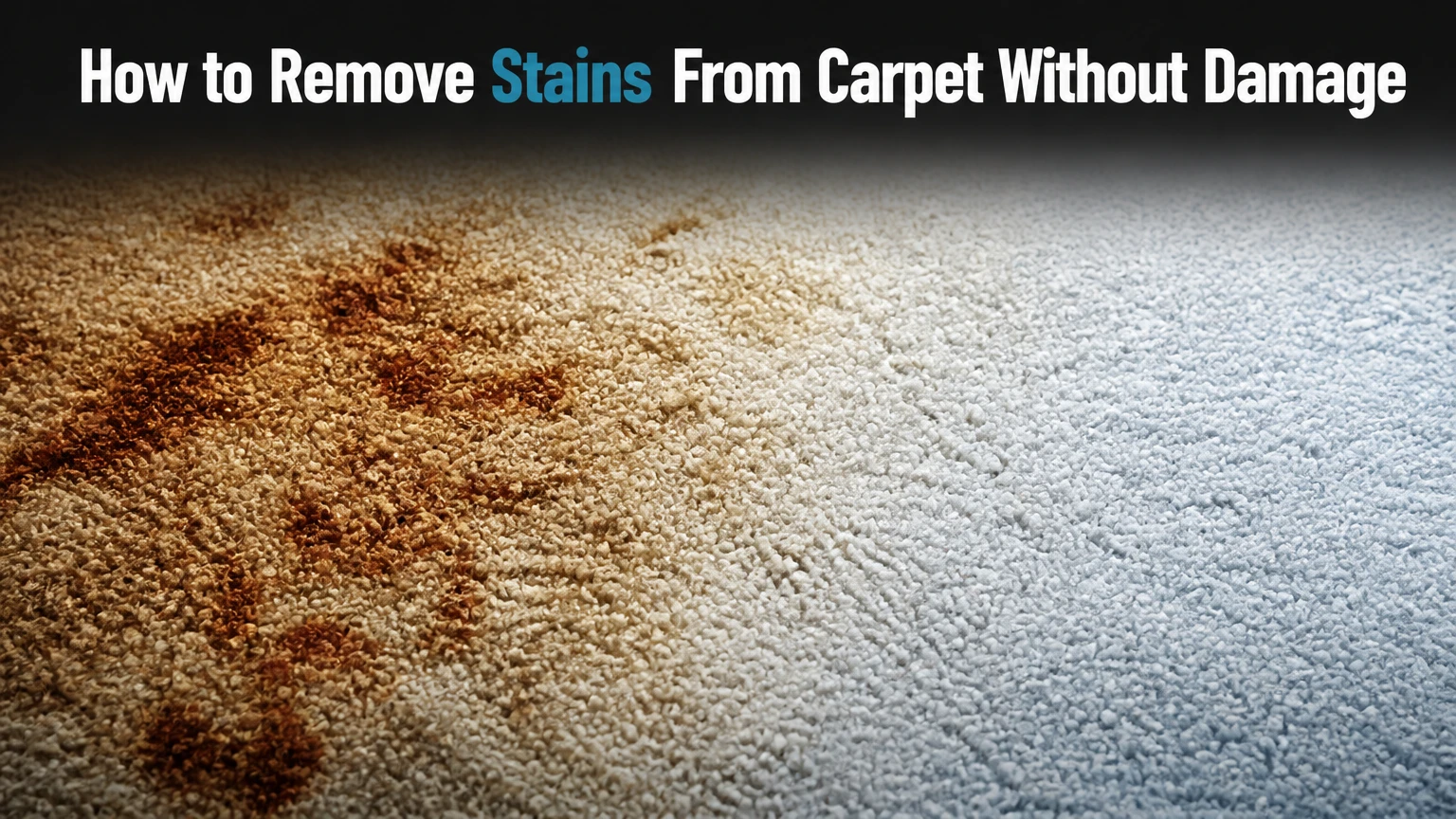
To remove stains from carpet, lift solids, blot liquids, apply a small amount of fiber-safe cleaner, allow the correct dwell time, rinse away residue, and dry the area quickly. The best treatment depends on the stain chemistry, carpet fiber, dye stability, and whether liquid has reached the backing or pad.
Key Facts at a Glance
- Blotting removes more fresh spill material than scrubbing because friction drives liquid deeper and damages yarn.
- Clear dish detergent diluted in water suits many fresh, water-based spills on synthetic carpet.
- Blood requires cold water, while heat can set protein stains more firmly.
- Enzyme cleaners target organic residue from urine, vomit, feces, and some food stains.
- Wool, silk, viscose, jute, and antique rugs need a product approved for that fiber or professional treatment.
- A carpet stain that returns after drying usually indicates wicking from the backing or pad, not a new spill.
Before You Start
A fresh, palm-sized stain usually takes 10-20 minutes to treat and another 6-24 hours to dry. DIY treatment typically costs $1-$15 when you already have white towels, while a commercial spot cleaner usually costs $8-$25.
Materials and safety checklist
| Item | Typical amount or specification | Purpose |
|---|---|---|
| White towels | 4-8 clean, lint-free towels | Blotting and color transfer |
| Clear dish detergent | 1/4 teaspoon per 1 cup water | Water-based soil and food |
| Lukewarm water | 1-2 cups | Dilution and rinsing |
| Soft brush or spoon | 1 spoon, brush under 2 inches wide | Solid removal and gentle agitation |
| Enzyme cleaner | Enough to reach contaminated fibers | Pet and organic residue |
| Fan | 1 floor or box fan | Faster, safer drying |
| White paper or cloth | 1 hidden test area | Colorfastness check |
Open windows and keep children and pets away from wet carpet. Never combine bleach with ammonia, vinegar, or another cleaner. Avoid flammable solvents near candles, pilot lights, heaters, cigarettes, or electrical sparks.
Test the carpet first
Find a hidden section inside a closet or beneath furniture. Apply one drop of the proposed cleaner, wait five minutes, blot with a white towel, and inspect both the carpet and towel for color transfer. Stop if the fiber changes color, becomes sticky, feels rough, or releases dye.
Carpet fiber determines the safe chemical range. Nylon and polyester generally tolerate more commercial spot products than wool, viscose, or plant fibers, but manufacturer instructions override general rules.
How Does Carpet Stain Removal Work?
Carpet stain removal works by separating soil from fiber, dissolving or digesting the contaminant, and transferring the loosened material into a towel or extractor. Surfactants surround oily particles, solvents dissolve certain non-water-based soils, enzymes break down organic residue, and physical extraction removes the cleaning liquid.
The process has four linked stages: surface chemistry, neutralization, agitation, and capillary extraction. A cleaner can loosen a stain without removing it if the towel, vacuum, or extractor does not carry the dissolved residue away.
Carpet fibers also transport moisture through narrow spaces. As water evaporates, dissolved soil can travel toward the yarn tips and leave a visible ring. This process, called wicking, explains why a treated spot sometimes reappears after it looks clean.
The Carpet and Rug Institute recommends prompt blotting and following the carpet manufacturer’s care instructions. Professional cleaners often describe the practical rule as “dry soil first, wet soil second,” because removing loose particles before adding liquid reduces mud formation and residue.
How to Remove Stains From Carpet: Six Steps
Step 1: Remove solids and blot the spill
Lift food, mud, or pet waste with a spoon, dull knife, or piece of cardboard. Hold a folded white towel over liquid and press straight down for 10-15 seconds, then move to a dry section of towel and repeat from the outer edge toward the center.
Do not rub. Rubbing spreads the stain, abrades the yarn, and can create a permanently fuzzy patch known as blooming or fuzzing.
You will know it worked when: the towel absorbs less liquid after several presses and the wet outline stops expanding.
Common mistake: starting with cleaner before removing thick solids. Scrape first, because wetting a solid deposit can push pigment and oils into the backing.
Step 2: Choose a cleaner that matches the stain
Identify whether the material is water-based, oily, dye-heavy, protein-based, or unknown. For a typical fresh spill on synthetic carpet, mix 1/4 teaspoon of clear, non-bleach dish detergent with 1 cup of lukewarm water.
Apply the solution to a white towel or use a small spray on the stained fibers. Avoid pouring cleaner directly onto the carpet, especially near seams or edges.
You will know it worked when: the stain begins transferring to the towel instead of merely becoming wetter.
Common mistake: using colored dish soap. Blue, green, or red dye can transfer to pale carpet.
Step 3: Allow controlled dwell time
Leave diluted detergent on a fresh water-based stain for 3-5 minutes. Follow the product label for commercial cleaners, because some require 5-10 minutes and enzyme products often require 15-30 minutes or longer.
Keep the area damp during enzyme dwell time, but do not flood the carpet. Enzymes need contact with organic residue; they do not need a large volume of water.
You will know it worked when: the residue feels less tacky and a light tamp releases material without aggressive brushing.
Common mistake: allowing a solvent to evaporate in a closed room or leaving a high-pH product on wool.
Step 4: Agitate gently
Tamp the spot with a soft-bristled brush, clean towel, or fingertips through a towel. Use short vertical movements rather than circular scrubbing, and work from the perimeter toward the middle.
Loop-pile carpet needs extra care because a brush can pull or distort loops. A towel-tamping method is safer for looped construction, berber carpet, and delicate rugs.
You will know it worked when: the stain edge becomes less distinct and the carpet pile remains aligned.
Common mistake: increasing pressure when the stain does not disappear immediately. Repeat the chemical and extraction cycle instead of adding friction.
Step 5: Rinse and extract the residue
Dampen a clean white towel with plain water and press it over the treated area. Use only enough water to remove detergent, then blot with a dry towel or extract with a portable machine.
Residual soap attracts soil because its surfactants remain sticky after evaporation. Rinsing is particularly important when using dish detergent, concentrated commercial sprays, or alkaline products.
You will know it worked when: the towel no longer feels soapy and the carpet does not feel stiff after partial drying.
Common mistake: skipping the rinse because the stain appears gone. Residue can create a dark traffic mark within days.
Step 6: Dry the carpet under airflow
Cover the damp area with a clean, dry white towel and place a flat, non-staining weight over it for 6-12 hours. Replace the towel if it becomes wet, then run a fan across the carpet until the fibers and backing feel dry.
Do not use high heat from a hair dryer or steam appliance on an unknown carpet. Excessive heat can set dyes, distort synthetic fibers, soften adhesives, or accelerate browning in some natural-fiber materials.
You will know it worked when: the pile feels dry at its base, no odor remains, and the stain does not return after 24 hours.
Common mistake: closing the room while the carpet is wet. Slow drying increases odor, wicking, and backing damage.
Which Cleaner Matches Each Carpet Stain?
The correct cleaner depends more on the contaminant than on the stain’s color. Use the mildest method that fits the chemistry, and test every product before treating visible carpet.
| Stain or material | First treatment | Typical dwell time | Important restriction |
|---|---|---|---|
| Soda, juice, berries | 1/4 tsp clear detergent in 1 cup water | 3-5 minutes | Rinse sugar residue |
| Coffee or tea | Detergent solution, then water rinse | 3-5 minutes | Avoid heat; tannins may leave a brown edge |
| Red wine or fruit dye | Blot, detergent solution, labeled oxygen product if safe | 5-10 minutes | Test peroxide products for color loss |
| Grease, butter, makeup | Isopropyl alcohol on a white towel, or labeled solvent | 1-3 minutes | Ventilate; keep away from ignition |
| Blood | Cold water first, then labeled protein or enzyme product | 5-15 minutes | Never start with hot water |
| Pet urine | Enzyme cleaner applied to affected fibers | 15 minutes to overnight | Match application depth to urine penetration |
| Mud | Let dry, vacuum, then detergent solution | 3-5 minutes | Wet mud spreads and penetrates |
| Wax or gum | Harden with ice, scrape, then treat residue | 5 minutes | Do not pull carpet yarn |
How do you remove oil-based carpet stains?
Oil-based carpet stains need a small amount of solvent because water and detergent alone may leave a greasy film. Apply 70% or 91% isopropyl alcohol to a white cloth, never directly to the carpet, and blot from the outside inward.
Test first, ventilate the room, and use only enough solvent to dampen the cloth. Continue transferring oil to fresh sections of towel, then rinse lightly with a detergent solution and plain water.
Do not use gasoline, paint thinner, acetone, or an unlabeled dry-cleaning fluid indoors. These products can dissolve carpet backing, leave hazardous vapors, or create a fire risk. Professional solvent extraction is safer for large grease deposits.
How do you remove blood from carpet?
Remove blood with cold water and a white towel, followed by a carpet-safe protein or enzyme cleaner if residue remains. Cold water limits protein coagulation, whereas hot water can make blood bind more strongly to fibers.
Blot fresh blood without spreading it. For dried blood, place a cold-water-dampened towel over the area for five minutes, lift softened material carefully, and repeat with fresh towels. Never mix hydrogen peroxide with chlorine bleach or other oxidizers.
Hydrogen peroxide can remove some blood pigment from light, synthetic carpet, but it can bleach colored fibers. Use a labeled carpet product, test for colorfastness, and stop if the test area lightens.
How do you remove pet urine odor?
Pet urine requires an enzyme cleaner that reaches the same depth as the urine. Surface spraying may remove the visible mark while leaving uric-acid residue in the backing or pad, which can release odor again when humidity rises.
Blot fresh urine first, then apply enough enzyme product to penetrate the contaminated area without flooding surrounding seams. Keep the product wet for the label’s stated period, usually 15 minutes to overnight, and extract or blot afterward.
Do not use ammonia to disguise urine odor. Ammonia resembles one component of urine odor and may encourage repeat marking by some pets. If urine has soaked into the pad, carpet removal or professional subsurface treatment may be necessary.
Which Carpet Fibers Need Special Care?
Wool, silk, viscose, jute, and antique rugs require conservative spot treatment because their fibers, dyes, and backing can react to water, alkalinity, friction, or heat. Use cool-to-lukewarm water and a fiber-approved neutral cleaner, then stop after two careful attempts if the stain remains.
WoolSafe recommends products tested for wool and other sensitive textile fibers. Wool is a protein fiber, so chlorine bleach, strong alkaline cleaners, ammonia, and high heat can damage structure or color. Viscose can develop permanent texture changes when wet and agitated.
| Carpet type | Safer starting method | Avoid | Escalation point |
|---|---|---|---|
| Nylon | Clear detergent solution | Excessive peroxide or heat | Two unsuccessful cycles |
| Polyester | Detergent, labeled oxygen product | Strong solvents on backing | Dye stain remains after rinse |
| Wool | Cool water, WoolSafe-approved cleaner | Ammonia, bleach, high pH | Immediately for valuable rugs |
| Viscose | Minimal moisture and friction | Saturation, brushing, extraction | Any texture change |
| Berber loop pile | Towel tamping and low moisture | Aggressive brushing | Pulled loops or seam moisture |
| Silk or antique rug | Professional assessment | DIY chemicals and soaking | Before treatment |
Can Old or Set-In Carpet Stains Be Removed?
Old carpet stains can often be lightened, but complete removal becomes less predictable after heat exposure, repeated cleaning, fiber dye damage, or backing contamination. Start by vacuuming dry residue, identify the stain, and perform one controlled treatment cycle rather than layering several chemicals.
A stain may be permanent for three different reasons: the contaminant chemically altered the fiber dye, the cleaner bleached the carpet, or the original material remains below the surface. A dark outline around a clean center usually indicates wicking from the backing or pad.
Do not repeatedly wet a large area hoping to dissolve a set-in stain. Multiple wet cycles can delaminate backing, create odor, and spread contamination. A professional can use controlled hot-water extraction, specialty reducing or oxidizing agents, and subsurface treatment when appropriate.
What Should You Use: DIY, Machine, or Professional Cleaning?
DIY spot treatment is the best first choice for a fresh, small spill on colorfast synthetic carpet. A portable extractor becomes more useful for repeated pet accidents or several small stains, while professional cleaning is the safer decision for extensive, old, delicate, or pad-deep contamination.
| Method | Typical cost | Drying time | Best use | Main limitation |
|---|---|---|---|---|
| DIY detergent treatment | $1-$5 | 6-24 hours | Fresh food and drink | Limited extraction depth |
| Commercial spot spray | $8-$25 | 6-24 hours | Targeted synthetic-carpet stains | Residue or color loss |
| Portable extractor rental | $30-$60 per day | 8-24 hours | Multiple rooms or pet spots | Overwetting risk |
| Portable extractor purchase | $100-$250 | 8-24 hours | Frequent household spills | Requires careful rinsing |
| Professional room cleaning | $30-$80 per room typical | 6-24 hours | Broad or set-in soiling | Minimum fees often $120-$200 |
| Specialty rug cleaning | $80-$300+ typical | 1-7 days | Wool, silk, antique rugs | Transport and inspection |
Prices vary by region, room size, access, furniture, and minimum service charge. A professional quote should identify whether stain treatment, deodorization, furniture movement, and pad treatment are included.
When should you hire a professional?
Hire a professional when the stain covers more than a few square feet, returns after two treatments, smells despite enzyme treatment, reaches the pad, or appears on wool, silk, viscose, or an expensive rug. Professional help is also appropriate after sewage, floodwater, vomit over a large area, or unknown chemical exposure.
Ask what extraction method will be used, how the cleaner protects the backing, and whether the company follows the carpet manufacturer’s recommendations. For rugs, look for a cleaner with relevant training from organizations such as the Institute of Inspection Cleaning and Restoration Certification or a recognized textile-rug program.
Common Mistakes and How to Fix Them
| Mistake | What happens | Recovery |
|---|---|---|
| Scrubbing hard | Fibers fuzz, spread, or distort | Stop friction; blot and trim only professionally |
| Flooding the spot | Liquid reaches pad and wicks upward | Extract, towel-weight, and dry with airflow |
| Mixing cleaners | Toxic vapors or chemical damage | Stop, ventilate, and rinse only after safe separation |
| Using hot water on blood | Protein binds more firmly | Re-treat with cold water and a labeled product |
| Leaving soap behind | Dirt sticks to detergent residue | Rinse with plain water and extract |
| Applying peroxide blindly | Carpet dye may lighten | Stop oxidation; seek professional color correction |
One practitioner rule is to keep the wet perimeter smaller than the original visible stain. Expanding the wet area gives dissolved soil more space to migrate and makes ring formation more likely.
A second rule is to change towels frequently. A saturated towel can redeposit stain material, even when pressure and chemistry are correct.
A third rule is to judge success after complete drying, not while the carpet is wet. Moisture temporarily darkens fibers and can conceal both residual soil and color loss.
Why Did the Carpet Stain Come Back?
A carpet stain that reappears after drying usually contains residue in the carpet backing or pad. Evaporation pulls that residue upward through the yarn, producing a visible ring or central spot known as wicking.
Lightly dampen the affected surface with plain water, place a thick white towel over it, and apply a flat weight for 6-24 hours. Replace the towel when damp, then dry the area with a fan. The method works only when contamination remains near the surface.
A recurring pet-urine odor or a stain that returns after several cycles indicates deeper contamination. Surface treatment cannot reliably remove material trapped beneath the carpet, so subsurface extraction or pad replacement may be required.
How Much Time and Money Does Removal Take?
A fresh stain usually needs 10-20 minutes of active work and 6-24 hours of drying. Set-in dye stains may require several treatment cycles over 24-48 hours, while enzyme treatment for pet urine can require overnight contact and longer drying.
| Situation | Active labor | Total elapsed time | Typical DIY cost |
|---|---|---|---|
| Fresh drink spill | 10-15 minutes | 6-12 hours | $1-$5 |
| Coffee or wine spot | 15-30 minutes | 6-24 hours | $3-$15 |
| Grease or makeup | 15-30 minutes | 6-12 hours | $5-$15 |
| Dried blood | 20-40 minutes | 12-24 hours | $5-$20 |
| Pet urine surface spot | 20-45 minutes | 12-36 hours | $8-$25 |
| Several rooms | 2-4 hours | 12-24 hours | $30-$250 |
The determining factor is not the price of the cleaner. It is whether the treatment removes contamination or merely redistributes it deeper into the carpet system.
FAQ
Does baking soda remove stains from carpet?
Baking soda absorbs some surface moisture and odor, but it does not reliably dissolve dye, grease, or urine crystals. Sprinkle it only after a stain is mostly dry, vacuum thoroughly, and avoid combining it with vinegar inside the carpet because the reaction produces foam without providing meaningful extraction.
Is vinegar safe for every carpet?
Vinegar is not safe for every carpet. Diluted white vinegar may help neutralize alkaline residue on some synthetic fibers, but repeated acidity can affect dyes, backing, or natural fibers. Never use it as a universal treatment, and do not mix vinegar with bleach or ammonia.
Can I use a steam cleaner on a carpet stain?
A steam or hot-water extraction machine can remove loosened soil, but heat and moisture may set some stains, damage delicate fibers, or drive liquid into the pad. Vacuum dry material first, use the manufacturer’s solution, make slow extraction passes, and dry the carpet rapidly.
How do I remove a mystery stain?
Treat a mystery stain as potentially dye-based or chemical until testing identifies it. Photograph the stain, inspect for odor and texture, blot with a dry white towel, and test plain water in a hidden area. Avoid random chemicals, because an unknown product may react with an earlier cleaner.
How do I stop a carpet stain from spreading?
Contain a spreading stain by working from the outer edge toward the center, using minimal liquid and changing towels after each blot. Do not walk across the area, use a wet vacuum if available, and place absorbent white towels around the perimeter while the spot dries.
Is carpet stain removal possible without a machine?
Most fresh, small carpet stains can be treated without a machine using white towels, diluted clear detergent, controlled rinsing, and airflow. A machine becomes valuable when liquid has reached the backing, several spots require extraction, or repeated blotting leaves visible detergent and soil residue.
The Bottom Line
The safest way to remove stains from carpet is to scrape solids, blot immediately, match the cleaner to the stain chemistry and fiber, use minimal moisture, rinse away residue, and dry under airflow. Synthetic carpet tolerates more DIY treatment than wool, silk, viscose, or antique rugs. If the stain returns, odor persists, or contamination reaches the pad, stop adding chemicals and arrange professional extraction.