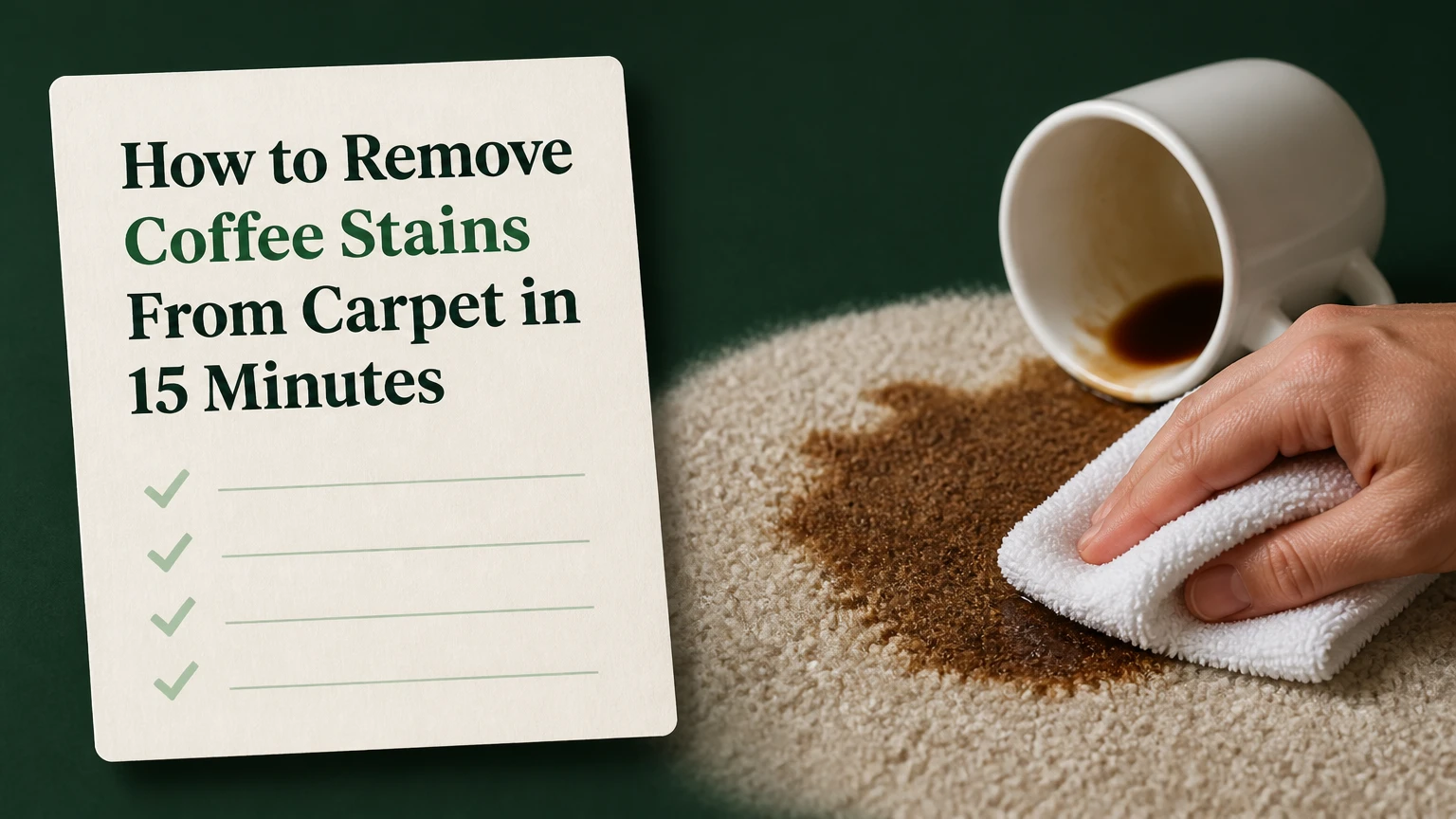
To remove coffee stains from carpet, blot the spill immediately, apply a small amount of diluted dish soap, transfer the loosened coffee into white towels, rinse with cool water, and dry the carpet thoroughly. Fresh spills usually need 10-15 minutes; dried or milk-based stains may require two treatments and careful colorfastness testing.
Key Facts
- White towels transfer coffee residue more reliably than colored cloths and reveal when the stain is lifting.
- Scrubbing spreads liquid through the pile and can permanently distort carpet fibers.
- A practical spot-cleaning mixture is 1/4 teaspoon of clear dishwashing liquid in 1 cup of cool water.
- Rinsing matters because detergent residue attracts dry soil and can create a darker replacement spot.
- A stain that returns after drying usually indicates wicking from the carpet backing or pad.
- Wool, silk, viscose, antique rugs, and carpet with unknown dyes require a professional cleaner before wet treatment.
How Does Coffee Stain Carpet?
Coffee stains carpet because brewed coffee leaves water-soluble brown tannins and other plant compounds among the fibers; milk, cream, and sugar add fat, protein, and sticky solids. Water carries those materials downward through the pile, while evaporation leaves concentrated residue that can bond more strongly to fiber surfaces.
Carpet construction changes the result. Nylon and polyester generally tolerate cautious water-based spot treatment, while wool can felt, shrink, bleed, or become distorted when exposed to excess moisture, friction, heat, or unsuitable pH. Cotton-backed rugs and carpet over absorbent padding also hold more liquid than a thin synthetic mat.
The cleaning mechanism is transfer, not destruction. A diluted cleaner loosens soil, and repeated pressure moves the suspended residue from carpet to towel. The towel must be changed as it becomes damp or brown, otherwise the operator redistributes the coffee.
What determines removal difficulty?
| Condition | Typical effect | Recommended response |
|---|---|---|
| Fresh black coffee, 10-30 ml | Surface liquid, limited residue | Blot and use diluted detergent |
| Coffee with sugar, 10-30 ml | Sticky residue after drying | Detergent rinse, then dry fully |
| Coffee with milk, 10-30 ml | Fat and protein odor risk | Detergent treatment, controlled rinse |
| Dried black coffee, under 24 hours | Concentrated tannin residue | Rehydrate briefly, then blot |
| Spill over 250 ml | Possible backing and pad saturation | Extract from edges inward, assess padding |
| Wool or viscose rug | Dye, shrinkage, and texture risk | Blot only, then contact a specialist |
The Carpet and Rug Institute uses the practical instruction “Blot, don’t rub” in its consumer stain-care guidance. That rule protects pile structure while maximizing liquid transfer.
What Should You Do in the First Five Minutes?
During the first five minutes, remove liquid before adding a cleaning product. Place a folded white towel over the spill, press vertically with your hand or body weight for 10-15 seconds, lift, rotate to a dry section, and repeat until the towel absorbs little or no coffee.
Do not begin with a large spray. Excess water drives coffee below the visible surface and increases the chance of wicking. If the spill is larger than a dinner plate, work in sections of approximately 10 by 10 centimetres so each area can be extracted and dried.
Protect the floor beneath a loose rug before wetting it. A towel under the rug catches migration and prevents moisture from reaching wood, laminate, or unfinished flooring.
Before You Start
| Requirement | Practical specification |
|---|---|
| Time | 10-15 minutes for a fresh spot, 30-60 minutes for a dried spot |
| Difficulty | Low for synthetic carpet, high for wool or unknown fibers |
| Cost | Approximately $0-$10 for household supplies |
| Towels | 4-8 clean, white, absorbent towels or paper towels |
| Cleaning solution | 1 cup cool water plus 1/4 teaspoon clear dish soap |
| Optional tools | Spoon, spray bottle, wet vacuum, fan, plastic sheet |
| Safety check | Hidden colorfastness test and manufacturer-care review |
How to Remove Coffee Stains From Carpet Step by Step
The safest household process has six steps: remove liquid, prepare a mild solution, test colorfastness, apply sparingly, blot toward the center, rinse, and dry. A fresh coffee spill typically takes 10-15 minutes when the carpet backing is not saturated, and success depends more on controlled moisture than on stronger chemicals.
Step 1: Blot the coffee spill
Press a white towel directly onto the coffee for 10-15 seconds, then lift rather than drag it across the pile. Repeat with dry towel sections until the towel shows only faint beige transfer.
Start at the outside edge when the spill has spread. Working inward limits lateral movement and keeps the damp zone smaller.
You will know it worked when: the towel feels damp but no longer becomes visibly brown after several presses.
Common mistake: rubbing back and forth. Friction bends or frays pile, pushes coffee toward the backing, and can create a fuzzy patch that remains after the stain disappears.
Step 2: Mix a low-residue cleaning solution
Add 1/4 teaspoon of clear, dye-free liquid dish soap to 1 cup of cool or lukewarm water. Stir gently without making a bowl of foam, because foam is harder to rinse from carpet.
The goal is low concentration. A stronger mixture does not necessarily clean better, and excess surfactant can leave a sticky film that attracts soil. Avoid hand soap, laundry detergent, dishwasher detergent, and products containing bleach.
You will know it worked when: the solution feels slightly slippery but remains nearly clear and produces little foam.
Common mistake: using a tablespoon of dish soap in a cup of water. That concentration is difficult to remove from carpet and often causes a dark halo after drying.
Step 3: Test the carpet for colorfastness
Dab the solution onto a hidden area, such as beneath furniture or at the edge of a fitted carpet. Press a white towel over the test area for 10 seconds and check the towel and fibers for dye transfer.
Wait until the test area dries if the carpet is valuable, brightly colored, hand-dyed, or made from wool, viscose, cotton, or silk. Manufacturer instructions take priority over a general home recipe.
You will know it worked when: the towel remains free of carpet dye and the test patch shows no lightening, bleeding, or texture change.
Common mistake: testing only the cleaner in a bottle. The relevant test is the diluted solution applied with the same moisture level and contact time used on the stain.
Step 4: Apply solution from the outside inward
Dampen a white cloth with the mixture, or use a spray bottle to apply no more than 1-2 teaspoons to a small spot. Treat the outer boundary first, then move toward the center without flooding the carpet.
Allow the solution to dwell for 2-3 minutes. A short dwell loosens residue; prolonged soaking increases the chance that coffee reaches the backing.
You will know it worked when: the stain boundary looks softer and the surface becomes evenly damp rather than wet enough to feel squishy.
Common mistake: pouring the solution directly onto the carpet. Direct pouring creates a deep moisture pocket that can wick upward during drying.
Step 5: Blot and transfer the loosened coffee
Place a fresh white towel over the damp area and press straight down for 10-15 seconds. Lift, inspect the towel, rotate to a clean section, and repeat until coffee color stops transferring.
For a loop-pile carpet, press without twisting the towel. For a cut-pile carpet, gentle vertical pressure protects the pile while still extracting liquid. A small wet vacuum can improve extraction, but use short passes and do not repeatedly flood the spot.
You will know it worked when: the towel remains nearly clean after two consecutive presses.
Common mistake: using the first dirty towel throughout the process. A saturated towel cannot accept more coffee and can redeposit the stain.
Step 6: Rinse, extract, and dry completely
Apply 1-2 teaspoons of cool, clean water, then press with a dry towel. Repeat the small rinse-and-blot cycle once if the carpet still feels soapy.
Cover the spot with a dry towel and place a flat, non-staining weight over it for 30-60 minutes. Remove the weight, replace the towel if damp, and run a fan across the area until it is fully dry, often 2-6 hours depending on pile depth and humidity.
You will know it worked when: the carpet feels dry at the surface and base, has no detergent tackiness, and shows no darkening after several hours.
Common mistake: judging the result while the carpet is still damp. Moisture temporarily darkens fibers and can conceal wicking or a remaining ring.
Which Coffee-Stain Method Should You Use?
Diluted dish soap is the best first method for a fresh black-coffee spill on colorfast synthetic carpet. Vinegar is a limited rinse option, commercial products can help with dried residue, and professional hot-water extraction is safer for large, old, delicate, or repeatedly returning stains.
| Method | Suitable material | Typical cost | Contact and drying time | Main limitation |
|---|---|---|---|---|
| Dish soap solution | Nylon, polyester, polypropylene | $0.25-$1 per spot | 10-15 minutes, 2-6 hours drying | Can leave residue if overused |
| White vinegar dilution | Colorfast synthetic carpet | $0.25-$2 per spot | 15-25 minutes, 2-6 hours drying | Odor, limited action on oily milk |
| Oxygen spot product | Colorfast synthetic carpet | $5-$15 per container | 15-45 minutes, 4-8 hours drying | May lighten unstable dyes |
| Enzyme cleaner | Milk or cream residue | $6-$20 per container | 30-60 minutes, 4-8 hours drying | Coffee tannins are not fully digested |
| Portable extractor | Larger synthetic spills | $20-$200 equipment | 20-45 minutes, 4-12 hours drying | Can over-wet backing |
| Professional extraction | Large, delicate, or recurring stains | $75-$300 typical room visit | 1-3 hours, 6-12 hours drying | Cost and appointment required |
Can vinegar remove coffee from carpet?
A diluted white-vinegar solution can help reduce alkaline detergent residue and may loosen some coffee discoloration on colorfast synthetic carpet, but vinegar is not a universal coffee solvent. Use 1 tablespoon of white vinegar in 1 cup of water only after a hidden test, and rinse with plain water afterward.
Vinegar is a poor first choice for coffee containing milk or cream because acidity does not remove all fat and protein residue. Never mix vinegar with bleach, ammonia, or an unknown commercial cleaner. On wool, silk, viscose, antique rugs, or unstable dyes, skip vinegar unless the manufacturer or a rug specialist approves it.
Are enzyme cleaners best for coffee with milk?
Enzyme cleaners are useful for milk, cream, and sugar residue, but they are not automatically the best treatment for black coffee. Enzymes target selected proteins or organic compounds, while coffee tannins may remain after the food residue has been treated.
Choose a product labeled for carpet and follow its label dilution and dwell time. Do not combine it with vinegar, disinfectant, bleach, or another spot product. Rinse only as directed, because some formulas require a longer undisturbed dwell while others leave a polymer residue that must be extracted.
Can Dried Coffee Stains Be Removed?
Dried coffee stains can often be reduced or removed from colorfast synthetic carpet, but treatment usually takes 30-60 minutes and may require two controlled applications. Rehydrate the residue lightly with cool water for 3-5 minutes, loosen it with diluted detergent, then blot and rinse rather than scraping aggressively.
First vacuum loose particles from the dry area. Apply approximately 1-2 teaspoons of solution per 10-centimetre section, cover it with a damp cloth for several minutes, and press with a clean towel. Repeat once after the carpet dries if the stain has visibly lightened but remains.
Do not use a knife, stiff brush, hot water, or steam from a household iron. Dried tannin may be bonded to the fiber, and excessive mechanical action can damage the carpet even when the color improves.
A brown outline after treatment does not always mean the original stain remains. The ring may be residue at the treatment boundary, soil pulled from surrounding carpet, or coffee wicking from the backing.
How Do You Treat Coffee With Milk, Cream, or Sugar?
Coffee with milk, cream, or sugar needs residue control as well as color removal. Blot the liquid, use a low-foam detergent solution, rinse with small amounts of clean water, and dry rapidly enough to prevent sour odor from trapped organic material.
Do not increase the soap concentration to dissolve cream. Use repeated low-moisture passes instead. A commercial carpet product labeled for food or protein residue may help, but its label instructions and colorfastness test are more reliable than a homemade “strong” mixture.
If the spill has soaked through a rug into its pad, a surface treatment may remove the visible brown mark while leaving odor below. A professional cleaner should inspect spills larger than approximately 250-500 ml, especially when the pad feels damp or the smell returns after drying.
What Changes for Wool, Silk, Viscose, and Antique Rugs?
Wool, silk, viscose, cotton-backed, and antique rugs should not receive an untested household cleaner. Blot with a dry white towel, then use only the care method supplied by the manufacturer or contact a rug-washing professional, because moisture, friction, and pH can cause permanent texture or dye damage.
Wool is a protein fiber with a scaly surface that can felt under agitation. Viscose can develop permanent water rings, stiff texture, and color distortion. Silk has low tolerance for abrasion and many cleaning chemicals.
For these materials, stop DIY treatment when any of the following appears:
- Red, blue, or other carpet dye transfers to the towel.
- The pile changes direction or becomes fuzzy.
- The rug develops a pale edge or expanding halo.
- The backing curls, ripples, or feels saturated.
- The stain covers more than a hand-sized area.
A professional rug cleaner may use controlled immersion, specialized rinsing, or low-moisture methods depending on construction. “Steam cleaning” is not a safe generic instruction for every rug.
What Should You Never Use on a Coffee Stain?
Never use chlorine bleach, ammonia, undiluted vinegar, hydrogen peroxide without a color test, boiling water, or abrasive powder on an unknown carpet. These substances can remove dye, weaken fibers, create a chemical odor, or leave residue that attracts soil.
Baking soda can absorb surface odor after a spill dries, but it does not reliably remove coffee tannins from carpet. Vinegar and baking soda largely neutralize one another, producing fizz without a dependable extraction benefit. The mixture can also leave particles in deep pile.
Hot water is not universally forbidden in professional carpet cleaning, where trained operators control temperature and extraction. The safer home rule is to use cool or lukewarm water for a spot, because uncontrolled heat and moisture can set discoloration or drive it into the backing.
Practitioner rules that prevent repeat damage
- Treat the smallest wet area possible. A 10-centimetre controlled zone is easier to rinse and dry than a 40-centimetre halo.
- Change towels before they become saturated. Extraction depends on an absorbent towel gradient, not pressure alone.
- Judge color only after drying. Wet carpet can look darker, while a returning mark may not appear for several hours.
- Never add a second chemical without rinsing the first. Unknown interactions can damage dyes and make professional correction harder.
Why Did the Coffee Stain Come Back?
A coffee stain that reappears after drying usually results from wicking, which occurs when dissolved coffee in the backing or pad travels upward through drying carpet fibers. A dark ring can also come from detergent residue or soil drawn from the surrounding pile.
To correct a small recurring spot, lightly dampen the visible area with cool water, avoid flooding it, and place several layers of dry white towel over the area. Weight the towel with a flat, non-staining object for 30-60 minutes, then replace the towel and repeat until it remains dry.
If the spot returns twice, becomes larger, or smells sour, stop adding water. The backing or pad may need professional extraction. Repeated DIY wetting can enlarge the contaminated zone and create a permanent edge.
Is yellowing the same as bleach damage?
Yellowing may indicate residue, cellulosic browning, age-related change, or actual chemical damage, so the cause must be identified before treatment. A brown or yellow spot that changes after rinsing may be residue; a pale patch that stays pale is more consistent with dye loss.
Do not attempt to “neutralize” an unknown chemical with vinegar. A chemical burn cannot be reversed by household acid, and additional products can enlarge the damaged area. Photograph the spot, note every product applied, and provide that information to a carpet technician.
When Should You Use a Carpet Cleaner or Professional?
Use a portable carpet extractor for a larger synthetic spill when the machine can recover nearly all applied water. Use professional cleaning for saturated padding, wool or antique rugs, persistent odor, recurring wicking, color transfer, or a stain larger than approximately 30 centimetres.
A portable extractor should make several slow extraction passes without repeatedly spraying the same area. Empty dirty water promptly, keep furniture off the damp carpet, and provide ventilation until the backing is dry.
Professional hot-water extraction is different from household steam vapor. The technician applies a controlled solution, agitates as appropriate for the fiber, and removes suspended soil with vacuum recovery. Typical residential spot or room-service pricing ranges from $75-$300, while delicate rug cleaning often costs $50-$200 or more per rug depending on size and construction.
| Situation | Home treatment | Professional threshold | Typical timeframe |
|---|---|---|---|
| Fresh spot under 10 cm | Yes, if colorfast synthetic | Not usually needed | 10-15 minutes |
| Dried spot under 10 cm | One or two careful treatments | If unchanged after two attempts | 30-60 minutes |
| Spill over 250 ml | Extractor if available | If pad remains damp | 1-3 hours service |
| Wool or silk rug | Blot only | Contact before wet chemistry | 1-7 days including pickup |
| Returning ring | One controlled re-extraction | After one recurrence | 1-3 hours service |
| Dye transfer or light patch | Stop immediately | Required | Varies by damage |
Professional cleaning is not a guarantee that a chemically altered dye will return to its original color. Extraction can remove coffee and residue, but it cannot recreate fiber pigment or reverse heat damage.
How Do You Prevent Rings and Future Coffee Spots?
Prevent rings by keeping the treated area compact, applying solution with a damp cloth rather than pouring, rinsing lightly, extracting thoroughly, and drying with airflow. Prevent future stains by placing coffee on stable surfaces, using a lidded travel mug near carpet, and storing white towels and a labeled spot kit together.
A useful kit contains white towels, a measuring spoon, clear dye-free dish soap, a small spray bottle, a plastic sheet for rug protection, and a portable fan. Label the bottle with the dilution and date so an emergency response does not become a guess.
Renters should photograph existing carpet condition before treatment and check the lease or property manager’s cleaning rules. Some rental agreements require approved products or professional extraction, particularly for wall-to-wall carpet.
FAQ
Does salt remove coffee stains from carpet?
Salt may absorb a small amount of surface moisture, but salt does not extract coffee tannins from carpet fibers. Remove the liquid with a white towel, then use a diluted carpet-safe detergent solution on colorfast synthetic carpet. Vacuuming dry salt later does not replace rinsing and extraction.
Can hydrogen peroxide remove coffee from carpet?
Hydrogen peroxide can lighten some organic stains, but it can also bleach unstable carpet dyes. Do not use it on wool, silk, viscose, dark carpet, or an untested rug. If a carpet-safe product contains peroxide, follow its label and complete a hidden colorfastness test first.
How long should coffee stain remover sit?
A diluted household detergent solution generally needs 2-3 minutes of dwell time, while a labeled commercial product may require 5-15 minutes. Longer contact is not automatically better because excess moisture can reach the backing and increase wicking.
Will a coffee stain disappear after the carpet dries?
A fresh, lightly treated coffee spot may disappear after drying, but a dark edge can become visible later if residue or coffee remains in the backing. Inspect the carpet again after 4-6 hours. If the mark returns, use one controlled rinse-and-weight treatment rather than flooding it.
Can coffee stains permanently damage carpet?
Coffee can permanently discolor carpet when tannins bond deeply, dyes bleed, heat sets the mark, or aggressive cleaning damages the pile. Fresh spills on colorfast nylon or polyester have the best outlook. Wool, viscose, antique rugs, and saturated padding need earlier professional assessment.
The Bottom Line
To remove coffee stains from carpet, blot first, use 1/4 teaspoon of clear dish soap in 1 cup of cool water, apply only 1-2 teaspoons at a time, transfer the residue into clean white towels, rinse lightly, and dry completely. For a fresh synthetic-carpet spill, that controlled process is usually the safest starting point. Do not scrub, flood, heat, bleach, or repeatedly layer chemicals. When how to remove coffee stains from carpet involves wool, viscose, a large spill, dye transfer, odor, or a returning ring, stop home treatment and use a qualified carpet or rug-cleaning professional.