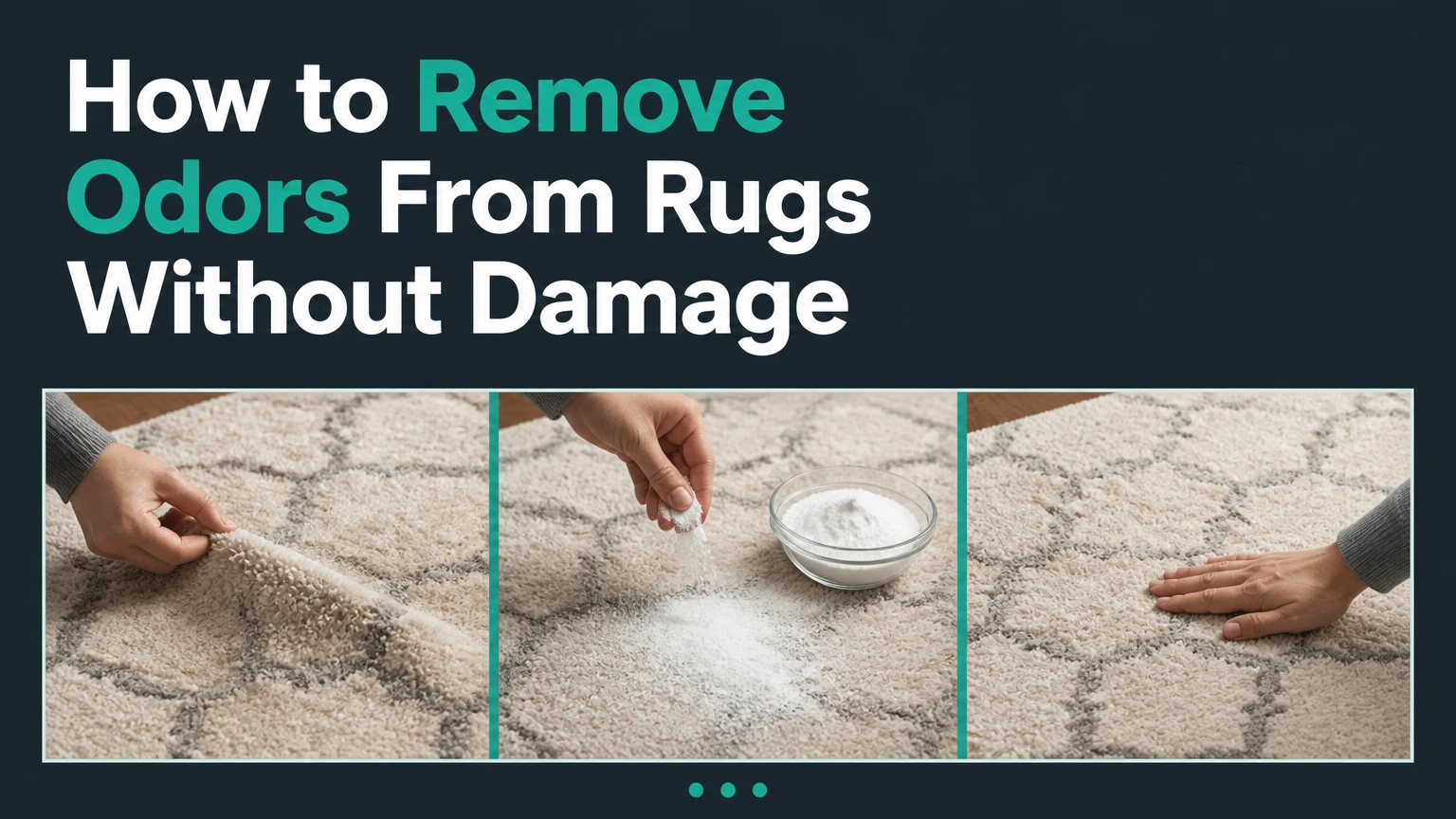
To remove odors from rugs, first remove dry soil, identify the odor source, apply a compatible treatment, and dry the rug completely within 24-48 hours. Baking soda suits light surface odors, enzyme cleaners suit pet urine and organic spills, while wool, silk, viscose, jute, antique, and saturated rugs usually require specialized care.
Key Facts at a Glance
- Pet urine odor requires an enzyme product that reaches the rug backing and contaminated pad, not only the visible pile.
- Baking soda deodorizes light, dry odors but cannot extract urine salts, mold growth, or deeply contaminated padding.
- White vinegar can reduce some alkaline surface odors, but it is not a dependable mold treatment or broad-spectrum disinfectant.
- Complete drying is the main safety requirement because damp backing, jute, latex, and cotton foundations can develop new odors.
- Hydrogen peroxide can lighten dyes and is unsuitable for many wool, silk, viscose, antique, and dark-colored rugs.
- A professional rug washer is the safest option when odor covers most of the rug, returns after drying, or involves a valuable textile.
Why Do Rugs Smell?
Rugs smell when fibers, backing, rug pads, or subfloors retain odor-producing material such as urine salts, food residue, smoke particles, body oils, soil, or excess moisture. A rug can appear clean while its backing or pad remains contaminated, which explains why odor often returns after the surface dries.
Odor has three useful diagnostic attributes: source, depth, and moisture. A recent spill on synthetic pile is shallow and treatable; cat urine that has migrated through the foundation is deep; a musty smell after flooding indicates a moisture problem that deodorizer alone cannot solve.
Humidity changes perception. Relative humidity above roughly 60% can make musty and organic smells more noticeable because absorbed moisture helps volatile compounds move through the pile. A dehumidifier, airflow, and source removal therefore matter as much as the cleaning solution.
What Should You Check Before Cleaning?
Inspect the rug label, fiber, backing, rug pad, floor beneath it, and any visible stain before applying liquid. A simple moisture meter is useful for large incidents, but smell, discoloration, tacky backing, damp padding, or swollen wood also indicate that the problem extends below the face fibers.
Use a white cotton cloth to test a hidden corner. Press the damp cloth on the rug for 10 seconds, then check for transferred dye, bleeding, texture change, or color loss after the spot dries. Do not proceed with a liquid treatment when the test fails.
What Is the Safest Process for Rug Odor Removal?
The safest process has seven stages: isolate the source, remove dry soil, absorb liquid, test compatibility, treat the correct depth, extract residue, and dry rapidly. For a small synthetic-rug incident, the process typically takes 30-60 minutes of active work plus 12-48 hours of drying.
Before You Start
| Requirement | Typical specification | Why it matters |
|---|---|---|
| Active work time | 30-60 minutes | Covers vacuuming, testing, treatment, and blotting |
| Drying time | 12-48 hours | Prevents odor from damp backing and padding |
| Basic cost | $3-$15 | Covers towels, baking soda, or diluted vinegar |
| Enzyme cleaner | 16-32 fluid ounces | Suitable for one or two small pet accidents |
| Tools | Vacuum, white towels, gloves, fan | Removes soil and controls moisture |
| Prerequisite | Colorfastness test | Reduces dye-bleeding risk |
Step 1: Find and Isolate the Odor Source
Move furniture, lift the rug, and inspect the underside, pad, floor, and nearby upholstery. Use a UV flashlight in a dark room to locate some older urine deposits, but treat fluorescence as a clue rather than proof because detergent residue and optical brighteners can also glow.
Remove the rug pad if the pad smells stronger than the rug. Place the rug on a clean, dry surface or hang it only if the construction can support its weight without stretching.
You will know it worked when: the strongest smell has a specific location or layer.
Common mistake: treating the top surface while leaving a contaminated pad underneath.
Step 2: Remove Dry Soil and Fresh Liquid
Vacuum both sides using suction appropriate for the rug. Avoid a rotating beater bar on fringe, loose pile, hand-knotted rugs, braided edges, and fragile antique textiles. For fresh liquid, press white towels into the area and replace them repeatedly until transfer becomes minimal.
Do not scrub. Rubbing spreads liquid sideways and forces debris deeper into the foundation, while repeated pressing transfers moisture into the towel with less fiber distortion.
You will know it worked when: the towel shows little new liquid and the pile contains no loose grit.
Common mistake: using colored paper towels that can transfer dye.
Step 3: Test the Odor Treatment
Apply a small amount of the chosen product to an inconspicuous area, such as beneath furniture or near an edge. Wait until the test area dries, because some dye bleeding and texture changes appear only after evaporation.
Test baking soda dry, diluted vinegar at its intended concentration, and enzyme cleaner separately. Never assume that a solution safe for polypropylene is safe for wool, silk, viscose, jute, cotton, or a latex-backed rug.
You will know it worked when: the dry test area has no color shift, stiffness, halo, or dye transfer.
Common mistake: testing only for immediate color loss and ignoring later browning.
Step 4: Apply the Correct Treatment
Choose the treatment according to the odor source, not the strongest-smelling product. Use a light dry powder for shallow odors, a labeled enzyme cleaner for urine and organic residue, or a controlled professional process for widespread contamination.
For a small synthetic-rug urine spot, apply enough enzyme cleaner to reach the contaminated depth, following the manufacturer’s label. A surface mist is inadequate when urine has passed through the pile. Do not mix enzyme products with bleach, vinegar, peroxide, or disinfectants because altered pH and oxidizers can reduce enzyme activity.
You will know it worked when: the treatment reaches the affected layer without creating a broad wet halo.
Common mistake: applying fragrance over the odor and mistaking temporary masking for removal.
Step 5: Blot and Extract Residue
Press clean white towels over the treated area, working from the outside toward the center. For a washable synthetic rug, a wet-dry vacuum can remove more liquid than towels, but keep the vacuum head moving and avoid flooding the backing.
Residue left in the pile attracts soil and can produce a sticky, sour smell. If the product label requires rinsing, use the smallest amount of clean water that removes residue, then extract promptly.
You will know it worked when: the rug feels damp rather than wet, and the towel no longer picks up visible soil.
Common mistake: rinsing repeatedly without extracting, which moves contamination into the foundation.
Step 6: Dry the Rug Completely
Place fans so air crosses the rug surface and, when possible, the underside. Run a dehumidifier in the room, maintain ventilation, and turn the rug only when its construction permits safe handling. Avoid folding a damp rug because trapped moisture encourages mildew and foundation distortion.
A thin synthetic rug may dry in 6-12 hours under strong airflow, while wool, thick pile, cotton foundation, and dense padding often need 24-48 hours. Direct sunlight can help some colorfast synthetic rugs, but intense sunlight may fade dyes, dry natural fibers unevenly, or damage latex.
You will know it worked when: the underside, edges, and pad are dry and no cool, damp feeling remains.
Common mistake: returning the rug to the floor when the face feels dry but the backing remains damp.
Step 7: Recheck the Rug and Pad
Smell the rug after it has been dry for several hours, then inspect the pad and floor separately. If the odor returns only when humidity rises, contamination remains in a lower layer or the room still has a moisture source.
Repeat a compatible treatment only when the first application was correctly applied and the rug is fully dry. Persistent odor across most of the rug usually justifies professional inspection rather than repeated home soaking.
You will know it worked when: the rug, pad, and floor remain neutral after drying and normal room humidity returns.
Common mistake: repeating treatments without diagnosing the pad, subfloor, or wall moisture.
Which Odor Removal Method Should You Choose?
The best method depends on the contaminant and rug construction. Baking soda is the lowest-moisture option for light odor, enzyme cleaner is the targeted option for urine and biological residue, and professional washing is the appropriate choice for valuable or deeply saturated rugs.
| Method | Best use | Application and dwell | Typical DIY cost | Main limitation |
|---|---|---|---|---|
| Baking soda | Light dry, smoke, and general odor | Dry layer, 12-24 hours | $2-$8 | Does not remove deep urine or mold |
| Diluted white vinegar | Mild alkaline surface residue | 1:3 vinegar-to-water test mix, then dry | $2-$6 | Can affect dyes and does not reliably kill mold |
| Enzyme cleaner | Fresh or old pet urine and organic spills | Label-directed saturation, often 8-24 hours | $8-$25 | Unsuitable for some delicate fibers |
| 3% hydrogen peroxide | Small stains on colorfast light synthetics | Spot application, immediate blotting | $3-$10 | Can bleach dyes and weaken sensitive fibers |
| Professional rug washing | Full-rug, deep, valuable, or antique contamination | Inspection, dusting, wash, extraction, controlled dry | $75-$500+ | Transport, price, and service availability |
| Outdoor airing | New-fabric or mild environmental odor | Dry shade or brief filtered sun, 2-8 hours | $0-$10 | Cannot remove a contaminated source |
How Does Baking Soda Remove Rug Odor?
Baking soda reduces some light odors by adsorbing moisture and odor molecules on its dry crystalline surface; it does not physically extract contaminants from a rug foundation. Vacuum first, distribute a thin visible layer, leave it for 12-24 hours, and vacuum slowly in multiple directions.
Use pure sodium bicarbonate without fragrance, essential oils, or cornstarch additives. Avoid pushing large amounts into dense shag, weakly bonded pile, or rugs that a household vacuum cannot clean thoroughly, since residual powder can remain near the backing or stress the vacuum motor.
Baking soda is appropriate for dry smoke residue, mild household odor, and routine maintenance. It is not a cure for urine salts, active mold, sewage, or a wet rug.
When Is Vinegar Appropriate?
Diluted distilled white vinegar can reduce some alkaline surface residues and may lessen mild odors after drying, but vinegar should not be described as a dependable disinfectant or mold-killing treatment. Acetic acid at household concentration is not a substitute for moisture removal, laundering, or professional remediation.
For a colorfast synthetic rug, start with a 1:3 ratio of vinegar to water rather than automatically using equal parts. Mist lightly, avoid saturating the backing, ventilate the room, and allow complete drying. Never combine vinegar with chlorine bleach, ammonia, or peroxide.
Vinegar is a poor choice for silk, viscose, antique dyed wool, jute, sisal, and rugs with unstable cotton foundations. The low pH and moisture can contribute to dye change, browning, stiffness, or fiber distortion.
How Do You Remove Pet Urine Odor From a Rug?
An enzyme cleaner is the preferred DIY treatment for pet urine on a colorfast, washable rug because the product targets organic residue rather than covering its smell. The cleaner must reach every contaminated layer, including the backing and pad, while the area remains damp for the label-specified dwell time.
Blot fresh urine first. For an older deposit, identify the full affected zone because urine can spread beyond the visible stain. Apply the enzyme product generously enough to reach the same depth as the urine, cover loosely with plastic only if the label permits it, then leave it for the stated period.
Avoid ammonia-based cleaners. Ammonia has a urine-like odor and may encourage repeat marking in some animals. Avoid steam or hot-water treatment before biological residue is removed, because heat can spread contamination and make odor diagnosis harder.
| Urine situation | Recommended action | Typical drying period | Replace or escalate when |
|---|---|---|---|
| Fresh spot, synthetic rug | Blot, enzyme treat, extract | 12-24 hours | Odor returns after two correct treatments |
| Old spot, synthetic rug | Locate full zone, saturate to backing | 24-48 hours | Pad remains strongly contaminated |
| Large urine area | Isolate rug and inspect underside | 24-72 hours | More than 25% of rug smells |
| Wool or silk rug | Avoid DIY saturation, consult cleaner | 24-72 hours | Dye test fails or odor is deep |
| Cat urine on pad | Treat or replace pad separately | 12-48 hours | Pad retains odor when rug is removed |
Which Rug Materials Can Be Treated at Home?
Synthetic polypropylene and polyester rugs generally tolerate carefully controlled spot treatment better than natural or regenerated fibers, but the manufacturer’s care instructions and dye stability remain decisive. Wool, silk, viscose, jute, sisal, antique, and hand-knotted rugs have higher risks from moisture, agitation, pH, and uneven drying.
| Rug material | Lower-risk home option | Avoid | Professional threshold |
|---|---|---|---|
| Polypropylene | Limited enzyme spot treatment | High heat and excessive flooding | Odor covers most of rug |
| Polyester | Baking soda or tested enzyme product | Strong peroxide on dark dyes | Backing or pad contamination |
| Wool | Dry vacuuming and airflow | Peroxide, alkaline soaking, aggressive brushing | Any deep biological odor |
| Silk | Airing and professional assessment | Vinegar, peroxide, enzyme saturation | Any liquid stain or odor |
| Viscose | Dry cleaning specialist | Water, scrubbing, steam | Most liquid treatments |
| Jute or sisal | Dry vacuuming and low humidity | Wet misting and saturation | Any musty or mildew odor |
| Cotton braided rug | Label-approved washing | Uneven wetting and hot drying | Dye bleed or foundation distortion |
How Do You Treat a Rug Pad and Floor?
Treating the rug pad and floor is necessary when odor returns after surface cleaning. Wash a washable synthetic pad according to its instructions, replace foam or heavily contaminated pads, and clean the underlying hard floor with a compatible product before the rug goes back.
Wood subfloors require restraint. Excess liquid can enter seams and create swelling or persistent odor, so use minimal moisture and dry immediately. Concrete may retain urine salts in pores, while unfinished wood can absorb biological residue below the rug.
The rug pad is often the hidden reservoir. If the rug smells neutral outdoors but the room smells when the pad is installed, replace or separately treat the pad instead of repeating rug deodorizer.
How Do You Remove Mildew, Smoke, and New-Rug Odors?
Mildew odor requires moisture-source control before deodorizing. Smoke odor often needs repeated dry soil removal and professional washing because tobacco and fire residues adhere to fibers, backing, walls, and furnishings. New-rug odor commonly decreases through ventilation over several days, but strong chemical odor deserves inspection.
For mildew, do not seal a damp rug in a plastic bag or spray fragrance over it. Dry the rug in a controlled area, inspect for visible growth, and contact a remediation professional when flooding, sewage, extensive growth, or health concerns are involved.
For smoke, vacuum both sides, ventilate outdoors in shade, and use a professional cleaner for full-rug contamination. Ozone generators are not a safe routine household deodorizer because ozone can irritate lungs and react with indoor materials.
For a new rug, air it in a dry, ventilated space for 24-72 hours. Polypropylene, wool, jute, adhesives, and backing compounds can release different odors, so the smell’s gradual decline matters more than a single deodorizing application.
What Mistakes Make Rug Odors Worse?
The most damaging rug-cleaning mistakes are excessive water, incompatible chemistry, trapped drying moisture, heat before biological treatment, and aggressive agitation. Each mistake can create a second problem, such as dye bleeding, browning, delamination, mildew, or a permanently distorted foundation.
- Over-wetting the backing: Flooding cotton, jute, latex, or glued backing can cause shrinkage, browning, odor, and delamination. Use controlled application and extract promptly.
- Mixing chemicals: Vinegar, bleach, ammonia, peroxide, and enzyme products should not be combined. Some combinations produce hazardous fumes or deactivate the intended treatment.
- Using heat first: Steam can spread urine and protein residue and may set some stains. Remove biological contamination before considering heat, and follow the rug maker’s instructions.
- Skipping the hidden test: A colorfastness test must dry before approval. Immediate inspection misses delayed bleeding and browning.
- Scrubbing the pile: Back-and-forth abrasion breaks fiber tips and creates a fuzzy, matted area. Press, lift, and repeat instead.
- Masking with fragrance: Perfume changes the odor profile but leaves the contaminant in place, producing a mixed smell when humidity rises.
A practitioner rule is simple: treat the lowest contaminated layer you can identify, but never add more moisture than you can remove. That rule explains why a small, deep urine spot may need more targeted liquid than a broad, shallow surface odor.
When Should You Hire a Professional Rug Cleaner?
Hire a professional rug cleaner when the odor affects most of the rug, returns after complete drying, involves an antique or valuable textile, follows flooding or sewage, or reaches a dense pad and foundation. Professional cleaning is also safer when colorfastness fails or the rug cannot dry rapidly at home.
A qualified cleaner should inspect fiber, dyes, construction, backing, fringe, and prior repairs before selecting a process. For washable rugs, the process may include dry soil removal, dye testing, immersion or controlled washing, water extraction, and climate-controlled drying.
Ask whether the cleaner handles hand-knotted, Persian, Oriental, silk, viscose, and antique rugs rather than treating every textile like wall-to-wall synthetic carpet. A low price cannot compensate for dye bleed, shrinkage, or foundation damage.
| Situation | DIY suitability | Typical professional price | Typical service time |
|---|---|---|---|
| Small synthetic spot | High | $50-$125 | 1-3 days |
| Medium pet accident | Moderate | $75-$200 | 2-4 days |
| Full wool rug odor | Low | $100-$350 | 3-7 days |
| Silk or antique rug | Very low | $150-$500+ | 5-10 days |
| Flood or sewage exposure | None | $200-$1,000+ | 3-14 days |
| Odor in rug pad only | Moderate | $25-$150 | 1-3 days |
Prices are typical U.S. consumer ranges, not fixed quotes. Size, region, pickup, fiber, repairs, contamination, and drying requirements change the final price.
How Can You Prevent Rug Odors From Returning?
Prevent recurring odor by vacuuming high-traffic rugs weekly, removing spills immediately, keeping indoor humidity near 30%-50%, and drying every wet incident before replacing the rug pad. Rotate the rug every 3-6 months to distribute wear and expose hidden debris.
Use a pad that fits the rug and floor, but inspect it every 6-12 months in humid rooms or homes with pets. Keep outdoor rugs elevated enough for drainage, and bring natural-fiber rugs indoors before prolonged rain.
Do not apply deodorizing powder on a damp rug. Dry contamination and moisture contamination require different responses, and powder can conceal the condition of the backing.
FAQ
Can I use a carpet cleaner on an area rug?
Use a carpet-extraction machine only when the rug label permits water cleaning and the backing can tolerate moisture. Synthetic machine-washable rugs are the most suitable candidates. Wool, silk, viscose, jute, antique, and glued rugs can shrink, bleed, brown, or delaminate under uncontrolled extraction.
Does sunlight remove rug odor?
Sunlight can reduce mild odor while airflow dries the textile, but ultraviolet exposure can fade dyes and weaken some fibers. Use short periods in filtered or indirect sun, test colorfastness first, and never rely on sunlight for urine, mold, sewage, or smoke contamination.
How long does vinegar smell last on a rug?
A diluted vinegar smell usually decreases as the rug dries and the room ventilates, often within several hours. Persistent vinegar odor usually indicates excess application, slow drying, or residue in the backing. Do not add fragrance; improve airflow and verify that the rug is dry underneath.
Should I replace a rug that still smells after cleaning?
Replace a low-value rug when odor remains after two correctly performed treatments, the pad is contaminated, the backing is delaminating, or the textile cannot dry safely. Valuable rugs should be assessed by a specialist before replacement because professional washing or foundation repair may recover them.
Is baking soda safe for pets on rugs?
Baking soda is relatively low-risk when applied lightly and fully vacuumed, but pets should be kept away during application because inhaling or ingesting loose powder can irritate them. Do not use fragrance oils or chemical additives, and avoid powder if your vacuum cannot remove it completely.
Why does my rug smell worse in humid weather?
Humidity increases moisture in fibers and backing, allowing trapped odor compounds to become more volatile. A returning smell indicates a remaining source, often a rug pad, subfloor, urine salt, or incompletely dried foundation. Dehumidification helps, but source removal is the lasting solution.
The Bottom Line
The safest way to remove odors from rugs is to match the treatment to the contaminant, reach the contaminated layer, and dry every component completely. Use baking soda for light dry odor, a labeled enzyme cleaner for pet urine on suitable synthetic rugs, and professional rug washing for delicate, valuable, saturated, or persistently odorous textiles.